1
翻译
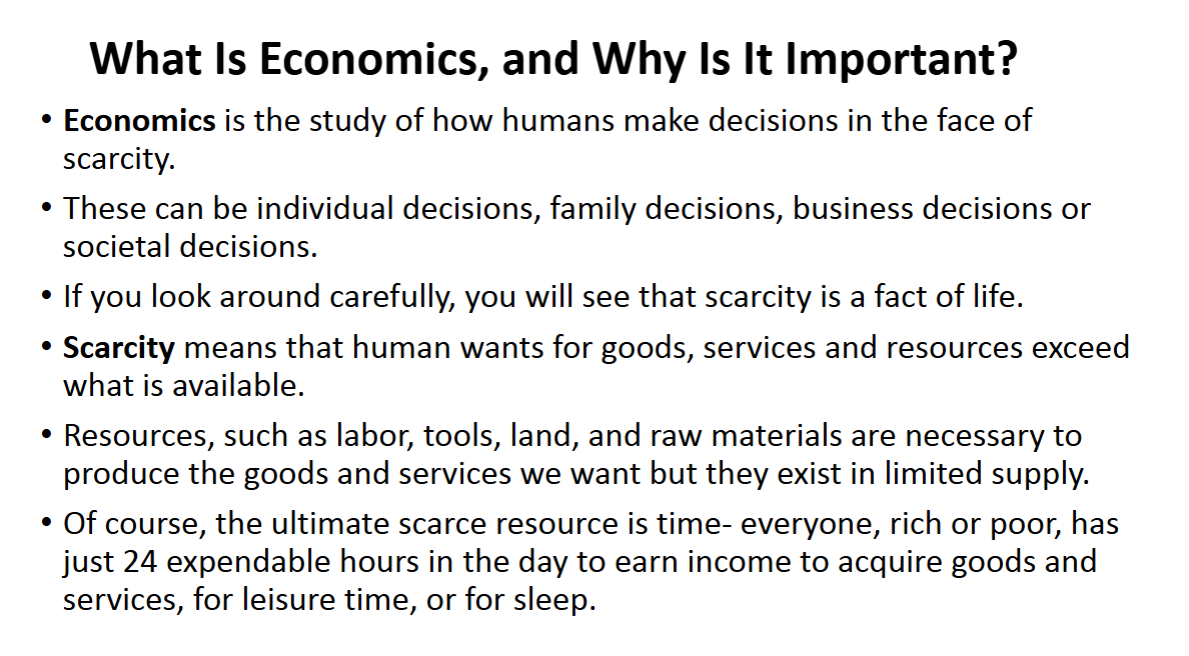
经济学是研究人类在面对稀缺性时如何做出决策的学科。
• 这些决策可以是个人的、家庭的、企业的或社会的。
• 如果你仔细观察,你会发现稀缺性是生活中的一个事实。
• 稀缺性意味着人类对商品、服务和资源的需求超过了可用的数量。
• 资源,如劳动力、工具、土地和原材料,是生产我们想要的商品和服务所必需的,但它们的供应是有限的。
• 当然,最终的稀缺资源是时间——每个人,无论贫富,每天只有24小时可以用来赚取收入以获取商品和服务,用于休闲或睡眠。
知识点列表及拓展
-
经济学 (Economics)
-
英文解释: The study of how individuals, businesses, and societies make choices about allocating limited resources to satisfy their unlimited wants.
-
中文解释: 研究个人、企业和社会如何分配有限资源以满足无限需求的学科。
-
例子: 一个家庭决定如何分配他们的月收入来支付房租、食物和娱乐活动。
-
-
稀缺性 (Scarcity)
-
英文解释: The fundamental economic problem of having seemingly unlimited human wants in a world of limited resources.
-
中文解释: 在一个资源有限的世界中,人类需求似乎无限的这一基本经济问题。
-
例子: 水资源在干旱地区是稀缺的,居民必须决定如何合理分配用水。
-
-
决策 (Decision-making)
-
英文解释: The process of making choices by identifying a decision, gathering information, and assessing alternative resolutions.
-
中文解释: 通过识别决策、收集信息和评估替代方案来做出选择的过程。
-
例子: 一家公司决定是否投资新技术以提高生产效率。
-
-
资源 (Resources)
-
英文解释: The inputs used to produce goods and services, including labor, capital, land, and raw materials.
-
中文解释: 用于生产商品和服务的投入,包括劳动力、资本、土地和原材料。
-
例子: 农民使用土地、种子和劳动力来种植农作物。
-
-
时间管理 (Time Management)
-
英文解释: The process of planning and exercising conscious control over the amount of time spent on specific activities to increase efficiency or productivity.
-
中文解释: 计划和有意识地控制花在特定活动上的时间,以提高效率或生产力的过程。
-
例子: 一个学生决定每天花两小时学习,一小时锻炼,其余时间用于休息和娱乐。
-
拓展知识点
-
机会成本 (Opportunity Cost)
-
英文解释: The value of the next best alternative that is foregone as a result of making a particular choice.
-
中文解释: 由于做出某个特定选择而放弃的下一个最佳替代品的价值。
-
例子: 如果你选择去看电影而不是工作,那么你放弃的工资就是机会成本。
-
-
供给与需求 (Supply and Demand)
-
英文解释: The fundamental economic model that determines the price of goods and services based on their availability (supply) and the desire for them (demand).
-
中文解释: 基于商品和服务的可用性(供给)和对它们的需求(需求)来决定价格的基本经济模型。
-
例子: 当新款智能手机发布时,需求增加,如果供应不足,价格可能会上涨。
-
-
边际分析 (Marginal Analysis)
-
英文解释: The examination of the additional benefits of an activity compared to the additional costs incurred by that same activity.
-
中文解释: 比较一项活动的额外收益与额外成本的分析方法。
-
例子: 一家工厂考虑是否增加一个班次,通过比较增加的产量和增加的劳动力成本来决定。
-
-
效用 (Utility)
-
英文解释: The satisfaction or pleasure that consumers derive from consuming goods and services.
-
中文解释: 消费者从消费商品和服务中获得的满足感或快乐。
-
例子: 一个人在炎热的夏天喝一杯冰镇饮料所获得的满足感就是效用。
-
-
生产可能性边界 (Production Possibility Frontier, PPF)
-
英文解释: A curve that illustrates the maximum feasible amounts of two goods that an economy can produce given its resources and technology.
-
中文解释: 一条曲线,表示在给定资源和技术条件下,一个经济体可以生产的两种商品的最大可行数量。
-
例子: 一个国家可以选择生产更多的武器或更多的食品,生产可能性边界展示了在资源有限的情况下,两者之间的权衡。
2
原文与译文一一对应 (Original Text with Translations):
Economic Way of Thinking (经济思维方式)
-
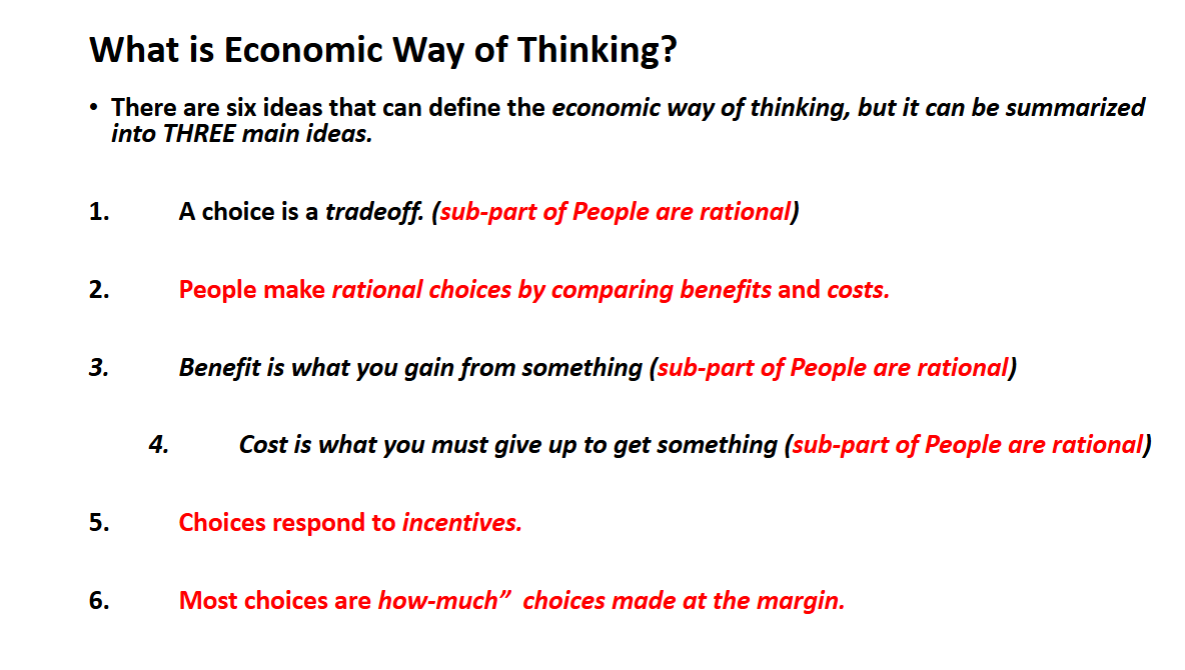
原文 (Original): There are six ideas that can define the economic way of thinking, but it can be summarized into THREE main ideas.
译文 (Translation): 有六个观点可以定义经济思维方式,但可以总结为三个主要观点。
1. A choice is a tradeoff. (sub-part of People are rational) (选择是取舍)(理性人部分)
-
原文 (Original): A choice is a tradeoff.
译文 (Translation): 选择是取舍。
-
原文 (Original): (sub-part of People are rational)
译文 (Translation): (理性人部分)
2. People make rational choices by comparing benefits and costs. (人们通过比较利益和成本做出理性选择)
-
原文 (Original): People make rational choices by comparing benefits and costs.
译文 (Translation): 人们通过比较利益和成本做出理性选择。
3. Benefit is what you gain from something. (sub-part of People are rational) (利益是你从某件事中获得的)
-
原文 (Original): Benefit is what you gain from something.
译文 (Translation): 利益是你从某件事中获得的。
-
原文 (Original): (sub-part of People are rational)
译文 (Translation): (理性人部分)
4. Cost is what you must give up to get something. (sub-part of People are rational) (成本是你为了获得某样东西必须放弃的)
-
原文 (Original): Cost is what you must give up to get something.
译文 (Translation): 成本是你为了获得某样东西必须放弃的。
-
原文 (Original): (sub-part of People are rational)
译文 (Translation): (理性人部分)
5. Choices respond to incentives. (选择响应激励)
-
原文 (Original): Choices respond to incentives.
译文 (Translation): 选择响应激励。
6. Most choices are “how-much” choices made at the margin. (大多数选择是边际上的“多少”选择)
-
原文 (Original): Most choices are “how-much” choices made at the margin.
译文 (Translation): 大多数选择是边际上的“多少”选择。
知识点列表与拓展 (Knowledge Points and Extensions):
-
Tradeoff (取舍)
-
解释 (Explanation): A tradeoff occurs when a decision is made by sacrificing one thing in order to gain another.
(取舍发生在做出决策时,放弃一件事以获得另一件事。)
-
例子 (Example): Choosing to spend money on a new phone means you might have to give up buying other things you wanted.
(选择花钱买新手机意味着你可能不得不放弃购买其他想要的东西。)
-
-
Rational Decision-Making (理性决策)
-
解释 (Explanation): Rational decision-making involves comparing the benefits and costs to make the most advantageous choice.
(理性决策涉及比较利益和成本,以做出最有利的选择。)
-
例子 (Example): If the benefit of a job offer exceeds the cost (commute, stress), you may accept the job.
(如果工作机会的利益超过成本(通勤、压力),你可能会接受这份工作。)
-
-
Benefit (利益)
-
解释 (Explanation): Benefit refers to the positive outcomes or satisfaction gained from a particular decision or action.
(利益是指从特定决策或行为中获得的正面结果或满足感。)
-
例子 (Example): The benefit of going to the gym is improved health and fitness.
(去健身房的利益是改善健康和体能。)
-
-
Cost (成本)
-
解释 (Explanation): Cost refers to what must be sacrificed in order to acquire something, such as time, money, or effort.
(成本指的是为了获得某样东西必须牺牲的东西,如时间、金钱或努力。)
-
例子 (Example): The cost of attending a concert includes the price of the ticket and the time spent at the event.
(参加音乐会的成本包括门票的价格和在活动上花费的时间。)
-
-
Incentives (激励)
-
解释 (Explanation): Incentives are rewards or penalties that motivate individuals to make certain choices.
(激励是奖励或惩罚,激励个人做出特定选择。)
-
例子 (Example): A bonus at work acts as an incentive for employees to work harder.
(工作中的奖金是激励员工更加努力工作的动力。)
-
-
Marginal Decision-Making (边际决策)
-
解释 (Explanation): Marginal decision-making involves making choices based on small incremental changes, such as deciding how much more to consume or produce.
(边际决策涉及基于小的增量变化做出选择,例如决定再消费或生产多少。)
-
例子 (Example): If you decide to study one more hour before a test, this is a marginal decision about how much more time to allocate.
(如果你决定在考试前再学习一个小时,这是一个关于分配更多时间的边际决策。)
-
PS:大多数经济决策都是在边际上做出的“多少”选择,也就是说,决策通常涉及到对某个活动或资源的增量变化进行评估,而不是做出全局性的选择。边际选择关注的是每多做一个单位的活动或消耗一个单位的资源所带来的额外收益或成本。==例如,在购买商品时,我们常常不是决定是否购买,而是决定再多买一个单位是否值得。==
3
原文与译文一一对应 (Original Text with Translations):
People are Rational and they make Rational (Sensible) Choices (人们是理性的,他们做出理性(明智)选择)
-
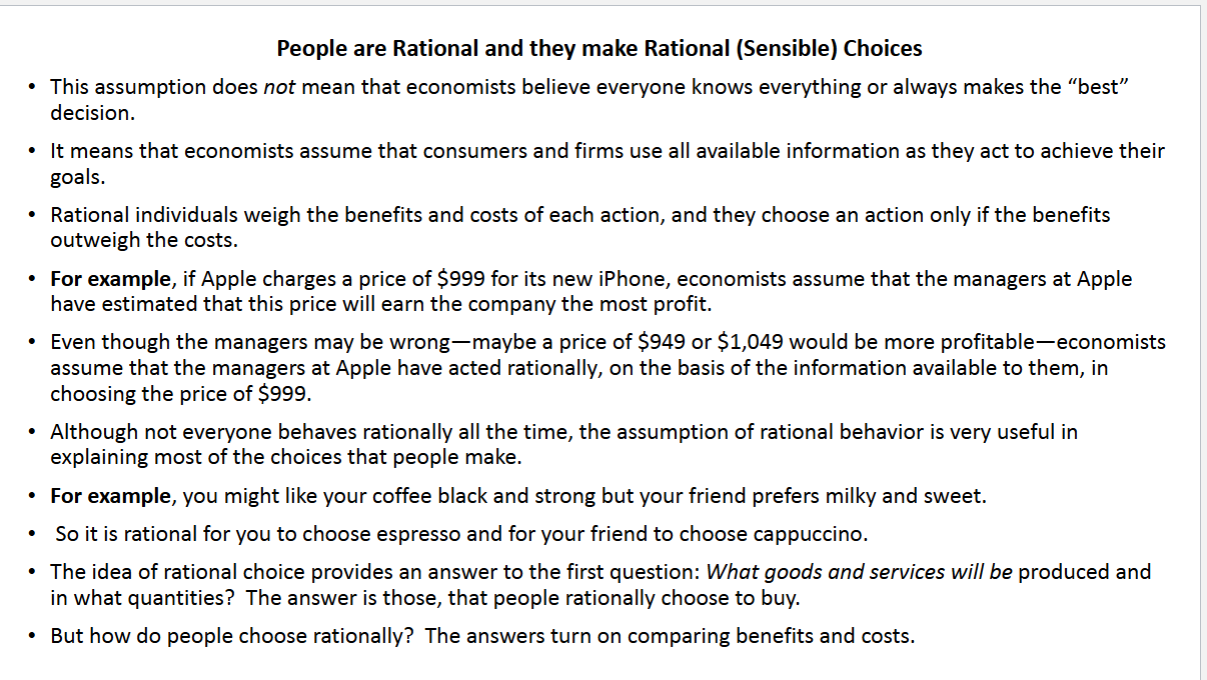
原文 (Original): This assumption does not mean that economists believe everyone knows everything or always makes the “best” decision.
译文 (Translation): 这个假设并不意味着经济学家认为每个人都知道一切或总是做出“最佳”决策。
-
原文 (Original): It means that economists assume that consumers and firms use all available information as they act to achieve their goals.
译文 (Translation): 它意味着经济学家假设消费者和公司在采取行动以实现目标时,利用所有可用的信息。
-
原文 (Original): Rational individuals weigh the benefits and costs of each action, and they choose an action only if the benefits outweigh the costs.
译文 (Translation): 理性个体会权衡每个行动的利益和成本,只有当利益超过成本时,他们才会选择某个行动。
-
原文 (Original): For example, if Apple charges a price of $999 for its new iPhone, economists assume that the managers at Apple have estimated that this price will earn the company the most profit.
译文 (Translation): 例如,如果苹果公司为其新款iPhone定价999美元,经济学家假设苹果的经理们已经估计这个价格将为公司带来最大的利润。
-
原文 (Original): Even though the managers may be wrong—maybe a price of 1,049 would be more profitable—economists assume that the managers at Apple have acted rationally, on the basis of the information available to them, in choosing the price of $999.
译文 (Translation): 即使经理们可能错了——也许价格为949美元或1049美元会更有利可图——经济学家假设苹果的经理们基于可用的信息,理性地选择了999美元这个价格。
-
原文 (Original): Although not everyone behaves rationally all the time, the assumption of rational behavior is very useful in explaining most of the choices that people make.
译文 (Translation): 虽然并非每个人一直都表现得理性,但理性行为的假设在解释大多数人做出的选择时非常有用。
-
原文 (Original): For example, you might like your coffee black and strong but your friend prefers milky and sweet.
译文 (Translation): 例如,你可能喜欢黑咖啡且口味浓烈,但你的朋友则偏好奶香甜味的咖啡。
-
原文 (Original): So it is rational for you to choose espresso and for your friend to choose cappuccino.
译文 (Translation): 所以你选择浓缩咖啡是理性的,而你的朋友选择卡布奇诺也是理性的。
-
原文 (Original): The idea of rational choice provides an answer to the first question: What goods and services will be produced and in what quantities? The answer is those, that people rationally choose to buy.
译文 (Translation): 理性选择的概念回答了第一个问题:什么商品和服务将被生产,生产多少?答案是那些人们理性地选择购买的商品和服务。
-
原文 (Original): But how do people choose rationally? The answers turn on comparing benefits and costs.
译文 (Translation): 那么人们如何做出理性选择呢?答案是通过比较利益和成本来决定。
知识点列表与拓展 (Knowledge Points and Extensions):
-
Rational Decision-Making (理性决策)
-
解释 (Explanation): Rational decision-making assumes that individuals will make choices that maximize their benefits and minimize their costs based on the information available to them.
(理性决策假设个人将根据他们所拥有的信息做出最大化利益、最小化成本的选择。)
-
例子 (Example): If you choose to buy a laptop after researching various models, considering both the price and the features, that would be a rational decision.
(如果你在研究了各种型号并考虑价格和功能后选择购买一台笔记本电脑,那将是一个理性决策。)
-
-
Information Utilization (信息利用)
-
解释 (Explanation): Rational decision-makers use all available information to guide their actions in order to achieve their goals effectively.
(理性决策者利用所有可用信息来指导他们的行动,以有效实现目标。)
-
例子 (Example): A consumer might compare prices, reviews, and quality before deciding where to buy a product.
(消费者可能会比较价格、评论和质量,然后决定在哪购买某个产品。)
-
-
Cost-Benefit Analysis (成本效益分析)
-
解释 (Explanation): Cost-benefit analysis is the process of comparing the benefits of an action to its costs, and only undertaking the action if the benefits outweigh the costs.
(成本效益分析是将某一行动的收益与成本进行比较的过程,只有当收益超过成本时,才会采取该行动。)
-
例子 (Example): If the cost of commuting to work exceeds the benefit of the job’s salary, a person might choose to find a closer job.
(如果通勤成本超过了工作的薪资收益,一个人可能会选择找一份离家更近的工作。)
-
-
Rational Behavior in Consumer Choices (消费者选择中的理性行为)
-
解释 (Explanation): Rational behavior in consumer choices involves selecting products or services based on personal preferences, benefits, and costs.
(消费者选择中的理性行为是指基于个人偏好、收益和成本选择商品或服务。)
-
例子 (Example): A consumer might choose to buy a smartphone with better features and performance even if it costs a little more because the perceived benefit is worth the price.
(消费者可能会选择购买一款功能和性能更好的智能手机,即使它价格稍高,因为感知到的收益足以抵消价格。)
-
-
Rational Choice and Market Outcomes (理性选择与市场结果)
-
解释 (Explanation): Rational choice theory helps explain how individuals’ decisions lead to market outcomes, such as the supply and demand for goods and services.
(理性选择理论有助于解释个体决策如何导致市场结果,如商品和服务的供需关系。)
-
例子 (Example): If consumers rationally choose to buy more electric cars due to environmental concerns, the demand for electric cars will increase, influencing car manufacturers to produce more of them.
(如果消费者因环保问题理性地选择购买更多电动汽车,电动汽车的需求将增加,从而促使汽车制造商生产更多电动汽车。)
-
-
Rational Choice and Incentives (理性选择与激励)
-
解释 (Explanation): Incentives play a key role in shaping rational choices, as individuals respond to rewards or penalties when making decisions.
(激励在塑造理性选择中起着关键作用,因为个体在做出决策时会对奖励或惩罚作出反应。)
-
例子 (Example): If a company offers a bonus for meeting sales targets, sales representatives may rationally work harder to earn the bonus.
(如果公司提供达到销售目标的奖金,销售代表可能会理性地更加努力工作以赚取奖金。)
-
4
原文与译文一一对应 (Original Text with Translations):
People respond to Incentives (人们对激励做出反应)
-
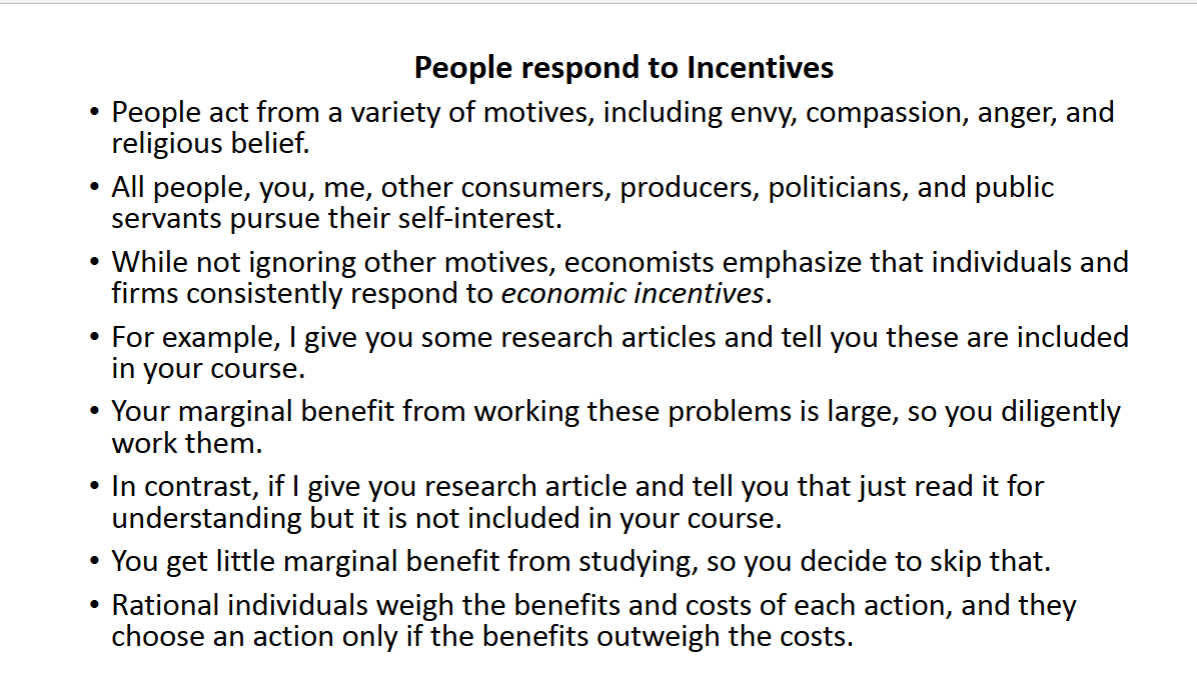
原文 (Original): People act from a variety of motives, including envy, compassion, anger, and religious belief.
译文 (Translation): 人们出于各种动机行动,包括嫉妒、同情、愤怒和宗教信仰。
-
原文 (Original): All people, you, me, other consumers, producers, politicians, and public servants pursue their self-interest.
译文 (Translation): 所有人,包括你、我、其他消费者、生产者、政治家和公务员,都在追求自己的利益。
-
原文 (Original): While not ignoring other motives, economists emphasize that individuals and firms consistently respond to economic incentives.
译文 (Translation): 虽然不忽视其他动机,经济学家强调个人和企业始终会响应经济激励。
-
原文 (Original): For example, I give you some research articles and tell you these are included in your course.
译文 (Translation): 例如,我给你一些研究文章并告诉你这些是你课程的一部分。
-
原文 (Original): Your ==marginal benefit ==from working these problems is large, so you diligently work them.
译文 (Translation): 你从做这些问题中获得的边际收益很大,因此你勤奋地做这些题目。
==marginal benefit 边际效用== :指在消费某种商品或服务的数量增加一个单位时所获得的额外收益
-
原文 (Original): In contrast, if I give you a research article and tell you that just read it for understanding but it is not included in your course.
译文 (Translation): 相比之下,如果我给你一篇研究文章,并告诉你只是为了理解它,但它不包含在你的课程中。
-
原文 (Original): You get little marginal benefit from studying, so you decide to skip that.
译文 (Translation): 你从学习中获得的边际收益很少,因此你决定跳过它。
-
原文 (Original): Rational individuals weigh the benefits and costs of each action, and they choose an action only if the benefits outweigh the costs.
译文 (Translation): 理性个体会权衡每个行动的利益和成本,只有当利益超过成本时,他们才会选择某个行动。
知识点列表与拓展 (Knowledge Points and Extensions):
-
Incentives (激励)
-
解释 (Explanation): Incentives are rewards or penalties that motivate individuals to make certain choices or take specific actions.
(激励是奖励或惩罚,促使个人做出特定选择或采取特定行动。)
-
例子 (Example): A teacher offers extra credit to students who submit assignments on time. This motivates students to meet deadlines.
(老师为按时提交作业的学生提供额外学分,这激励学生按时完成作业。)
-
-
Self-Interest (自身利益)
-
解释 (Explanation): People are assumed to act in ways that they believe will best serve their own needs and desires.
(假设人们会以他们认为最有利于满足自己需求和欲望的方式行事。)
-
例子 (Example): A person may choose a job that offers the highest salary because it best serves their financial needs.
(一个人可能会选择提供最高薪资的工作,因为它最能满足他们的财务需求。)
-
-
Economic Incentives (经济激励)
-
解释 (Explanation): Economic incentives are factors that encourage people to make decisions that are aligned with economic outcomes, such as profits or savings.
(经济激励是鼓励人们做出符合经济结果的决策的因素,如利润或储蓄。)
-
例子 (Example): A company may offer discounts to customers to increase sales, thus aligning their actions with economic incentives.
(一家公司可能会为客户提供折扣以增加销量,从而使他们的行为与经济激励一致。)
-
-
Marginal Benefit (边际效益)
-
解释 (Explanation): Marginal benefit refers to the additional satisfaction or utility gained from consuming one more unit of a good or service.
(边际效益是指消费一单位商品或服务所带来的额外满足感或效用。)
-
例子 (Example): If you’re studying for an exam and each additional hour spent studying results in a higher test score, the marginal benefit of studying increases.
(如果你在为考试学习,每多花一小时学习就能提高考试成绩,那么学习的边际效益就会增加。)
-
-
Rational Behavior (理性行为)
-
解释 (Explanation): Rational behavior is when individuals make decisions that maximize their benefits and minimize their costs based on available information.
(理性行为是指个人根据可用信息做出最大化利益和最小化成本的决策。)
-
例子 (Example): A rational consumer will choose to buy a product on sale if the price reduction is greater than the time and effort spent shopping around.
(理性的消费者如果发现折扣大于逛商店所花的时间和精力,就会选择购买打折商品。)
-
-
Cost-Benefit Analysis (成本效益分析)
-
解释 (Explanation): Cost-benefit analysis is the process of comparing the costs of an action with the benefits it brings in order to determine whether the action is worthwhile.
(成本效益分析是将某一行动的成本与其带来的收益进行比较的过程,以确定该行动是否值得。)
-
例子 (Example): Before buying a new car, a person might compare the cost of the car with the benefits of having a more reliable vehicle.
(在购买新车之前,一个人可能会将汽车的成本与拥有一辆更可靠车辆的收益进行比较。)
-
(选择花钱买新手机意味着你可能不得不放弃购买其他想要的东西。)
-
Rational Decision-Making (理性决策)
-
解释 (Explanation): Rational decision-making involves comparing the benefits and costs to make the most advantageous choice.
(理性决策涉及比较利益和成本,以做出最有利的选择。)
-
例子 (Example): If the benefit of a job offer exceeds the cost (commute, stress), you may accept the job.
(如果工作机会的利益超过成本(通勤、压力),你可能会接受这份工作。)
-
-
Benefit (利益)
-
解释 (Explanation): Benefit refers to the positive outcomes or satisfaction gained from a particular decision or action.
(利益是指从特定决策或行为中获得的正面结果或满足感。)
-
例子 (Example): The benefit of going to the gym is improved health and fitness.
(去健身房的利益是改善健康和体能。)
-
-
Cost (成本)
-
解释 (Explanation): Cost refers to what must be sacrificed in order to acquire something, such as time, money, or effort.
(成本指的是为了获得某样东西必须牺牲的东西,如时间、金钱或努力。)
-
例子 (Example): The cost of attending a concert includes the price of the ticket and the time spent at the event.
(参加音乐会的成本包括门票的价格和在活动上花费的时间。)
-
-
Incentives (激励)
-
解释 (Explanation): Incentives are rewards or penalties that motivate individuals to make certain choices.
(激励是奖励或惩罚,激励个人做出特定选择。)
-
例子 (Example): A bonus at work acts as an incentive for employees to work harder.
(工作中的奖金是激励员工更加努力工作的动力。)
-
-
Marginal Decision-Making (边际决策)
-
解释 (Explanation): Marginal decision-making involves making choices based on small incremental changes, such as deciding how much more to consume or produce.
(边际决策涉及基于小的增量变化做出选择,例如决定再消费或生产多少。)
-
例子 (Example): If you decide to study one more hour before a test, this is a marginal decision about how much more time to allocate.
(如果你决定在考试前再学习一个小时,这是一个关于分配更多时间的边际决策。)
-
PS:大多数经济决策都是在边际上做出的“多少”选择,也就是说,决策通常涉及到对某个活动或资源的增量变化进行评估,而不是做出全局性的选择。边际选择关注的是每多做一个单位的活动或消耗一个单位的资源所带来的额外收益或成本。==例如,在购买商品时,我们常常不是决定是否购买,而是决定再多买一个单位是否值得。==
3

原文与译文一一对应 (Original Text with Translations):
People are Rational and they make Rational (Sensible) Choices (人们是理性的,他们做出理性(明智)选择)
-
原文 (Original): This assumption does not mean that economists believe everyone knows everything or always makes the “best” decision.
译文 (Translation): 这个假设并不意味着经济学家认为每个人都知道一切或总是做出“最佳”决策。
-
原文 (Original): It means that economists assume that consumers and firms use all available information as they act to achieve their goals.
译文 (Translation): 它意味着经济学家假设消费者和公司在采取行动以实现目标时,利用所有可用的信息。
-
原文 (Original): Rational individuals weigh the benefits and costs of each action, and they choose an action only if the benefits outweigh the costs.
译文 (Translation): 理性个体会权衡每个行动的利益和成本,只有当利益超过成本时,他们才会选择某个行动。
-
原文 (Original): For example, if Apple charges a price of $999 for its new iPhone, economists assume that the managers at Apple have estimated that this price will earn the company the most profit.
译文 (Translation): 例如,如果苹果公司为其新款iPhone定价999美元,经济学家假设苹果的经理们已经估计这个价格将为公司带来最大的利润。
-
原文 (Original): Even though the managers may be wrong—maybe a price of 1,049 would be more profitable—economists assume that the managers at Apple have acted rationally, on the basis of the information available to them, in choosing the price of $999.
译文 (Translation): 即使经理们可能错了——也许价格为949美元或1049美元会更有利可图——经济学家假设苹果的经理们基于可用的信息,理性地选择了999美元这个价格。
-
原文 (Original): Although not everyone behaves rationally all the time, the assumption of rational behavior is very useful in explaining most of the choices that people make.
译文 (Translation): 虽然并非每个人一直都表现得理性,但理性行为的假设在解释大多数人做出的选择时非常有用。
-
原文 (Original): For example, you might like your coffee black and strong but your friend prefers milky and sweet.
译文 (Translation): 例如,你可能喜欢黑咖啡且口味浓烈,但你的朋友则偏好奶香甜味的咖啡。
-
原文 (Original): So it is rational for you to choose espresso and for your friend to choose cappuccino.
译文 (Translation): 所以你选择浓缩咖啡是理性的,而你的朋友选择卡布奇诺也是理性的。
-
原文 (Original): The idea of rational choice provides an answer to the first question: What goods and services will be produced and in what quantities? The answer is those, that people rationally choose to buy.
译文 (Translation): 理性选择的概念回答了第一个问题:什么商品和服务将被生产,生产多少?答案是那些人们理性地选择购买的商品和服务。
-
原文 (Original): But how do people choose rationally? The answers turn on comparing benefits and costs.
译文 (Translation): 那么人们如何做出理性选择呢?答案是通过比较利益和成本来决定。
知识点列表与拓展 (Knowledge Points and Extensions):
-
Rational Decision-Making (理性决策)
-
解释 (Explanation): Rational decision-making assumes that individuals will make choices that maximize their benefits and minimize their costs based on the information available to them.
(理性决策假设个人将根据他们所拥有的信息做出最大化利益、最小化成本的选择。)
-
例子 (Example): If you choose to buy a laptop after researching various models, considering both the price and the features, that would be a rational decision.
(如果你在研究了各种型号并考虑价格和功能后选择购买一台笔记本电脑,那将是一个理性决策。)
-
-
Information Utilization (信息利用)
-
解释 (Explanation): Rational decision-makers use all available information to guide their actions in order to achieve their goals effectively.
(理性决策者利用所有可用信息来指导他们的行动,以有效实现目标。)
-
例子 (Example): A consumer might compare prices, reviews, and quality before deciding where to buy a product.
(消费者可能会比较价格、评论和质量,然后决定在哪购买某个产品。)
-
-
Cost-Benefit Analysis (成本效益分析)
-
解释 (Explanation): Cost-benefit analysis is the process of comparing the benefits of an action to its costs, and only undertaking the action if the benefits outweigh the costs.
(成本效益分析是将某一行动的收益与成本进行比较的过程,只有当收益超过成本时,才会采取该行动。)
-
例子 (Example): If the cost of commuting to work exceeds the benefit of the job’s salary, a person might choose to find a closer job.
(如果通勤成本超过了工作的薪资收益,一个人可能会选择找一份离家更近的工作。)
-
-
Rational Behavior in Consumer Choices (消费者选择中的理性行为)
-
解释 (Explanation): Rational behavior in consumer choices involves selecting products or services based on personal preferences, benefits, and costs.
(消费者选择中的理性行为是指基于个人偏好、收益和成本选择商品或服务。)
-
例子 (Example): A consumer might choose to buy a smartphone with better features and performance even if it costs a little more because the perceived benefit is worth the price.
(消费者可能会选择购买一款功能和性能更好的智能手机,即使它价格稍高,因为感知到的收益足以抵消价格。)
-
-
Rational Choice and Market Outcomes (理性选择与市场结果)
-
解释 (Explanation): Rational choice theory helps explain how individuals’ decisions lead to market outcomes, such as the supply and demand for goods and services.
(理性选择理论有助于解释个体决策如何导致市场结果,如商品和服务的供需关系。)
-
例子 (Example): If consumers rationally choose to buy more electric cars due to environmental concerns, the demand for electric cars will increase, influencing car manufacturers to produce more of them.
(如果消费者因环保问题理性地选择购买更多电动汽车,电动汽车的需求将增加,从而促使汽车制造商生产更多电动汽车。)
-
-
Rational Choice and Incentives (理性选择与激励)
-
解释 (Explanation): Incentives play a key role in shaping rational choices, as individuals respond to rewards or penalties when making decisions.
(激励在塑造理性选择中起着关键作用,因为个体在做出决策时会对奖励或惩罚作出反应。)
-
例子 (Example): If a company offers a bonus for meeting sales targets, sales representatives may rationally work harder to earn the bonus.
(如果公司提供达到销售目标的奖金,销售代表可能会理性地更加努力工作以赚取奖金。)
-
4

原文与译文一一对应 (Original Text with Translations):
People respond to Incentives (人们对激励做出反应)
-
原文 (Original): People act from a variety of motives, including envy, compassion, anger, and religious belief.
译文 (Translation): 人们出于各种动机行动,包括嫉妒、同情、愤怒和宗教信仰。
-
原文 (Original): All people, you, me, other consumers, producers, politicians, and public servants pursue their self-interest.
译文 (Translation): 所有人,包括你、我、其他消费者、生产者、政治家和公务员,都在追求自己的利益。
-
原文 (Original): While not ignoring other motives, economists emphasize that individuals and firms consistently respond to economic incentives.
译文 (Translation): 虽然不忽视其他动机,经济学家强调个人和企业始终会响应经济激励。
-
原文 (Original): For example, I give you some research articles and tell you these are included in your course.
译文 (Translation): 例如,我给你一些研究文章并告诉你这些是你课程的一部分。
-
原文 (Original): Your ==marginal benefit ==from working these problems is large, so you diligently work them.
译文 (Translation): 你从做这些问题中获得的边际收益很大,因此你勤奋地做这些题目。
==marginal benefit 边际效用== :指在消费某种商品或服务的数量增加一个单位时所获得的额外收益
-
原文 (Original): In contrast, if I give you a research article and tell you that just read it for understanding but it is not included in your course.
译文 (Translation): 相比之下,如果我给你一篇研究文章,并告诉你只是为了理解它,但它不包含在你的课程中。
-
原文 (Original): You get little marginal benefit from studying, so you decide to skip that.
译文 (Translation): 你从学习中获得的边际收益很少,因此你决定跳过它。
-
原文 (Original): Rational individuals weigh the benefits and costs of each action, and they choose an action only if the benefits outweigh the costs.
译文 (Translation): 理性个体会权衡每个行动的利益和成本,只有当利益超过成本时,他们才会选择某个行动。
知识点列表与拓展 (Knowledge Points and Extensions):
-
Incentives (激励)
-
解释 (Explanation): Incentives are rewards or penalties that motivate individuals to make certain choices or take specific actions.
(激励是奖励或惩罚,促使个人做出特定选择或采取特定行动。)
-
例子 (Example): A teacher offers extra credit to students who submit assignments on time. This motivates students to meet deadlines.
(老师为按时提交作业的学生提供额外学分,这激励学生按时完成作业。)
-
-
Self-Interest (自身利益)
-
解释 (Explanation): People are assumed to act in ways that they believe will best serve their own needs and desires.
(假设人们会以他们认为最有利于满足自己需求和欲望的方式行事。)
-
例子 (Example): A person may choose a job that offers the highest salary because it best serves their financial needs.
(一个人可能会选择提供最高薪资的工作,因为它最能满足他们的财务需求。)
-
-
Economic Incentives (经济激励)
-
解释 (Explanation): Economic incentives are factors that encourage people to make decisions that are aligned with economic outcomes, such as profits or savings.
(经济激励是鼓励人们做出符合经济结果的决策的因素,如利润或储蓄。)
-
例子 (Example): A company may offer discounts to customers to increase sales, thus aligning their actions with economic incentives.
(一家公司可能会为客户提供折扣以增加销量,从而使他们的行为与经济激励一致。)
-
-
Marginal Benefit (边际效益)
-
解释 (Explanation): Marginal benefit refers to the additional satisfaction or utility gained from consuming one more unit of a good or service.
(边际效益是指消费一单位商品或服务所带来的额外满足感或效用。)
-
例子 (Example): If you’re studying for an exam and each additional hour spent studying results in a higher test score, the marginal benefit of studying increases.
(如果你在为考试学习,每多花一小时学习就能提高考试成绩,那么学习的边际效益就会增加。)
-
-
Rational Behavior (理性行为)
-
解释 (Explanation): Rational behavior is when individuals make decisions that maximize their benefits and minimize their costs based on available information.
(理性行为是指个人根据可用信息做出最大化利益和最小化成本的决策。)
-
例子 (Example): A rational consumer will choose to buy a product on sale if the price reduction is greater than the time and effort spent shopping around.
(理性的消费者如果发现折扣大于逛商店所花的时间和精力,就会选择购买打折商品。)
-
-
Cost-Benefit Analysis (成本效益分析)
-
解释 (Explanation): Cost-benefit analysis is the process of comparing the costs of an action with the benefits it brings in order to determine whether the action is worthwhile.
(成本效益分析是将某一行动的成本与其带来的收益进行比较的过程,以确定该行动是否值得。)
-
例子 (Example): Before buying a new car, a person might compare the cost of the car with the benefits of having a more reliable vehicle.
(在购买新车之前,一个人可能会将汽车的成本与拥有一辆更可靠车辆的收益进行比较。)
-
评论
0 条正在加载评论...