1
Market Equilibrium and Government Intervention (市场均衡与政府干预)
In a competitive market, the price adjusts to ensure that the quantity demanded equals the quantity supplied.
📖 点击查看译文
在竞争市场中,价格会调整以确保需求量等于供给量。
In equilibrium, every consumer willing to pay the market price is able to buy as much of the product as they want, and every firm willing to accept the market price can sell as much as it wants.
📖 点击查看译文
在均衡状态下,每个愿意支付市场价格的消费者都可以购买到所需数量的产品,而每个愿意接受市场价格的公司都可以售出其全部产品。
Consumers would naturally prefer to pay a lower price, and sellers would prefer to receive a higher price.
📖 点击查看译文
消费者自然希望支付更低的价格,而卖方希望获得更高的价格。
Normally, consumers and firms have no choice but to accept the equilibrium price if they wish to participate in the market.
📖 点击查看译文
通常情况下,如果消费者和企业希望参与市场交易,就必须接受均衡价格。
Occasionally, however, consumers or firms persuade the government to intervene to try to lower or raise the market price of a good or service.
📖 点击查看译文
然而,有时消费者或企业会说服政府进行干预,以试图降低或提高某种商品或服务的市场价格。
Consumers sometimes succeed in having the government impose a price ceiling, which is a legally determined maximum price that sellers may charge.
📖 点击查看译文
消费者有时会成功说服政府设定价格上限,即法律规定的卖方可以收取的最高价格。
Rent control is an example of a price ceiling.
📖 点击查看译文
租金管制就是价格上限的一个例子。
知识点列表与拓展 (Knowledge Points and Extensions):
1. Market Equilibrium (市场均衡)
-
解释 (Explanation):
Market equilibrium occurs when the quantity demanded equals the quantity supplied at a given price.
(市场均衡是指在一定价格下,需求量等于供给量的状态。)
-
例子 (Example):
If the price of coffee is too high, demand decreases while supply increases, leading to a surplus and a price reduction toward equilibrium.
(如果咖啡价格过高,需求减少而供给增加,会导致供给过剩,使价格下降趋向均衡。)
-
拓展 (Extension):
Equilibrium price and quantity are determined through the interaction of supply and demand, forming the foundation of market efficiency.
(均衡价格和数量由供需关系决定,是市场效率的基础。)
2. Price Ceiling (价格上限)
-
解释 (Explanation):
A price ceiling is a government-imposed limit on how high a price can be charged for a product or service.
(价格上限是政府对商品或服务设定的最高可收取价格的限制。)
-
例子 (Example):
Rent control policies prevent landlords from charging excessively high rents, making housing more affordable.
(租金管制政策防止房东收取过高租金,使住房更加负担得起。)
-
拓展 (Extension):
While price ceilings can help consumers, they may lead to shortages, as suppliers have less incentive to produce at lower prices.
(虽然价格上限有助于消费者,但可能导致供应短缺,因为供应商在较低价格下的生产动力减少。)
2
Government Intervention in Markets (政府对市场的干预)
Firms sometimes succeed in having the government impose a price floor, which is a legally determined minimum price that sellers may receive.
📖 点击查看译文
企业有时会成功说服政府设定价格下限,即法律规定的卖方可获得的最低价格。
Another way the government intervenes in markets is by imposing taxes.
📖 点击查看译文
政府干预市场的另一种方式是征收税收。
The government relies on the revenue raised from taxes to finance its operations.
📖 点击查看译文
政府依赖税收收入来支持其运作。
But taxes also affect the decisions that consumers and firms make.
📖 点击查看译文
但税收也会影响消费者和企业的决策。
Each of these government interventions has predictable negative consequences for economic efficiency.
📖 点击查看译文
这些政府干预措施都会对经济效率产生可预测的负面影响。
Economists have developed the concepts of consumer surplus, producer surplus, and deadweight loss to help policymakers and voters analyze the economic effects of price ceilings, price floors, and taxes.
📖 点击查看译文
经济学家提出了消费者剩余、生产者剩余和无谓损失的概念,以帮助政策制定者和选民分析价格上限、价格下限和税收对经济的影响。
知识点列表与拓展 (Knowledge Points and Extensions):
1. Price Floor (价格下限)
-
解释 (Explanation):
A price floor is a minimum price set by the government that sellers must receive for a product or service.
(价格下限是政府规定的商品或服务最低售价,卖方不能低于此价格出售。)
-
例子 (Example):
Minimum wage laws set a price floor for labor, ensuring workers receive at least a certain amount per hour.
(最低工资法为劳动力设定了价格下限,确保工人每小时至少获得一定的薪资。)
-
拓展 (Extension):
Price floors can lead to surpluses, such as excess labor supply (unemployment) when the minimum wage is set above the equilibrium wage.
(价格下限可能导致供给过剩,例如当最低工资高于均衡工资时,会引发劳动力过剩(失业)。)
2. Taxation and Economic Decisions (税收与经济决策)
-
解释 (Explanation):
Taxes impact market behavior by altering costs for consumers and producers, potentially reducing trade and efficiency.
(税收通过改变消费者和生产者的成本来影响市场行为,可能降低交易量和市场效率。)
-
例子 (Example):
A tax on sugary drinks increases the price, discouraging consumption and potentially improving public health.
(对含糖饮料征税会提高其价格,从而减少消费,可能改善公众健康。)
-
拓展 (Extension):
Taxes create deadweight loss, reducing the total economic surplus by discouraging mutually beneficial transactions.
(税收会造成无谓损失,减少总经济剩余,因为它阻碍了潜在的互利交易。)
3. Consumer Surplus, Producer Surplus, and Deadweight Loss (消费者剩余、生产者剩余与无谓损失)
-
解释 (Explanation):
-
Consumer surplus is the difference between what consumers are willing to pay and what they actually pay.
(消费者剩余是消费者愿意支付的价格与实际支付价格之间的差额。)
-
Producer surplus is the difference between the price sellers receive and their minimum acceptable price.
(生产者剩余是卖方收到的价格与其最低可接受价格之间的差额。)
-
Deadweight loss is the reduction in total economic surplus due to market inefficiencies like taxes or price controls.
(无谓损失是由于市场低效(如税收或价格管制)导致的总经济剩余减少。)
-
-
例子 (Example):
A rent control policy (price ceiling) reduces producer surplus by limiting landlords’ income, increasing housing shortages and creating deadweight loss.
(租金管制政策(价格上限)减少了房东的生产者剩余,导致住房短缺,并造成无谓损失。)
-
拓展 (Extension):
Governments must weigh the trade-off between economic efficiency and policy goals, such as equity and social welfare, when implementing interventions.
(政府在实施干预措施时,必须权衡经济效率与政策目标(如公平和社会福利)之间的取舍。)
3
Rent Control and Its Impact (租金管制及其影响)
Suppose you have been elected to your city council. A group of renters has become concerned that rising rents are making it difficult for them to find affordable apartments.
📖 点击查看译文
假设你当选了市议会成员。一些租户担心不断上涨的租金使他们难以找到负担得起的公寓。
They propose that the city council enact a rent control law that will keep rents in the future from rising above their current levels.
📖 点击查看译文
他们建议市议会颁布租金管制法,以防止未来租金高于当前水平。
If you and the other city council members vote to enact this law, is it likely that in the future it will be easier for renters to find affordable apartments in your city?
📖 点击查看译文
如果你和其他市议会成员投票通过这项法律,未来租户在你的城市更容易找到负担得起的公寓吗?
Who in your city would benefit, and who would lose from this law?
📖 点击查看译文
在你的城市,谁会从这项法律中受益,谁会受损?
知识点列表与拓展 (Knowledge Points and Extensions):
1. Rent Control (租金管制)
-
解释 (Explanation):
Rent control is a price ceiling that limits the amount landlords can charge for rent to make housing more affordable.
(租金管制是一种价格上限,限制房东可以收取的租金金额,以使住房更具可负担性。)
-
例子 (Example):
Cities like New York and San Francisco have rent control policies to prevent excessive rent increases.
(纽约和旧金山等城市实施租金管制政策,以防止租金过度上涨。)
-
拓展 (Extension):
While rent control helps current tenants, it can reduce the incentive for landlords to maintain or build new rental properties, leading to housing shortages.
(尽管租金管制有助于现有租户,但它可能降低房东维护或新建出租房的动力,导致住房短缺。)
2. Winners and Losers of Rent Control (租金管制的受益者与受损者)
-
解释 (Explanation):
-
Winners: Current tenants who secure lower rents.
(受益者:获得低租金的现有租户。)
-
Losers: Future renters facing housing shortages and landlords experiencing reduced income.
(受损者:未来租户因住房短缺受影响,房东收入减少。)
-
-
例子 (Example):
After rent control laws were enacted in Stockholm, long waitlists for apartments emerged due to reduced supply.
(斯德哥尔摩实施租金管制后,由于供应减少,公寓等待名单变得很长。)
-
拓展 (Extension):
Black markets for rental properties may develop as landlords seek to circumvent price controls.
(房东可能通过黑市交易来规避租金管制。)
3. Long-Term Effects of Rent Control (租金管制的长期影响)
-
解释 (Explanation):
Over time, rent control can discourage new construction, worsen housing quality, and reduce the availability of rental units.
(长期来看,租金管制可能会抑制新建住房,降低住房质量,并减少可出租房源。)
-
例子 (Example):
In some cities with strict rent controls, landlords convert rental properties into condominiums to avoid regulations.
(在某些实施严格租金管制的城市,房东将出租房改为公寓出售,以规避监管。)
-
拓展 (Extension):
Policymakers must balance affordability concerns with incentives for housing development when designing rental policies.
(政策制定者在设计租赁政策时,必须在住房可负担性和住房开发激励之间取得平衡。)
4
Consumer Surplus and Producer Surplus (消费者剩余与生产者剩余)
Consumer surplus measures the dollar benefit consumers receive from buying goods or services in a particular market.
📖 点击查看译文
消费者剩余衡量消费者在特定市场购买商品或服务所获得的美元收益。
Producer surplus measures the dollar benefit firms receive from selling goods or services in a particular market.
📖 点击查看译文
生产者剩余衡量企业在特定市场销售商品或服务所获得的美元收益。
Economic surplus in a market is the sum of consumer surplus and producer surplus.
📖 点击查看译文
市场中的经济剩余是消费者剩余和生产者剩余的总和。
As we will see, when the government imposes a price ceiling or a price floor, the amount of economic surplus in a market is reduced; in other words, price ceilings and price floors reduce the total benefit to consumers and firms from buying and selling in a market.
📖 点击查看译文
正如我们将看到的,当政府实施价格上限或价格下限时,市场中的经济剩余会减少;换句话说,价格上限和价格下限减少了消费者和企业在市场买卖中获得的总收益。
To understand why this is true, we need to understand how consumer surplus and producer surplus are determined.
📖 点击查看译文
要理解为什么会这样,我们需要了解消费者剩余和生产者剩余是如何确定的。
知识点列表与拓展 (Knowledge Points and Extensions):
1. Consumer Surplus (消费者剩余)
-
解释 (Explanation):
Consumer surplus is the difference between the highest price a consumer is willing to pay and the actual price they pay.
(消费者剩余是消费者愿意支付的最高价格与实际支付价格之间的差额。)
-
例子 (Example):
If a person is willing to pay 6, their consumer surplus is $4.
(如果一个人愿意为一杯咖啡支付 10 美元,但实际支付 6 美元,那么他们的消费者剩余为 4 美元。)
-
拓展 (Extension):
Higher consumer surplus indicates greater benefits for buyers, but it may decline if prices rise due to supply constraints.
(更高的消费者剩余意味着购买者获得更大收益,但如果由于供应限制价格上涨,消费者剩余可能会减少。)
2. Producer Surplus (生产者剩余)
-
解释 (Explanation):
Producer surplus is the difference between the lowest price a firm is willing to accept for a product and the price it actually receives.
(生产者剩余是企业愿意接受的最低价格与其实际收到的价格之间的差额。)
-
例子 (Example):
If a firm is willing to sell a product for 25, the producer surplus is $10.
(如果企业愿意以 15 美元出售一件产品,但最终售价为 25 美元,那么生产者剩余为 10 美元。)
-
拓展 (Extension):
Producer surplus increases when market prices rise due to strong demand or supply shortages.
(当市场价格因需求旺盛或供应短缺而上涨时,生产者剩余会增加。)
3. Economic Surplus and Market Efficiency (经济剩余与市场效率)
-
解释 (Explanation):
Economic surplus is maximized in a competitive market with no price controls, ensuring efficient allocation of resources.
(在没有价格管制的竞争市场中,经济剩余达到最大化,从而确保资源的有效配置。)
-
例子 (Example):
When supply and demand are in equilibrium, total economic surplus is at its highest.
(当供需达到均衡时,经济剩余总量最高。)
-
拓展 (Extension):
Government interventions such as price ceilings and price floors can reduce economic surplus, leading to inefficiencies like shortages or surpluses.
(政府干预,如价格上限和价格下限,可能减少经济剩余,导致短缺或过剩等低效现象。)
5
Consumer Surplus (消费者剩余)
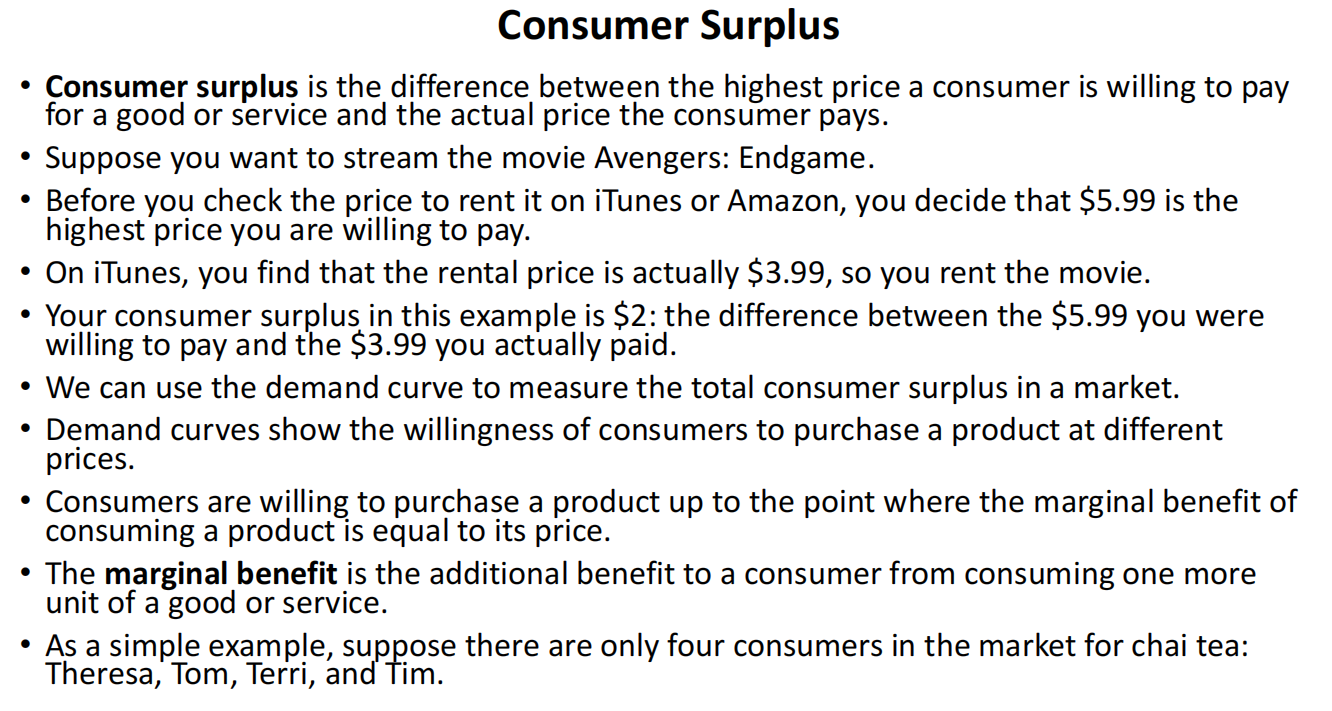
Consumer surplus is the difference between the highest price a consumer is willing to pay for a good or service and the actual price the consumer pays.
📖 点击查看译文
消费者剩余是消费者愿意支付的最高价格与实际支付的价格之间的差额。
Suppose you want to stream the movie Avengers: Endgame.
📖 点击查看译文
假设你想观看电影《复仇者联盟:终局之战》。
Before you check the price to rent it on iTunes or Amazon, you decide that $5.99 is the highest price you are willing to pay.
📖 点击查看译文
在查看 iTunes 或 Amazon 上的租赁价格之前,你决定自己最多愿意支付 5.99 美元。
On iTunes, you find that the rental price is actually $3.99, so you rent the movie.
📖 点击查看译文
在 iTunes 上,你发现租赁价格实际上是 3.99 美元,因此你租了这部电影。
Your consumer surplus in this example is 5.99 you were willing to pay and the $3.99 you actually paid.
📖 点击查看译文
在这个例子中,你的消费者剩余是 2 美元,即 5.99 美元的愿付价格与 3.99 美元的实际支付价格之间的差额。
We can use the demand curve to measure the total consumer surplus in a market.
📖 点击查看译文
我们可以使用需求曲线来衡量市场中的总消费者剩余。
Demand curves show the willingness of consumers to purchase a product at different prices.
📖 点击查看译文
需求曲线展示了消费者在不同价格水平下购买商品的意愿。
Consumers are willing to purchase a product up to the point where the marginal benefit of consuming a product is equal to its price.
📖 点击查看译文
消费者愿意购买商品,直到商品的边际效益等于其价格为止。
The marginal benefit is the additional benefit to a consumer from consuming one more unit of a good or service.
📖 点击查看译文
边际效益是消费者从额外消费一单位商品或服务中获得的附加收益。
As a simple example, suppose there are only four consumers in the market for chai tea: Theresa, Tom, Terri, and Tim.
📖 点击查看译文
举个简单的例子,假设市场上只有四位购买奶茶的消费者:Theresa、Tom、Terri 和 Tim。
知识点列表与拓展 (Knowledge Points and Extensions):
1. Consumer Surplus and Willingness to Pay (消费者剩余与支付意愿)
-
解释 (Explanation):
Consumer surplus is derived from the difference between what consumers are willing to pay and what they actually pay.
(消费者剩余来源于消费者愿意支付的价格与实际支付价格之间的差额。)
-
例子 (Example):
If a person is willing to pay 80, their consumer surplus is $20.
(如果一个人愿意支付 100 美元购买演唱会门票,但实际支付 80 美元,则其消费者剩余为 20 美元。)
-
拓展 (Extension):
Consumer surplus is larger when the market price is lower, benefiting consumers more.
(当市场价格较低时,消费者剩余更大,消费者受益更多。)
2. Demand Curve and Consumer Surplus (需求曲线与消费者剩余)
-
解释 (Explanation):
The area below the demand curve and above the market price represents total consumer surplus.
(需求曲线下方、市场价格上方的区域表示总消费者剩余。)
-
例子 (Example):
A downward-sloping demand curve shows that some consumers are willing to pay more than the equilibrium price, contributing to consumer surplus.
(向下倾斜的需求曲线表明,一些消费者愿意支付高于均衡价格的金额,这部分构成消费者剩余。)
-
拓展 (Extension):
A steep demand curve indicates less price sensitivity, meaning consumer surplus changes less with price fluctuations.
(陡峭的需求曲线表示消费者对价格不敏感,因此消费者剩余随价格波动变化较小。)
3. Marginal Benefit and Consumer Decisions (边际效益与消费者决策)
-
解释 (Explanation):
Consumers continue purchasing until the marginal benefit of an additional unit equals its price.
(消费者会持续购买,直到额外一单位的边际效益等于其价格。)
-
例子 (Example):
If drinking a third cup of coffee brings the same satisfaction as its price, the consumer is indifferent about purchasing it.
(如果第三杯咖啡带来的满足感与其价格相等,消费者在购买与否之间无差异。)
-
拓展 (Extension):
When the price of a good decreases, the marginal benefit of purchasing additional units exceeds the price, increasing consumer surplus.
(当商品价格下降时,额外购买单位的边际效益超过价格,消费者剩余增加。)
6
Consumer Surplus and Market Demand (消费者剩余与市场需求)
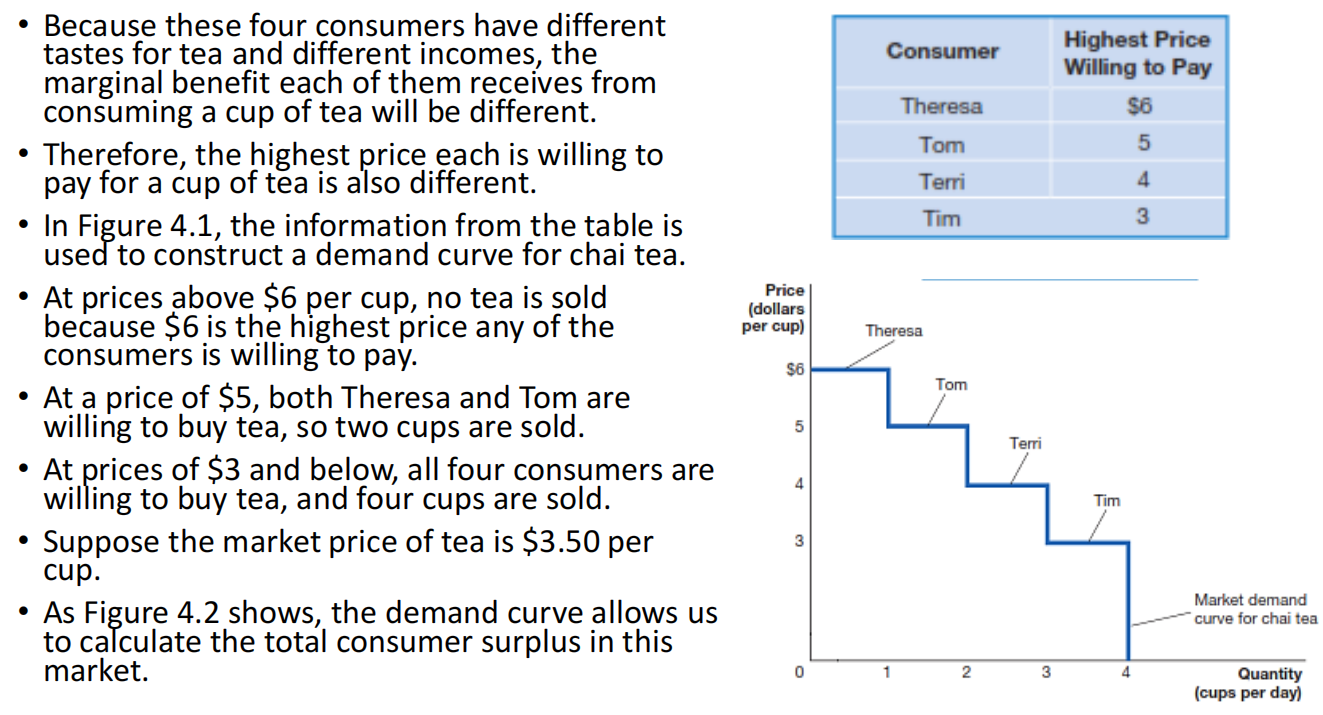
Because these four consumers have different tastes for tea and different incomes, the marginal benefit each of them receives from consuming a cup of tea will be different.
📖 点击查看译文
由于这四位消费者对茶的口味偏好和收入不同,他们从饮用一杯茶中获得的边际效益也不同。
Therefore, the highest price each is willing to pay for a cup of tea is also different.
📖 点击查看译文
因此,他们愿意支付的最高价格也不同。
In Figure 4.1, the information from the table is used to construct a demand curve for chai tea.
📖 点击查看译文
在图 4.1 中,表格中的信息被用于构建奶茶的需求曲线。
At prices above 6 is the highest price any of the consumers is willing to pay.
📖 点击查看译文
当每杯价格超过 6 美元时,茶叶销量为零,因为 6 美元是消费者愿意支付的最高价格。
At a price of $5, both Theresa and Tom are willing to buy tea, so two cups are sold.
📖 点击查看译文
当价格为 5 美元时,Theresa 和 Tom 愿意购买茶叶,因此销量为 2 杯。
At prices of $3 and below, all four consumers are willing to buy tea, and four cups are sold.
📖 点击查看译文
当价格降至 3 美元及以下时,所有四位消费者都愿意购买茶叶,因此销量为 4 杯。
Suppose the market price of tea is $3.50 per cup.
📖 点击查看译文
假设市场上茶叶的价格为每杯 3.50 美元。
As Figure 4.2 shows, the demand curve allows us to calculate the total consumer surplus in this market.
📖 点击查看译文
如图 4.2 所示,需求曲线可以用来计算该市场的总消费者剩余。
知识点列表与拓展 (Knowledge Points and Extensions):
1. Individual vs. Market Demand (个人需求与市场需求)
-
解释 (Explanation):
Market demand is the sum of all individual consumers’ demands at each price level.
(市场需求是所有消费者在不同价格水平下需求的总和。)
-
例子 (Example):
If Theresa is willing to buy tea for 5, their individual demand differs.
(如果 Theresa 愿意以 6 美元购买茶,而 Tom 只愿意支付 5 美元,他们的需求不同。)
-
拓展 (Extension):
A flatter demand curve suggests consumers are more price-sensitive, while a steeper curve suggests they are less responsive to price changes.
(较平缓的需求曲线表明消费者对价格较敏感,而陡峭的需求曲线表明他们对价格变化反应较小。)
2. Demand Curve and Willingness to Pay (需求曲线与支付意愿)
-
解释 (Explanation):
The demand curve reflects consumers’ willingness to pay, decreasing as price increases.
(需求曲线反映了消费者的支付意愿,随着价格上升,支付意愿下降。)
-
例子 (Example):
If the price of tea is 3, all four consumers purchase tea.
(如果茶叶价格为 6 美元,则无人购买;降至 3 美元时,所有消费者都会购买。)
-
拓展 (Extension):
When a price ceiling is imposed below equilibrium, it increases demand but reduces supply, leading to shortages.
(当价格上限低于均衡价格时,需求增加但供给减少,导致短缺。)
3. Consumer Surplus and Market Price (消费者剩余与市场价格)
-
解释 (Explanation):
Consumer surplus is maximized when the market price is low, benefiting more buyers.
(当市场价格较低时,消费者剩余最大,更多消费者受益。)
-
例子 (Example):
If the market price is 5, their consumer surplus is $1.50.
(如果市场价格为 3.50 美元,而消费者愿意支付 5 美元,则消费者剩余为 1.50 美元。)
-
拓展 (Extension):
Price discrimination (charging different prices to different consumers) can reduce consumer surplus but increase producer surplus.
(价格歧视即对不同消费者收取不同价格,会减少消费者剩余但增加生产者剩余。)
7
Consumer Surplus Calculation (消费者剩余计算)
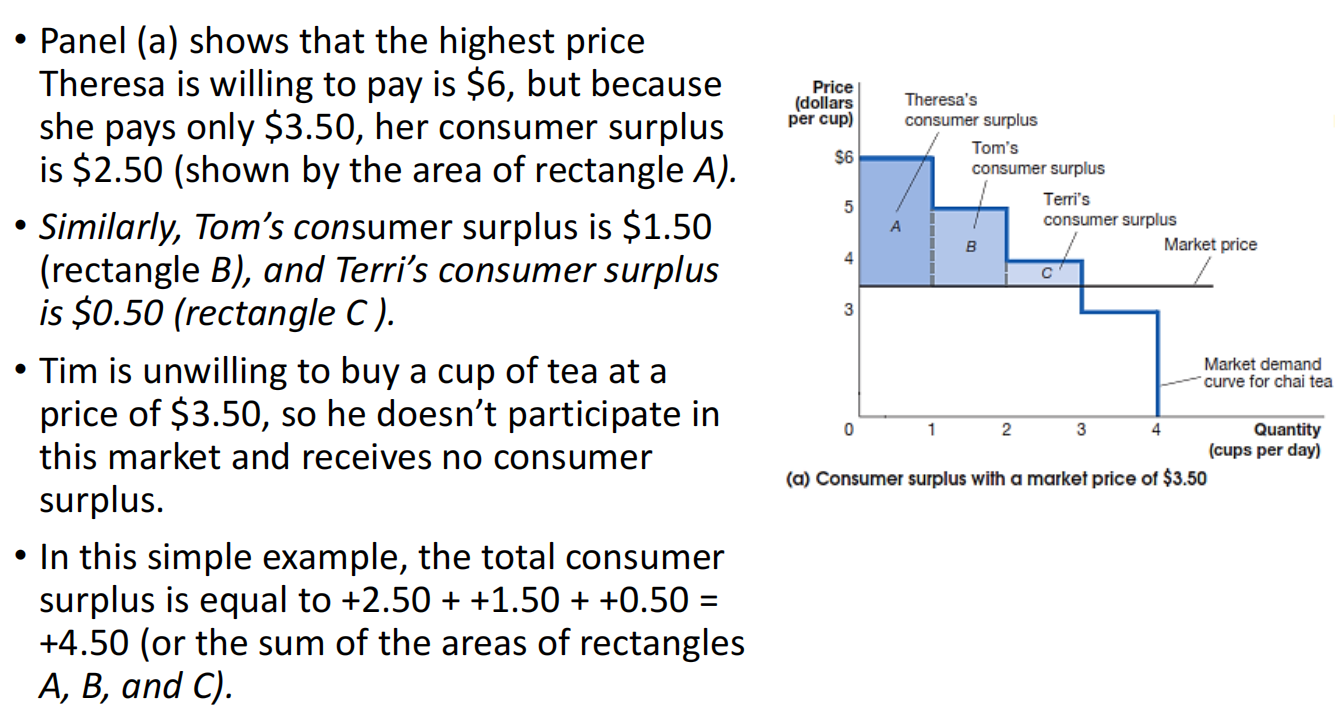
Panel (a) shows that the highest price Theresa is willing to pay is 3.50, her consumer surplus is $2.50 (shown by the area of rectangle A).
📖 点击查看译文
图表 (a) 显示,Theresa 愿意支付的最高价格是 6 美元,但她实际支付 3.50 美元,因此她的消费者剩余为 2.50 美元(对应矩形 A 的面积)。
Similarly, Tom’s consumer surplus is 0.50 (rectangle C).
📖 点击查看译文
同样,Tom 的消费者剩余为 1.50 美元(矩形 B),Terri 的消费者剩余为 0.50 美元(矩形 C)。
Tim is unwilling to buy a cup of tea at a price of $3.50, so he doesn’t participate in this market and receives no consumer surplus.
📖 点击查看译文
Tim 在 3.50 美元的价格下不愿意购买茶,因此他不参与市场交易,也没有消费者剩余。
In this simple example, the total consumer surplus is equal to +2.50 + +1.50 + +0.50 = +4.50 (or the sum of the areas of rectangles A, B, and C).
📖 点击查看译文
在此简单示例中,总消费者剩余等于 2.50 + 1.50 + 0.50 = 4.50(即矩形 A、B 和 C 的面积之和)。
知识点列表与拓展 (Knowledge Points and Extensions):
1. Consumer Surplus and Price Willingness (消费者剩余与支付意愿)
-
解释 (Explanation):
Consumer surplus is calculated as the difference between the maximum price a consumer is willing to pay and the actual price paid.
(消费者剩余等于消费者愿意支付的最高价格与实际支付价格之间的差额。)
-
例子 (Example):
Theresa was willing to pay 3.50, so her consumer surplus is $2.50.
(Theresa 愿意支付 6 美元,但实际支付 3.50 美元,因此她的消费者剩余是 2.50 美元。)
-
拓展 (Extension):
When market prices decrease, consumer surplus increases, benefiting more consumers.
(当市场价格下降时,消费者剩余增加,更多消费者受益。)
2. Total Consumer Surplus and Market Impact (总消费者剩余与市场影响)
-
解释 (Explanation):
The total consumer surplus in a market is the sum of all individual consumer surpluses.
(市场中的总消费者剩余是所有个体消费者剩余的总和。)
-
例子 (Example):
In this case, total consumer surplus = 2.50 + 1.50 + 0.50 = 4.50.
(本例中,总消费者剩余 = 2.50 + 1.50 + 0.50 = 4.50。)
-
拓展 (Extension):
Consumer surplus is higher in a competitive market than in a monopoly, where prices are often set above equilibrium.
(在竞争市场中,消费者剩余较高;而在垄断市场中,价格往往高于均衡价格,导致消费者剩余减少。)
3. Price Sensitivity and Consumer Decisions (价格敏感性与消费者决策)
-
解释 (Explanation):
Consumers with higher willingness to pay gain more consumer surplus, while those unwilling to pay the price receive none.
(愿意支付更高价格的消费者获得更多消费者剩余,而不愿支付价格的消费者则无剩余。)
-
例子 (Example):
Tim refused to buy at $3.50, so his consumer surplus is zero.
(Tim 在 3.50 美元的价格下不愿购买,因此他的消费者剩余为零。)
-
拓展 (Extension):
Companies use price segmentation (e.g., discounts for students) to capture more consumer surplus by targeting different groups.
(企业通过价格分层(如针对学生的折扣)来获取更多消费者剩余,针对不同群体定价。)
8
消费者剩余与价格下降 (Consumer Surplus and Price Reduction)
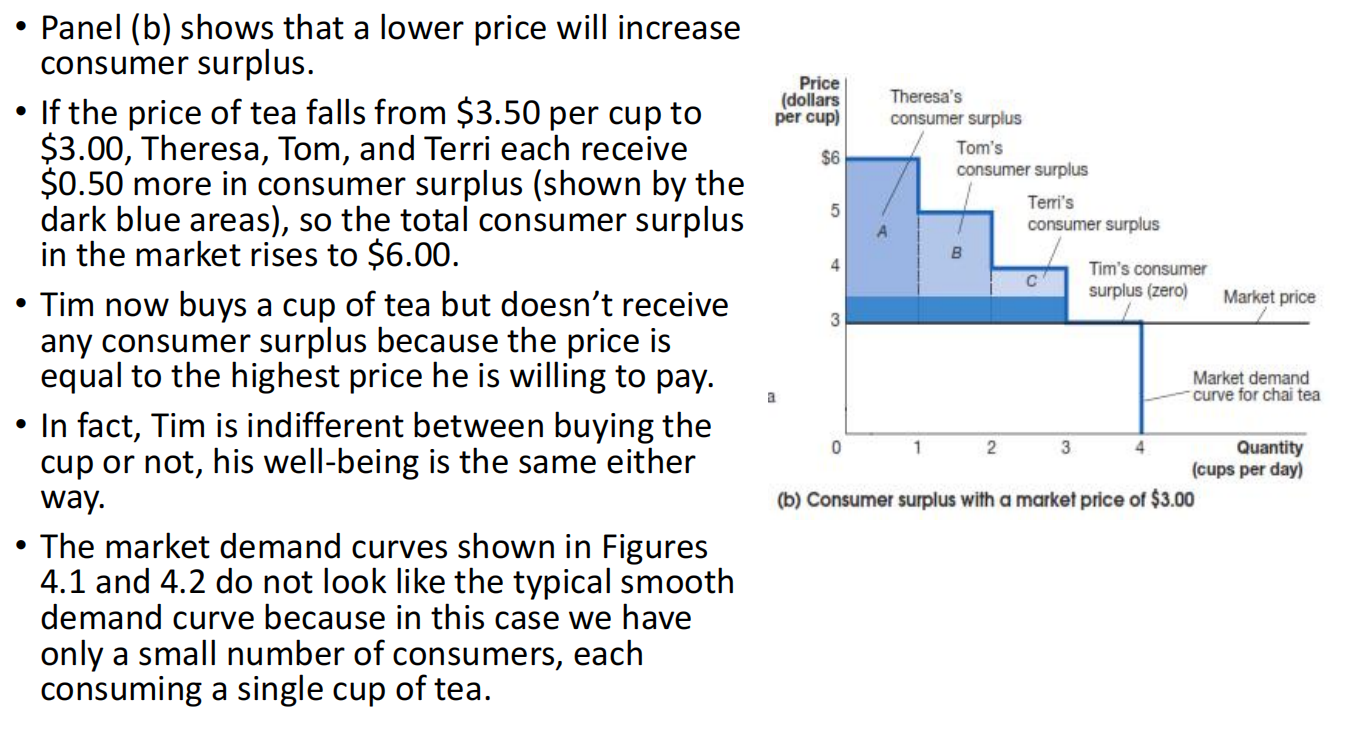
Panel (b) shows that a lower price will increase consumer surplus.
📖 点击查看译文
图表 (b) 显示,较低的价格会增加消费者剩余。
If the price of tea falls from 3.00, Theresa, Tom, and Terri each receive 6.00.
📖 点击查看译文
如果茶的价格从每杯 3.50 美元降至 3.00 美元,Theresa、Tom 和 Terri 各获得 0.50 美元额外的消费者剩余(深蓝色区域),因此市场的总消费者剩余增加到 6.00 美元。
Tim now buys a cup of tea but doesn’t receive any consumer surplus because the price is equal to the highest price he is willing to pay.
📖 点击查看译文
Tim 现在购买了一杯茶,但没有消费者剩余,因为价格等于他愿意支付的最高价格。
In fact, Tim is indifferent between buying the cup or not, his well-being is the same either way.
📖 点击查看译文
实际上,Tim 对于是否购买这杯茶无所谓,因为无论买或不买,他的效用都是相同的。
The market demand curves shown in Figures 4.1 and 4.2 do not look like the typical smooth demand curve because in this case we have only a small number of consumers, each consuming a single cup of tea.
📖 点击查看译文
图 4.1 和 4.2 中的市场需求曲线看起来不像典型的平滑需求曲线,因为在这个案例中,只有少量消费者,每人只消费一杯茶。
知识点列表与拓展 (Knowledge Points and Extensions):
1. 价格下降如何影响消费者剩余 (How Price Reductions Affect Consumer Surplus)
-
解释 (Explanation):
When the price of a good decreases, existing consumers gain additional surplus, and new consumers may enter the market.
(当商品价格下降时,现有消费者的剩余增加,同时可能会有新消费者进入市场。)
-
例子 (Example):
When tea prices fall from 3.00, Theresa, Tom, and Terri each gain an extra $0.50 in consumer surplus.
(当茶的价格从 3.50 美元降至 3.00 美元时,Theresa、Tom 和 Terri 各自获得额外的 0.50 美元消费者剩余。)
-
拓展 (Extension):
In real-world markets, sales promotions and discounts work similarly by increasing consumer surplus and attracting more buyers.
(在现实市场中,促销和折扣通过增加消费者剩余并吸引更多买家来发挥类似作用。)
2. 新消费者的无差异选择 (Indifference of New Consumers)
-
解释 (Explanation):
If a consumer enters the market at a price exactly equal to their maximum willingness to pay, they experience no surplus and are indifferent to buying or not.
(如果新进入市场的消费者支付的价格恰好等于其最高支付意愿,他们不会获得消费者剩余,因此对购买与否无所谓。)
-
例子 (Example):
Tim purchases tea at $3.00, which is his exact willingness to pay, so he experiences no additional benefit.
(Tim 以 3.00 美元购买了一杯茶,但因其支付意愿也是 3.00 美元,因此没有获得额外的消费者剩余。)
-
拓展 (Extension):
This concept is crucial in understanding marginal consumers in competitive pricing strategies, where firms aim to convert indifferent consumers into loyal buyers.
(这一概念对于理解竞争性定价策略中的边际消费者至关重要,企业通常试图将无差别消费者转化为忠实买家。)
3. 需求曲线的平滑性与市场规模 (Smoothness of Demand Curves and Market Size)
-
解释 (Explanation):
When a market has only a few buyers, the demand curve appears step-like, but in larger markets, it becomes smoother.
(当市场中的买家较少时,需求曲线呈阶梯状;而在更大市场中,需求曲线趋于平滑。)
-
例子 (Example):
Figures 4.1 and 4.2 show a step-shaped demand curve due to the small number of consumers.
(图 4.1 和 4.2 的需求曲线呈阶梯状,因为市场中的消费者数量较少。)
-
拓展 (Extension):
In a national or global market, demand curves become smoother because individual purchasing decisions aggregate into continuous market behavior.
(在全国或全球市场中,由于个体购买决策的聚合,需求曲线会变得更加平滑。)
9
消费者剩余与市场需求曲线 (Consumer Surplus and the Market Demand Curve)
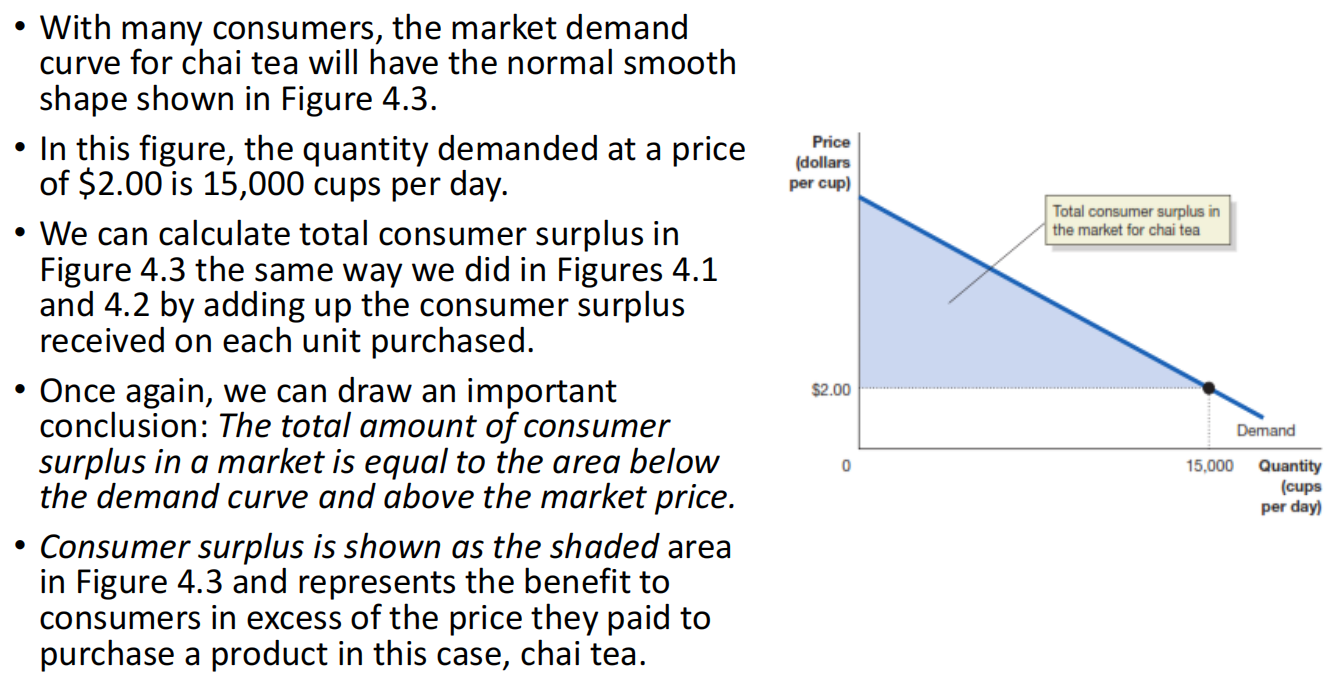
With many consumers, the market demand curve for chai tea will have the normal smooth shape shown in Figure 4.3.
📖 点击查看译文
当消费者数量较多时,茶市场的需求曲线将呈现正常的平滑形态,如图 4.3 所示。
In this figure, the quantity demanded at a price of $2.00 is 15,000 cups per day.
📖 点击查看译文
在该图中,当价格为 2.00 美元时,每天的需求量为 15,000 杯。
We can calculate total consumer surplus in Figure 4.3 the same way we did in Figures 4.1 and 4.2 by adding up the consumer surplus received on each unit purchased.
📖 点击查看译文
我们可以像计算图 4.1 和 4.2 中的消费者剩余一样,计算图 4.3 中的总消费者剩余,即累加每个购买单位所获得的消费者剩余。
Once again, we can draw an important conclusion: The total amount of consumer surplus in a market is equal to the area below the demand curve and above the market price.
📖 点击查看译文
再次,我们可以得出一个重要结论:市场中的消费者剩余总量等于需求曲线以下、市场价格以上的面积。
Consumer surplus is shown as the shaded area in Figure 4.3 and represents the benefit to consumers in excess of the price they paid to purchase a product in this case, chai tea.
📖 点击查看译文
消费者剩余在图 4.3 中以阴影区域表示,代表消费者获得的超出其支付价格的收益(在此案例中为茶)。
知识点列表与拓展 (Knowledge Points and Extensions):
1. 市场需求曲线的平滑性 (Smoothness of the Market Demand Curve)
-
解释 (Explanation):
As the number of consumers increases, individual purchasing variations smooth out, resulting in a continuous demand curve.
(随着消费者数量增加,个体购买行为的变化被平滑化,从而形成连续的需求曲线。)
-
例子 (Example):
When the tea market expands to thousands of buyers, the demand curve in Figure 4.3 is smooth, unlike the step-like curve in Figures 4.1 and 4.2.
(当茶市场扩展到成千上万的买家时,图 4.3 中的需求曲线变得平滑,而不是图 4.1 和 4.2 中的阶梯状曲线。)
-
拓展 (Extension):
In large markets, demand elasticity is easier to measure since small price changes affect many consumers.
(在大型市场中,需求弹性更容易测量,因为价格的微小变动会影响大量消费者。)
2. 计算消费者剩余 (Calculating Consumer Surplus)
-
解释 (Explanation):
Consumer surplus is the area between the demand curve and the price level, summing the surplus for all purchased units.
(消费者剩余是需求曲线与市场价格之间的区域,代表所有购买单位的剩余总和。)
-
例子 (Example):
If 15,000 cups of tea are sold daily at $2.00 each, the consumer surplus is the shaded area under the demand curve in Figure 4.3.
(如果每天售出 15,000 杯茶,每杯 2.00 美元,则消费者剩余是图 4.3 需求曲线下方的阴影区域。)
-
拓展 (Extension):
This principle applies to other goods, such as airline tickets—when airlines lower prices, total consumer surplus increases.
(这一原理适用于其他商品,例如机票——当航空公司降价时,总消费者剩余增加。)
3. 消费者剩余的经济意义 (Economic Significance of Consumer Surplus)
-
解释 (Explanation):
Consumer surplus measures how much consumers gain from transactions beyond what they pay, indicating market efficiency.
(消费者剩余衡量消费者从交易中获得的额外收益,反映市场的效率。)
-
例子 (Example):
In a competitive market, higher consumer surplus suggests that consumers are getting better deals.
(在竞争性市场中,较高的消费者剩余意味着消费者获得了更好的交易。)
-
拓展 (Extension):
Governments sometimes use consumer surplus analysis to justify policies like subsidies or price controls.
(政府有时利用消费者剩余分析来论证补贴或价格管制等政策的合理性。)
10
生产者剩余与供给曲线 (Producer Surplus and the Supply Curve)
Just as demand curves show the willingness of consumers to buy a product at different prices, supply curves show the willingness of firms to supply a product at different prices.
📖 点击查看译文
正如需求曲线显示消费者在不同价格下购买产品的意愿,供给曲线显示企业在不同价格下供应产品的意愿。
The willingness to supply a product depends on the cost of producing it.
📖 点击查看译文
供应产品的意愿取决于生产该产品的成本。
Firms will supply an additional unit of a product only if they receive a price equal to the additional cost of producing that unit.
📖 点击查看译文
企业只有在获得的价格等于该单位产品的额外生产成本时,才会供应额外的产品单位。
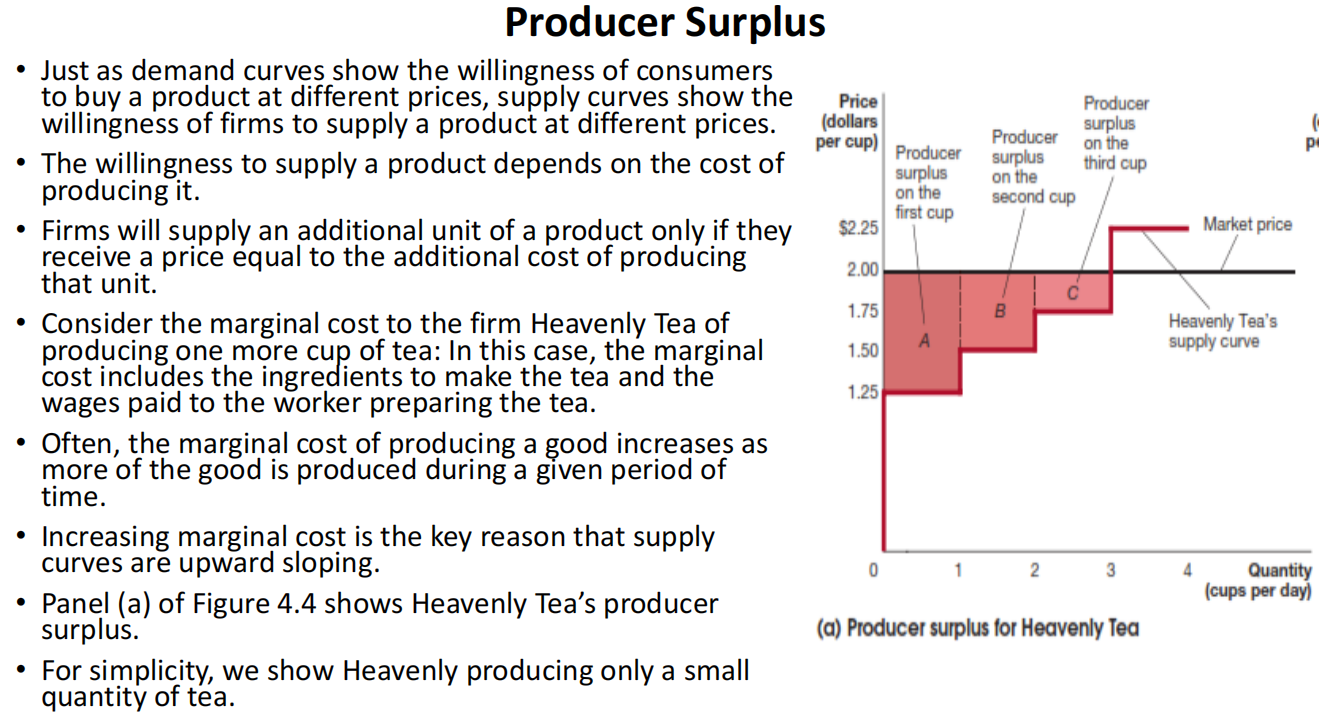
Consider the marginal cost to the firm Heavenly Tea of producing one more cup of tea: In this case, the marginal cost includes the ingredients to make the tea and the wages paid to the worker preparing the tea.
📖 点击查看译文
以 Heavenly Tea 公司生产一杯额外的茶为例:在这种情况下,边际成本包括制作茶的原材料成本以及支付给制茶工人的工资。
Often, the marginal cost of producing a good increases as more of the good is produced during a given period of time.
📖 点击查看译文
通常,在特定时间段内生产的产品数量增加时,边际成本会上升。
Increasing marginal cost is the key reason that supply curves are upward sloping.
📖 点击查看译文
边际成本的增加是供给曲线向上倾斜的关键原因。
Panel (a) of Figure 4.4 shows Heavenly Tea’s producer surplus.
📖 点击查看译文
图 4.4 的 (a) 面板显示了 Heavenly Tea 公司的生产者剩余。
For simplicity, we show Heavenly producing only a small quantity of tea.
📖 点击查看译文
为了简化分析,我们仅展示 Heavenly 公司生产少量茶的情况。
知识点列表与拓展 (Knowledge Points and Extensions):
1. 供给曲线与生产意愿 (Supply Curve and Willingness to Produce)
-
解释 (Explanation):
The supply curve represents firms’ willingness to produce a good at different price levels, which depends on their costs.
(供给曲线表示企业在不同价格水平下的生产意愿,这取决于其生产成本。)
-
例子 (Example):
If the price of tea increases, Heavenly Tea is willing to produce more because it covers higher marginal costs.
(如果茶的价格上涨,Heavenly Tea 公司愿意生产更多,因为更高的价格能覆盖其增加的边际成本。)
-
拓展 (Extension):
In industries with high fixed costs (e.g., airlines), firms must consider long-term pricing strategies beyond marginal costs.
(在固定成本较高的行业(如航空业),企业必须考虑超出边际成本的长期定价策略。)
2. 边际成本的概念 (Concept of Marginal Cost)
-
解释 (Explanation):
Marginal cost is the additional cost of producing one more unit of a good, which typically increases as production expands.
(边际成本是生产额外一个单位产品所增加的成本,通常随着生产扩张而上升。)
-
例子 (Example):
As Heavenly Tea produces more tea, it may need to hire extra workers or use more expensive ingredients, increasing marginal costs.
(当 Heavenly Tea 生产更多茶时,可能需要雇佣额外的工人或使用更昂贵的原料,从而提高边际成本。)
-
拓展 (Extension):
Marginal cost pricing is used in competitive markets where firms set prices close to marginal cost to maximize efficiency.
(在竞争性市场中,企业通常采用边际成本定价,以最大化市场效率。)
3. 生产者剩余的经济意义 (Economic Significance of Producer Surplus)
-
解释 (Explanation):
Producer surplus measures the benefit firms receive from selling at a market price higher than their minimum acceptable price.
(生产者剩余衡量的是企业以高于其最低接受价格的市场价格销售产品所获得的收益。)
-
例子 (Example):
If Heavenly Tea is willing to sell a cup of tea for 3.50, its producer surplus per cup is $1.50.
(如果 Heavenly Tea 愿意以 2.00 美元卖出一杯茶,而市场价格是 3.50 美元,则其每杯茶的生产者剩余为 1.50 美元。)
-
拓展 (Extension):
Governments sometimes use producer surplus analysis to determine tax policies or subsidies that support local businesses.
(政府有时利用生产者剩余分析来制定税收政策或补贴,以支持本地企业。)
11
生产者剩余计算与供给曲线 (Producer Surplus Calculation and the Supply Curve)
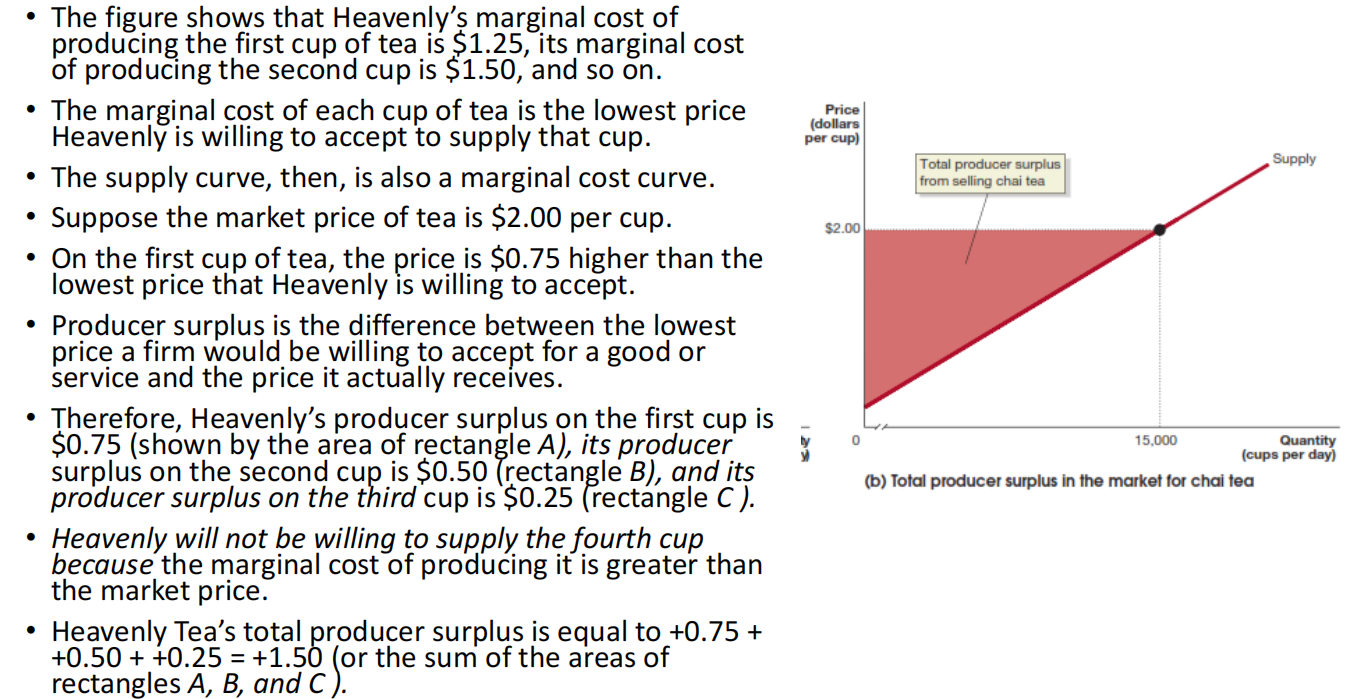
The figure shows that Heavenly’s marginal cost of producing the first cup of tea is 1.50, and so on.
📖 点击查看译文
图示表明,Heavenly 公司生产第一杯茶的边际成本为 1.25 美元,生产第二杯的边际成本为 1.50 美元,以此类推。
The marginal cost of each cup of tea is the lowest price Heavenly is willing to accept to supply that cup.
📖 点击查看译文
每杯茶的边际成本是 Heavenly 公司愿意供应该杯茶的最低价格。
The supply curve, then, is also a marginal cost curve.
📖 点击查看译文
因此,供给曲线也是边际成本曲线。
Suppose the market price of tea is $2.00 per cup.
📖 点击查看译文
假设市场上每杯茶的价格为 2.00 美元。
On the first cup of tea, the price is $0.75 higher than the lowest price that Heavenly is willing to accept.
📖 点击查看译文
第一杯茶的市场价格比 Heavenly 公司愿意接受的最低价格高出 0.75 美元。
Producer surplus is the difference between the lowest price a firm would be willing to accept for a good or service and the price it actually receives.
📖 点击查看译文
生产者剩余是企业愿意接受的最低价格与其实际获得的价格之间的差额。
Therefore, Heavenly’s producer surplus on the first cup is 0.50 (rectangle B), and its producer surplus on the third cup is $0.25 (rectangle C ).
📖 点击查看译文
因此,Heavenly 公司第一杯茶的生产者剩余为 0.75 美元(矩形 A),第二杯的生产者剩余为 0.50 美元(矩形 B),第三杯的生产者剩余为 0.25 美元(矩形 C)。
Heavenly will not be willing to supply the fourth cup because the marginal cost of producing it is greater than the market price.
📖 点击查看译文
Heavenly 公司不会愿意供应第四杯茶,因为生产该杯茶的边际成本高于市场价格。
Heavenly Tea’s total producer surplus is equal to +0.75 + +0.50 + +0.25 = +1.50 (or the sum of the areas of rectangles A, B, and C ).
📖 点击查看译文
Heavenly Tea 公司的总生产者剩余等于 0.75 + 0.50 + 0.25 = 1.50 美元(即矩形 A、B 和 C 的总面积)。
知识点列表与拓展 (Knowledge Points and Extensions):
1. 生产者剩余的计算方法 (Calculation of Producer Surplus)
-
解释 (Explanation):
Producer surplus is calculated by finding the difference between the market price and the marginal cost for each unit sold.
(生产者剩余通过计算市场价格与每个销售单位的边际成本之间的差额得出。)
-
例子 (Example):
If a firm’s marginal cost for a unit is 2.00, its producer surplus for that unit is $0.50.
(如果企业某单位产品的边际成本为 1.50 美元,但以 2.00 美元的价格售出,则该单位的生产者剩余为 0.50 美元。)
-
拓展 (Extension):
Governments analyze producer surplus when implementing subsidies, as increased surplus can indicate greater business profitability.
(政府在制定补贴政策时会分析生产者剩余,因为更高的剩余可能表明企业盈利能力增强。)
2. 供给曲线与边际成本 (Supply Curve and Marginal Cost)
-
解释 (Explanation):
The supply curve represents the marginal cost curve, meaning firms supply goods only when the price meets or exceeds marginal cost.
(供给曲线即边际成本曲线,这意味着企业只有在价格满足或超过边际成本时才会提供商品。)
-
例子 (Example):
If a firm’s marginal cost for a product is 2.00.
(如果企业某产品的边际成本为 2.00 美元,那么只有当市场价格至少达到 2.00 美元时,它才会生产。)
-
拓展 (Extension):
In industries with economies of scale, marginal costs may decrease initially before increasing as production expands.
(在具有规模经济的行业,边际成本可能会先下降,然后随着生产扩大而上升。)
3. 生产者剩余的市场影响 (Market Impact of Producer Surplus)
-
解释 (Explanation):
High producer surplus indicates that firms are benefiting from higher prices, which may attract more firms into the market.
(高生产者剩余表明企业从较高价格中获益,这可能会吸引更多企业进入市场。)
-
例子 (Example):
If tea prices rise, more tea producers may enter the market, increasing supply and potentially lowering prices over time.
(如果茶叶价格上涨,更多生产商可能会进入市场,增加供给,并最终可能导致价格下降。)
-
拓展 (Extension):
In perfectly competitive markets, producer surplus is minimized as firms compete to lower prices near marginal costs.
(在完全竞争市场中,生产者剩余最小化,因为企业竞争降低价格,使其接近边际成本。)
12
生产者剩余与价格变化 (Producer Surplus and Price Changes)
A higher price will increase producer surplus.
📖 点击查看译文
更高的价格会增加生产者剩余。
For example, if the market price of chai tea rises from +2.00 to +2.25, Heavenly Tea’s producer surplus will increase from 2.25.
📖 点击查看译文
例如,如果市场上柴茶的价格从 2.00 美元上涨到 2.25 美元,Heavenly Tea 的生产者剩余将从 1.50 美元增加到 2.25 美元。
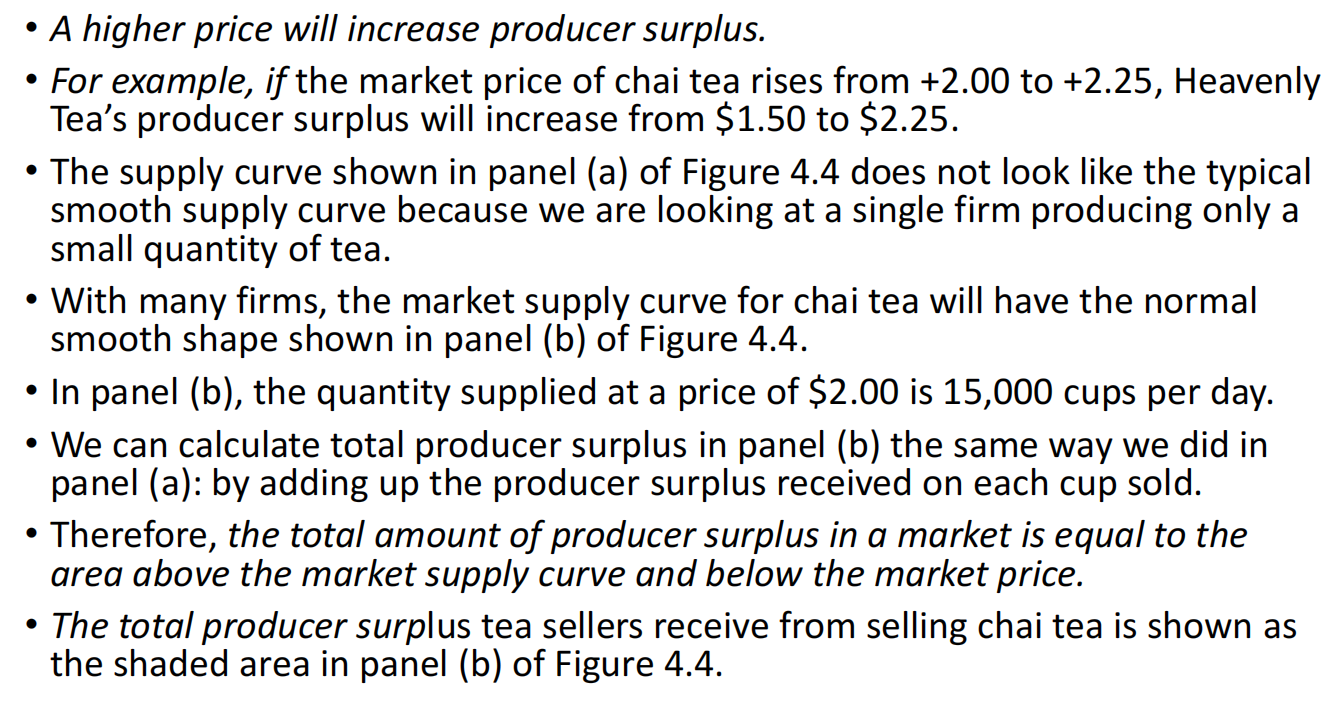
The supply curve shown in panel (a) of Figure 4.4 does not look like the typical smooth supply curve because we are looking at a single firm producing only a small quantity of tea.
📖 点击查看译文
图 4.4(a) 所示的供给曲线不像典型的平滑供给曲线,因为这里研究的是单个企业生产少量茶叶的情况。
With many firms, the market supply curve for chai tea will have the normal smooth shape shown in panel (b) of Figure 4.4.
📖 点击查看译文
当市场上有许多企业时,柴茶的市场供给曲线将呈现图 4.4(b) 中的典型平滑形态。
In panel (b), the quantity supplied at a price of $2.00 is 15,000 cups per day.
📖 点击查看译文
在图 4.4(b) 中,当价格为 2.00 美元时,市场每天供应 15,000 杯柴茶。
We can calculate total producer surplus in panel (b) the same way we did in panel (a): by adding up the producer surplus received on each cup sold.
📖 点击查看译文
我们可以像计算图 4.4(a) 中的生产者剩余一样计算图 4.4(b) 的总生产者剩余,即将每杯茶的生产者剩余相加。
Therefore, the total amount of producer surplus in a market is equal to the area above the market supply curve and below the market price.
📖 点击查看译文
因此,市场中的总生产者剩余等于市场供给曲线以上、市场价格以下的区域面积。
The total producer surplus tea sellers receive from selling chai tea is shown as the shaded area in panel (b) of Figure 4.4.
📖 点击查看译文
柴茶销售商获得的总生产者剩余在图 4.4(b) 中以阴影区域表示。
知识点列表与拓展 (Knowledge Points and Extensions):
1. 价格变化对生产者剩余的影响 (Effect of Price Changes on Producer Surplus)
-
解释 (Explanation):
Producer surplus increases when market prices rise because firms receive a higher price than their marginal cost.
(当市场价格上升时,生产者剩余增加,因为企业获得的价格高于其边际成本。)
-
例子 (Example):
If a firm’s marginal cost is 2.00 to 0.50 to $0.75.
(如果某企业的边际成本为 1.50 美元,市场价格从 2.00 美元涨到 2.25 美元,则每单位的生产者剩余从 0.50 美元增加到 0.75 美元。)
-
拓展 (Extension):
Government-imposed price ceilings can reduce producer surplus by limiting the price firms can charge.
(政府设定的价格上限可能会减少生产者剩余,因为它限制了企业可以收取的价格。)
2. 供给曲线的形状 (Shape of the Supply Curve)
-
解释 (Explanation):
In individual firms, supply curves may appear step-like due to discrete production levels, but in a competitive market, the curve appears smooth.
(在单个企业的供给曲线上,生产水平可能是不连续的,表现为阶梯状,而在竞争性市场中,供给曲线通常是平滑的。)
-
例子 (Example):
A small tea shop may only be able to produce whole units of 10, 20, or 30 cups per hour, causing its supply curve to have steps.
(一家小型茶店可能只能每小时生产 10、20 或 30 杯,使其供给曲线呈阶梯状。)
-
拓展 (Extension):
The long-run supply curve is typically flatter than the short-run supply curve because firms can enter or exit the market over time.
(长期供给曲线通常比短期供给曲线更平缓,因为企业可以随着时间推移进入或退出市场。)
3. 生产者剩余的市场计算 (Market Calculation of Producer Surplus)
-
解释 (Explanation):
Market-wide producer surplus is calculated as the area between the market supply curve and the market price.
(市场总生产者剩余的计算方法是求市场供给曲线与市场价格之间的面积。)
-
例子 (Example):
If the market price of tea is 1.50, the area between these values represents total producer surplus.
(如果市场上的茶叶价格为 2.00 美元,而企业的最低边际成本为 1.50 美元,则这些数值之间的面积代表总生产者剩余。)
-
拓展 (Extension):
Competitive markets with many firms tend to have lower producer surplus because competition pushes prices closer to marginal costs.
(在完全竞争市场中,生产者剩余通常较低,因为竞争会使价格接近边际成本。)
13
竞争市场的效率 (The Efficiency of Competitive Markets)
We know that a competitive market is a market with many buyers and many sellers.
📖 点击查看译文
我们知道,竞争市场是指买卖双方众多的市场。
An important advantage of the market system is that it results in efficient economic outcomes.
📖 点击查看译文
市场体系的一个重要优势是它能带来高效的经济结果。
But what does economic efficiency mean?
📖 点击查看译文
但经济效率是什么意思呢?
The concepts we have developed so far in this chapter give us two ways to think about the economic efficiency of competitive markets.
📖 点击查看译文
本章目前介绍的概念为我们提供了两种思考竞争市场经济效率的方法。
We can think in terms of marginal benefit and marginal cost.
📖 点击查看译文
我们可以从边际收益和边际成本的角度来思考。
We can also think in terms of consumer surplus and producer surplus.
📖 点击查看译文
我们也可以从消费者剩余和生产者剩余的角度来思考。
As we will see, these two approaches lead to the same outcome, but using both can increase our understanding of economic efficiency.
📖 点击查看译文
正如我们将看到的,这两种方法会得出相同的结果,但结合使用可以加深我们对经济效率的理解。
知识点列表与拓展 (Knowledge Points and Extensions):
1. 竞争市场的基本特征 (Key Features of Competitive Markets)
-
解释 (Explanation):
Competitive markets have many buyers and sellers, no single entity controls prices, and products are largely homogeneous.
(竞争市场的特点是买卖双方众多,没有单个实体控制价格,并且产品基本相同。)
-
例子 (Example):
The agricultural market for wheat is a competitive market because there are many producers, and no single farmer can dictate the price.
(小麦的农业市场是一个竞争市场,因为有许多生产者,没有任何单个农民能决定价格。)
-
拓展 (Extension):
In imperfectly competitive markets, firms have some price-setting power, which can reduce efficiency.
(在不完全竞争市场中,企业具有一定的定价能力,这可能会降低效率。)
2. 经济效率的衡量方式 (Measures of Economic Efficiency)
-
解释 (Explanation):
Economic efficiency is achieved when marginal benefit equals marginal cost (MB = MC).
(当边际收益等于边际成本 (MB = MC) 时,经济效率达到最优。)
-
例子 (Example):
If the benefit of producing one more unit of a good is 6, production should stop to avoid inefficiency.
(如果生产额外一单位商品的收益为 5 美元,但成本为 6 美元,则应停止生产,以避免无效率。)
-
拓展 (Extension):
Economic efficiency is also maximized when total consumer surplus and producer surplus are maximized.
(当消费者剩余和生产者剩余的总和最大化时,经济效率也达到最优。)
3. 消费者剩余与生产者剩余的关系 (Relationship Between Consumer Surplus and Producer Surplus)
-
解释 (Explanation):
A competitive market maximizes the sum of consumer surplus and producer surplus, leading to an efficient allocation of resources.
(竞争市场最大化消费者剩余和生产者剩余的总和,实现资源的有效配置。)
-
例子 (Example):
If a government imposes a price ceiling below the equilibrium price, consumer surplus may increase, but producer surplus decreases, leading to inefficiency.
(如果政府设定低于均衡价格的价格上限,消费者剩余可能增加,但生产者剩余减少,从而导致无效率。)
-
拓展 (Extension):
Deadweight loss occurs when price controls, taxes, or monopolies prevent the market from reaching equilibrium.
(当价格管制、税收或垄断阻止市场达到均衡时,就会产生无谓损失 (deadweight loss)。)
14
竞争均衡下边际收益等于边际成本 (Marginal Benefit Equals Marginal Cost in Competitive Equilibrium)
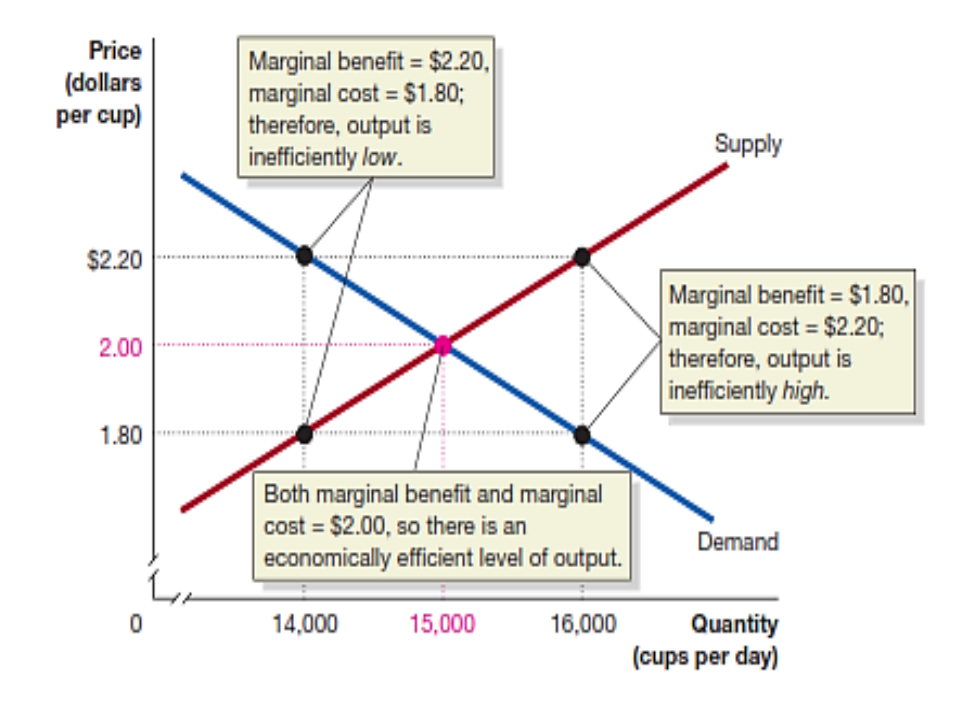
As per the market for chai tea, the demand curve shows the marginal benefit received by consumers, and the supply curve shows the marginal cost of production.
📖 点击查看译文
在香料茶 (chai tea) 市场中,需求曲线表示消费者获得的边际收益,而供给曲线表示生产的边际成本。
For this market to achieve economic efficiency, the marginal benefit from the last unit sold should equal the marginal cost of production.
📖 点击查看译文
为了使该市场实现经济效率,最后一杯茶销售所带来的边际收益应等于其生产的边际成本。
The figure shows that this equality occurs at competitive equilibrium where 15,000 cups per day are produced and marginal benefit and marginal cost are both equal to $2.00.
📖 点击查看译文
图示表明,在竞争均衡点,每天生产 15,000 杯茶,此时边际收益和边际成本均为 2.00 美元。
This outcome is economically efficient because every cup of chai tea has been produced where the marginal benefit to buyers is greater than or equal to the marginal cost to producers.
📖 点击查看译文
该结果是经济高效的,因为生产的每一杯茶都满足了消费者的边际收益大于或等于生产者的边际成本的条件。
To further understand why the level of output at competitive equilibrium is efficient, consider what the situation would be if output were at a different level.
📖 点击查看译文
为了进一步理解为什么竞争均衡时的产量是高效的,可以考虑在不同产量水平下的情况。
Suppose that output of chai tea were 14,000 cups per day.
📖 点击查看译文
假设每天的香料茶产量为 14,000 杯。
Figure 4.5 shows that at this level of output, the marginal benefit from the last cup sold is 1.80.
📖 点击查看译文
图 4.5 显示,在这个产量水平下,最后一杯茶的边际收益为 2.20 美元,而边际成本仅为 1.80 美元。
知识点列表与拓展 (Knowledge Points and Extensions):
1. 竞争均衡的定义 (Definition of Competitive Equilibrium)
-
解释 (Explanation):
Competitive equilibrium occurs where the quantity demanded equals the quantity supplied, ensuring that resources are allocated efficiently.
(竞争均衡发生在需求量等于供给量的点,从而确保资源被有效分配。)
-
例子 (Example):
If the market price of tea is $2.00 and at this price 15,000 cups are both demanded and supplied, the market is in equilibrium.
(如果茶的市场价格为 2.00 美元,并且在该价格下需求量和供给量均为 15,000 杯,则市场处于均衡状态。)
-
拓展 (Extension):
In the long run, firms enter or exit the market based on profit signals, which helps maintain equilibrium.
(长期来看,企业会根据利润信号进入或退出市场,从而维持均衡状态。)
2. 边际收益与边际成本的关系 (Relationship Between Marginal Benefit and Marginal Cost)
-
解释 (Explanation):
Efficiency is achieved when MB = MC, meaning that the value consumers place on an additional unit equals its production cost.
(当 MB = MC 时,实现效率最大化,即消费者对额外单位商品的评价等于其生产成本。)
-
例子 (Example):
If the last cup of tea provides 2.00 to produce, the allocation is efficient.
(如果最后一杯茶带来的收益为 2.00 美元,而生产成本也是 2.00 美元,则资源配置是有效的。)
-
拓展 (Extension):
If MB > MC, more production is needed; if MB < MC, production should be reduced.
(如果 MB > MC,则需要增加产量;如果 MB < MC,则应减少产量。)
3. 低于均衡产量时的影响 (Effects of Output Below Equilibrium)
-
解释 (Explanation):
When output is too low, MB > MC, meaning consumers are willing to pay more than the production cost, leading to lost economic value.
(当产量低于均衡水平时,MB > MC,意味着消费者愿意支付的价格高于生产成本,造成经济价值的损失。)
-
例子 (Example):
At 14,000 cups per day, MB = 1.80, indicating underproduction.
(在 14,000 杯/天的产量水平下,MB = 2.20 美元,而 MC = 1.80 美元,表明产量不足。)
-
拓展 (Extension):
Governments sometimes implement subsidies to encourage production when output is below equilibrium.
(当产量低于均衡水平时,政府有时会提供补贴以鼓励生产。)
15
16
竞争市场中的均衡与效率 (Equilibrium and Efficiency in a Competitive Market)
This level of output is not efficient because 1,000 more cups could be produced for which the additional benefit to consumers would be greater than the additional cost of production.
📖 点击查看译文
该产量水平并不高效,因为还可以生产额外 1,000 杯茶,而这些额外杯数带来的消费者收益大于其生产成本。
Consumers would willingly purchase those cups, and tea sellers would willingly supply them, making both consumers and sellers better off.
📖 点击查看译文
消费者愿意购买这些额外的茶,而茶商也愿意供应,这使得消费者和茶商双方的境况都得到改善。
Similarly, if the output of chai tea were 16,000 cups per day, the marginal cost of the 16,000th cup is 1.80.
📖 点击查看译文
同样,如果香料茶的产量达到 16,000 杯/天,第 16,000 杯的边际成本为 2.20 美元,而边际收益仅为 1.80 美元。
Tea sellers would only be willing to supply this cup at a price of 0.40 higher than consumers would be willing to pay.
📖 点击查看译文
茶商只有在 2.20 美元的价格下才愿意供应这杯茶,而这个价格比消费者愿意支付的价格高出 0.40 美元。
In fact, consumers would not be willing to pay the price tea sellers would need to receive for any cup beyond the 15,000th.
📖 点击查看译文
事实上,消费者不会愿意支付茶商在第 15,000 杯之后需要的价格。
To summarize: Equilibrium in a competitive market results in the economically efficient level of output, at which marginal benefit equals marginal cost.
📖 点击查看译文
总结:竞争市场中的均衡会导致经济上高效的产量水平,即边际收益等于边际成本的产量水平。
知识点列表与拓展 (Knowledge Points and Extensions):
1. 产量低于均衡时的非效率 (Inefficiency of Output Below Equilibrium)
-
解释 (Explanation):
When output is below equilibrium, some units that could have been produced with MB > MC are not made, leading to lost potential welfare.
(当产量低于均衡水平时,本可生产且 MB > MC 的单位未被生产,导致潜在福利损失。)
-
例子 (Example):
At 14,000 cups per day, the additional benefit of each extra cup is 1.80, meaning more cups should be produced.
(当产量为 14,000 杯/天时,每多生产一杯茶带来的额外收益为 2.20 美元,而成本仅为 1.80 美元,意味着应该增加产量。)
-
拓展 (Extension):
Governments may use incentives like subsidies to encourage production when output is inefficiently low.
(当产量过低时,政府可能会提供补贴等激励措施以促进生产。)
2. 产量高于均衡时的非效率 (Inefficiency of Output Above Equilibrium)
-
解释 (Explanation):
When output exceeds equilibrium, MB < MC, meaning resources are wasted because the cost of production is higher than the benefit consumers receive.
(当产量超过均衡水平时,MB < MC,意味着生产成本高于消费者获得的收益,导致资源浪费。)
-
例子 (Example):
At 16,000 cups per day, the cost of the last cup is 1.80, indicating overproduction.
(当产量为 16,000 杯/天时,最后一杯茶的成本为 2.20 美元,而消费者仅愿意支付 1.80 美元,表明产量过高。)
-
拓展 (Extension):
Governments may impose taxes or regulations to reduce production when output is inefficiently high.
(当产量过高时,政府可能会通过征税或监管来减少生产。)
3. 竞争均衡的经济效率 (Economic Efficiency in Competitive Equilibrium)
-
解释 (Explanation):
At equilibrium, all units where MB > MC are produced, and no units where MB < MC are produced, maximizing total surplus.
(在均衡状态下,所有 MB > MC 的单位都会被生产,而 MB < MC 的单位不会被生产,从而实现总剩余最大化。)
-
例子 (Example):
At 15,000 cups per day, MB = MC = $2.00, ensuring optimal resource allocation.
(当产量为 15,000 杯/天时,MB = MC = 2.00 美元,确保了资源的最佳配置。)
-
拓展 (Extension):
In the real world, market imperfections like externalities or market power can prevent markets from achieving efficiency.
(在现实世界中,外部性或市场势力等市场不完善因素可能会阻碍市场实现效率。)
由于这四位消费者对茶的口味偏好和收入不同,他们从饮用一杯茶中获得的边际效益也不同。
Therefore, the highest price each is willing to pay for a cup of tea is also different.
📖 点击查看译文
因此,他们愿意支付的最高价格也不同。
In Figure 4.1, the information from the table is used to construct a demand curve for chai tea.
📖 点击查看译文
在图 4.1 中,表格中的信息被用于构建奶茶的需求曲线。
At prices above 6 is the highest price any of the consumers is willing to pay.
📖 点击查看译文
当每杯价格超过 6 美元时,茶叶销量为零,因为 6 美元是消费者愿意支付的最高价格。
At a price of $5, both Theresa and Tom are willing to buy tea, so two cups are sold.
📖 点击查看译文
当价格为 5 美元时,Theresa 和 Tom 愿意购买茶叶,因此销量为 2 杯。
At prices of $3 and below, all four consumers are willing to buy tea, and four cups are sold.
📖 点击查看译文
当价格降至 3 美元及以下时,所有四位消费者都愿意购买茶叶,因此销量为 4 杯。
Suppose the market price of tea is $3.50 per cup.
📖 点击查看译文
假设市场上茶叶的价格为每杯 3.50 美元。
As Figure 4.2 shows, the demand curve allows us to calculate the total consumer surplus in this market.
📖 点击查看译文
如图 4.2 所示,需求曲线可以用来计算该市场的总消费者剩余。
知识点列表与拓展 (Knowledge Points and Extensions):
1. Individual vs. Market Demand (个人需求与市场需求)
-
解释 (Explanation):
Market demand is the sum of all individual consumers’ demands at each price level.
(市场需求是所有消费者在不同价格水平下需求的总和。)
-
例子 (Example):
If Theresa is willing to buy tea for 5, their individual demand differs.
(如果 Theresa 愿意以 6 美元购买茶,而 Tom 只愿意支付 5 美元,他们的需求不同。)
-
拓展 (Extension):
A flatter demand curve suggests consumers are more price-sensitive, while a steeper curve suggests they are less responsive to price changes.
(较平缓的需求曲线表明消费者对价格较敏感,而陡峭的需求曲线表明他们对价格变化反应较小。)
2. Demand Curve and Willingness to Pay (需求曲线与支付意愿)
-
解释 (Explanation):
The demand curve reflects consumers’ willingness to pay, decreasing as price increases.
(需求曲线反映了消费者的支付意愿,随着价格上升,支付意愿下降。)
-
例子 (Example):
If the price of tea is 3, all four consumers purchase tea.
(如果茶叶价格为 6 美元,则无人购买;降至 3 美元时,所有消费者都会购买。)
-
拓展 (Extension):
When a price ceiling is imposed below equilibrium, it increases demand but reduces supply, leading to shortages.
(当价格上限低于均衡价格时,需求增加但供给减少,导致短缺。)
3. Consumer Surplus and Market Price (消费者剩余与市场价格)
-
解释 (Explanation):
Consumer surplus is maximized when the market price is low, benefiting more buyers.
(当市场价格较低时,消费者剩余最大,更多消费者受益。)
-
例子 (Example):
If the market price is 5, their consumer surplus is $1.50.
(如果市场价格为 3.50 美元,而消费者愿意支付 5 美元,则消费者剩余为 1.50 美元。)
-
拓展 (Extension):
Price discrimination (charging different prices to different consumers) can reduce consumer surplus but increase producer surplus.
(价格歧视即对不同消费者收取不同价格,会减少消费者剩余但增加生产者剩余。)
7

Consumer Surplus Calculation (消费者剩余计算)
Panel (a) shows that the highest price Theresa is willing to pay is 3.50, her consumer surplus is $2.50 (shown by the area of rectangle A).
📖 点击查看译文
图表 (a) 显示,Theresa 愿意支付的最高价格是 6 美元,但她实际支付 3.50 美元,因此她的消费者剩余为 2.50 美元(对应矩形 A 的面积)。
Similarly, Tom’s consumer surplus is 0.50 (rectangle C).
📖 点击查看译文
同样,Tom 的消费者剩余为 1.50 美元(矩形 B),Terri 的消费者剩余为 0.50 美元(矩形 C)。
Tim is unwilling to buy a cup of tea at a price of $3.50, so he doesn’t participate in this market and receives no consumer surplus.
📖 点击查看译文
Tim 在 3.50 美元的价格下不愿意购买茶,因此他不参与市场交易,也没有消费者剩余。
In this simple example, the total consumer surplus is equal to +2.50 + +1.50 + +0.50 = +4.50 (or the sum of the areas of rectangles A, B, and C).
📖 点击查看译文
在此简单示例中,总消费者剩余等于 2.50 + 1.50 + 0.50 = 4.50(即矩形 A、B 和 C 的面积之和)。
知识点列表与拓展 (Knowledge Points and Extensions):
1. Consumer Surplus and Price Willingness (消费者剩余与支付意愿)
-
解释 (Explanation):
Consumer surplus is calculated as the difference between the maximum price a consumer is willing to pay and the actual price paid.
(消费者剩余等于消费者愿意支付的最高价格与实际支付价格之间的差额。)
-
例子 (Example):
Theresa was willing to pay 3.50, so her consumer surplus is $2.50.
(Theresa 愿意支付 6 美元,但实际支付 3.50 美元,因此她的消费者剩余是 2.50 美元。)
-
拓展 (Extension):
When market prices decrease, consumer surplus increases, benefiting more consumers.
(当市场价格下降时,消费者剩余增加,更多消费者受益。)
2. Total Consumer Surplus and Market Impact (总消费者剩余与市场影响)
-
解释 (Explanation):
The total consumer surplus in a market is the sum of all individual consumer surpluses.
(市场中的总消费者剩余是所有个体消费者剩余的总和。)
-
例子 (Example):
In this case, total consumer surplus = 2.50 + 1.50 + 0.50 = 4.50.
(本例中,总消费者剩余 = 2.50 + 1.50 + 0.50 = 4.50。)
-
拓展 (Extension):
Consumer surplus is higher in a competitive market than in a monopoly, where prices are often set above equilibrium.
(在竞争市场中,消费者剩余较高;而在垄断市场中,价格往往高于均衡价格,导致消费者剩余减少。)
3. Price Sensitivity and Consumer Decisions (价格敏感性与消费者决策)
-
解释 (Explanation):
Consumers with higher willingness to pay gain more consumer surplus, while those unwilling to pay the price receive none.
(愿意支付更高价格的消费者获得更多消费者剩余,而不愿支付价格的消费者则无剩余。)
-
例子 (Example):
Tim refused to buy at $3.50, so his consumer surplus is zero.
(Tim 在 3.50 美元的价格下不愿购买,因此他的消费者剩余为零。)
-
拓展 (Extension):
Companies use price segmentation (e.g., discounts for students) to capture more consumer surplus by targeting different groups.
(企业通过价格分层(如针对学生的折扣)来获取更多消费者剩余,针对不同群体定价。)
8

消费者剩余与价格下降 (Consumer Surplus and Price Reduction)
Panel (b) shows that a lower price will increase consumer surplus.
📖 点击查看译文
图表 (b) 显示,较低的价格会增加消费者剩余。
If the price of tea falls from 3.00, Theresa, Tom, and Terri each receive 6.00.
📖 点击查看译文
如果茶的价格从每杯 3.50 美元降至 3.00 美元,Theresa、Tom 和 Terri 各获得 0.50 美元额外的消费者剩余(深蓝色区域),因此市场的总消费者剩余增加到 6.00 美元。
Tim now buys a cup of tea but doesn’t receive any consumer surplus because the price is equal to the highest price he is willing to pay.
📖 点击查看译文
Tim 现在购买了一杯茶,但没有消费者剩余,因为价格等于他愿意支付的最高价格。
In fact, Tim is indifferent between buying the cup or not, his well-being is the same either way.
📖 点击查看译文
实际上,Tim 对于是否购买这杯茶无所谓,因为无论买或不买,他的效用都是相同的。
The market demand curves shown in Figures 4.1 and 4.2 do not look like the typical smooth demand curve because in this case we have only a small number of consumers, each consuming a single cup of tea.
📖 点击查看译文
图 4.1 和 4.2 中的市场需求曲线看起来不像典型的平滑需求曲线,因为在这个案例中,只有少量消费者,每人只消费一杯茶。
知识点列表与拓展 (Knowledge Points and Extensions):
1. 价格下降如何影响消费者剩余 (How Price Reductions Affect Consumer Surplus)
-
解释 (Explanation):
When the price of a good decreases, existing consumers gain additional surplus, and new consumers may enter the market.
(当商品价格下降时,现有消费者的剩余增加,同时可能会有新消费者进入市场。)
-
例子 (Example):
When tea prices fall from 3.00, Theresa, Tom, and Terri each gain an extra $0.50 in consumer surplus.
(当茶的价格从 3.50 美元降至 3.00 美元时,Theresa、Tom 和 Terri 各自获得额外的 0.50 美元消费者剩余。)
-
拓展 (Extension):
In real-world markets, sales promotions and discounts work similarly by increasing consumer surplus and attracting more buyers.
(在现实市场中,促销和折扣通过增加消费者剩余并吸引更多买家来发挥类似作用。)
2. 新消费者的无差异选择 (Indifference of New Consumers)
-
解释 (Explanation):
If a consumer enters the market at a price exactly equal to their maximum willingness to pay, they experience no surplus and are indifferent to buying or not.
(如果新进入市场的消费者支付的价格恰好等于其最高支付意愿,他们不会获得消费者剩余,因此对购买与否无所谓。)
-
例子 (Example):
Tim purchases tea at $3.00, which is his exact willingness to pay, so he experiences no additional benefit.
(Tim 以 3.00 美元购买了一杯茶,但因其支付意愿也是 3.00 美元,因此没有获得额外的消费者剩余。)
-
拓展 (Extension):
This concept is crucial in understanding marginal consumers in competitive pricing strategies, where firms aim to convert indifferent consumers into loyal buyers.
(这一概念对于理解竞争性定价策略中的边际消费者至关重要,企业通常试图将无差别消费者转化为忠实买家。)
3. 需求曲线的平滑性与市场规模 (Smoothness of Demand Curves and Market Size)
-
解释 (Explanation):
When a market has only a few buyers, the demand curve appears step-like, but in larger markets, it becomes smoother.
(当市场中的买家较少时,需求曲线呈阶梯状;而在更大市场中,需求曲线趋于平滑。)
-
例子 (Example):
Figures 4.1 and 4.2 show a step-shaped demand curve due to the small number of consumers.
(图 4.1 和 4.2 的需求曲线呈阶梯状,因为市场中的消费者数量较少。)
-
拓展 (Extension):
In a national or global market, demand curves become smoother because individual purchasing decisions aggregate into continuous market behavior.
(在全国或全球市场中,由于个体购买决策的聚合,需求曲线会变得更加平滑。)
9

消费者剩余与市场需求曲线 (Consumer Surplus and the Market Demand Curve)
With many consumers, the market demand curve for chai tea will have the normal smooth shape shown in Figure 4.3.
📖 点击查看译文
当消费者数量较多时,茶市场的需求曲线将呈现正常的平滑形态,如图 4.3 所示。
In this figure, the quantity demanded at a price of $2.00 is 15,000 cups per day.
📖 点击查看译文
在该图中,当价格为 2.00 美元时,每天的需求量为 15,000 杯。
We can calculate total consumer surplus in Figure 4.3 the same way we did in Figures 4.1 and 4.2 by adding up the consumer surplus received on each unit purchased.
📖 点击查看译文
我们可以像计算图 4.1 和 4.2 中的消费者剩余一样,计算图 4.3 中的总消费者剩余,即累加每个购买单位所获得的消费者剩余。
Once again, we can draw an important conclusion: The total amount of consumer surplus in a market is equal to the area below the demand curve and above the market price.
📖 点击查看译文
再次,我们可以得出一个重要结论:市场中的消费者剩余总量等于需求曲线以下、市场价格以上的面积。
Consumer surplus is shown as the shaded area in Figure 4.3 and represents the benefit to consumers in excess of the price they paid to purchase a product in this case, chai tea.
📖 点击查看译文
消费者剩余在图 4.3 中以阴影区域表示,代表消费者获得的超出其支付价格的收益(在此案例中为茶)。
知识点列表与拓展 (Knowledge Points and Extensions):
1. 市场需求曲线的平滑性 (Smoothness of the Market Demand Curve)
-
解释 (Explanation):
As the number of consumers increases, individual purchasing variations smooth out, resulting in a continuous demand curve.
(随着消费者数量增加,个体购买行为的变化被平滑化,从而形成连续的需求曲线。)
-
例子 (Example):
When the tea market expands to thousands of buyers, the demand curve in Figure 4.3 is smooth, unlike the step-like curve in Figures 4.1 and 4.2.
(当茶市场扩展到成千上万的买家时,图 4.3 中的需求曲线变得平滑,而不是图 4.1 和 4.2 中的阶梯状曲线。)
-
拓展 (Extension):
In large markets, demand elasticity is easier to measure since small price changes affect many consumers.
(在大型市场中,需求弹性更容易测量,因为价格的微小变动会影响大量消费者。)
2. 计算消费者剩余 (Calculating Consumer Surplus)
-
解释 (Explanation):
Consumer surplus is the area between the demand curve and the price level, summing the surplus for all purchased units.
(消费者剩余是需求曲线与市场价格之间的区域,代表所有购买单位的剩余总和。)
-
例子 (Example):
If 15,000 cups of tea are sold daily at $2.00 each, the consumer surplus is the shaded area under the demand curve in Figure 4.3.
(如果每天售出 15,000 杯茶,每杯 2.00 美元,则消费者剩余是图 4.3 需求曲线下方的阴影区域。)
-
拓展 (Extension):
This principle applies to other goods, such as airline tickets—when airlines lower prices, total consumer surplus increases.
(这一原理适用于其他商品,例如机票——当航空公司降价时,总消费者剩余增加。)
3. 消费者剩余的经济意义 (Economic Significance of Consumer Surplus)
-
解释 (Explanation):
Consumer surplus measures how much consumers gain from transactions beyond what they pay, indicating market efficiency.
(消费者剩余衡量消费者从交易中获得的额外收益,反映市场的效率。)
-
例子 (Example):
In a competitive market, higher consumer surplus suggests that consumers are getting better deals.
(在竞争性市场中,较高的消费者剩余意味着消费者获得了更好的交易。)
-
拓展 (Extension):
Governments sometimes use consumer surplus analysis to justify policies like subsidies or price controls.
(政府有时利用消费者剩余分析来论证补贴或价格管制等政策的合理性。)
10

生产者剩余与供给曲线 (Producer Surplus and the Supply Curve)
Just as demand curves show the willingness of consumers to buy a product at different prices, supply curves show the willingness of firms to supply a product at different prices.
📖 点击查看译文
正如需求曲线显示消费者在不同价格下购买产品的意愿,供给曲线显示企业在不同价格下供应产品的意愿。
The willingness to supply a product depends on the cost of producing it.
📖 点击查看译文
供应产品的意愿取决于生产该产品的成本。
Firms will supply an additional unit of a product only if they receive a price equal to the additional cost of producing that unit.
📖 点击查看译文
企业只有在获得的价格等于该单位产品的额外生产成本时,才会供应额外的产品单位。
Consider the marginal cost to the firm Heavenly Tea of producing one more cup of tea: In this case, the marginal cost includes the ingredients to make the tea and the wages paid to the worker preparing the tea.
📖 点击查看译文
以 Heavenly Tea 公司生产一杯额外的茶为例:在这种情况下,边际成本包括制作茶的原材料成本以及支付给制茶工人的工资。
Often, the marginal cost of producing a good increases as more of the good is produced during a given period of time.
📖 点击查看译文
通常,在特定时间段内生产的产品数量增加时,边际成本会上升。
Increasing marginal cost is the key reason that supply curves are upward sloping.
📖 点击查看译文
边际成本的增加是供给曲线向上倾斜的关键原因。
Panel (a) of Figure 4.4 shows Heavenly Tea’s producer surplus.
📖 点击查看译文
图 4.4 的 (a) 面板显示了 Heavenly Tea 公司的生产者剩余。
For simplicity, we show Heavenly producing only a small quantity of tea.
📖 点击查看译文
为了简化分析,我们仅展示 Heavenly 公司生产少量茶的情况。
知识点列表与拓展 (Knowledge Points and Extensions):
1. 供给曲线与生产意愿 (Supply Curve and Willingness to Produce)
-
解释 (Explanation):
The supply curve represents firms’ willingness to produce a good at different price levels, which depends on their costs.
(供给曲线表示企业在不同价格水平下的生产意愿,这取决于其生产成本。)
-
例子 (Example):
If the price of tea increases, Heavenly Tea is willing to produce more because it covers higher marginal costs.
(如果茶的价格上涨,Heavenly Tea 公司愿意生产更多,因为更高的价格能覆盖其增加的边际成本。)
-
拓展 (Extension):
In industries with high fixed costs (e.g., airlines), firms must consider long-term pricing strategies beyond marginal costs.
(在固定成本较高的行业(如航空业),企业必须考虑超出边际成本的长期定价策略。)
2. 边际成本的概念 (Concept of Marginal Cost)
-
解释 (Explanation):
Marginal cost is the additional cost of producing one more unit of a good, which typically increases as production expands.
(边际成本是生产额外一个单位产品所增加的成本,通常随着生产扩张而上升。)
-
例子 (Example):
As Heavenly Tea produces more tea, it may need to hire extra workers or use more expensive ingredients, increasing marginal costs.
(当 Heavenly Tea 生产更多茶时,可能需要雇佣额外的工人或使用更昂贵的原料,从而提高边际成本。)
-
拓展 (Extension):
Marginal cost pricing is used in competitive markets where firms set prices close to marginal cost to maximize efficiency.
(在竞争性市场中,企业通常采用边际成本定价,以最大化市场效率。)
3. 生产者剩余的经济意义 (Economic Significance of Producer Surplus)
-
解释 (Explanation):
Producer surplus measures the benefit firms receive from selling at a market price higher than their minimum acceptable price.
(生产者剩余衡量的是企业以高于其最低接受价格的市场价格销售产品所获得的收益。)
-
例子 (Example):
If Heavenly Tea is willing to sell a cup of tea for 3.50, its producer surplus per cup is $1.50.
(如果 Heavenly Tea 愿意以 2.00 美元卖出一杯茶,而市场价格是 3.50 美元,则其每杯茶的生产者剩余为 1.50 美元。)
-
拓展 (Extension):
Governments sometimes use producer surplus analysis to determine tax policies or subsidies that support local businesses.
(政府有时利用生产者剩余分析来制定税收政策或补贴,以支持本地企业。)
11

生产者剩余计算与供给曲线 (Producer Surplus Calculation and the Supply Curve)
The figure shows that Heavenly’s marginal cost of producing the first cup of tea is 1.50, and so on.
📖 点击查看译文
图示表明,Heavenly 公司生产第一杯茶的边际成本为 1.25 美元,生产第二杯的边际成本为 1.50 美元,以此类推。
The marginal cost of each cup of tea is the lowest price Heavenly is willing to accept to supply that cup.
📖 点击查看译文
每杯茶的边际成本是 Heavenly 公司愿意供应该杯茶的最低价格。
The supply curve, then, is also a marginal cost curve.
📖 点击查看译文
因此,供给曲线也是边际成本曲线。
Suppose the market price of tea is $2.00 per cup.
📖 点击查看译文
假设市场上每杯茶的价格为 2.00 美元。
On the first cup of tea, the price is $0.75 higher than the lowest price that Heavenly is willing to accept.
📖 点击查看译文
第一杯茶的市场价格比 Heavenly 公司愿意接受的最低价格高出 0.75 美元。
Producer surplus is the difference between the lowest price a firm would be willing to accept for a good or service and the price it actually receives.
📖 点击查看译文
生产者剩余是企业愿意接受的最低价格与其实际获得的价格之间的差额。
Therefore, Heavenly’s producer surplus on the first cup is 0.50 (rectangle B), and its producer surplus on the third cup is $0.25 (rectangle C ).
📖 点击查看译文
因此,Heavenly 公司第一杯茶的生产者剩余为 0.75 美元(矩形 A),第二杯的生产者剩余为 0.50 美元(矩形 B),第三杯的生产者剩余为 0.25 美元(矩形 C)。
Heavenly will not be willing to supply the fourth cup because the marginal cost of producing it is greater than the market price.
📖 点击查看译文
Heavenly 公司不会愿意供应第四杯茶,因为生产该杯茶的边际成本高于市场价格。
Heavenly Tea’s total producer surplus is equal to +0.75 + +0.50 + +0.25 = +1.50 (or the sum of the areas of rectangles A, B, and C ).
📖 点击查看译文
Heavenly Tea 公司的总生产者剩余等于 0.75 + 0.50 + 0.25 = 1.50 美元(即矩形 A、B 和 C 的总面积)。
知识点列表与拓展 (Knowledge Points and Extensions):
1. 生产者剩余的计算方法 (Calculation of Producer Surplus)
-
解释 (Explanation):
Producer surplus is calculated by finding the difference between the market price and the marginal cost for each unit sold.
(生产者剩余通过计算市场价格与每个销售单位的边际成本之间的差额得出。)
-
例子 (Example):
If a firm’s marginal cost for a unit is 2.00, its producer surplus for that unit is $0.50.
(如果企业某单位产品的边际成本为 1.50 美元,但以 2.00 美元的价格售出,则该单位的生产者剩余为 0.50 美元。)
-
拓展 (Extension):
Governments analyze producer surplus when implementing subsidies, as increased surplus can indicate greater business profitability.
(政府在制定补贴政策时会分析生产者剩余,因为更高的剩余可能表明企业盈利能力增强。)
2. 供给曲线与边际成本 (Supply Curve and Marginal Cost)
-
解释 (Explanation):
The supply curve represents the marginal cost curve, meaning firms supply goods only when the price meets or exceeds marginal cost.
(供给曲线即边际成本曲线,这意味着企业只有在价格满足或超过边际成本时才会提供商品。)
-
例子 (Example):
If a firm’s marginal cost for a product is 2.00.
(如果企业某产品的边际成本为 2.00 美元,那么只有当市场价格至少达到 2.00 美元时,它才会生产。)
-
拓展 (Extension):
In industries with economies of scale, marginal costs may decrease initially before increasing as production expands.
(在具有规模经济的行业,边际成本可能会先下降,然后随着生产扩大而上升。)
3. 生产者剩余的市场影响 (Market Impact of Producer Surplus)
-
解释 (Explanation):
High producer surplus indicates that firms are benefiting from higher prices, which may attract more firms into the market.
(高生产者剩余表明企业从较高价格中获益,这可能会吸引更多企业进入市场。)
-
例子 (Example):
If tea prices rise, more tea producers may enter the market, increasing supply and potentially lowering prices over time.
(如果茶叶价格上涨,更多生产商可能会进入市场,增加供给,并最终可能导致价格下降。)
-
拓展 (Extension):
In perfectly competitive markets, producer surplus is minimized as firms compete to lower prices near marginal costs.
(在完全竞争市场中,生产者剩余最小化,因为企业竞争降低价格,使其接近边际成本。)
12

生产者剩余与价格变化 (Producer Surplus and Price Changes)
A higher price will increase producer surplus.
📖 点击查看译文
更高的价格会增加生产者剩余。
For example, if the market price of chai tea rises from +2.00 to +2.25, Heavenly Tea’s producer surplus will increase from 2.25.
📖 点击查看译文
例如,如果市场上柴茶的价格从 2.00 美元上涨到 2.25 美元,Heavenly Tea 的生产者剩余将从 1.50 美元增加到 2.25 美元。
The supply curve shown in panel (a) of Figure 4.4 does not look like the typical smooth supply curve because we are looking at a single firm producing only a small quantity of tea.
📖 点击查看译文
图 4.4(a) 所示的供给曲线不像典型的平滑供给曲线,因为这里研究的是单个企业生产少量茶叶的情况。
With many firms, the market supply curve for chai tea will have the normal smooth shape shown in panel (b) of Figure 4.4.
📖 点击查看译文
当市场上有许多企业时,柴茶的市场供给曲线将呈现图 4.4(b) 中的典型平滑形态。
In panel (b), the quantity supplied at a price of $2.00 is 15,000 cups per day.
📖 点击查看译文
在图 4.4(b) 中,当价格为 2.00 美元时,市场每天供应 15,000 杯柴茶。
We can calculate total producer surplus in panel (b) the same way we did in panel (a): by adding up the producer surplus received on each cup sold.
📖 点击查看译文
我们可以像计算图 4.4(a) 中的生产者剩余一样计算图 4.4(b) 的总生产者剩余,即将每杯茶的生产者剩余相加。
Therefore, the total amount of producer surplus in a market is equal to the area above the market supply curve and below the market price.
📖 点击查看译文
因此,市场中的总生产者剩余等于市场供给曲线以上、市场价格以下的区域面积。
The total producer surplus tea sellers receive from selling chai tea is shown as the shaded area in panel (b) of Figure 4.4.
📖 点击查看译文
柴茶销售商获得的总生产者剩余在图 4.4(b) 中以阴影区域表示。
知识点列表与拓展 (Knowledge Points and Extensions):
1. 价格变化对生产者剩余的影响 (Effect of Price Changes on Producer Surplus)
-
解释 (Explanation):
Producer surplus increases when market prices rise because firms receive a higher price than their marginal cost.
(当市场价格上升时,生产者剩余增加,因为企业获得的价格高于其边际成本。)
-
例子 (Example):
If a firm’s marginal cost is 2.00 to 0.50 to $0.75.
(如果某企业的边际成本为 1.50 美元,市场价格从 2.00 美元涨到 2.25 美元,则每单位的生产者剩余从 0.50 美元增加到 0.75 美元。)
-
拓展 (Extension):
Government-imposed price ceilings can reduce producer surplus by limiting the price firms can charge.
(政府设定的价格上限可能会减少生产者剩余,因为它限制了企业可以收取的价格。)
2. 供给曲线的形状 (Shape of the Supply Curve)
-
解释 (Explanation):
In individual firms, supply curves may appear step-like due to discrete production levels, but in a competitive market, the curve appears smooth.
(在单个企业的供给曲线上,生产水平可能是不连续的,表现为阶梯状,而在竞争性市场中,供给曲线通常是平滑的。)
-
例子 (Example):
A small tea shop may only be able to produce whole units of 10, 20, or 30 cups per hour, causing its supply curve to have steps.
(一家小型茶店可能只能每小时生产 10、20 或 30 杯,使其供给曲线呈阶梯状。)
-
拓展 (Extension):
The long-run supply curve is typically flatter than the short-run supply curve because firms can enter or exit the market over time.
(长期供给曲线通常比短期供给曲线更平缓,因为企业可以随着时间推移进入或退出市场。)
3. 生产者剩余的市场计算 (Market Calculation of Producer Surplus)
-
解释 (Explanation):
Market-wide producer surplus is calculated as the area between the market supply curve and the market price.
(市场总生产者剩余的计算方法是求市场供给曲线与市场价格之间的面积。)
-
例子 (Example):
If the market price of tea is 1.50, the area between these values represents total producer surplus.
(如果市场上的茶叶价格为 2.00 美元,而企业的最低边际成本为 1.50 美元,则这些数值之间的面积代表总生产者剩余。)
-
拓展 (Extension):
Competitive markets with many firms tend to have lower producer surplus because competition pushes prices closer to marginal costs.
(在完全竞争市场中,生产者剩余通常较低,因为竞争会使价格接近边际成本。)
13

竞争市场的效率 (The Efficiency of Competitive Markets)
We know that a competitive market is a market with many buyers and many sellers.
📖 点击查看译文
我们知道,竞争市场是指买卖双方众多的市场。
An important advantage of the market system is that it results in efficient economic outcomes.
📖 点击查看译文
市场体系的一个重要优势是它能带来高效的经济结果。
But what does economic efficiency mean?
📖 点击查看译文
但经济效率是什么意思呢?
The concepts we have developed so far in this chapter give us two ways to think about the economic efficiency of competitive markets.
📖 点击查看译文
本章目前介绍的概念为我们提供了两种思考竞争市场经济效率的方法。
We can think in terms of marginal benefit and marginal cost.
📖 点击查看译文
我们可以从边际收益和边际成本的角度来思考。
We can also think in terms of consumer surplus and producer surplus.
📖 点击查看译文
我们也可以从消费者剩余和生产者剩余的角度来思考。
As we will see, these two approaches lead to the same outcome, but using both can increase our understanding of economic efficiency.
📖 点击查看译文
正如我们将看到的,这两种方法会得出相同的结果,但结合使用可以加深我们对经济效率的理解。
知识点列表与拓展 (Knowledge Points and Extensions):
1. 竞争市场的基本特征 (Key Features of Competitive Markets)
-
解释 (Explanation):
Competitive markets have many buyers and sellers, no single entity controls prices, and products are largely homogeneous.
(竞争市场的特点是买卖双方众多,没有单个实体控制价格,并且产品基本相同。)
-
例子 (Example):
The agricultural market for wheat is a competitive market because there are many producers, and no single farmer can dictate the price.
(小麦的农业市场是一个竞争市场,因为有许多生产者,没有任何单个农民能决定价格。)
-
拓展 (Extension):
In imperfectly competitive markets, firms have some price-setting power, which can reduce efficiency.
(在不完全竞争市场中,企业具有一定的定价能力,这可能会降低效率。)
2. 经济效率的衡量方式 (Measures of Economic Efficiency)
-
解释 (Explanation):
Economic efficiency is achieved when marginal benefit equals marginal cost (MB = MC).
(当边际收益等于边际成本 (MB = MC) 时,经济效率达到最优。)
-
例子 (Example):
If the benefit of producing one more unit of a good is 6, production should stop to avoid inefficiency.
(如果生产额外一单位商品的收益为 5 美元,但成本为 6 美元,则应停止生产,以避免无效率。)
-
拓展 (Extension):
Economic efficiency is also maximized when total consumer surplus and producer surplus are maximized.
(当消费者剩余和生产者剩余的总和最大化时,经济效率也达到最优。)
3. 消费者剩余与生产者剩余的关系 (Relationship Between Consumer Surplus and Producer Surplus)
-
解释 (Explanation):
A competitive market maximizes the sum of consumer surplus and producer surplus, leading to an efficient allocation of resources.
(竞争市场最大化消费者剩余和生产者剩余的总和,实现资源的有效配置。)
-
例子 (Example):
If a government imposes a price ceiling below the equilibrium price, consumer surplus may increase, but producer surplus decreases, leading to inefficiency.
(如果政府设定低于均衡价格的价格上限,消费者剩余可能增加,但生产者剩余减少,从而导致无效率。)
-
拓展 (Extension):
Deadweight loss occurs when price controls, taxes, or monopolies prevent the market from reaching equilibrium.
(当价格管制、税收或垄断阻止市场达到均衡时,就会产生无谓损失 (deadweight loss)。)
14

竞争均衡下边际收益等于边际成本 (Marginal Benefit Equals Marginal Cost in Competitive Equilibrium)
As per the market for chai tea, the demand curve shows the marginal benefit received by consumers, and the supply curve shows the marginal cost of production.
📖 点击查看译文
在香料茶 (chai tea) 市场中,需求曲线表示消费者获得的边际收益,而供给曲线表示生产的边际成本。
For this market to achieve economic efficiency, the marginal benefit from the last unit sold should equal the marginal cost of production.
📖 点击查看译文
为了使该市场实现经济效率,最后一杯茶销售所带来的边际收益应等于其生产的边际成本。
The figure shows that this equality occurs at competitive equilibrium where 15,000 cups per day are produced and marginal benefit and marginal cost are both equal to $2.00.
📖 点击查看译文
图示表明,在竞争均衡点,每天生产 15,000 杯茶,此时边际收益和边际成本均为 2.00 美元。
This outcome is economically efficient because every cup of chai tea has been produced where the marginal benefit to buyers is greater than or equal to the marginal cost to producers.
📖 点击查看译文
该结果是经济高效的,因为生产的每一杯茶都满足了消费者的边际收益大于或等于生产者的边际成本的条件。
To further understand why the level of output at competitive equilibrium is efficient, consider what the situation would be if output were at a different level.
📖 点击查看译文
为了进一步理解为什么竞争均衡时的产量是高效的,可以考虑在不同产量水平下的情况。
Suppose that output of chai tea were 14,000 cups per day.
📖 点击查看译文
假设每天的香料茶产量为 14,000 杯。
Figure 4.5 shows that at this level of output, the marginal benefit from the last cup sold is 1.80.
📖 点击查看译文
图 4.5 显示,在这个产量水平下,最后一杯茶的边际收益为 2.20 美元,而边际成本仅为 1.80 美元。
知识点列表与拓展 (Knowledge Points and Extensions):
1. 竞争均衡的定义 (Definition of Competitive Equilibrium)
-
解释 (Explanation):
Competitive equilibrium occurs where the quantity demanded equals the quantity supplied, ensuring that resources are allocated efficiently.
(竞争均衡发生在需求量等于供给量的点,从而确保资源被有效分配。)
-
例子 (Example):
If the market price of tea is $2.00 and at this price 15,000 cups are both demanded and supplied, the market is in equilibrium.
(如果茶的市场价格为 2.00 美元,并且在该价格下需求量和供给量均为 15,000 杯,则市场处于均衡状态。)
-
拓展 (Extension):
In the long run, firms enter or exit the market based on profit signals, which helps maintain equilibrium.
(长期来看,企业会根据利润信号进入或退出市场,从而维持均衡状态。)
2. 边际收益与边际成本的关系 (Relationship Between Marginal Benefit and Marginal Cost)
-
解释 (Explanation):
Efficiency is achieved when MB = MC, meaning that the value consumers place on an additional unit equals its production cost.
(当 MB = MC 时,实现效率最大化,即消费者对额外单位商品的评价等于其生产成本。)
-
例子 (Example):
If the last cup of tea provides 2.00 to produce, the allocation is efficient.
(如果最后一杯茶带来的收益为 2.00 美元,而生产成本也是 2.00 美元,则资源配置是有效的。)
-
拓展 (Extension):
If MB > MC, more production is needed; if MB < MC, production should be reduced.
(如果 MB > MC,则需要增加产量;如果 MB < MC,则应减少产量。)
3. 低于均衡产量时的影响 (Effects of Output Below Equilibrium)
-
解释 (Explanation):
When output is too low, MB > MC, meaning consumers are willing to pay more than the production cost, leading to lost economic value.
(当产量低于均衡水平时,MB > MC,意味着消费者愿意支付的价格高于生产成本,造成经济价值的损失。)
-
例子 (Example):
At 14,000 cups per day, MB = 1.80, indicating underproduction.
(在 14,000 杯/天的产量水平下,MB = 2.20 美元,而 MC = 1.80 美元,表明产量不足。)
-
拓展 (Extension):
Governments sometimes implement subsidies to encourage production when output is below equilibrium.
(当产量低于均衡水平时,政府有时会提供补贴以鼓励生产。)
15

16

竞争市场中的均衡与效率 (Equilibrium and Efficiency in a Competitive Market)
This level of output is not efficient because 1,000 more cups could be produced for which the additional benefit to consumers would be greater than the additional cost of production.
📖 点击查看译文
该产量水平并不高效,因为还可以生产额外 1,000 杯茶,而这些额外杯数带来的消费者收益大于其生产成本。
Consumers would willingly purchase those cups, and tea sellers would willingly supply them, making both consumers and sellers better off.
📖 点击查看译文
消费者愿意购买这些额外的茶,而茶商也愿意供应,这使得消费者和茶商双方的境况都得到改善。
Similarly, if the output of chai tea were 16,000 cups per day, the marginal cost of the 16,000th cup is 1.80.
📖 点击查看译文
同样,如果香料茶的产量达到 16,000 杯/天,第 16,000 杯的边际成本为 2.20 美元,而边际收益仅为 1.80 美元。
Tea sellers would only be willing to supply this cup at a price of 0.40 higher than consumers would be willing to pay.
📖 点击查看译文
茶商只有在 2.20 美元的价格下才愿意供应这杯茶,而这个价格比消费者愿意支付的价格高出 0.40 美元。
In fact, consumers would not be willing to pay the price tea sellers would need to receive for any cup beyond the 15,000th.
📖 点击查看译文
事实上,消费者不会愿意支付茶商在第 15,000 杯之后需要的价格。
To summarize: Equilibrium in a competitive market results in the economically efficient level of output, at which marginal benefit equals marginal cost.
📖 点击查看译文
总结:竞争市场中的均衡会导致经济上高效的产量水平,即边际收益等于边际成本的产量水平。
知识点列表与拓展 (Knowledge Points and Extensions):
1. 产量低于均衡时的非效率 (Inefficiency of Output Below Equilibrium)
-
解释 (Explanation):
When output is below equilibrium, some units that could have been produced with MB > MC are not made, leading to lost potential welfare.
(当产量低于均衡水平时,本可生产且 MB > MC 的单位未被生产,导致潜在福利损失。)
-
例子 (Example):
At 14,000 cups per day, the additional benefit of each extra cup is 1.80, meaning more cups should be produced.
(当产量为 14,000 杯/天时,每多生产一杯茶带来的额外收益为 2.20 美元,而成本仅为 1.80 美元,意味着应该增加产量。)
-
拓展 (Extension):
Governments may use incentives like subsidies to encourage production when output is inefficiently low.
(当产量过低时,政府可能会提供补贴等激励措施以促进生产。)
2. 产量高于均衡时的非效率 (Inefficiency of Output Above Equilibrium)
-
解释 (Explanation):
When output exceeds equilibrium, MB < MC, meaning resources are wasted because the cost of production is higher than the benefit consumers receive.
(当产量超过均衡水平时,MB < MC,意味着生产成本高于消费者获得的收益,导致资源浪费。)
-
例子 (Example):
At 16,000 cups per day, the cost of the last cup is 1.80, indicating overproduction.
(当产量为 16,000 杯/天时,最后一杯茶的成本为 2.20 美元,而消费者仅愿意支付 1.80 美元,表明产量过高。)
-
拓展 (Extension):
Governments may impose taxes or regulations to reduce production when output is inefficiently high.
(当产量过高时,政府可能会通过征税或监管来减少生产。)
3. 竞争均衡的经济效率 (Economic Efficiency in Competitive Equilibrium)
-
解释 (Explanation):
At equilibrium, all units where MB > MC are produced, and no units where MB < MC are produced, maximizing total surplus.
(在均衡状态下,所有 MB > MC 的单位都会被生产,而 MB < MC 的单位不会被生产,从而实现总剩余最大化。)
-
例子 (Example):
At 15,000 cups per day, MB = MC = $2.00, ensuring optimal resource allocation.
(当产量为 15,000 杯/天时,MB = MC = 2.00 美元,确保了资源的最佳配置。)
-
拓展 (Extension):
In the real world, market imperfections like externalities or market power can prevent markets from achieving efficiency.
(在现实世界中,外部性或市场势力等市场不完善因素可能会阻碍市场实现效率。)
评论
0 条正在加载评论...