1
Economic Surplus (经济剩余)
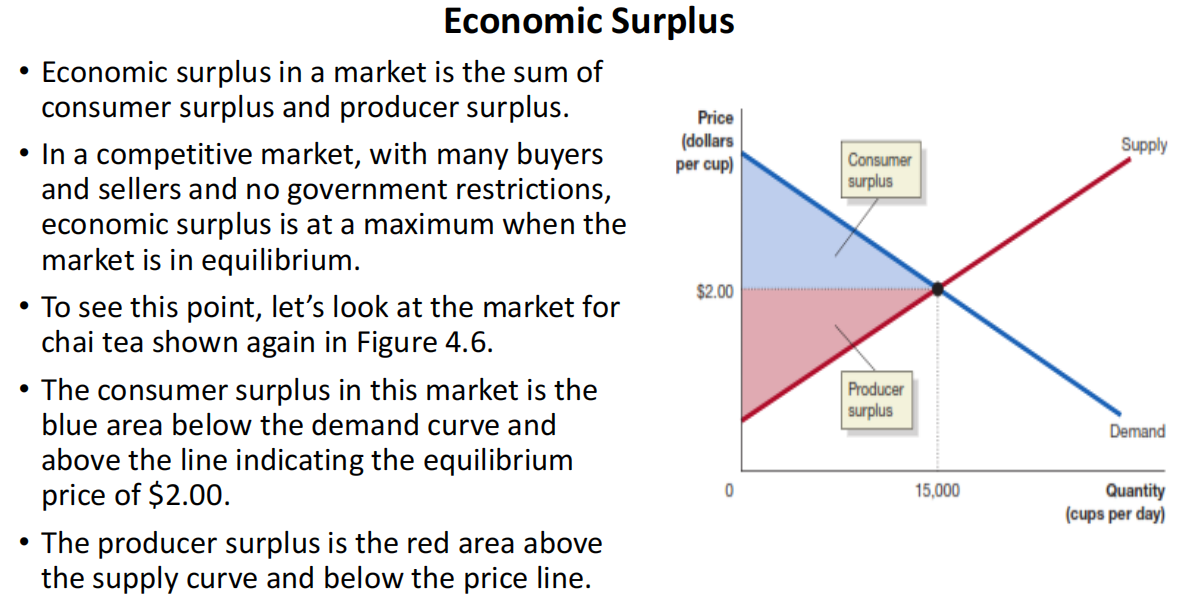
Economic surplus in a market is the sum of consumer surplus and producer surplus.
📖 点击查看译文
市场中的经济剩余是消费者剩余和生产者剩余的总和。
In a competitive market, with many buyers and sellers and no government restrictions, economic surplus is at a maximum when the market is in equilibrium.
📖 点击查看译文
在一个有众多买家和卖家且没有政府限制的竞争市场中,市场处于均衡时,经济剩余达到最大。
To see this point, let’s look at the market for chai tea shown again in Figure 4.6.
📖 点击查看译文
为了说明这一点,让我们再次观察图 4.6 所示的奶茶市场。
The consumer surplus in this market is the blue area below the demand curve and above the line indicating the equilibrium price of $2.00.
📖 点击查看译文
该市场中的消费者剩余是需求曲线下方、均衡价格 $2.00 以上的蓝色区域。
The producer surplus is the red area above the supply curve and below the price line.
📖 点击查看译文
生产者剩余是供给曲线上方、价格线以下的红色区域。
知识点列表与拓展 (Knowledge Points and Extensions):
1. Economic Surplus (经济剩余)
-
解释 (Explanation):
Economic surplus is the total benefit to society, calculated as the sum of consumer surplus and producer surplus.
(经济剩余是社会的总收益,计算方式是消费者剩余与生产者剩余的总和。)
-
例子 (Example):
If a product’s equilibrium price is $2.00, consumer surplus is represented by the area above this price but below the demand curve, while producer surplus is the area below the price but above the supply curve.
(如果某商品的均衡价格为 $2.00,消费者剩余是该价格上方但在需求曲线下方的区域,而生产者剩余是价格下方但在供给曲线上方的区域。)
-
拓展 (Extension):
Government interventions such as price controls, taxes, and subsidies can reduce economic surplus by creating inefficiencies in the market.
(政府干预,如价格控制、税收和补贴,会通过造成市场低效来减少经济剩余。)
2
Deadweight Loss (无谓损失)
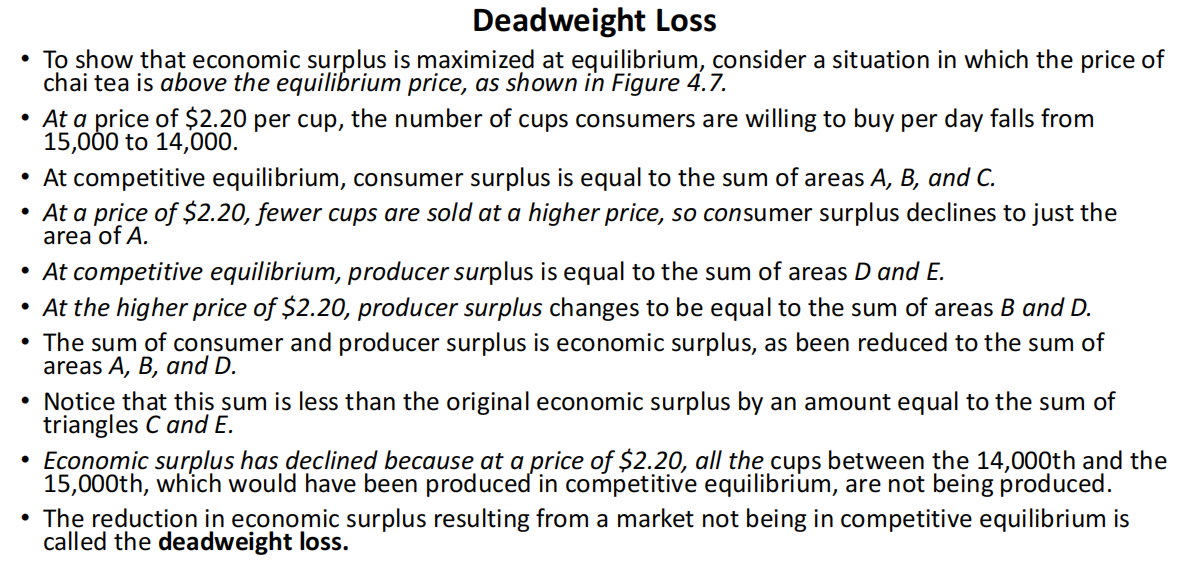
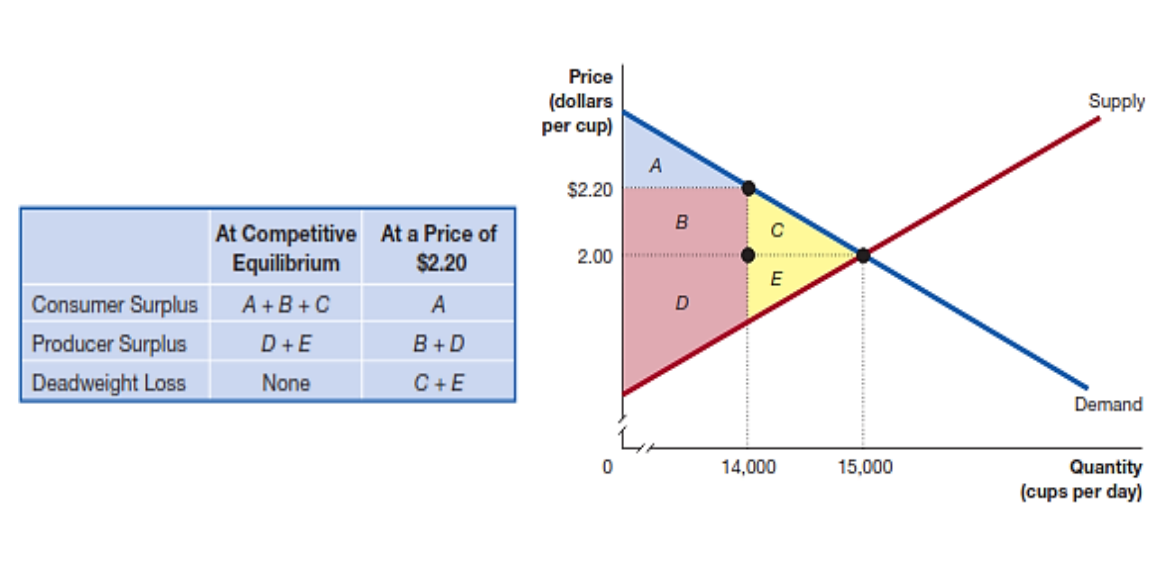
To show that economic surplus is maximized at equilibrium, consider a situation in which the price of chai tea is above the equilibrium price, as shown in Figure 4.7.
📖 点击查看译文
为了说明经济剩余在均衡时达到最大值,考虑一种情况,即奶茶的价格高于均衡价格,如图 4.7 所示。
At a price of $2.20 per cup, the number of cups consumers are willing to buy per day falls from 15,000 to 14,000.
📖 点击查看译文
当每杯价格为 $2.20 时,消费者每天愿意购买的杯数从 15,000 杯减少到 14,000 杯。
At competitive equilibrium, consumer surplus is equal to the sum of areas A, B, and C.
📖 点击查看译文
在竞争均衡状态下,消费者剩余等于 A、B 和 C 区域的总和。
At a price of $2.20, fewer cups are sold at a higher price, so consumer surplus declines to just the area of A.
📖 点击查看译文
当价格升至 $2.20 时,销售的杯数减少,价格上升,因此消费者剩余减少,仅剩 A 区域。
At competitive equilibrium, producer surplus is equal to the sum of areas D and E.
📖 点击查看译文
在竞争均衡状态下,生产者剩余等于 D 和 E 区域的总和。
At the higher price of $2.20, producer surplus changes to be equal to the sum of areas B and D.
📖 点击查看译文
当价格升至 $2.20 时,生产者剩余变为 B 和 D 区域的总和。
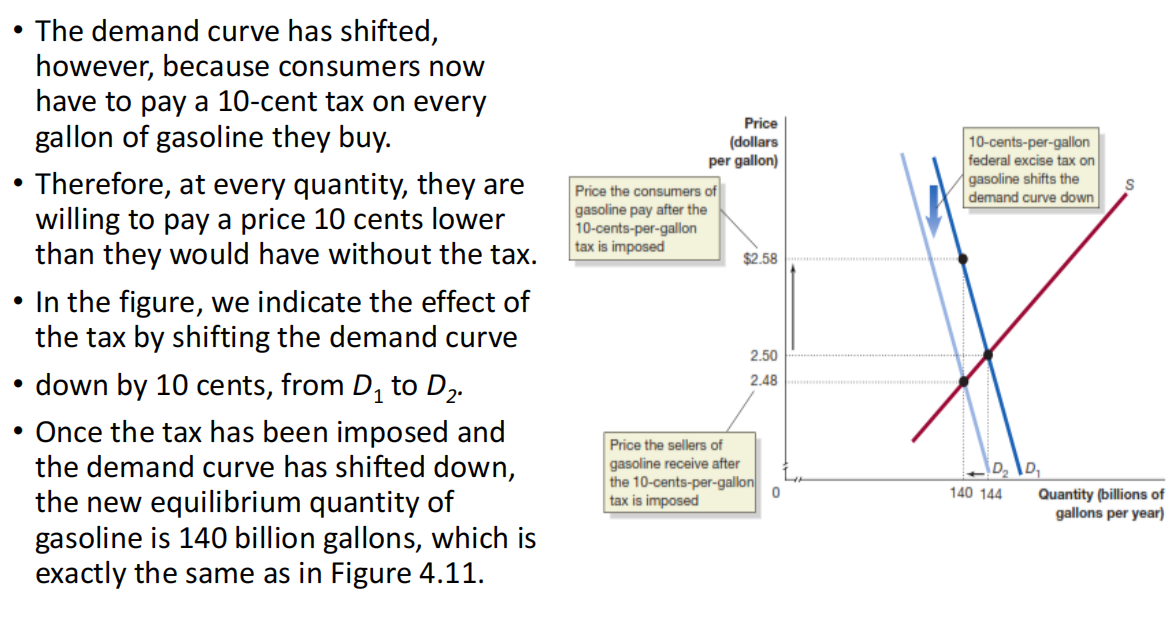
The sum of consumer and producer surplus is economic surplus, as been reduced to the sum of areas A, B, and D.
📖 点击查看译文
消费者剩余和生产者剩余之和构成经济剩余,其值减少至 A、B 和 D 区域的总和。
Notice that this sum is less than the original economic surplus by an amount equal to the sum of triangles C and E.
📖 点击查看译文
请注意,该总和比原始经济剩余少了 C 和 E 两个三角形区域的总和。
Economic surplus has declined because at a price of $2.20, all the cups between the 14,000th and the 15,000th, which would have been produced in competitive equilibrium, are not being produced.
📖 点击查看译文
经济剩余减少的原因是,当价格为 $2.20 时,原本在竞争均衡下会生产的 14,000 至 15,000 杯奶茶未被生产。
The reduction in economic surplus resulting from a market not being in competitive equilibrium is called the deadweight loss.
📖 点击查看译文
由于市场未处于竞争均衡状态导致经济剩余减少的部分,称为无谓损失。
知识点列表与拓展 (Knowledge Points and Extensions):
1. Deadweight Loss (无谓损失)
-
解释 (Explanation):
Deadweight loss is the loss of economic efficiency that occurs when the equilibrium outcome is not achieved due to market distortions, such as price controls, taxes, or monopolies.
(无谓损失是指由于市场扭曲(如价格管制、税收或垄断)导致均衡结果未能实现,从而造成的经济效率损失。)
-
例子 (Example):
If the government imposes a price floor above the equilibrium price, fewer transactions occur, leading to a loss of potential gains from trade, represented by deadweight loss.
(如果政府设定的价格下限高于均衡价格,交易量将减少,导致潜在交易收益损失,这部分损失即为无谓损失。)
-
拓展 (Extension):
Deadweight loss is a key concept in evaluating economic policies, as it highlights the inefficiencies caused by interventions such as taxation and subsidies.
(无谓损失是评估经济政策的重要概念,它揭示了税收、补贴等干预措施导致的低效问题。)
3
4
Government Intervention in the Market: Price Floors and Price Ceilings (政府对市场的干预:价格下限与价格上限)
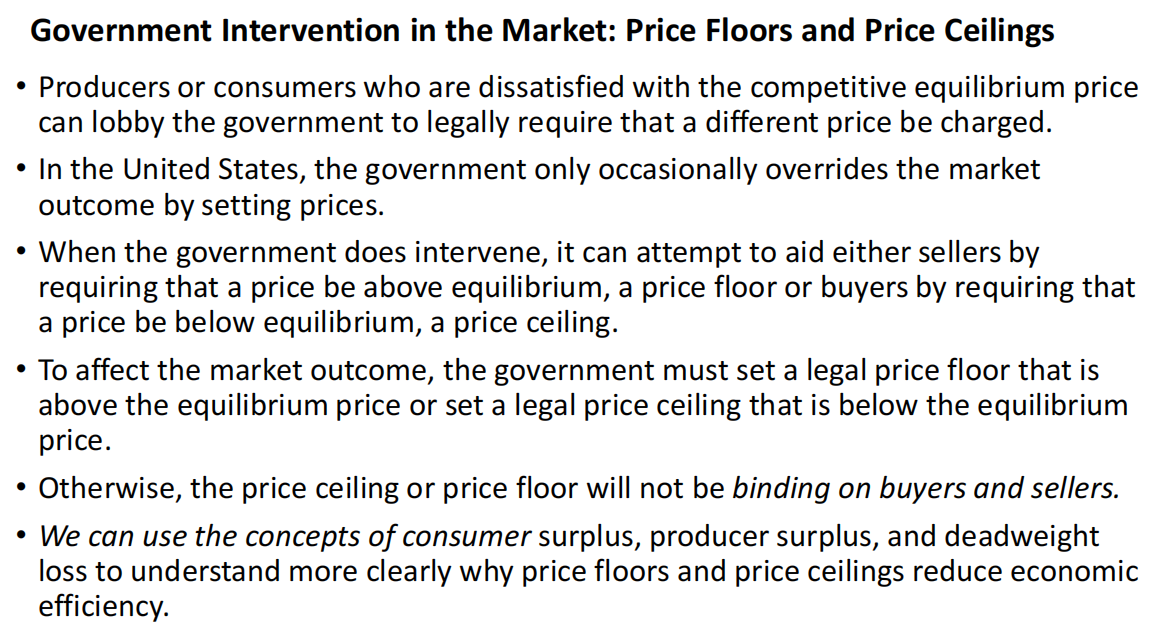
Producers or consumers who are dissatisfied with the competitive equilibrium price can lobby the government to legally require that a different price be charged.
📖 点击查看译文
对竞争均衡价格不满的生产者或消费者可以游说政府,要求法律规定不同的价格。
In the United States, the government only occasionally overrides the market outcome by setting prices.
📖 点击查看译文
在美国,政府只有在少数情况下才会通过设定价格来干预市场结果。
When the government does intervene, it can attempt to aid either sellers by requiring that a price be above equilibrium, a price floor, or buyers by requiring that a price be below equilibrium, a price ceiling.
📖 点击查看译文
当政府进行干预时,可以通过设定高于均衡价格的价格下限来帮助卖方,或通过设定低于均衡价格的价格上限来帮助买方。
To affect the market outcome, the government must set a legal price floor that is above the equilibrium price or set a legal price ceiling that is below the equilibrium price.
📖 点击查看译文
为了影响市场结果,政府必须设定高于均衡价格的法定价格下限,或设定低于均衡价格的法定价格上限。
Otherwise, the price ceiling or price floor will not be binding on buyers and sellers.
📖 点击查看译文
否则,价格上限或价格下限对买卖双方都不会产生约束力。
We can use the concepts of consumer surplus, producer surplus, and deadweight loss to understand more clearly why price floors and price ceilings reduce economic efficiency.
📖 点击查看译文
我们可以利用消费者剩余、生产者剩余和无谓损失的概念,更清楚地理解为什么价格下限和价格上限会降低经济效率。
知识点列表与拓展 (Knowledge Points and Extensions):
1. Price Floors and Price Ceilings (价格下限与价格上限)
-
解释 (Explanation):
A price floor is a minimum price set by the government, above the equilibrium price, to benefit producers. A price ceiling is a maximum price set below equilibrium to help consumers.
(价格下限是政府设定的最低价格,高于均衡价格,以保护生产者。价格上限是政府设定的最高价格,低于均衡价格,以帮助消费者。)
-
例子 (Example):
A minimum wage is an example of a price floor, as it sets a legal lower limit on wages. Rent control is an example of a price ceiling, as it limits how much landlords can charge tenants.
(最低工资是价格下限的例子,因为它规定了工资的最低合法水平。租金管制是价格上限的例子,因为它限制了房东向租户收取的租金。)
-
拓展 (Extension):
Price floors can lead to surpluses, such as excess labor supply (unemployment), while price ceilings can lead to shortages, such as housing shortages in rent-controlled areas.
(价格下限可能导致过剩,如劳动力供过于求(失业);价格上限可能导致短缺,如租金管制地区的住房短缺。)
5
Price Floors: Government Policy in Agricultural Markets (价格下限:政府在农业市场的政策)
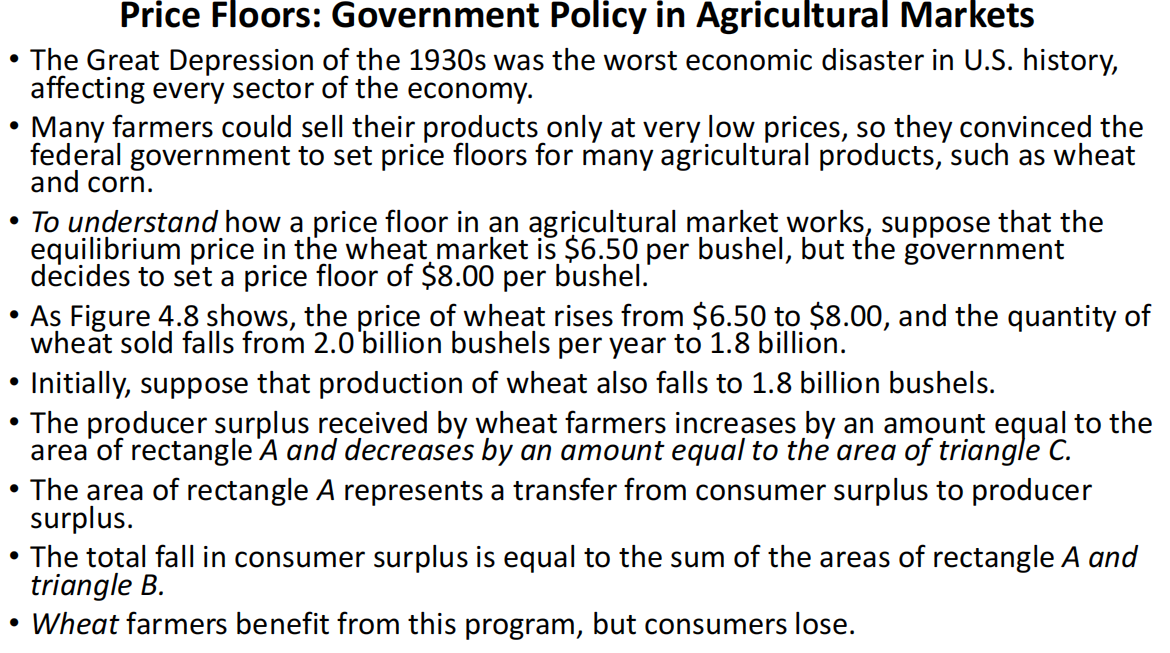
The Great Depression of the 1930s was the worst economic disaster in U.S. history, affecting every sector of the economy.
📖 点击查看译文
20世纪30年代的大萧条是美国历史上最严重的经济灾难,影响了经济的各个领域。
Many farmers could sell their products only at very low prices, so they convinced the federal government to set price floors for many agricultural products, such as wheat and corn.
📖 点击查看译文
许多农民只能以极低的价格出售他们的产品,因此他们说服联邦政府为小麦、玉米等农产品设定价格下限。
To understand how a price floor in an agricultural market works, suppose that the equilibrium price in the wheat market is 8.00 per bushel.
📖 点击查看译文
为了理解农业市场中的价格下限是如何运作的,假设小麦市场的均衡价格为每蒲式耳6.50美元,但政府决定设定价格下限为8.00美元。
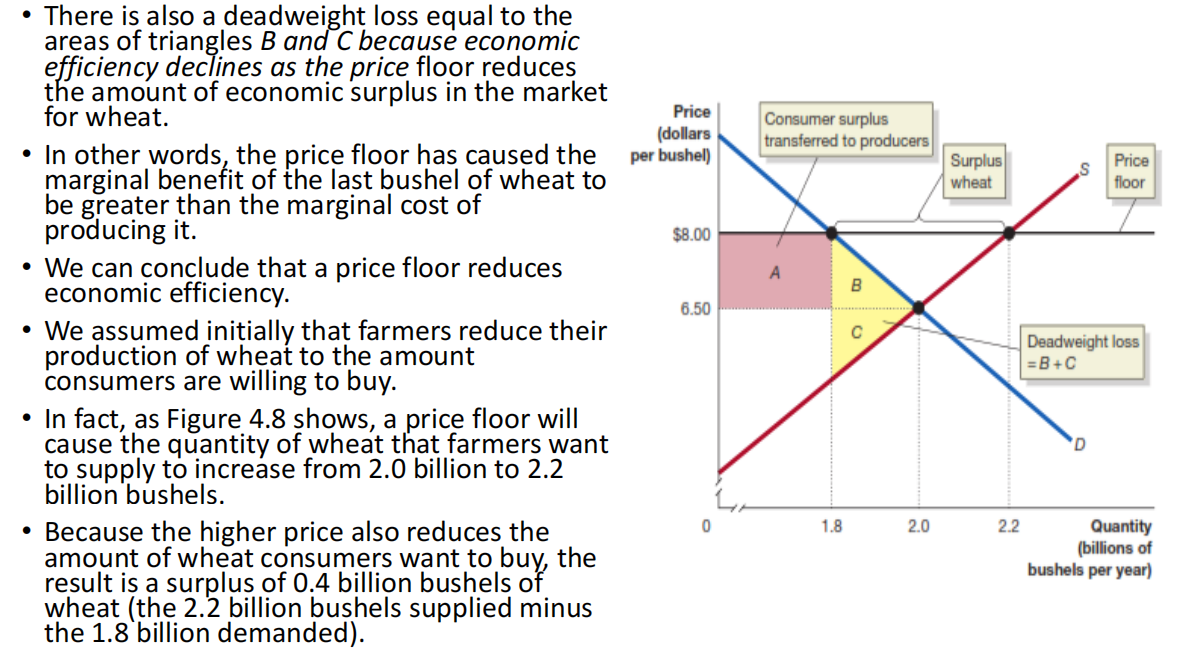
As Figure 4.8 shows, the price of wheat rises from 8.00, and the quantity of wheat sold falls from 2.0 billion bushels per year to 1.8 billion.
📖 点击查看译文
如图4.8所示,小麦价格从6.50美元上升到8.00美元,销售量从每年20亿蒲式耳减少到18亿蒲式耳。
Initially, suppose that production of wheat also falls to 1.8 billion bushels.
📖 点击查看译文
最初,假设小麦的产量也下降到18亿蒲式耳。
The producer surplus received by wheat farmers increases by an amount equal to the area of rectangle A and decreases by an amount equal to the area of triangle C.
📖 点击查看译文
小麦农民获得的生产者剩余增加的部分等于矩形A的面积,但减少的部分等于三角形C的面积。
The area of rectangle A represents a transfer from consumer surplus to producer surplus.
📖 点击查看译文
矩形A的面积代表了消费者剩余向生产者剩余的转移。
The total fall in consumer surplus is equal to the sum of the areas of rectangle A and triangle B.
📖 点击查看译文
消费者剩余的总减少量等于矩形A和三角形B的面积总和。
Wheat farmers benefit from this program, but consumers lose.
📖 点击查看译文
小麦农民从该政策中受益,但消费者遭受损失。
知识点列表与拓展 (Knowledge Points and Extensions):
1. Price Floors in Agricultural Markets (农业市场中的价格下限)
-
解释 (Explanation):
A price floor in agriculture is set above the market equilibrium price to ensure farmers receive a minimum income, but it often leads to surpluses.
(农业市场的价格下限被设定在均衡价格之上,以确保农民获得最低收入,但通常会导致供给过剩。)
-
例子 (Example):
Government subsidies for wheat and corn during the Great Depression established price floors that kept prices artificially high.
(大萧条时期,政府对小麦和玉米的补贴设定了价格下限,使价格维持在人为较高的水平。)
-
拓展 (Extension):
When a surplus occurs, governments may purchase excess supply, store it, or provide it as aid, but this can lead to inefficiencies and increased taxpayer burden.
(当出现供给过剩时,政府可能会购买过剩产品、储存它们或作为援助提供,但这可能导致低效并增加纳税人负担。)
6
Price Floors and Economic Efficiency (价格下限与经济效率)
There is also a deadweight loss equal to the areas of triangles B and C because economic efficiency declines as the price floor reduces the amount of economic surplus in the market for wheat.
📖 点击查看译文
由于价格下限减少了小麦市场中的经济剩余,导致经济效率下降,从而产生了等于三角形B和C面积的无谓损失。
In other words, the price floor has caused the marginal benefit of the last bushel of wheat to be greater than the marginal cost of producing it.
📖 点击查看译文
换句话说,价格下限导致最后一蒲式耳小麦的边际效益大于其生产的边际成本。
We can conclude that a price floor reduces economic efficiency.
📖 点击查看译文
我们可以得出结论,价格下限降低了经济效率。
We assumed initially that farmers reduce their production of wheat to the amount consumers are willing to buy.
📖 点击查看译文
我们最初假设农民将小麦产量减少到消费者愿意购买的数量。
In fact, as Figure 4.8 shows, a price floor will cause the quantity of wheat that farmers want to supply to increase from 2.0 billion to 2.2 billion bushels.
📖 点击查看译文
事实上,如图4.8所示,价格下限会导致农民希望供应的小麦数量从20亿蒲式耳增加到22亿蒲式耳。
Because the higher price also reduces the amount of wheat consumers want to buy, the result is a surplus of 0.4 billion bushels of wheat (the 2.2 billion bushels supplied minus the 1.8 billion demanded).
📖 点击查看译文
由于较高的价格减少了消费者想要购买的小麦数量,最终导致0.4亿蒲式耳的小麦过剩(22亿蒲式耳的供应量减去18亿蒲式耳的需求量)。
知识点列表与拓展 (Knowledge Points and Extensions):
1. Deadweight Loss from Price Floors (价格下限导致的无谓损失)
-
解释 (Explanation):
A price floor above equilibrium reduces total economic surplus, creating deadweight loss by preventing mutually beneficial transactions.
(高于均衡价格的价格下限会减少总经济剩余,阻止互惠交易,从而导致无谓损失。)
-
例子 (Example):
If the government sets a minimum wage above the market rate, some workers who would have been employed at the lower wage may lose their jobs, leading to deadweight loss.
(如果政府设定的最低工资高于市场工资,一些原本可以以较低工资就业的工人可能失业,造成无谓损失。)
-
拓展 (Extension):
Deadweight loss analysis applies to other government interventions, such as price ceilings and taxation, where artificial constraints lead to inefficiencies.
(无谓损失的分析适用于其他政府干预措施,如价格上限和税收,因为人为限制会导致低效。)
7
Price Ceilings and Rent Control (价格上限与房租管制)
Support for governments setting price floors typically comes from sellers, and support for governments setting price ceilings typically comes from consumers.
📖 点击查看译文
支持政府设定价格下限的通常是卖方,而支持政府设定价格上限的通常是消费者。
For example, when there is a sharp increase in gasoline prices, proposals are often made for the government to impose a price ceiling on the market for gasoline.
📖 点击查看译文
例如,当汽油价格大幅上涨时,政府通常会被提议对汽油市场设定价格上限。
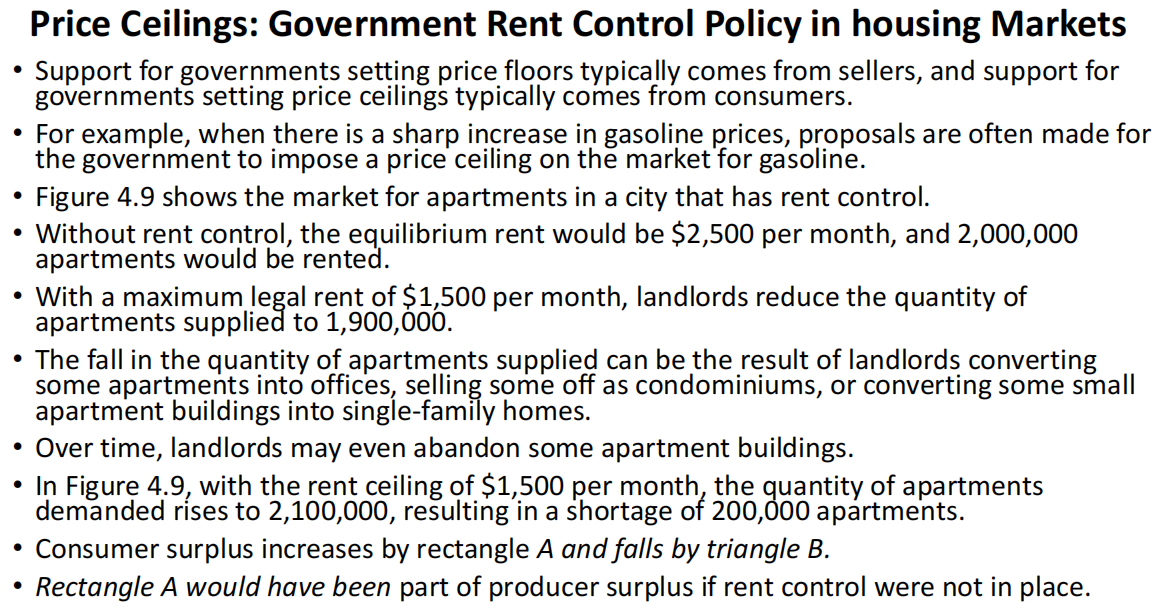
Figure 4.9 shows the market for apartments in a city that has rent control.
📖 点击查看译文
图4.9显示了一个实施房租管制的城市的公寓市场。
Without rent control, the equilibrium rent would be $2,500 per month, and 2,000,000 apartments would be rented.
📖 点击查看译文
如果没有房租管制,均衡租金将是每月2500美元,租赁公寓的数量为200万套。
With a maximum legal rent of $1,500 per month, landlords reduce the quantity of apartments supplied to 1,900,000.
📖 点击查看译文
在每月1500美元的最高合法租金下,房东减少了公寓的供应量至190万套。
The fall in the quantity of apartments supplied can be the result of landlords converting some apartments into offices, selling some off as condominiums, or converting some small apartment buildings into single-family homes.
📖 点击查看译文
公寓供应量的减少可能是因为房东将部分公寓改造成办公空间,出售为公寓单元,或将一些小型公寓楼改造成独栋住宅。
Over time, landlords may even abandon some apartment buildings.
📖 点击查看译文
随着时间推移,房东甚至可能会放弃一些公寓楼。
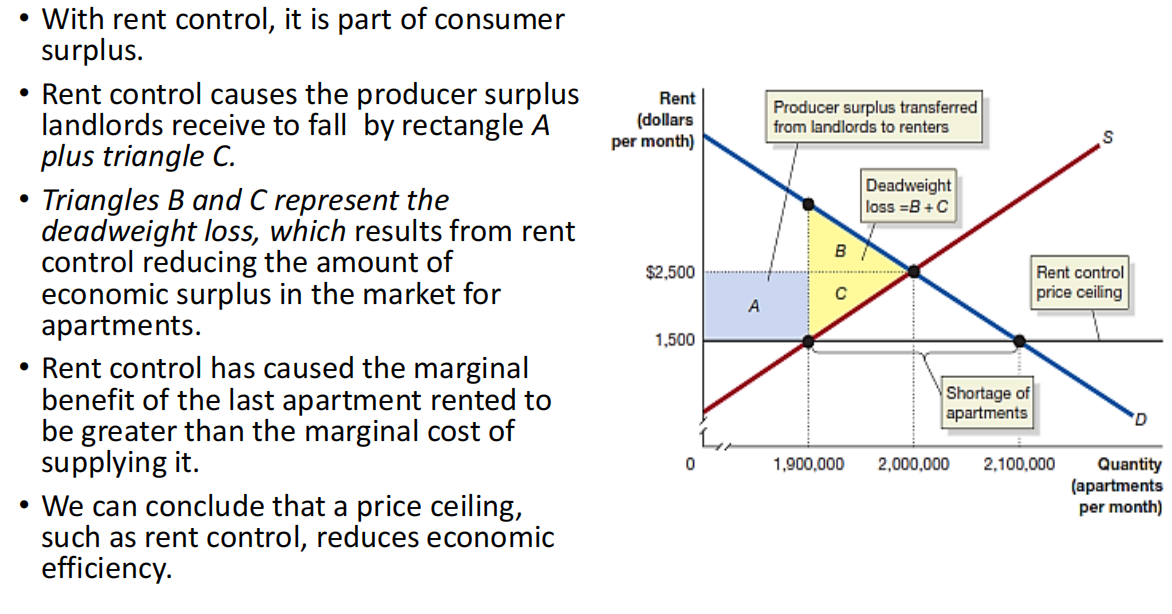
In Figure 4.9, with the rent ceiling of $1,500 per month, the quantity of apartments demanded rises to 2,100,000, resulting in a shortage of 200,000 apartments.
📖 点击查看译文
在图4.9中,房租上限为每月1500美元时,公寓需求量上升至210万套,导致20万套公寓短缺。
Consumer surplus increases by rectangle A and falls by triangle B.
📖 点击查看译文
消费者剩余因矩形A而增加,同时因三角形B而减少。
Rectangle A would have been part of producer surplus if rent control were not in place.
📖 点击查看译文
如果没有房租管制,矩形A本应属于生产者剩余的一部分。
知识点列表与拓展 (Knowledge Points and Extensions):
1. Rent Control and Market Shortages (房租管制与市场短缺)
-
解释 (Explanation):
A price ceiling set below the equilibrium rent leads to a shortage of rental housing as demand increases while supply decreases.
(低于均衡租金的价格上限会导致租赁住房短缺,因为需求增加而供应减少。)
-
例子 (Example):
Cities like New York and San Francisco have rent control policies that lead to lower rental prices but also reduced availability of apartments.
(纽约和旧金山等城市的房租管制政策降低了租金价格,但也减少了公寓供应。)
-
拓展 (Extension):
Rent control may lead to black markets where landlords charge illegal fees, reduce maintenance efforts, or convert properties into alternative uses.
(房租管制可能导致黑市交易,房东收取非法费用,减少维护,或将房产转换为其他用途。)
8
Effects of Rent Control (房租管制的影响)
With rent control, it is part of consumer surplus.
📖 点击查看译文
在房租管制下,这部分属于消费者剩余。
Rent control causes the producer surplus landlords receive to fall by rectangle A plus triangle C.
📖 点击查看译文
房租管制导致房东获得的生产者剩余减少,减少部分为矩形A加上三角形C。
Triangles B and C represent the deadweight loss, which results from rent control reducing the amount of economic surplus in the market for apartments.
📖 点击查看译文
三角形B和C代表无谓损失,这是由于房租管制减少了公寓市场的经济剩余所导致的。
Rent control has caused the marginal benefit of the last apartment rented to be greater than the marginal cost of supplying it.
📖 点击查看译文
房租管制导致最后出租的公寓的边际收益大于其供应的边际成本。
We can conclude that a price ceiling, such as rent control, reduces economic efficiency.
📖 点击查看译文
我们可以得出结论,价格上限(如房租管制)会降低经济效率。
知识点列表与拓展 (Knowledge Points and Extensions):
1. Deadweight Loss from Rent Control (房租管制导致的无谓损失)
-
解释 (Explanation):
Rent control prevents the market from reaching equilibrium, causing a deadweight loss by reducing economic surplus.
(房租管制阻碍市场达到均衡,减少经济剩余,造成无谓损失。)
-
例子 (Example):
In cities with strict rent control, such as Stockholm, Sweden, long waiting lists exist for apartments, sometimes exceeding a decade.
(在瑞典斯德哥尔摩等实施严格房租管制的城市,公寓等待名单可能长达十年以上。)
-
拓展 (Extension):
Some cities implement alternative policies, such as rent subsidies or housing vouchers, to mitigate the negative effects of rent control.
(一些城市采用租金补贴或住房券等替代政策,以减少房租管制的负面影响。)
9
The Results of Government Price Controls (政府价格管制的结果)
1. Some people win.
📖 点击查看译文
1. 一些人获益。
The winners from rent control are the people who are paying less for rent because they live in rent-controlled apartments.
📖 点击查看译文
房租管制的受益者是那些因居住在受管制公寓中而支付较低房租的人。
Landlords may also gain if they break the law by charging rents above the legal maximum for their rent-controlled apartments, provided that those illegal rents are higher than the competitive equilibrium rents would be.
📖 点击查看译文
如果房东违法向租户收取高于法定上限的房租,并且这些非法房租高于竞争均衡房租,他们也可能受益。
2. Some people lose.
📖 点击查看译文
2. 一些人受损。
The losers from rent control are the landlords of rent-controlled apartments who abide by the law and renters who are unable to find apartments to rent at the controlled price.
📖 点击查看译文
房租管制的受害者是那些遵守法律的房东,以及无法以管制价格找到公寓出租的租客。
3. There is a loss of economic efficiency.
📖 点击查看译文
3. 经济效率降低。
Rent control reduces economic efficiency because fewer apartments are rented than would be rented in a competitive market (as per Figure 4.9).
📖 点击查看译文
房租管制降低了经济效率,因为出租的公寓数量少于竞争市场中的数量(如图4.9所示)。
The resulting deadweight loss measures the decrease in economic efficiency.
📖 点击查看译文
由此产生的无谓损失衡量了经济效率的下降。
知识点列表与拓展 (Knowledge Points and Extensions):
1. Price Controls and Black Markets (价格管制与黑市)
-
解释 (Explanation):
When the government enforces price controls, black markets may emerge where goods and services are sold at illegal prices.
(当政府实施价格管制时,可能会出现黑市,商品和服务在非法价格下交易。)
-
例子 (Example):
In cities with strict rent control, tenants may pay additional under-the-table fees to secure rental contracts.
(在实行严格房租管制的城市,租客可能会支付额外的私下费用以获取租赁合同。)
-
拓展 (Extension):
Some governments attempt to curb black markets by increasing enforcement efforts or providing subsidies to affected parties.
(一些政府通过加强执法或提供补贴来遏制黑市交易。)
10
The Economic Effect of Taxes (税收的经济影响)
The Effect of Taxes on Economic Efficiency (税收对经济效率的影响)
1. Whenever a government taxes a good or service, less of that good or service will be produced and consumed.
📖 点击查看译文
每当政府对某种商品或服务征税,该商品或服务的生产和消费都会减少。
2. For example, a tax on cigarettes will raise the cost of smoking and reduce the amount of smoking that takes place.
📖 点击查看译文
例如,对香烟征税会提高吸烟的成本,并减少吸烟的数量。
3. We can use a demand and supply graph to illustrate this point.
📖 点击查看译文
我们可以使用供需图来说明这一点。
4. Figure 4.10 shows the market for cigarettes.
📖 点击查看译文
图 4.10 显示了香烟市场。
5. Without the tax, the equilibrium price of cigarettes would be $5.00 per pack, and 4 billion packs of cigarettes would be sold per year (point A).
📖 点击查看译文
如果没有税收,香烟的均衡价格将为每包 5.00 美元,每年售出 40 亿包(点 A)。
6. If the federal government requires sellers of cigarettes to pay a 1.00 per pack.
📖 点击查看译文
如果联邦政府要求香烟销售商每包支付 1.00 美元的税款,那么他们销售香烟的成本将增加 1.00 美元。
7. This increase in cost causes the supply curve for cigarettes to shift up by 1.00 greater to supply the same quantity of cigarettes.
📖 点击查看译文
这一成本增加导致香烟的供给曲线上移 1.00 美元,因为销售商现在需要更高 1.00 美元的价格才能供应相同数量的香烟。
8. In Figure 4.10, the supply curve shifts up by 5.90 and a new equilibrium quantity of 3.7 billion packs (point B).
📖 点击查看译文
在图 4.10 中,供给曲线上移 1.00 美元以显示税收的影响,并形成新的均衡价格 5.90 美元,以及新的均衡数量 37 亿包(点 B)。
知识点列表与拓展 (Knowledge Points and Extensions):
1. Tax Incidence (税收归宿)
-
解释 (Explanation):
Tax incidence refers to how the burden of a tax is shared between buyers and sellers.
(税收归宿指税收负担在买方和卖方之间的分配方式。)
-
例子 (Example):
If the demand for cigarettes is inelastic, consumers will bear most of the tax burden.
(如果香烟的需求缺乏弹性,消费者将承担大部分税收负担。)
-
拓展 (Extension):
Governments often impose higher taxes on inelastic goods like tobacco to generate revenue with minimal quantity reduction.
(政府通常对缺乏弹性的商品(如烟草)征收较高的税,以在减少数量最小的情况下增加收入。)
11
The Economic Effect of Taxes (税收的经济影响)
The Effect of Taxes on Economic Efficiency (税收对经济效率的影响)
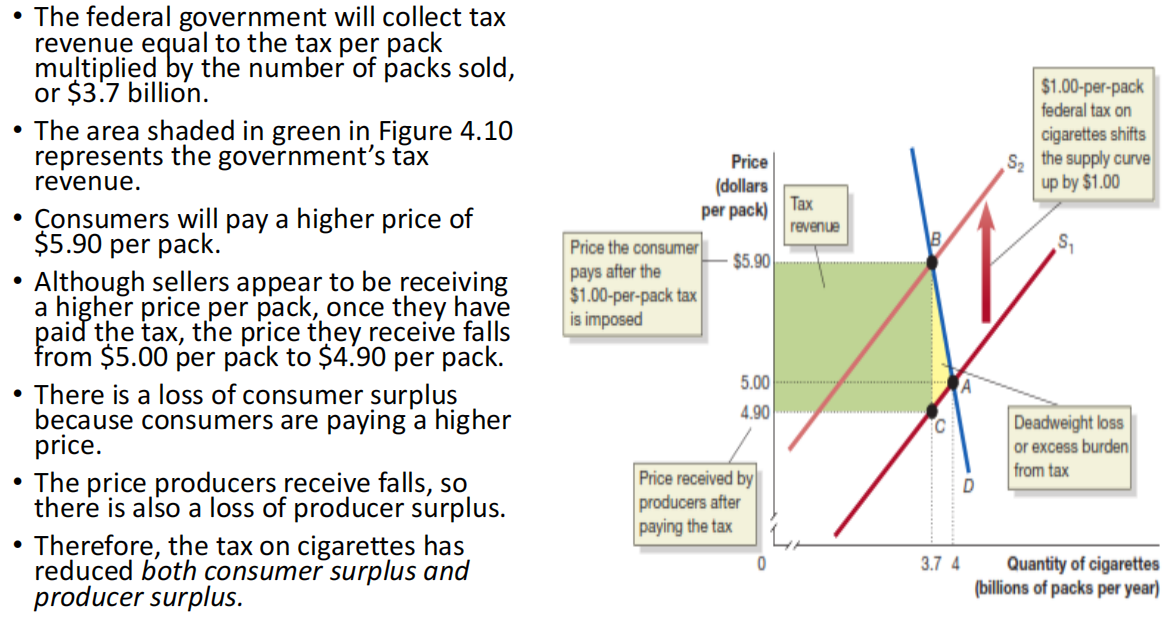
9. The federal government will collect tax revenue equal to the tax per pack multiplied by the number of packs sold, or $3.7 billion.
📖 点击查看译文
联邦政府将获得的税收收入等于每包香烟的税额乘以售出的香烟数量,总计 37 亿美元。
10. The area shaded in green in Figure 4.10 represents the government’s tax revenue.
📖 点击查看译文
图 4.10 中绿色阴影区域表示政府的税收收入。
11. Consumers will pay a higher price of $5.90 per pack.
📖 点击查看译文
消费者将支付更高的价格,每包 5.90 美元。
12. Although sellers appear to be receiving a higher price per pack, once they have paid the tax, the price they receive falls from 4.90 per pack.
📖 点击查看译文
尽管卖家表面上每包获得了更高的价格,但在支付税款后,他们实际获得的价格从 5.00 美元降至 4.90 美元。
13. There is a loss of consumer surplus because consumers are paying a higher price.
📖 点击查看译文
由于消费者支付了更高的价格,消费者剩余减少。
14. The price producers receive falls, so there is also a loss of producer surplus.
📖 点击查看译文
由于生产者获得的价格降低,生产者剩余也减少。
15. Therefore, the tax on cigarettes has reduced both consumer surplus and producer surplus.
📖 点击查看译文
因此,对香烟的税收减少了消费者剩余和生产者剩余。
知识点列表与拓展 (Knowledge Points and Extensions):
2. Deadweight Loss of Taxation (税收的无谓损失)
-
解释 (Explanation):
Taxes create a deadweight loss by reducing the quantity of goods exchanged in the market.
(税收通过减少市场中交换的商品数量,造成无谓损失。)
-
例子 (Example):
In the cigarette market, the tax reduces the equilibrium quantity from 4 billion packs to 3.7 billion packs, leading to inefficiency.
(在香烟市场中,税收将均衡数量从 40 亿包减少到 37 亿包,导致市场低效。)
-
拓展 (Extension):
Deadweight loss is larger when demand or supply is more elastic, meaning consumers and producers can more easily adjust to price changes.
(当需求或供给更具弹性时,无谓损失更大,因为消费者和生产者更容易对价格变化做出调整。)
12
The Economic Effect of Taxes (税收的经济影响)
The Effect of Taxes on Economic Efficiency (税收对经济效率的影响)
16. Some of the reduction in consumer and producer surplus becomes tax revenue for the government.
📖 点击查看译文
消费者和生产者剩余的减少部分转化为政府的税收收入。
17. The rest of the reduction in consumer and producer surplus is equal to the deadweight loss from the tax, shown by the yellow-shaded triangle in the figure.
📖 点击查看译文
消费者和生产者剩余的其余减少部分等于税收造成的无谓损失,在图中由黄色阴影三角形表示。
18. We can conclude that the true burden of a tax is not just the amount consumers and producers pay the government but also includes the deadweight loss.
📖 点击查看译文
可以得出结论,税收的真正负担不仅是消费者和生产者支付给政府的金额,还包括无谓损失。
19. The deadweight loss from a tax is referred to as the excess burden of the tax.
📖 点击查看译文
税收的无谓损失被称为税收的超额负担。
20. A tax is efficient if it imposes a small excess burden relative to the tax revenue it raises.
📖 点击查看译文
如果税收产生的超额负担相对于其带来的税收收入较小,则该税收是高效的。
21. One contribution economists make to government tax policy is to advise policymakers on which taxes are most efficient.
📖 点击查看译文
经济学家对政府税收政策的一项贡献是向决策者提供建议,指出哪些税收是最有效率的。
知识点列表与拓展 (Knowledge Points and Extensions):
3. Tax Efficiency and Excess Burden (税收效率与超额负担)
-
解释 (Explanation):
Taxes create deadweight loss, which is the lost economic surplus due to market distortions.
(税收产生无谓损失,即市场扭曲导致的经济剩余损失。)
-
例子 (Example):
If a cigarette tax raises 1 billion deadweight loss, the tax may not be fully efficient.
(如果香烟税带来了 37 亿美元的收入,但造成 10 亿美元的无谓损失,则该税收可能并不完全高效。)
-
拓展 (Extension):
Economists often suggest taxing goods with inelastic demand (like gasoline) because they generate revenue with minimal economic distortion.
(经济学家通常建议对需求缺乏弹性的商品(如汽油)征税,因为这类税收能在最小的经济扭曲下获得收入。)
13
Tax Incidence and Economic Burden (税收归宿与经济负担)
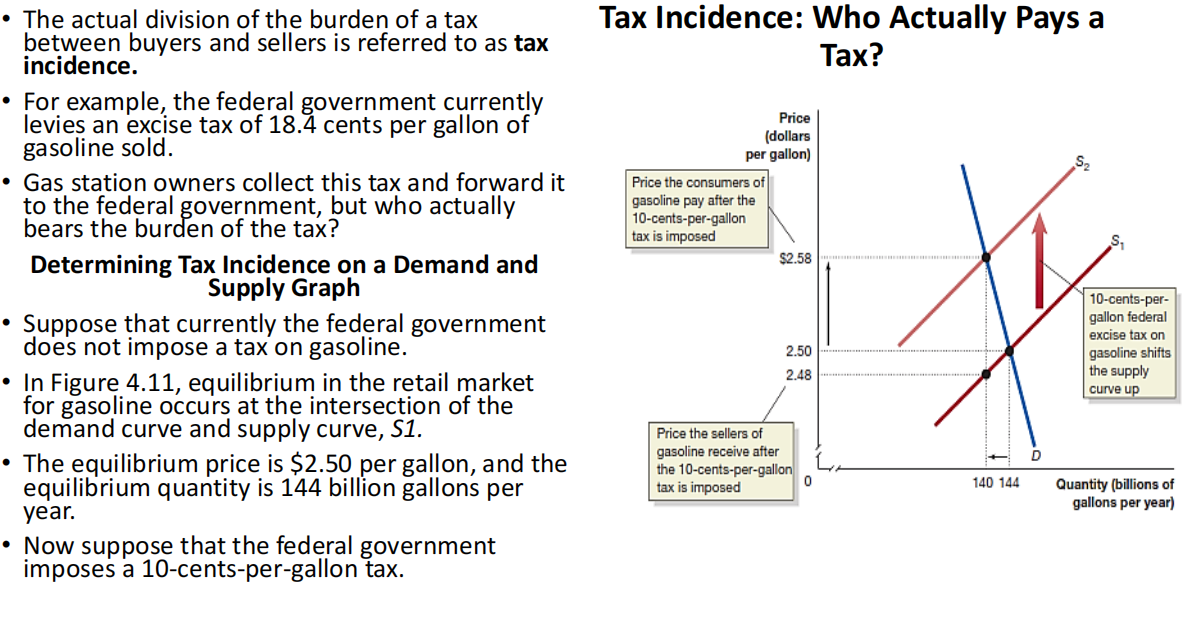
22. The actual division of the burden of a tax between buyers and sellers is referred to as tax incidence.
📖 点击查看译文
税收负担在买方和卖方之间的实际分配称为税收归宿。
23. For example, the federal government currently levies an excise tax of 18.4 cents per gallon of gasoline sold.
📖 点击查看译文
例如,联邦政府目前对每加仑汽油征收 18.4 美分的消费税。
24. Gas station owners collect this tax and forward it to the federal government, but who actually bears the burden of the tax?
📖 点击查看译文
加油站老板收取这笔税款并上交联邦政府,但究竟谁真正承担了这笔税收的负担呢?
Determining Tax Incidence on a Demand and Supply Graph (在供需图上确定税收归宿)
25. Suppose that currently the federal government does not impose a tax on gasoline.
📖 点击查看译文
假设目前联邦政府不对汽油征税。
26. In Figure 4.11, equilibrium in the retail market for gasoline occurs at the intersection of the demand curve and supply curve, S1.
📖 点击查看译文
在图 4.11 中,汽油零售市场的均衡点位于需求曲线和供给曲线 S1 的交点。
27. The equilibrium price is $2.50 per gallon, and the equilibrium quantity is 144 billion gallons per year.
📖 点击查看译文
均衡价格为每加仑 2.50 美元,均衡数量为每年 1440 亿加仑。
28. Now suppose that the federal government imposes a 10-cents-per-gallon tax.
📖 点击查看译文
现在假设联邦政府对每加仑汽油征收 10 美分的税。
知识点列表与拓展 (Knowledge Points and Extensions):
4. Tax Incidence and Elasticity (税收归宿与弹性)
-
解释 (Explanation):
Tax incidence depends on the relative price elasticities of demand and supply.
==(税收归宿取决于需求和供给的相对价格弹性。)==
-
例子 (Example):
If gasoline demand is inelastic, consumers bear most of the tax burden; if elastic, producers bear more.
==(如果汽油需求缺乏弹性,消费者将承担大部分税收负担;如果有弹性,生产商承受更多。)==
-
拓展 (Extension):
Governments often tax goods with inelastic demand (e.g., tobacco, gasoline) because they generate stable revenue with minimal quantity reduction.
(政府通常对需求缺乏弹性的商品(如烟草、汽油)征税,因为这些商品能在数量减少较小的情况下产生稳定的税收收入。)
14
Tax Incidence and Market Price Adjustment (税收归宿与市场价格调整)
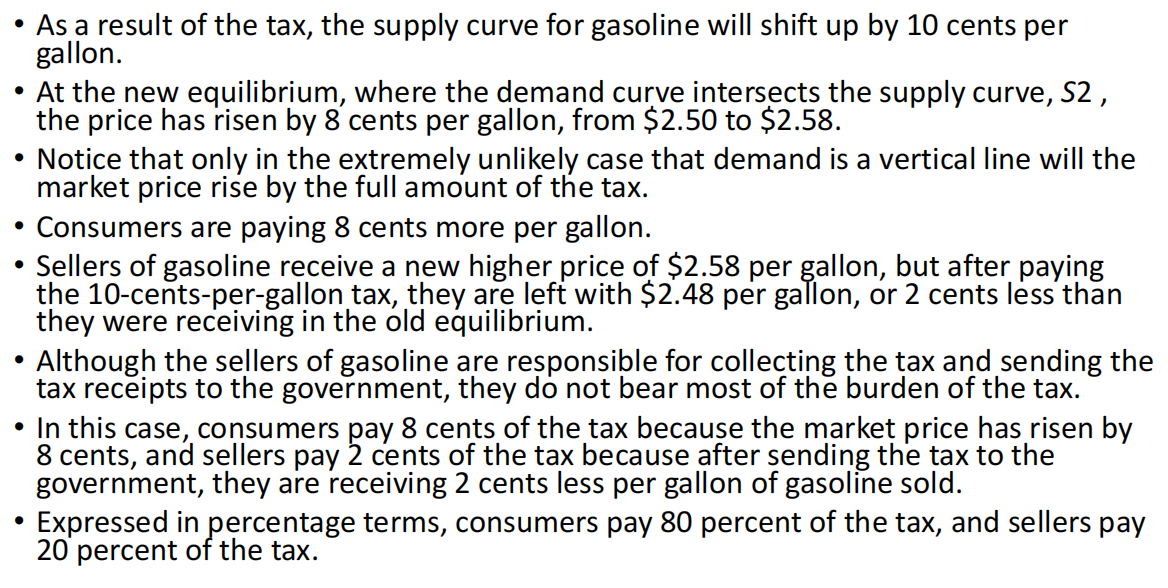
29. As a result of the tax, the supply curve for gasoline will shift up by 10 cents per gallon.
📖 点击查看译文
由于税收的影响,汽油的供给曲线将上移 10 美分/加仑。
30. At the new equilibrium, where the demand curve intersects the supply curve, S2, the price has risen by 8 cents per gallon, from 2.58.
📖 点击查看译文
在新的均衡点,需求曲线与供给曲线 S2 相交,价格上涨了 8 美分/加仑,从 2.50 美元上升到 2.58 美元。
31. Notice that only in the extremely unlikely case that demand is a vertical line will the market price rise by the full amount of the tax.
📖 点击查看译文
请注意,只有在需求曲线完全垂直的极端情况下,市场价格才会完全上升与税收相等的金额。
32. Consumers are paying 8 cents more per gallon.
📖 点击查看译文
消费者每加仑汽油多支付 8 美分。
33. Sellers of gasoline receive a new higher price of 2.48 per gallon, or 2 cents less than they were receiving in the old equilibrium.
📖 点击查看译文
汽油卖方收到的新价格是 2.58 美元/加仑,但支付 10 美分/加仑的税后,他们实际得到 2.48 美元/加仑,比原来的均衡价格少 2 美分。
34. Although the sellers of gasoline are responsible for collecting the tax and sending the tax receipts to the government, they do not bear most of the burden of the tax.
📖 点击查看译文
尽管汽油卖方负责收取税款并将税款上交政府,但他们并未承担大部分税负。
35. In this case, consumers pay 8 cents of the tax because the market price has risen by 8 cents, and sellers pay 2 cents of the tax because after sending the tax to the government, they are receiving 2 cents less per gallon of gasoline sold.
📖 点击查看译文
在这种情况下,消费者承担 8 美分的税负,因为市场价格上涨了 8 美分;卖方承担 2 美分的税负,因为他们在缴税后,每加仑汽油的收入减少了 2 美分。
36. Expressed in percentage terms, consumers pay 80 percent of the tax, and sellers pay 20 percent of the tax.
📖 点击查看译文
按百分比计算,消费者承担 80% 的税负,卖方承担 20% 的税负。
知识点列表与拓展 (Knowledge Points and Extensions):
5. Elasticity and Tax Burden Distribution (弹性与税负分配)
-
解释 (Explanation):
The more inelastic the demand, the more of the tax burden consumers bear.
(需求越缺乏弹性,消费者承担的税负比例越大。)
-
例子 (Example):
Gasoline demand is relatively inelastic because consumers still need fuel for transportation, so they bear most of the tax burden.
(汽油需求相对缺乏弹性,因为消费者仍然需要燃料用于交通,因此他们承担大部分税负。)
-
拓展 (Extension):
Governments use tax incidence analysis to determine which goods to tax more heavily to maximize revenue while minimizing economic distortions.
(政府利用税收归宿分析来决定对哪些商品征收较高的税,以最大化税收收入并最小化经济扭曲。)
15
Consumer Tax Burden in Sales Tax Increases (销售税增加时消费者的税负分配)
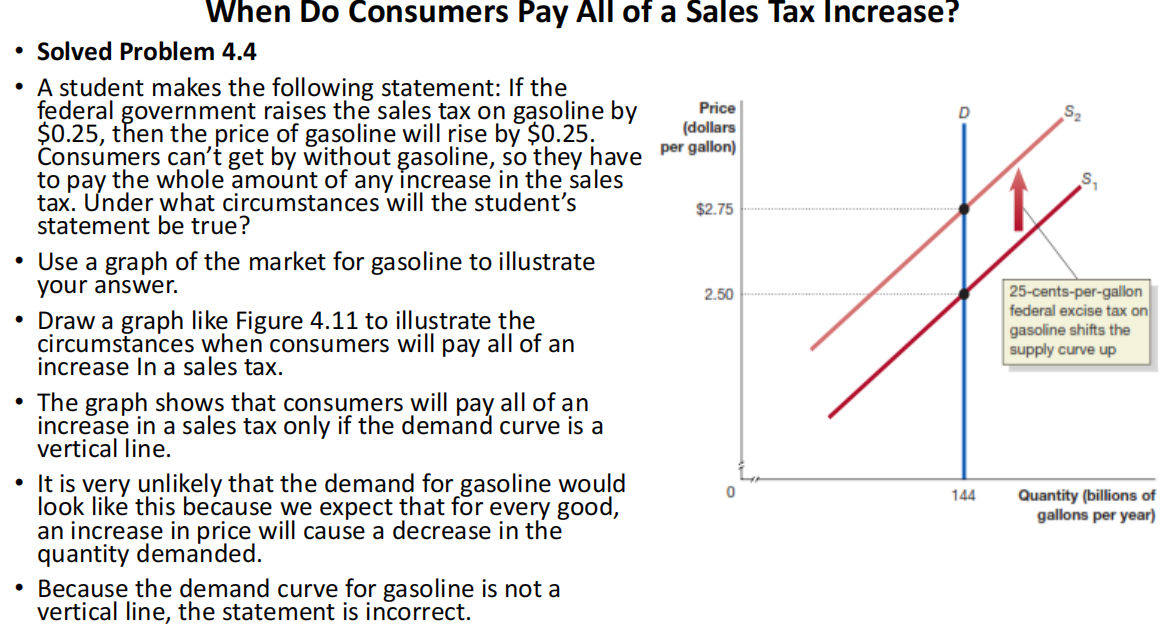
37. A student makes the following statement: If the federal government raises the sales tax on gasoline by 0.25. Consumers can’t get by without gasoline, so they have to pay the whole amount of any increase in the sales tax. Under what circumstances will the student’s statement be true?
📖 点击查看译文
一名学生提出以下观点:如果联邦政府将汽油的销售税提高 0.25 美元,那么汽油价格将上涨 0.25 美元。消费者无法离开汽油,因此必须承担所有的销售税增加额。在什么情况下,这一说法才成立?
38. Use a graph of the market for gasoline to illustrate your answer.
📖 点击查看译文
使用汽油市场的供需图来说明你的答案。
39. Draw a graph like Figure 4.11 to illustrate the circumstances when consumers will pay all of an increase in a sales tax.
📖 点击查看译文
绘制类似于图 4.11 的图表,说明消费者完全承担销售税增加的情况。
40. The graph shows that consumers will pay all of an increase in a sales tax only if the demand curve is a vertical line.
📖 点击查看译文
该图表显示,只有当需求曲线是一条垂直线时,消费者才会承担销售税增加的全部成本。
41. It is very unlikely that the demand for gasoline would look like this because we expect that for every good, an increase in price will cause a decrease in the quantity demanded.
📖 点击查看译文
汽油的需求曲线极不可能呈现垂直形态,因为对于任何商品而言,价格上涨都会导致需求量减少。
42. Because the demand curve for gasoline is not a vertical line, the statement is incorrect.
📖 点击查看译文
由于汽油的需求曲线不是垂直的,因此该观点是不正确的。
知识点列表与拓展 (Knowledge Points and Extensions):
6. Demand Elasticity and Full Tax Burden (需求弹性与税收负担分配)
-
解释 (Explanation):
If demand is perfectly inelastic (vertical demand curve), consumers bear the full tax burden.
(如果需求是完全无弹性的(需求曲线垂直),消费者将承担全部税负。)
-
例子 (Example):
Life-saving medications often have highly inelastic demand, meaning consumers bear almost all of the tax burden.
(救命药品的需求通常是高度无弹性的,这意味着消费者承担几乎所有的税负。)
-
拓展 (Extension):
Policymakers consider demand elasticity when designing tax policies to predict tax burden distribution.
(政策制定者在设计税收政策时会考虑需求弹性,以预测税负的分配情况。)
16
Tax Collection from Buyers vs. Sellers (买方与卖方缴税的区别)
43. We have already seen the important distinction between who is legally required to pay a tax and who actually bears the burden of a tax.
📖 点击查看译文
我们已经看到,法律上规定谁需要缴税与谁真正承担税负之间存在重要区别。
44. We can reinforce this point by noting explicitly that the incidence of a tax does not depend on whether the government collects a tax from the buyers of a good or from the sellers.
📖 点击查看译文
我们可以进一步强调,税负的分配并不取决于政府向买方还是卖方征税。
45. Figure 4.12 illustrates this point by showing the effect on equilibrium in the market for gasoline if a 10-cents-per-gallon tax is imposed on buyers rather than on sellers.
📖 点击查看译文
图 4.12 说明了这一点,展示了如果每加仑 10 美分的汽油税由买方而非卖方支付,对市场均衡的影响。
46. That is, we are now assuming that instead of sellers having to collect the 10-cents-per-gallon tax at the pump, buyers are responsible for keeping track of how many gallons of gasoline they purchase and sending the tax to the government.
📖 点击查看译文
也就是说,我们现在假设,由买方负责记录其购买的汽油量并向政府缴纳 10 美分的汽油税,而不是由卖方在加油站代收。
47. (Of course, it would be very difficult for buyers to keep track of their purchases or for the government to check whether they were paying all of the taxes they owe.)
📖 点击查看译文
(当然,买方很难准确记录其购买的汽油量,政府也难以核查他们是否缴纳了全部税款。)
48. That is why the government collects the tax on gasoline from sellers.
📖 点击查看译文
这就是政府向卖方征收汽油税的原因。
49. Figure 4.12 is similar to Figure 4.11 except that it shows the gasoline tax being imposed on buyers rather than on sellers.
📖 点击查看译文
图 4.12 与图 4.11 类似,但它显示的是买方缴纳汽油税的情况,而不是卖方。
50. In Figure 4.12, the supply curve does not shift because nothing has happened to change the quantity of gasoline sellers are willing to supply at any given price.
📖 点击查看译文
在图 4.12 中,供应曲线没有发生变化,因为卖方在任何给定价格下愿意供应的汽油数量没有改变。
知识点列表与拓展 (Knowledge Points and Extensions):
7. Tax Incidence and Economic Efficiency (税收归宿与经济效率)
-
解释 (Explanation):
The tax burden distribution is determined by relative demand and supply elasticities, not by who formally pays the tax.
(税负的分配取决于需求与供给的相对弹性,而不是由谁在形式上支付税款决定。)
-
例子 (Example):
Payroll taxes are often shared between employers and employees, regardless of who remits them to the government.
(工资税通常由雇主和雇员共同承担,无论谁向政府缴纳税款。)
-
拓展 (Extension):
Governments typically tax sellers for administrative convenience, but the true burden still depends on market conditions.
(政府通常向卖方征税以方便管理,但实际税负仍取决于市场状况。)
17
Tax Impact on Demand Curve (税收对需求曲线的影响)
51. The demand curve has shifted, however, because consumers now have to pay a 10-cent tax on every gallon of gasoline they buy.
📖 点击查看译文
然而,需求曲线发生了变化,因为消费者现在需要为每加仑汽油支付 10 美分的税款。
52. Therefore, at every quantity, they are willing to pay a price 10 cents lower than they would have without the tax.
📖 点击查看译文
因此,在每一个数量水平上,消费者愿意支付的价格比没有税收时低 10 美分。
53. In the figure, we indicate the effect of the tax by shifting the demand curve down by 10 cents, from D1 to D2.
📖 点击查看译文
在图中,我们通过将需求曲线从 D1 下移 10 美分至 D2 来表示税收的影响。
54. Once the tax has been imposed and the demand curve has shifted down, the new equilibrium quantity of gasoline is 140 billion gallons, which is exactly the same as in Figure 4.11.
📖 点击查看译文
一旦税收实施并导致需求曲线下移,新的汽油均衡数量为 1400 亿加仑,这与图 4.11 完全相同。
知识点列表与拓展 (Knowledge Points and Extensions):
8. Demand Curve Shift Due to Taxes (税收导致的需求曲线移动)
-
解释 (Explanation):
A tax on buyers effectively reduces their willingness to pay, shifting the demand curve downward.
(对买方征税会降低他们的支付意愿,从而导致需求曲线向下移动。)
-
例子 (Example):
A sales tax on electronics reduces the effective price consumers are willing to pay, shifting the demand curve lower.
(电子产品的销售税降低了消费者愿意支付的有效价格,使需求曲线下移。)
-
拓展 (Extension):
Whether the tax is imposed on buyers or sellers, the economic outcome remains the same as long as market conditions do not change.
(无论税收针对买方还是卖方,只要市场条件不变,最终的经济结果是相同的。)
18
Tax and Equilibrium Price Comparison (税收与均衡价格对比)
55. The new equilibrium price after the tax is imposed appears to be different in Figure 4.12 than in Figure 4.11, but if we include the tax, buyers will pay the same price and sellers will receive the same price in both figures.
📖 点击查看译文
在税收实施后,图 4.12 的新均衡价格似乎与图 4.11 不同,但如果考虑税收,买家支付的总价格和卖家收到的价格在两幅图中是相同的。
56. To see this point, notice that in Figure 4.11, buyers pay sellers a price of $2.58 per gallon.
📖 点击查看译文
为了说明这一点,请注意在图 4.11 中,买家向卖家支付的汽油价格为每加仑 2.58 美元。
57. In Figure 4.12, they pay sellers only $2.48, but they must also pay the government a tax of 10 cents per gallon.
📖 点击查看译文
在图 4.12 中,买家仅向卖家支付 2.48 美元,但还需向政府支付每加仑 10 美分的税款。
58. So, the total price buyers pay remains $2.58 per gallon.
📖 点击查看译文
因此,买家支付的总价格仍然是每加仑 2.58 美元。
59. In Figure 4.11, sellers receive 2.48, which is the same amount they receive in Figure 4.12.
📖 点击查看译文
在图 4.11 中,卖家从买家处收到每加仑 2.58 美元,但在支付 10 美分的税款后,他们实际获得的价格是 2.48 美元,这与图 4.12 中的情况相同。
知识点列表与拓展 (Knowledge Points and Extensions):
9. Tax Incidence and Price Consistency (税收归宿与价格一致性)
-
解释 (Explanation):
The final economic burden of the tax does not depend on whether it is collected from buyers or sellers; the market adjusts accordingly.
(税收的最终经济负担不取决于税收是向买方还是卖方征收,市场会自动调整。)
-
例子 (Example):
A sales tax on soft drinks, whether collected from manufacturers or consumers, results in the same price structure.
(软饮料的销售税,无论是由制造商支付还是由消费者支付,最终的价格结构是相同的。)
-
拓展 (Extension):
Governments often collect taxes from sellers for administrative convenience, even though the tax incidence is shared between buyers and sellers.
(政府通常从卖方征税以简化管理流程,尽管税收负担由买卖双方共同承担。)
19
Rent Control and Its Economic Impact (租金管制及其经济影响)
60. If you and the other city council members vote to enact a rent control law, is it likely that in the future it will be easier for renters to find an affordable apartment in your city?
📖 点击查看译文
如果你和其他市议会成员投票通过租金管制法,将来租房者在你的城市更容易找到可负担的公寓吗?
61. Who in your city would benefit, and who would lose from this law?
📖 点击查看译文
在你的城市中,谁会从这项法律中受益,谁会因此受损?
62. This chapter has shown that although rent control can keep rents lower than they might otherwise be, it can also lead to a permanent shortage of apartments.
📖 点击查看译文
本章表明,尽管租金管制可以使租金低于市场水平,但它也可能导致长期的公寓短缺。
63. Renters may have to search for a long time to find a suitable apartment, and landlords may even ask renters to make additional payments, in violation of the rent control law, which would make the actual rent paid higher than the controlled rent.
📖 点击查看译文
租房者可能需要花费更长时间寻找合适的公寓,而房东甚至可能要求租房者支付额外费用,违反租金管制法,从而使实际支付的租金高于受控租金。
64. Finding an apartment in a city after enactment of rent control will typically be more difficult.
📖 点击查看译文
在实施租金管制后,通常会更难在城市中找到公寓。
65. People who are able to find an apartment at the controlled rent will benefit if the city council enacts the law, while landlords and renters who are unable to find an apartment at the controlled rent will lose.
📖 点击查看译文
如果市议会通过该法律,能够以受控租金租到公寓的人将受益,而无法找到公寓的房东和租客将受损。
66. As the chapter also notes, whether rent control should be enacted is a normative question—one that you and the rest of the city council will have to answer.
📖 点击查看译文
正如本章所指出的,是否应实行租金管制是一个规范性问题——你和市议会的其他成员需要作出决策。
知识点列表与拓展 (Knowledge Points and Extensions):
10. Effects of Rent Control (租金管制的影响)
-
解释 (Explanation):
Rent control leads to artificially lower rental prices but also creates shortages and inefficiencies.
(租金管制使租金被人为压低,但也导致住房短缺和市场低效。)
-
例子 (Example):
New York City’s rent control laws have kept some rental prices low but led to a decline in housing supply.
(纽约市的租金管制法使部分房租保持低水平,但导致住房供应下降。)
-
拓展 (Extension):
Some economists suggest rent subsidies or housing vouchers as alternatives to rent control to avoid shortages.
(一些经济学家建议使用租金补贴或住房券作为租金管制的替代方案,以避免住房短缺。)
📖 点击查看译文
消费者剩余因矩形A而增加,同时因三角形B而减少。
Rectangle A would have been part of producer surplus if rent control were not in place.
📖 点击查看译文
如果没有房租管制,矩形A本应属于生产者剩余的一部分。
知识点列表与拓展 (Knowledge Points and Extensions):
1. Rent Control and Market Shortages (房租管制与市场短缺)
-
解释 (Explanation):
A price ceiling set below the equilibrium rent leads to a shortage of rental housing as demand increases while supply decreases.
(低于均衡租金的价格上限会导致租赁住房短缺,因为需求增加而供应减少。)
-
例子 (Example):
Cities like New York and San Francisco have rent control policies that lead to lower rental prices but also reduced availability of apartments.
(纽约和旧金山等城市的房租管制政策降低了租金价格,但也减少了公寓供应。)
-
拓展 (Extension):
Rent control may lead to black markets where landlords charge illegal fees, reduce maintenance efforts, or convert properties into alternative uses.
(房租管制可能导致黑市交易,房东收取非法费用,减少维护,或将房产转换为其他用途。)
8

Effects of Rent Control (房租管制的影响)
With rent control, it is part of consumer surplus.
📖 点击查看译文
在房租管制下,这部分属于消费者剩余。
Rent control causes the producer surplus landlords receive to fall by rectangle A plus triangle C.
📖 点击查看译文
房租管制导致房东获得的生产者剩余减少,减少部分为矩形A加上三角形C。
Triangles B and C represent the deadweight loss, which results from rent control reducing the amount of economic surplus in the market for apartments.
📖 点击查看译文
三角形B和C代表无谓损失,这是由于房租管制减少了公寓市场的经济剩余所导致的。
Rent control has caused the marginal benefit of the last apartment rented to be greater than the marginal cost of supplying it.
📖 点击查看译文
房租管制导致最后出租的公寓的边际收益大于其供应的边际成本。
We can conclude that a price ceiling, such as rent control, reduces economic efficiency.
📖 点击查看译文
我们可以得出结论,价格上限(如房租管制)会降低经济效率。
知识点列表与拓展 (Knowledge Points and Extensions):
1. Deadweight Loss from Rent Control (房租管制导致的无谓损失)
-
解释 (Explanation):
Rent control prevents the market from reaching equilibrium, causing a deadweight loss by reducing economic surplus.
(房租管制阻碍市场达到均衡,减少经济剩余,造成无谓损失。)
-
例子 (Example):
In cities with strict rent control, such as Stockholm, Sweden, long waiting lists exist for apartments, sometimes exceeding a decade.
(在瑞典斯德哥尔摩等实施严格房租管制的城市,公寓等待名单可能长达十年以上。)
-
拓展 (Extension):
Some cities implement alternative policies, such as rent subsidies or housing vouchers, to mitigate the negative effects of rent control.
(一些城市采用租金补贴或住房券等替代政策,以减少房租管制的负面影响。)
9

The Results of Government Price Controls (政府价格管制的结果)
1. Some people win.
📖 点击查看译文
1. 一些人获益。
The winners from rent control are the people who are paying less for rent because they live in rent-controlled apartments.
📖 点击查看译文
房租管制的受益者是那些因居住在受管制公寓中而支付较低房租的人。
Landlords may also gain if they break the law by charging rents above the legal maximum for their rent-controlled apartments, provided that those illegal rents are higher than the competitive equilibrium rents would be.
📖 点击查看译文
如果房东违法向租户收取高于法定上限的房租,并且这些非法房租高于竞争均衡房租,他们也可能受益。
2. Some people lose.
📖 点击查看译文
2. 一些人受损。
The losers from rent control are the landlords of rent-controlled apartments who abide by the law and renters who are unable to find apartments to rent at the controlled price.
📖 点击查看译文
房租管制的受害者是那些遵守法律的房东,以及无法以管制价格找到公寓出租的租客。
3. There is a loss of economic efficiency.
📖 点击查看译文
3. 经济效率降低。
Rent control reduces economic efficiency because fewer apartments are rented than would be rented in a competitive market (as per Figure 4.9).
📖 点击查看译文
房租管制降低了经济效率,因为出租的公寓数量少于竞争市场中的数量(如图4.9所示)。
The resulting deadweight loss measures the decrease in economic efficiency.
📖 点击查看译文
由此产生的无谓损失衡量了经济效率的下降。
知识点列表与拓展 (Knowledge Points and Extensions):
1. Price Controls and Black Markets (价格管制与黑市)
-
解释 (Explanation):
When the government enforces price controls, black markets may emerge where goods and services are sold at illegal prices.
(当政府实施价格管制时,可能会出现黑市,商品和服务在非法价格下交易。)
-
例子 (Example):
In cities with strict rent control, tenants may pay additional under-the-table fees to secure rental contracts.
(在实行严格房租管制的城市,租客可能会支付额外的私下费用以获取租赁合同。)
-
拓展 (Extension):
Some governments attempt to curb black markets by increasing enforcement efforts or providing subsidies to affected parties.
(一些政府通过加强执法或提供补贴来遏制黑市交易。)
10

The Economic Effect of Taxes (税收的经济影响)
The Effect of Taxes on Economic Efficiency (税收对经济效率的影响)
1. Whenever a government taxes a good or service, less of that good or service will be produced and consumed.
📖 点击查看译文
每当政府对某种商品或服务征税,该商品或服务的生产和消费都会减少。
2. For example, a tax on cigarettes will raise the cost of smoking and reduce the amount of smoking that takes place.
📖 点击查看译文
例如,对香烟征税会提高吸烟的成本,并减少吸烟的数量。
3. We can use a demand and supply graph to illustrate this point.
📖 点击查看译文
我们可以使用供需图来说明这一点。
4. Figure 4.10 shows the market for cigarettes.
📖 点击查看译文
图 4.10 显示了香烟市场。
5. Without the tax, the equilibrium price of cigarettes would be $5.00 per pack, and 4 billion packs of cigarettes would be sold per year (point A).
📖 点击查看译文
如果没有税收,香烟的均衡价格将为每包 5.00 美元,每年售出 40 亿包(点 A)。
6. If the federal government requires sellers of cigarettes to pay a 1.00 per pack.
📖 点击查看译文
如果联邦政府要求香烟销售商每包支付 1.00 美元的税款,那么他们销售香烟的成本将增加 1.00 美元。
7. This increase in cost causes the supply curve for cigarettes to shift up by 1.00 greater to supply the same quantity of cigarettes.
📖 点击查看译文
这一成本增加导致香烟的供给曲线上移 1.00 美元,因为销售商现在需要更高 1.00 美元的价格才能供应相同数量的香烟。
8. In Figure 4.10, the supply curve shifts up by 5.90 and a new equilibrium quantity of 3.7 billion packs (point B).
📖 点击查看译文
在图 4.10 中,供给曲线上移 1.00 美元以显示税收的影响,并形成新的均衡价格 5.90 美元,以及新的均衡数量 37 亿包(点 B)。
知识点列表与拓展 (Knowledge Points and Extensions):
1. Tax Incidence (税收归宿)
-
解释 (Explanation):
Tax incidence refers to how the burden of a tax is shared between buyers and sellers.
(税收归宿指税收负担在买方和卖方之间的分配方式。)
-
例子 (Example):
If the demand for cigarettes is inelastic, consumers will bear most of the tax burden.
(如果香烟的需求缺乏弹性,消费者将承担大部分税收负担。)
-
拓展 (Extension):
Governments often impose higher taxes on inelastic goods like tobacco to generate revenue with minimal quantity reduction.
(政府通常对缺乏弹性的商品(如烟草)征收较高的税,以在减少数量最小的情况下增加收入。)
11

The Economic Effect of Taxes (税收的经济影响)
The Effect of Taxes on Economic Efficiency (税收对经济效率的影响)
9. The federal government will collect tax revenue equal to the tax per pack multiplied by the number of packs sold, or $3.7 billion.
📖 点击查看译文
联邦政府将获得的税收收入等于每包香烟的税额乘以售出的香烟数量,总计 37 亿美元。
10. The area shaded in green in Figure 4.10 represents the government’s tax revenue.
📖 点击查看译文
图 4.10 中绿色阴影区域表示政府的税收收入。
11. Consumers will pay a higher price of $5.90 per pack.
📖 点击查看译文
消费者将支付更高的价格,每包 5.90 美元。
12. Although sellers appear to be receiving a higher price per pack, once they have paid the tax, the price they receive falls from 4.90 per pack.
📖 点击查看译文
尽管卖家表面上每包获得了更高的价格,但在支付税款后,他们实际获得的价格从 5.00 美元降至 4.90 美元。
13. There is a loss of consumer surplus because consumers are paying a higher price.
📖 点击查看译文
由于消费者支付了更高的价格,消费者剩余减少。
14. The price producers receive falls, so there is also a loss of producer surplus.
📖 点击查看译文
由于生产者获得的价格降低,生产者剩余也减少。
15. Therefore, the tax on cigarettes has reduced both consumer surplus and producer surplus.
📖 点击查看译文
因此,对香烟的税收减少了消费者剩余和生产者剩余。
知识点列表与拓展 (Knowledge Points and Extensions):
2. Deadweight Loss of Taxation (税收的无谓损失)
-
解释 (Explanation):
Taxes create a deadweight loss by reducing the quantity of goods exchanged in the market.
(税收通过减少市场中交换的商品数量,造成无谓损失。)
-
例子 (Example):
In the cigarette market, the tax reduces the equilibrium quantity from 4 billion packs to 3.7 billion packs, leading to inefficiency.
(在香烟市场中,税收将均衡数量从 40 亿包减少到 37 亿包,导致市场低效。)
-
拓展 (Extension):
Deadweight loss is larger when demand or supply is more elastic, meaning consumers and producers can more easily adjust to price changes.
(当需求或供给更具弹性时,无谓损失更大,因为消费者和生产者更容易对价格变化做出调整。)
12

The Economic Effect of Taxes (税收的经济影响)
The Effect of Taxes on Economic Efficiency (税收对经济效率的影响)
16. Some of the reduction in consumer and producer surplus becomes tax revenue for the government.
📖 点击查看译文
消费者和生产者剩余的减少部分转化为政府的税收收入。
17. The rest of the reduction in consumer and producer surplus is equal to the deadweight loss from the tax, shown by the yellow-shaded triangle in the figure.
📖 点击查看译文
消费者和生产者剩余的其余减少部分等于税收造成的无谓损失,在图中由黄色阴影三角形表示。
18. We can conclude that the true burden of a tax is not just the amount consumers and producers pay the government but also includes the deadweight loss.
📖 点击查看译文
可以得出结论,税收的真正负担不仅是消费者和生产者支付给政府的金额,还包括无谓损失。
19. The deadweight loss from a tax is referred to as the excess burden of the tax.
📖 点击查看译文
税收的无谓损失被称为税收的超额负担。
20. A tax is efficient if it imposes a small excess burden relative to the tax revenue it raises.
📖 点击查看译文
如果税收产生的超额负担相对于其带来的税收收入较小,则该税收是高效的。
21. One contribution economists make to government tax policy is to advise policymakers on which taxes are most efficient.
📖 点击查看译文
经济学家对政府税收政策的一项贡献是向决策者提供建议,指出哪些税收是最有效率的。
知识点列表与拓展 (Knowledge Points and Extensions):
3. Tax Efficiency and Excess Burden (税收效率与超额负担)
-
解释 (Explanation):
Taxes create deadweight loss, which is the lost economic surplus due to market distortions.
(税收产生无谓损失,即市场扭曲导致的经济剩余损失。)
-
例子 (Example):
If a cigarette tax raises 1 billion deadweight loss, the tax may not be fully efficient.
(如果香烟税带来了 37 亿美元的收入,但造成 10 亿美元的无谓损失,则该税收可能并不完全高效。)
-
拓展 (Extension):
Economists often suggest taxing goods with inelastic demand (like gasoline) because they generate revenue with minimal economic distortion.
(经济学家通常建议对需求缺乏弹性的商品(如汽油)征税,因为这类税收能在最小的经济扭曲下获得收入。)
13

Tax Incidence and Economic Burden (税收归宿与经济负担)
22. The actual division of the burden of a tax between buyers and sellers is referred to as tax incidence.
📖 点击查看译文
税收负担在买方和卖方之间的实际分配称为税收归宿。
23. For example, the federal government currently levies an excise tax of 18.4 cents per gallon of gasoline sold.
📖 点击查看译文
例如,联邦政府目前对每加仑汽油征收 18.4 美分的消费税。
24. Gas station owners collect this tax and forward it to the federal government, but who actually bears the burden of the tax?
📖 点击查看译文
加油站老板收取这笔税款并上交联邦政府,但究竟谁真正承担了这笔税收的负担呢?
Determining Tax Incidence on a Demand and Supply Graph (在供需图上确定税收归宿)
25. Suppose that currently the federal government does not impose a tax on gasoline.
📖 点击查看译文
假设目前联邦政府不对汽油征税。
26. In Figure 4.11, equilibrium in the retail market for gasoline occurs at the intersection of the demand curve and supply curve, S1.
📖 点击查看译文
在图 4.11 中,汽油零售市场的均衡点位于需求曲线和供给曲线 S1 的交点。
27. The equilibrium price is $2.50 per gallon, and the equilibrium quantity is 144 billion gallons per year.
📖 点击查看译文
均衡价格为每加仑 2.50 美元,均衡数量为每年 1440 亿加仑。
28. Now suppose that the federal government imposes a 10-cents-per-gallon tax.
📖 点击查看译文
现在假设联邦政府对每加仑汽油征收 10 美分的税。
知识点列表与拓展 (Knowledge Points and Extensions):
4. Tax Incidence and Elasticity (税收归宿与弹性)
-
解释 (Explanation):
Tax incidence depends on the relative price elasticities of demand and supply.
==(税收归宿取决于需求和供给的相对价格弹性。)==
-
例子 (Example):
If gasoline demand is inelastic, consumers bear most of the tax burden; if elastic, producers bear more.
==(如果汽油需求缺乏弹性,消费者将承担大部分税收负担;如果有弹性,生产商承受更多。)==
-
拓展 (Extension):
Governments often tax goods with inelastic demand (e.g., tobacco, gasoline) because they generate stable revenue with minimal quantity reduction.
(政府通常对需求缺乏弹性的商品(如烟草、汽油)征税,因为这些商品能在数量减少较小的情况下产生稳定的税收收入。)
14

Tax Incidence and Market Price Adjustment (税收归宿与市场价格调整)
29. As a result of the tax, the supply curve for gasoline will shift up by 10 cents per gallon.
📖 点击查看译文
由于税收的影响,汽油的供给曲线将上移 10 美分/加仑。
30. At the new equilibrium, where the demand curve intersects the supply curve, S2, the price has risen by 8 cents per gallon, from 2.58.
📖 点击查看译文
在新的均衡点,需求曲线与供给曲线 S2 相交,价格上涨了 8 美分/加仑,从 2.50 美元上升到 2.58 美元。
31. Notice that only in the extremely unlikely case that demand is a vertical line will the market price rise by the full amount of the tax.
📖 点击查看译文
请注意,只有在需求曲线完全垂直的极端情况下,市场价格才会完全上升与税收相等的金额。
32. Consumers are paying 8 cents more per gallon.
📖 点击查看译文
消费者每加仑汽油多支付 8 美分。
33. Sellers of gasoline receive a new higher price of 2.48 per gallon, or 2 cents less than they were receiving in the old equilibrium.
📖 点击查看译文
汽油卖方收到的新价格是 2.58 美元/加仑,但支付 10 美分/加仑的税后,他们实际得到 2.48 美元/加仑,比原来的均衡价格少 2 美分。
34. Although the sellers of gasoline are responsible for collecting the tax and sending the tax receipts to the government, they do not bear most of the burden of the tax.
📖 点击查看译文
尽管汽油卖方负责收取税款并将税款上交政府,但他们并未承担大部分税负。
35. In this case, consumers pay 8 cents of the tax because the market price has risen by 8 cents, and sellers pay 2 cents of the tax because after sending the tax to the government, they are receiving 2 cents less per gallon of gasoline sold.
📖 点击查看译文
在这种情况下,消费者承担 8 美分的税负,因为市场价格上涨了 8 美分;卖方承担 2 美分的税负,因为他们在缴税后,每加仑汽油的收入减少了 2 美分。
36. Expressed in percentage terms, consumers pay 80 percent of the tax, and sellers pay 20 percent of the tax.
📖 点击查看译文
按百分比计算,消费者承担 80% 的税负,卖方承担 20% 的税负。
知识点列表与拓展 (Knowledge Points and Extensions):
5. Elasticity and Tax Burden Distribution (弹性与税负分配)
-
解释 (Explanation):
The more inelastic the demand, the more of the tax burden consumers bear.
(需求越缺乏弹性,消费者承担的税负比例越大。)
-
例子 (Example):
Gasoline demand is relatively inelastic because consumers still need fuel for transportation, so they bear most of the tax burden.
(汽油需求相对缺乏弹性,因为消费者仍然需要燃料用于交通,因此他们承担大部分税负。)
-
拓展 (Extension):
Governments use tax incidence analysis to determine which goods to tax more heavily to maximize revenue while minimizing economic distortions.
(政府利用税收归宿分析来决定对哪些商品征收较高的税,以最大化税收收入并最小化经济扭曲。)
15

Consumer Tax Burden in Sales Tax Increases (销售税增加时消费者的税负分配)
37. A student makes the following statement: If the federal government raises the sales tax on gasoline by 0.25. Consumers can’t get by without gasoline, so they have to pay the whole amount of any increase in the sales tax. Under what circumstances will the student’s statement be true?
📖 点击查看译文
一名学生提出以下观点:如果联邦政府将汽油的销售税提高 0.25 美元,那么汽油价格将上涨 0.25 美元。消费者无法离开汽油,因此必须承担所有的销售税增加额。在什么情况下,这一说法才成立?
38. Use a graph of the market for gasoline to illustrate your answer.
📖 点击查看译文
使用汽油市场的供需图来说明你的答案。
39. Draw a graph like Figure 4.11 to illustrate the circumstances when consumers will pay all of an increase in a sales tax.
📖 点击查看译文
绘制类似于图 4.11 的图表,说明消费者完全承担销售税增加的情况。
40. The graph shows that consumers will pay all of an increase in a sales tax only if the demand curve is a vertical line.
📖 点击查看译文
该图表显示,只有当需求曲线是一条垂直线时,消费者才会承担销售税增加的全部成本。
41. It is very unlikely that the demand for gasoline would look like this because we expect that for every good, an increase in price will cause a decrease in the quantity demanded.
📖 点击查看译文
汽油的需求曲线极不可能呈现垂直形态,因为对于任何商品而言,价格上涨都会导致需求量减少。
42. Because the demand curve for gasoline is not a vertical line, the statement is incorrect.
📖 点击查看译文
由于汽油的需求曲线不是垂直的,因此该观点是不正确的。
知识点列表与拓展 (Knowledge Points and Extensions):
6. Demand Elasticity and Full Tax Burden (需求弹性与税收负担分配)
-
解释 (Explanation):
If demand is perfectly inelastic (vertical demand curve), consumers bear the full tax burden.
(如果需求是完全无弹性的(需求曲线垂直),消费者将承担全部税负。)
-
例子 (Example):
Life-saving medications often have highly inelastic demand, meaning consumers bear almost all of the tax burden.
(救命药品的需求通常是高度无弹性的,这意味着消费者承担几乎所有的税负。)
-
拓展 (Extension):
Policymakers consider demand elasticity when designing tax policies to predict tax burden distribution.
(政策制定者在设计税收政策时会考虑需求弹性,以预测税负的分配情况。)
16

Tax Collection from Buyers vs. Sellers (买方与卖方缴税的区别)
43. We have already seen the important distinction between who is legally required to pay a tax and who actually bears the burden of a tax.
📖 点击查看译文
我们已经看到,法律上规定谁需要缴税与谁真正承担税负之间存在重要区别。
44. We can reinforce this point by noting explicitly that the incidence of a tax does not depend on whether the government collects a tax from the buyers of a good or from the sellers.
📖 点击查看译文
我们可以进一步强调,税负的分配并不取决于政府向买方还是卖方征税。
45. Figure 4.12 illustrates this point by showing the effect on equilibrium in the market for gasoline if a 10-cents-per-gallon tax is imposed on buyers rather than on sellers.
📖 点击查看译文
图 4.12 说明了这一点,展示了如果每加仑 10 美分的汽油税由买方而非卖方支付,对市场均衡的影响。
46. That is, we are now assuming that instead of sellers having to collect the 10-cents-per-gallon tax at the pump, buyers are responsible for keeping track of how many gallons of gasoline they purchase and sending the tax to the government.
📖 点击查看译文
也就是说,我们现在假设,由买方负责记录其购买的汽油量并向政府缴纳 10 美分的汽油税,而不是由卖方在加油站代收。
47. (Of course, it would be very difficult for buyers to keep track of their purchases or for the government to check whether they were paying all of the taxes they owe.)
📖 点击查看译文
(当然,买方很难准确记录其购买的汽油量,政府也难以核查他们是否缴纳了全部税款。)
48. That is why the government collects the tax on gasoline from sellers.
📖 点击查看译文
这就是政府向卖方征收汽油税的原因。
49. Figure 4.12 is similar to Figure 4.11 except that it shows the gasoline tax being imposed on buyers rather than on sellers.
📖 点击查看译文
图 4.12 与图 4.11 类似,但它显示的是买方缴纳汽油税的情况,而不是卖方。
50. In Figure 4.12, the supply curve does not shift because nothing has happened to change the quantity of gasoline sellers are willing to supply at any given price.
📖 点击查看译文
在图 4.12 中,供应曲线没有发生变化,因为卖方在任何给定价格下愿意供应的汽油数量没有改变。
知识点列表与拓展 (Knowledge Points and Extensions):
7. Tax Incidence and Economic Efficiency (税收归宿与经济效率)
-
解释 (Explanation):
The tax burden distribution is determined by relative demand and supply elasticities, not by who formally pays the tax.
(税负的分配取决于需求与供给的相对弹性,而不是由谁在形式上支付税款决定。)
-
例子 (Example):
Payroll taxes are often shared between employers and employees, regardless of who remits them to the government.
(工资税通常由雇主和雇员共同承担,无论谁向政府缴纳税款。)
-
拓展 (Extension):
Governments typically tax sellers for administrative convenience, but the true burden still depends on market conditions.
(政府通常向卖方征税以方便管理,但实际税负仍取决于市场状况。)
17

Tax Impact on Demand Curve (税收对需求曲线的影响)
51. The demand curve has shifted, however, because consumers now have to pay a 10-cent tax on every gallon of gasoline they buy.
📖 点击查看译文
然而,需求曲线发生了变化,因为消费者现在需要为每加仑汽油支付 10 美分的税款。
52. Therefore, at every quantity, they are willing to pay a price 10 cents lower than they would have without the tax.
📖 点击查看译文
因此,在每一个数量水平上,消费者愿意支付的价格比没有税收时低 10 美分。
53. In the figure, we indicate the effect of the tax by shifting the demand curve down by 10 cents, from D1 to D2.
📖 点击查看译文
在图中,我们通过将需求曲线从 D1 下移 10 美分至 D2 来表示税收的影响。
54. Once the tax has been imposed and the demand curve has shifted down, the new equilibrium quantity of gasoline is 140 billion gallons, which is exactly the same as in Figure 4.11.
📖 点击查看译文
一旦税收实施并导致需求曲线下移,新的汽油均衡数量为 1400 亿加仑,这与图 4.11 完全相同。
知识点列表与拓展 (Knowledge Points and Extensions):
8. Demand Curve Shift Due to Taxes (税收导致的需求曲线移动)
-
解释 (Explanation):
A tax on buyers effectively reduces their willingness to pay, shifting the demand curve downward.
(对买方征税会降低他们的支付意愿,从而导致需求曲线向下移动。)
-
例子 (Example):
A sales tax on electronics reduces the effective price consumers are willing to pay, shifting the demand curve lower.
(电子产品的销售税降低了消费者愿意支付的有效价格,使需求曲线下移。)
-
拓展 (Extension):
Whether the tax is imposed on buyers or sellers, the economic outcome remains the same as long as market conditions do not change.
(无论税收针对买方还是卖方,只要市场条件不变,最终的经济结果是相同的。)
18

Tax and Equilibrium Price Comparison (税收与均衡价格对比)
55. The new equilibrium price after the tax is imposed appears to be different in Figure 4.12 than in Figure 4.11, but if we include the tax, buyers will pay the same price and sellers will receive the same price in both figures.
📖 点击查看译文
在税收实施后,图 4.12 的新均衡价格似乎与图 4.11 不同,但如果考虑税收,买家支付的总价格和卖家收到的价格在两幅图中是相同的。
56. To see this point, notice that in Figure 4.11, buyers pay sellers a price of $2.58 per gallon.
📖 点击查看译文
为了说明这一点,请注意在图 4.11 中,买家向卖家支付的汽油价格为每加仑 2.58 美元。
57. In Figure 4.12, they pay sellers only $2.48, but they must also pay the government a tax of 10 cents per gallon.
📖 点击查看译文
在图 4.12 中,买家仅向卖家支付 2.48 美元,但还需向政府支付每加仑 10 美分的税款。
58. So, the total price buyers pay remains $2.58 per gallon.
📖 点击查看译文
因此,买家支付的总价格仍然是每加仑 2.58 美元。
59. In Figure 4.11, sellers receive 2.48, which is the same amount they receive in Figure 4.12.
📖 点击查看译文
在图 4.11 中,卖家从买家处收到每加仑 2.58 美元,但在支付 10 美分的税款后,他们实际获得的价格是 2.48 美元,这与图 4.12 中的情况相同。
知识点列表与拓展 (Knowledge Points and Extensions):
9. Tax Incidence and Price Consistency (税收归宿与价格一致性)
-
解释 (Explanation):
The final economic burden of the tax does not depend on whether it is collected from buyers or sellers; the market adjusts accordingly.
(税收的最终经济负担不取决于税收是向买方还是卖方征收,市场会自动调整。)
-
例子 (Example):
A sales tax on soft drinks, whether collected from manufacturers or consumers, results in the same price structure.
(软饮料的销售税,无论是由制造商支付还是由消费者支付,最终的价格结构是相同的。)
-
拓展 (Extension):
Governments often collect taxes from sellers for administrative convenience, even though the tax incidence is shared between buyers and sellers.
(政府通常从卖方征税以简化管理流程,尽管税收负担由买卖双方共同承担。)
19

Rent Control and Its Economic Impact (租金管制及其经济影响)
60. If you and the other city council members vote to enact a rent control law, is it likely that in the future it will be easier for renters to find an affordable apartment in your city?
📖 点击查看译文
如果你和其他市议会成员投票通过租金管制法,将来租房者在你的城市更容易找到可负担的公寓吗?
61. Who in your city would benefit, and who would lose from this law?
📖 点击查看译文
在你的城市中,谁会从这项法律中受益,谁会因此受损?
62. This chapter has shown that although rent control can keep rents lower than they might otherwise be, it can also lead to a permanent shortage of apartments.
📖 点击查看译文
本章表明,尽管租金管制可以使租金低于市场水平,但它也可能导致长期的公寓短缺。
63. Renters may have to search for a long time to find a suitable apartment, and landlords may even ask renters to make additional payments, in violation of the rent control law, which would make the actual rent paid higher than the controlled rent.
📖 点击查看译文
租房者可能需要花费更长时间寻找合适的公寓,而房东甚至可能要求租房者支付额外费用,违反租金管制法,从而使实际支付的租金高于受控租金。
64. Finding an apartment in a city after enactment of rent control will typically be more difficult.
📖 点击查看译文
在实施租金管制后,通常会更难在城市中找到公寓。
65. People who are able to find an apartment at the controlled rent will benefit if the city council enacts the law, while landlords and renters who are unable to find an apartment at the controlled rent will lose.
📖 点击查看译文
如果市议会通过该法律,能够以受控租金租到公寓的人将受益,而无法找到公寓的房东和租客将受损。
66. As the chapter also notes, whether rent control should be enacted is a normative question—one that you and the rest of the city council will have to answer.
📖 点击查看译文
正如本章所指出的,是否应实行租金管制是一个规范性问题——你和市议会的其他成员需要作出决策。
知识点列表与拓展 (Knowledge Points and Extensions):
10. Effects of Rent Control (租金管制的影响)
-
解释 (Explanation):
Rent control leads to artificially lower rental prices but also creates shortages and inefficiencies.
(租金管制使租金被人为压低,但也导致住房短缺和市场低效。)
-
例子 (Example):
New York City’s rent control laws have kept some rental prices low but led to a decline in housing supply.
(纽约市的租金管制法使部分房租保持低水平,但导致住房供应下降。)
-
拓展 (Extension):
Some economists suggest rent subsidies or housing vouchers as alternatives to rent control to avoid shortages.
(一些经济学家建议使用租金补贴或住房券作为租金管制的替代方案,以避免住房短缺。)
评论
0 条正在加载评论...