1
What’s the “Best” Level of Pollution? (“最佳”污染水平是多少?)
Policymakers debate alternative approaches for achieving the goal of reducing carbon dioxide emissions.
📖 点击查看译文
政策制定者正在讨论实现减少二氧化碳排放目标的不同方法。
But how do we know the “best” level of carbon emissions?
📖 点击查看译文
但我们如何知道“最佳”二氧化碳排放水平是多少?
If carbon dioxide emissions hurt the environment, should the government take action to eliminate them completely?
📖 点击查看译文
如果二氧化碳排放对环境有害,政府是否应采取行动完全消除它们?
We know that pollution is a part of economic life.
📖 点击查看译文
我们知道污染是经济生活的一部分。
Consumers create air pollution by burning gasoline to power their cars and natural gas to heat their homes.
📖 点击查看译文
消费者通过燃烧汽油为汽车提供动力和燃烧天然气来取暖,从而造成空气污染。
Firms create air pollution when they produce electricity, pesticides, or plastics, among other products.
📖 点击查看译文
企业在生产电力、杀虫剂或塑料等产品时会产生空气污染。
Utilities such as electric power plants produce sulfur dioxide when they burn coal to generate electricity.
📖 点击查看译文
电力厂等公用事业在燃烧煤炭发电时会产生二氧化硫。
Sulfur dioxide contributes to acid rain, which can damage trees, crops, and buildings.
📖 点击查看译文
二氧化硫会导致酸雨,酸雨会损害树木、农作物和建筑物。
The burning of fossil fuels generates carbon dioxide and other greenhouse gases that can increase global warming.
📖 点击查看译文
化石燃料的燃烧会产生二氧化碳和其他温室气体,这些气体可能加剧全球变暖。
Pollution is just one example of an externality.
📖 点击查看译文
污染只是外部性的一种例子。
知识点列表与拓展 (Knowledge Points and Extensions):
1. Externalities (外部性)
-
解释 (Explanation):
An externality is a cost or benefit that affects a third party who did not choose to incur that cost or benefit.
(外部性是指影响未选择承担该成本或收益的第三方的成本或收益。)
-
例子 (Example):
Air pollution from a factory affects nearby residents’ health, even though they are not involved in the factory’s production.
(工厂的空气污染会影响附近居民的健康,即使他们并未参与工厂的生产。)
-
拓展 (Extension):
Governments can use policies such as taxes, subsidies, or regulations to correct negative externalities and encourage positive externalities.
(政府可以通过税收、补贴或法规来纠正负外部性,并鼓励正外部性。)
2
Externalities and Market Efficiency (外部性与市场效率)
An externality is a benefit or cost that affects someone who is not directly involved in the production or consumption of a good or service.
📖 点击查看译文
外部性是指影响未直接参与商品或服务生产或消费的人的收益或成本。
In the case of air pollution, there is a negative externality because, for example, people with asthma may bear a cost even though they were not involved in the buying or selling of the electricity that caused the pollution.
📖 点击查看译文
以空气污染为例,它是一种负外部性,因为例如患有哮喘的人可能会因此承担健康成本,即使他们并未参与导致污染的电力交易。
Positive externalities are also possible.
📖 点击查看译文
正外部性也是可能存在的。
For instance, medical research can provide a positive externality because people who are not directly involved in producing it or paying for it can benefit.
📖 点击查看译文
例如,医学研究可以带来正外部性,因为即使没有直接参与研究或支付费用的人也能从中受益。
A competitive market usually does a good job of producing the economically efficient quantity of a good or service, but not when there is an externality in the market.
📖 点击查看译文
竞争市场通常能够有效地产出经济上最优数量的商品或服务,但在存在外部性时则不一定。
When there is a negative externality, the market may produce a quantity of the good that is greater than the efficient amount.
📖 点击查看译文
当存在负外部性时,市场可能会生产超过最优数量的商品。
When there is a positive externality, the market may produce a quantity that is less than the efficient amount.
📖 点击查看译文
当存在正外部性时,市场可能会生产少于最优数量的商品。
Government interventions in the economy such as the price floors on agricultural products or price ceilings on rents can reduce economic efficiency.
📖 点击查看译文
政府对经济的干预,例如对农产品设定价格下限或对租金设定价格上限,可能会降低经济效率。
But, when there are externalities, government intervention may actually increase economic efficiency and enhance the well-being of society.
📖 点击查看译文
但当存在外部性时,政府干预可能会提高经济效率,并改善社会福利。
知识点列表与拓展 (Knowledge Points and Extensions):
1. Market Failure (市场失灵)
-
解释 (Explanation):
Market failure occurs when the free market fails to allocate resources efficiently, often due to externalities.
(市场失灵是指自由市场未能有效配置资源,通常是由于外部性的存在。)
-
例子 (Example):
When a factory pollutes a river, nearby residents suffer but are not compensated, leading to inefficient resource allocation.
(当工厂污染河流时,附近居民受害但未得到补偿,从而导致资源配置低效。)
-
拓展 (Extension):
Governments can use tools like taxes, subsidies, and regulations to correct market failures and improve efficiency.
(政府可以通过税收、补贴和法规来纠正市场失灵,提高经济效率。)
3
Externalities and Economic Efficiency (外部性与经济效率)
When you consume a Big Mac, only you benefit, but when you consume a college education, other people also benefit.
📖 点击查看译文
当你吃一个巨无霸汉堡时,只有你自己受益;但当你接受高等教育时,其他人也会受益。
College-educated people are less likely to commit crimes, and by being better-informed voters, they are more likely to contribute to better government policies.
📖 点击查看译文
受过高等教育的人犯罪率较低,并且由于他们是更具知识的选民,更可能推动更好的政府政策。
So, although you capture most of the benefits of your college education, you do not capture all of them.
📖 点击查看译文
因此,尽管你享受了大部分高等教育带来的好处,但并非所有好处都归你所有。
When you buy a Big Mac, the price you pay covers all of the cost McDonald’s incurs in producing the Big Mac.
📖 点击查看译文
当你购买一个巨无霸汉堡时,你支付的价格涵盖了麦当劳生产该汉堡的所有成本。
When you buy electricity from a utility that burns coal and generates carbon dioxide, though, the price you pay covers some of the costs the utility incurs, but does not cover the cost of the damage carbon dioxide does to the environment.
📖 点击查看译文
然而,当你从燃煤发电的公用事业公司购买电力时,你支付的价格仅涵盖了该公司的一部分成本,但并未包括二氧化碳对环境造成的损害成本。
So, there is a positive externality in the production of college educations because people who do not pay for them will nonetheless benefit from them.
📖 点击查看译文
因此,高等教育的生产具有正外部性,因为即使没有支付费用的人也能从中受益。
There is a negative externality in the generation of electricity.
📖 点击查看译文
发电过程中存在负外部性。
For example, if fish and wildlife have disappeared from a lake because of acid rain generated by a utility, people who live near the lake incur a cost even though they may not purchase electricity from that utility.
📖 点击查看译文
例如,如果由于某家公用事业公司的酸雨排放导致湖泊中的鱼类和野生动物消失,那么即使附近居民没有从该公司购买电力,他们仍然要承担由此产生的成本。
知识点列表与拓展 (Knowledge Points and Extensions):
1. Private vs. Social Costs and Benefits (私人 vs. 社会成本与收益)
-
解释 (Explanation):
Private costs and benefits affect only the buyer and seller, whereas social costs and benefits include effects on third parties.
(私人成本和收益仅影响买卖双方,而社会成本和收益包括对第三方的影响。)
-
例子 (Example):
A college degree benefits both the student (higher earnings) and society (better governance and lower crime rates).
(大学学历既使学生受益(收入更高),也使社会受益(治理改善,犯罪率降低)。)
-
拓展 (Extension):
Governments can address externalities through subsidies for positive externalities (e.g., education grants) and taxes for negative externalities (e.g., carbon taxes).
(政府可以通过对正外部性提供补贴(如教育补助)和对负外部性征税(如碳税)来应对外部性问题。)
4
The Effect of Externalities (外部性的影响)
Externalities interfere with the economic efficiency of a market equilibrium.
📖 点击查看译文
外部性会干扰市场均衡的经济效率。
A competitive market achieves economic efficiency by maximizing the sum of consumer surplus and producer surplus.
📖 点击查看译文
竞争市场通过最大化消费者剩余和生产者剩余的总和来实现经济效率。
But that result holds only if there are no externalities in production or consumption.
📖 点击查看译文
但这一结果仅在生产或消费中不存在外部性时成立。
An externality can cause a difference between the private cost of production and the social cost.
📖 点击查看译文
外部性可能导致私人成本与社会成本之间的差异。
The private cost is the cost borne by the producer of a good or service.
📖 点击查看译文
私人成本是由商品或服务的生产者承担的成本。
The social cost is the total cost of producing a good or service, and it is equal to the private cost plus any external cost, such as the cost of pollution.
📖 点击查看译文
社会成本是生产某种商品或服务的总成本,等于私人成本加上任何外部成本,例如污染成本。
Unless there is an externality, the private cost and the social cost are equal.
📖 点击查看译文
如果没有外部性,私人成本和社会成本是相等的。
An externality can also cause a difference between the private benefit from consumption and the social benefit.
📖 点击查看译文
外部性还可能导致私人收益与社会收益之间的差异。
The private benefit is the benefit received by the consumer of a good or service.
📖 点击查看译文
私人收益是商品或服务的消费者所获得的收益。
The social benefit is the total benefit from consuming a good or service, and it is equal to the private benefit plus any external benefit, such as the benefit to others resulting from your college education.
📖 点击查看译文
社会收益是消费某种商品或服务所带来的总收益,等于私人收益加上任何外部收益,例如你的大学教育给他人带来的益处。
Unless there is an externality, the private benefit and the social benefit are equal.
📖 点击查看译文
如果没有外部性,私人收益和社会收益是相等的。
知识点列表与拓展 (Knowledge Points and Extensions):
1. Private vs. Social Costs and Benefits (私人成本与收益 vs. 社会成本与收益)
-
解释 (Explanation):
Private costs and benefits affect only individuals directly involved in a transaction, while social costs and benefits include external effects on others.
(私人成本与收益仅影响交易的直接参与者,而社会成本与收益则包括对其他人的外部影响。)
-
例子 (Example):
A factory producing goods incurs private costs (labor, materials) but may also generate social costs (pollution).
(工厂在生产商品时会承担私人成本(劳动力、材料),但可能也会产生社会成本(污染)。)
-
拓展 (Extension):
Governments can impose taxes on activities with negative externalities (e.g., carbon taxes) and provide subsidies for activities with positive externalities (e.g., education grants).
(政府可以对具有负外部性的活动征税(如碳税),并对具有正外部性的活动提供补贴(如教育资助)。)
5
How a Negative Externality in Production Reduces Economic Efficiency (生产中的负外部性如何降低经济效率)
Typically, economists assume that the producer of a good or service must bear all the costs of production.
📖 点击查看译文
通常,经济学家假设商品或服务的生产者必须承担所有的生产成本。
But we now know that this assumption is not always true.
📖 点击查看译文
但我们现在知道,这一假设并不总是成立。
In the production of electricity, private costs are borne by the utility, but some external costs of pollution are borne by people who are not customers of the utility.
📖 点击查看译文
在电力生产过程中,私人成本由公用事业公司承担,但一些污染的外部成本则由非该公司客户的人承担。
The social cost of producing electricity is the sum of the private cost plus the external cost.
📖 点击查看译文
生产电力的社会成本是私人成本加上外部成本的总和。
Figure 5.1 shows the effect on the market for electricity of a negative externality in production.
📖 点击查看译文
图 5.1 展示了生产中的负外部性对电力市场的影响。
S1 is the market supply curve and represents only the private costs that utilities have to bear in generating electricity.
📖 点击查看译文
S1 是市场供给曲线,仅代表公用事业公司在发电时需要承担的私人成本。
Firms will supply an additional unit of a good or service only if they receive a price equal to the additional cost of producing that unit, so a supply curve represents the marginal cost of producing a good or service.
📖 点击查看译文
企业只有在获得等于该单位商品或服务边际生产成本的价格时,才会供应额外的单位,因此供给曲线代表了商品或服务的边际成本。
If utilities also had to bear the cost of pollution, the supply curve would be S2, which represents the true marginal social cost of generating electricity.
📖 点击查看译文
如果公用事业公司也必须承担污染成本,供给曲线将变为 S2,这代表了发电的真实边际社会成本。
知识点列表与拓展 (Knowledge Points and Extensions):
1. Negative Externalities in Production (生产中的负外部性)
-
解释 (Explanation):
A negative externality in production occurs when the production of a good or service imposes additional costs on third parties who are not involved in the transaction.
(生产中的负外部性是指某种商品或服务的生产对未参与交易的第三方造成额外成本。)
-
例子 (Example):
A factory emitting pollution into the air imposes health costs on nearby residents who do not buy its products.
(一家工厂向空气中排放污染物,使附近居民承担健康成本,而这些居民并未购买该工厂的产品。)
-
拓展 (Extension):
Governments can address negative externalities through regulations, taxes (e.g., carbon taxes), or cap-and-trade systems to internalize the external costs.
(政府可以通过法规、税收(如碳税)或排放交易系统来解决负外部性,使外部成本内部化。)
6
The Effect of Externalities on Equilibrium (外部性对均衡的影响)
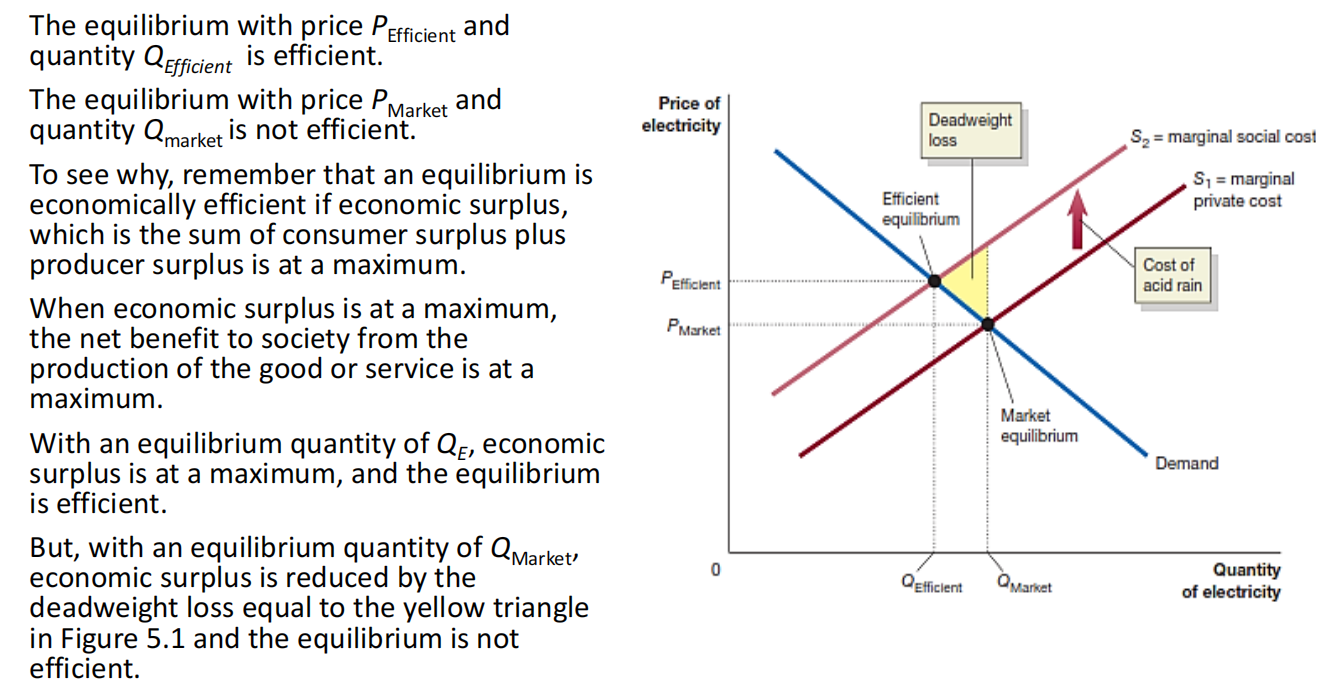
The equilibrium with price PEfficient and quantity QEfficient is efficient.
📖 点击查看译文
价格为PEfficient和数量为QEfficient的均衡是有效的。
The equilibrium with price PMarket and quantity Qmarket is not efficient.
📖 点击查看译文
价格为PMarket和数量为QMarket的均衡是无效的。
To see why, remember that an equilibrium is economically efficient if economic surplus, which is the sum of consumer surplus plus producer surplus, is at a maximum.
📖 点击查看译文
要理解为什么这样,记住如果经济盈余(消费者剩余加上生产者剩余之和)达到最大值,均衡才是经济有效的。
When economic surplus is at a maximum, the net benefit to society from the production of the good or service is at a maximum.
📖 点击查看译文
当经济盈余达到最大时,社会从商品或服务生产中获得的净效益也达到最大。
With an equilibrium quantity of QE, economic surplus is at a maximum, and the equilibrium is efficient.
📖 点击查看译文
当均衡数量为QE时,经济盈余最大,均衡是有效的。
But, with an equilibrium quantity of QMarket, economic surplus is reduced by the deadweight loss equal to the yellow triangle in Figure 5.1 and the equilibrium is not efficient.
📖 点击查看译文
但是,当均衡数量为QMarket时,经济盈余减少,由图5.1中的黄色三角形表示的死重损失减小了经济盈余,因此该均衡是无效的。
知识点列表与拓展 (Knowledge Points and Extensions):
1. Economic Surplus (经济盈余)
-
解释 (Explanation):
Economic surplus is the sum of consumer surplus and producer surplus, representing the total benefit to society from the production and consumption of a good or service.
(经济盈余是消费者剩余和生产者剩余之和,表示从商品或服务的生产和消费中获得的社会总利益。)
-
例子 (Example):
If a product is sold at a price lower than the consumer’s willingness to pay and the producer’s cost to make it, both consumer and producer benefit.
(如果某产品的售价低于消费者愿意支付的价格和生产者的生产成本,消费者和生产者都会受益。)
-
拓展 (Extension):
The presence of externalities can lead to inefficiencies, where the market fails to allocate resources in a way that maximizes economic surplus.
(外部性的存在可能导致低效,市场未能以最大化经济盈余的方式配置资源。)
7
无谓损失与负外部性
无谓损失发生是因为在QEfficient和QMarket之间的电力生产中,供给曲线高于需求曲线。
📖 点击查看译文
The deadweight loss occurs because the supply curve is above the demand curve for the production of the units of electricity between QEfficient and QMarket.
也就是说,生产这些单位的额外成本(包括外部成本)大于消费者的边际效益,消费者的边际效益由需求曲线表示。
📖 点击查看译文
That is, the additional cost including the external cost of producing these units is greater than the marginal benefit to consumers, as represented by the demand curve.
换句话说,由于污染的成本,如果减少电力生产,经济效率将得到提高。
📖 点击查看译文
In other words, because of the cost of the pollution, economic efficiency would be improved if less electricity were produced.
我们可以得出以下结论:当生产某种商品或服务存在负外部性时,市场均衡时会生产过多的该商品或服务。
📖 点击查看译文
We can conclude the following: When there is a negative externality in producing a good or service, too much of the good or service will be produced at market equilibrium.
知识点列表与拓展 (Knowledge Points and Extensions):
1. 无谓损失 (Deadweight Loss)
-
解释 (Explanation):
无谓损失是指市场未能有效运作时,经济盈余的损失,通常是由于外部性或其他市场扭曲造成的。
(Deadweight loss is the loss of economic surplus that occurs when a market is not operating efficiently, often due to externalities or other market distortions.)
-
例子 (Example):
负外部性,如电力生产中的污染,会导致电力的过度生产,从而造成无谓损失。
(A negative externality, like pollution from electricity production, leads to an overproduction of electricity, causing a deadweight loss.)
-
拓展 (Extension):
无谓损失是理解市场失灵如何发生的一个重要概念,并且可以通过政府干预,如税收或监管,来纠正。
(Deadweight loss is an important concept in understanding how market failures occur and can be corrected through government intervention, such as taxes or regulations.)
8
正外部性对消费的影响与经济效率 (How a Positive Externality in Consumption Reduces Economic Efficiency)
We have seen that a negative externality interferes with achieving economic efficiency.
📖 点击查看译文
我们已经看到负外部性干扰了经济效率的实现。
The same holds true for a positive externality.
📖 点击查看译文
正外部性也是如此。
We know that the demand curve represents all the benefits that come from consuming a good.
📖 点击查看译文
我们知道,需求曲线代表了消费一种商品所带来的所有效益。
But a college education generates benefits that are not captured by the student receiving the education and so are not included in the market demand curve for college educations.
📖 点击查看译文
但大学教育产生的效益并未被接受教育的学生所完全获得,因此这些效益没有包含在大学教育的市场需求曲线中。
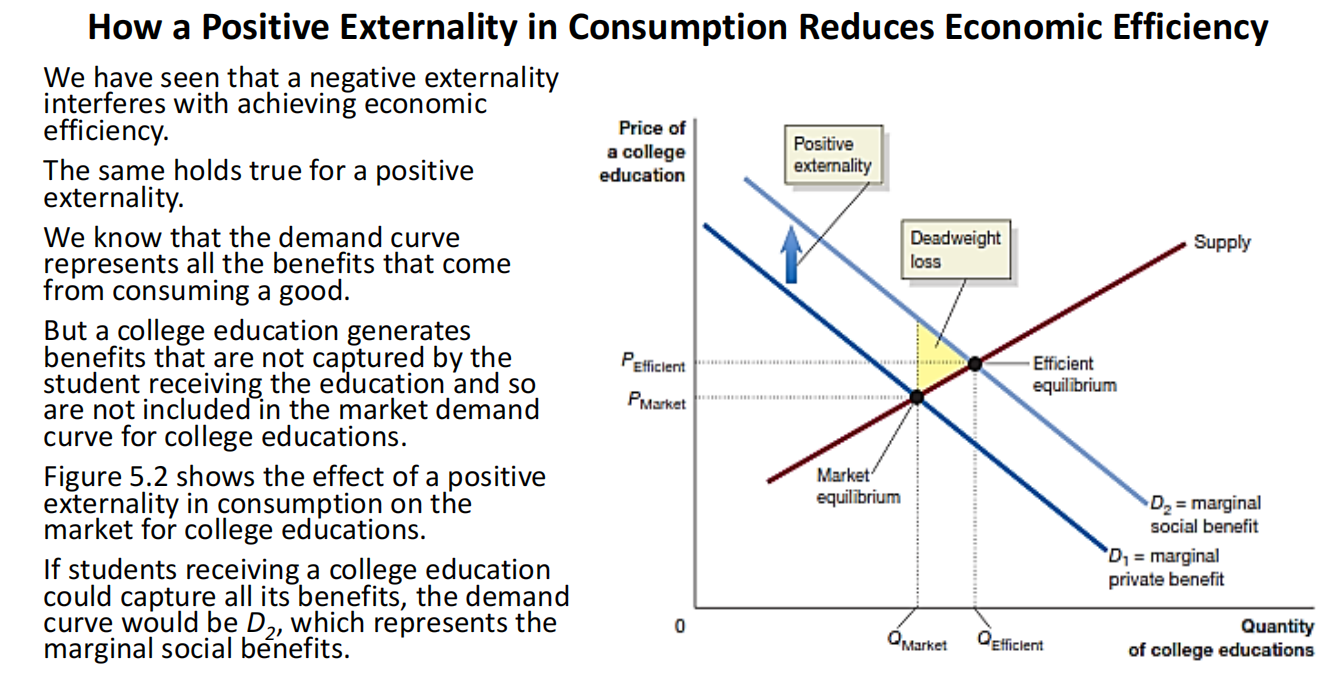
Figure 5.2 shows the effect of a positive externality in consumption on the market for college educations.
📖 点击查看译文
图5.2展示了消费中正外部性对大学教育市场的影响。
If students receiving a college education could capture all its benefits, the demand curve would be D2, which represents the marginal social benefits.
📖 点击查看译文
如果接受大学教育的学生能够获得所有的效益,需求曲线将是D2,代表边际社会效益。
知识点列表与拓展 (Knowledge Points and Extensions):
1. Positive Externality in Consumption (消费中的正外部性)
-
解释 (Explanation):
正外部性是指一种商品或服务的消费带来了额外的效益,这些效益未被消费该商品的个体所捕捉,导致市场需求未能反映其所有社会效益。
(A positive externality occurs when the consumption of a good or service generates additional benefits that are not captured by the individual consuming the good, leading to a market demand curve that does not reflect its full social benefits.)
-
例子 (Example):
大学教育可以带来不只是受教育者本身的收益,还能改善社会福利,如减少犯罪率和提高选民素质,这些效益并未反映在个人需求中。
(A college education generates benefits beyond the student, such as reduced crime rates and more informed voters, which are not reflected in the individual’s demand.)
-
拓展 (Extension):
正外部性的存在往往意味着市场提供的商品或服务少于社会最优水平,政府可能需要通过补贴或其他政策来提高生产或消费水平,以增强社会福利。
(The presence of positive externalities often means that the market provides less of a good or service than is socially optimal, and government intervention, such as subsidies or other policies, may be needed to increase production or consumption to enhance social welfare.)
9
正外部性对消费的影响与经济效率 (How a Positive Externality in Consumption Reduces Economic Efficiency)
The actual demand curve is D1, however, which represents only the marginal private benefits received by students.
📖 点击查看译文
然而,实际的需求曲线是D1,它仅代表学生所获得的边际私人效益。
The efficient equilibrium would occur at price PEfficient and quantity QEfficient.
📖 点击查看译文
最优均衡将发生在价格PEfficient和数量QEfficient处。
At this equilibrium, economic surplus is maximized.
📖 点击查看译文
在这一均衡下,经济盈余最大化。
The market equilibrium, at price PMarket and quantity QMarket, will not be efficient because the demand curve is above the supply curve for production of the units between QMarket and QEfficient.
📖 点击查看译文
市场均衡,价格为PMarket和数量为QMarket,将不会是有效的,因为在QMarket和QEfficient之间的单位生产中,需求曲线高于供给曲线。
This is the marginal benefit including the external benefit of producing these units is greater than the marginal cost.
📖 点击查看译文
这是因为生产这些单位的边际效益(包括外部效益)大于边际成本。
As a result, there is a deadweight loss equal to the area of the yellow triangle.
📖 点击查看译文
因此,存在一个无谓损失,等于黄色三角形的面积。
Because of the positive externality, economic efficiency would be improved if more college educations were produced.
📖 点击查看译文
由于正外部性,如果生产更多的大学教育,经济效率将得到提高。
We can conclude the following: When there is a positive externality in consuming a good or service, too little of the good or service will be produced at market equilibrium.
📖 点击查看译文
我们可以得出以下结论:当消费某种商品或服务存在正外部性时,市场均衡时该商品或服务的生产量过少。
知识点列表与拓展 (Knowledge Points and Extensions):
1. Positive Externality in Consumption (消费中的正外部性)
-
解释 (Explanation):
正外部性是指消费一种商品或服务所产生的额外社会效益,这些效益未能被消费该商品的个体所捕捉,导致市场需求曲线无法体现商品的真实社会效益。
(A positive externality occurs when the consumption of a good or service generates additional social benefits that are not captured by the individual consuming the good, leading to a market demand curve that does not reflect the true social benefits of the good.)
-
例子 (Example):
大学教育不仅对学生个人有益,还能带来社会效益,如提高选民素质和减少犯罪率,这些效益未反映在市场需求中。
(A college education benefits not only the student but also society, such as by increasing the quality of voters and reducing crime rates, which are not reflected in the market demand.)
-
拓展 (Extension):
正外部性往往导致市场无法提供足够的商品或服务,政府可以通过补贴或其他措施来提高商品的生产和消费水平,以实现更高的社会福利。
(Positive externalities often result in markets underproducing goods or services, and the government can intervene with subsidies or other measures to increase production and consumption to achieve higher social welfare.)
10
What Causes Externalities? (外部性的原因)
Governments need to guarantee property rights in order for a market system to function well.
📖 点击查看译文
政府需要保证财产权,以确保市场系统的良好运作。
Property rights refer to the rights individuals or businesses have to the exclusive use of their property, including the right to buy or sell it.
📖 点击查看译文
财产权指的是个人或企业对其财产的独占使用权,包括买卖权。
Property can be tangible or physical, such as a store or factory.
📖 点击查看译文
财产可以是有形的或物理的,例如商店或工厂。
Property can also be intangible, such as the right to an idea.
📖 点击查看译文
财产也可以是无形的,例如对一个想法的权利。
Most of the time, the governments of the United States and other high-income countries do a good job of enforcing property rights, but in certain situations, property rights do not exist or cannot be legally enforced.
📖 点击查看译文
大多数情况下,美国和其他高收入国家的政府在执行财产权方面做得很好,但在某些情况下,财产权并不存在或无法依法执行。
Consider the following situation: Lee owns land that includes a lake.
📖 点击查看译文
考虑以下情况:李拥有一片包括湖泊的土地。
A paper company wants to lease some of Lee’s land to build a paper mill.
📖 点击查看译文
一家造纸公司想要租赁李的部分土地建造纸厂。
The paper mill will discharge pollutants into Lee’s lake.
📖 点击查看译文
纸厂会将污染物排放到李的湖泊中。
Because Lee owns the lake, he can charge the paper company the cost of cleaning up the pollutants.
📖 点击查看译文
因为李拥有湖泊,他可以向造纸公司收取清理污染物的费用。
The result is that the cost of the pollution is a private cost to the paper company and is included in the price of the paper it sells.
📖 点击查看译文
结果是,污染的成本变成了造纸公司的私人成本,并包含在其出售的纸张价格中。
There is no externality, the efficient level of paper is produced, and there is no market failure.
📖 点击查看译文
没有外部性,生产了有效水平的纸张,也没有市场失灵。
知识点列表与拓展 (Knowledge Points and Extensions):
1. Property Rights (财产权)
-
解释 (Explanation):
财产权是指个人或企业对某种资产的独占使用权,包括出售、出租或转让的权利。在良好的财产权保障下,市场能够有效运作。
(Property rights refer to the exclusive right individuals or businesses have to use, sell, or transfer assets. With strong property rights, markets can function efficiently.)
-
例子 (Example):
李拥有湖泊的财产权,可以通过向造纸公司收取污染清理费用来确保污染成本被内部化。
(Lee holds property rights to the lake and can charge the paper company for pollution cleanup, internalizing the pollution cost.)
-
拓展 (Extension):
财产权的缺失或执行困难可能导致外部性问题,政府应通过法律保障财产权,从而减少市场失灵的情况。
(The lack of or difficulty in enforcing property rights can lead to externalities. Governments should ensure property rights through laws to reduce market failure.)
11
What Causes Externalities? (外部性的原因)
Now suppose the paper company again builds its paper mill on privately owned land but discharges its pollutants into a lake that is owned by the state government rather than by an individual.
📖 点击查看译文
现在假设造纸公司再次在私有土地上建造纸厂,但将污染物排放到由州政府拥有的湖泊中,而不是个人拥有的湖泊。
In the absence of any government regulations, the company can discharge pollutants into the lake without having to pay a fee.
📖 点击查看译文
在没有政府监管的情况下,造纸公司可以将污染物排放到湖泊中,而无需支付任何费用。
The cost of the pollution will be external to the company because it doesn’t have to pay the cost of cleaning it up.
📖 点击查看译文
污染的成本对造纸公司来说是外部的,因为它不需要支付清理费用。
The paper mill will produce a quantity of paper that is greater than the economically efficient level, and a market failure will occur.
📖 点击查看译文
纸厂将生产出超过经济有效水平的纸张,导致市场失灵。
Or, suppose that Lee owns the lake, but the pollution is caused by acid rain generated by an electric utility hundreds of miles away.
📖 点击查看译文
或者假设李拥有湖泊,但污染是由几百英里外的电力公司产生的酸雨造成的。
The law does not allow Lee to charge the electric utility for the damage caused by the acid rain.
📖 点击查看译文
法律不允许李向电力公司收取酸雨造成的损害费用。
Even though someone is damaging Lee’s property, he cannot enforce his property rights in this situation.
📖 点击查看译文
尽管有人在损害李的财产,但在这种情况下他无法执行自己的财产权。
Once again, there is an externality, and the market failure will result in too much electricity being produced.
📖 点击查看译文
再次出现外部性,市场失灵将导致过多的电力生产。
If you buy a house, the government will protect your right to exclusive use of that house. No one else can use the house without your permission.
📖 点击查看译文
如果你购买一套房子,政府会保护你对房子的独占使用权。没有你的许可,其他人不能使用这所房子。
When you buy a college education, however, other people are able to benefit from it. You have no property right that will enable you to prevent them from benefiting or to charge them for the benefits they receive.
📖 点击查看译文
然而,当你购买一份大学教育时,其他人也能从中受益。你没有财产权来阻止他们受益或向他们收取受益费用。
Externalities and market failures result from incomplete property rights or from the difficulty of enforcing property rights in certain situations.
📖 点击查看译文
外部性和市场失灵是由于财产权的不完全或在某些情况下难以执行财产权所导致的。
知识点列表与拓展 (Knowledge Points and Extensions):
1. Incomplete Property Rights (不完全的财产权)
-
解释 (Explanation):
不完全的财产权指的是无法清晰界定或执行的财产权,导致外部性和市场失灵的产生。
(Incomplete property rights refer to property rights that are unclear or unenforceable, leading to externalities and market failures.)
-
例子 (Example):
当李无法向电力公司追究酸雨造成的损害时,表明财产权未被完全执行,造成了外部性。
(When Lee cannot hold the electric utility accountable for the damage caused by acid rain, it shows that property rights are not fully enforced, resulting in an externality.)
-
拓展 (Extension):
外部性和市场失灵通常源自财产权不明确或无法强制执行,政府可以通过法律来确保财产权的明确和执行,从而减少市场失灵。
(Externalities and market failures often arise from unclear or unenforceable property rights. Governments can reduce market failures by ensuring the clarity and enforcement of property rights through laws.)
12
Private Solutions to Externalities: The Coase Theorem (外部性的私人解决方案:科斯定理)
We know that government intervention may actually increase economic efficiency and enhance the well-being of society when externalities are present.
📖 点击查看译文
我们知道,当存在外部性时,政府干预实际上可能提高经济效率并改善社会福祉。
It is also possible, however, for people to find private solutions to the problem of externalities.
📖 点击查看译文
然而,人们也有可能找到解决外部性问题的私人解决方案。
Can the market cure market failure?
📖 点击查看译文
市场能否解决市场失灵?
In an influential article written in 1960, Ronald Coase argued that under some circumstances, private solutions to the problem of externalities will occur.
📖 点击查看译文
在1960年发表的一篇具有影响力的文章中,罗纳德·科斯(Ronald Coase)认为,在某些情况下,外部性问题的私人解决方案会出现。
To understand Coase’s argument, we need to recognize that completely eliminating an externality usually is not economically efficient.
📖 点击查看译文
要理解科斯的论点,我们需要认识到,完全消除外部性通常不是经济上有效的。
Consider pollution, for example.
📖 点击查看译文
例如,考虑污染。
There is, in fact, an economically efficient level of pollution reduction.
📖 点击查看译文
事实上,存在一个经济上有效的污染减少水平。
At first, this seems illogical.
📖 点击查看译文
一开始,这看起来不合逻辑。
Pollution is bad, and you might think the efficient amount of a bad thing is zero.
📖 点击查看译文
污染是有害的,你可能会认为,任何坏事的有效数量应该是零。
But it isn’t zero.
📖 点击查看译文
但它并非零。
知识点列表与拓展 (Knowledge Points and Extensions):
1. Coase Theorem (科斯定理)
-
解释 (Explanation):
科斯定理指出,在某些条件下,私人方之间的谈判和协议可以有效解决外部性问题,而无需政府干预。
(The Coase Theorem states that under certain conditions, private negotiations and agreements between parties can effectively resolve externality problems without government intervention.)
-
例子 (Example):
如果工厂污染了附近的湖泊,而湖泊的拥有者(如私人或社区)与工厂达成协议,要求工厂支付污染费用或采取减排措施,这种私人协议可以避免政府介入。
(If a factory pollutes a nearby lake, and the lake’s owner (such as a private individual or community) reaches an agreement with the factory to pay for the pollution or take reduction measures, this private agreement can avoid government intervention.)
-
拓展 (Extension):
科斯定理要求涉及外部性的各方有明确的财产权并能够协商,这在实际中可能因为交易成本或信息不对称而难以实现。
(The Coase Theorem requires clear property rights and the ability for the involved parties to negotiate, which may be difficult to achieve in practice due to transaction costs or information asymmetry.)
13
The Economically Efficient Level of Pollution Reduction (经济上有效的污染减少水平)
We know that the optimal decision is to continue any activity up to the point where the marginal benefit equals the marginal cost.
📖 点击查看译文
我们知道,最佳决策是在边际效益等于边际成本时继续进行任何活动。
This idea applies to reducing pollution just as much as it does to other activities.
📖 点击查看译文
这个观点同样适用于减少污染,就像其他活动一样。
Sulfur dioxide emissions contribute to smog and acid rain.
📖 点击查看译文
二氧化硫排放会导致雾霾和酸雨。
As sulfur dioxide emissions or any other type of pollution decline, society benefits: Fewer trees die, fewer buildings are damaged, and fewer people suffer breathing problems.
📖 点击查看译文
随着二氧化硫排放或其他类型污染的减少,社会将受益:死亡的树木减少,受损的建筑物减少,呼吸问题的人也减少。
But, a key point is that the additional benefit—that is, the marginal benefit received from eliminating another ton of sulfur dioxide—declines as sulfur dioxide emissions are reduced.
📖 点击查看译文
但一个关键点是,额外的效益,即通过消除另一吨二氧化硫获得的边际效益,随着二氧化硫排放量的减少而下降。
To see why, consider what happens if utilities generate electricity without attempting to reduce sulfur dioxide emissions.
📖 点击查看译文
为了理解原因,考虑如果公用事业公司在不试图减少二氧化硫排放的情况下发电,会发生什么情况。
In this situation, many smoggy days will occur in the cities of the Midwest and Northeast.
📖 点击查看译文
在这种情况下,中西部和东北部的城市将会发生许多雾霾天气。
Even healthy people may experience breathing problems.
📖 点击查看译文
即使是健康的人也可能会经历呼吸问题。
As sulfur dioxide emissions are reduced, the number of smoggy days will fall, and healthy people will no longer experience breathing problems.
📖 点击查看译文
随着二氧化硫排放量的减少,雾霾天数将减少,健康的人将不再经历呼吸问题。
Eventually, if sulfur dioxide emissions fall to low levels, people with asthma will no longer be affected.
📖 点击查看译文
最终,如果二氧化硫排放量降到低水平,哮喘患者将不再受到影响。
Further reductions in sulfur dioxide emissions will have little additional benefit.
📖 点击查看译文
进一步减少二氧化硫排放将带来很少的额外效益。
The same will be true of the other benefits from reducing sulfur dioxide emissions: As the reductions increase, the additional benefits from fewer buildings and trees being damaged and lakes polluted will decline.
📖 点击查看译文
减少二氧化硫排放带来的其他效益也将是如此:随着减少量的增加,减少的建筑物和树木损害以及湖泊污染的额外效益将减少。
知识点列表与拓展 (Knowledge Points and Extensions):
1. Economically Efficient Level of Pollution Reduction (经济上有效的污染减少水平)
-
解释 (Explanation):
达到经济上有效的污染减少水平时,边际效益等于边际成本,从而实现最佳的资源配置。污染的减少应考虑到减少污染带来的额外效益以及其成本。
(The economically efficient level of pollution reduction occurs when the marginal benefit equals the marginal cost, thus achieving the optimal allocation of resources. The reduction of pollution should take into account the additional benefits of pollution reduction and its costs.)
-
例子 (Example):
如果减少二氧化硫排放的成本较高,而效益较小,进一步减少排放将不再有效。因此,合理的做法是停止在边际效益和边际成本相等时进一步减少污染。
(If the cost of reducing sulfur dioxide emissions is high and the benefits are small, further reductions in emissions will no longer be efficient. Therefore, it is optimal to stop reducing pollution when the marginal benefit equals the marginal cost.)
-
拓展 (Extension):
这个理论的应用不仅适用于二氧化硫排放,也适用于其他类型的环境污染和资源消耗的管理。
(This theory applies not only to sulfur dioxide emissions but also to the management of other types of environmental pollution and resource consumption.)
14
Marginal Cost of Reducing Pollution (减少污染的边际成本)
What about the marginal cost to electric utilities of reducing pollution?
📖 点击查看译文
那么,减少污染对电力公司的边际成本如何呢?
To reduce sulfur dioxide emissions, utilities have to switch from burning high-sulfur coal to burning more costly fuel, or they have to install pollution control devices, such as scrubbers.
📖 点击查看译文
为了减少二氧化硫排放,公用事业公司必须将燃烧高硫煤转为燃烧更昂贵的燃料,或者他们必须安装污染控制设备,如烟气脱硫装置。
As the level of pollution falls, further reductions become increasingly costly.
📖 点击查看译文
随着污染水平的下降,进一步减少污染的成本越来越高。
Reducing emissions or other types of pollution to very low levels can require complex and expensive new technologies.
📖 点击查看译文
将排放或其他类型的污染减少到非常低的水平可能需要复杂且昂贵的新技术。
For example, research has shown that the marginal cost of removing 97 percent of pollutants from municipal wastewater is more than twice as high as the marginal cost of removing 95 percent.
📖 点击查看译文
例如,研究表明,从市政污水中去除97%的污染物的边际成本是去除95%的污染物的边际成本的两倍多。
The net benefit to society from reducing pollution is equal to the difference between the benefit of reducing pollution and the cost.
📖 点击查看译文
减少污染给社会带来的净效益等于减少污染的效益与成本之间的差额。
For us to maximize the net benefit to society, sulfur dioxide emissions or any other type of pollution should be reduced up to the point where the marginal benefit from another ton of reduction is equal to the marginal cost.
📖 点击查看译文
为了最大化社会的净效益,二氧化硫排放或任何其他类型的污染应该减少到边际效益与边际成本相等的程度。
Figure 5.3 illustrates this point.
📖 点击查看译文
图5.3说明了这一点。
In Figure 5.3, we measure reductions in sulfur dioxide emissions on the horizontal axis.
📖 点击查看译文
在图5.3中,我们在横轴上测量二氧化硫排放的减少量。
We measure the marginal benefit and marginal cost in dollars from eliminating another ton of sulfur dioxide emissions on the vertical axis.
📖 点击查看译文
我们在纵轴上测量消除另一吨二氧化硫排放所带来的边际效益和边际成本,单位为美元。
知识点列表与拓展 (Knowledge Points and Extensions):
1. Marginal Cost of Reducing Pollution (减少污染的边际成本)
-
解释 (Explanation):
随着污染减少,减少污染的边际成本会增加,特别是当污染降到较低水平时,进一步减少的成本可能会显著上升。
(As pollution reduces, the marginal cost of further reductions increases, especially when pollution is reduced to low levels, where further reductions can become significantly more expensive.)
-
例子 (Example):
例如,研究表明,从市政污水中去除更高比例的污染物(如97%)会比去除较低比例(如95%)的成本高得多。
(For example, studies have shown that removing a higher percentage of pollutants from municipal wastewater (such as 97%) is much more costly than removing a lower percentage (such as 95%).)
-
拓展 (Extension):
对于其他类型的污染,如空气污染或温室气体排放,类似的效益递减和成本增加现象也适用。
(Similar diminishing benefits and increasing costs apply to other types of pollution, such as air pollution or greenhouse gas emissions.)
15
Economically Efficient Pollution Reduction (经济有效的污染减少)
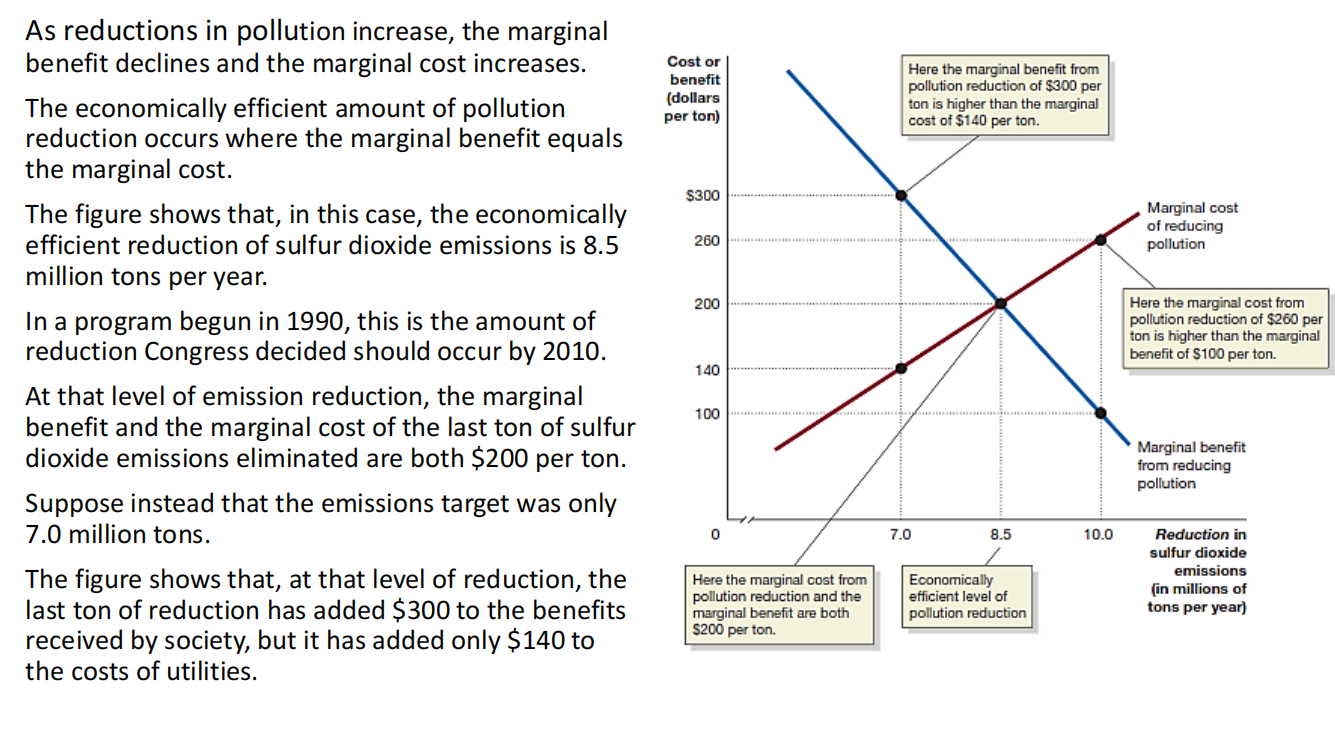
As reductions in pollution increase, the marginal benefit declines and the marginal cost increases.
📖 点击查看译文
随着污染减少,边际效益下降,边际成本上升。
The economically efficient amount of pollution reduction occurs where the marginal benefit equals the marginal cost.
📖 点击查看译文
经济有效的污染减少量发生在边际效益等于边际成本的地方。
The figure shows that, in this case, the economically efficient reduction of sulfur dioxide emissions is 8.5 million tons per year.
📖 点击查看译文
该图表显示,在这种情况下,经济有效的二氧化硫排放减少量为每年850万吨。
In a program begun in 1990, this is the amount of reduction Congress decided should occur by 2010.
📖 点击查看译文
在1990年启动的一项计划中,这是国会决定到2010年应减少的排放量。
At that level of emission reduction, the marginal benefit and the marginal cost of the last ton of sulfur dioxide emissions eliminated are both $200 per ton.
📖 点击查看译文
在这一排放减少水平下,最后一吨二氧化硫排放减少的边际效益和边际成本均为每吨200美元。
Suppose instead that the emissions target was only 7.0 million tons.
📖 点击查看译文
假设排放目标只有700万吨。
The figure shows that, at that level of reduction, the last ton of reduction has added 140 to the costs of utilities.
📖 点击查看译文
该图表显示,在这一减少水平下,最后一吨减少为社会带来的效益增加了300美元,但它只为公用事业带来了140美元的成本。
知识点列表与拓展 (Knowledge Points and Extensions):
1. Marginal Benefit and Marginal Cost (边际效益与边际成本)
-
解释 (Explanation):
随着污染减少,边际效益逐渐减少,边际成本则逐渐增加,最终达到一个平衡点,即边际效益与边际成本相等时的污染减少量为经济有效的减少量。
(As pollution reduction increases, the marginal benefit declines, and the marginal cost rises, eventually reaching an equilibrium where the marginal benefit equals the marginal cost, representing the economically efficient reduction.)
-
例子 (Example):
在1990年的计划中,国会决定到2010年减少850万吨二氧化硫排放,在这一水平下,最后一吨排放的边际效益和边际成本都为200美元。
(In the 1990 program, Congress decided to reduce sulfur dioxide emissions by 8.5 million tons by 2010, where the marginal benefit and marginal cost of the last ton of reduction were both $200.)
-
拓展 (Extension):
如果排放目标设置过低,例如700万吨,那么最终的边际效益与边际成本之间会产生不平衡,导致社会福利无法最大化。
(If the emission target is set too low, such as 7 million tons, the marginal benefit and marginal cost will become unbalanced, leading to a suboptimal societal welfare outcome.)
16
Economically Efficient Pollution Reduction (经济有效的污染减少)
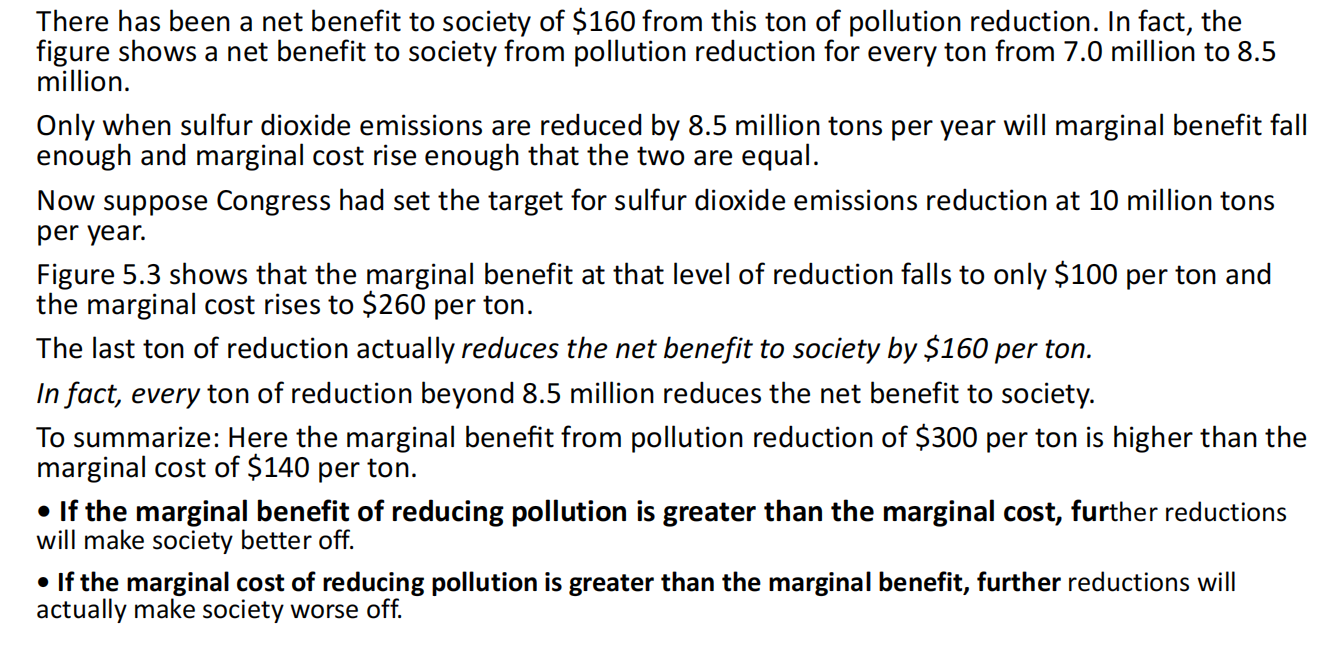
There has been a net benefit to society of $160 from this ton of pollution reduction.
📖 点击查看译文
这一吨污染减少给社会带来了160美元的净效益。
In fact, the figure shows a net benefit to society from pollution reduction for every ton from 7.0 million to 8.5 million.
📖 点击查看译文
事实上,该图表显示从700万吨到850万吨的污染减少,每吨都会为社会带来净效益。
Only when sulfur dioxide emissions are reduced by 8.5 million tons per year will marginal benefit fall enough and marginal cost rise enough that the two are equal.
📖 点击查看译文
只有当二氧化硫排放减少850万吨时,边际效益才会下降到足够低,边际成本会上升到足够高,从而使两者相等。
Now suppose Congress had set the target for sulfur dioxide emissions reduction at 10 million tons per year.
📖 点击查看译文
现在假设国会设定的二氧化硫排放减少目标为每年1000万吨。
Figure 5.3 shows that the marginal benefit at that level of reduction falls to only 260 per ton.
📖 点击查看译文
图表显示,在这一减少水平下,边际效益降至每吨100美元,而边际成本上升至每吨260美元。
The last ton of reduction actually reduces the net benefit to society by $160 per ton.
📖 点击查看译文
最后一吨减少实际上会使社会的净效益减少每吨160美元。
In fact, every ton of reduction beyond 8.5 million reduces the net benefit to society.
📖 点击查看译文
事实上,超过850万吨的每一吨减少都会降低社会的净效益。
To summarize: Here the marginal benefit from pollution reduction of 140 per ton.
📖 点击查看译文
总结一下:这里污染减少的边际效益每吨300美元高于边际成本每吨140美元。
If the marginal benefit of reducing pollution is greater than the marginal cost, further reductions will make society better off.
📖 点击查看译文
如果减少污染的边际效益大于边际成本,进一步的减少将使社会更好。
If the marginal cost of reducing pollution is greater than the marginal benefit, further reductions will actually make society worse off.
📖 点击查看译文
如果减少污染的边际成本大于边际效益,进一步的减少实际上会使社会变得更糟。
知识点列表与拓展 (Knowledge Points and Extensions):
1. Marginal Benefit and Marginal Cost (边际效益与边际成本)
-
解释 (Explanation):
经济有效的污染减少量发生在边际效益等于边际成本的地方。当边际效益大于边际成本时,社会可以从进一步的减少中获益;当边际成本大于边际效益时,进一步的减少会损害社会福利。
(The economically efficient reduction occurs when marginal benefit equals marginal cost. When marginal benefit exceeds marginal cost, further reductions benefit society; when marginal cost exceeds marginal benefit, further reductions harm societal welfare.)
-
例子 (Example):
如果排放减少到850万吨,最后一吨减少的边际效益与边际成本相等,经济有效。而在减少1000万吨时,边际成本大于边际效益,进一步减少会损害社会。
(If emissions are reduced to 8.5 million tons, the marginal benefit and marginal cost are equal, representing an efficient level. At 10 million tons, marginal cost exceeds marginal benefit, and further reductions harm society.)
-
拓展 (Extension):
通过理解这一点,政策制定者可以设定一个目标,确保在最大化社会净效益的同时,考虑到成本和效益的平衡。
(By understanding this concept, policymakers can set goals to ensure the balance of costs and benefits while maximizing societal net benefit.)
17
The Basis for Private Solutions to Externalities (外部性私有解决方案的基础)
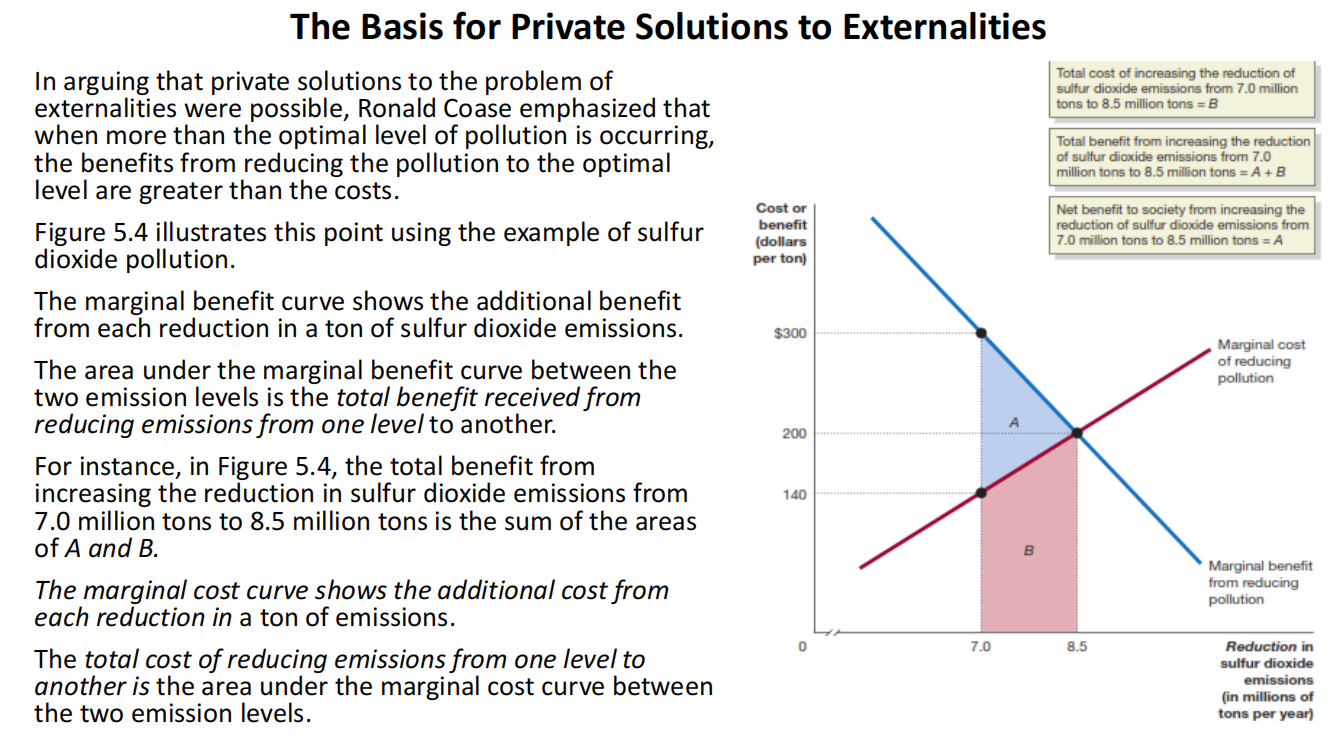
In arguing that private solutions to the problem of externalities were possible, Ronald Coase emphasized that when more than the optimal level of pollution is occurring, the benefits from reducing the pollution to the optimal level are greater than the costs.
📖 点击查看译文
在论证外部性问题可以通过私有解决方案来解决时,罗纳德·科斯强调,当污染超过最优水平时,将污染减少到最优水平的收益大于成本。
Figure 5.4 illustrates this point using the example of sulfur dioxide pollution.
📖 点击查看译文
图5.4通过二氧化硫污染的例子来说明这一点。
The marginal benefit curve shows the additional benefit from each reduction in a ton of sulfur dioxide emissions.
📖 点击查看译文
边际效益曲线显示每减少一吨二氧化硫排放所带来的额外效益。
The area under the marginal benefit curve between the two emission levels is the total benefit received from reducing emissions from one level to another.
📖 点击查看译文
在两个排放水平之间,边际效益曲线下的面积表示从一个排放水平减少到另一个排放水平所获得的总效益。
For instance, in Figure 5.4, the total benefit from increasing the reduction in sulfur dioxide emissions from 7.0 million tons to 8.5 million tons is the sum of the areas of A and B.
📖 点击查看译文
例如,在图5.4中,将二氧化硫排放减少从700万吨增加到850万吨所获得的总效益是A和B两个区域的总和。
The marginal cost curve shows the additional cost from each reduction in a ton of emissions.
📖 点击查看译文
边际成本曲线显示每减少一吨排放所产生的额外成本。
The total cost of reducing emissions from one level to another is the area under the marginal cost curve between the two emission levels.
📖 点击查看译文
从一个排放水平减少到另一个排放水平的总成本是两个排放水平之间边际成本曲线下的面积。
18
The Basis for Private Solutions to Externalities (外部性私有解决方案的基础)
The total cost from increasing the reduction in emissions from 7.0 million tons to 8.5 million tons is the area of B.
📖 点击查看译文
从700万吨到850万吨的排放减少所带来的总成本是B区域的面积。
The net benefit from reducing emissions is the difference between the total cost and the total benefit, which is equal to the area of A.
📖 点击查看译文
减少排放的净效益是总效益与总成本之间的差额,即A区域的面积。
In Figure 5.4, the benefits from further reductions in sulfur dioxide emissions are much greater than the costs.
📖 点击查看译文
在图5.4中,进一步减少二氧化硫排放带来的效益远大于成本。
As per the formula for calculating the area of a triangle, which is ½ Base x Height, and the formula for the area of a rectangle, which is Base x Height.
📖 点击查看译文
根据计算三角形面积的公式,即 ½ 基底 x 高度,以及矩形面积的公式,即 基底 x 高度。
Using these formulas, we can calculate the value of the total benefits from the reduction in emissions and the value of the total costs.
📖 点击查看译文
使用这些公式,我们可以计算出减少排放所带来的总效益和总成本的数值。
The value of the benefits (A + B) is $375 million.
📖 点击查看译文
效益的价值(A + B)为3.75亿美元。
The value of the costs (B) is $255 million.
📖 点击查看译文
成本的价值(B)为2.55亿美元。
If the people who would benefit from a reduction in pollution could get together, they could offer to pay the electric utilities $255 million to reduce the pollution to the optimal level.
📖 点击查看译文
如果那些从减少污染中受益的人们能够聚集在一起,他们可以提议支付电力公司2.55亿美元,以将污染减少到最优水平。
After making the payment, they would still be left with a net benefit of $120 million.
📖 点击查看译文
在支付后,他们仍然会获得1.2亿美元的净效益。
In other words, a private agreement to reduce pollution to the optimal level is possible, without any government intervention.
📖 点击查看译文
换句话说,通过私人协议减少污染到最优水平是可能的,无需任何政府干预。
知识点列表与拓展 (Knowledge Points and Extensions):
1. Net Benefit Calculation (净效益计算)
-
解释 (Explanation):
通过计算减少污染带来的总效益和总成本,可以确定净效益,并以此判断是否值得采取行动。
(By calculating the total benefits and total costs of pollution reduction, we can determine the net benefit and decide whether action is worthwhile.)
-
例子 (Example):
在图5.4中,减少二氧化硫排放的净效益为1.2亿美元。
(In Figure 5.4, the net benefit from reducing sulfur dioxide emissions is $120 million.)
-
拓展 (Extension):
如果受益者能够协作并承担减少污染的成本,私人解决方案可以在没有政府干预的情况下实现经济效率。
(If the beneficiaries can cooperate and bear the costs of pollution reduction, a private solution can achieve economic efficiency without government intervention.)
7

无谓损失与负外部性
无谓损失发生是因为在QEfficient和QMarket之间的电力生产中,供给曲线高于需求曲线。
📖 点击查看译文
The deadweight loss occurs because the supply curve is above the demand curve for the production of the units of electricity between QEfficient and QMarket.
也就是说,生产这些单位的额外成本(包括外部成本)大于消费者的边际效益,消费者的边际效益由需求曲线表示。
📖 点击查看译文
That is, the additional cost including the external cost of producing these units is greater than the marginal benefit to consumers, as represented by the demand curve.
换句话说,由于污染的成本,如果减少电力生产,经济效率将得到提高。
📖 点击查看译文
In other words, because of the cost of the pollution, economic efficiency would be improved if less electricity were produced.
我们可以得出以下结论:当生产某种商品或服务存在负外部性时,市场均衡时会生产过多的该商品或服务。
📖 点击查看译文
We can conclude the following: When there is a negative externality in producing a good or service, too much of the good or service will be produced at market equilibrium.
知识点列表与拓展 (Knowledge Points and Extensions):
1. 无谓损失 (Deadweight Loss)
-
解释 (Explanation):
无谓损失是指市场未能有效运作时,经济盈余的损失,通常是由于外部性或其他市场扭曲造成的。
(Deadweight loss is the loss of economic surplus that occurs when a market is not operating efficiently, often due to externalities or other market distortions.)
-
例子 (Example):
负外部性,如电力生产中的污染,会导致电力的过度生产,从而造成无谓损失。
(A negative externality, like pollution from electricity production, leads to an overproduction of electricity, causing a deadweight loss.)
-
拓展 (Extension):
无谓损失是理解市场失灵如何发生的一个重要概念,并且可以通过政府干预,如税收或监管,来纠正。
(Deadweight loss is an important concept in understanding how market failures occur and can be corrected through government intervention, such as taxes or regulations.)
8

正外部性对消费的影响与经济效率 (How a Positive Externality in Consumption Reduces Economic Efficiency)
We have seen that a negative externality interferes with achieving economic efficiency.
📖 点击查看译文
我们已经看到负外部性干扰了经济效率的实现。
The same holds true for a positive externality.
📖 点击查看译文
正外部性也是如此。
We know that the demand curve represents all the benefits that come from consuming a good.
📖 点击查看译文
我们知道,需求曲线代表了消费一种商品所带来的所有效益。
But a college education generates benefits that are not captured by the student receiving the education and so are not included in the market demand curve for college educations.
📖 点击查看译文
但大学教育产生的效益并未被接受教育的学生所完全获得,因此这些效益没有包含在大学教育的市场需求曲线中。
Figure 5.2 shows the effect of a positive externality in consumption on the market for college educations.
📖 点击查看译文
图5.2展示了消费中正外部性对大学教育市场的影响。
If students receiving a college education could capture all its benefits, the demand curve would be D2, which represents the marginal social benefits.
📖 点击查看译文
如果接受大学教育的学生能够获得所有的效益,需求曲线将是D2,代表边际社会效益。
知识点列表与拓展 (Knowledge Points and Extensions):
1. Positive Externality in Consumption (消费中的正外部性)
-
解释 (Explanation):
正外部性是指一种商品或服务的消费带来了额外的效益,这些效益未被消费该商品的个体所捕捉,导致市场需求未能反映其所有社会效益。
(A positive externality occurs when the consumption of a good or service generates additional benefits that are not captured by the individual consuming the good, leading to a market demand curve that does not reflect its full social benefits.)
-
例子 (Example):
大学教育可以带来不只是受教育者本身的收益,还能改善社会福利,如减少犯罪率和提高选民素质,这些效益并未反映在个人需求中。
(A college education generates benefits beyond the student, such as reduced crime rates and more informed voters, which are not reflected in the individual’s demand.)
-
拓展 (Extension):
正外部性的存在往往意味着市场提供的商品或服务少于社会最优水平,政府可能需要通过补贴或其他政策来提高生产或消费水平,以增强社会福利。
(The presence of positive externalities often means that the market provides less of a good or service than is socially optimal, and government intervention, such as subsidies or other policies, may be needed to increase production or consumption to enhance social welfare.)
9

正外部性对消费的影响与经济效率 (How a Positive Externality in Consumption Reduces Economic Efficiency)
The actual demand curve is D1, however, which represents only the marginal private benefits received by students.
📖 点击查看译文
然而,实际的需求曲线是D1,它仅代表学生所获得的边际私人效益。
The efficient equilibrium would occur at price PEfficient and quantity QEfficient.
📖 点击查看译文
最优均衡将发生在价格PEfficient和数量QEfficient处。
At this equilibrium, economic surplus is maximized.
📖 点击查看译文
在这一均衡下,经济盈余最大化。
The market equilibrium, at price PMarket and quantity QMarket, will not be efficient because the demand curve is above the supply curve for production of the units between QMarket and QEfficient.
📖 点击查看译文
市场均衡,价格为PMarket和数量为QMarket,将不会是有效的,因为在QMarket和QEfficient之间的单位生产中,需求曲线高于供给曲线。
This is the marginal benefit including the external benefit of producing these units is greater than the marginal cost.
📖 点击查看译文
这是因为生产这些单位的边际效益(包括外部效益)大于边际成本。
As a result, there is a deadweight loss equal to the area of the yellow triangle.
📖 点击查看译文
因此,存在一个无谓损失,等于黄色三角形的面积。
Because of the positive externality, economic efficiency would be improved if more college educations were produced.
📖 点击查看译文
由于正外部性,如果生产更多的大学教育,经济效率将得到提高。
We can conclude the following: When there is a positive externality in consuming a good or service, too little of the good or service will be produced at market equilibrium.
📖 点击查看译文
我们可以得出以下结论:当消费某种商品或服务存在正外部性时,市场均衡时该商品或服务的生产量过少。
知识点列表与拓展 (Knowledge Points and Extensions):
1. Positive Externality in Consumption (消费中的正外部性)
-
解释 (Explanation):
正外部性是指消费一种商品或服务所产生的额外社会效益,这些效益未能被消费该商品的个体所捕捉,导致市场需求曲线无法体现商品的真实社会效益。
(A positive externality occurs when the consumption of a good or service generates additional social benefits that are not captured by the individual consuming the good, leading to a market demand curve that does not reflect the true social benefits of the good.)
-
例子 (Example):
大学教育不仅对学生个人有益,还能带来社会效益,如提高选民素质和减少犯罪率,这些效益未反映在市场需求中。
(A college education benefits not only the student but also society, such as by increasing the quality of voters and reducing crime rates, which are not reflected in the market demand.)
-
拓展 (Extension):
正外部性往往导致市场无法提供足够的商品或服务,政府可以通过补贴或其他措施来提高商品的生产和消费水平,以实现更高的社会福利。
(Positive externalities often result in markets underproducing goods or services, and the government can intervene with subsidies or other measures to increase production and consumption to achieve higher social welfare.)
10

What Causes Externalities? (外部性的原因)
Governments need to guarantee property rights in order for a market system to function well.
📖 点击查看译文
政府需要保证财产权,以确保市场系统的良好运作。
Property rights refer to the rights individuals or businesses have to the exclusive use of their property, including the right to buy or sell it.
📖 点击查看译文
财产权指的是个人或企业对其财产的独占使用权,包括买卖权。
Property can be tangible or physical, such as a store or factory.
📖 点击查看译文
财产可以是有形的或物理的,例如商店或工厂。
Property can also be intangible, such as the right to an idea.
📖 点击查看译文
财产也可以是无形的,例如对一个想法的权利。
Most of the time, the governments of the United States and other high-income countries do a good job of enforcing property rights, but in certain situations, property rights do not exist or cannot be legally enforced.
📖 点击查看译文
大多数情况下,美国和其他高收入国家的政府在执行财产权方面做得很好,但在某些情况下,财产权并不存在或无法依法执行。
Consider the following situation: Lee owns land that includes a lake.
📖 点击查看译文
考虑以下情况:李拥有一片包括湖泊的土地。
A paper company wants to lease some of Lee’s land to build a paper mill.
📖 点击查看译文
一家造纸公司想要租赁李的部分土地建造纸厂。
The paper mill will discharge pollutants into Lee’s lake.
📖 点击查看译文
纸厂会将污染物排放到李的湖泊中。
Because Lee owns the lake, he can charge the paper company the cost of cleaning up the pollutants.
📖 点击查看译文
因为李拥有湖泊,他可以向造纸公司收取清理污染物的费用。
The result is that the cost of the pollution is a private cost to the paper company and is included in the price of the paper it sells.
📖 点击查看译文
结果是,污染的成本变成了造纸公司的私人成本,并包含在其出售的纸张价格中。
There is no externality, the efficient level of paper is produced, and there is no market failure.
📖 点击查看译文
没有外部性,生产了有效水平的纸张,也没有市场失灵。
知识点列表与拓展 (Knowledge Points and Extensions):
1. Property Rights (财产权)
-
解释 (Explanation):
财产权是指个人或企业对某种资产的独占使用权,包括出售、出租或转让的权利。在良好的财产权保障下,市场能够有效运作。
(Property rights refer to the exclusive right individuals or businesses have to use, sell, or transfer assets. With strong property rights, markets can function efficiently.)
-
例子 (Example):
李拥有湖泊的财产权,可以通过向造纸公司收取污染清理费用来确保污染成本被内部化。
(Lee holds property rights to the lake and can charge the paper company for pollution cleanup, internalizing the pollution cost.)
-
拓展 (Extension):
财产权的缺失或执行困难可能导致外部性问题,政府应通过法律保障财产权,从而减少市场失灵的情况。
(The lack of or difficulty in enforcing property rights can lead to externalities. Governments should ensure property rights through laws to reduce market failure.)
11

What Causes Externalities? (外部性的原因)
Now suppose the paper company again builds its paper mill on privately owned land but discharges its pollutants into a lake that is owned by the state government rather than by an individual.
📖 点击查看译文
现在假设造纸公司再次在私有土地上建造纸厂,但将污染物排放到由州政府拥有的湖泊中,而不是个人拥有的湖泊。
In the absence of any government regulations, the company can discharge pollutants into the lake without having to pay a fee.
📖 点击查看译文
在没有政府监管的情况下,造纸公司可以将污染物排放到湖泊中,而无需支付任何费用。
The cost of the pollution will be external to the company because it doesn’t have to pay the cost of cleaning it up.
📖 点击查看译文
污染的成本对造纸公司来说是外部的,因为它不需要支付清理费用。
The paper mill will produce a quantity of paper that is greater than the economically efficient level, and a market failure will occur.
📖 点击查看译文
纸厂将生产出超过经济有效水平的纸张,导致市场失灵。
Or, suppose that Lee owns the lake, but the pollution is caused by acid rain generated by an electric utility hundreds of miles away.
📖 点击查看译文
或者假设李拥有湖泊,但污染是由几百英里外的电力公司产生的酸雨造成的。
The law does not allow Lee to charge the electric utility for the damage caused by the acid rain.
📖 点击查看译文
法律不允许李向电力公司收取酸雨造成的损害费用。
Even though someone is damaging Lee’s property, he cannot enforce his property rights in this situation.
📖 点击查看译文
尽管有人在损害李的财产,但在这种情况下他无法执行自己的财产权。
Once again, there is an externality, and the market failure will result in too much electricity being produced.
📖 点击查看译文
再次出现外部性,市场失灵将导致过多的电力生产。
If you buy a house, the government will protect your right to exclusive use of that house. No one else can use the house without your permission.
📖 点击查看译文
如果你购买一套房子,政府会保护你对房子的独占使用权。没有你的许可,其他人不能使用这所房子。
When you buy a college education, however, other people are able to benefit from it. You have no property right that will enable you to prevent them from benefiting or to charge them for the benefits they receive.
📖 点击查看译文
然而,当你购买一份大学教育时,其他人也能从中受益。你没有财产权来阻止他们受益或向他们收取受益费用。
Externalities and market failures result from incomplete property rights or from the difficulty of enforcing property rights in certain situations.
📖 点击查看译文
外部性和市场失灵是由于财产权的不完全或在某些情况下难以执行财产权所导致的。
知识点列表与拓展 (Knowledge Points and Extensions):
1. Incomplete Property Rights (不完全的财产权)
-
解释 (Explanation):
不完全的财产权指的是无法清晰界定或执行的财产权,导致外部性和市场失灵的产生。
(Incomplete property rights refer to property rights that are unclear or unenforceable, leading to externalities and market failures.)
-
例子 (Example):
当李无法向电力公司追究酸雨造成的损害时,表明财产权未被完全执行,造成了外部性。
(When Lee cannot hold the electric utility accountable for the damage caused by acid rain, it shows that property rights are not fully enforced, resulting in an externality.)
-
拓展 (Extension):
外部性和市场失灵通常源自财产权不明确或无法强制执行,政府可以通过法律来确保财产权的明确和执行,从而减少市场失灵。
(Externalities and market failures often arise from unclear or unenforceable property rights. Governments can reduce market failures by ensuring the clarity and enforcement of property rights through laws.)
12

Private Solutions to Externalities: The Coase Theorem (外部性的私人解决方案:科斯定理)
We know that government intervention may actually increase economic efficiency and enhance the well-being of society when externalities are present.
📖 点击查看译文
我们知道,当存在外部性时,政府干预实际上可能提高经济效率并改善社会福祉。
It is also possible, however, for people to find private solutions to the problem of externalities.
📖 点击查看译文
然而,人们也有可能找到解决外部性问题的私人解决方案。
Can the market cure market failure?
📖 点击查看译文
市场能否解决市场失灵?
In an influential article written in 1960, Ronald Coase argued that under some circumstances, private solutions to the problem of externalities will occur.
📖 点击查看译文
在1960年发表的一篇具有影响力的文章中,罗纳德·科斯(Ronald Coase)认为,在某些情况下,外部性问题的私人解决方案会出现。
To understand Coase’s argument, we need to recognize that completely eliminating an externality usually is not economically efficient.
📖 点击查看译文
要理解科斯的论点,我们需要认识到,完全消除外部性通常不是经济上有效的。
Consider pollution, for example.
📖 点击查看译文
例如,考虑污染。
There is, in fact, an economically efficient level of pollution reduction.
📖 点击查看译文
事实上,存在一个经济上有效的污染减少水平。
At first, this seems illogical.
📖 点击查看译文
一开始,这看起来不合逻辑。
Pollution is bad, and you might think the efficient amount of a bad thing is zero.
📖 点击查看译文
污染是有害的,你可能会认为,任何坏事的有效数量应该是零。
But it isn’t zero.
📖 点击查看译文
但它并非零。
知识点列表与拓展 (Knowledge Points and Extensions):
1. Coase Theorem (科斯定理)
-
解释 (Explanation):
科斯定理指出,在某些条件下,私人方之间的谈判和协议可以有效解决外部性问题,而无需政府干预。
(The Coase Theorem states that under certain conditions, private negotiations and agreements between parties can effectively resolve externality problems without government intervention.)
-
例子 (Example):
如果工厂污染了附近的湖泊,而湖泊的拥有者(如私人或社区)与工厂达成协议,要求工厂支付污染费用或采取减排措施,这种私人协议可以避免政府介入。
(If a factory pollutes a nearby lake, and the lake’s owner (such as a private individual or community) reaches an agreement with the factory to pay for the pollution or take reduction measures, this private agreement can avoid government intervention.)
-
拓展 (Extension):
科斯定理要求涉及外部性的各方有明确的财产权并能够协商,这在实际中可能因为交易成本或信息不对称而难以实现。
(The Coase Theorem requires clear property rights and the ability for the involved parties to negotiate, which may be difficult to achieve in practice due to transaction costs or information asymmetry.)
13

The Economically Efficient Level of Pollution Reduction (经济上有效的污染减少水平)
We know that the optimal decision is to continue any activity up to the point where the marginal benefit equals the marginal cost.
📖 点击查看译文
我们知道,最佳决策是在边际效益等于边际成本时继续进行任何活动。
This idea applies to reducing pollution just as much as it does to other activities.
📖 点击查看译文
这个观点同样适用于减少污染,就像其他活动一样。
Sulfur dioxide emissions contribute to smog and acid rain.
📖 点击查看译文
二氧化硫排放会导致雾霾和酸雨。
As sulfur dioxide emissions or any other type of pollution decline, society benefits: Fewer trees die, fewer buildings are damaged, and fewer people suffer breathing problems.
📖 点击查看译文
随着二氧化硫排放或其他类型污染的减少,社会将受益:死亡的树木减少,受损的建筑物减少,呼吸问题的人也减少。
But, a key point is that the additional benefit—that is, the marginal benefit received from eliminating another ton of sulfur dioxide—declines as sulfur dioxide emissions are reduced.
📖 点击查看译文
但一个关键点是,额外的效益,即通过消除另一吨二氧化硫获得的边际效益,随着二氧化硫排放量的减少而下降。
To see why, consider what happens if utilities generate electricity without attempting to reduce sulfur dioxide emissions.
📖 点击查看译文
为了理解原因,考虑如果公用事业公司在不试图减少二氧化硫排放的情况下发电,会发生什么情况。
In this situation, many smoggy days will occur in the cities of the Midwest and Northeast.
📖 点击查看译文
在这种情况下,中西部和东北部的城市将会发生许多雾霾天气。
Even healthy people may experience breathing problems.
📖 点击查看译文
即使是健康的人也可能会经历呼吸问题。
As sulfur dioxide emissions are reduced, the number of smoggy days will fall, and healthy people will no longer experience breathing problems.
📖 点击查看译文
随着二氧化硫排放量的减少,雾霾天数将减少,健康的人将不再经历呼吸问题。
Eventually, if sulfur dioxide emissions fall to low levels, people with asthma will no longer be affected.
📖 点击查看译文
最终,如果二氧化硫排放量降到低水平,哮喘患者将不再受到影响。
Further reductions in sulfur dioxide emissions will have little additional benefit.
📖 点击查看译文
进一步减少二氧化硫排放将带来很少的额外效益。
The same will be true of the other benefits from reducing sulfur dioxide emissions: As the reductions increase, the additional benefits from fewer buildings and trees being damaged and lakes polluted will decline.
📖 点击查看译文
减少二氧化硫排放带来的其他效益也将是如此:随着减少量的增加,减少的建筑物和树木损害以及湖泊污染的额外效益将减少。
知识点列表与拓展 (Knowledge Points and Extensions):
1. Economically Efficient Level of Pollution Reduction (经济上有效的污染减少水平)
-
解释 (Explanation):
达到经济上有效的污染减少水平时,边际效益等于边际成本,从而实现最佳的资源配置。污染的减少应考虑到减少污染带来的额外效益以及其成本。
(The economically efficient level of pollution reduction occurs when the marginal benefit equals the marginal cost, thus achieving the optimal allocation of resources. The reduction of pollution should take into account the additional benefits of pollution reduction and its costs.)
-
例子 (Example):
如果减少二氧化硫排放的成本较高,而效益较小,进一步减少排放将不再有效。因此,合理的做法是停止在边际效益和边际成本相等时进一步减少污染。
(If the cost of reducing sulfur dioxide emissions is high and the benefits are small, further reductions in emissions will no longer be efficient. Therefore, it is optimal to stop reducing pollution when the marginal benefit equals the marginal cost.)
-
拓展 (Extension):
这个理论的应用不仅适用于二氧化硫排放,也适用于其他类型的环境污染和资源消耗的管理。
(This theory applies not only to sulfur dioxide emissions but also to the management of other types of environmental pollution and resource consumption.)
14

Marginal Cost of Reducing Pollution (减少污染的边际成本)
What about the marginal cost to electric utilities of reducing pollution?
📖 点击查看译文
那么,减少污染对电力公司的边际成本如何呢?
To reduce sulfur dioxide emissions, utilities have to switch from burning high-sulfur coal to burning more costly fuel, or they have to install pollution control devices, such as scrubbers.
📖 点击查看译文
为了减少二氧化硫排放,公用事业公司必须将燃烧高硫煤转为燃烧更昂贵的燃料,或者他们必须安装污染控制设备,如烟气脱硫装置。
As the level of pollution falls, further reductions become increasingly costly.
📖 点击查看译文
随着污染水平的下降,进一步减少污染的成本越来越高。
Reducing emissions or other types of pollution to very low levels can require complex and expensive new technologies.
📖 点击查看译文
将排放或其他类型的污染减少到非常低的水平可能需要复杂且昂贵的新技术。
For example, research has shown that the marginal cost of removing 97 percent of pollutants from municipal wastewater is more than twice as high as the marginal cost of removing 95 percent.
📖 点击查看译文
例如,研究表明,从市政污水中去除97%的污染物的边际成本是去除95%的污染物的边际成本的两倍多。
The net benefit to society from reducing pollution is equal to the difference between the benefit of reducing pollution and the cost.
📖 点击查看译文
减少污染给社会带来的净效益等于减少污染的效益与成本之间的差额。
For us to maximize the net benefit to society, sulfur dioxide emissions or any other type of pollution should be reduced up to the point where the marginal benefit from another ton of reduction is equal to the marginal cost.
📖 点击查看译文
为了最大化社会的净效益,二氧化硫排放或任何其他类型的污染应该减少到边际效益与边际成本相等的程度。
Figure 5.3 illustrates this point.
📖 点击查看译文
图5.3说明了这一点。
In Figure 5.3, we measure reductions in sulfur dioxide emissions on the horizontal axis.
📖 点击查看译文
在图5.3中,我们在横轴上测量二氧化硫排放的减少量。
We measure the marginal benefit and marginal cost in dollars from eliminating another ton of sulfur dioxide emissions on the vertical axis.
📖 点击查看译文
我们在纵轴上测量消除另一吨二氧化硫排放所带来的边际效益和边际成本,单位为美元。
知识点列表与拓展 (Knowledge Points and Extensions):
1. Marginal Cost of Reducing Pollution (减少污染的边际成本)
-
解释 (Explanation):
随着污染减少,减少污染的边际成本会增加,特别是当污染降到较低水平时,进一步减少的成本可能会显著上升。
(As pollution reduces, the marginal cost of further reductions increases, especially when pollution is reduced to low levels, where further reductions can become significantly more expensive.)
-
例子 (Example):
例如,研究表明,从市政污水中去除更高比例的污染物(如97%)会比去除较低比例(如95%)的成本高得多。
(For example, studies have shown that removing a higher percentage of pollutants from municipal wastewater (such as 97%) is much more costly than removing a lower percentage (such as 95%).)
-
拓展 (Extension):
对于其他类型的污染,如空气污染或温室气体排放,类似的效益递减和成本增加现象也适用。
(Similar diminishing benefits and increasing costs apply to other types of pollution, such as air pollution or greenhouse gas emissions.)
15

Economically Efficient Pollution Reduction (经济有效的污染减少)
As reductions in pollution increase, the marginal benefit declines and the marginal cost increases.
📖 点击查看译文
随着污染减少,边际效益下降,边际成本上升。
The economically efficient amount of pollution reduction occurs where the marginal benefit equals the marginal cost.
📖 点击查看译文
经济有效的污染减少量发生在边际效益等于边际成本的地方。
The figure shows that, in this case, the economically efficient reduction of sulfur dioxide emissions is 8.5 million tons per year.
📖 点击查看译文
该图表显示,在这种情况下,经济有效的二氧化硫排放减少量为每年850万吨。
In a program begun in 1990, this is the amount of reduction Congress decided should occur by 2010.
📖 点击查看译文
在1990年启动的一项计划中,这是国会决定到2010年应减少的排放量。
At that level of emission reduction, the marginal benefit and the marginal cost of the last ton of sulfur dioxide emissions eliminated are both $200 per ton.
📖 点击查看译文
在这一排放减少水平下,最后一吨二氧化硫排放减少的边际效益和边际成本均为每吨200美元。
Suppose instead that the emissions target was only 7.0 million tons.
📖 点击查看译文
假设排放目标只有700万吨。
The figure shows that, at that level of reduction, the last ton of reduction has added 140 to the costs of utilities.
📖 点击查看译文
该图表显示,在这一减少水平下,最后一吨减少为社会带来的效益增加了300美元,但它只为公用事业带来了140美元的成本。
知识点列表与拓展 (Knowledge Points and Extensions):
1. Marginal Benefit and Marginal Cost (边际效益与边际成本)
-
解释 (Explanation):
随着污染减少,边际效益逐渐减少,边际成本则逐渐增加,最终达到一个平衡点,即边际效益与边际成本相等时的污染减少量为经济有效的减少量。
(As pollution reduction increases, the marginal benefit declines, and the marginal cost rises, eventually reaching an equilibrium where the marginal benefit equals the marginal cost, representing the economically efficient reduction.)
-
例子 (Example):
在1990年的计划中,国会决定到2010年减少850万吨二氧化硫排放,在这一水平下,最后一吨排放的边际效益和边际成本都为200美元。
(In the 1990 program, Congress decided to reduce sulfur dioxide emissions by 8.5 million tons by 2010, where the marginal benefit and marginal cost of the last ton of reduction were both $200.)
-
拓展 (Extension):
如果排放目标设置过低,例如700万吨,那么最终的边际效益与边际成本之间会产生不平衡,导致社会福利无法最大化。
(If the emission target is set too low, such as 7 million tons, the marginal benefit and marginal cost will become unbalanced, leading to a suboptimal societal welfare outcome.)
16

Economically Efficient Pollution Reduction (经济有效的污染减少)
There has been a net benefit to society of $160 from this ton of pollution reduction.
📖 点击查看译文
这一吨污染减少给社会带来了160美元的净效益。
In fact, the figure shows a net benefit to society from pollution reduction for every ton from 7.0 million to 8.5 million.
📖 点击查看译文
事实上,该图表显示从700万吨到850万吨的污染减少,每吨都会为社会带来净效益。
Only when sulfur dioxide emissions are reduced by 8.5 million tons per year will marginal benefit fall enough and marginal cost rise enough that the two are equal.
📖 点击查看译文
只有当二氧化硫排放减少850万吨时,边际效益才会下降到足够低,边际成本会上升到足够高,从而使两者相等。
Now suppose Congress had set the target for sulfur dioxide emissions reduction at 10 million tons per year.
📖 点击查看译文
现在假设国会设定的二氧化硫排放减少目标为每年1000万吨。
Figure 5.3 shows that the marginal benefit at that level of reduction falls to only 260 per ton.
📖 点击查看译文
图表显示,在这一减少水平下,边际效益降至每吨100美元,而边际成本上升至每吨260美元。
The last ton of reduction actually reduces the net benefit to society by $160 per ton.
📖 点击查看译文
最后一吨减少实际上会使社会的净效益减少每吨160美元。
In fact, every ton of reduction beyond 8.5 million reduces the net benefit to society.
📖 点击查看译文
事实上,超过850万吨的每一吨减少都会降低社会的净效益。
To summarize: Here the marginal benefit from pollution reduction of 140 per ton.
📖 点击查看译文
总结一下:这里污染减少的边际效益每吨300美元高于边际成本每吨140美元。
If the marginal benefit of reducing pollution is greater than the marginal cost, further reductions will make society better off.
📖 点击查看译文
如果减少污染的边际效益大于边际成本,进一步的减少将使社会更好。
If the marginal cost of reducing pollution is greater than the marginal benefit, further reductions will actually make society worse off.
📖 点击查看译文
如果减少污染的边际成本大于边际效益,进一步的减少实际上会使社会变得更糟。
知识点列表与拓展 (Knowledge Points and Extensions):
1. Marginal Benefit and Marginal Cost (边际效益与边际成本)
-
解释 (Explanation):
经济有效的污染减少量发生在边际效益等于边际成本的地方。当边际效益大于边际成本时,社会可以从进一步的减少中获益;当边际成本大于边际效益时,进一步的减少会损害社会福利。
(The economically efficient reduction occurs when marginal benefit equals marginal cost. When marginal benefit exceeds marginal cost, further reductions benefit society; when marginal cost exceeds marginal benefit, further reductions harm societal welfare.)
-
例子 (Example):
如果排放减少到850万吨,最后一吨减少的边际效益与边际成本相等,经济有效。而在减少1000万吨时,边际成本大于边际效益,进一步减少会损害社会。
(If emissions are reduced to 8.5 million tons, the marginal benefit and marginal cost are equal, representing an efficient level. At 10 million tons, marginal cost exceeds marginal benefit, and further reductions harm society.)
-
拓展 (Extension):
通过理解这一点,政策制定者可以设定一个目标,确保在最大化社会净效益的同时,考虑到成本和效益的平衡。
(By understanding this concept, policymakers can set goals to ensure the balance of costs and benefits while maximizing societal net benefit.)
17

The Basis for Private Solutions to Externalities (外部性私有解决方案的基础)
In arguing that private solutions to the problem of externalities were possible, Ronald Coase emphasized that when more than the optimal level of pollution is occurring, the benefits from reducing the pollution to the optimal level are greater than the costs.
📖 点击查看译文
在论证外部性问题可以通过私有解决方案来解决时,罗纳德·科斯强调,当污染超过最优水平时,将污染减少到最优水平的收益大于成本。
Figure 5.4 illustrates this point using the example of sulfur dioxide pollution.
📖 点击查看译文
图5.4通过二氧化硫污染的例子来说明这一点。
The marginal benefit curve shows the additional benefit from each reduction in a ton of sulfur dioxide emissions.
📖 点击查看译文
边际效益曲线显示每减少一吨二氧化硫排放所带来的额外效益。
The area under the marginal benefit curve between the two emission levels is the total benefit received from reducing emissions from one level to another.
📖 点击查看译文
在两个排放水平之间,边际效益曲线下的面积表示从一个排放水平减少到另一个排放水平所获得的总效益。
For instance, in Figure 5.4, the total benefit from increasing the reduction in sulfur dioxide emissions from 7.0 million tons to 8.5 million tons is the sum of the areas of A and B.
📖 点击查看译文
例如,在图5.4中,将二氧化硫排放减少从700万吨增加到850万吨所获得的总效益是A和B两个区域的总和。
The marginal cost curve shows the additional cost from each reduction in a ton of emissions.
📖 点击查看译文
边际成本曲线显示每减少一吨排放所产生的额外成本。
The total cost of reducing emissions from one level to another is the area under the marginal cost curve between the two emission levels.
📖 点击查看译文
从一个排放水平减少到另一个排放水平的总成本是两个排放水平之间边际成本曲线下的面积。
18

The Basis for Private Solutions to Externalities (外部性私有解决方案的基础)
The total cost from increasing the reduction in emissions from 7.0 million tons to 8.5 million tons is the area of B.
📖 点击查看译文
从700万吨到850万吨的排放减少所带来的总成本是B区域的面积。
The net benefit from reducing emissions is the difference between the total cost and the total benefit, which is equal to the area of A.
📖 点击查看译文
减少排放的净效益是总效益与总成本之间的差额,即A区域的面积。
In Figure 5.4, the benefits from further reductions in sulfur dioxide emissions are much greater than the costs.
📖 点击查看译文
在图5.4中,进一步减少二氧化硫排放带来的效益远大于成本。
As per the formula for calculating the area of a triangle, which is ½ Base x Height, and the formula for the area of a rectangle, which is Base x Height.
📖 点击查看译文
根据计算三角形面积的公式,即 ½ 基底 x 高度,以及矩形面积的公式,即 基底 x 高度。
Using these formulas, we can calculate the value of the total benefits from the reduction in emissions and the value of the total costs.
📖 点击查看译文
使用这些公式,我们可以计算出减少排放所带来的总效益和总成本的数值。
The value of the benefits (A + B) is $375 million.
📖 点击查看译文
效益的价值(A + B)为3.75亿美元。
The value of the costs (B) is $255 million.
📖 点击查看译文
成本的价值(B)为2.55亿美元。
If the people who would benefit from a reduction in pollution could get together, they could offer to pay the electric utilities $255 million to reduce the pollution to the optimal level.
📖 点击查看译文
如果那些从减少污染中受益的人们能够聚集在一起,他们可以提议支付电力公司2.55亿美元,以将污染减少到最优水平。
After making the payment, they would still be left with a net benefit of $120 million.
📖 点击查看译文
在支付后,他们仍然会获得1.2亿美元的净效益。
In other words, a private agreement to reduce pollution to the optimal level is possible, without any government intervention.
📖 点击查看译文
换句话说,通过私人协议减少污染到最优水平是可能的,无需任何政府干预。
知识点列表与拓展 (Knowledge Points and Extensions):
1. Net Benefit Calculation (净效益计算)
-
解释 (Explanation):
通过计算减少污染带来的总效益和总成本,可以确定净效益,并以此判断是否值得采取行动。
(By calculating the total benefits and total costs of pollution reduction, we can determine the net benefit and decide whether action is worthwhile.)
-
例子 (Example):
在图5.4中,减少二氧化硫排放的净效益为1.2亿美元。
(In Figure 5.4, the net benefit from reducing sulfur dioxide emissions is $120 million.)
-
拓展 (Extension):
如果受益者能够协作并承担减少污染的成本,私人解决方案可以在没有政府干预的情况下实现经济效率。
(If the beneficiaries can cooperate and bear the costs of pollution reduction, a private solution can achieve economic efficiency without government intervention.)
评论
0 条正在加载评论...