1
The Problem of Transactions Costs (交易成本问题)
Unfortunately, often polluters and the victims of pollution have difficulty arriving at a private solution to the problem of externalities.
📖 点击查看译文
不幸的是,污染者和受污染影响的受害者往往难以通过私下解决外部性问题。
One important reason is that there are often both many polluters and many people suffering from the negative effects of pollution.
📖 点击查看译文
一个重要原因是,污染者通常不止一个,而遭受污染负面影响的人也往往众多。
Negotiating an agreement between the people suffering from pollution and the firms causing the pollution often fails because of the transactions costs involved.
📖 点击查看译文
受污染影响的人与造成污染的企业之间的谈判往往会因涉及交易成本而失败。
Transactions costs are the costs in time and other resources that parties incur in the process of agreeing to and carrying out an exchange of goods or services.
📖 点击查看译文
交易成本是指各方在达成并执行商品或服务交换协议过程中所付出的时间和其他资源成本。
In this case, the transactions costs would include the time and other costs of negotiating an agreement, drawing up a binding contract, and monitoring the agreement.
📖 点击查看译文
在这种情况下,交易成本包括谈判达成协议、起草具有约束力的合同以及监督协议执行所花费的时间和其他成本。
Unfortunately, when many people are involved, the transactions costs are often higher than the net benefits from reducing the externality.
📖 点击查看译文
不幸的是,当涉及的人数较多时,交易成本往往高于减少外部性的净收益。
In that case, the cost of transacting ends up exceeding the gain from the transaction, and a private solution to an externality problem is not feasible.
📖 点击查看译文
在这种情况下,交易成本最终会超过交易所带来的收益,从而使私下解决外部性问题变得不可行。
知识点列表与拓展 (Knowledge Points and Extensions):
1. Transactions Costs (交易成本)
-
解释 (Explanation):
Transactions costs refer to the costs in time and other resources that parties incur in the process of agreeing to and carrying out an exchange of goods or services.
(交易成本是指各方在达成并执行商品或服务交换协议过程中所付出的时间和其他资源成本。)
-
例子 (Example):
If a factory pollutes a river and nearby residents try to negotiate compensation, the legal fees, time spent negotiating, and enforcement costs all contribute to the transactions costs.
(如果一家工厂污染了河流,而附近居民试图谈判获得补偿,那么律师费、谈判所耗费的时间以及执行协议的成本都属于交易成本。)
-
拓展 (Extension):
High transactions costs can prevent private solutions to externality problems, leading to a need for government intervention, such as taxation or regulation.
(高交易成本可能阻碍私下解决外部性问题,从而需要政府干预,如征税或监管。)
2
The Coase Theorem (科斯定理)
Coase’s argument that private solutions to the problem of externalities are possible is summed up in the Coase theorem: If transactions costs are low, private bargaining will result in an efficient solution to the problem of externalities.
📖 点击查看译文
科斯认为,外部性问题可以通过私下解决,这一观点被总结为科斯定理:如果交易成本较低,私下谈判将导致外部性问题的高效解决方案。
We have seen the basis for the Coase theorem in the preceding example of pollution by electric utilities: Because the benefits from reducing an externality are often greater than the costs, private bargaining can lead to an efficient outcome.
📖 点击查看译文
我们在前述电力公司的污染案例中看到了科斯定理的基础:由于减少外部性的收益通常大于成本,私下谈判可以实现高效的结果。
But we have also seen that this outcome will occur only if transactions costs are low, and in the case of pollution, they usually are not.
📖 点击查看译文
但我们也看到,这一结果只有在交易成本较低时才会发生,而在污染问题中,交易成本通常较高。
In general, private bargaining is most likely to reach an efficient outcome if the number of parties bargaining is small.
📖 点击查看译文
一般来说,如果参与谈判的各方数量较少,私下谈判更有可能达成高效的结果。
In practice, we must add a couple of other qualifications to the Coase theorem.
📖 点击查看译文
在实践中,我们必须为科斯定理添加一些额外的限定条件。
In addition to low transactions costs, private solutions to the problem of externalities will occur only if all parties to the agreement have full information about the costs and benefits associated with the externality, and all parties must be willing to accept a reasonable agreement.
📖 点击查看译文
除了交易成本较低,外部性问题的私下解决还要求协议的各方对外部性相关的成本和收益具有充分的信息,并且各方都愿意接受合理的协议。
For example, if those suffering from the effects of pollution do not have information on the costs of reducing pollution, it is unlikely that the parties can reach an agreement.
📖 点击查看译文
例如,如果受污染影响的人不了解减少污染的成本,那么各方很可能无法达成协议。
Unreasonable demands can also hinder an agreement.
📖 点击查看译文
不合理的要求也可能阻碍协议的达成。
知识点列表与拓展 (Knowledge Points and Extensions):
1. Coase Theorem (科斯定理)
-
解释 (Explanation):
The Coase theorem states that if transactions costs are low and property rights are well-defined, private bargaining can efficiently resolve externality problems.
(科斯定理指出,如果交易成本较低且产权明晰,私下谈判可以高效解决外部性问题。)
-
例子 (Example):
Suppose a factory emits noise that disturbs a nearby homeowner. If transactions costs are low, the factory and homeowner can negotiate compensation rather than relying on government intervention.
(假设一家工厂产生噪音,影响了附近的房主。如果交易成本较低,工厂和房主可以通过谈判达成补偿协议,而无需政府介入。)
-
拓展 (Extension):
In reality, high transactions costs, asymmetric information, and irrational behavior often prevent the Coase theorem from functioning perfectly, necessitating regulatory or legal solutions.
(在现实中,高交易成本、信息不对称以及非理性行为常常阻碍科斯定理的有效运作,因此需要监管或法律干预来解决外部性问题。)
3
Government Policies to Deal with Externalities (政府应对外部性的政策)
Learning Objective: Analyze government policies to achieve economic efficiency in a market with an externality.
📖 点击查看译文
学习目标:分析政府在存在外部性的市场中实现经济效率的政策。
Imposing a tax When there Is a Negative Externality
📖 点击查看译文
在存在负外部性时征税
Pigou argued that to deal with a negative externality in production, the government should impose a tax equal to the cost of the externality.
📖 点击查看译文
庇古认为,为了应对生产中的负外部性,政府应征收等于外部性成本的税收。
The effect of such a tax is shown in Figure 5.5, which reproduces the negative externality from acid rain.
📖 点击查看译文
这种税收的影响如图 5.5 所示,该图再现了酸雨带来的负外部性。
By imposing a tax on the production of electricity equal to the cost of acid rain, the government will cause electric utilities to internalize the externality.
📖 点击查看译文
通过对电力生产征收等于酸雨成本的税收,政府将促使电力公司内部化外部性。
As a consequence, the cost of the acid rain will become a private cost borne by the utilities, and the supply curve for electricity will shift from S1 to S2.
📖 点击查看译文
因此,酸雨的成本将成为电力公司的私人成本,电力的供给曲线将从 S1 移动到 S2。
The result will be a decrease in the equilibrium output of electricity from QMarket to the efficient level, Qefficient.
📖 点击查看译文
其结果是电力的均衡产出将从 QMarket 下降到高效水平 Qefficient。
The price consumers pay for electricity will rise from PMarket, which does not include the cost of acid rain, to Pefficient, which does include the cost.
📖 点击查看译文
消费者支付的电价将从不包含酸雨成本的 PMarket 上升到包含该成本的 Pefficient。
Producers will receive a price P, which is equal to Pefficient minus the amount of the tax.
📖 点击查看译文
生产者将获得的价格 P 等于 Pefficient 减去税收金额。
知识点列表与拓展 (Knowledge Points and Extensions):
1. Pigovian Tax (庇古税)
-
解释 (Explanation):
A Pigovian tax is a tax imposed on a market activity that generates negative externalities, intended to correct the market outcome by internalizing the external cost.
(庇古税是对产生负外部性的市场活动征收的税,旨在通过内部化外部成本来纠正市场结果。)
-
例子 (Example):
A government may impose a tax on carbon emissions from factories to reflect the environmental damage they cause.
(政府可能会对工厂的碳排放征税,以反映其对环境造成的损害。)
-
拓展 (Extension):
While Pigovian taxes can improve efficiency, they require accurate estimation of external costs, and their effectiveness depends on proper enforcement and market responses.
(虽然庇古税可以提高效率,但它需要准确估算外部成本,其效果取决于合理的执行和市场反应。)
5
6
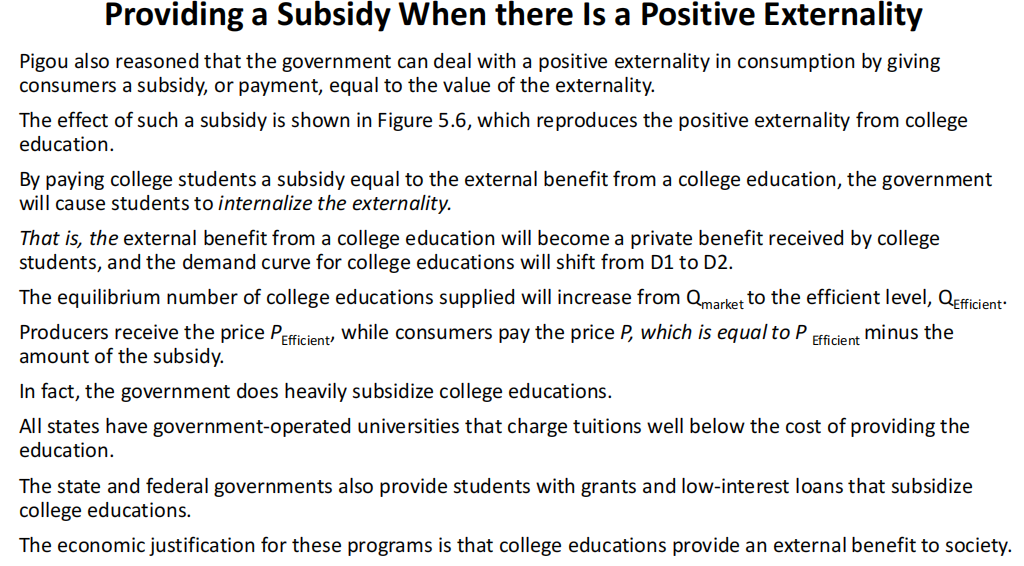
Providing a Subsidy When there Is a Positive Externality (当存在正外部性时提供补贴)
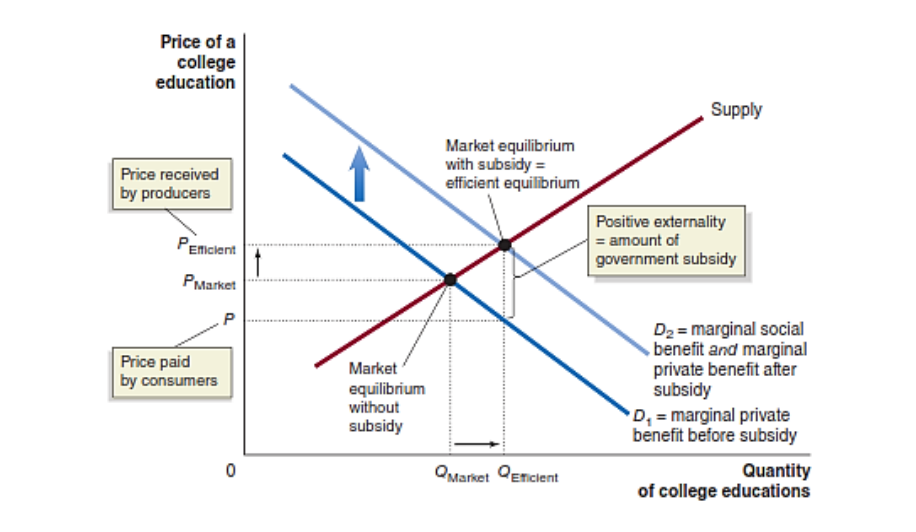
Pigou also reasoned that the government can deal with a positive externality in consumption by giving consumers a subsidy, or payment, equal to the value of the externality.
📖 点击查看译文
庇古还认为,政府可以通过向消费者提供补贴或支付,补贴金额等于外部性的价值,从而应对消费中的正外部性。
The effect of such a subsidy is shown in Figure 5.6, which reproduces the positive externality from college education.
📖 点击查看译文
这种补贴的效果如图 5.6 所示,该图再现了大学教育的正外部性。
By paying college students a subsidy equal to the external benefit from a college education, the government will cause students to internalize the externality.
📖 点击查看译文
通过支付给大学生等于大学教育外部收益的补贴,政府将促使学生内部化正外部性。
That is, the external benefit from a college education will become a private benefit received by college students, and the demand curve for college educations will shift from D1 to D2.
📖 点击查看译文
也就是说,大学教育的外部效益将成为大学生获得的私人成本,大学教育的需求曲线将从 D1 移动到 D2。
The equilibrium number of college educations supplied will increase from Qmarket to the efficient level, QEfficient.
📖 点击查看译文
大学教育的供给数量将从 Qmarket 增加到高效水平 QEfficient。
Producers receive the price PEfficient, while consumers pay the price P, which is equal to PEfficient minus the amount of the subsidy.
📖 点击查看译文
生产者将获得价格 PEfficient,而消费者支付价格 P,P 等于 PEfficient 减去补贴金额。
In fact, the government does heavily subsidize college educations.
📖 点击查看译文
事实上,政府确实大力补贴大学教育。
All states have government-operated universities that charge tuitions well below the cost of providing the education.
📖 点击查看译文
所有州都有政府运营的大学,其学费远低于提供教育的成本。
The state and federal governments also provide students with grants and low-interest loans that subsidize college educations.
📖 点击查看译文
州政府和联邦政府还为学生提供助学金和低利息贷款,用以补贴大学教育。
The economic justification for these programs is that college educations provide an external benefit to society.
📖 点击查看译文
这些项目的经济理由是大学教育为社会提供了外部效益。
知识点列表与拓展 (Knowledge Points and Extensions):
1. Subsidy for Positive Externality (正外部性的补贴)
-
解释 (Explanation):
A subsidy for a positive externality is a payment made by the government to encourage the production or consumption of a good or service that generates external benefits.
(正外部性的补贴是政府为鼓励生产或消费带来外部效益的商品或服务而提供的支付。)
-
例子 (Example):
Government grants to students for pursuing higher education are subsidies aimed at encouraging the positive externalities associated with education, such as increased societal productivity.
(政府为鼓励学生接受高等教育而提供的助学金是补贴,旨在促进教育所带来的正外部性,如提高社会生产力。)
-
拓展 (Extension):
While subsidies can promote the desired outcome, they may also lead to inefficiencies if the subsidized activity is overproduced or if there is insufficient oversight on the use of funds.
(虽然补贴可以促进预期的结果,但如果补贴活动过度生产或对资金使用监管不足,也可能导致低效。)
7
8
Pigovian Taxes and Subsidies (庇古税与补贴)
Because Pigou was the first economist to propose using government taxes and subsidies to deal with externalities, they are sometimes referred to as Pigovian taxes and subsidies.
📖 点击查看译文
因为庇古是第一个提出使用政府税收和补贴来解决外部性问题的经济学家,所以这些税收和补贴有时被称为庇古税和庇古补贴。
Note that a Pigovian tax eliminates deadweight loss and improves economic efficiency, unlike most taxes, which are intended simply to raise revenue and can reduce consumer surplus and producer surplus and create a deadweight loss.
📖 点击查看译文
注意,庇古税消除了无谓损失并提高了经济效率,而大多数税收仅仅是为了增加收入,可能会减少消费者剩余和生产者剩余,并造成无谓损失。
In fact, one reason that economists support Pigovian taxes as a way to deal with negative externalities is that the government can use the revenues raised by Pigovian taxes to lower other taxes that reduce economic efficiency.
📖 点击查看译文
事实上,经济学家支持庇古税作为应对负外部性的一种方式的原因之一是,政府可以利用庇古税收的收入来降低其他减少经济效率的税收。
For instance, the Canadian province of British Columbia has enacted a Pigovian tax on carbon dioxide emissions and uses the revenue raised to reduce personal income taxes.
📖 点击查看译文
例如,加拿大不列颠哥伦比亚省已对二氧化碳排放征收庇古税,并利用征收的收入降低个人所得税。
知识点列表与拓展 (Knowledge Points and Extensions):
1. Pigovian Taxes and Subsidies (庇古税与补贴)
-
解释 (Explanation):
Pigovian taxes and subsidies are economic policies designed to correct market inefficiencies caused by externalities. A Pigovian tax is intended to reduce negative externalities, while a Pigovian subsidy encourages positive externalities.
(庇古税与补贴是旨在纠正外部性造成的市场低效的经济政策。庇古税旨在减少负外部性,而庇古补贴则鼓励正外部性。)
-
例子 (Example):
A Pigovian tax on pollution helps to reduce harmful emissions, while a Pigovian subsidy for education encourages more people to invest in their education for the benefit of society.
(对污染征收庇古税有助于减少有害排放,而对教育提供庇古补贴则鼓励更多人投资教育,从而惠及社会。)
-
拓展 (Extension):
While Pigovian taxes and subsidies are efficient tools for addressing externalities, they require accurate estimation of external costs and benefits and proper monitoring to ensure their effectiveness.
(虽然庇古税与补贴是解决外部性的有效工具,但它们需要准确估算外部成本与效益,并进行适当的监管以确保其有效性。)
9
Command-and-Control versus Market-Based Approaches (命令与控制方法与市场导向方法)
Although the federal government has sometimes used taxes and subsidies to deal with externalities, it has more frequently used a command-and-control approach to deal with pollution.
📖 点击查看译文
虽然联邦政府有时使用税收和补贴来处理外部性,但它更常使用命令与控制方法来应对污染。
A command-and-control approach to reducing pollution involves the government imposing quantitative limits on the amount of pollution firms are allowed to emit or requiring firms to install specific pollution control devices.
📖 点击查看译文
命令与控制方法减少污染是指政府对企业排放污染物的数量设定定量限制,或者要求企业安装特定的污染控制设备。
For example, in the 1980s, the federal government required auto manufacturers such as Ford and General Motors to install catalytic converters to reduce auto emissions on all new automobiles.
📖 点击查看译文
例如,在1980年代,联邦政府要求福特和通用汽车等汽车制造商在所有新车上安装催化转化器,以减少汽车排放。
Congress could have used a command-and-control approach to achieve its goal of reducing sulfur dioxide emissions by 8.5 million tons per year by 2010.
📖 点击查看译文
国会本可以使用命令与控制方法实现其目标,即到2010年每年减少850万吨二氧化硫排放。
However, this approach would not have been an economically efficient solution to the problem because utilities can have very different costs of reducing sulfur dioxide emissions.
📖 点击查看译文
然而,这种方法并不会是经济上高效的解决方案,因为各个公用事业减少二氧化硫排放的成本差异很大。
Some utilities that already used low-sulfur coal could reduce emissions further only at a high cost.
📖 点击查看译文
一些已经使用低硫煤的公用事业只能以高成本进一步减少排放。
Other utilities, particularly those in the Midwest, were able to reduce emissions at a lower cost.
📖 点击查看译文
其他公用事业,特别是中西部地区的公用事业,能够以较低的成本减少排放。
Congress decided to use a market-based approach to reducing sulfur dioxide emissions by setting up a cap-and-trade system of tradable emission allowances.
📖 点击查看译文
国会决定通过建立可交易排放配额的限额与交易制度,使用市场导向的方法减少二氧化硫排放。
The federal government gave allowances to utilities equal to the total target amount of sulfur dioxide emissions.
📖 点击查看译文
联邦政府向公用事业公司提供的排放配额总量等于二氧化硫排放的目标总量。
The utilities were then free to buy and sell the allowances.
📖 点击查看译文
然后,公用事业公司可以自由买卖这些排放配额。
知识点列表与拓展 (Knowledge Points and Extensions):
1. Command-and-Control Approach (命令与控制方法)
-
解释 (Explanation):
A command-and-control approach involves the government setting regulations that impose specific limits on pollution emissions or mandating pollution control technologies for firms.
(命令与控制方法是指政府通过设定法规对污染排放设定具体限制,或强制企业安装污染控制技术。)
-
例子 (Example):
Requiring auto manufacturers to install catalytic converters in cars to reduce emissions is an example of a command-and-control regulation.
(要求汽车制造商在汽车上安装催化转化器以减少排放是命令与控制方法的一个例子。)
-
拓展 (Extension):
While effective in controlling pollution, command-and-control policies can be inefficient if different firms face varying costs for compliance.
(虽然命令与控制政策在控制污染方面有效,但如果不同企业面临不同的合规成本,这些政策可能是低效的。)
2. Market-Based Approach (市场导向方法)
-
解释 (Explanation):
A market-based approach, such as cap-and-trade, allows firms to buy and sell pollution allowances to achieve pollution reduction at the lowest cost.
(市场导向方法,如限额与交易,允许企业买卖污染配额,以最低成本实现污染减少。)
-
例子 (Example):
The cap-and-trade system for sulfur dioxide emissions in the U.S. is an example of a market-based approach.
(美国的二氧化硫排放限额与交易系统是市场导向方法的一个例子。)
-
拓展 (Extension):
Market-based approaches can be more economically efficient than command-and-control methods by allowing firms with lower reduction costs to sell allowances to firms with higher reduction costs.
(市场导向方法比命令与控制方法更具经济效率,因为它允许具有较低减排成本的企业将配额卖给减排成本较高的企业。)
10
Market-Based Approaches in Pollution Control (市场导向方法在污染控制中的应用)
An active market where the allowances could be bought and sold was conducted on the Chicago Mercantile Exchange.
📖 点击查看译文
一个活跃的市场,允许配额的买卖,是在芝加哥商品交易所进行的。
Utilities that could reduce emissions at low cost did so and sold their allowances.
📖 点击查看译文
那些能够以低成本减少排放的公用事业公司就这样做,并出售它们的配额。
Utilities that could only reduce emissions at high cost bought allowances.
📖 点击查看译文
那些只能以高成本减少排放的公用事业公司则购买配额。
Using tradable emission allowances to reduce acid rain was a success in that it made it possible for utilities to meet Congress’s emissions goal at a much lower cost than expected.
📖 点击查看译文
使用可交易排放配额减少酸雨是成功的,因为它使得公用事业公司能够以远低于预期的成本实现国会的排放目标。
Just before Congress enacted the allowances program in 1990, the Edison Electric Institute estimated that the cost to utilities of complying with the program would be $7.4 billion by 2010.
📖 点击查看译文
就在国会于1990年实施配额计划之前,爱迪生电力协会估计,公用事业公司遵守该计划的成本将在2010年达到74亿美元。
By 1994, the federal government’s General Accounting Office estimated that the cost would be less than $2 billion.
📖 点击查看译文
到1994年,联邦政府的总务会计办公室估计,成本将低于20亿美元。
In practice, the cost was almost 90 percent less than the initial estimate, or only about $870 million.
📖 点击查看译文
实际上,成本比初始估算低了近90%,仅约为8.7亿美元。
知识点列表与拓展 (Knowledge Points and Extensions):
1. Tradable Emission Allowances (可交易排放配额)
-
解释 (Explanation):
Tradable emission allowances are permits that allow firms to emit a certain amount of pollution, which can be bought or sold in a market.
(可交易排放配额是允许企业排放一定量污染的许可证,可以在市场中买卖。)
-
例子 (Example):
In the U.S. sulfur dioxide reduction program, utilities could trade emission allowances to meet pollution reduction goals.
(在美国的二氧化硫减排计划中,公用事业公司可以交易排放配额,以实现减排目标。)
-
拓展 (Extension):
This market-based approach allows for flexibility in how firms reduce pollution and provides economic efficiency by allocating reductions to those who can achieve them at the lowest cost.
(这种市场导向方法允许企业在减少污染的方式上有更大的灵活性,并通过将减排任务分配给那些能以最低成本实现减排的公司来提高经济效率。)
2. Cost Reductions through Market-Based Approaches (通过市场导向方法降低成本)
-
解释 (Explanation):
Market-based approaches like tradable allowances can help achieve environmental goals at lower costs than command-and-control methods.
(像可交易配额这样的市场导向方法可以以比命令与控制方法更低的成本实现环境目标。)
-
例子 (Example):
The U.S. sulfur dioxide program saw costs come in at 90% below the original estimate due to the flexibility provided by tradable allowances.
(美国的二氧化硫减排计划由于可交易配额提供的灵活性,成本比原始估算低了90%。)
-
拓展 (Extension):
By allowing firms with low abatement costs to sell allowances to those with higher costs, market-based approaches maximize the overall efficiency of pollution reduction.
(通过允许低减排成本的公司将配额卖给减排成本较高的公司,市场导向方法最大化了污染减排的整体效率。)
11
The End of the Sulfur Dioxide Cap-and-Trade System (二氧化硫配额交易系统的结束)
The dollar value of the total benefits of reducing sulfur dioxide emissions turned out to be at least 25 times as large as the costs.
📖 点击查看译文
减少二氧化硫排放的总收益的美元价值最终发现至少是成本的25倍。
Despite its successes, however, the sulfur dioxide cap-and-trade system had effectively ended by 2013.
📖 点击查看译文
然而,尽管取得了成功,二氧化硫配额交易系统在2013年实际上已经结束。
Over the years, research showed that the amount of illnesses caused by sulfur dioxide emissions was greater than had been thought.
📖 点击查看译文
多年来,研究表明,二氧化硫排放造成的疾病比原先认为的要多。
In response to these findings, President George W. Bush proposed legislation lowering the cap on sulfur dioxide emissions, but Congress did not pass the legislation.
📖 点击查看译文
针对这些发现,乔治·W·布什总统提议立法降低二氧化硫排放的上限,但国会未通过该法案。
Court rulings kept the Environmental Protection Agency (EPA) from using regulations to set up a new trading system for sulfur dioxide allowances with a lower cap.
📖 点击查看译文
法院裁决使得环境保护局(EPA)无法通过法规设立一个新的二氧化硫排放配额交易系统,并降低排放上限。
As a result, the EPA reverted to the previous system of setting limits on sulfur dioxide emissions at the state or individual power plant level.
📖 点击查看译文
因此,EPA回归到之前的系统,在州或单个电厂层面设定二氧化硫排放限额。
Because nationwide trading of emission allowances was no longer possible, the allowances lost their value.
📖 点击查看译文
由于全国范围内的排放配额交易不再可能,配额失去了它们的价值。
Many economists continue to believe that using market-based policies, such as the sulfur dioxide cap-and-trade system, is an efficient way to deal with the externalities of pollution.
📖 点击查看译文
许多经济学家仍然认为,使用市场导向政策(如二氧化硫配额交易系统)是处理污染外部性的一种高效方式。
But in the end, any policy requires substantial political support to be enacted and maintained.
📖 点击查看译文
但最终,任何政策都需要大量的政治支持才能实施和维持。
知识点列表与拓展 (Knowledge Points and Extensions):
1. Political Support in Environmental Policy (环境政策中的政治支持)
-
解释 (Explanation):
The success of environmental policies often depends on the political will to pass and maintain them.
(环境政策的成功通常依赖于通过和维持这些政策的政治意愿。)
-
例子 (Example):
The failure to pass legislation to lower the sulfur dioxide emission cap shows the importance of political support in environmental policy.
(未通过降低二氧化硫排放上限的立法显示了政治支持在环境政策中的重要性。)
-
拓展 (Extension):
Even well-designed market-based environmental policies can fail without sufficient political backing.
(即使是设计良好的市场导向环境政策,没有足够的政治支持也可能失败。)
2. Market-Based Policies and Externalities (市场导向政策与外部性)
-
解释 (Explanation):
Market-based policies, such as cap-and-trade systems, aim to address externalities by providing economic incentives to reduce pollution.
(市场导向政策,如配额交易系统,旨在通过提供经济激励来减少污染,从而应对外部性问题。)
-
例子 (Example):
The sulfur dioxide cap-and-trade system helped reduce emissions more cost-effectively than traditional command-and-control approaches.
(二氧化硫配额交易系统比传统的命令与控制方法更具成本效益地减少了排放。)
-
拓展 (Extension):
Market-based solutions are often more flexible and efficient than command-and-control regulations, but they still require strong regulatory frameworks and political stability.
(市场导向解决方案通常比命令与控制法规更灵活和高效,但仍然需要强有力的监管框架和政治稳定性。)
12
Are Tradable Emission Allowances Licenses to Pollute? (可交易排放配额是污染许可证吗?)
Tradable emission allowances face a political problem because some environmentalists have criticized them for being licenses to pollute.
📖 点击查看译文
可交易排放配额面临一个政治问题,因为一些环保主义者批评它们是污染许可证。
These environmentalists argue that just as the government does not issue licenses to rob banks or drive drunk, it should not issue licenses to pollute.
📖 点击查看译文
这些环保主义者认为,就像政府不会发放抢银行或酒后驾车的许可证一样,也不应该发放污染许可证。
But, this criticism ignores one of the central lessons of economics: Because resources are scarce, trade-offs exist.
📖 点击查看译文
但是,这种批评忽略了经济学的一个核心教训:因为资源是稀缺的,所以存在权衡。
Resources that are spent on reducing one type of pollution are not available to reduce other types of pollution or for any other use.
📖 点击查看译文
用于减少一种污染的资源不能用于减少其他类型的污染或用于其他用途。
Because reducing acid rain using tradable emission allowances cost utilities 7.4 billion, as originally estimated, society saved more than $6.5 billion per year.
📖 点击查看译文
因为通过可交易排放配额减少酸雨的费用是每年8.7亿美元,而不是最初估计的74亿美元,社会每年节省了超过65亿美元。
知识点列表与拓展 (Knowledge Points and Extensions):
1. Tradable Emission Allowances (可交易排放配额)
-
解释 (Explanation):
Tradable emission allowances are permits that allow firms to emit a certain amount of pollutants, which can be bought or sold in a market.
(可交易排放配额是允许企业排放一定量污染物的许可证,这些配额可以在市场上购买或出售。)
-
例子 (Example):
The sulfur dioxide cap-and-trade system used tradable emission allowances to reduce acid rain.
(二氧化硫配额交易系统使用可交易排放配额来减少酸雨。)
-
拓展 (Extension):
While critics argue that tradable allowances are licenses to pollute, they can lead to cost-effective pollution reduction by allowing market forces to determine the most efficient ways to cut emissions.
(尽管批评者认为可交易配额是污染许可证,但它们可以通过让市场力量决定最有效的减排方式,从而实现成本效益的污染减少。)
2. Trade-offs in Economics (经济学中的权衡)
-
解释 (Explanation):
In economics, trade-offs occur when scarce resources are allocated between different uses, meaning that allocating resources to one area reduces their availability for others.
(在经济学中,当稀缺资源在不同用途之间分配时,会发生权衡,这意味着将资源分配到一个领域会减少它们用于其他领域的可用性。)
-
例子 (Example):
Using resources to reduce one form of pollution, such as acid rain, means those resources are not available to reduce other forms of pollution.
(使用资源减少一种污染(如酸雨)意味着这些资源无法用于减少其他类型的污染。)
-
拓展 (Extension):
The concept of trade-offs is essential for understanding the efficiency of market-based policies like tradable emission allowances, which seek to achieve the best outcome with limited resources.
(权衡的概念对于理解市场导向政策(如可交易排放配额)的效率至关重要,这些政策旨在利用有限资源实现最佳结果。)
13
Four Categories of Goods (商品的四种分类)
Goods can be categorized on the basis of whether they are rival or excludable.
📖 点击查看译文
商品可以根据它们是否具有竞争性和排他性来分类。
We can explore further the question of when the market is likely to succeed in supplying the efficient quantity of a good by understanding that goods differ on the basis of whether their consumption is rival and excludable:
📖 点击查看译文
我们可以进一步探讨市场何时可能成功地提供有效数量的商品,通过理解商品在其消费是否具有竞争性和排他性方面的不同。
Rivalry occurs when one person’s consumption of a unit of a good means no one else can consume it.
📖 点击查看译文
竞争性是指一个人消费一单位商品意味着其他人无法消费它。
If you consume a Big Mac, for example, no one else can consume it.
📖 点击查看译文
例如,如果你吃了一个巨无霸,其他人就无法再吃它了。
Excludability means that anyone who does not pay for a good cannot consume it.
📖 点击查看译文
排他性是指任何不为商品付费的人无法消费它。
If you don’t pay for a Big Mac, McDonald’s can exclude you from consuming it.
📖 点击查看译文
如果你没有为巨无霸付费,麦当劳可以将你排除在消费之外。
The consumption of a Big Mac is therefore rival and excludable.
📖 点击查看译文
因此,巨无霸的消费是具有竞争性和排他性的。
The consumption of some goods, however, can be either nonrival or nonexcludable:
📖 点击查看译文
然而,一些商品的消费可以是非竞争性的或非排他性的:
Nonrival means that one person’s consumption does not interfere with another person’s consumption.
📖 点击查看译文
非竞争性是指一个人的消费不会干扰另一个人的消费。
Nonexcludable means that it is impossible to exclude others from consuming the good, whether they have paid for it or not.
📖 点击查看译文
非排他性是指无论他人是否为商品付费,都无法将其排除在消费之外。
Figure 5.7 shows four possible categories into which goods can fall.
📖 点击查看译文
图5.7显示了商品可能归类的四种类别。
We next consider each of the four categories:
📖 点击查看译文
接下来,我们将考虑这四个类别:
知识点列表与拓展 (Knowledge Points and Extensions):
1. Rivalry (竞争性)
-
解释 (Explanation):
Rivalry refers to a situation where one person’s consumption of a good prevents others from consuming it.
(竞争性是指一个人消费某商品会阻止其他人消费该商品的情况。)
-
例子 (Example):
A concert ticket is rival because once one person buys the ticket, others cannot attend the concert.
(音乐会门票是具有竞争性的,因为一旦一个人购买了门票,其他人就不能再参加演唱会。)
-
拓展 (Extension):
The concept of rivalry is essential in understanding market dynamics, as it affects how resources are allocated and the efficiency of supply.
(竞争性的概念对于理解市场动态至关重要,因为它影响资源的分配方式和供应的效率。)
2. Excludability (排他性)
-
解释 (Explanation):
Excludability means that it is possible to prevent someone from consuming a good if they do not pay for it.
(排他性意味着如果某人不为商品付费,就可以阻止他们消费该商品。)
-
例子 (Example):
Subscription-based streaming services are excludable because only paying customers can access the content.
(基于订阅的流媒体服务是具有排他性的,因为只有付费用户才能访问内容。)
-
拓展 (Extension):
Excludability is a key factor in determining whether a good is a private good or a public good.
(排他性是决定商品是私有商品还是公共商品的关键因素。)
3. Nonrival (非竞争性)
-
解释 (Explanation):
Nonrival goods are those where one person’s consumption does not affect another person’s consumption.
(非竞争性商品是指一个人的消费不会影响另一个人的消费。)
-
例子 (Example):
National defense is nonrival because one person benefiting from protection does not reduce the protection available to others.
(国家防御是非竞争性的,因为一个人从保护中受益并不会减少对其他人的保护。)
-
拓展 (Extension):
Nonrival goods often lead to market failure because they are typically public goods, which are underprovided by the market.
(非竞争性商品通常会导致市场失灵,因为它们通常是公共商品,市场提供不足。)
4. Nonexcludable (非排他性)
-
解释 (Explanation):
Nonexcludable goods are those where it is difficult or impossible to prevent someone from using the good.
(非排他性商品是指很难或不可能阻止某人使用该商品的商品。)
-
例子 (Example):
Clean air is nonexcludable because it is impossible to prevent anyone from breathing it.
(清洁空气是非排他性的,因为无法阻止任何人呼吸它。)
-
拓展 (Extension):
Nonexcludable goods are typically public goods, and their provision often requires government intervention to ensure adequate supply.
(非排他性商品通常是公共商品,其提供通常需要政府干预以确保充足供应。)
14
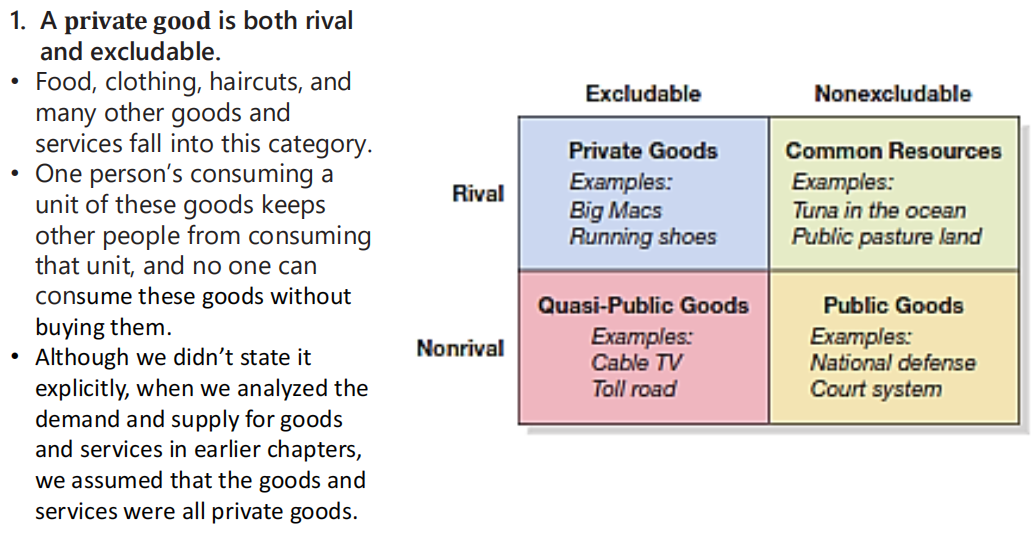
Private Goods (私有商品)
1. A private good is both rival and excludable.
📖 点击查看译文
私有商品既具有竞争性又具有排他性。
• Food, clothing, haircuts, and many other goods and services fall into this category.
📖 点击查看译文
食品、衣物、理发和许多其他商品和服务属于这一类别。
• One person’s consuming a unit of these goods keeps other people from consuming that unit, and no one can consume these goods without buying them.
📖 点击查看译文
一个人消费了这些商品的一单位就会阻止其他人消费该单位,而且没有购买这些商品的人不能消费它们。
• Although we didn’t state it explicitly, when we analyzed the demand and supply for goods and services in earlier chapters, we assumed that the goods and services were all private goods.
📖 点击查看译文
尽管我们没有明确说明,但在之前的章节中分析商品和服务的需求与供给时,我们假设这些商品和服务都是私有商品。
知识点列表与拓展 (Knowledge Points and Extensions):
1. Private Goods (私有商品)
-
解释 (Explanation):
A private good is one that is both rival and excludable. This means that one person’s consumption prevents others from consuming it, and individuals must pay to consume it.
(私有商品是既具有竞争性又具有排他性的商品。这意味着一个人的消费会阻止其他人消费它,而且个人必须为消费它支付费用。)
-
例子 (Example):
A pair of shoes is a private good because if one person buys it, no one else can use that pair, and only those who pay for it can own it.
(一双鞋是私有商品,因为如果一个人购买了它,其他人就无法使用那双鞋,只有付费的人才能拥有它。)
-
拓展 (Extension):
Private goods are typically efficiently allocated by the market, as prices reflect both scarcity and consumer demand.
(私有商品通常通过市场高效分配,因为价格反映了稀缺性和消费者需求。)
15
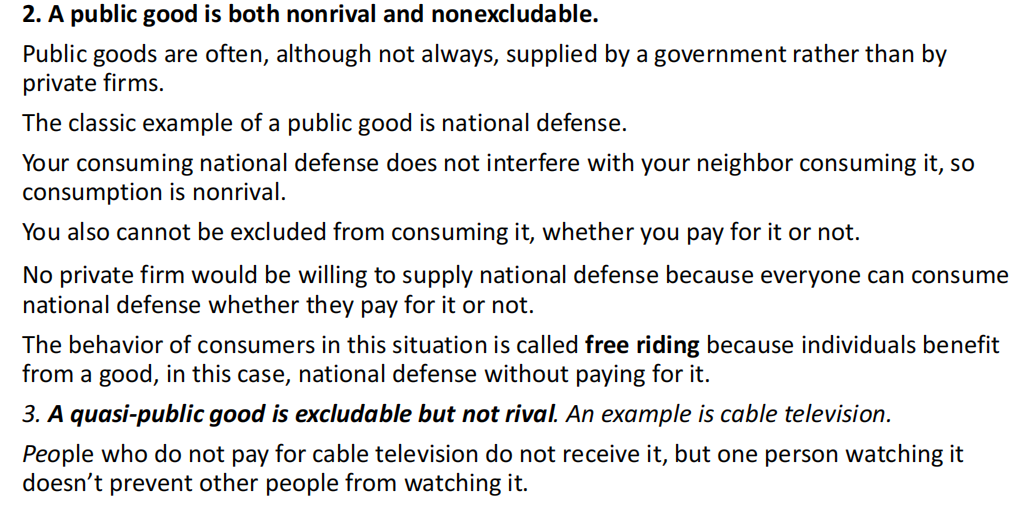
Public Goods (公共商品)
2. A public good is both nonrival and nonexcludable.
📖 点击查看译文
公共商品既是非竞争性的又是非排他性的。
• Public goods are often, although not always, supplied by a government rather than by private firms.
📖 点击查看译文
公共商品通常由政府提供,尽管不是总是如此,而不是由私人公司提供。
• The classic example of a public good is national defense.
📖 点击查看译文
公共商品的经典例子是国家防卫。
• Your consuming national defense does not interfere with your neighbor consuming it, so consumption is nonrival.
📖 点击查看译文
你消费国家防卫并不妨碍邻居消费它,因此消费是非竞争性的。
• You also cannot be excluded from consuming it, whether you pay for it or not.
📖 点击查看译文
无论你是否为其支付费用,你都无法被排除在外,不能阻止你消费它。
• No private firm would be willing to supply national defense because everyone can consume national defense whether they pay for it or not.
📖 点击查看译文
没有私人公司愿意提供国家防卫,因为无论是否支付费用,每个人都能消费国家防卫。
• The behavior of consumers in this situation is called free riding because individuals benefit from a good, in this case, national defense without paying for it.
📖 点击查看译文
在这种情况下,消费者的行为被称为搭便车,因为个人在没有支付的情况下从商品(此例中为国家防卫)中获益。
Quasi-Public Goods (准公共商品)
• A quasi-public good is excludable but not rival. An example is cable television.
📖 点击查看译文
准公共商品是可排除的但非竞争性的。例如有线电视。
• People who do not pay for cable television do not receive it, but one person watching it doesn’t prevent other people from watching it.
📖 点击查看译文
没有支付有线电视费用的人无法接收电视信号,但一个人观看并不妨碍其他人观看。
知识点列表与拓展 (Knowledge Points and Extensions):
2. Public Goods (公共商品)
-
解释 (Explanation):
A public good is a good that is nonrival (one person’s consumption does not reduce the availability for others) and nonexcludable (no one can be excluded from consuming it).
(公共商品是既非竞争性又非排他性的商品,一个人消费它不会减少其他人消费的机会,并且无法排除任何人消费它。)
-
例子 (Example):
National defense is a classic example of a public good, as it benefits everyone without reducing its availability to others.
(国家防卫是公共商品的经典例子,因为它惠及每个人,而不会减少其他人的可得性。)
-
拓展 (Extension):
Public goods often lead to market failures because of the free rider problem, where people benefit without contributing to the cost.
(公共商品通常会导致市场失败,因为搭便车问题,导致人们在不承担成本的情况下受益。)
16
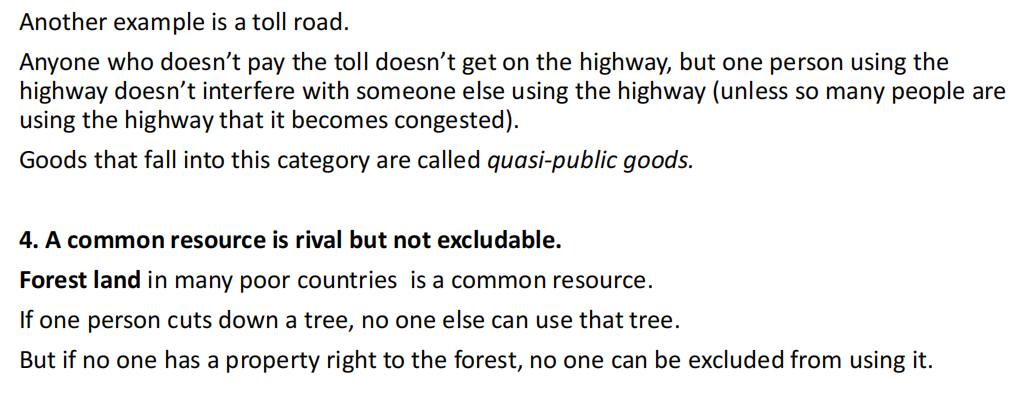
Quasi-Public Goods (准公共商品)
• Another example is a toll road.
📖 点击查看译文
另一个例子是收费公路。
• Anyone who doesn’t pay the toll doesn’t get on the highway, but one person using the highway doesn’t interfere with someone else using the highway (unless so many people are using the highway that it becomes congested).
📖 点击查看译文
没有支付过路费的人无法上高速公路,但一个人使用公路并不妨碍其他人使用公路(除非使用公路的人数过多,导致拥堵)。
• Goods that fall into this category are called quasi-public goods.
📖 点击查看译文
属于这一类的商品被称为准公共商品。
Common Resources (公共资源)
• A common resource is rival but not excludable.
📖 点击查看译文
公共资源是具有竞争性但非排他性的。
• Forest land in many poor countries is a common resource.
📖 点击查看译文
许多贫困国家的森林土地是公共资源。
• If one person cuts down a tree, no one else can use that tree.
📖 点击查看译文
如果一个人砍伐了一棵树,其他人就无法再利用这棵树。
• But if no one has a property right to the forest, no one can be excluded from using it.
📖 点击查看译文
但是,如果没有人拥有森林的所有权,没人能排除其他人使用它。
知识点列表与拓展 (Knowledge Points and Extensions):
3. Quasi-Public Goods (准公共商品)
-
解释 (Explanation):
A quasi-public good is a good that is excludable but not rival. This means that people who do not pay for it can be excluded, but one person’s consumption does not interfere with others.
(准公共商品是可排除但非竞争性的商品,这意味着不支付费用的人会被排除在外,但一个人消费并不妨碍其他人的消费。)
-
例子 (Example):
Toll roads are an example of quasi-public goods because access is restricted to those who pay the toll, but one person’s use does not prevent another person from using it (unless there is congestion).
(收费公路是准公共商品的例子,因为只有支付过路费的人才能使用,但一个人的使用并不会妨碍他人的使用(除非发生拥堵)。)
4. Common Resources (公共资源)
-
解释 (Explanation):
A common resource is a good that is rival but not excludable. This means that one person’s consumption of the resource reduces the availability of the resource for others, but it is difficult to exclude people from using it.
(公共资源是具有竞争性但非排他性的商品,这意味着一个人的消费减少了他人使用该资源的机会,但很难将人们排除在使用之外。)
-
例子 (Example):
Forest land in many poor countries is a common resource. If one person cuts down a tree, no one else can use that tree, but no one can prevent others from using the forest.
(许多贫困国家的森林土地是公共资源。如果一个人砍伐了一棵树,其他人无法使用这棵树,但没人能够阻止他人使用森林。)
-
拓展 (Extension):
Overuse of common resources, often referred to as the “tragedy of the commons,” occurs when individuals overconsume a resource without regard to the long-term consequences for others.
(公共资源的过度使用,通常被称为“公地悲剧”,发生在个人在没有考虑长期后果的情况下过度消费资源时。)
17
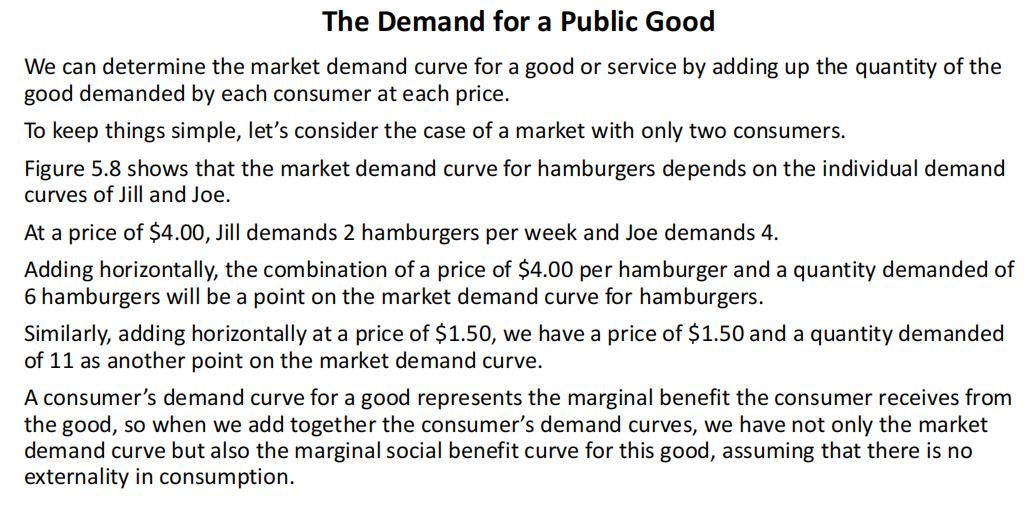
The Demand for a Public Good (公共商品的需求)
• We can determine the market demand curve for a good or service by adding up the quantity of the good demanded by each consumer at each price.
📖 点击查看译文
我们可以通过将每个消费者在每个价格下所需求的商品数量相加来确定商品或服务的市场需求曲线。
• To keep things simple, let’s consider the case of a market with only two consumers.
📖 点击查看译文
为了简单起见,我们假设市场中只有两个消费者。
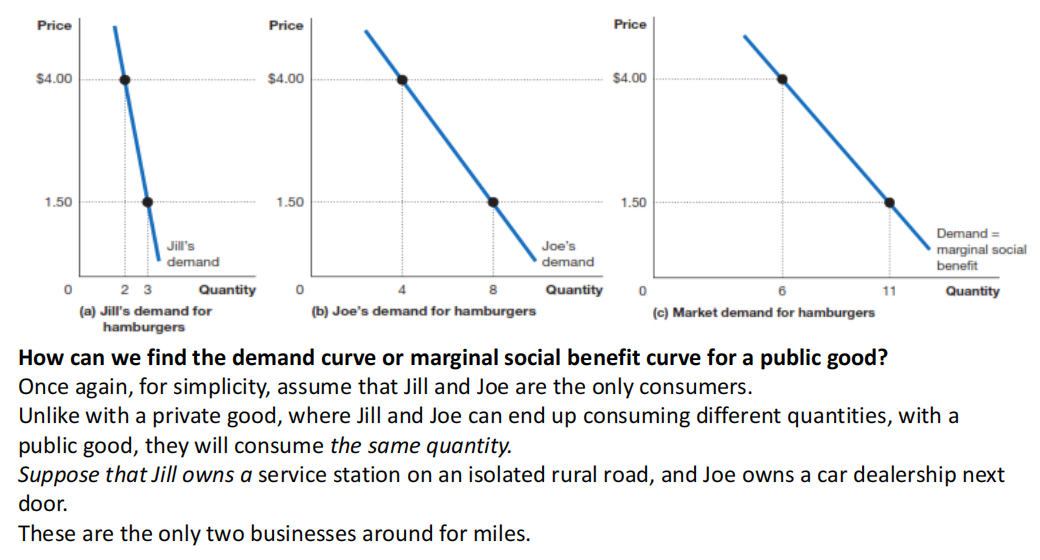
• Figure 5.8 shows that the market demand curve for hamburgers depends on the individual demand curves of Jill and Joe.
📖 点击查看译文
图5.8显示了汉堡的市场需求曲线依赖于Jill和Joe的个人需求曲线。
• At a price of $4.00, Jill demands 2 hamburgers per week and Joe demands 4.
📖 点击查看译文
当价格为4.00美元时,Jill每周需求2个汉堡,而Joe需求4个。
• Adding horizontally, the combination of a price of $4.00 per hamburger and a quantity demanded of 6 hamburgers will be a point on the market demand curve for hamburgers.
📖 点击查看译文
通过水平加法,价格为每个汉堡4.00美元,需求数量为6个汉堡的组合将是汉堡市场需求曲线上的一个点。
• Similarly, adding horizontally at a price of 1.50 and a quantity demanded of 11 as another point on the market demand curve.
📖 点击查看译文
类似地,通过水平加法,价格为1.50美元时,需求数量为11个汉堡,将是市场需求曲线上的另一个点。
• A consumer’s demand curve for a good represents the marginal benefit the consumer receives from the good, so when we add together the consumer’s demand curves, we have not only the market demand curve but also the marginal social benefit curve for this good, assuming that there is no externality in consumption.
📖 点击查看译文
消费者对商品的需求曲线代表了消费者从商品中获得的边际效益,因此当我们将消费者的需求曲线加在一起时,我们不仅得到了市场需求曲线,还得到了该商品的边际社会效益曲线,假设消费中没有外部性。
知识点列表与拓展 (Knowledge Points and Extensions):
1. Market Demand Curve for Public Goods (公共商品的市场需求曲线)
-
解释 (Explanation):
To determine the market demand curve for a good, we add the quantities demanded by individual consumers at each price level.
(为了确定商品的市场需求曲线,我们将每个价格水平下各个消费者的需求数量相加。)
-
举例 (Example):
In the example, if Jill demands 2 hamburgers at $4.00 and Joe demands 4, the total demand at this price is 6 hamburgers. This is a point on the market demand curve.
(在这个例子中,如果Jill在4.00美元时需求2个汉堡,而Joe需求4个,总需求为6个汉堡。这是市场需求曲线上的一个点。)
-
拓展 (Extension):
For public goods, the marginal social benefit curve is derived by adding up individual demand curves horizontally. This is different from private goods, where we add quantities vertically.
(对于公共商品,边际社会效益曲线是通过水平加法将个人需求曲线相加得出的。这与私人商品不同,后者是通过垂直加法得到数量的。)
18
Finding the Demand Curve or Marginal Social Benefit Curve for a Public Good (如何找到公共商品的需求曲线或边际社会效益曲线)
• Unlike with a private good, where Jill and Joe can end up consuming different quantities, with a public good, they will consume the same quantity.
📖 点击查看译文
与私人商品不同,Jill和Joe可能会消费不同数量的商品,而在公共商品中,他们将消费相同数量。
• Suppose that Jill owns a service station on an isolated rural road, and Joe owns a car dealership next door.
📖 点击查看译文
假设Jill在一条偏远的乡村道路上拥有一个加油站,而Joe则在旁边经营着一家汽车经销商。
• These are the only two businesses around for miles.
📖 点击查看译文
这是周围几英里范围内唯一的两家商店。
Knowledge Points and Extensions (知识点与拓展)
1. Public Good Consumption (公共商品消费)
-
Explanation (解释):
For public goods, consumers will consume the same quantity. The marginal social benefit (MSB) curve is found by adding together the individual demand curves vertically because both consumers benefit from the same amount of the good.
(对于公共商品,消费者将消费相同数量。边际社会效益(MSB)曲线通过垂直加法将个体需求曲线加在一起,因为两个消费者都从相同数量的商品中获益。)
-
Example (举例):
In this case, Jill and Joe both consume the same amount of the service station’s good or service (e.g., a roadside rest stop). Their demand curves for the good are added vertically.
(在这个例子中,Jill和Joe都消费相同数量的加油站商品或服务(例如,路边休息站)。他们对该商品的需求曲线通过垂直加法合并。)
-
Extension (拓展):
When the consumption of the good benefits multiple consumers equally, the demand curves are added vertically. This method contrasts with private goods, where the demand curves are added horizontally since individuals consume different quantities.
(当商品的消费对多个消费者都有相同的益处时,需求曲线通过垂直加法合并。这与私人商品不同,私人商品的需求曲线通过水平加法合并,因为每个消费者的消费数量不同。)
18
Finding the Demand Curve for a Public Good (寻找公共商品的需求曲线)
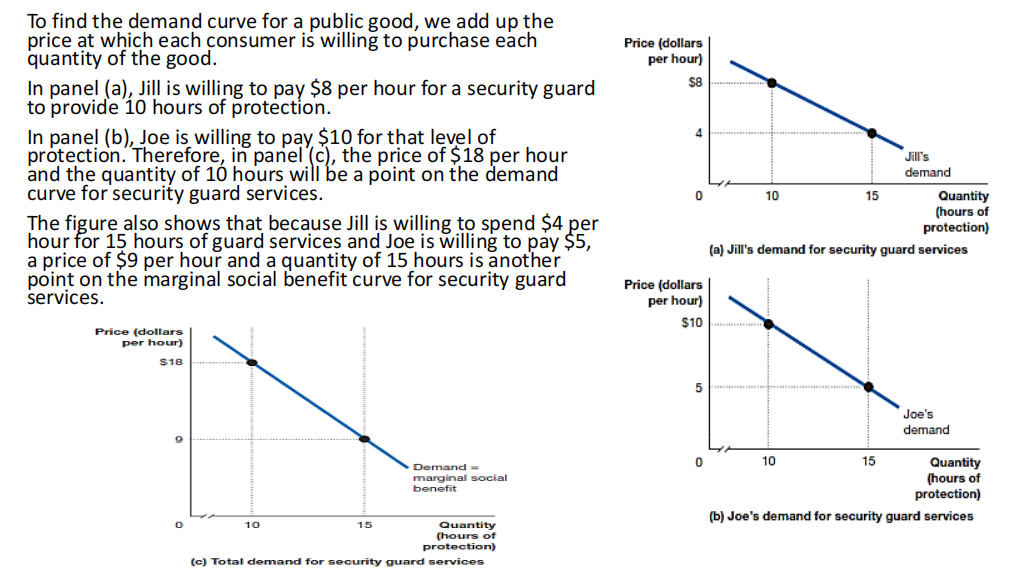
• To find the demand curve for a public good, we add up the price at which each consumer is willing to purchase each quantity of the good.
📖 点击查看译文
为了找到公共商品的需求曲线,我们需要将每个消费者愿意为每个数量的商品支付的价格加在一起。
• In panel (a), Jill is willing to pay $8 per hour for a security guard to provide 10 hours of protection.
📖 点击查看译文
在图表(a)中,Jill愿意为安保人员提供10小时的保护支付每小时8美元。
• In panel (b), Joe is willing to pay 18 per hour and the quantity of 10 hours will be a point on the demand curve for security guard services.
📖 点击查看译文
在图表(b)中,Joe愿意为该级别的保护支付10美元。因此,在图表(c)中,每小时18美元和10小时的数量将成为安保服务需求曲线上的一个点。
• The figure also shows that because Jill is willing to spend 5, a price of $9 per hour and a quantity of 15 hours is another point on the marginal social benefit curve for security guard services.
📖 点击查看译文
图表还显示,由于Jill愿意为15小时的安保服务支付每小时4美元,而Joe愿意支付5美元,因此每小时9美元和15小时的数量是安保服务边际社会效益曲线上的另一个点。
Knowledge Points and Extensions (知识点与拓展)
1. Public Good Demand Curve (公共商品需求曲线)
-
Explanation (解释):
The demand curve for a public good is derived by vertically adding the price each consumer is willing to pay for each quantity of the good. The point on the demand curve represents the total amount consumers are willing to pay for that quantity.
(公共商品的需求曲线通过垂直加总每个消费者愿意为每个数量的商品支付的价格得出。需求曲线上的点表示消费者愿意为该数量支付的总金额。)
-
Example (举例):
In this case, Jill and Joe’s willingness to pay for different quantities of security guard services is combined to form the market demand curve.
(在这个例子中,Jill和Joe愿意为不同数量的安保服务支付的金额被合并形成市场需求曲线。)
-
Extension (拓展):
This method contrasts with private goods, where the demand curves are added horizontally. The concept of marginal social benefit is relevant here because the total willingness to pay for each quantity of the public good reflects the social value of that good.
(这种方法与私人商品不同,私人商品的需求曲线是水平加法。边际社会效益的概念在这里是相关的,因为每个数量的公共商品的总支付意愿反映了该商品的社会价值。)
19
The Optimal Quantity of Public Good (公共商品的最优数量)
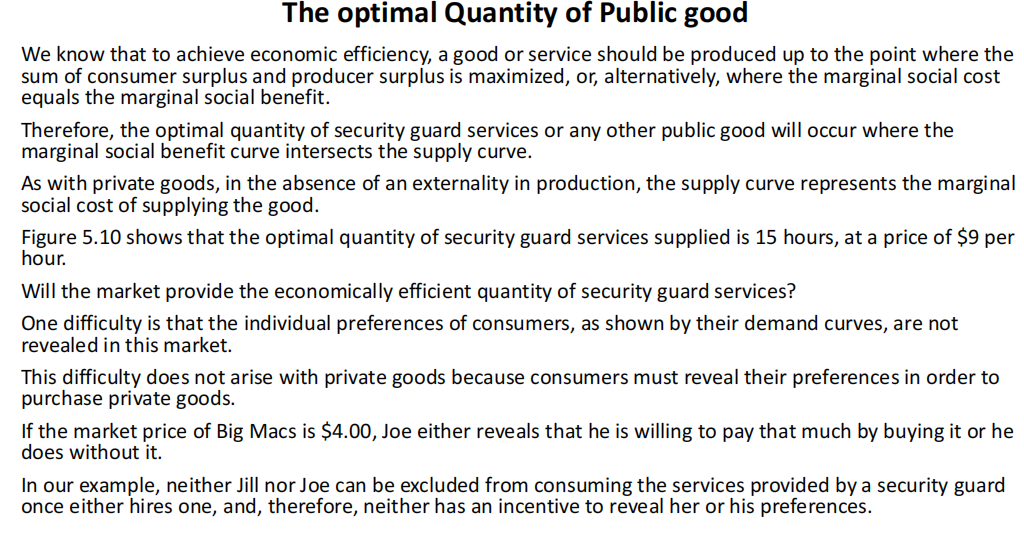
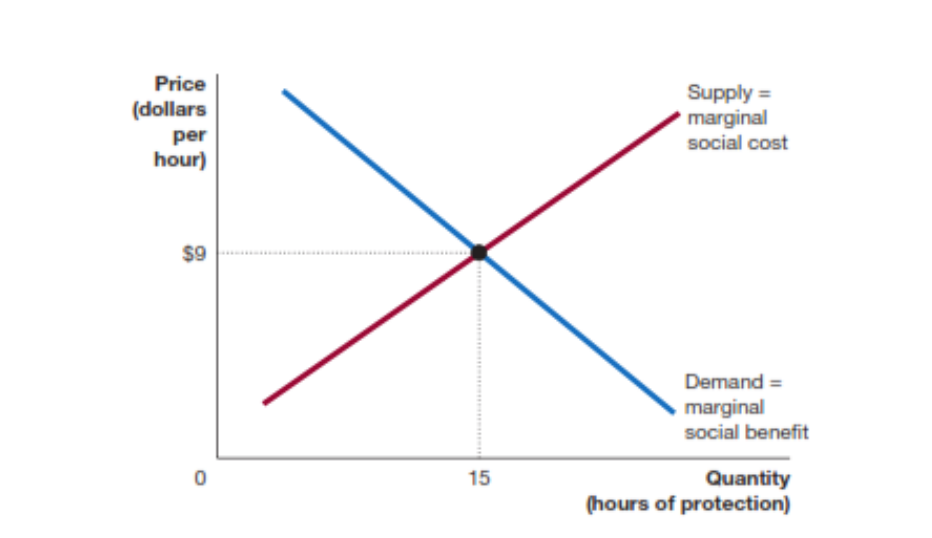
• We know that to achieve economic efficiency, a good or service should be produced up to the point where the sum of consumer surplus and producer surplus is maximized, or, alternatively, where the marginal social cost equals the marginal social benefit.
📖 点击查看译文
为了实现经济效率,商品或服务应该生产到消费者剩余和生产者剩余的总和最大化的程度,或者,换句话说,生产的边际社会成本等于边际社会效益。
• Therefore, the optimal quantity of security guard services or any other public good will occur where the marginal social benefit curve intersects the supply curve.
📖 点击查看译文
因此,安保服务或任何其他公共商品的最优数量将在边际社会效益曲线与供给曲线相交的地方发生。
• As with private goods, in the absence of an externality in production, the supply curve represents the marginal social cost of supplying the good.
📖 点击查看译文
与私人商品一样,在生产中没有外部性时,供给曲线代表提供商品的边际社会成本。
• Figure 5.10 shows that the optimal quantity of security guard services supplied is 15 hours, at a price of $9 per hour.
📖 点击查看译文
图5.10显示,提供的安保服务的最优数量是15小时,价格为每小时9美元。
• Will the market provide the economically efficient quantity of security guard services?
📖 点击查看译文
市场是否会提供经济上高效的安保服务数量?
• One difficulty is that the individual preferences of consumers, as shown by their demand curves, are not revealed in this market.
📖 点击查看译文
一个困难是,消费者的个人偏好(如其需求曲线所示)在这个市场中没有显现出来。
• This difficulty does not arise with private goods because consumers must reveal their preferences in order to purchase private goods.
📖 点击查看译文
这个困难在私人商品中并不存在,因为消费者必须通过购买私人商品来显现其偏好。
• If the market price of Big Macs is $4.00, Joe either reveals that he is willing to pay that much by buying it or he does without it.
📖 点击查看译文
如果Big Mac的市场价格是4美元,Joe要么通过购买它来显现他愿意支付这个价格,要么就不买它。
• In our example, neither Jill nor Joe can be excluded from consuming the services provided by a security guard once either hires one, and therefore, neither has an incentive to reveal her or his preferences.
📖 点击查看译文
在我们的例子中,一旦Jill或Joe雇佣了安保人员,他们都无法被排除在享受该服务之外,因此,他们都没有激励去显现自己的偏好。
Knowledge Points and Extensions (知识点与拓展)
1. Marginal Social Benefit and Marginal Social Cost (边际社会效益与边际社会成本)
-
Explanation (解释):
The optimal quantity of a public good is found where the marginal social benefit equals the marginal social cost. This ensures that the total benefit from consuming the good is maximized while minimizing the costs of production.
(公共商品的最优数量是在边际社会效益等于边际社会成本的地方找到的。这样可以确保从消费商品中获得的总效益最大化,同时最小化生产成本。)
-
Example (举例):
In the case of security guard services, the price at which the marginal social benefit equals the marginal social cost determines the optimal number of hours of service.
(在安保服务的例子中,边际社会效益等于边际社会成本的价格决定了最优的服务小时数。)
-
Extension (拓展):
While the optimal quantity of public goods is theoretically determined by the intersection of supply and demand curves, challenges arise because public goods are nonexcludable, and consumers do not necessarily reveal their preferences. This can lead to inefficiency in the provision of public goods.
(尽管公共商品的最优数量理论上由供给和需求曲线的交点决定,但由于公共商品是不可排除的,消费者不一定显现他们的偏好,因此会导致公共商品提供的低效性。)
20
21
Private Bargaining and Public Goods (私人谈判与公共商品)
• In this case, though, with only two consumers, it is likely that private bargaining will result in an efficient quantity of the public good.
📖 点击查看译文
然而,在只有两个消费者的情况下,私人谈判可能会导致公共商品的有效数量。
• This outcome is not likely for a public good such as national defense that is supplied by the government to millions of consumers.
📖 点击查看译文
对于像国防这样的公共商品,这种结果不太可能发生,因为它是由政府提供给数百万消费者的。
• Governments sometimes use cost–benefit analysis to determine what quantity of a public good should be supplied.
📖 点击查看译文
政府有时使用成本-效益分析来确定应提供多少公共商品。
• For example, before building a dam on a river, the federal government will attempt to weigh the costs against the benefits.
📖 点击查看译文
例如,在建设河流大坝之前,联邦政府将试图权衡成本与效益。
• The costs include the opportunity cost of other projects the government cannot carry out if it builds the dam.
📖 点击查看译文
成本包括政府如果建设大坝无法进行的其他项目的机会成本。
• The benefits include improved flood control or new recreational opportunities on the lake formed by the dam.
📖 点击查看译文
效益包括改善的洪水控制或大坝形成的湖泊上的新娱乐机会。
• However, for many public goods, including national defense, the government does not use a formal cost-benefit analysis.
📖 点击查看译文
然而,对于许多公共商品,包括国防,政府并不使用正式的成本-效益分析。
• Instead, the quantity of national defense supplied is determined by a political process involving Congress and the president.
📖 点击查看译文
相反,国防提供的数量是由一个涉及国会和总统的政治过程决定的。
• Even here, of course, Congress and the president realize that tradeoffs are involved:
📖 点击查看译文
当然,即便在这里,国会和总统也意识到涉及权衡:
• The more resources used for national defense, the fewer resources are available for other public or private goods.
📖 点击查看译文
用于国防的资源越多,可用于其他公共商品或私人商品的资源就越少。
Knowledge Points and Extensions (知识点与拓展)
1. Cost–Benefit Analysis and Public Goods (成本-效益分析与公共商品)
-
Explanation (解释):
Governments may use cost–benefit analysis to evaluate the best amount of a public good to provide, considering both the costs (e.g., opportunity cost) and benefits (e.g., improved services or public welfare).
(政府可以使用成本-效益分析来评估提供公共商品的最佳数量,考虑成本(例如机会成本)和效益(例如改善的服务或公共福利)。)
-
Example (举例):
Before investing in large public infrastructure projects like dams, cost–benefit analysis helps governments decide whether the project’s benefits (e.g., flood control) outweigh the costs (e.g., funds unavailable for other projects).
(在投资大型公共基础设施项目(如大坝)之前,成本-效益分析帮助政府决定该项目的效益(如洪水控制)是否超过成本(如无法用于其他项目的资金)。)
-
Extension (拓展):
While cost–benefit analysis is often used for tangible public goods (e.g., infrastructure), it may not be as effective for intangible public goods (e.g., national defense) due to difficulty in quantifying benefits.
(虽然成本-效益分析通常用于有形公共商品(如基础设施),但对于无形公共商品(如国防)而言,由于难以量化效益,它可能不那么有效。)
2. Political Process in Public Good Provision (公共商品提供中的政治过程)
-
Explanation (解释):
In cases like national defense, where a formal cost-benefit analysis may be impractical, the provision of the public good is often determined by political decisions made by elected officials.
(在像国防这样的情况中,正式的成本-效益分析可能不切实际,公共商品的提供通常由民选官员做出的政治决定决定。)
-
Example (举例):
Congress and the president decide the budget and level of national defense, balancing political factors, public opinion, and resource availability.
(国会和总统决定国防的预算和水平,平衡政治因素、公众意见和资源可用性。)
-
Extension (拓展):
The political process can create inefficiencies in public good provision, as decisions may reflect political pressures rather than the true marginal benefit and cost of the good.
(政治过程可能导致公共商品提供的低效,因为决策可能反映政治压力,而非商品的真实边际效益和成本。)
22
The Tragedy of the Commons (公地悲剧)
• The tendency for a common resource to be overused is called the tragedy of the commons.
📖 点击查看译文
公地资源被过度使用的倾向称为公地悲剧。
• The forests in many poor countries are a modern example.
📖 点击查看译文
许多贫困国家的森林是一个现代例子。
• When a family chops down a tree in a public forest, it takes into account the benefits of gaining firewood or wood for building, but it does not take into account the costs of deforestation.
📖 点击查看译文
当一个家庭在公共森林中砍树时,它考虑的是获得柴火或建筑木材的收益,但没有考虑到砍伐森林的成本。
• Haiti, for example, was once heavily forested.
📖 点击查看译文
例如,海地曾经有大量森林。
• Today, 80 percent of the country’s forests have been cut down, primarily to be burned to create charcoal for heating and cooking.
📖 点击查看译文
今天,该国80%的森林已被砍伐,主要是为了烧制木炭用于取暖和做饭。
• Because the mountains no longer have tree roots to hold the soil, heavy rains now often lead to devastating floods.
📖 点击查看译文
由于山脉不再有树根固定土壤,暴雨现在常常导致毁灭性的洪水。
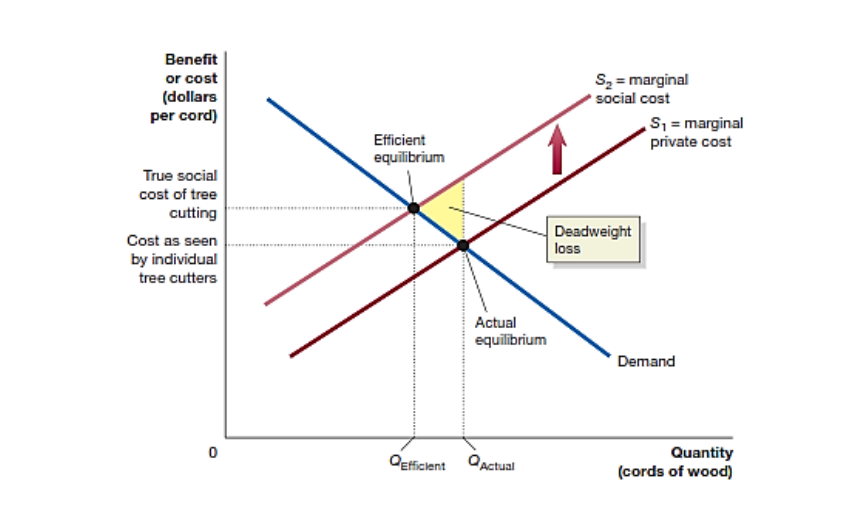
• Figure 5.11 shows that with a common resource such as wood from a forest, the efficient level of use, QEfficient, is determined by the intersection of the demand curve, which represents the marginal social benefit received by consumers, and S2 which represents the marginal social cost of cutting the wood.
📖 点击查看译文
图5.11显示,对于像森林木材这样的公地资源,使用的有效水平QEfficient是由需求曲线(代表消费者所获得的边际社会效益)与S2(代表砍伐木材的边际社会成本)交点决定的。
• As in our discussion of negative externalities, the social cost is equal to the private cost of cutting the wood plus the external cost.
📖 点击查看译文
正如我们讨论负外部性的情况一样,社会成本等于砍伐木材的私人成本加上外部成本。
• In this case, the external cost represents the fact that the more wood each person cuts, the less wood there is available for others and the greater the deforestation, which increases the chances of floods.
📖 点击查看译文
在这种情况下,外部成本代表了这样一个事实:每个人砍伐的木材越多,其他人可用的木材就越少,森林砍伐的程度就越大,从而增加了洪水的可能性。
• Because each individual tree cutter ignores the external cost, the equilibrium quantity of wood cut is QActual, which is greater than the efficient quantity.
📖 点击查看译文
因为每个树木砍伐者忽视了外部成本,所以砍伐的木材的均衡数量是QActual,这大于有效数量。
• At the actual equilibrium level of output, there is a deadweight loss, equal to the area of the yellow triangle in Figure 5.11.
📖 点击查看译文
在实际的生产均衡水平下,存在无谓损失,等于图5.11中黄色三角形的面积。
Knowledge Points and Extensions (知识点与拓展)
1. The Tragedy of the Commons (公地悲剧)
-
Explanation (解释):
The tragedy of the commons refers to the overuse of a resource that is not owned by anyone, leading to depletion or damage of that resource.
(公地悲剧指的是对没有任何人拥有的资源的过度使用,导致该资源的枯竭或损害。)
-
Example (举例):
Deforestation in poor countries, like Haiti, is a modern example of the tragedy of the commons, where individuals use the forest resources without considering the long-term consequences.
(贫困国家如海地的森林砍伐是公地悲剧的现代例子,个人在使用森林资源时没有考虑长期后果。)
-
Extension (拓展):
The tragedy of the commons can be mitigated through government regulation, property rights, or community management strategies to ensure sustainable use of resources.
(通过政府监管、产权制度或社区管理策略可以减轻公地悲剧,确保资源的可持续使用。)
2. Externalities in Resource Use (资源使用中的外部性)
-
Explanation (解释):
Externalities occur when individuals or businesses do not account for the full social costs or benefits of their actions, leading to inefficient outcomes like overuse of common resources.
(外部性发生在个人或企业没有考虑到其行为的全部社会成本或效益时,导致像过度使用公共资源这样的低效结果。)
-
Example (举例):
In the case of deforestation, the external cost includes the long-term environmental damage such as soil erosion, flooding, and loss of biodiversity, which individuals do not account for when they chop down trees.
(在森林砍伐的情况下,外部成本包括长期的环境损害,如土壤侵蚀、洪水和生物多样性丧失,而个人在砍伐树木时并未考虑这些因素。)
-
Extension (拓展):
Addressing externalities often requires intervention such as taxes, regulations, or the creation of markets for tradable rights to resources (e.g., tradable pollution permits).
(解决外部性通常需要干预措施,如征税、法规或创建资源可交易权市场(例如,可交易污染许可证)。)
23
24
Is There a Way Out of the Tragedy of the Commons? (公地悲剧是否有解决方法?)
• Notice that our discussion of the tragedy of the commons is very similar to our earlier discussion of negative externalities.
📖 点击查看译文
注意,我们对公地悲剧的讨论与之前对负外部性的讨论非常相似。
• In some situations, though, enforcing property rights is not feasible.
📖 点击查看译文
然而,在某些情况下,执行产权是不可行的。
• An example is the oceans.
📖 点击查看译文
例如,海洋。
• Because no country owns the oceans beyond its own coastal waters, the fish and other resources of the ocean will remain a common resource.
📖 点击查看译文
由于没有任何国家拥有自己沿海水域之外的海洋,海洋中的鱼类和其他资源将继续作为公地资源。
• In situations in which enforcing property rights is not feasible, two types of solutions to the tragedy of the commons are possible:
- If the geographic area involved is limited and the number of people involved is small, access to the commons can be restricted through community norms and laws.
📖 点击查看译文
如果所涉及的地理区域有限且涉及的人数较少,可以通过社区规范和法律限制对公地的访问。
- If the geographic area or the number of people involved is large, legal restrictions on access to the commons are required.
📖 点击查看译文
如果所涉及的地理区域或人数较多,则需要对公地的访问实施法律限制。
• For instance, the tragedy of the commons was avoided in the Middle Ages by traditional limits on the number of animals each family was allowed to put on the common pasture.
📖 点击查看译文
例如,在中世纪,通过传统的限制每个家庭可以在公用牧场上放置的动物数量来避免公地悲剧。
• Although these traditions were not formal laws, they were usually enforced adequately by social pressure.
📖 点击查看译文
尽管这些传统不是正式的法律,但它们通常通过社会压力得到了充分的执行。
Knowledge Points and Extensions (知识点与拓展)
1. Solutions to the Tragedy of the Commons (公地悲剧的解决方法)
-
Explanation (解释):
The tragedy of the commons can be mitigated through two main solutions: community-based norms and laws for small areas, or legal restrictions for larger areas with more people.
(公地悲剧可以通过两种主要解决方法来减轻:对于小范围的地区,采用社区规范和法律;对于更大范围和更多人的地区,则需要法律限制。)
-
Example (举例):
Traditional limits on the number of animals allowed in common pastures, as seen in the Middle Ages, provide a historical example of how social norms can regulate access to common resources.
(中世纪对公用牧场上允许放牧动物数量的传统限制提供了一个历史性的例子,说明社会规范如何调节对公地资源的使用。)
-
Extension (拓展):
For global resources like oceans, international treaties and agreements can help create regulations to prevent overuse and promote sustainability.
(对于像海洋这样的全球资源,国际条约和协议可以帮助制定规则,防止过度使用并促进可持续性。)
2. Challenges in Enforcing Property Rights (执行产权的挑战)
-
Explanation (解释):
In cases like the oceans, enforcing property rights is not feasible due to the difficulty in determining ownership and jurisdiction over such vast and unbounded resources.
(在像海洋这样的案例中,由于难以确定所有权和管辖权,执行产权不可行。)
-
Example (举例):
The overfishing problem is a direct result of the difficulty in enforcing property rights over ocean resources, leading to a tragedy of the commons scenario.
(过度捕捞问题是由于难以执行海洋资源产权的直接结果,导致公地悲剧的情形。)
-
Extension (拓展):
Efforts like the creation of exclusive economic zones (EEZs) or international fishing regulations are attempts to manage shared resources more effectively.
(创建专属经济区(EEZ)或国际渔业法规等努力,是更有效管理共享资源的尝试。)
25
2. If the geographic area or the number of people involved is large, legal restrictions on access to the commons are required. (如果涉及的地理区域或人数较多,则需要对公地的访问实施法律限制.)
• These restrictions can take several different forms, including taxes, quotas, and tradable permits.
📖 点击查看译文
这些限制可以采取几种不同的形式,包括税收、配额和可交易许可证。
• By setting a tax equal to the external cost, governments can ensure that the efficient quantity of a resource is used.
📖 点击查看译文
通过设定等于外部成本的税收,政府可以确保以高效的数量使用资源。
• In the United States, the government has used quotas to limit access to pools of oil that are beneath property owned by many different persons.
📖 点击查看译文
在美国,政府使用配额限制对位于许多不同个人所有的财产下的油藏的访问。
• The quotas specify the quantity of oil that can be pumped during a given period of time.
📖 点击查看译文
配额指定在给定时间段内可以抽取的油量。
Knowledge Points and Extensions (知识点与拓展)
1. Legal Restrictions on Access to Commons (公地访问的法律限制)
-
Explanation (解释):
When a resource is widely shared and it is difficult to enforce property rights, legal restrictions such as taxes, quotas, and tradable permits are necessary to manage access and ensure efficient use.
(当一个资源被广泛共享且难以执行产权时,税收、配额和可交易许可证等法律限制是管理访问和确保高效使用所必需的。)
-
Example (举例):
In the U.S., quotas have been used for oil extraction, where the government limits the amount of oil that can be extracted from common reservoirs to prevent overuse.
(在美国,配额已被用于石油开采,政府限制从公共油藏中提取的石油量,以防止过度使用。)
-
Extension (拓展):
Tradable permits, like those used in carbon markets, can allow for flexible allocation of resources while maintaining overall efficiency.
(像碳市场中使用的可交易许可证可以允许灵活分配资源,同时保持整体效率。)
2. Taxes as a Tool for Managing Externalities (税收作为管理外部性工具)
-
Explanation (解释):
Taxes can be used to internalize externalities by setting the tax equal to the external cost of resource use, making individuals or firms consider the full social cost when making decisions.
(税收可以通过将税额设定为资源使用的外部成本,来内化外部性,使个人或企业在做决策时考虑全部社会成本。)
-
Example (举例):
A carbon tax is an example where the government charges a tax on carbon emissions equal to the estimated external cost to encourage firms to reduce their emissions.
(碳税就是一个例子,政府对碳排放征收税费,税额等于估算的外部成本,以鼓励企业减少排放。)
-
Extension (拓展):
Combining taxes with subsidies for alternative resources (like renewable energy) can improve both resource management and environmental outcomes.
(结合税收与对替代资源(如可再生能源)的补贴,可以改善资源管理和环境结果。)
The dollar value of the total benefits of reducing sulfur dioxide emissions turned out to be at least 25 times as large as the costs.
📖 点击查看译文
减少二氧化硫排放的总收益的美元价值最终发现至少是成本的25倍。
Despite its successes, however, the sulfur dioxide cap-and-trade system had effectively ended by 2013.
📖 点击查看译文
然而,尽管取得了成功,二氧化硫配额交易系统在2013年实际上已经结束。
Over the years, research showed that the amount of illnesses caused by sulfur dioxide emissions was greater than had been thought.
📖 点击查看译文
多年来,研究表明,二氧化硫排放造成的疾病比原先认为的要多。
In response to these findings, President George W. Bush proposed legislation lowering the cap on sulfur dioxide emissions, but Congress did not pass the legislation.
📖 点击查看译文
针对这些发现,乔治·W·布什总统提议立法降低二氧化硫排放的上限,但国会未通过该法案。
Court rulings kept the Environmental Protection Agency (EPA) from using regulations to set up a new trading system for sulfur dioxide allowances with a lower cap.
📖 点击查看译文
法院裁决使得环境保护局(EPA)无法通过法规设立一个新的二氧化硫排放配额交易系统,并降低排放上限。
As a result, the EPA reverted to the previous system of setting limits on sulfur dioxide emissions at the state or individual power plant level.
📖 点击查看译文
因此,EPA回归到之前的系统,在州或单个电厂层面设定二氧化硫排放限额。
Because nationwide trading of emission allowances was no longer possible, the allowances lost their value.
📖 点击查看译文
由于全国范围内的排放配额交易不再可能,配额失去了它们的价值。
Many economists continue to believe that using market-based policies, such as the sulfur dioxide cap-and-trade system, is an efficient way to deal with the externalities of pollution.
📖 点击查看译文
许多经济学家仍然认为,使用市场导向政策(如二氧化硫配额交易系统)是处理污染外部性的一种高效方式。
But in the end, any policy requires substantial political support to be enacted and maintained.
📖 点击查看译文
但最终,任何政策都需要大量的政治支持才能实施和维持。
知识点列表与拓展 (Knowledge Points and Extensions):
1. Political Support in Environmental Policy (环境政策中的政治支持)
-
解释 (Explanation):
The success of environmental policies often depends on the political will to pass and maintain them.
(环境政策的成功通常依赖于通过和维持这些政策的政治意愿。)
-
例子 (Example):
The failure to pass legislation to lower the sulfur dioxide emission cap shows the importance of political support in environmental policy.
(未通过降低二氧化硫排放上限的立法显示了政治支持在环境政策中的重要性。)
-
拓展 (Extension):
Even well-designed market-based environmental policies can fail without sufficient political backing.
(即使是设计良好的市场导向环境政策,没有足够的政治支持也可能失败。)
2. Market-Based Policies and Externalities (市场导向政策与外部性)
-
解释 (Explanation):
Market-based policies, such as cap-and-trade systems, aim to address externalities by providing economic incentives to reduce pollution.
(市场导向政策,如配额交易系统,旨在通过提供经济激励来减少污染,从而应对外部性问题。)
-
例子 (Example):
The sulfur dioxide cap-and-trade system helped reduce emissions more cost-effectively than traditional command-and-control approaches.
(二氧化硫配额交易系统比传统的命令与控制方法更具成本效益地减少了排放。)
-
拓展 (Extension):
Market-based solutions are often more flexible and efficient than command-and-control regulations, but they still require strong regulatory frameworks and political stability.
(市场导向解决方案通常比命令与控制法规更灵活和高效,但仍然需要强有力的监管框架和政治稳定性。)
12

Are Tradable Emission Allowances Licenses to Pollute? (可交易排放配额是污染许可证吗?)
Tradable emission allowances face a political problem because some environmentalists have criticized them for being licenses to pollute.
📖 点击查看译文
可交易排放配额面临一个政治问题,因为一些环保主义者批评它们是污染许可证。
These environmentalists argue that just as the government does not issue licenses to rob banks or drive drunk, it should not issue licenses to pollute.
📖 点击查看译文
这些环保主义者认为,就像政府不会发放抢银行或酒后驾车的许可证一样,也不应该发放污染许可证。
But, this criticism ignores one of the central lessons of economics: Because resources are scarce, trade-offs exist.
📖 点击查看译文
但是,这种批评忽略了经济学的一个核心教训:因为资源是稀缺的,所以存在权衡。
Resources that are spent on reducing one type of pollution are not available to reduce other types of pollution or for any other use.
📖 点击查看译文
用于减少一种污染的资源不能用于减少其他类型的污染或用于其他用途。
Because reducing acid rain using tradable emission allowances cost utilities 7.4 billion, as originally estimated, society saved more than $6.5 billion per year.
📖 点击查看译文
因为通过可交易排放配额减少酸雨的费用是每年8.7亿美元,而不是最初估计的74亿美元,社会每年节省了超过65亿美元。
知识点列表与拓展 (Knowledge Points and Extensions):
1. Tradable Emission Allowances (可交易排放配额)
-
解释 (Explanation):
Tradable emission allowances are permits that allow firms to emit a certain amount of pollutants, which can be bought or sold in a market.
(可交易排放配额是允许企业排放一定量污染物的许可证,这些配额可以在市场上购买或出售。)
-
例子 (Example):
The sulfur dioxide cap-and-trade system used tradable emission allowances to reduce acid rain.
(二氧化硫配额交易系统使用可交易排放配额来减少酸雨。)
-
拓展 (Extension):
While critics argue that tradable allowances are licenses to pollute, they can lead to cost-effective pollution reduction by allowing market forces to determine the most efficient ways to cut emissions.
(尽管批评者认为可交易配额是污染许可证,但它们可以通过让市场力量决定最有效的减排方式,从而实现成本效益的污染减少。)
2. Trade-offs in Economics (经济学中的权衡)
-
解释 (Explanation):
In economics, trade-offs occur when scarce resources are allocated between different uses, meaning that allocating resources to one area reduces their availability for others.
(在经济学中,当稀缺资源在不同用途之间分配时,会发生权衡,这意味着将资源分配到一个领域会减少它们用于其他领域的可用性。)
-
例子 (Example):
Using resources to reduce one form of pollution, such as acid rain, means those resources are not available to reduce other forms of pollution.
(使用资源减少一种污染(如酸雨)意味着这些资源无法用于减少其他类型的污染。)
-
拓展 (Extension):
The concept of trade-offs is essential for understanding the efficiency of market-based policies like tradable emission allowances, which seek to achieve the best outcome with limited resources.
(权衡的概念对于理解市场导向政策(如可交易排放配额)的效率至关重要,这些政策旨在利用有限资源实现最佳结果。)
13

Four Categories of Goods (商品的四种分类)
Goods can be categorized on the basis of whether they are rival or excludable.
📖 点击查看译文
商品可以根据它们是否具有竞争性和排他性来分类。
We can explore further the question of when the market is likely to succeed in supplying the efficient quantity of a good by understanding that goods differ on the basis of whether their consumption is rival and excludable:
📖 点击查看译文
我们可以进一步探讨市场何时可能成功地提供有效数量的商品,通过理解商品在其消费是否具有竞争性和排他性方面的不同。
Rivalry occurs when one person’s consumption of a unit of a good means no one else can consume it.
📖 点击查看译文
竞争性是指一个人消费一单位商品意味着其他人无法消费它。
If you consume a Big Mac, for example, no one else can consume it.
📖 点击查看译文
例如,如果你吃了一个巨无霸,其他人就无法再吃它了。
Excludability means that anyone who does not pay for a good cannot consume it.
📖 点击查看译文
排他性是指任何不为商品付费的人无法消费它。
If you don’t pay for a Big Mac, McDonald’s can exclude you from consuming it.
📖 点击查看译文
如果你没有为巨无霸付费,麦当劳可以将你排除在消费之外。
The consumption of a Big Mac is therefore rival and excludable.
📖 点击查看译文
因此,巨无霸的消费是具有竞争性和排他性的。
The consumption of some goods, however, can be either nonrival or nonexcludable:
📖 点击查看译文
然而,一些商品的消费可以是非竞争性的或非排他性的:
Nonrival means that one person’s consumption does not interfere with another person’s consumption.
📖 点击查看译文
非竞争性是指一个人的消费不会干扰另一个人的消费。
Nonexcludable means that it is impossible to exclude others from consuming the good, whether they have paid for it or not.
📖 点击查看译文
非排他性是指无论他人是否为商品付费,都无法将其排除在消费之外。
Figure 5.7 shows four possible categories into which goods can fall.
📖 点击查看译文
图5.7显示了商品可能归类的四种类别。
We next consider each of the four categories:
📖 点击查看译文
接下来,我们将考虑这四个类别:
知识点列表与拓展 (Knowledge Points and Extensions):
1. Rivalry (竞争性)
-
解释 (Explanation):
Rivalry refers to a situation where one person’s consumption of a good prevents others from consuming it.
(竞争性是指一个人消费某商品会阻止其他人消费该商品的情况。)
-
例子 (Example):
A concert ticket is rival because once one person buys the ticket, others cannot attend the concert.
(音乐会门票是具有竞争性的,因为一旦一个人购买了门票,其他人就不能再参加演唱会。)
-
拓展 (Extension):
The concept of rivalry is essential in understanding market dynamics, as it affects how resources are allocated and the efficiency of supply.
(竞争性的概念对于理解市场动态至关重要,因为它影响资源的分配方式和供应的效率。)
2. Excludability (排他性)
-
解释 (Explanation):
Excludability means that it is possible to prevent someone from consuming a good if they do not pay for it.
(排他性意味着如果某人不为商品付费,就可以阻止他们消费该商品。)
-
例子 (Example):
Subscription-based streaming services are excludable because only paying customers can access the content.
(基于订阅的流媒体服务是具有排他性的,因为只有付费用户才能访问内容。)
-
拓展 (Extension):
Excludability is a key factor in determining whether a good is a private good or a public good.
(排他性是决定商品是私有商品还是公共商品的关键因素。)
3. Nonrival (非竞争性)
-
解释 (Explanation):
Nonrival goods are those where one person’s consumption does not affect another person’s consumption.
(非竞争性商品是指一个人的消费不会影响另一个人的消费。)
-
例子 (Example):
National defense is nonrival because one person benefiting from protection does not reduce the protection available to others.
(国家防御是非竞争性的,因为一个人从保护中受益并不会减少对其他人的保护。)
-
拓展 (Extension):
Nonrival goods often lead to market failure because they are typically public goods, which are underprovided by the market.
(非竞争性商品通常会导致市场失灵,因为它们通常是公共商品,市场提供不足。)
4. Nonexcludable (非排他性)
-
解释 (Explanation):
Nonexcludable goods are those where it is difficult or impossible to prevent someone from using the good.
(非排他性商品是指很难或不可能阻止某人使用该商品的商品。)
-
例子 (Example):
Clean air is nonexcludable because it is impossible to prevent anyone from breathing it.
(清洁空气是非排他性的,因为无法阻止任何人呼吸它。)
-
拓展 (Extension):
Nonexcludable goods are typically public goods, and their provision often requires government intervention to ensure adequate supply.
(非排他性商品通常是公共商品,其提供通常需要政府干预以确保充足供应。)
14

Private Goods (私有商品)
1. A private good is both rival and excludable.
📖 点击查看译文
私有商品既具有竞争性又具有排他性。
• Food, clothing, haircuts, and many other goods and services fall into this category.
📖 点击查看译文
食品、衣物、理发和许多其他商品和服务属于这一类别。
• One person’s consuming a unit of these goods keeps other people from consuming that unit, and no one can consume these goods without buying them.
📖 点击查看译文
一个人消费了这些商品的一单位就会阻止其他人消费该单位,而且没有购买这些商品的人不能消费它们。
• Although we didn’t state it explicitly, when we analyzed the demand and supply for goods and services in earlier chapters, we assumed that the goods and services were all private goods.
📖 点击查看译文
尽管我们没有明确说明,但在之前的章节中分析商品和服务的需求与供给时,我们假设这些商品和服务都是私有商品。
知识点列表与拓展 (Knowledge Points and Extensions):
1. Private Goods (私有商品)
-
解释 (Explanation):
A private good is one that is both rival and excludable. This means that one person’s consumption prevents others from consuming it, and individuals must pay to consume it.
(私有商品是既具有竞争性又具有排他性的商品。这意味着一个人的消费会阻止其他人消费它,而且个人必须为消费它支付费用。)
-
例子 (Example):
A pair of shoes is a private good because if one person buys it, no one else can use that pair, and only those who pay for it can own it.
(一双鞋是私有商品,因为如果一个人购买了它,其他人就无法使用那双鞋,只有付费的人才能拥有它。)
-
拓展 (Extension):
Private goods are typically efficiently allocated by the market, as prices reflect both scarcity and consumer demand.
(私有商品通常通过市场高效分配,因为价格反映了稀缺性和消费者需求。)
15

Public Goods (公共商品)
2. A public good is both nonrival and nonexcludable.
📖 点击查看译文
公共商品既是非竞争性的又是非排他性的。
• Public goods are often, although not always, supplied by a government rather than by private firms.
📖 点击查看译文
公共商品通常由政府提供,尽管不是总是如此,而不是由私人公司提供。
• The classic example of a public good is national defense.
📖 点击查看译文
公共商品的经典例子是国家防卫。
• Your consuming national defense does not interfere with your neighbor consuming it, so consumption is nonrival.
📖 点击查看译文
你消费国家防卫并不妨碍邻居消费它,因此消费是非竞争性的。
• You also cannot be excluded from consuming it, whether you pay for it or not.
📖 点击查看译文
无论你是否为其支付费用,你都无法被排除在外,不能阻止你消费它。
• No private firm would be willing to supply national defense because everyone can consume national defense whether they pay for it or not.
📖 点击查看译文
没有私人公司愿意提供国家防卫,因为无论是否支付费用,每个人都能消费国家防卫。
• The behavior of consumers in this situation is called free riding because individuals benefit from a good, in this case, national defense without paying for it.
📖 点击查看译文
在这种情况下,消费者的行为被称为搭便车,因为个人在没有支付的情况下从商品(此例中为国家防卫)中获益。
Quasi-Public Goods (准公共商品)
• A quasi-public good is excludable but not rival. An example is cable television.
📖 点击查看译文
准公共商品是可排除的但非竞争性的。例如有线电视。
• People who do not pay for cable television do not receive it, but one person watching it doesn’t prevent other people from watching it.
📖 点击查看译文
没有支付有线电视费用的人无法接收电视信号,但一个人观看并不妨碍其他人观看。
知识点列表与拓展 (Knowledge Points and Extensions):
2. Public Goods (公共商品)
-
解释 (Explanation):
A public good is a good that is nonrival (one person’s consumption does not reduce the availability for others) and nonexcludable (no one can be excluded from consuming it).
(公共商品是既非竞争性又非排他性的商品,一个人消费它不会减少其他人消费的机会,并且无法排除任何人消费它。)
-
例子 (Example):
National defense is a classic example of a public good, as it benefits everyone without reducing its availability to others.
(国家防卫是公共商品的经典例子,因为它惠及每个人,而不会减少其他人的可得性。)
-
拓展 (Extension):
Public goods often lead to market failures because of the free rider problem, where people benefit without contributing to the cost.
(公共商品通常会导致市场失败,因为搭便车问题,导致人们在不承担成本的情况下受益。)
16

Quasi-Public Goods (准公共商品)
• Another example is a toll road.
📖 点击查看译文
另一个例子是收费公路。
• Anyone who doesn’t pay the toll doesn’t get on the highway, but one person using the highway doesn’t interfere with someone else using the highway (unless so many people are using the highway that it becomes congested).
📖 点击查看译文
没有支付过路费的人无法上高速公路,但一个人使用公路并不妨碍其他人使用公路(除非使用公路的人数过多,导致拥堵)。
• Goods that fall into this category are called quasi-public goods.
📖 点击查看译文
属于这一类的商品被称为准公共商品。
Common Resources (公共资源)
• A common resource is rival but not excludable.
📖 点击查看译文
公共资源是具有竞争性但非排他性的。
• Forest land in many poor countries is a common resource.
📖 点击查看译文
许多贫困国家的森林土地是公共资源。
• If one person cuts down a tree, no one else can use that tree.
📖 点击查看译文
如果一个人砍伐了一棵树,其他人就无法再利用这棵树。
• But if no one has a property right to the forest, no one can be excluded from using it.
📖 点击查看译文
但是,如果没有人拥有森林的所有权,没人能排除其他人使用它。
知识点列表与拓展 (Knowledge Points and Extensions):
3. Quasi-Public Goods (准公共商品)
-
解释 (Explanation):
A quasi-public good is a good that is excludable but not rival. This means that people who do not pay for it can be excluded, but one person’s consumption does not interfere with others.
(准公共商品是可排除但非竞争性的商品,这意味着不支付费用的人会被排除在外,但一个人消费并不妨碍其他人的消费。)
-
例子 (Example):
Toll roads are an example of quasi-public goods because access is restricted to those who pay the toll, but one person’s use does not prevent another person from using it (unless there is congestion).
(收费公路是准公共商品的例子,因为只有支付过路费的人才能使用,但一个人的使用并不会妨碍他人的使用(除非发生拥堵)。)
4. Common Resources (公共资源)
-
解释 (Explanation):
A common resource is a good that is rival but not excludable. This means that one person’s consumption of the resource reduces the availability of the resource for others, but it is difficult to exclude people from using it.
(公共资源是具有竞争性但非排他性的商品,这意味着一个人的消费减少了他人使用该资源的机会,但很难将人们排除在使用之外。)
-
例子 (Example):
Forest land in many poor countries is a common resource. If one person cuts down a tree, no one else can use that tree, but no one can prevent others from using the forest.
(许多贫困国家的森林土地是公共资源。如果一个人砍伐了一棵树,其他人无法使用这棵树,但没人能够阻止他人使用森林。)
-
拓展 (Extension):
Overuse of common resources, often referred to as the “tragedy of the commons,” occurs when individuals overconsume a resource without regard to the long-term consequences for others.
(公共资源的过度使用,通常被称为“公地悲剧”,发生在个人在没有考虑长期后果的情况下过度消费资源时。)
17

The Demand for a Public Good (公共商品的需求)
• We can determine the market demand curve for a good or service by adding up the quantity of the good demanded by each consumer at each price.
📖 点击查看译文
我们可以通过将每个消费者在每个价格下所需求的商品数量相加来确定商品或服务的市场需求曲线。
• To keep things simple, let’s consider the case of a market with only two consumers.
📖 点击查看译文
为了简单起见,我们假设市场中只有两个消费者。
• Figure 5.8 shows that the market demand curve for hamburgers depends on the individual demand curves of Jill and Joe.
📖 点击查看译文
图5.8显示了汉堡的市场需求曲线依赖于Jill和Joe的个人需求曲线。
• At a price of $4.00, Jill demands 2 hamburgers per week and Joe demands 4.
📖 点击查看译文
当价格为4.00美元时,Jill每周需求2个汉堡,而Joe需求4个。
• Adding horizontally, the combination of a price of $4.00 per hamburger and a quantity demanded of 6 hamburgers will be a point on the market demand curve for hamburgers.
📖 点击查看译文
通过水平加法,价格为每个汉堡4.00美元,需求数量为6个汉堡的组合将是汉堡市场需求曲线上的一个点。
• Similarly, adding horizontally at a price of 1.50 and a quantity demanded of 11 as another point on the market demand curve.
📖 点击查看译文
类似地,通过水平加法,价格为1.50美元时,需求数量为11个汉堡,将是市场需求曲线上的另一个点。
• A consumer’s demand curve for a good represents the marginal benefit the consumer receives from the good, so when we add together the consumer’s demand curves, we have not only the market demand curve but also the marginal social benefit curve for this good, assuming that there is no externality in consumption.
📖 点击查看译文
消费者对商品的需求曲线代表了消费者从商品中获得的边际效益,因此当我们将消费者的需求曲线加在一起时,我们不仅得到了市场需求曲线,还得到了该商品的边际社会效益曲线,假设消费中没有外部性。
知识点列表与拓展 (Knowledge Points and Extensions):
1. Market Demand Curve for Public Goods (公共商品的市场需求曲线)
-
解释 (Explanation):
To determine the market demand curve for a good, we add the quantities demanded by individual consumers at each price level.
(为了确定商品的市场需求曲线,我们将每个价格水平下各个消费者的需求数量相加。)
-
举例 (Example):
In the example, if Jill demands 2 hamburgers at $4.00 and Joe demands 4, the total demand at this price is 6 hamburgers. This is a point on the market demand curve.
(在这个例子中,如果Jill在4.00美元时需求2个汉堡,而Joe需求4个,总需求为6个汉堡。这是市场需求曲线上的一个点。)
-
拓展 (Extension):
For public goods, the marginal social benefit curve is derived by adding up individual demand curves horizontally. This is different from private goods, where we add quantities vertically.
(对于公共商品,边际社会效益曲线是通过水平加法将个人需求曲线相加得出的。这与私人商品不同,后者是通过垂直加法得到数量的。)
18

Finding the Demand Curve or Marginal Social Benefit Curve for a Public Good (如何找到公共商品的需求曲线或边际社会效益曲线)
• Unlike with a private good, where Jill and Joe can end up consuming different quantities, with a public good, they will consume the same quantity.
📖 点击查看译文
与私人商品不同,Jill和Joe可能会消费不同数量的商品,而在公共商品中,他们将消费相同数量。
• Suppose that Jill owns a service station on an isolated rural road, and Joe owns a car dealership next door.
📖 点击查看译文
假设Jill在一条偏远的乡村道路上拥有一个加油站,而Joe则在旁边经营着一家汽车经销商。
• These are the only two businesses around for miles.
📖 点击查看译文
这是周围几英里范围内唯一的两家商店。
Knowledge Points and Extensions (知识点与拓展)
1. Public Good Consumption (公共商品消费)
-
Explanation (解释):
For public goods, consumers will consume the same quantity. The marginal social benefit (MSB) curve is found by adding together the individual demand curves vertically because both consumers benefit from the same amount of the good.
(对于公共商品,消费者将消费相同数量。边际社会效益(MSB)曲线通过垂直加法将个体需求曲线加在一起,因为两个消费者都从相同数量的商品中获益。)
-
Example (举例):
In this case, Jill and Joe both consume the same amount of the service station’s good or service (e.g., a roadside rest stop). Their demand curves for the good are added vertically.
(在这个例子中,Jill和Joe都消费相同数量的加油站商品或服务(例如,路边休息站)。他们对该商品的需求曲线通过垂直加法合并。)
-
Extension (拓展):
When the consumption of the good benefits multiple consumers equally, the demand curves are added vertically. This method contrasts with private goods, where the demand curves are added horizontally since individuals consume different quantities.
(当商品的消费对多个消费者都有相同的益处时,需求曲线通过垂直加法合并。这与私人商品不同,私人商品的需求曲线通过水平加法合并,因为每个消费者的消费数量不同。)
18

Finding the Demand Curve for a Public Good (寻找公共商品的需求曲线)
• To find the demand curve for a public good, we add up the price at which each consumer is willing to purchase each quantity of the good.
📖 点击查看译文
为了找到公共商品的需求曲线,我们需要将每个消费者愿意为每个数量的商品支付的价格加在一起。
• In panel (a), Jill is willing to pay $8 per hour for a security guard to provide 10 hours of protection.
📖 点击查看译文
在图表(a)中,Jill愿意为安保人员提供10小时的保护支付每小时8美元。
• In panel (b), Joe is willing to pay 18 per hour and the quantity of 10 hours will be a point on the demand curve for security guard services.
📖 点击查看译文
在图表(b)中,Joe愿意为该级别的保护支付10美元。因此,在图表(c)中,每小时18美元和10小时的数量将成为安保服务需求曲线上的一个点。
• The figure also shows that because Jill is willing to spend 5, a price of $9 per hour and a quantity of 15 hours is another point on the marginal social benefit curve for security guard services.
📖 点击查看译文
图表还显示,由于Jill愿意为15小时的安保服务支付每小时4美元,而Joe愿意支付5美元,因此每小时9美元和15小时的数量是安保服务边际社会效益曲线上的另一个点。
Knowledge Points and Extensions (知识点与拓展)
1. Public Good Demand Curve (公共商品需求曲线)
-
Explanation (解释):
The demand curve for a public good is derived by vertically adding the price each consumer is willing to pay for each quantity of the good. The point on the demand curve represents the total amount consumers are willing to pay for that quantity.
(公共商品的需求曲线通过垂直加总每个消费者愿意为每个数量的商品支付的价格得出。需求曲线上的点表示消费者愿意为该数量支付的总金额。)
-
Example (举例):
In this case, Jill and Joe’s willingness to pay for different quantities of security guard services is combined to form the market demand curve.
(在这个例子中,Jill和Joe愿意为不同数量的安保服务支付的金额被合并形成市场需求曲线。)
-
Extension (拓展):
This method contrasts with private goods, where the demand curves are added horizontally. The concept of marginal social benefit is relevant here because the total willingness to pay for each quantity of the public good reflects the social value of that good.
(这种方法与私人商品不同,私人商品的需求曲线是水平加法。边际社会效益的概念在这里是相关的,因为每个数量的公共商品的总支付意愿反映了该商品的社会价值。)
19

The Optimal Quantity of Public Good (公共商品的最优数量)
• We know that to achieve economic efficiency, a good or service should be produced up to the point where the sum of consumer surplus and producer surplus is maximized, or, alternatively, where the marginal social cost equals the marginal social benefit.
📖 点击查看译文
为了实现经济效率,商品或服务应该生产到消费者剩余和生产者剩余的总和最大化的程度,或者,换句话说,生产的边际社会成本等于边际社会效益。
• Therefore, the optimal quantity of security guard services or any other public good will occur where the marginal social benefit curve intersects the supply curve.
📖 点击查看译文
因此,安保服务或任何其他公共商品的最优数量将在边际社会效益曲线与供给曲线相交的地方发生。
• As with private goods, in the absence of an externality in production, the supply curve represents the marginal social cost of supplying the good.
📖 点击查看译文
与私人商品一样,在生产中没有外部性时,供给曲线代表提供商品的边际社会成本。
• Figure 5.10 shows that the optimal quantity of security guard services supplied is 15 hours, at a price of $9 per hour.
📖 点击查看译文
图5.10显示,提供的安保服务的最优数量是15小时,价格为每小时9美元。
• Will the market provide the economically efficient quantity of security guard services?
📖 点击查看译文
市场是否会提供经济上高效的安保服务数量?
• One difficulty is that the individual preferences of consumers, as shown by their demand curves, are not revealed in this market.
📖 点击查看译文
一个困难是,消费者的个人偏好(如其需求曲线所示)在这个市场中没有显现出来。
• This difficulty does not arise with private goods because consumers must reveal their preferences in order to purchase private goods.
📖 点击查看译文
这个困难在私人商品中并不存在,因为消费者必须通过购买私人商品来显现其偏好。
• If the market price of Big Macs is $4.00, Joe either reveals that he is willing to pay that much by buying it or he does without it.
📖 点击查看译文
如果Big Mac的市场价格是4美元,Joe要么通过购买它来显现他愿意支付这个价格,要么就不买它。
• In our example, neither Jill nor Joe can be excluded from consuming the services provided by a security guard once either hires one, and therefore, neither has an incentive to reveal her or his preferences.
📖 点击查看译文
在我们的例子中,一旦Jill或Joe雇佣了安保人员,他们都无法被排除在享受该服务之外,因此,他们都没有激励去显现自己的偏好。
Knowledge Points and Extensions (知识点与拓展)
1. Marginal Social Benefit and Marginal Social Cost (边际社会效益与边际社会成本)
-
Explanation (解释):
The optimal quantity of a public good is found where the marginal social benefit equals the marginal social cost. This ensures that the total benefit from consuming the good is maximized while minimizing the costs of production.
(公共商品的最优数量是在边际社会效益等于边际社会成本的地方找到的。这样可以确保从消费商品中获得的总效益最大化,同时最小化生产成本。)
-
Example (举例):
In the case of security guard services, the price at which the marginal social benefit equals the marginal social cost determines the optimal number of hours of service.
(在安保服务的例子中,边际社会效益等于边际社会成本的价格决定了最优的服务小时数。)
-
Extension (拓展):
While the optimal quantity of public goods is theoretically determined by the intersection of supply and demand curves, challenges arise because public goods are nonexcludable, and consumers do not necessarily reveal their preferences. This can lead to inefficiency in the provision of public goods.
(尽管公共商品的最优数量理论上由供给和需求曲线的交点决定,但由于公共商品是不可排除的,消费者不一定显现他们的偏好,因此会导致公共商品提供的低效性。)
20

21

Private Bargaining and Public Goods (私人谈判与公共商品)
• In this case, though, with only two consumers, it is likely that private bargaining will result in an efficient quantity of the public good.
📖 点击查看译文
然而,在只有两个消费者的情况下,私人谈判可能会导致公共商品的有效数量。
• This outcome is not likely for a public good such as national defense that is supplied by the government to millions of consumers.
📖 点击查看译文
对于像国防这样的公共商品,这种结果不太可能发生,因为它是由政府提供给数百万消费者的。
• Governments sometimes use cost–benefit analysis to determine what quantity of a public good should be supplied.
📖 点击查看译文
政府有时使用成本-效益分析来确定应提供多少公共商品。
• For example, before building a dam on a river, the federal government will attempt to weigh the costs against the benefits.
📖 点击查看译文
例如,在建设河流大坝之前,联邦政府将试图权衡成本与效益。
• The costs include the opportunity cost of other projects the government cannot carry out if it builds the dam.
📖 点击查看译文
成本包括政府如果建设大坝无法进行的其他项目的机会成本。
• The benefits include improved flood control or new recreational opportunities on the lake formed by the dam.
📖 点击查看译文
效益包括改善的洪水控制或大坝形成的湖泊上的新娱乐机会。
• However, for many public goods, including national defense, the government does not use a formal cost-benefit analysis.
📖 点击查看译文
然而,对于许多公共商品,包括国防,政府并不使用正式的成本-效益分析。
• Instead, the quantity of national defense supplied is determined by a political process involving Congress and the president.
📖 点击查看译文
相反,国防提供的数量是由一个涉及国会和总统的政治过程决定的。
• Even here, of course, Congress and the president realize that tradeoffs are involved:
📖 点击查看译文
当然,即便在这里,国会和总统也意识到涉及权衡:
• The more resources used for national defense, the fewer resources are available for other public or private goods.
📖 点击查看译文
用于国防的资源越多,可用于其他公共商品或私人商品的资源就越少。
Knowledge Points and Extensions (知识点与拓展)
1. Cost–Benefit Analysis and Public Goods (成本-效益分析与公共商品)
-
Explanation (解释):
Governments may use cost–benefit analysis to evaluate the best amount of a public good to provide, considering both the costs (e.g., opportunity cost) and benefits (e.g., improved services or public welfare).
(政府可以使用成本-效益分析来评估提供公共商品的最佳数量,考虑成本(例如机会成本)和效益(例如改善的服务或公共福利)。)
-
Example (举例):
Before investing in large public infrastructure projects like dams, cost–benefit analysis helps governments decide whether the project’s benefits (e.g., flood control) outweigh the costs (e.g., funds unavailable for other projects).
(在投资大型公共基础设施项目(如大坝)之前,成本-效益分析帮助政府决定该项目的效益(如洪水控制)是否超过成本(如无法用于其他项目的资金)。)
-
Extension (拓展):
While cost–benefit analysis is often used for tangible public goods (e.g., infrastructure), it may not be as effective for intangible public goods (e.g., national defense) due to difficulty in quantifying benefits.
(虽然成本-效益分析通常用于有形公共商品(如基础设施),但对于无形公共商品(如国防)而言,由于难以量化效益,它可能不那么有效。)
2. Political Process in Public Good Provision (公共商品提供中的政治过程)
-
Explanation (解释):
In cases like national defense, where a formal cost-benefit analysis may be impractical, the provision of the public good is often determined by political decisions made by elected officials.
(在像国防这样的情况中,正式的成本-效益分析可能不切实际,公共商品的提供通常由民选官员做出的政治决定决定。)
-
Example (举例):
Congress and the president decide the budget and level of national defense, balancing political factors, public opinion, and resource availability.
(国会和总统决定国防的预算和水平,平衡政治因素、公众意见和资源可用性。)
-
Extension (拓展):
The political process can create inefficiencies in public good provision, as decisions may reflect political pressures rather than the true marginal benefit and cost of the good.
(政治过程可能导致公共商品提供的低效,因为决策可能反映政治压力,而非商品的真实边际效益和成本。)
22

The Tragedy of the Commons (公地悲剧)
• The tendency for a common resource to be overused is called the tragedy of the commons.
📖 点击查看译文
公地资源被过度使用的倾向称为公地悲剧。
• The forests in many poor countries are a modern example.
📖 点击查看译文
许多贫困国家的森林是一个现代例子。
• When a family chops down a tree in a public forest, it takes into account the benefits of gaining firewood or wood for building, but it does not take into account the costs of deforestation.
📖 点击查看译文
当一个家庭在公共森林中砍树时,它考虑的是获得柴火或建筑木材的收益,但没有考虑到砍伐森林的成本。
• Haiti, for example, was once heavily forested.
📖 点击查看译文
例如,海地曾经有大量森林。
• Today, 80 percent of the country’s forests have been cut down, primarily to be burned to create charcoal for heating and cooking.
📖 点击查看译文
今天,该国80%的森林已被砍伐,主要是为了烧制木炭用于取暖和做饭。
• Because the mountains no longer have tree roots to hold the soil, heavy rains now often lead to devastating floods.
📖 点击查看译文
由于山脉不再有树根固定土壤,暴雨现在常常导致毁灭性的洪水。
• Figure 5.11 shows that with a common resource such as wood from a forest, the efficient level of use, QEfficient, is determined by the intersection of the demand curve, which represents the marginal social benefit received by consumers, and S2 which represents the marginal social cost of cutting the wood.
📖 点击查看译文
图5.11显示,对于像森林木材这样的公地资源,使用的有效水平QEfficient是由需求曲线(代表消费者所获得的边际社会效益)与S2(代表砍伐木材的边际社会成本)交点决定的。
• As in our discussion of negative externalities, the social cost is equal to the private cost of cutting the wood plus the external cost.
📖 点击查看译文
正如我们讨论负外部性的情况一样,社会成本等于砍伐木材的私人成本加上外部成本。
• In this case, the external cost represents the fact that the more wood each person cuts, the less wood there is available for others and the greater the deforestation, which increases the chances of floods.
📖 点击查看译文
在这种情况下,外部成本代表了这样一个事实:每个人砍伐的木材越多,其他人可用的木材就越少,森林砍伐的程度就越大,从而增加了洪水的可能性。
• Because each individual tree cutter ignores the external cost, the equilibrium quantity of wood cut is QActual, which is greater than the efficient quantity.
📖 点击查看译文
因为每个树木砍伐者忽视了外部成本,所以砍伐的木材的均衡数量是QActual,这大于有效数量。
• At the actual equilibrium level of output, there is a deadweight loss, equal to the area of the yellow triangle in Figure 5.11.
📖 点击查看译文
在实际的生产均衡水平下,存在无谓损失,等于图5.11中黄色三角形的面积。
Knowledge Points and Extensions (知识点与拓展)
1. The Tragedy of the Commons (公地悲剧)
-
Explanation (解释):
The tragedy of the commons refers to the overuse of a resource that is not owned by anyone, leading to depletion or damage of that resource.
(公地悲剧指的是对没有任何人拥有的资源的过度使用,导致该资源的枯竭或损害。)
-
Example (举例):
Deforestation in poor countries, like Haiti, is a modern example of the tragedy of the commons, where individuals use the forest resources without considering the long-term consequences.
(贫困国家如海地的森林砍伐是公地悲剧的现代例子,个人在使用森林资源时没有考虑长期后果。)
-
Extension (拓展):
The tragedy of the commons can be mitigated through government regulation, property rights, or community management strategies to ensure sustainable use of resources.
(通过政府监管、产权制度或社区管理策略可以减轻公地悲剧,确保资源的可持续使用。)
2. Externalities in Resource Use (资源使用中的外部性)
-
Explanation (解释):
Externalities occur when individuals or businesses do not account for the full social costs or benefits of their actions, leading to inefficient outcomes like overuse of common resources.
(外部性发生在个人或企业没有考虑到其行为的全部社会成本或效益时,导致像过度使用公共资源这样的低效结果。)
-
Example (举例):
In the case of deforestation, the external cost includes the long-term environmental damage such as soil erosion, flooding, and loss of biodiversity, which individuals do not account for when they chop down trees.
(在森林砍伐的情况下,外部成本包括长期的环境损害,如土壤侵蚀、洪水和生物多样性丧失,而个人在砍伐树木时并未考虑这些因素。)
-
Extension (拓展):
Addressing externalities often requires intervention such as taxes, regulations, or the creation of markets for tradable rights to resources (e.g., tradable pollution permits).
(解决外部性通常需要干预措施,如征税、法规或创建资源可交易权市场(例如,可交易污染许可证)。)
23

24

Is There a Way Out of the Tragedy of the Commons? (公地悲剧是否有解决方法?)
• Notice that our discussion of the tragedy of the commons is very similar to our earlier discussion of negative externalities.
📖 点击查看译文
注意,我们对公地悲剧的讨论与之前对负外部性的讨论非常相似。
• In some situations, though, enforcing property rights is not feasible.
📖 点击查看译文
然而,在某些情况下,执行产权是不可行的。
• An example is the oceans.
📖 点击查看译文
例如,海洋。
• Because no country owns the oceans beyond its own coastal waters, the fish and other resources of the ocean will remain a common resource.
📖 点击查看译文
由于没有任何国家拥有自己沿海水域之外的海洋,海洋中的鱼类和其他资源将继续作为公地资源。
• In situations in which enforcing property rights is not feasible, two types of solutions to the tragedy of the commons are possible:
- If the geographic area involved is limited and the number of people involved is small, access to the commons can be restricted through community norms and laws.
📖 点击查看译文
如果所涉及的地理区域有限且涉及的人数较少,可以通过社区规范和法律限制对公地的访问。
- If the geographic area or the number of people involved is large, legal restrictions on access to the commons are required.
📖 点击查看译文
如果所涉及的地理区域或人数较多,则需要对公地的访问实施法律限制。
• For instance, the tragedy of the commons was avoided in the Middle Ages by traditional limits on the number of animals each family was allowed to put on the common pasture.
📖 点击查看译文
例如,在中世纪,通过传统的限制每个家庭可以在公用牧场上放置的动物数量来避免公地悲剧。
• Although these traditions were not formal laws, they were usually enforced adequately by social pressure.
📖 点击查看译文
尽管这些传统不是正式的法律,但它们通常通过社会压力得到了充分的执行。
Knowledge Points and Extensions (知识点与拓展)
1. Solutions to the Tragedy of the Commons (公地悲剧的解决方法)
-
Explanation (解释):
The tragedy of the commons can be mitigated through two main solutions: community-based norms and laws for small areas, or legal restrictions for larger areas with more people.
(公地悲剧可以通过两种主要解决方法来减轻:对于小范围的地区,采用社区规范和法律;对于更大范围和更多人的地区,则需要法律限制。)
-
Example (举例):
Traditional limits on the number of animals allowed in common pastures, as seen in the Middle Ages, provide a historical example of how social norms can regulate access to common resources.
(中世纪对公用牧场上允许放牧动物数量的传统限制提供了一个历史性的例子,说明社会规范如何调节对公地资源的使用。)
-
Extension (拓展):
For global resources like oceans, international treaties and agreements can help create regulations to prevent overuse and promote sustainability.
(对于像海洋这样的全球资源,国际条约和协议可以帮助制定规则,防止过度使用并促进可持续性。)
2. Challenges in Enforcing Property Rights (执行产权的挑战)
-
Explanation (解释):
In cases like the oceans, enforcing property rights is not feasible due to the difficulty in determining ownership and jurisdiction over such vast and unbounded resources.
(在像海洋这样的案例中,由于难以确定所有权和管辖权,执行产权不可行。)
-
Example (举例):
The overfishing problem is a direct result of the difficulty in enforcing property rights over ocean resources, leading to a tragedy of the commons scenario.
(过度捕捞问题是由于难以执行海洋资源产权的直接结果,导致公地悲剧的情形。)
-
Extension (拓展):
Efforts like the creation of exclusive economic zones (EEZs) or international fishing regulations are attempts to manage shared resources more effectively.
(创建专属经济区(EEZ)或国际渔业法规等努力,是更有效管理共享资源的尝试。)
25

2. If the geographic area or the number of people involved is large, legal restrictions on access to the commons are required. (如果涉及的地理区域或人数较多,则需要对公地的访问实施法律限制.)
• These restrictions can take several different forms, including taxes, quotas, and tradable permits.
📖 点击查看译文
这些限制可以采取几种不同的形式,包括税收、配额和可交易许可证。
• By setting a tax equal to the external cost, governments can ensure that the efficient quantity of a resource is used.
📖 点击查看译文
通过设定等于外部成本的税收,政府可以确保以高效的数量使用资源。
• In the United States, the government has used quotas to limit access to pools of oil that are beneath property owned by many different persons.
📖 点击查看译文
在美国,政府使用配额限制对位于许多不同个人所有的财产下的油藏的访问。
• The quotas specify the quantity of oil that can be pumped during a given period of time.
📖 点击查看译文
配额指定在给定时间段内可以抽取的油量。
Knowledge Points and Extensions (知识点与拓展)
1. Legal Restrictions on Access to Commons (公地访问的法律限制)
-
Explanation (解释):
When a resource is widely shared and it is difficult to enforce property rights, legal restrictions such as taxes, quotas, and tradable permits are necessary to manage access and ensure efficient use.
(当一个资源被广泛共享且难以执行产权时,税收、配额和可交易许可证等法律限制是管理访问和确保高效使用所必需的。)
-
Example (举例):
In the U.S., quotas have been used for oil extraction, where the government limits the amount of oil that can be extracted from common reservoirs to prevent overuse.
(在美国,配额已被用于石油开采,政府限制从公共油藏中提取的石油量,以防止过度使用。)
-
Extension (拓展):
Tradable permits, like those used in carbon markets, can allow for flexible allocation of resources while maintaining overall efficiency.
(像碳市场中使用的可交易许可证可以允许灵活分配资源,同时保持整体效率。)
2. Taxes as a Tool for Managing Externalities (税收作为管理外部性工具)
-
Explanation (解释):
Taxes can be used to internalize externalities by setting the tax equal to the external cost of resource use, making individuals or firms consider the full social cost when making decisions.
(税收可以通过将税额设定为资源使用的外部成本,来内化外部性,使个人或企业在做决策时考虑全部社会成本。)
-
Example (举例):
A carbon tax is an example where the government charges a tax on carbon emissions equal to the estimated external cost to encourage firms to reduce their emissions.
(碳税就是一个例子,政府对碳排放征收税费,税额等于估算的外部成本,以鼓励企业减少排放。)
-
Extension (拓展):
Combining taxes with subsidies for alternative resources (like renewable energy) can improve both resource management and environmental outcomes.
(结合税收与对替代资源(如可再生能源)的补贴,可以改善资源管理和环境结果。)
评论
0 条正在加载评论...