1
Utility and Consumer Decision Making (效用与消费者决策)
Imagine walking through a shopping mall, trying to decide how to spend your clothing budget.
📖 点击查看译文
想象一下你正在逛购物中心,试图决定如何花掉你的服装预算。
If you had an unlimited budget, your decision would be easy: Just buy as much of everything as you want.
📖 点击查看译文
如果你的预算是无限的,决策就很简单:想买多少就买多少。
Given that you have a limited budget, what do you do?
📖 点击查看译文
但由于你的预算有限,你该怎么办呢?
Economists assume that consumers act so as to make themselves as well off as possible.
📖 点击查看译文
经济学家假设,消费者会尽可能让自己处于最有利的状态。
Therefore, you should choose the one combination of clothes that makes you as well off as possible from among those combinations that you can afford.
📖 点击查看译文
因此,你应该在你能够负担的衣物组合中,选择让你最满意的一组。
知识点列表与拓展 (Knowledge Points and Extensions):
1. Utility (效用)
-
解释 (Explanation):
Utility is the satisfaction or pleasure that people receive from consuming goods and services.
(效用是指人们从消费商品和服务中获得的满足感或愉悦感。)
-
例子 (Example):
Buying a jacket that keeps you warm and makes you feel confident provides you with utility.
(买一件既保暖又让你自信的夹克能为你带来效用。)
-
拓展 (Extension):
Consumers aim to maximize their total utility given their budget constraints by choosing the most satisfying combination of goods they can afford.
(消费者在预算有限的情况下,会选择他们所能负担的、最能带来满足感的商品组合,以实现效用最大化。)
2
Utility and Consumer Behavior (效用与消费者行为)
Stated more generally, the economic model of consumer behavior predicts that consumers will choose to buy the combination of goods and services that makes them as well off as possible from among all the combinations that their budgets allow them to buy.
📖 点击查看译文
更一般地说,经济学中的消费者行为模型预测,消费者会在他们预算所允许的所有商品和服务组合中,选择使自己尽可能满意的一种组合。
The amount of satisfaction you receive from consuming a particular combination of goods and services depends on your tastes or preferences.
📖 点击查看译文
你从消费某种特定商品和服务组合中获得的满足感,取决于你的喜好或偏好。
There is an old saying, “There’s no accounting for taste,” and economists don’t try to.
📖 点击查看译文
有句老话说:“口味无从解释”,经济学家对此也不加干涉。
If you buy a can of Red Bull energy drink instead of a can of Monster Energy, even though Monster Energy has a lower price, you must receive more enjoyment or satisfaction from drinking Red Bull.
📖 点击查看译文
如果你选择买一罐红牛而不是价格更低的魔爪能量饮料,那说明你从红牛中获得了更多的享受或满足感。
Economists refer to the enjoyment or satisfaction people receive from consuming goods and services as utility.
📖 点击查看译文
经济学家把人们从消费商品和服务中获得的愉悦或满足称为“效用”。
So we can say that the goal of a consumer is to spend available income so as to maximize utility.
📖 点击查看译文
因此我们可以说,消费者的目标是通过合理支配可用收入,实现效用最大化。
But utility is a difficult concept to measure because there is no way of knowing exactly how much enjoyment or satisfaction someone receives from consuming a product.
📖 点击查看译文
但效用是一个难以量化的概念,因为我们无法准确知道某人从消费某种商品中获得了多少满足感。
Similarly, it is not possible to compare utility across consumers.
📖 点击查看译文
同样,不同消费者之间的效用也无法进行比较。
知识点列表与拓展 (Knowledge Points and Extensions):
2. Preferences and Subjectivity of Utility (偏好与效用的主观性)
-
解释 (Explanation):
Utility depends on individual preferences, which vary from person to person. Thus, what gives high utility to one person may not do so for another.
(效用取决于个人偏好,每个人的喜好不同,因此对一个人来说效用高的东西,对另一个人来说可能并不如此。)
-
例子 (Example):
Even if two drinks have different prices, a consumer may still choose the more expensive one if they enjoy it more.
(即使两种饮料价格不同,如果某人更喜欢其中较贵的那一款,他仍然会选择它。)
-
拓展 (Extension):
Because utility is subjective and not directly measurable, economists avoid comparing utility levels across individuals and instead focus on the choices consumers make.
(由于效用具有主观性且无法直接测量,经济学家避免在不同个体之间比较效用,而是关注消费者的实际选择。)
3
Is Utility Measurable? (效用能被衡量吗?)
There is no way of knowing for sure whether Jill receives more or less satisfaction than Jack from drinking a can of Red Bull.
📖 点击查看译文
我们无法确定 Jill 喝一罐红牛所获得的满足感是否比 Jack 多或少。
Two hundred years ago, economists hoped to measure utility in units called utils.
📖 点击查看译文
两百年前,经济学家希望用一种叫做“效用单位(utils)”的单位来衡量效用。
The util would be an objective measure in the same way that temperature is: If it is 75 degrees in New York and 75 degrees in Los Angeles, it is just as warm in both cities.
📖 点击查看译文
效用单位原本被设想为像温度那样的客观衡量方式:如果纽约和洛杉矶都是75度,那它们一样暖和。
These economists wanted to say that if Jack’s utility from drinking a can of Red Bull is 10 utils and Jill’s utility is 5 utils, then Jack receives exactly twice the satisfaction from drinking a can of Red Bull as Jill does.
📖 点击查看译文
这些经济学家希望能够说,如果 Jack 喝一罐红牛获得的效用是 10 个单位,而 Jill 是 5 个单位,那 Jack 就获得了 Jill 的两倍满足感。
In fact, it is not possible to measure utility across people.
📖 点击查看译文
但事实上,我们无法在人与人之间比较效用。
It turns out that none of the important conclusions of the economic model of consumer behavior depend on utility being directly measurable.
📖 点击查看译文
事实证明,消费者行为经济模型中的关键结论并不依赖于效用能否被直接测量。
Nevertheless, the economic model of consumer behavior is easier to understand if we assume that utility is something directly measurable, like temperature.
📖 点击查看译文
尽管如此,如果我们假设效用像温度一样是可以直接测量的,那么消费者行为模型会更容易理解。
知识点列表与拓展 (Knowledge Points and Extensions):
3. Utils and the Cardinal vs. Ordinal Utility Debate (效用单位与基数效用 vs. 序数效用的争论)
-
解释 (Explanation):
Early economists proposed “utils” as a way to assign numerical values to utility, aiming to compare satisfaction levels across individuals (cardinal utility).
(早期经济学家提出“效用单位”来为效用赋予数值,希望比较不同个体之间的满足程度,即“基数效用”。)
-
例子 (Example):
If Jack has 10 utils from a Red Bull and Jill has 5, Jack is assumed to get twice as much satisfaction — though in reality, such measurement is impossible.
(如果 Jack 喝红牛获得 10 个效用单位,而 Jill 只有 5 个,理论上 Jack 得到的满足是 Jill 的两倍——尽管实际上无法测量。)
-
拓展 (Extension):
Modern economics generally accepts ordinal utility — focusing on the ranking of preferences rather than precise measurement. As long as a person prefers A over B, utility theory can still explain behavior.
(现代经济学更倾向于接受“序数效用”——关注偏好的顺序而非精确数值。只要某人偏好 A 胜于 B,效用理论仍能解释其行为。)
4
The Principle of Diminishing Marginal Utility (边际效用递减法则)
To make the model of consumer behavior more concrete, let’s see how a consumer makes decisions in a case involving just two products: pizza and Coke.
📖 点击查看译文
为了使消费者行为模型更加具体,让我们看看在涉及两种商品(比萨和可乐)的情况下,消费者是如何做决策的。
To begin, consider how the utility you receive from consuming a good changes with the quantity of the good you consume.
📖 点击查看译文
首先,考虑一下你从消费某种商品中获得的效用是如何随着消费量的变化而变化的。
Suppose that you have just arrived at a Super Bowl party where the hosts are serving pizza and you are very hungry.
📖 点击查看译文
假设你刚到一个超级碗派对,主人正在提供比萨,而你非常饿。
In this situation, you are likely to receive quite a lot of enjoyment, or utility, from consuming the first slice of pizza.
📖 点击查看译文
在这种情况下,你可能会从吃第一片比萨中获得相当多的享受或效用。
Suppose this satisfaction is measurable and is equal to 20 units of utility, or utils.
📖 点击查看译文
假设这种满足感是可衡量的,并且等于 20 个效用单位,或称为效用单位(utils)。
After eating the first slice, you decide to have a second slice.
📖 点击查看译文
吃完第一片后,你决定再吃第二片。
Because you are no longer as hungry, the satisfaction you receive from eating the second slice of pizza is less than the satisfaction you received from eating the first slice.
📖 点击查看译文
由于你不再那么饿,吃第二片比萨带来的满足感低于吃第一片时的满足感。
Consuming the second slice increases your utility by only an additional 16 utils, which raises your total utility from eating the 2 slices to 36 utils.
📖 点击查看译文
吃第二片比萨使你的效用仅增加了 16 个效用单位,这使你吃两片比萨的总效用达到了 36 个效用单位。
If you continue eating slices, each additional slice gives you less and less additional satisfaction.
📖 点击查看译文
如果你继续吃比萨,每吃一片额外的比萨所带来的满足感会越来越少。
The table in Figure 10.1 shows the relationship between the number of slices of pizza you consume while watching the Super Bowl and the amount of utility you receive.
📖 点击查看译文
图10.1中的表格展示了你在观看超级碗时消费的比萨片数与获得的效用之间的关系。
知识点列表与拓展 (Knowledge Points and Extensions):
4. Diminishing Marginal Utility (边际效用递减法则)
-
解释 (Explanation):
The principle of diminishing marginal utility states that as a person consumes more units of a good, the additional satisfaction (or utility) gained from each additional unit decreases.
(边际效用递减法则指出,随着某人消费更多单位的商品,每增加一单位所获得的额外满足感(或效用)会减少。)
-
例子 (Example):
After eating one slice of pizza, the second slice brings less satisfaction, and this continues with each additional slice.
(吃完一片比萨后,第二片带来的满足感较少,之后每增加一片也会继续减少。)
-
拓展 (Extension):
This principle is fundamental to understanding consumer choices and demand curves, as it helps explain why consumers don’t spend all their income on a single good.
(这一法则是理解消费者选择和需求曲线的基础,它有助于解释为什么消费者不会将所有收入都花费在某一种商品上。)
5
The Marginal Utility from Consuming Pizza (消费比萨的边际效用)
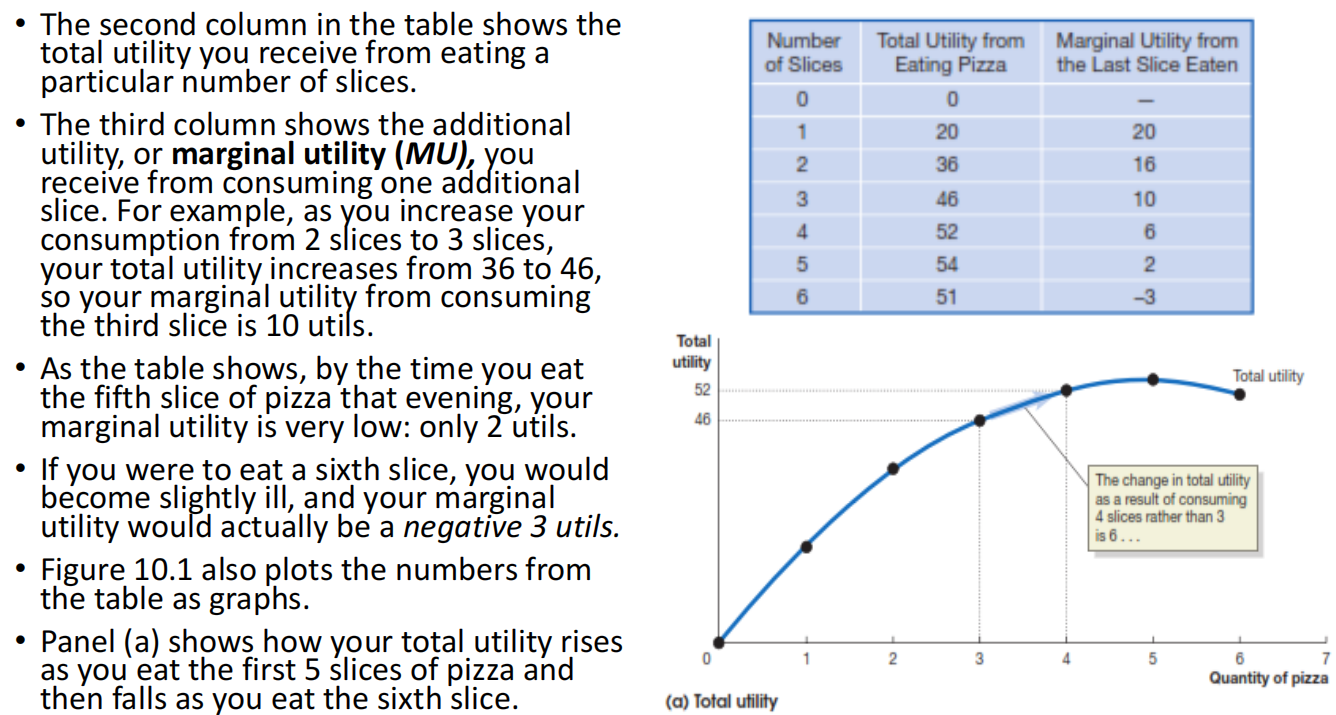
The second column in the table shows the total utility you receive from eating a particular number of slices.
📖 点击查看译文
表格的第二列显示了你吃特定数量比萨所获得的总效用。
The third column shows the additional utility, or marginal utility (MU), you receive from consuming one additional slice.
📖 点击查看译文
第三列显示了你通过消费一片额外比萨所获得的额外效用,或称边际效用(MU)。
For example, as you increase your consumption from 2 slices to 3 slices, your total utility increases from 36 to 46, so your marginal utility from consuming the third slice is 10 utils.
📖 点击查看译文
例如,当你从吃 2 片比萨增加到 3 片时,总效用从 36 增加到 46,所以吃第三片比萨的边际效用为 10 个效用单位。
As the table shows, by the time you eat the fifth slice of pizza that evening, your marginal utility is very low: only 2 utils.
📖 点击查看译文
如表格所示,当你吃到那个晚上第五片比萨时,边际效用非常低:只有 2 个效用单位。
If you were to eat a sixth slice, you would become slightly ill, and your marginal utility would actually be a negative 3 utils.
📖 点击查看译文
如果你吃第六片比萨,你会稍微感到不适,并且你的边际效用实际上会变成负 3 个效用单位。
Figure 10.1 also plots the numbers from the table as graphs.
📖 点击查看译文
图10.1还将表格中的数据绘制成图表。
Panel (a) shows how your total utility rises as you eat the first 5 slices of pizza and then falls as you eat the sixth slice.
📖 点击查看译文
面板(a)展示了你在吃掉前五片比萨时,总效用如何上升,之后吃第六片比萨时,总效用开始下降。
知识点列表与拓展 (Knowledge Points and Extensions):
5. Marginal Utility and Consumer Decisions (边际效用与消费者决策)
-
解释 (Explanation):
Marginal utility refers to the additional satisfaction or utility gained from consuming one more unit of a good or service. The law of diminishing marginal utility states that as more units of a good are consumed, the marginal utility decreases.
(边际效用指的是消费一单位商品或服务所获得的额外满足感或效用。边际效用递减法则指出,随着商品消费单位的增加,边际效用会减少。)
-
例子 (Example):
Eating the first slice of pizza brings high satisfaction, but as more slices are consumed, the satisfaction from each additional slice becomes smaller, eventually even negative.
(吃第一片比萨带来很高的满足感,但随着更多比萨的消费,每增加一片带来的满足感会逐渐变小,最终甚至为负值。)
-
拓展 (Extension):
This principle explains why consumers allocate their budget to a variety of goods rather than spending it all on one good. By diversifying consumption, they can maximize their total utility.
(这一法则解释了为什么消费者会将预算分配到多种商品上,而不是将其全部花费在一种商品上。通过多样化消费,他们能够最大化总体效用。)
6
The Decline in Marginal Utility (边际效用的下降)
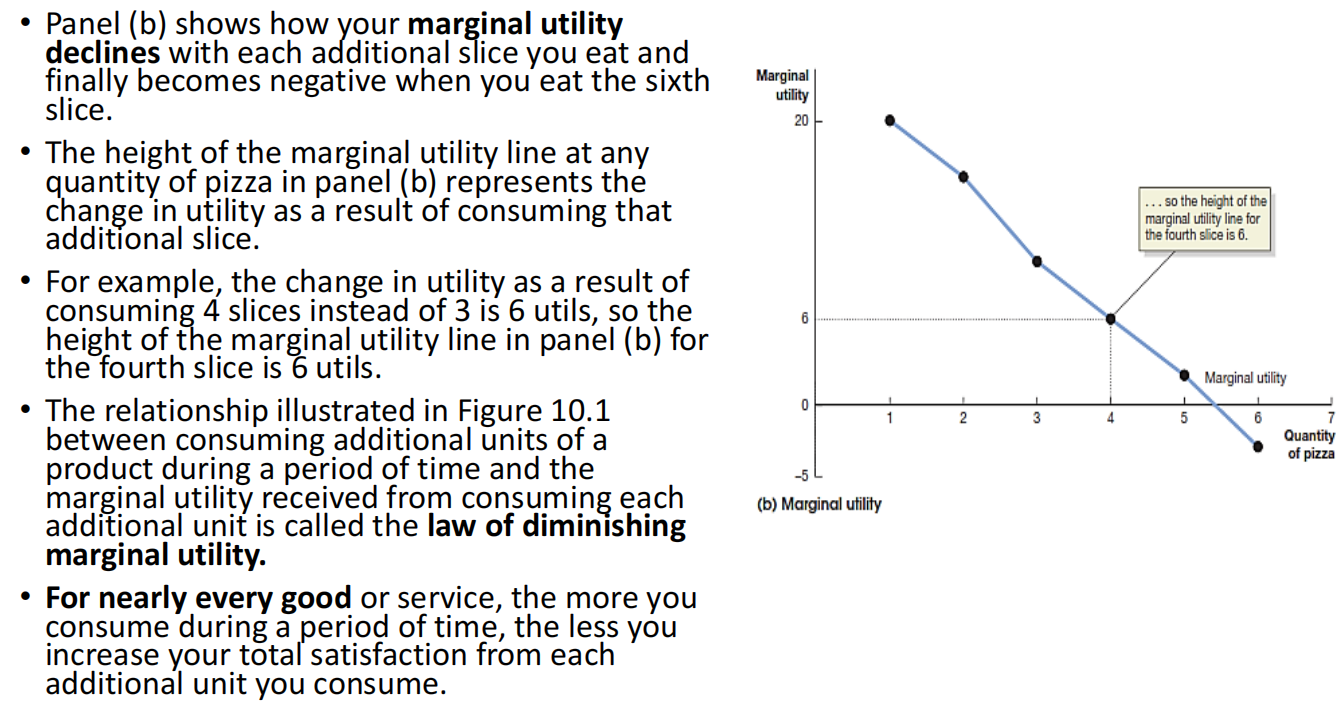
Panel (b) shows how your marginal utility declines with each additional slice you eat and finally becomes negative when you eat the sixth slice.
📖 点击查看译文
面板(b)展示了随着每增加一片比萨,边际效用如何下降,并且当你吃到第六片时,边际效用变为负数。
The height of the marginal utility line at any quantity of pizza in panel (b) represents the change in utility as a result of consuming that additional slice.
📖 点击查看译文
面板(b)中任意数量比萨的边际效用线的高度表示由于消费该额外一片比萨而导致的效用变化。
For example, the change in utility as a result of consuming 4 slices instead of 3 is 6 utils, so the height of the marginal utility line in panel (b) for the fourth slice is 6 utils.
📖 点击查看译文
例如,消费 4 片比萨而不是 3 片所带来的效用变化是 6 个效用单位,所以面板(b)中第四片比萨的边际效用线高度为 6 个效用单位。
The relationship illustrated in Figure 10.1 between consuming additional units of a product during a period of time and the marginal utility received from consuming each additional unit is called the law of diminishing marginal utility.
📖 点击查看译文
图10.1中展示的在一段时间内消费额外单位商品与从消费每个额外单位中获得的边际效用之间的关系,被称为边际效用递减法则。
For nearly every good or service, the more you consume during a period of time, the less you increase your total satisfaction from each additional unit you consume.
📖 点击查看译文
对于几乎所有商品或服务,在一段时间内消费越多,每消费一个额外单位所带来的总满足感增加就越少。
知识点列表与拓展 (Knowledge Points and Extensions):
6. Law of Diminishing Marginal Utility (边际效用递减法则)
-
解释 (Explanation):
The law of diminishing marginal utility states that as more units of a good or service are consumed, the additional satisfaction gained from each successive unit decreases.
(边际效用递减法则指出,随着消费更多单位的商品或服务,每增加一单位所获得的额外满足感会减少。)
-
例子 (Example):
As you consume more slices of pizza, each additional slice adds less satisfaction, eventually leading to a decrease in total satisfaction.
(随着你吃更多的比萨,每多吃一片带来的满足感减少,最终导致总满足感的下降。)
-
拓展 (Extension):
The law of diminishing marginal utility is fundamental to understanding consumer behavior and is key to the downward-sloping demand curve in economics.
(边际效用递减法则是理解消费者行为的基础,也是经济学中需求曲线向下倾斜的关键。)
7
The Rule of Equal Marginal Utility per Dollar Spent (每一单位货币的边际效用相等法则)
The key challenge for consumers is to decide how to allocate their limited incomes among all the products they want to buy.
📖 点击查看译文
消费者面临的关键挑战是决定如何在他们想购买的所有商品中分配有限的收入。
Every consumer has to make trade-offs: If you have $100 to spend on entertainment for the month, then the more movies you rent or buy online, the fewer movies you can see in the theater.
📖 点击查看译文
每个消费者都必须做出取舍:如果你有100美元用于本月的娱乐消费,那么你租赁或在线购买的电影越多,你在电影院看的电影就越少。
Economists refer to the limited amount of income you have available to spend on goods and services as your budget constraint.
📖 点击查看译文
经济学家将你可用于购买商品和服务的有限收入称为预算约束。
The principle of diminishing marginal utility helps us understand how consumers can best spend their limited incomes on the products available to them.
📖 点击查看译文
边际效用递减法则帮助我们理解消费者如何在可用的商品上最佳地分配有限的收入。
Suppose you attend a Super Bowl party at a restaurant, and you have $10 to spend on refreshments.
📖 点击查看译文
假设你参加了一场在餐厅举办的超级碗派对,你有10美元用于购买点心。
Pizza is selling for 1 per cup.
📖 点击查看译文
比萨每片售价2美元,汽水每杯售价1美元。
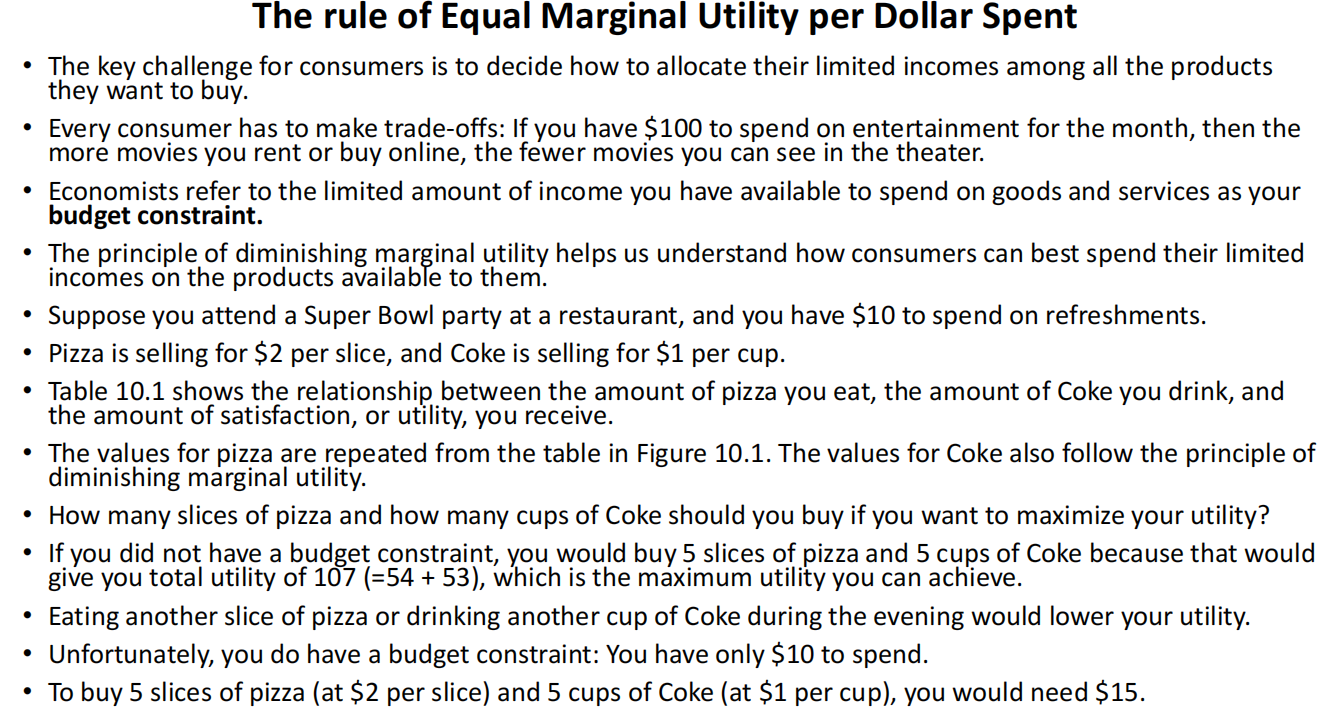
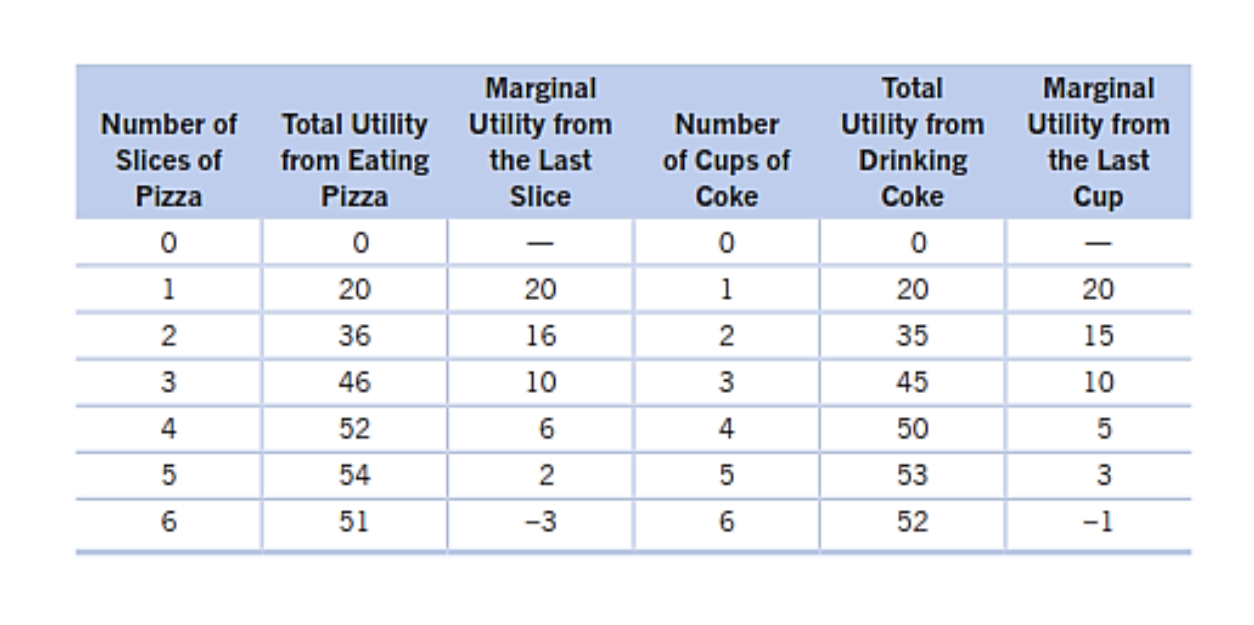
Table 10.1 shows the relationship between the amount of pizza you eat, the amount of Coke you drink, and the amount of satisfaction, or utility, you receive.
📖 点击查看译文
表10.1展示了你吃的比萨量、喝的汽水量以及你所获得的满足感或效用之间的关系。
The values for pizza are repeated from the table in Figure 10.1. The values for Coke also follow the principle of diminishing marginal utility.
📖 点击查看译文
比萨的数值与图10.1中的表格重复。汽水的数值也遵循边际效用递减法则。
How many slices of pizza and how many cups of Coke should you buy if you want to maximize your utility?
📖 点击查看译文
如果你想最大化效用,应该买多少片比萨和多少杯汽水?
If you did not have a budget constraint, you would buy 5 slices of pizza and 5 cups of Coke because that would give you total utility of 107 (=54 + 53), which is the maximum utility you can achieve.
📖 点击查看译文
如果没有预算约束,你会买5片比萨和5杯汽水,因为那样可以获得总效用107(=54 + 53),这是你能达到的最大效用。
Eating another slice of pizza or drinking another cup of Coke during the evening would lower your utility.
📖 点击查看译文
如果再吃一片比萨或再喝一杯汽水,会降低你的效用。
Unfortunately, you do have a budget constraint: You have only $10 to spend.
📖 点击查看译文
不幸的是,你有预算约束:你只有10美元可支配。
To buy 5 slices of pizza (at 1 per cup), you would need $15.
📖 点击查看译文
要购买5片比萨(每片2美元)和5杯汽水(每杯1美元),你需要15美元。
知识点列表与拓展 (Knowledge Points and Extensions):
7. Budget Constraint (预算约束)
-
解释 (Explanation):
A budget constraint refers to the limited amount of income a consumer has to spend on goods and services.
(预算约束是指消费者用于购买商品和服务的有限收入。)
-
例子 (Example):
If a consumer has $50 to spend, they must decide how to allocate this amount among different goods and services.
(如果消费者有50美元可支配,他们必须决定如何将这笔钱分配到不同的商品和服务上。)
-
拓展 (Extension):
The budget constraint helps determine the most efficient allocation of resources, and is essential for understanding consumer choice and maximizing utility.
(预算约束有助于确定资源的最有效分配,对于理解消费者选择和最大化效用至关重要。)
8. Equal Marginal Utility per Dollar Spent (每单位货币的边际效用相等法则)
-
解释 (Explanation):
The rule states that consumers should allocate their income in such a way that the marginal utility per dollar spent on each good is the same.
(该法则指出,消费者应当以一种方式分配他们的收入,使得在每个商品上的每一单位货币的边际效用相同。)
-
例子 (Example):
If the marginal utility per dollar spent on pizza is higher than that for Coke, a consumer should spend more on pizza until the marginal utility per dollar spent is equalized.
(如果在比萨上的每单位货币的边际效用高于汽水,消费者应当多花点钱在比萨上,直到每单位货币的边际效用相等为止。)
-
拓展 (Extension):
This principle helps consumers make decisions about how to best allocate their limited resources to maximize total utility.
(这一原则帮助消费者做出关于如何最佳分配有限资源以最大化总效用的决策。)
8
9
The Rule of Equal Marginal Utility per Dollar Spent (每一单位货币的边际效用相等法则)
To select the best way to spend your $10, remember this key economic principle: Optimal decisions are made at the margin.
📖 点击查看译文
为了选择最佳的10美元消费方式,请记住这一关键经济原则:最佳决策是在边际上做出的。
In this case, you are choosing to consume a little more pizza or a little more Coke.
📖 点击查看译文
在这种情况下,你选择多吃一点比萨或多喝一点汽水。
Everyone faces a budget constraint, and everyone faces trade-offs.
📖 点击查看译文
每个人都面临预算约束,每个人都面临取舍。
The key to making the best consumption decision is to maximize utility by following the rule of equal marginal utility per dollar spent.
📖 点击查看译文
做出最佳消费决策的关键是通过遵循每单位货币的边际效用相等法则来最大化效用。
It is important to remember that to follow this rule, you must equalize your marginal utility per dollar spent, not your marginal utility from each good.
📖 点击查看译文
需要记住的是,要遵循这个法则,你必须使每单位货币的边际效用相等,而不是每个商品的边际效用相等。
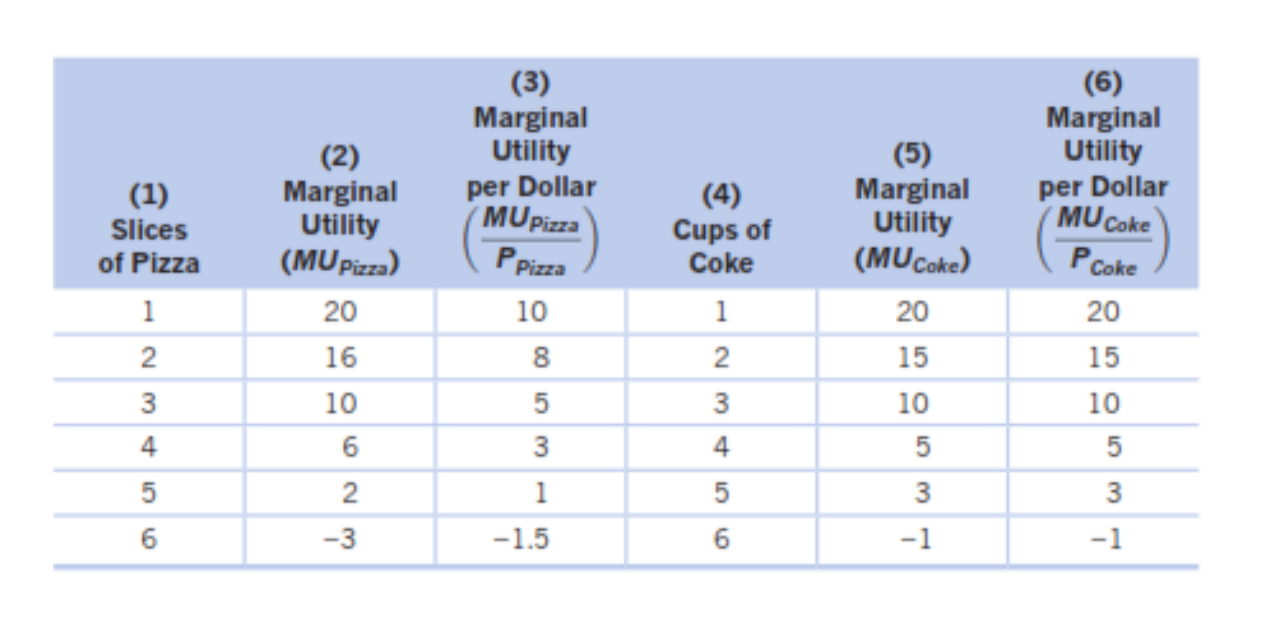
To decide how many slices of pizza and cups of Coke to buy, you must convert the values for marginal utility in Table 10.1 into marginal utility per dollar.
📖 点击查看译文
要决定购买多少片比萨和多少杯汽水,你必须将表10.1中的边际效用值转换为每单位货币的边际效用。
You can do this by dividing marginal utility by the price of each good, as shown in Table 10.2.
📖 点击查看译文
你可以通过将边际效用除以每个商品的价格来完成此操作,如表10.2所示。
In column (3), we calculate marginal utility per dollar spent on pizza.
📖 点击查看译文
在第(3)列中,我们计算了每单位货币花费在比萨上的边际效用。
Because the price of pizza is 2, or 10 utils per dollar.
📖 点击查看译文
由于比萨的价格为每片2美元,吃1片比萨的每单位货币的边际效用等于20除以2美元,即每单位货币10个效用单位。
Similarly, we show in column (6) that because the price of Coke is 1, or 20 utils per dollar.
📖 点击查看译文
类似地,在第(6)列中,我们显示了由于汽水的价格为每杯1美元,喝1杯汽水的每单位货币的边际效用等于20除以1美元,即每单位货币20个效用单位。
To maximize the total utility you receive, you must make sure that the utility per dollar of pizza for the last slice of pizza is equal to the utility per dollar of Coke for the last cup of Coke.
📖 点击查看译文
为了最大化你所获得的总效用,你必须确保最后一片比萨的每单位货币的效用等于最后一杯汽水的每单位货币的效用。
Table 10.2 shows that there are three combinations of slices of pizza and cups of Coke where marginal utility per dollar is equalized.
📖 点击查看译文
表10.2显示了有三种比萨片数和汽水杯数的组合,其中每单位货币的边际效用相等。
知识点列表与拓展 (Knowledge Points and Extensions):
9. Marginal Utility per Dollar (每单位货币的边际效用)
-
解释 (Explanation):
Marginal utility per dollar is calculated by dividing the marginal utility by the price of the good. This helps consumers make decisions about how to spend their limited income.
(每单位货币的边际效用通过将边际效用除以商品价格来计算。这帮助消费者做出如何花费有限收入的决策。)
-
例子 (Example):
If the marginal utility of a pizza slice is 20 utils and the price is $2, then the marginal utility per dollar is 10 utils per dollar.
(如果一片比萨的边际效用是20个效用单位,价格是2美元,那么每单位货币的边际效用就是每单位货币10个效用单位。)
-
拓展 (Extension):
Consumers should allocate their income in such a way that the marginal utility per dollar is the same across all goods they consume in order to maximize total utility.
(消费者应该以这种方式分配他们的收入,使得他们消费的所有商品的每单位货币的边际效用相同,以最大化总效用。)
10. Budget Allocation (预算分配)
-
解释 (Explanation):
Budget allocation involves deciding how to spend limited income across different goods and services to maximize utility.
(预算分配是指决定如何在不同的商品和服务上分配有限收入,以最大化效用。)
-
例子 (Example):
If a consumer has a budget of 4 to buy pizza and $6 to buy soda based on the marginal utility per dollar.
(如果消费者的预算是10美元,他们可能根据每单位货币的边际效用将4美元用于购买比萨,将6美元用于购买汽水。)
-
拓展 (Extension):
Understanding budget allocation and marginal utility per dollar can help individuals make informed purchasing decisions and optimize their well-being.
(理解预算分配和每单位货币的边际效用可以帮助个人做出明智的购买决策,并优化他们的幸福感。)
10
11
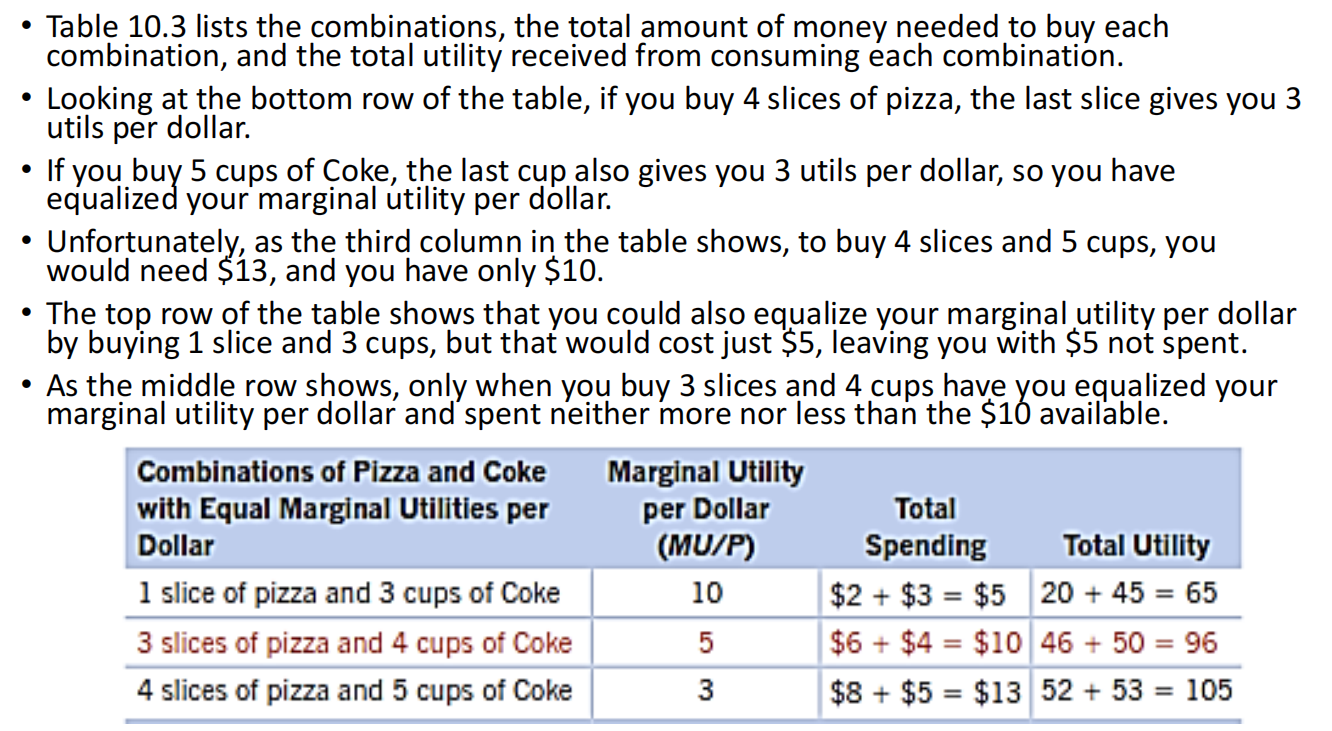
Table 10.3: Allocating Budget for Optimal Utility
Table 10.3 lists the combinations, the total amount of money needed to buy each combination, and the total utility received from consuming each combination.
📖 点击查看译文
表10.3列出了组合、购买每个组合所需的总金额以及从消费每个组合中获得的总效用。
Looking at the bottom row of the table, if you buy 4 slices of pizza, the last slice gives you 3 utils per dollar.
📖 点击查看译文
查看表格底部的行,如果你购买4片比萨,最后一片给你每单位货币3个效用单位。
If you buy 5 cups of Coke, the last cup also gives you 3 utils per dollar, so you have equalized your marginal utility per dollar.
📖 点击查看译文
如果你购买5杯汽水,最后一杯也给你每单位货币3个效用单位,所以你已经使每单位货币的边际效用相等。
Unfortunately, as the third column in the table shows, to buy 4 slices and 5 cups, you would need 10.
📖 点击查看译文
不幸的是,正如表格中的第三列所示,要购买4片比萨和5杯汽水,你需要13美元,而你只有10美元。
The top row of the table shows that you could also equalize your marginal utility per dollar by buying 1 slice and 3 cups, but that would cost just 5 not spent.
📖 点击查看译文
表格的顶部行显示,你也可以通过购买1片比萨和3杯汽水来使每单位货币的边际效用相等,但这只需花费5美元,剩余5美元未花费。
As the middle row shows, only when you buy 3 slices and 4 cups have you equalized your marginal utility per dollar and spent neither more nor less than the $10 available.
📖 点击查看译文
正如中间一行所示,只有当你购买3片比萨和4杯汽水时,你才能使每单位货币的边际效用相等,并且正好花费了10美元,没有多花或少花。
知识点列表与拓展 (Knowledge Points and Extensions):
11. Budget Constraint and Utility Maximization (预算约束与效用最大化)
-
解释 (Explanation):
Consumers must allocate their limited income to maximize utility. This requires balancing the marginal utility per dollar across different goods and services.
(消费者必须分配他们有限的收入以最大化效用。这需要在不同商品和服务之间平衡每单位货币的边际效用。)
-
例子 (Example):
If a consumer has $10, they might choose to buy 3 slices of pizza and 4 cups of Coke, as this combination maximizes their utility without exceeding their budget.
(如果消费者有10美元,他们可能选择购买3片比萨和4杯汽水,因为这种组合最大化了他们的效用且不超出预算。)
-
拓展 (Extension):
Consumers should adjust their purchases in response to their budget constraints and the marginal utility per dollar to make the best decisions.
(消费者应根据预算约束和每单位货币的边际效用调整他们的购买,以做出最佳决策。)
12. Trade-offs and Opportunity Costs (取舍与机会成本)
-
解释 (Explanation):
Making choices involves trade-offs, where choosing more of one good or service means forgoing another. The opportunity cost is the value of the next best alternative.
(做选择涉及取舍,选择更多某个商品或服务意味着放弃另一个商品或服务。机会成本是下一个最佳选择的价值。)
-
例子 (Example):
By spending $10 on 3 slices of pizza and 4 cups of Coke, the consumer forgoes other combinations that could potentially yield more utility.
(通过将10美元花费在3片比萨和4杯汽水上,消费者放弃了其他可能带来更多效用的组合。)
-
拓展 (Extension):
Understanding trade-offs and opportunity costs can help consumers make better decisions in their everyday spending.
(理解取舍和机会成本可以帮助消费者在日常消费中做出更好的决策。)
12
13
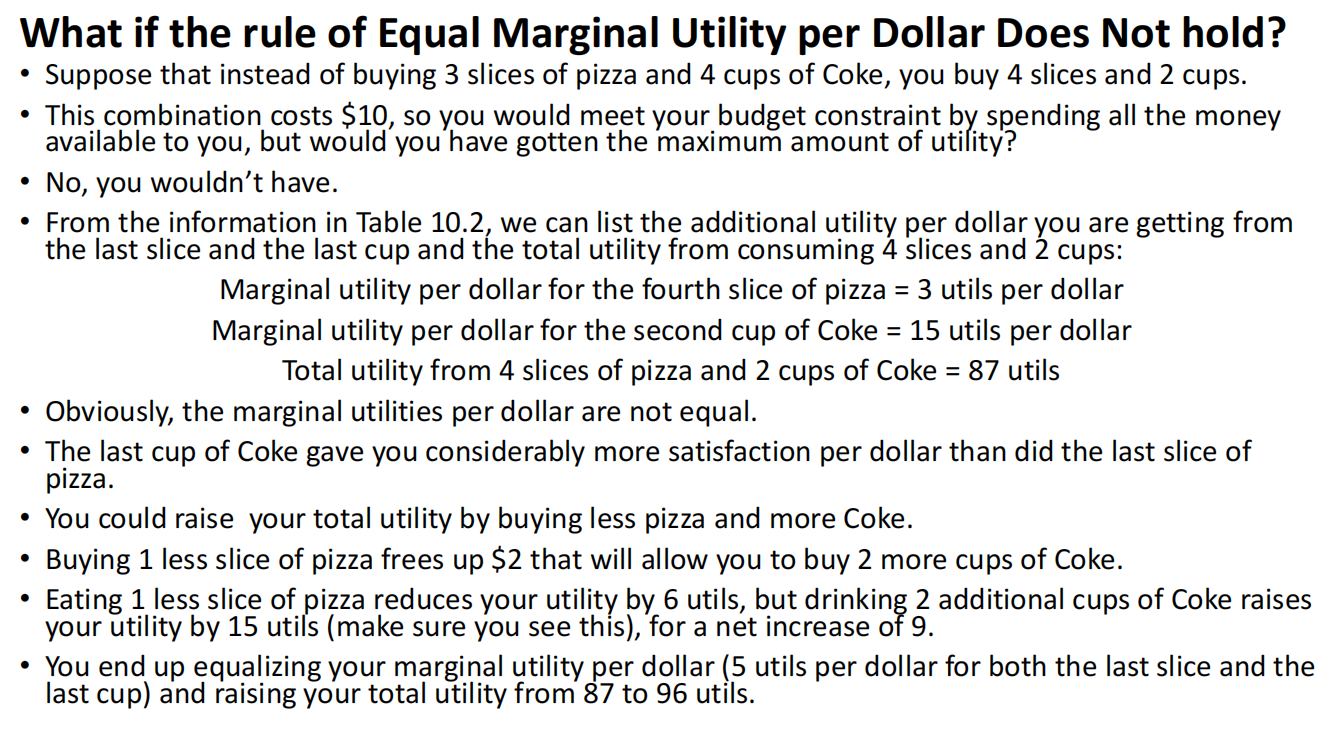
What if the Rule of Equal Marginal Utility per Dollar Does Not Hold?
Suppose that instead of buying 3 slices of pizza and 4 cups of Coke, you buy 4 slices and 2 cups.
📖 点击查看译文
假设你没有购买3片比萨和4杯汽水,而是购买了4片比萨和2杯汽水。
This combination costs $10, so you would meet your budget constraint by spending all the money available to you, but would you have gotten the maximum amount of utility?
📖 点击查看译文
这个组合花费了10美元,所以你满足了预算约束,但你是否获得了最大的效用?
No, you wouldn’t have.
📖 点击查看译文
不,你没有。
From the information in Table 10.2, we can list the additional utility per dollar you are getting from the last slice and the last cup and the total utility from consuming 4 slices and 2 cups:
-
Marginal utility per dollar for the fourth slice of pizza = 3 utils per dollar
-
Marginal utility per dollar for the second cup of Coke = 15 utils per dollar
-
Total utility from 4 slices of pizza and 2 cups of Coke = 87 utils
📖 点击查看译文
根据表格10.2中的信息,我们可以列出你从最后一片比萨和最后一杯汽水中获得的每单位货币的额外效用,以及消费4片比萨和2杯汽水的总效用:
-
第四片比萨的每单位货币效用 = 3个效用单位
-
第二杯汽水的每单位货币效用 = 15个效用单位
-
4片比萨和2杯汽水的总效用 = 87个效用单位
Obviously, the marginal utilities per dollar are not equal.
📖 点击查看译文
显然,每单位货币的边际效用不相等。
The last cup of Coke gave you considerably more satisfaction per dollar than did the last slice of pizza.
📖 点击查看译文
最后一杯汽水给你每单位货币的效用远高于最后一片比萨。
You could raise your total utility by buying less pizza and more Coke.
📖 点击查看译文
你可以通过少买比萨,多买汽水来提高你的总效用。
Buying 1 less slice of pizza frees up $2 that will allow you to buy 2 more cups of Coke.
📖 点击查看译文
少买1片比萨可以节省2美元,这样你就可以再买2杯汽水。
Eating 1 less slice of pizza reduces your utility by 6 utils, but drinking 2 additional cups of Coke raises your utility by 15 utils (make sure you see this), for a net increase of 9.
📖 点击查看译文
少吃1片比萨会使你的效用减少6个效用单位,但再喝2杯汽水会使你的效用增加15个效用单位(确保你明白这一点),净增加9个效用单位。
You end up equalizing your marginal utility per dollar (5 utils per dollar for both the last slice and the last cup) and raising your total utility from 87 to 96 utils.
📖 点击查看译文
你最终使每单位货币的边际效用相等(最后一片比萨和最后一杯汽水都为每单位货币5个效用单位),并将总效用从87个效用单位提高到96个效用单位。
知识点列表与拓展 (Knowledge Points and Extensions):
13. Marginal Utility and Budget Allocation (边际效用与预算分配)
-
解释 (Explanation):
If the rule of equal marginal utility per dollar is not followed, consumers can increase total utility by reallocating spending from goods with lower marginal utility per dollar to those with higher marginal utility per dollar.
(如果不遵循每单位货币的边际效用相等规则,消费者可以通过将支出从每单位货币效用较低的商品转移到每单位货币效用较高的商品来增加总效用。)
-
例子 (Example):
In the example, spending less on pizza and more on Coke increases the consumer’s total utility from 87 to 96 utils.
(在这个例子中,减少比萨的消费,增加汽水的消费,将消费者的总效用从87个效用单位提高到96个效用单位。)
-
拓展 (Extension):
Consumers should always adjust their spending to ensure that the marginal utility per dollar is equalized across all goods and services to maximize total utility.
(消费者应始终调整他们的消费,确保各个商品和服务的每单位货币边际效用相等,以最大化总效用。)
14
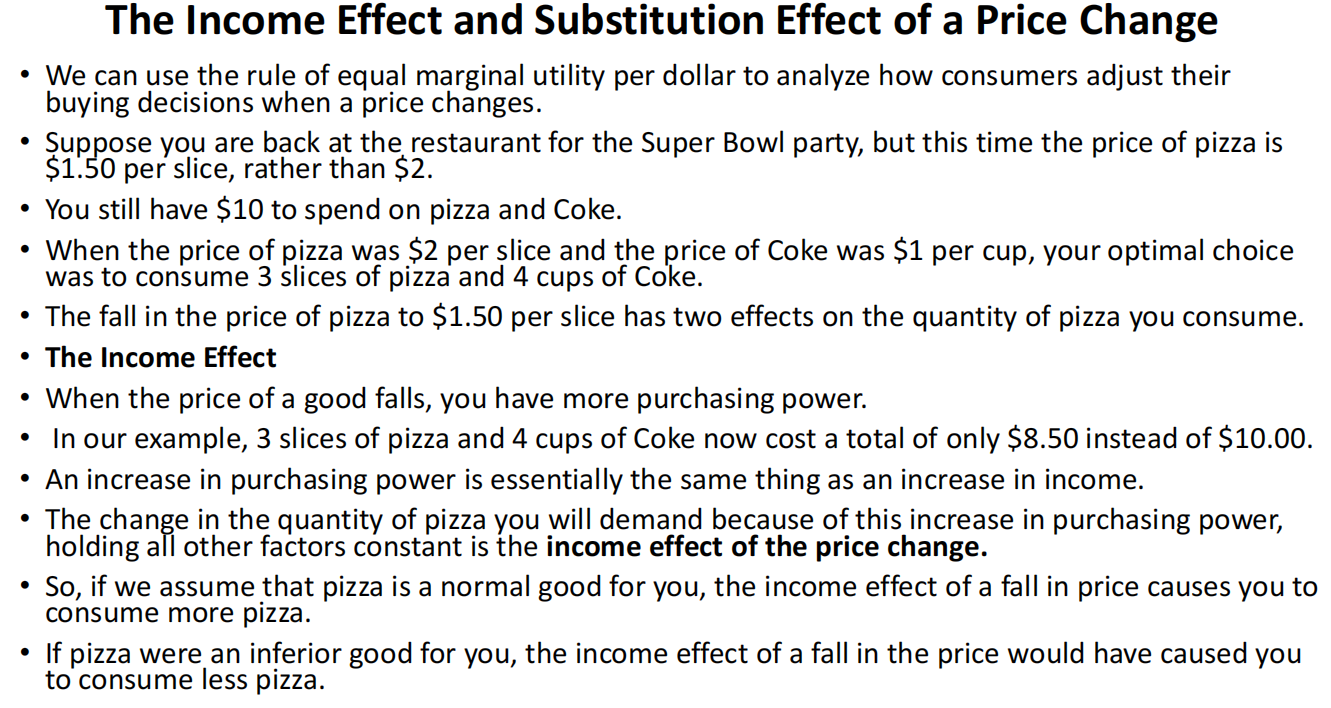
收入效应与替代效应的价格变化分析 (The Income Effect and Substitution Effect of a Price Change)
我们可以使用每单位货币的边际效用相等规则来分析价格变化时消费者如何调整购买决策。
📖 点击查看译文
We can use the rule of equal marginal utility per dollar to analyze how consumers adjust their buying decisions when a price changes.
假设你又回到了为超级碗派对而来的餐厅,但这次比萨的价格是每片1.5美元,而不是2美元。
📖 点击查看译文
Suppose you are back at the restaurant for the Super Bowl party, but this time the price of pizza is 2.
你仍然有10美元可以花在比萨和汽水上。
📖 点击查看译文
You still have $10 to spend on pizza and Coke.
当比萨价格为每片2美元,汽水价格为每杯1美元时,你的最佳选择是消费3片比萨和4杯汽水。
📖 点击查看译文
When the price of pizza was 1 per cup, your optimal choice was to consume 3 slices of pizza and 4 cups of Coke.
比萨价格降至每片1.5美元对你消费的比萨数量有两个影响。
📖 点击查看译文
The fall in the price of pizza to $1.50 per slice has two effects on the quantity of pizza you consume.
收入效应 (The Income Effect)
当某个商品的价格下降时,你的购买力增加。
📖 点击查看译文
When the price of a good falls, you have more purchasing power.
在我们的例子中,3片比萨和4杯汽水现在只需要8.5美元,而不是10美元。
📖 点击查看译文
In our example, 3 slices of pizza and 4 cups of Coke now cost a total of only 10.00.
购买力的增加本质上等同于收入的增加。
📖 点击查看译文
An increase in purchasing power is essentially the same thing as an increase in income.
由于购买力的增加,在其他因素不变的情况下,你对比萨需求量的变化就是价格变化的收入效应。
📖 点击查看译文
The change in the quantity of pizza you will demand because of this increase in purchasing power, holding all other factors constant, is the income effect of the price change.
因此,如果我们假设比萨对你来说是正常商品,价格下降的收入效应会导致你消费更多的比萨。
📖 点击查看译文
So, if we assume that pizza is a normal good for you, the income effect of a fall in price causes you to consume more pizza.
如果比萨对你来说是劣质商品,价格下降的收入效应将导致你消费更少的比萨。
📖 点击查看译文
If pizza were an inferior good for you, the income effect of a fall in the price would have caused you to consume less pizza.
知识点列表与拓展 (Knowledge Points and Extensions):
14. 收入效应与替代效应 (Income Effect and Substitution Effect)
-
解释 (Explanation):
The income effect refers to the change in the quantity demanded of a good due to an increase in purchasing power, as a result of a price change. If the price of a good falls, consumers may demand more of it if it is a normal good, or less if it is an inferior good.
(收入效应是指由于价格变化而导致的购买力增加所引起的商品需求量的变化。如果某商品的价格下降,消费者可能会增加该商品的需求,如果它是正常商品,或者减少,如果它是劣质商品。)
-
例子 (Example):
When the price of pizza falls from 1.50 per slice, the consumer’s purchasing power increases, and if pizza is a normal good, they may consume more.
(当比萨的价格从每片2美元降到1.5美元时,消费者的购买力增加,如果比萨是正常商品,他们可能会消费更多。)
-
拓展 (Extension):
The substitution effect also comes into play when a good becomes cheaper, as consumers may substitute other goods for the now cheaper good.
(当某个商品变得更便宜时,替代效应也会发挥作用,因为消费者可能会用便宜的商品替代其他商品。)
15
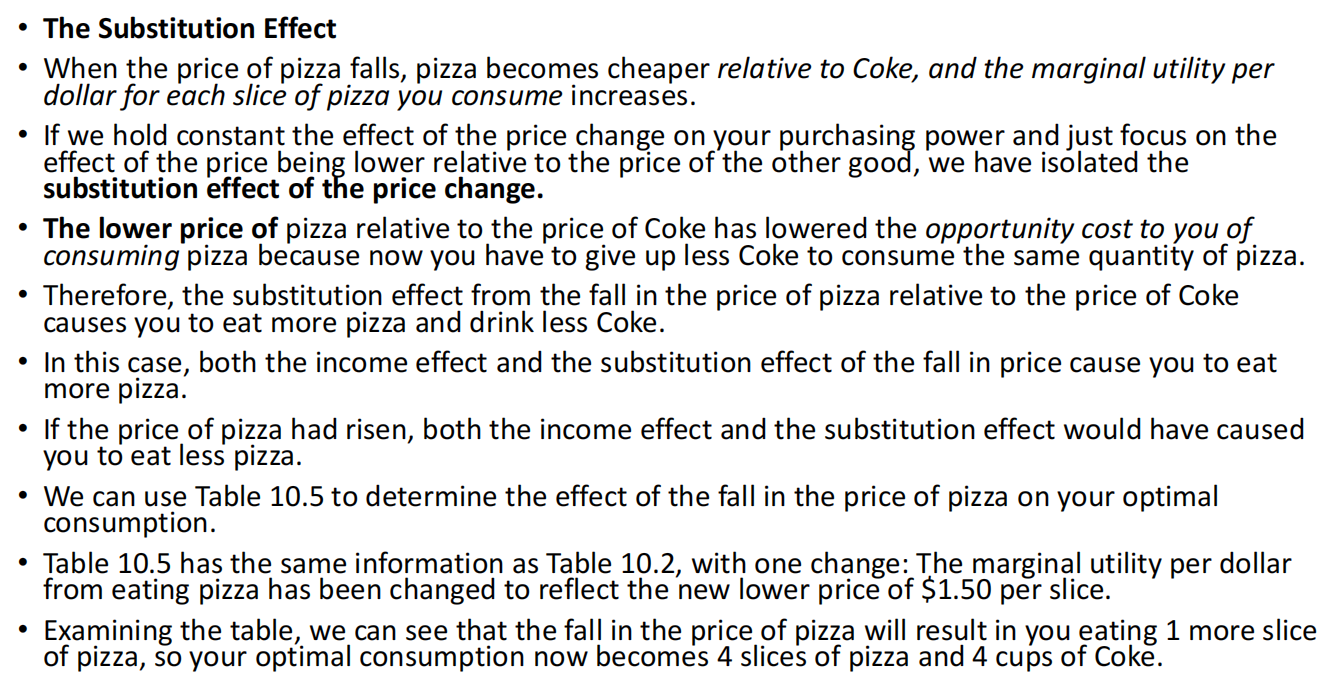
替代效应 (The Substitution Effect)
当比萨的价格下降时,比萨相对于汽水变得更便宜,你消费的每片比萨的边际效用每美元增加。
📖 点击查看译文
When the price of pizza falls, pizza becomes cheaper relative to Coke, and the marginal utility per dollar for each slice of pizza you consume increases.
如果我们保持购买力变化的影响不变,只关注价格相对于其他商品价格较低的影响,那么我们就可以孤立出价格变化的替代效应。
📖 点击查看译文
If we hold constant the effect of the price change on your purchasing power and just focus on the effect of the price being lower relative to the price of the other good, we have isolated the substitution effect of the price change.
比萨相对于汽水的价格下降,降低了你消费比萨的机会成本,因为现在你消费同样数量的比萨时需要放弃更少的汽水。
📖 点击查看译文
The lower price of pizza relative to the price of Coke has lowered the opportunity cost to you of consuming pizza because now you have to give up less Coke to consume the same quantity of pizza.
因此,比萨价格相对于汽水价格下降的替代效应导致你吃更多的比萨,喝更少的汽水。
📖 点击查看译文
Therefore, the substitution effect from the fall in the price of pizza relative to the price of Coke causes you to eat more pizza and drink less Coke.
在这种情况下,价格下降的收入效应和替代效应都会导致你吃更多的比萨。
📖 点击查看译文
In this case, both the income effect and the substitution effect of the fall in price cause you to eat more pizza.
如果比萨的价格上升,收入效应和替代效应都会导致你吃更少的比萨。
📖 点击查看译文
If the price of pizza had risen, both the income effect and the substitution effect would have caused you to eat less pizza.
我们可以使用表10.5来确定比萨价格下降对你最佳消费选择的影响。
📖 点击查看译文
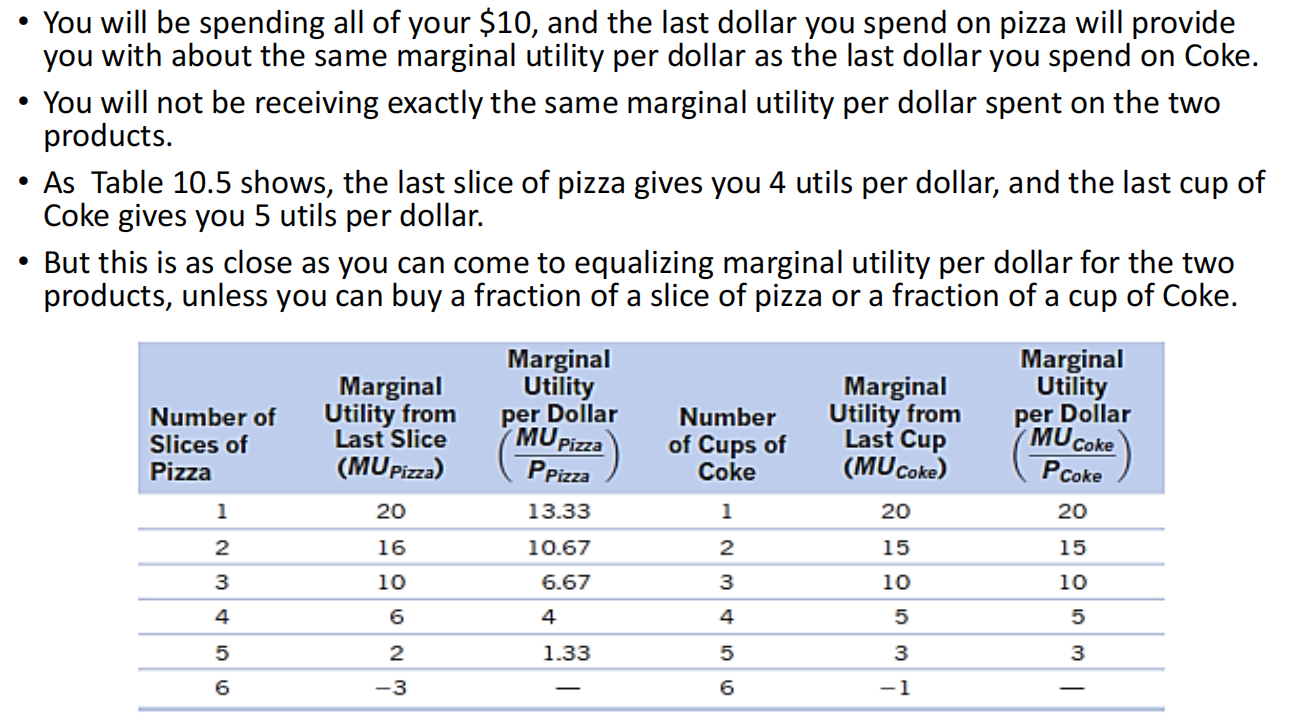
We can use Table 10.5 to determine the effect of the fall in the price of pizza on your optimal consumption.
表10.5包含与表10.2相同的信息,只不过有一个变化:每片比萨的边际效用每美元已经反映了1.5美元的新低价。
📖 点击查看译文
Table 10.5 has the same information as Table 10.2, with one change: The marginal utility per dollar from eating pizza has been changed to reflect the new lower price of $1.50 per slice.
通过检查表格,我们可以看到,比萨价格下降将导致你多吃1片比萨,因此你最佳的消费量现在变成了4片比萨和4杯汽水。
📖 点击查看译文
Examining the table, we can see that the fall in the price of pizza will result in you eating 1 more slice of pizza, so your optimal consumption now becomes 4 slices of pizza and 4 cups of Coke.
知识点列表与拓展 (Knowledge Points and Extensions):
15. 替代效应 (Substitution Effect)
-
解释 (Explanation):
The substitution effect refers to the change in the quantity demanded of a good when its price falls, causing it to become relatively cheaper compared to other goods. This results in consumers substituting the cheaper good for the more expensive one.
(替代效应是指当某商品价格下降时,该商品相对其他商品变得更便宜,从而导致消费者用便宜的商品替代更贵的商品。)
-
例子 (Example):
If the price of pizza falls while the price of Coke remains constant, consumers will tend to buy more pizza and less Coke.
(如果比萨的价格下降,而汽水的价格保持不变,消费者会倾向于买更多的比萨,买更少的汽水。)
-
拓展 (Extension):
The substitution effect is often seen in the context of consumer choice, as individuals continuously adjust their purchases in response to relative price changes.
(替代效应通常出现在消费者选择的背景下,因为个体会根据相对价格变化不断调整他们的购买。)
16
17
需求曲线的来源 (Where Demand Curves Come From)
学习目标:使用效用概念解释需求法则
📖 点击查看译文
Learning Objective: Use the concept of utility to explain the law of demand
根据需求法则,当一种商品的价格下降时,需求量会增加。
📖 点击查看译文
According to the law of demand, whenever the price of a product falls, the quantity demanded increases.
在我们关于超级碗派对上比萨和汽水的最佳消费例子中,我们得出了以下结论:
📖 点击查看译文
In our example of optimal consumption of pizza and Coke at the Super Bowl party, we found the following:
-
比萨的价格 = +2美元/片,需求量 = 3片。
-
比萨的价格 = +1.50美元/片,需求量 = 4片。
📖 点击查看译文
-
Price of pizza = +2 per slice, Quantity of pizza demanded = 3 slices.
-
Price of pizza = +1.50 per slice, Quantity of pizza demanded = 4 slices.
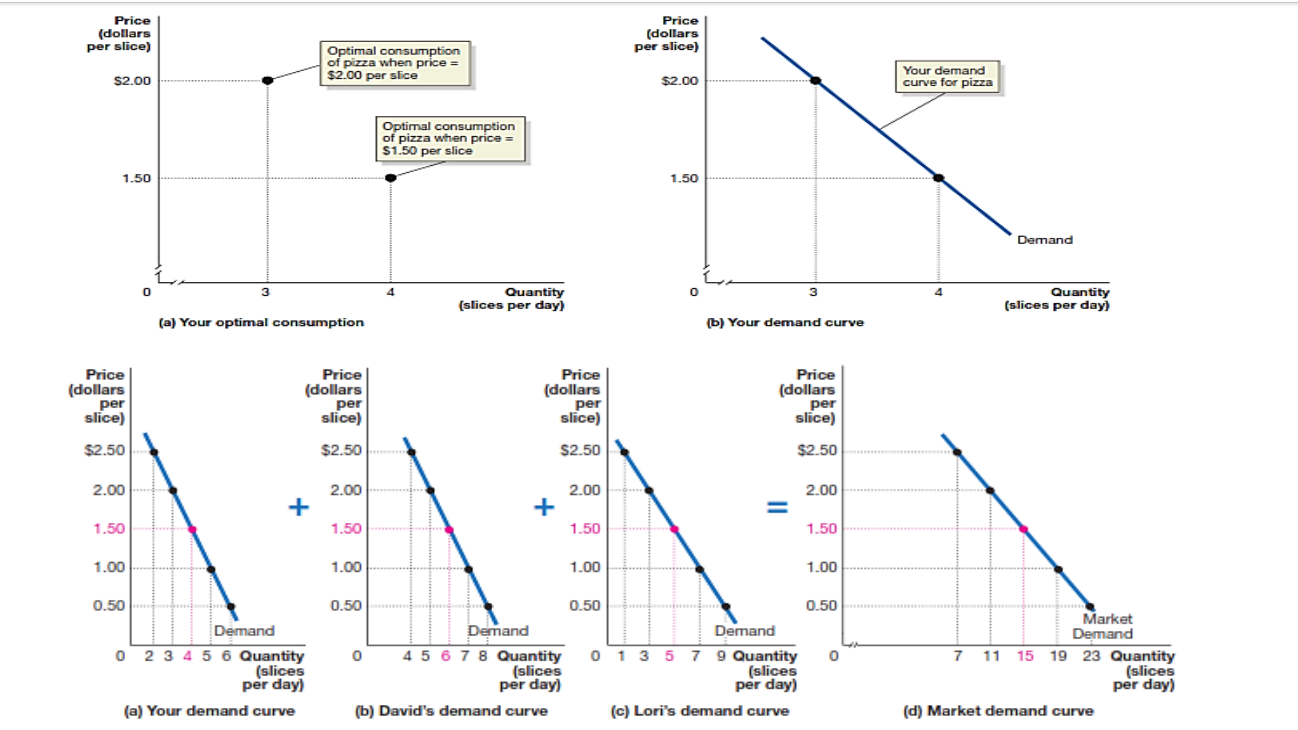
在图10.2的面板(a)中,我们绘制了显示在每个价格下你选择消费的比萨的最佳数量的两个点。
📖 点击查看译文
In panel (a) of Figure 10.2, we plot the two points showing the optimal number of slices of pizza you choose to consume at each price.
在面板(b)中,我们画出连接这两个点的直线。
📖 点击查看译文
In panel (b), we draw a line connecting the two points.
这条向下倾斜的直线代表你的比萨需求曲线。
📖 点击查看译文
This downward-sloping line represents your demand curve for pizza.
我们可以通过改变比萨的价格,并使用表10.2中的信息找到每个价格下你会要求的新的最佳比萨数量,从而找到需求曲线上的更多点。
📖 点击查看译文
We could find more points on the line by changing the price of pizza and using the information in Table 10.2 to find the new optimal number of slices of pizza you would demand at each price.
为了简化问题,我们假设市场上只有三位消费者:你、David和Lori。
📖 点击查看译文
To keep things simple, let’s assume that there are only three consumers in the market for pizza: you, David, and Lori.
图10.3中的表格展示了三位消费者的个人需求量表。
📖 点击查看译文
The table in Figure 10.3 shows the individual demand schedules for the three consumers.
例如,在比萨价格为每片1.50美元时,你的需求量为4片,David的为6片,Lori的为5片。
📖 点击查看译文
For example, at a price of $1.50 per slice, your quantity demanded is 4 slices, David’s is 6 slices, and Lori’s is 5 slices.
因此,在价格为1.50美元时,市场上需求的比萨数量为15片。
📖 点击查看译文
So, at a price of $1.50, a quantity of 15 slices is demanded in the market.
图中的图形显示了我们可以通过水平加总各个消费者的需求曲线来获得市场需求曲线。
📖 点击查看译文
The graphs in the figure show that we can obtain the market demand curve by adding horizontally the individual demand curves.
知识点列表与拓展 (Knowledge Points and Extensions):
16. 需求曲线的形成 (Formation of the Demand Curve)
-
解释 (Explanation):
The demand curve is derived by plotting the quantity of a good demanded at various prices. As the price of a good decreases, the quantity demanded generally increases, following the law of demand.
(需求曲线是通过绘制在不同价格下所要求的商品数量而形成的。根据需求法则,商品价格下降时,需求量通常会增加。)
-
例子 (Example):
In the context of pizza and Coke at the Super Bowl party, the optimal number of pizza slices demanded at different prices is used to plot the demand curve.
(在超级碗派对的比萨和汽水的例子中,不同价格下对比萨的最佳需求量被用来绘制需求曲线。)
-
拓展 (Extension):
The market demand curve is obtained by horizontally adding the individual demand curves of all consumers in the market.
(市场需求曲线是通过水平加总市场中所有消费者的个人需求曲线来获得的。)
18
19
需求法则与价格变化 (Law of Demand and Price Changes)
记住,根据需求法则,市场需求曲线总是向下倾斜的。
📖 点击查看译文
Remember that according to the law of demand, market demand curves always slope downward.
我们现在知道,这一结果成立是因为价格下降的收入效应和替代效应导致消费者增加他们需求的商品数量。
📖 点击查看译文
We now know that this result holds because the income and substitution effects of a decrease in price cause consumers to increase the quantity of the good they demand.
对于劣质商品,收入效应导致消费者减少需求量。
📖 点击查看译文
For an inferior good, the income effect leads consumers to decrease the quantity of the good they demand.
另一方面,替代效应使得消费者在价格下降时,增加他们对正常商品和劣质商品的需求量。
📖 点击查看译文
The substitution effect, on the other hand, results in consumers increasing the quantity they demand of both normal and inferior goods when the price falls.
因此,当劣质商品的价格下降时,收入效应和替代效应的方向相反:收入效应使消费者减少他们的需求量,而替代效应使消费者增加他们的需求量。
📖 点击查看译文
So, when the price of an inferior good falls, the income effect and substitution effect work in opposite directions: The income effect causes consumers to decrease the quantity of the good they demand, while the substitution effect causes consumers to increase the quantity of the good they demand.
那么,消费者在价格下降时是否有可能实际上减少购买某个商品呢?
📖 点击查看译文
Is it possible, then, that consumers might actually buy less of a good when the price falls?
如果发生这种情况,那么需求曲线将是向上倾斜的。
📖 点击查看译文
If they did, the demand curve would be upward sloping.
知识点列表与拓展 (Knowledge Points and Extensions):
17. 需求法则与劣质商品 (Law of Demand and Inferior Goods)
-
解释 (Explanation):
The law of demand generally states that as the price of a good falls, the quantity demanded increases. However, for inferior goods, the income effect can lead to a decrease in demand, even if the price decreases.
(需求法则通常认为商品价格下降时,需求量增加。然而,对于劣质商品,收入效应可能导致需求量减少,即使价格下降。)
-
例子 (Example):
If the price of an inferior good decreases, the substitution effect encourages more consumption, but the income effect leads to less consumption.
(如果劣质商品价格下降,替代效应会鼓励更多消费,但收入效应则导致消费减少。)
-
拓展 (Extension):
In rare cases, the demand curve for an inferior good might slope upward due to the overriding effect of the income effect.
(在极少数情况下,劣质商品的需求曲线可能会向上倾斜,因为收入效应的作用更为显著。)
6. Law of Diminishing Marginal Utility (边际效用递减法则)
-
解释 (Explanation):
The law of diminishing marginal utility states that as more units of a good or service are consumed, the additional satisfaction gained from each successive unit decreases.
(边际效用递减法则指出,随着消费更多单位的商品或服务,每增加一单位所获得的额外满足感会减少。)
-
例子 (Example):
As you consume more slices of pizza, each additional slice adds less satisfaction, eventually leading to a decrease in total satisfaction.
(随着你吃更多的比萨,每多吃一片带来的满足感减少,最终导致总满足感的下降。)
-
拓展 (Extension):
The law of diminishing marginal utility is fundamental to understanding consumer behavior and is key to the downward-sloping demand curve in economics.
(边际效用递减法则是理解消费者行为的基础,也是经济学中需求曲线向下倾斜的关键。)
7

The Rule of Equal Marginal Utility per Dollar Spent (每一单位货币的边际效用相等法则)
The key challenge for consumers is to decide how to allocate their limited incomes among all the products they want to buy.
📖 点击查看译文
消费者面临的关键挑战是决定如何在他们想购买的所有商品中分配有限的收入。
Every consumer has to make trade-offs: If you have $100 to spend on entertainment for the month, then the more movies you rent or buy online, the fewer movies you can see in the theater.
📖 点击查看译文
每个消费者都必须做出取舍:如果你有100美元用于本月的娱乐消费,那么你租赁或在线购买的电影越多,你在电影院看的电影就越少。
Economists refer to the limited amount of income you have available to spend on goods and services as your budget constraint.
📖 点击查看译文
经济学家将你可用于购买商品和服务的有限收入称为预算约束。
The principle of diminishing marginal utility helps us understand how consumers can best spend their limited incomes on the products available to them.
📖 点击查看译文
边际效用递减法则帮助我们理解消费者如何在可用的商品上最佳地分配有限的收入。
Suppose you attend a Super Bowl party at a restaurant, and you have $10 to spend on refreshments.
📖 点击查看译文
假设你参加了一场在餐厅举办的超级碗派对,你有10美元用于购买点心。
Pizza is selling for 1 per cup.
📖 点击查看译文
比萨每片售价2美元,汽水每杯售价1美元。
Table 10.1 shows the relationship between the amount of pizza you eat, the amount of Coke you drink, and the amount of satisfaction, or utility, you receive.
📖 点击查看译文
表10.1展示了你吃的比萨量、喝的汽水量以及你所获得的满足感或效用之间的关系。
The values for pizza are repeated from the table in Figure 10.1. The values for Coke also follow the principle of diminishing marginal utility.
📖 点击查看译文
比萨的数值与图10.1中的表格重复。汽水的数值也遵循边际效用递减法则。
How many slices of pizza and how many cups of Coke should you buy if you want to maximize your utility?
📖 点击查看译文
如果你想最大化效用,应该买多少片比萨和多少杯汽水?
If you did not have a budget constraint, you would buy 5 slices of pizza and 5 cups of Coke because that would give you total utility of 107 (=54 + 53), which is the maximum utility you can achieve.
📖 点击查看译文
如果没有预算约束,你会买5片比萨和5杯汽水,因为那样可以获得总效用107(=54 + 53),这是你能达到的最大效用。
Eating another slice of pizza or drinking another cup of Coke during the evening would lower your utility.
📖 点击查看译文
如果再吃一片比萨或再喝一杯汽水,会降低你的效用。
Unfortunately, you do have a budget constraint: You have only $10 to spend.
📖 点击查看译文
不幸的是,你有预算约束:你只有10美元可支配。
To buy 5 slices of pizza (at 1 per cup), you would need $15.
📖 点击查看译文
要购买5片比萨(每片2美元)和5杯汽水(每杯1美元),你需要15美元。
知识点列表与拓展 (Knowledge Points and Extensions):
7. Budget Constraint (预算约束)
-
解释 (Explanation):
A budget constraint refers to the limited amount of income a consumer has to spend on goods and services.
(预算约束是指消费者用于购买商品和服务的有限收入。)
-
例子 (Example):
If a consumer has $50 to spend, they must decide how to allocate this amount among different goods and services.
(如果消费者有50美元可支配,他们必须决定如何将这笔钱分配到不同的商品和服务上。)
-
拓展 (Extension):
The budget constraint helps determine the most efficient allocation of resources, and is essential for understanding consumer choice and maximizing utility.
(预算约束有助于确定资源的最有效分配,对于理解消费者选择和最大化效用至关重要。)
8. Equal Marginal Utility per Dollar Spent (每单位货币的边际效用相等法则)
-
解释 (Explanation):
The rule states that consumers should allocate their income in such a way that the marginal utility per dollar spent on each good is the same.
(该法则指出,消费者应当以一种方式分配他们的收入,使得在每个商品上的每一单位货币的边际效用相同。)
-
例子 (Example):
If the marginal utility per dollar spent on pizza is higher than that for Coke, a consumer should spend more on pizza until the marginal utility per dollar spent is equalized.
(如果在比萨上的每单位货币的边际效用高于汽水,消费者应当多花点钱在比萨上,直到每单位货币的边际效用相等为止。)
-
拓展 (Extension):
This principle helps consumers make decisions about how to best allocate their limited resources to maximize total utility.
(这一原则帮助消费者做出关于如何最佳分配有限资源以最大化总效用的决策。)
8

9

The Rule of Equal Marginal Utility per Dollar Spent (每一单位货币的边际效用相等法则)
To select the best way to spend your $10, remember this key economic principle: Optimal decisions are made at the margin.
📖 点击查看译文
为了选择最佳的10美元消费方式,请记住这一关键经济原则:最佳决策是在边际上做出的。
In this case, you are choosing to consume a little more pizza or a little more Coke.
📖 点击查看译文
在这种情况下,你选择多吃一点比萨或多喝一点汽水。
Everyone faces a budget constraint, and everyone faces trade-offs.
📖 点击查看译文
每个人都面临预算约束,每个人都面临取舍。
The key to making the best consumption decision is to maximize utility by following the rule of equal marginal utility per dollar spent.
📖 点击查看译文
做出最佳消费决策的关键是通过遵循每单位货币的边际效用相等法则来最大化效用。
It is important to remember that to follow this rule, you must equalize your marginal utility per dollar spent, not your marginal utility from each good.
📖 点击查看译文
需要记住的是,要遵循这个法则,你必须使每单位货币的边际效用相等,而不是每个商品的边际效用相等。
To decide how many slices of pizza and cups of Coke to buy, you must convert the values for marginal utility in Table 10.1 into marginal utility per dollar.
📖 点击查看译文
要决定购买多少片比萨和多少杯汽水,你必须将表10.1中的边际效用值转换为每单位货币的边际效用。
You can do this by dividing marginal utility by the price of each good, as shown in Table 10.2.
📖 点击查看译文
你可以通过将边际效用除以每个商品的价格来完成此操作,如表10.2所示。
In column (3), we calculate marginal utility per dollar spent on pizza.
📖 点击查看译文
在第(3)列中,我们计算了每单位货币花费在比萨上的边际效用。
Because the price of pizza is 2, or 10 utils per dollar.
📖 点击查看译文
由于比萨的价格为每片2美元,吃1片比萨的每单位货币的边际效用等于20除以2美元,即每单位货币10个效用单位。
Similarly, we show in column (6) that because the price of Coke is 1, or 20 utils per dollar.
📖 点击查看译文
类似地,在第(6)列中,我们显示了由于汽水的价格为每杯1美元,喝1杯汽水的每单位货币的边际效用等于20除以1美元,即每单位货币20个效用单位。
To maximize the total utility you receive, you must make sure that the utility per dollar of pizza for the last slice of pizza is equal to the utility per dollar of Coke for the last cup of Coke.
📖 点击查看译文
为了最大化你所获得的总效用,你必须确保最后一片比萨的每单位货币的效用等于最后一杯汽水的每单位货币的效用。
Table 10.2 shows that there are three combinations of slices of pizza and cups of Coke where marginal utility per dollar is equalized.
📖 点击查看译文
表10.2显示了有三种比萨片数和汽水杯数的组合,其中每单位货币的边际效用相等。
知识点列表与拓展 (Knowledge Points and Extensions):
9. Marginal Utility per Dollar (每单位货币的边际效用)
-
解释 (Explanation):
Marginal utility per dollar is calculated by dividing the marginal utility by the price of the good. This helps consumers make decisions about how to spend their limited income.
(每单位货币的边际效用通过将边际效用除以商品价格来计算。这帮助消费者做出如何花费有限收入的决策。)
-
例子 (Example):
If the marginal utility of a pizza slice is 20 utils and the price is $2, then the marginal utility per dollar is 10 utils per dollar.
(如果一片比萨的边际效用是20个效用单位,价格是2美元,那么每单位货币的边际效用就是每单位货币10个效用单位。)
-
拓展 (Extension):
Consumers should allocate their income in such a way that the marginal utility per dollar is the same across all goods they consume in order to maximize total utility.
(消费者应该以这种方式分配他们的收入,使得他们消费的所有商品的每单位货币的边际效用相同,以最大化总效用。)
10. Budget Allocation (预算分配)
-
解释 (Explanation):
Budget allocation involves deciding how to spend limited income across different goods and services to maximize utility.
(预算分配是指决定如何在不同的商品和服务上分配有限收入,以最大化效用。)
-
例子 (Example):
If a consumer has a budget of 4 to buy pizza and $6 to buy soda based on the marginal utility per dollar.
(如果消费者的预算是10美元,他们可能根据每单位货币的边际效用将4美元用于购买比萨,将6美元用于购买汽水。)
-
拓展 (Extension):
Understanding budget allocation and marginal utility per dollar can help individuals make informed purchasing decisions and optimize their well-being.
(理解预算分配和每单位货币的边际效用可以帮助个人做出明智的购买决策,并优化他们的幸福感。)
10

11

Table 10.3: Allocating Budget for Optimal Utility
Table 10.3 lists the combinations, the total amount of money needed to buy each combination, and the total utility received from consuming each combination.
📖 点击查看译文
表10.3列出了组合、购买每个组合所需的总金额以及从消费每个组合中获得的总效用。
Looking at the bottom row of the table, if you buy 4 slices of pizza, the last slice gives you 3 utils per dollar.
📖 点击查看译文
查看表格底部的行,如果你购买4片比萨,最后一片给你每单位货币3个效用单位。
If you buy 5 cups of Coke, the last cup also gives you 3 utils per dollar, so you have equalized your marginal utility per dollar.
📖 点击查看译文
如果你购买5杯汽水,最后一杯也给你每单位货币3个效用单位,所以你已经使每单位货币的边际效用相等。
Unfortunately, as the third column in the table shows, to buy 4 slices and 5 cups, you would need 10.
📖 点击查看译文
不幸的是,正如表格中的第三列所示,要购买4片比萨和5杯汽水,你需要13美元,而你只有10美元。
The top row of the table shows that you could also equalize your marginal utility per dollar by buying 1 slice and 3 cups, but that would cost just 5 not spent.
📖 点击查看译文
表格的顶部行显示,你也可以通过购买1片比萨和3杯汽水来使每单位货币的边际效用相等,但这只需花费5美元,剩余5美元未花费。
As the middle row shows, only when you buy 3 slices and 4 cups have you equalized your marginal utility per dollar and spent neither more nor less than the $10 available.
📖 点击查看译文
正如中间一行所示,只有当你购买3片比萨和4杯汽水时,你才能使每单位货币的边际效用相等,并且正好花费了10美元,没有多花或少花。
知识点列表与拓展 (Knowledge Points and Extensions):
11. Budget Constraint and Utility Maximization (预算约束与效用最大化)
-
解释 (Explanation):
Consumers must allocate their limited income to maximize utility. This requires balancing the marginal utility per dollar across different goods and services.
(消费者必须分配他们有限的收入以最大化效用。这需要在不同商品和服务之间平衡每单位货币的边际效用。)
-
例子 (Example):
If a consumer has $10, they might choose to buy 3 slices of pizza and 4 cups of Coke, as this combination maximizes their utility without exceeding their budget.
(如果消费者有10美元,他们可能选择购买3片比萨和4杯汽水,因为这种组合最大化了他们的效用且不超出预算。)
-
拓展 (Extension):
Consumers should adjust their purchases in response to their budget constraints and the marginal utility per dollar to make the best decisions.
(消费者应根据预算约束和每单位货币的边际效用调整他们的购买,以做出最佳决策。)
12. Trade-offs and Opportunity Costs (取舍与机会成本)
-
解释 (Explanation):
Making choices involves trade-offs, where choosing more of one good or service means forgoing another. The opportunity cost is the value of the next best alternative.
(做选择涉及取舍,选择更多某个商品或服务意味着放弃另一个商品或服务。机会成本是下一个最佳选择的价值。)
-
例子 (Example):
By spending $10 on 3 slices of pizza and 4 cups of Coke, the consumer forgoes other combinations that could potentially yield more utility.
(通过将10美元花费在3片比萨和4杯汽水上,消费者放弃了其他可能带来更多效用的组合。)
-
拓展 (Extension):
Understanding trade-offs and opportunity costs can help consumers make better decisions in their everyday spending.
(理解取舍和机会成本可以帮助消费者在日常消费中做出更好的决策。)
12

13

What if the Rule of Equal Marginal Utility per Dollar Does Not Hold?
Suppose that instead of buying 3 slices of pizza and 4 cups of Coke, you buy 4 slices and 2 cups.
📖 点击查看译文
假设你没有购买3片比萨和4杯汽水,而是购买了4片比萨和2杯汽水。
This combination costs $10, so you would meet your budget constraint by spending all the money available to you, but would you have gotten the maximum amount of utility?
📖 点击查看译文
这个组合花费了10美元,所以你满足了预算约束,但你是否获得了最大的效用?
No, you wouldn’t have.
📖 点击查看译文
不,你没有。
From the information in Table 10.2, we can list the additional utility per dollar you are getting from the last slice and the last cup and the total utility from consuming 4 slices and 2 cups:
-
Marginal utility per dollar for the fourth slice of pizza = 3 utils per dollar
-
Marginal utility per dollar for the second cup of Coke = 15 utils per dollar
-
Total utility from 4 slices of pizza and 2 cups of Coke = 87 utils
📖 点击查看译文
根据表格10.2中的信息,我们可以列出你从最后一片比萨和最后一杯汽水中获得的每单位货币的额外效用,以及消费4片比萨和2杯汽水的总效用:
-
第四片比萨的每单位货币效用 = 3个效用单位
-
第二杯汽水的每单位货币效用 = 15个效用单位
-
4片比萨和2杯汽水的总效用 = 87个效用单位
Obviously, the marginal utilities per dollar are not equal.
📖 点击查看译文
显然,每单位货币的边际效用不相等。
The last cup of Coke gave you considerably more satisfaction per dollar than did the last slice of pizza.
📖 点击查看译文
最后一杯汽水给你每单位货币的效用远高于最后一片比萨。
You could raise your total utility by buying less pizza and more Coke.
📖 点击查看译文
你可以通过少买比萨,多买汽水来提高你的总效用。
Buying 1 less slice of pizza frees up $2 that will allow you to buy 2 more cups of Coke.
📖 点击查看译文
少买1片比萨可以节省2美元,这样你就可以再买2杯汽水。
Eating 1 less slice of pizza reduces your utility by 6 utils, but drinking 2 additional cups of Coke raises your utility by 15 utils (make sure you see this), for a net increase of 9.
📖 点击查看译文
少吃1片比萨会使你的效用减少6个效用单位,但再喝2杯汽水会使你的效用增加15个效用单位(确保你明白这一点),净增加9个效用单位。
You end up equalizing your marginal utility per dollar (5 utils per dollar for both the last slice and the last cup) and raising your total utility from 87 to 96 utils.
📖 点击查看译文
你最终使每单位货币的边际效用相等(最后一片比萨和最后一杯汽水都为每单位货币5个效用单位),并将总效用从87个效用单位提高到96个效用单位。
知识点列表与拓展 (Knowledge Points and Extensions):
13. Marginal Utility and Budget Allocation (边际效用与预算分配)
-
解释 (Explanation):
If the rule of equal marginal utility per dollar is not followed, consumers can increase total utility by reallocating spending from goods with lower marginal utility per dollar to those with higher marginal utility per dollar.
(如果不遵循每单位货币的边际效用相等规则,消费者可以通过将支出从每单位货币效用较低的商品转移到每单位货币效用较高的商品来增加总效用。)
-
例子 (Example):
In the example, spending less on pizza and more on Coke increases the consumer’s total utility from 87 to 96 utils.
(在这个例子中,减少比萨的消费,增加汽水的消费,将消费者的总效用从87个效用单位提高到96个效用单位。)
-
拓展 (Extension):
Consumers should always adjust their spending to ensure that the marginal utility per dollar is equalized across all goods and services to maximize total utility.
(消费者应始终调整他们的消费,确保各个商品和服务的每单位货币边际效用相等,以最大化总效用。)
14

收入效应与替代效应的价格变化分析 (The Income Effect and Substitution Effect of a Price Change)
我们可以使用每单位货币的边际效用相等规则来分析价格变化时消费者如何调整购买决策。
📖 点击查看译文
We can use the rule of equal marginal utility per dollar to analyze how consumers adjust their buying decisions when a price changes.
假设你又回到了为超级碗派对而来的餐厅,但这次比萨的价格是每片1.5美元,而不是2美元。
📖 点击查看译文
Suppose you are back at the restaurant for the Super Bowl party, but this time the price of pizza is 2.
你仍然有10美元可以花在比萨和汽水上。
📖 点击查看译文
You still have $10 to spend on pizza and Coke.
当比萨价格为每片2美元,汽水价格为每杯1美元时,你的最佳选择是消费3片比萨和4杯汽水。
📖 点击查看译文
When the price of pizza was 1 per cup, your optimal choice was to consume 3 slices of pizza and 4 cups of Coke.
比萨价格降至每片1.5美元对你消费的比萨数量有两个影响。
📖 点击查看译文
The fall in the price of pizza to $1.50 per slice has two effects on the quantity of pizza you consume.
收入效应 (The Income Effect)
当某个商品的价格下降时,你的购买力增加。
📖 点击查看译文
When the price of a good falls, you have more purchasing power.
在我们的例子中,3片比萨和4杯汽水现在只需要8.5美元,而不是10美元。
📖 点击查看译文
In our example, 3 slices of pizza and 4 cups of Coke now cost a total of only 10.00.
购买力的增加本质上等同于收入的增加。
📖 点击查看译文
An increase in purchasing power is essentially the same thing as an increase in income.
由于购买力的增加,在其他因素不变的情况下,你对比萨需求量的变化就是价格变化的收入效应。
📖 点击查看译文
The change in the quantity of pizza you will demand because of this increase in purchasing power, holding all other factors constant, is the income effect of the price change.
因此,如果我们假设比萨对你来说是正常商品,价格下降的收入效应会导致你消费更多的比萨。
📖 点击查看译文
So, if we assume that pizza is a normal good for you, the income effect of a fall in price causes you to consume more pizza.
如果比萨对你来说是劣质商品,价格下降的收入效应将导致你消费更少的比萨。
📖 点击查看译文
If pizza were an inferior good for you, the income effect of a fall in the price would have caused you to consume less pizza.
知识点列表与拓展 (Knowledge Points and Extensions):
14. 收入效应与替代效应 (Income Effect and Substitution Effect)
-
解释 (Explanation):
The income effect refers to the change in the quantity demanded of a good due to an increase in purchasing power, as a result of a price change. If the price of a good falls, consumers may demand more of it if it is a normal good, or less if it is an inferior good.
(收入效应是指由于价格变化而导致的购买力增加所引起的商品需求量的变化。如果某商品的价格下降,消费者可能会增加该商品的需求,如果它是正常商品,或者减少,如果它是劣质商品。)
-
例子 (Example):
When the price of pizza falls from 1.50 per slice, the consumer’s purchasing power increases, and if pizza is a normal good, they may consume more.
(当比萨的价格从每片2美元降到1.5美元时,消费者的购买力增加,如果比萨是正常商品,他们可能会消费更多。)
-
拓展 (Extension):
The substitution effect also comes into play when a good becomes cheaper, as consumers may substitute other goods for the now cheaper good.
(当某个商品变得更便宜时,替代效应也会发挥作用,因为消费者可能会用便宜的商品替代其他商品。)
15

替代效应 (The Substitution Effect)
当比萨的价格下降时,比萨相对于汽水变得更便宜,你消费的每片比萨的边际效用每美元增加。
📖 点击查看译文
When the price of pizza falls, pizza becomes cheaper relative to Coke, and the marginal utility per dollar for each slice of pizza you consume increases.
如果我们保持购买力变化的影响不变,只关注价格相对于其他商品价格较低的影响,那么我们就可以孤立出价格变化的替代效应。
📖 点击查看译文
If we hold constant the effect of the price change on your purchasing power and just focus on the effect of the price being lower relative to the price of the other good, we have isolated the substitution effect of the price change.
比萨相对于汽水的价格下降,降低了你消费比萨的机会成本,因为现在你消费同样数量的比萨时需要放弃更少的汽水。
📖 点击查看译文
The lower price of pizza relative to the price of Coke has lowered the opportunity cost to you of consuming pizza because now you have to give up less Coke to consume the same quantity of pizza.
因此,比萨价格相对于汽水价格下降的替代效应导致你吃更多的比萨,喝更少的汽水。
📖 点击查看译文
Therefore, the substitution effect from the fall in the price of pizza relative to the price of Coke causes you to eat more pizza and drink less Coke.
在这种情况下,价格下降的收入效应和替代效应都会导致你吃更多的比萨。
📖 点击查看译文
In this case, both the income effect and the substitution effect of the fall in price cause you to eat more pizza.
如果比萨的价格上升,收入效应和替代效应都会导致你吃更少的比萨。
📖 点击查看译文
If the price of pizza had risen, both the income effect and the substitution effect would have caused you to eat less pizza.
我们可以使用表10.5来确定比萨价格下降对你最佳消费选择的影响。
📖 点击查看译文
We can use Table 10.5 to determine the effect of the fall in the price of pizza on your optimal consumption.
表10.5包含与表10.2相同的信息,只不过有一个变化:每片比萨的边际效用每美元已经反映了1.5美元的新低价。
📖 点击查看译文
Table 10.5 has the same information as Table 10.2, with one change: The marginal utility per dollar from eating pizza has been changed to reflect the new lower price of $1.50 per slice.
通过检查表格,我们可以看到,比萨价格下降将导致你多吃1片比萨,因此你最佳的消费量现在变成了4片比萨和4杯汽水。
📖 点击查看译文
Examining the table, we can see that the fall in the price of pizza will result in you eating 1 more slice of pizza, so your optimal consumption now becomes 4 slices of pizza and 4 cups of Coke.
知识点列表与拓展 (Knowledge Points and Extensions):
15. 替代效应 (Substitution Effect)
-
解释 (Explanation):
The substitution effect refers to the change in the quantity demanded of a good when its price falls, causing it to become relatively cheaper compared to other goods. This results in consumers substituting the cheaper good for the more expensive one.
(替代效应是指当某商品价格下降时,该商品相对其他商品变得更便宜,从而导致消费者用便宜的商品替代更贵的商品。)
-
例子 (Example):
If the price of pizza falls while the price of Coke remains constant, consumers will tend to buy more pizza and less Coke.
(如果比萨的价格下降,而汽水的价格保持不变,消费者会倾向于买更多的比萨,买更少的汽水。)
-
拓展 (Extension):
The substitution effect is often seen in the context of consumer choice, as individuals continuously adjust their purchases in response to relative price changes.
(替代效应通常出现在消费者选择的背景下,因为个体会根据相对价格变化不断调整他们的购买。)
16

17

需求曲线的来源 (Where Demand Curves Come From)
学习目标:使用效用概念解释需求法则
📖 点击查看译文
Learning Objective: Use the concept of utility to explain the law of demand
根据需求法则,当一种商品的价格下降时,需求量会增加。
📖 点击查看译文
According to the law of demand, whenever the price of a product falls, the quantity demanded increases.
在我们关于超级碗派对上比萨和汽水的最佳消费例子中,我们得出了以下结论:
📖 点击查看译文
In our example of optimal consumption of pizza and Coke at the Super Bowl party, we found the following:
-
比萨的价格 = +2美元/片,需求量 = 3片。
-
比萨的价格 = +1.50美元/片,需求量 = 4片。
📖 点击查看译文
-
Price of pizza = +2 per slice, Quantity of pizza demanded = 3 slices.
-
Price of pizza = +1.50 per slice, Quantity of pizza demanded = 4 slices.
在图10.2的面板(a)中,我们绘制了显示在每个价格下你选择消费的比萨的最佳数量的两个点。
📖 点击查看译文
In panel (a) of Figure 10.2, we plot the two points showing the optimal number of slices of pizza you choose to consume at each price.
在面板(b)中,我们画出连接这两个点的直线。
📖 点击查看译文
In panel (b), we draw a line connecting the two points.
这条向下倾斜的直线代表你的比萨需求曲线。
📖 点击查看译文
This downward-sloping line represents your demand curve for pizza.
我们可以通过改变比萨的价格,并使用表10.2中的信息找到每个价格下你会要求的新的最佳比萨数量,从而找到需求曲线上的更多点。
📖 点击查看译文
We could find more points on the line by changing the price of pizza and using the information in Table 10.2 to find the new optimal number of slices of pizza you would demand at each price.
为了简化问题,我们假设市场上只有三位消费者:你、David和Lori。
📖 点击查看译文
To keep things simple, let’s assume that there are only three consumers in the market for pizza: you, David, and Lori.
图10.3中的表格展示了三位消费者的个人需求量表。
📖 点击查看译文
The table in Figure 10.3 shows the individual demand schedules for the three consumers.
例如,在比萨价格为每片1.50美元时,你的需求量为4片,David的为6片,Lori的为5片。
📖 点击查看译文
For example, at a price of $1.50 per slice, your quantity demanded is 4 slices, David’s is 6 slices, and Lori’s is 5 slices.
因此,在价格为1.50美元时,市场上需求的比萨数量为15片。
📖 点击查看译文
So, at a price of $1.50, a quantity of 15 slices is demanded in the market.
图中的图形显示了我们可以通过水平加总各个消费者的需求曲线来获得市场需求曲线。
📖 点击查看译文
The graphs in the figure show that we can obtain the market demand curve by adding horizontally the individual demand curves.
知识点列表与拓展 (Knowledge Points and Extensions):
16. 需求曲线的形成 (Formation of the Demand Curve)
-
解释 (Explanation):
The demand curve is derived by plotting the quantity of a good demanded at various prices. As the price of a good decreases, the quantity demanded generally increases, following the law of demand.
(需求曲线是通过绘制在不同价格下所要求的商品数量而形成的。根据需求法则,商品价格下降时,需求量通常会增加。)
-
例子 (Example):
In the context of pizza and Coke at the Super Bowl party, the optimal number of pizza slices demanded at different prices is used to plot the demand curve.
(在超级碗派对的比萨和汽水的例子中,不同价格下对比萨的最佳需求量被用来绘制需求曲线。)
-
拓展 (Extension):
The market demand curve is obtained by horizontally adding the individual demand curves of all consumers in the market.
(市场需求曲线是通过水平加总市场中所有消费者的个人需求曲线来获得的。)
18

19

需求法则与价格变化 (Law of Demand and Price Changes)
记住,根据需求法则,市场需求曲线总是向下倾斜的。
📖 点击查看译文
Remember that according to the law of demand, market demand curves always slope downward.
我们现在知道,这一结果成立是因为价格下降的收入效应和替代效应导致消费者增加他们需求的商品数量。
📖 点击查看译文
We now know that this result holds because the income and substitution effects of a decrease in price cause consumers to increase the quantity of the good they demand.
对于劣质商品,收入效应导致消费者减少需求量。
📖 点击查看译文
For an inferior good, the income effect leads consumers to decrease the quantity of the good they demand.
另一方面,替代效应使得消费者在价格下降时,增加他们对正常商品和劣质商品的需求量。
📖 点击查看译文
The substitution effect, on the other hand, results in consumers increasing the quantity they demand of both normal and inferior goods when the price falls.
因此,当劣质商品的价格下降时,收入效应和替代效应的方向相反:收入效应使消费者减少他们的需求量,而替代效应使消费者增加他们的需求量。
📖 点击查看译文
So, when the price of an inferior good falls, the income effect and substitution effect work in opposite directions: The income effect causes consumers to decrease the quantity of the good they demand, while the substitution effect causes consumers to increase the quantity of the good they demand.
那么,消费者在价格下降时是否有可能实际上减少购买某个商品呢?
📖 点击查看译文
Is it possible, then, that consumers might actually buy less of a good when the price falls?
如果发生这种情况,那么需求曲线将是向上倾斜的。
📖 点击查看译文
If they did, the demand curve would be upward sloping.
知识点列表与拓展 (Knowledge Points and Extensions):
17. 需求法则与劣质商品 (Law of Demand and Inferior Goods)
-
解释 (Explanation):
The law of demand generally states that as the price of a good falls, the quantity demanded increases. However, for inferior goods, the income effect can lead to a decrease in demand, even if the price decreases.
(需求法则通常认为商品价格下降时,需求量增加。然而,对于劣质商品,收入效应可能导致需求量减少,即使价格下降。)
-
例子 (Example):
If the price of an inferior good decreases, the substitution effect encourages more consumption, but the income effect leads to less consumption.
(如果劣质商品价格下降,替代效应会鼓励更多消费,但收入效应则导致消费减少。)
-
拓展 (Extension):
In rare cases, the demand curve for an inferior good might slope upward due to the overriding effect of the income effect.
(在极少数情况下,劣质商品的需求曲线可能会向上倾斜,因为收入效应的作用更为显著。)
评论
0 条正在加载评论...