1
Social Influences on Decision Making (社会影响对决策的影响)
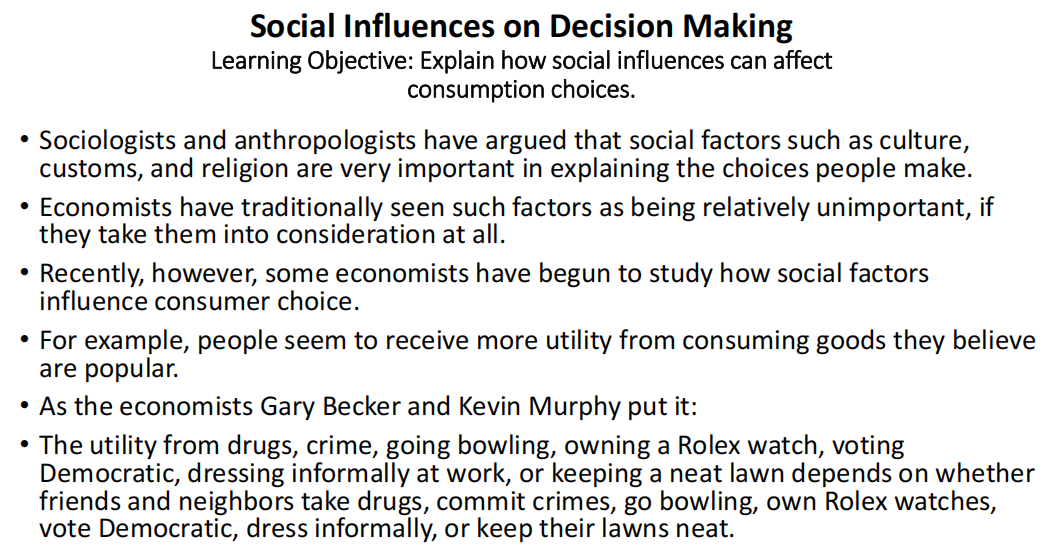
Learning Objective: Explain how social influences can affect consumption choices.
📖 点击查看译文
学习目标:解释社会因素如何影响消费选择。
• Sociologists and anthropologists have argued that social factors such as culture, customs, and religion are very important in explaining the choices people make.
📖 点击查看译文
社会学家和人类学家认为,文化、习俗和宗教等社会因素在解释人们的选择中非常重要。
• Economists have traditionally seen such factors as being relatively unimportant, if they take them into consideration at all.
📖 点击查看译文
经济学家传统上认为这些因素相对不重要,即使他们考虑这些因素,通常也只是微不足道的。
• Recently, however, some economists have begun to study how social factors influence consumer choice.
📖 点击查看译文
然而,最近一些经济学家开始研究社会因素如何影响消费者的选择。
• For example, people seem to receive more utility from consuming goods they believe are popular.
📖 点击查看译文
例如,人们似乎从消费他们认为受欢迎的商品中获得更多的效用。
• As the economists Gary Becker and Kevin Murphy put it:
📖 点击查看译文
正如经济学家Gary Becker和Kevin Murphy所说:
• The utility from drugs, crime, going bowling, owning a Rolex watch, voting Democratic, dressing informally at work, or keeping a neat lawn depends on whether friends and neighbors take drugs, commit crimes, go bowling, own Rolex watches, vote Democratic, dress informally, or keep their lawns neat.
📖 点击查看译文
毒品、犯罪、打保龄球、拥有劳力士手表、投票支持民主党、穿着随便上班或保持草坪整洁的效用,取决于朋友和邻居是否也做这些事情。
知识点列表与拓展 (Knowledge Points and Extensions):
1. Social Influences (社会影响)
-
解释 (Explanation):
Social influences refer to the impact that culture, customs, religion, and social norms have on individuals’ decision-making processes, particularly regarding consumption choices.
(社会影响是指文化、习俗、宗教和社会规范对个人决策过程,特别是消费选择的影响。)
-
例子 (Example):
People might choose to buy products that they believe are popular among their peers or society, such as owning designer items or following certain fashion trends.
(人们可能会选择购买他们认为在同龄人或社会中受欢迎的产品,如拥有名牌商品或跟随某些时尚潮流。)
-
拓展 (Extension):
Economists have traditionally overlooked social factors, but recent studies show that social influences can significantly affect consumer choices, from luxury goods to voting preferences.
(经济学家传统上忽视社会因素,但最近的研究表明,社会影响在消费选择中起着重要作用,从奢侈品到投票偏好等各方面。)
2. Social Norms and Consumption Choices (社会规范与消费选择)
-
解释 (Explanation):
Social norms are unwritten rules about what is acceptable behavior within a group or society. These norms can shape people’s preferences and consumption patterns.
(社会规范是关于群体或社会中可接受行为的非书面规则。这些规范可以塑造人们的偏好和消费模式。)
-
例子 (Example):
If wearing a specific brand of clothing is seen as fashionable within a community, individuals may be more likely to purchase those items to conform to social expectations.
(如果在某个社区中穿着特定品牌的衣服被视为时尚,个体可能更倾向于购买这些物品,以符合社会期望。)
-
拓展 (Extension):
Social conformity can drive consumption, with people choosing products that align with their social identity and the expectations of their peers.
(社会从众行为可以推动消费,人们选择与其社会身份和同伴期望一致的产品。)
3. Utility and Social Influence (效用与社会影响)
-
解释 (Explanation):
The utility people derive from goods and services may be influenced by whether those goods are perceived as popular or socially valued.
(人们从商品和服务中获得的效用可能会受到这些商品是否被认为是流行或社会价值的影响。)
-
例子 (Example):
People may enjoy owning items like Rolex watches or participating in activities like bowling, not just for personal satisfaction but because they believe it will enhance their social standing.
(人们可能享受拥有像劳力士手表这样的物品或参与像保龄球这样的活动,不仅仅是为了个人满足,而是因为他们认为这样能提高他们的社会地位。)
-
拓展 (Extension):
As economists Gary Becker and Kevin Murphy suggest, the value people place on various activities (such as voting or maintaining a neat lawn) can depend on whether their social circle engages in these activities.
(正如经济学家Gary Becker和Kevin Murphy所建议的,人们对各种活动(如投票或保持整洁的草坪)所赋予的价值可能取决于他们的社交圈是否参与这些活动。)
2
Social Influences on Decision Making (社会影响对决策的影响)
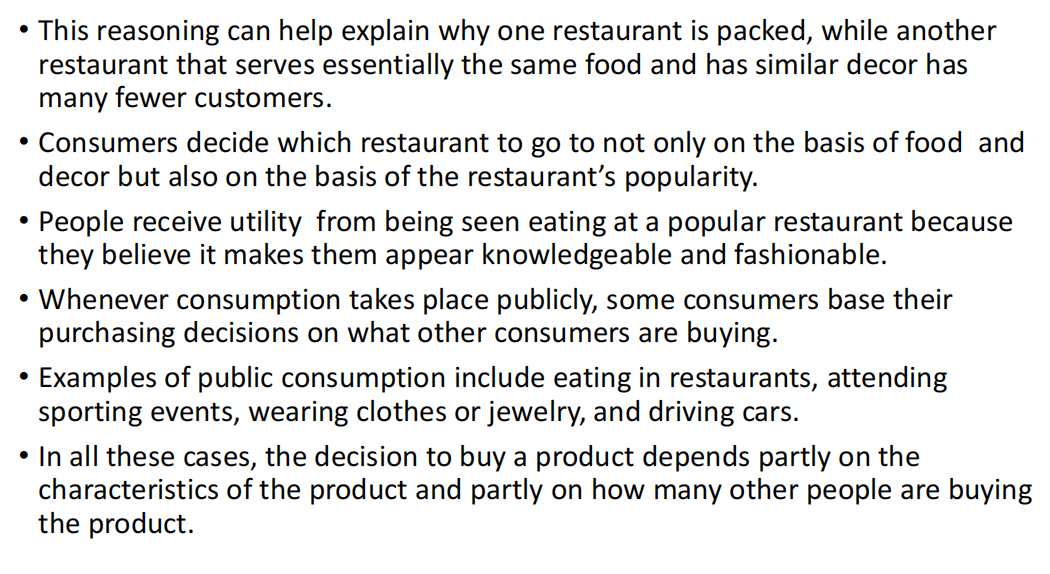
• This reasoning can help explain why one restaurant is packed, while another restaurant that serves essentially the same food and has similar decor has many fewer customers.
📖 点击查看译文
这一推理有助于解释为什么一家餐厅座无虚席,而另一家提供基本相同食物、装修相似的餐厅却顾客稀少。
• Consumers decide which restaurant to go to not only on the basis of food and decor but also on the basis of the restaurant’s popularity.
📖 点击查看译文
消费者选择去哪个餐厅不仅仅是基于食物和装饰,还取决于餐厅的受欢迎程度。
• People receive utility from being seen eating at a popular restaurant because they believe it makes them appear knowledgeable and fashionable.
📖 点击查看译文
人们从被看到在受欢迎的餐厅就餐中获得效用,因为他们认为这会让他们显得有见识和时尚。
• Whenever consumption takes place publicly, some consumers base their purchasing decisions on what other consumers are buying.
📖 点击查看译文
每当消费行为发生在公开场合时,一些消费者会根据其他消费者购买的产品来做出自己的购买决定。
• Examples of public consumption include eating in restaurants, attending sporting events, wearing clothes or jewelry, and driving cars.
📖 点击查看译文
公开消费的例子包括在餐厅就餐、参加体育赛事、穿衣服或佩戴珠宝、开车等。
• In all these cases, the decision to buy a product depends partly on the characteristics of the product and partly on how many other people are buying the product.
📖 点击查看译文
在所有这些情况下,购买产品的决策部分取决于产品的特性,部分取决于有多少其他人也在购买该产品。
知识点列表与拓展 (Knowledge Points and Extensions):
1. Popularity and Consumption (受欢迎程度与消费)
-
解释 (Explanation):
Consumers are influenced by the popularity of a product or service, which can affect their decision to purchase, even if the product or service is similar to alternatives.
(消费者会受到产品或服务受欢迎程度的影响,这会影响他们的购买决策,即使这些产品或服务与其他替代品相似。)
-
例子 (Example):
A restaurant’s popularity can attract more customers, as people may want to be seen dining at a fashionable spot, adding social value to their experience.
(餐厅的受欢迎程度能吸引更多顾客,因为人们可能希望被看到在时尚的餐厅就餐,从而为他们的经历增添社会价值。)
-
拓展 (Extension):
Public consumption often involves social signals, where the decision to purchase or participate is influenced by others’ choices and societal perceptions.
(公开消费常常涉及社会信号,购买或参与的决策会受到他人选择和社会认知的影响。)
2. Social Signaling (社会信号)
-
解释 (Explanation):
Social signaling refers to the process by which individuals make consumption choices to signal their social status, knowledge, or fashion sense to others.
(社会信号是指个体通过消费选择向他人传递其社会地位、知识或时尚感的过程。)
-
例子 (Example):
Wearing high-end fashion brands or driving expensive cars can serve as social signals, showing others that the individual is wealthy or stylish.
(穿戴高端时尚品牌或开昂贵汽车可以作为社会信号,向他人展示个人的财富或时尚感。)
-
拓展 (Extension):
The desire to conform to social norms and be seen in public spaces can lead to consumer behavior that is influenced as much by social pressures as by the intrinsic qualities of a product.
(渴望遵循社会规范并在公共场所被看到,可能导致消费者行为不仅受产品本身特性影响,还受到社会压力的影响。)
3
The Effects of Celebrity Endorsements (名人代言的影响)
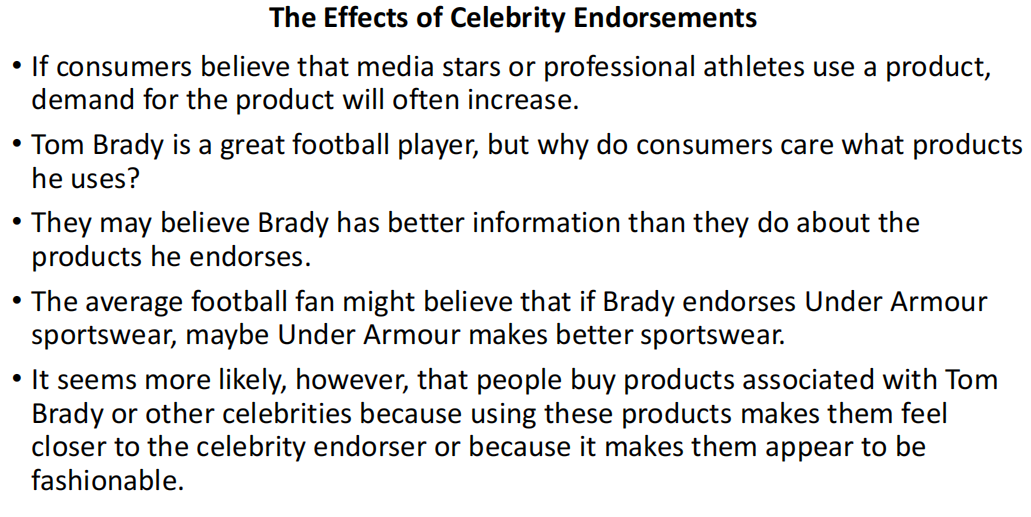
• If consumers believe that media stars or professional athletes use a product, demand for the product will often increase.
📖 点击查看译文
如果消费者认为媒体明星或职业运动员使用某种产品,该产品的需求通常会增加。
• Tom Brady is a great football player, but why do consumers care what products he uses?
📖 点击查看译文
汤姆·布雷迪是一位伟大的足球运动员,但为什么消费者关心他使用什么产品呢?
• They may believe Brady has better information than they do about the products he endorses.
📖 点击查看译文
他们可能认为布雷迪对他代言的产品有比他们更好的信息。
• The average football fan might believe that if Brady endorses Under Armour sportswear, maybe Under Armour makes better sportswear.
📖 点击查看译文
普通的足球迷可能会认为,如果布雷迪代言Under Armour运动服,可能Under Armour做得更好的运动服。
• It seems more likely, however, that people buy products associated with Tom Brady or other celebrities because using these products makes them feel closer to the celebrity endorser or because it makes them appear to be fashionable.
📖 点击查看译文
然而,更有可能的是,人们购买与汤姆·布雷迪或其他名人相关的产品,因为使用这些产品让他们感觉与代言人更亲近,或让他们看起来更时尚。
知识点列表与拓展 (Knowledge Points and Extensions):
1. Celebrity Influence on Consumer Behavior (名人对消费者行为的影响)
-
解释 (Explanation):
Celebrity endorsements can drive consumer demand, as individuals may trust or aspire to emulate the celebrity, believing that the product is superior due to the celebrity’s association with it.
(名人代言可以推动消费者需求,因为个人可能信任或希望效仿名人,认为由于名人代言,产品更为优越。)
-
例子 (Example):
A consumer may choose to purchase a brand of sportswear because a famous athlete like Tom Brady is associated with it, assuming the product is of higher quality.
(消费者可能会选择购买某个品牌的运动服,因为著名运动员汤姆·布雷迪与该品牌有关联,假设该产品质量更高。)
-
拓展 (Extension):
While some consumers may buy products because they trust the celebrity’s judgment, others may do so to feel closer to the celebrity or to appear fashionable.
(虽然一些消费者可能会因为信任名人的判断而购买产品,但也有消费者可能是为了感受到与名人更亲近或显得时尚而购买。)
2. The Psychology of Celebrity Endorsements (名人代言的心理学)
-
解释 (Explanation):
Celebrity endorsements work on the psychological principle of social influence, where consumers seek validation or social status by associating with a well-known figure.
(名人代言基于社会影响的心理学原理,消费者通过与知名人物关联来寻求认可或社会地位。)
-
例子 (Example):
A consumer may buy a high-end watch because it is endorsed by a famous actor, feeling that owning the watch will increase their social status.
(消费者可能会购买一款由著名演员代言的高端手表,觉得拥有这款手表会提升他们的社会地位。)
-
拓展 (Extension):
The desire to emulate a celebrity or the perceived benefits of owning a product endorsed by a celebrity can significantly affect consumer preferences and purchasing decisions.
(模仿名人的愿望或拥有名人代言产品的潜在好处可以显著影响消费者的偏好和购买决策。)
4
Network Externalities (网络外部性)
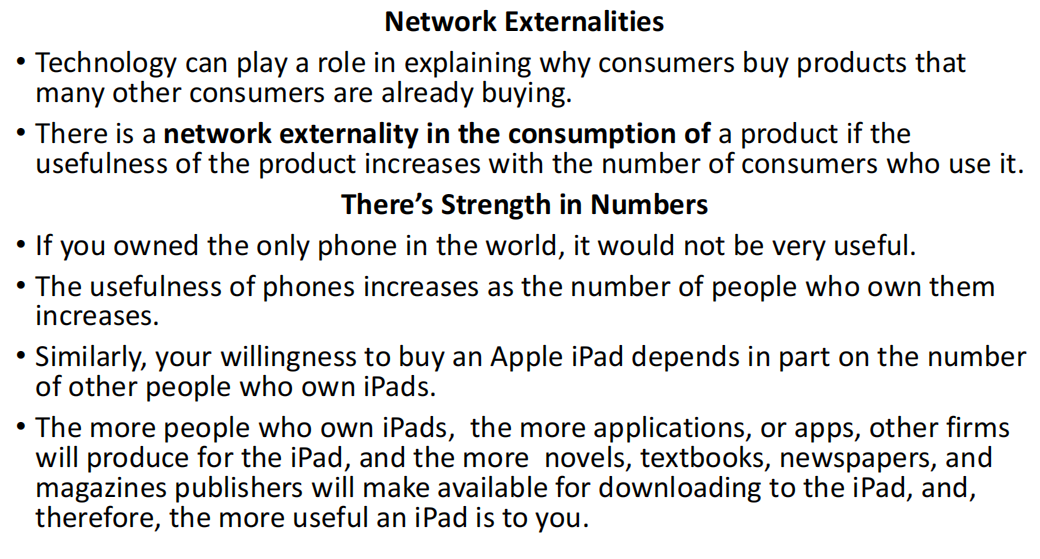
• Technology can play a role in explaining why consumers buy products that many other consumers are already buying.
📖 点击查看译文
技术可以在解释为什么消费者购买许多其他消费者已经购买的产品中发挥作用。
• There is a network externality in the consumption of a product if the usefulness of the product increases with the number of consumers who use it.
📖 点击查看译文
如果一件产品的有用性随着使用它的消费者数量增加而增加,那么该产品就存在网络外部性。
There’s Strength in Numbers (群体的力量)
• If you owned the only phone in the world, it would not be very useful.
📖 点击查看译文
如果你拥有世界上唯一的手机,那它不会很有用。
• The usefulness of phones increases as the number of people who own them increases.
📖 点击查看译文
随着拥有手机的人数增加,手机的有用性也会增加。
• Similarly, your willingness to buy an Apple iPad depends in part on the number of other people who own iPads.
📖 点击查看译文
类似地,你购买苹果iPad的意愿部分取决于其他拥有iPad的人数。
• The more people who own iPads, the more applications, or apps, other firms will produce for the iPad, and the more novels, textbooks, newspapers, and magazines publishers will make available for downloading to the iPad, and, therefore, the more useful an iPad is to you.
📖 点击查看译文
拥有iPad的人越多,其他公司为iPad开发的应用程序就越多,出版商为iPad提供的小说、教科书、报纸和杂志也会更多,因此,iPad对你的使用价值也会越大。
知识点列表与拓展 (Knowledge Points and Extensions):
1. Network Externalities (网络外部性)
-
解释 (Explanation):
A network externality occurs when the value or usefulness of a product increases as more people use it.
(网络外部性是指随着更多人使用某个产品,该产品的价值或有用性增加的现象。)
-
例子 (Example):
The value of a social media platform, like Facebook or Instagram, increases as more people join and use it, because users gain more connections and interactions.
(像Facebook或Instagram这样的社交媒体平台的价值随着更多人加入和使用而增加,因为用户能够获得更多的连接和互动。)
-
拓展 (Extension):
Network externalities are commonly observed in technology markets, where the utility of a product like a smartphone, software, or online service increases with the size of its user base.
(网络外部性通常在技术市场中观察到,在这些市场中,像智能手机、软件或在线服务这样的产品的效用随着用户群体的增大而增加。)
2. Positive Feedback Loops (正反馈循环)
-
解释 (Explanation):
A positive feedback loop occurs when an increase in the use or adoption of a product leads to further increases in its utility, which then attracts even more users, creating a cycle of growth.
(正反馈循环是指产品的使用或采纳增加时,其效用也随之增加,从而吸引更多用户,形成增长的循环。)
-
例子 (Example):
The increasing number of apps available for iPads makes the device more attractive, which, in turn, leads to more people buying iPads, further enhancing the usefulness of the product.
(iPad可用应用程序的数量增加,使得设备更具吸引力,进而导致更多人购买iPad,进一步提升产品的有用性。)
-
拓展 (Extension):
Positive feedback loops can lead to market dominance for certain products, as they create a self-reinforcing cycle where the product becomes more valuable the more people use it.
(正反馈循环可以导致某些产品在市场上的主导地位,因为它们创造了一个自我增强的循环,产品的价值随着更多人使用而增加。)
5
Do Switching Costs Cause Inferior Technologies to Survive? (切换成本是否导致劣质技术得以存活?)
• Some economists have suggested the possibility that network externalities may have a significant downside because they might result in consumers buying products that contain inferior technologies.
📖 点击查看译文
一些经济学家提出了网络外部性可能带来显著负面影响的可能性,因为它们可能导致消费者购买含有劣质技术的产品。
• This outcome could occur because network externalities can create significant switching costs related to changing products: When a product becomes established, consumers may find switching to a new product that contains a better technology too costly.
📖 点击查看译文
这种结果可能发生,因为网络外部性可能会产生与更换产品相关的显著切换成本:当一种产品变得普及时,消费者可能会发现切换到含有更好技术的新产品代价太高。
• The selection of products may be path dependent: Because of switching costs, the technology that was first available may have advantages over better technologies that were developed later.
📖 点击查看译文
产品的选择可能是路径依赖的:由于切换成本,最早出现的技术可能比后期开发的更好的技术具有优势。
• In other words, the path along which the economy has developed in the past is important.
📖 点击查看译文
换句话说,经济过去发展的路径是重要的。
• One possible example of path dependence and the use of an inferior technology is the QWERTY order of the letters along the top row of most computer keyboards.
📖 点击查看译文
路径依赖和使用劣质技术的一个可能例子是大多数计算机键盘上最上排字母的QWERTY排列。
• With computers, the problem that QWERTY was developed to solve no longer exists, so keyboards could be changed to have letters in a more efficient layout.
📖 点击查看译文
对于计算机来说,QWERTY排列最初是为了解决某个问题而开发的,但这个问题现在已经不存在,因此键盘可以改成更高效的字母布局。
• But because the overwhelming majority of people have learned to use keyboards with the QWERTY layout, there might be significant costs to them if they had to switch, even if a new layout ultimately made them faster typists.
📖 点击查看译文
但由于绝大多数人已经习惯了使用QWERTY布局的键盘,如果他们必须切换,即使新布局最终使他们打字更快,仍然可能会产生显著的成本。
• Other products that supposedly embodied inferior technologies are VHS video recorders supposedly inferior to Sony Betamax recorders and the Windows computers operating system supposedly inferior to the Macintosh operating system.
📖 点击查看译文
其他据说包含劣质技术的产品包括VHS录像机,通常被认为劣于索尼的Betamax录像机,以及Windows操作系统,通常被认为劣于Macintosh操作系统。
知识点列表与拓展 (Knowledge Points and Extensions):
1. Switching Costs (切换成本)
-
解释 (Explanation):
Switching costs refer to the costs that consumers face when changing from one product to another, which can prevent them from adopting superior technologies.
(切换成本是指消费者在从一种产品切换到另一种产品时所面临的成本,这可能会阻止他们采纳更优越的技术。)
-
例子 (Example):
Consumers may continue using a QWERTY keyboard layout, even if a more efficient layout exists, because switching would involve retraining their typing habits.
(消费者可能会继续使用QWERTY键盘布局,即使存在更高效的布局,因为切换需要重新训练他们的打字习惯。)
-
拓展 (Extension):
Switching costs can exist in various markets, including technology, services, and products, where consumers face time, financial, or effort costs when changing their choices.
(切换成本可以存在于各种市场中,包括技术、服务和产品领域,消费者在改变选择时可能会面临时间、财务或努力成本。)
2. Path Dependence (路径依赖)
-
解释 (Explanation):
Path dependence refers to the idea that decisions and outcomes are influenced by historical events or choices, even when better alternatives emerge.
(路径依赖指的是决策和结果受到历史事件或选择的影响,即使更好的替代方案出现时也是如此。)
-
例子 (Example):
The QWERTY keyboard layout is a classic example of path dependence, as its continued use is influenced more by past adoption than by current efficiency.
(QWERTY键盘布局是路径依赖的经典例子,因为它的继续使用更多是受过去采纳的影响,而非当前的效率。)
-
拓展 (Extension):
Path dependence can lead to the persistence of inferior technologies, as early choices create a momentum that makes it costly or difficult to switch to better alternatives.
(路径依赖可能导致劣质技术的持续存在,因为早期的选择会产生一种惯性,使得切换到更好的替代品变得昂贵或困难。)
6
Do Network Externalities Result in Market Failures? (网络外部性是否导致市场失灵?)
• Some economists have argued that because of path dependence and switching costs, network externalities can result in market failures.
📖 点击查看译文
一些经济学家认为,由于路径依赖和切换成本,网络外部性可能导致市场失灵。
• If network externalities result in market failure, government intervention in these markets might improve economic efficiency.
📖 点击查看译文
如果网络外部性导致市场失灵,政府干预这些市场可能会改善经济效率。
• Many economists are uncertain, however, that network externalities really do lead to consumers being locked into products with inferior technologies.
📖 点击查看译文
然而,许多经济学家对网络外部性是否真的导致消费者被锁定在劣质技术的产品上持不确定态度。
• Some economists argue that in practice, the gains from using a superior technology are larger than the losses due to switching costs.
📖 点击查看译文
一些经济学家认为,在实践中,使用优越技术所带来的收益大于因切换成本造成的损失。
• The implications of network externalities for economic efficiency remain controversial among economists.
📖 点击查看译文
网络外部性对经济效率的影响在经济学家中仍然存在争议。
知识点列表与拓展 (Knowledge Points and Extensions):
1. Market Failure (市场失灵)
-
解释 (Explanation):
Market failure occurs when the allocation of goods and services by a free market is not efficient, often due to externalities, monopolies, or other factors.
(市场失灵是指自由市场对商品和服务的配置效率低下,通常是由于外部性、垄断或其他因素所致。)
-
例子 (Example):
If a product becomes so dominant due to network externalities that it prevents better alternatives from emerging, it can result in a market failure.
(如果由于网络外部性某一产品过于主导,导致更好的替代品无法出现,这可能导致市场失灵。)
-
拓展 (Extension):
Governments can intervene in cases of market failure to promote competition or correct inefficiencies, such as through regulation or providing public goods.
(在市场失灵的情况下,政府可以通过促进竞争或纠正低效的方式进行干预,例如通过监管或提供公共产品。)
2. Government Intervention (政府干预)
-
解释 (Explanation):
Government intervention refers to the actions taken by a government to correct market failures, protect consumers, and ensure a more efficient market outcome.
(政府干预是指政府为纠正市场失灵、保护消费者并确保市场更高效的结果而采取的行动。)
-
例子 (Example):
The government may regulate monopolistic practices or subsidize certain technologies to encourage innovation and prevent market failure.
(政府可能会监管垄断行为或补贴某些技术,以鼓励创新并防止市场失灵。)
-
拓展 (Extension):
Government intervention can be controversial, as some economists argue that it may lead to inefficiencies or unintended consequences, such as creating new barriers to entry or stifling innovation.
(政府干预可能存在争议,因为一些经济学家认为它可能导致低效或意外后果,例如造成新的进入壁垒或扼杀创新。)
3. Switching Costs vs. Superior Technologies (切换成本与优越技术的对比)
-
解释 (Explanation):
Switching costs refer to the costs incurred when consumers change from one product or technology to another. In some cases, the benefits of a superior technology may outweigh these costs.
(切换成本是指消费者从一种产品或技术切换到另一种时所产生的成本。在某些情况下,优越技术的好处可能超过这些成本。)
-
例子 (Example):
Consumers may continue using an inferior technology like the QWERTY keyboard because the cost of switching to a new layout (e.g., Dvorak) seems too high, even if the new layout would improve typing speed.
(消费者可能继续使用劣质技术,比如QWERTY键盘,因为切换到新布局(例如Dvorak)所需的成本似乎太高,即使新布局能提高打字速度。)
-
拓展 (Extension):
When switching costs are high, it may prevent consumers from adopting superior technologies, leading to inefficiencies in the market, but sometimes the benefits of the new technology are compelling enough to overcome these costs.
(当切换成本很高时,它可能会阻止消费者采纳更优越的技术,从而导致市场低效,但有时新技术的好处足够吸引人,可以克服这些成本。)
7
Does Fairness Matter? (公平是否重要?)
• People like to be treated fairly, and prefer to treat each other fairly even if it is bad for them financially.
📖 点击查看译文
人们喜欢被公平对待,即使这样做对他们的财务状况不利,他们也更愿意公平地对待他人。
• Example: People tend to tip their servers, even if they never plan to go back to the restaurant.
📖 点击查看译文
例如:人们倾向于给服务员小费,即使他们不打算再去这家餐馆。
• In the United States, diners in restaurants typically add 15 to 20 percent to their food bills as tips to their servers.
📖 点击查看译文
在美国,餐馆的顾客通常会在餐费上加15%到20%的小费给服务员。
• Tips are not required, but most people consider not tipping to be very unfair, unless the service has been exceptionally bad.
📖 点击查看译文
小费并不是强制性的,但除非服务特别差,大多数人认为不给小费是非常不公平的。
• Another example is donations to charity.
📖 点击查看译文
另一个例子是向慈善机构捐款。
• Apparently, donating money to charity or leaving tips in restaurants that they will never visit again gives people more utility than they would receive from keeping the money and spending it on themselves.
📖 点击查看译文
显然,捐款给慈善机构或在他们再也不会光顾的餐馆留下小费,给人们带来的效用超过了他们把钱留给自己花的效用。
知识点列表与拓展 (Knowledge Points and Extensions):
1. Fairness (公平)
-
解释 (Explanation):
Fairness refers to the concept of being treated justly and equitably, often beyond self-interest or financial gain.
(公平是指被公正和平等对待的概念,通常超越了自我利益或经济利益。)
-
例子 (Example):
People often tip servers because they believe it is fair to compensate someone for their work, even if there is no formal requirement to do so.
(人们常常给服务员小费,因为他们认为补偿某人辛勤工作是公平的,即使没有正式要求这样做。)
-
拓展 (Extension):
Fairness plays a significant role in many social and economic decisions, and violations of fairness can lead to resentment, reduced cooperation, and market inefficiencies.
(公平在许多社会和经济决策中发挥重要作用,违反公平可能导致怨恨、合作减少和市场低效。)
2. Utility from Altruism (来自利他的效用)
-
解释 (Explanation):
Altruism refers to selfless concern for the well-being of others, and people may derive satisfaction or utility from acts like donating to charity or tipping.
(利他主义是指对他人福祉的无私关注,人们可能从像捐款或给小费这样的行为中获得满足感或效用。)
-
例子 (Example):
Donating to charity or tipping servers, even when they do not expect to benefit directly, can bring personal satisfaction or happiness.
(即使人们不期望直接从中受益,捐款或给小费也能带来个人的满足感或快乐。)
-
拓展 (Extension):
Altruism may explain why people engage in behaviors that are financially disadvantageous, as the emotional satisfaction derived from these actions can sometimes outweigh the financial costs.
(利他主义可以解释为什么人们参与一些在财务上不利的行为,因为从这些行为中获得的情感满足感有时能超过财务成本。)
8
Behavioral Economics: Do People Make Their Choices Rationally? (行为经济学:人们做出的选择是否理性?)
• In recent years, some economists have started studying situations in which people make choices that do not appear to be economically rational.
📖 点击查看译文
近年来,一些经济学家开始研究人们做出的似乎不符合经济理性的选择。
• This field of study is known as behavioral economics.
📖 点击查看译文
这一研究领域被称为行为经济学。
• Three common mistakes made by consumers are:
📖 点击查看译文
消费者常犯的三种错误是:
- Taking into account monetary costs but ignoring nonmonetary opportunity costs
📖 点击查看译文
考虑到货币成本却忽视非货币机会成本
- Failing to ignore sunk costs
📖 点击查看译文
未能忽视沉没成本
- Being unrealistic about their own future behavior
📖 点击查看译文
对自己未来的行为缺乏现实预期
1. Ignoring nonmonetary Opportunity costs (忽视非货币机会成本)
• People often treat monetary and non-monetary costs differently, even though they are both opportunity costs.
📖 点击查看译文
人们常常将货币成本与非货币成本区别对待,尽管它们都是机会成本。
• Example: People who won the NFL lottery for Super Bowl tickets were asked the following two questions:
📖 点击查看译文
例如:获得超级碗票的NFL彩票中奖者被问到了以下两个问题:
- If you had not won the lottery, would you have been willing to pay $3000 for the ticket?
📖 点击查看译文
如果你没有中奖,你是否愿意为这张票支付3000美元?
Answer 1: Ninety-four percent answered that they would not have paid $3,000 for a ticket.
📖 点击查看译文
答案1:94%的人表示他们不会为这张票支付3000美元。
- If, after winning the lottery, someone had offered you $3000 for your ticket, would you have sold it?
📖 点击查看译文
如果在中奖之后,有人出价3000美元买你的票,你会卖掉它吗?
Answer 2: Ninety-two percent answered that they would not have sold their ticket for $3,000.
📖 点击查看译文
答案2:92%的人表示他们不会以3000美元卖掉自己的票。
• But these answers are contradictory! If someone offers you $3,000 for your ticket, then by using the ticket rather than selling it, you incur an opportunity cost of +3,000.
📖 点击查看译文
但是这些答案是矛盾的!如果有人出价3000美元买你的票,那么使用这张票而不是卖掉它,实际上就相当于承担了+3000美元的机会成本。
• There really is a +3,000 cost involved in using that ticket, even though you do not pay +3,000 in cash.
📖 点击查看译文
实际上,使用这张票涉及到+3000美元的成本,尽管你没有直接支付3000美元现金。
• The two alternatives either paying 3,000 amount to exactly the same thing.
📖 点击查看译文
这两种选择——支付3000美元或不收到3000美元,实际上是等价的。
知识点列表与拓展 (Knowledge Points and Extensions):
1. Behavioral Economics (行为经济学)
-
解释 (Explanation):
Behavioral economics studies the effects of psychological, social, cognitive, and emotional factors on economic decisions. It challenges the assumption that people always act rationally in their best interest.
(行为经济学研究心理学、社会学、认知学和情感因素如何影响经济决策。它挑战了人们总是理性地做出最佳选择的假设。)
-
例子 (Example):
Consumers often make irrational decisions, such as paying more for a product simply because it is endorsed by a celebrity or purchasing something that doesn’t align with their best interests.
(消费者常常做出不理性的决策,例如仅仅因为某个产品有名人代言而支付更高的价格,或购买不符合自己最佳利益的东西。)
-
拓展 (Extension):
Behavioral economics has practical applications in policy design, marketing, and understanding consumer behavior. It suggests that improving decision-making involves addressing cognitive biases and emotional influences.
(行为经济学在政策设计、营销和理解消费者行为方面具有实际应用。它表明,改善决策需要解决认知偏见和情感影响。)
2. Opportunity Cost (机会成本)
-
解释 (Explanation):
Opportunity cost is the value of the next best alternative that must be given up when making a decision. It is a key concept in economics that helps individuals and businesses make more informed choices.
(机会成本是做决策时必须放弃的下一个最佳选择的价值。它是经济学中的一个关键概念,帮助个人和企业做出更明智的选择。)
-
例子 (Example):
If you spend 3,000 instead, such as saving it or spending it on something else.
(如果你花费3000美元购买一张演唱会票,那么机会成本就是你本可以用这3000美元做的其他事情,比如存起来或花在其他东西上。)
-
拓展 (Extension):
Ignoring opportunity costs can lead to poor decisions, such as spending money or time on an option that offers less value than an alternative.
(忽视机会成本可能导致糟糕的决策,例如把钱或时间花在提供的价值低于其他选择的选项上。)
9
Behavioral Economics: The Endowment Effect and Opportunity Costs (行为经济学:禀赋效应与机会成本)
• If the ticket is really not worth $3,000 to you, you should sell it.
📖 点击查看译文
如果这张票对你来说真的不值3000美元,你应该把它卖掉。
• If it is worth 3,000 in cash to buy it.
📖 点击查看译文
如果它对你值3000美元,你应该愿意支付3000美元现金来购买它。
• Not being willing to sell a ticket you already own for 3,000 if you didn’t already own one is inconsistent behavior.
📖 点击查看译文
如果你不愿意以3000美元卖掉自己已经拥有的票,同时又不愿意以3000美元购买一张你没有的票,这是一种不一致的行为。
• The inconsistency comes from a failure to take into account nonmonetary opportunity costs.
📖 点击查看译文
这种不一致性来自于未能考虑非货币机会成本。
• Behavioral economists believe this inconsistency is caused by the endowment effect, which is the tendency of people to be unwilling to sell a good they already own even if they are offered a price that is greater than the price they would be willing to pay to buy the good if they didn’t already own it.
📖 点击查看译文
行为经济学家认为,这种不一致性是由禀赋效应引起的,禀赋效应是指人们即使被提供的价格高于他们愿意为购买该物品支付的价格,仍然不愿意出售他们已经拥有的物品。
• The failure to take into account opportunity costs is a very common error in decision making.
📖 点击查看译文
忽视机会成本是在决策中非常常见的错误。
• Suppose, for example, that a friend is in a hurry to have his room cleaned—it’s the Friday before parents’ weekend, and he offers you $50 to do it for him.
📖 点击查看译文
举个例子,假设你的朋友急着让你帮他打扫房间——这是家长周末前的周五,他向你提供50美元让你帮他打扫。
• You turn him down and spend the time cleaning your own room, even though you know somebody down the hall who would be willing to clean your room for $20.
📖 点击查看译文
你拒绝了他,并花时间打扫自己的房间,尽管你知道走廊下有一个人愿意为20美元帮你打扫房间。
• The opportunity cost of cleaning your own room is $50, the amount your friend offered to pay you to clean his room.
📖 点击查看译文
打扫自己房间的机会成本是50美元,这是你朋友为打扫他房间提供的报酬。
• It is inconsistent to turn down an offer from someone else to clean your room for 50.
📖 点击查看译文
当你以50美元的成本自己打扫房间时,拒绝别人以20美元为你打扫房间的提议是不一致的。
• The key point here is this: Nonmonetary opportunity costs are just as real as monetary costs, and people should take them into account when making decisions.
📖 点击查看译文
这里的关键点是:非货币机会成本和货币成本一样真实,人们在做决策时应该考虑它们。
知识点列表与拓展 (Knowledge Points and Extensions):
1. Endowment Effect (禀赋效应)
-
解释 (Explanation):
The endowment effect refers to the tendency for people to value things more highly simply because they own them. This often leads to irrational decision-making, where individuals overvalue what they possess.
(禀赋效应指的是人们因为拥有某物而对其赋予更高的价值。这通常导致非理性决策,人们过高评价自己拥有的东西。)
-
例子 (Example):
A person may be unwilling to sell a concert ticket for a price higher than they would be willing to pay for it, simply because they own the ticket.
(一个人可能不愿意以高于自己愿意支付的价格出售演唱会门票,仅仅因为他拥有这张票。)
-
拓展 (Extension):
The endowment effect can lead to inefficient outcomes in markets where people overvalue their assets or possessions, preventing them from making beneficial trades.
(禀赋效应可能导致市场中的低效结果,人们过高估价自己的资产或物品,从而阻碍他们做出有利的交易。)
2. Opportunity Cost (机会成本)
-
解释 (Explanation):
Opportunity cost is the value of the best alternative forgone when making a choice. Both monetary and nonmonetary factors can represent opportunity costs.
(机会成本是做出选择时放弃的最佳替代品的价值。货币和非货币因素都可以代表机会成本。)
-
例子 (Example):
If you spend time studying for an exam, the opportunity cost is the time you could have spent doing something else, such as relaxing or working.
(如果你花时间复习考试,那么机会成本就是你本可以花时间做其他事情,比如放松或工作。)
-
拓展 (Extension):
Ignoring opportunity costs can lead to poor decision-making, as individuals fail to assess the full trade-offs involved in their choices.
(忽视机会成本可能导致糟糕的决策,因为个人未能全面评估其选择中的权衡。)
10
Behavioral Economics: Failing to Ignore Sunk Costs (行为经济学:未能忽视沉没成本)
• A sunk cost is a cost that has already been paid and cannot be recovered. Once you have paid money and can’t get it back, you should ignore that money in any later decisions you make. But people often allow past costs to influence future decisions.
📖 点击查看译文
沉没成本是已经支付且无法回收的成本。一旦你支付了钱且无法拿回,你应该在以后做决策时忽略这笔钱。但人们通常会让过去的成本影响未来的决策。
• Consider the following two situations:
📖 点击查看译文
考虑以下两种情况:
Situation 1 (情况1):
You bought a ticket to a play for $75. The ticket is nonrefundable and must be used on Tuesday night, which is the only night the play will be performed.
On Monday, a friend calls and invites you to a local comedy club to see a comedian you both like who is appearing only on Tuesday night.
Your friend offers to pay the cost of going to the club.
📖 点击查看译文
情况1:你买了一张75美元的戏剧票。票不可退款,且必须在周二晚上使用,这是该剧唯一的演出时间。
周一时,一个朋友打电话邀请你去本地的喜剧俱乐部看一位你们都喜欢的喜剧演员,他只在周二晚上出演。
你的朋友提议支付去俱乐部的费用。
Situation 2 (情况2):
It’s Monday night, and you are about to buy a ticket for the Tuesday night performance of the same play as in situation 1.
As you are leaving to buy the ticket, your friend calls and invites you to the comedy club.
📖 点击查看译文
情况2:这是周一晚上,你正打算购买周二晚上的同一场戏剧票。
正当你准备去买票时,朋友打电话邀请你去喜剧俱乐部。
• Most people would say that in situation 1, they would go to the play because otherwise they would lose the $75 they had paid for the ticket.
📖 点击查看译文
大多数人会说,在情况1中,他们会去看戏,因为否则他们会失去已经支付的75美元票款。
• In fact, the $75 is lost, no matter what you do because the ticket is nonrefundable.
📖 点击查看译文
实际上,75美元已经丢失,不管你做什么,因为票是不可退款的。
• The only real issue for you to decide is whether you would prefer to see the play or prefer to go with your friend to the comedy club.
📖 点击查看译文
你真正需要决定的唯一问题是,你更喜欢看戏,还是更愿意和朋友一起去喜剧俱乐部。
• If you would prefer to go to the club, the fact that you have already paid $75 for the ticket to the play is irrelevant.
📖 点击查看译文
如果你更愿意去俱乐部,那么你已经为戏票支付的75美元就无关紧要了。
• Your decision should be the same in situation 1 as in situation 2.
📖 点击查看译文
你的决策在情况1和情况2中应该是一样的。
知识点列表与拓展 (Knowledge Points and Extensions):
1. Sunk Costs (沉没成本)
-
解释 (Explanation):
A sunk cost refers to a cost that has already been incurred and cannot be recovered. The proper economic decision is to ignore sunk costs in future decisions.
(沉没成本是指已经发生并且无法收回的成本。正确的经济决策是忽视沉没成本,不影响未来的决策。)
-
例子 (Example):
An individual who has spent money on a concert ticket should not allow that past expense to affect their decision to attend another event.
(一个花了钱买演唱会票的人,不应让这笔过去的支出影响他们是否去参加另一个活动的决策。)
-
拓展 (Extension):
Ignoring sunk costs can help individuals and businesses make more rational decisions. The concept is widely applied in both personal and business finance.
(忽视沉没成本有助于个人和企业做出更理性的决策。这一概念在个人和商业财务中被广泛应用。)
2. Behavioral Economics and Decision Making (行为经济学与决策制定)
-
解释 (Explanation):
Behavioral economics studies how psychological factors influence economic decisions, often leading people to make irrational choices.
(行为经济学研究心理因素如何影响经济决策,通常导致人们做出非理性选择。)
-
例子 (Example):
A person might continue to invest in a losing stock because they have already spent a significant amount of money on it, failing to consider that the past investment is irretrievable.
(一个人可能会继续投资于一只亏损的股票,因为他们已经在上面花费了大量的钱,却未能考虑到过去的投资无法收回。)
-
拓展 (Extension):
Behavioral economics challenges the traditional notion that people always make decisions that maximize their utility. Instead, it recognizes that emotions, biases, and cognitive limitations often drive choices.
(行为经济学挑战了传统观点,即人们总是做出最大化效用的决策。相反,它认识到情感、偏见和认知限制常常驱动决策。)
11
Behavioral Economics: Being Unrealistic about Future Behavior (行为经济学:对未来行为的非现实预期)
• Studies have shown that a majority of adults in the United States are overweight.
📖 点击查看译文
研究表明,美国大多数成年人都超重。
• Why do many people choose to eat too much? One possibility is that they receive more utility from eating high-calorie foods than they would from being thin.
📖 点击查看译文
为什么许多人选择吃得过多?一种可能性是,他们从吃高热量食物中获得的效用超过了保持瘦身所能带来的效用。
• A more likely explanation, however, is that many people eat a lot today because they expect to eat less tomorrow.
📖 点击查看译文
然而,更可能的解释是,许多人今天吃得太多,是因为他们预期明天会吃得更少。
• But they never do eat less, and so they end up overweight.
📖 点击查看译文
但他们从未减少饮食,结果变得超重。
• Similarly, some people continue smoking today because they expect to be able to give it up sometime in the future.
📖 点击查看译文
类似地,一些人今天继续吸烟,因为他们预计自己将来能戒烟。
• Unfortunately, for many people that time never comes.
📖 点击查看译文
不幸的是,对于许多人来说,这个时刻从未到来。
• Economists who have studied this question argue that many people have preferences that are not consistent over time.
📖 点击查看译文
研究过这个问题的经济学家认为,许多人在时间上的偏好是不一致的。
• In the long run, you would like to be thin or give up smoking or achieve some other goal, but each day, you make decisions that are not consistent with this long-run goal.
📖 点击查看译文
从长远来看,你可能想要保持身材或戒烟,或实现其他目标,但每天做出的决策与这一长远目标不一致。
• If you are unrealistic about your future behavior, you underestimate the costs of choices, such as overeating or smoking, that you make today.
📖 点击查看译文
如果你对未来的行为预期不现实,你会低估今天做出的选择(如暴饮暴食或吸烟)的成本。
• A key way of avoiding this problem is to be realistic about your future behavior.
📖 点击查看译文
避免这个问题的关键是对未来的行为保持现实预期。
• Taking into account nonmonetary opportunity costs, ignoring sunk costs, and being more realistic about future behavior are three ways in which consumers are able to improve the decisions they make.
📖 点击查看译文
考虑非货币机会成本、忽视沉没成本,以及对未来行为保持更现实的预期,是消费者改进决策的三种方式。
知识点列表与拓展 (Knowledge Points and Extensions):
1. Unrealistic Future Behavior (对未来行为的非现实预期)
-
解释 (Explanation):
Many people make decisions based on the belief that they will change their future behavior. This often leads to suboptimal choices in the present.
(许多人基于自己将来会改变行为的信念做决策,这往往导致当前做出次优选择。)
-
例子 (Example):
A person may eat unhealthily today with the expectation of dieting tomorrow, but they often fail to stick to their future plan.
(一个人可能今天吃不健康的食物,期待明天节食,但他们常常无法坚持未来的计划。)
-
拓展 (Extension):
The concept of unrealistic future behavior is key to understanding many behaviors that people regret, such as procrastination, overeating, or smoking.
(对未来行为的非现实预期是理解许多让人后悔的行为(如拖延、暴饮暴食或吸烟)的关键。)
2. Behavioral Economics and Self-Control (行为经济学与自我控制)
-
解释 (Explanation):
Behavioral economics explores how people often fail to exercise self-control, leading them to make choices that are inconsistent with their long-term goals.
(行为经济学探讨了人们如何常常未能行使自我控制,导致他们做出与长期目标不一致的选择。)
-
例子 (Example):
A person may avoid exercise today because they feel it will be difficult, even though they know that long-term health benefits will outweigh the short-term discomfort.
(一个人今天可能避免锻炼,因为他们觉得这会很困难,尽管他们知道长期的健康益处会超过短期的不适感。)
-
拓展 (Extension):
Strategies to improve self-control include setting clear goals, breaking down tasks into manageable steps, and making small, incremental changes over time.
(改善自我控制的策略包括设定明确目标,将任务分解为可管理的步骤,并在时间上进行小而渐进的改变。)
12
The Behavioral Economics of Shopping (购物的行为经济学)
• In discussing how consumers maximize utility, we used simple examples where people were choosing the optimal quantity of two goods subject to a budget constraint.
📖 点击查看译文
在讨论消费者如何最大化效用时,我们使用了简单的例子,假设人们在预算约束下选择两种商品的最优数量。
• Consider, though, a typical trip to the supermarket.
📖 点击查看译文
然而,考虑一下典型的超市购物。
• Someone shopping for a family of four might end up buying 25 or more products.
📖 点击查看译文
为一个四口之家购物的人可能会买25件或更多的商品。
• A consumer in that situation is unlikely to equate the ratios of the marginal utilities to the prices for all these products when deciding the quantities to buy.
📖 点击查看译文
在这种情况下,消费者在决定购买数量时不太可能将所有这些商品的边际效用与价格的比率进行比较。
• Does it matter that consumers often do not make optimal consumption choices?
📖 点击查看译文
消费者通常没有做出最优消费选择,这是否重要?
• Economists are divided in their answers to this question.
📖 点击查看译文
经济学家对此问题的回答存在分歧。
• Many economists make these two points in arguing that the answer to the question is “no”:
📖 点击查看译文
许多经济学家提出以下两点,认为这个问题的答案是“否”:
1. The assumptions in most scientific models, including economic models, are not literally correct.
📖 点击查看译文
大多数科学模型,包括经济模型中的假设,并非字面上的正确。
• In the model of consumer choice, for example, unrealistic assumptions are necessary to simplify a complex reality by focusing on the most important factors involved in decision making.
📖 点击查看译文
例如,在消费者选择模型中,非现实的假设是必要的,以通过聚焦于决策中最重要的因素来简化复杂的现实。
2. Models are best judged by the success of their predictions rather than by the realism of their assumptions.
📖 点击查看译文
模型最好通过其预测的成功与否来评判,而不是根据其假设的现实性。
• Predictions based on the model of consumer choice have been successful in predicting many types of consumer behavior.
📖 点击查看译文
基于消费者选择模型的预测在预测许多类型的消费者行为方面已取得成功。
知识点列表与拓展 (Knowledge Points and Extensions):
1. Behavioral Economics in Shopping (购物中的行为经济学)
-
解释 (Explanation):
Behavioral economics examines how consumers make decisions that do not always maximize utility in complex, real-world situations.
(行为经济学研究消费者在复杂的现实情境中如何做出并不总是最大化效用的决策。)
-
例子 (Example):
In a typical shopping trip, consumers may not compare marginal utility to price for every item, leading to less optimal choices.
(在典型的购物过程中,消费者可能不会为每个商品比较边际效用与价格的比率,从而做出不那么最优的选择。)
-
拓展 (Extension):
Real-world behavior often deviates from the models used in economics, but these models still serve as useful tools for predicting trends in consumer behavior.
(现实中的行为常常偏离经济学中使用的模型,但这些模型仍然是预测消费者行为趋势的有用工具。)
2. Economic Models and Assumptions (经济模型与假设)
-
解释 (Explanation):
Economic models often rely on simplifying assumptions that do not perfectly reflect reality but are useful for understanding broad patterns.
(经济模型通常依赖于简化假设,这些假设虽然不完全反映现实,但有助于理解广泛的模式。)
-
例子 (Example):
In the consumer choice model, assumptions like rational behavior and perfect information help to focus on the main drivers of decision-making.
(在消费者选择模型中,理性行为和完美信息等假设有助于聚焦于决策的主要驱动因素。)
-
拓展 (Extension):
While assumptions may not always be realistic, the success of predictions based on the models indicates their practical utility.
(尽管假设可能并不总是现实的,但基于这些模型的预测成功表明了它们的实际效用。)
13
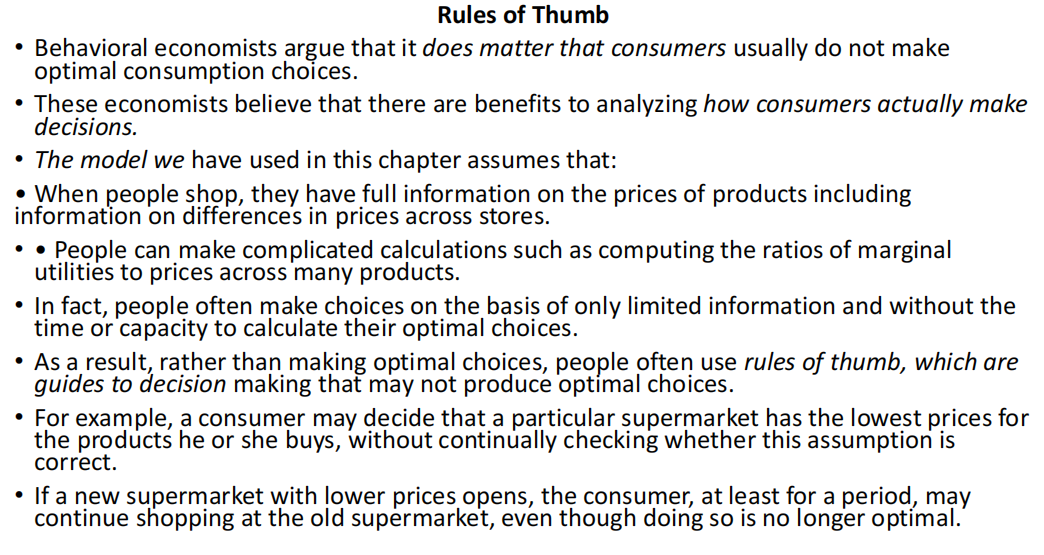
Rules of Thumb (经验法则)
• Behavioral economists argue that it does matter that consumers usually do not make optimal consumption choices.
📖 点击查看译文
行为经济学家认为,消费者通常不做出最优消费选择是很重要的。
• These economists believe that there are benefits to analyzing how consumers actually make decisions.
📖 点击查看译文
这些经济学家认为,分析消费者如何实际做出决策是有益的。
• The model we have used in this chapter assumes that:
📖 点击查看译文
我们在本章中使用的模型假设:
• When people shop, they have full information on the prices of products including information on differences in prices across stores.
📖 点击查看译文
当人们购物时,他们拥有关于产品价格的全部信息,包括各商店价格差异的信息。
• People can make complicated calculations such as computing the ratios of marginal utilities to prices across many products.
📖 点击查看译文
人们能够进行复杂的计算,例如计算多种商品的边际效用与价格的比率。
• In fact, people often make choices on the basis of only limited information and without the time or capacity to calculate their optimal choices.
📖 点击查看译文
事实上,人们通常根据有限的信息做出选择,并没有足够的时间或能力来计算最优选择。
• As a result, rather than making optimal choices, people often use rules of thumb, which are guides to decision making that may not produce optimal choices.
📖 点击查看译文
因此,人们常常使用经验法则来做决策,这些法则可能不会产生最优选择。
• For example, a consumer may decide that a particular supermarket has the lowest prices for the products he or she buys, without continually checking whether this assumption is correct.
📖 点击查看译文
例如,消费者可能会认为某个超市的价格最低,尽管他或她没有持续检查这一假设是否正确。
• If a new supermarket with lower prices opens, the consumer, at least for a period, may continue shopping at the old supermarket, even though doing so is no longer optimal.
📖 点击查看译文
如果一家新开设的超市价格更低,消费者至少在一段时间内可能仍然会继续在旧超市购物,尽管这样做不再是最优选择。
知识点列表与拓展 (Knowledge Points and Extensions):
1. Rules of Thumb in Decision-Making (决策中的经验法则)
-
解释 (Explanation):
Consumers often rely on simple decision-making shortcuts, or rules of thumb, due to limited information and time, which may not lead to optimal choices.
(由于信息有限和时间不足,消费者常常依赖于简单的决策捷径或经验法则,这可能不会导致最优选择。)
-
例子 (Example):
A consumer believes that a specific supermarket always offers the lowest prices without constantly verifying this assumption.
(消费者相信某个超市总是提供最低价格,而不不断验证这一假设。)
-
拓展 (Extension):
While rules of thumb can simplify decision-making, they may also lead to suboptimal choices, such as continuing to shop at a more expensive store.
(虽然经验法则可以简化决策过程,但也可能导致次优选择,比如继续在更贵的商店购物。)
2. Limited Information and Consumer Behavior (有限信息与消费者行为)
-
解释 (Explanation):
People often make decisions based on limited information because they cannot process all available data or have limited time for making choices.
(人们常常基于有限的信息做出决策,因为他们无法处理所有可用数据或没有足够的时间做出选择。)
-
例子 (Example):
A consumer may not check all available supermarkets to compare prices, relying instead on their perception of the one they visit.
(消费者可能不会检查所有可用的超市来比较价格,而是依赖于他们对访问的超市的看法。)
-
拓展 (Extension):
Decision-making models may need to be adjusted to account for real-world constraints such as limited information and the use of heuristics.
(决策模型可能需要调整,以考虑现实世界中的限制因素,如有限的信息和启发式方法的使用。)
(QWERTY键盘布局是路径依赖的经典例子,因为它的继续使用更多是受过去采纳的影响,而非当前的效率。)
-
拓展 (Extension):
Path dependence can lead to the persistence of inferior technologies, as early choices create a momentum that makes it costly or difficult to switch to better alternatives.
(路径依赖可能导致劣质技术的持续存在,因为早期的选择会产生一种惯性,使得切换到更好的替代品变得昂贵或困难。)
6

Do Network Externalities Result in Market Failures? (网络外部性是否导致市场失灵?)
• Some economists have argued that because of path dependence and switching costs, network externalities can result in market failures.
📖 点击查看译文
一些经济学家认为,由于路径依赖和切换成本,网络外部性可能导致市场失灵。
• If network externalities result in market failure, government intervention in these markets might improve economic efficiency.
📖 点击查看译文
如果网络外部性导致市场失灵,政府干预这些市场可能会改善经济效率。
• Many economists are uncertain, however, that network externalities really do lead to consumers being locked into products with inferior technologies.
📖 点击查看译文
然而,许多经济学家对网络外部性是否真的导致消费者被锁定在劣质技术的产品上持不确定态度。
• Some economists argue that in practice, the gains from using a superior technology are larger than the losses due to switching costs.
📖 点击查看译文
一些经济学家认为,在实践中,使用优越技术所带来的收益大于因切换成本造成的损失。
• The implications of network externalities for economic efficiency remain controversial among economists.
📖 点击查看译文
网络外部性对经济效率的影响在经济学家中仍然存在争议。
知识点列表与拓展 (Knowledge Points and Extensions):
1. Market Failure (市场失灵)
-
解释 (Explanation):
Market failure occurs when the allocation of goods and services by a free market is not efficient, often due to externalities, monopolies, or other factors.
(市场失灵是指自由市场对商品和服务的配置效率低下,通常是由于外部性、垄断或其他因素所致。)
-
例子 (Example):
If a product becomes so dominant due to network externalities that it prevents better alternatives from emerging, it can result in a market failure.
(如果由于网络外部性某一产品过于主导,导致更好的替代品无法出现,这可能导致市场失灵。)
-
拓展 (Extension):
Governments can intervene in cases of market failure to promote competition or correct inefficiencies, such as through regulation or providing public goods.
(在市场失灵的情况下,政府可以通过促进竞争或纠正低效的方式进行干预,例如通过监管或提供公共产品。)
2. Government Intervention (政府干预)
-
解释 (Explanation):
Government intervention refers to the actions taken by a government to correct market failures, protect consumers, and ensure a more efficient market outcome.
(政府干预是指政府为纠正市场失灵、保护消费者并确保市场更高效的结果而采取的行动。)
-
例子 (Example):
The government may regulate monopolistic practices or subsidize certain technologies to encourage innovation and prevent market failure.
(政府可能会监管垄断行为或补贴某些技术,以鼓励创新并防止市场失灵。)
-
拓展 (Extension):
Government intervention can be controversial, as some economists argue that it may lead to inefficiencies or unintended consequences, such as creating new barriers to entry or stifling innovation.
(政府干预可能存在争议,因为一些经济学家认为它可能导致低效或意外后果,例如造成新的进入壁垒或扼杀创新。)
3. Switching Costs vs. Superior Technologies (切换成本与优越技术的对比)
-
解释 (Explanation):
Switching costs refer to the costs incurred when consumers change from one product or technology to another. In some cases, the benefits of a superior technology may outweigh these costs.
(切换成本是指消费者从一种产品或技术切换到另一种时所产生的成本。在某些情况下,优越技术的好处可能超过这些成本。)
-
例子 (Example):
Consumers may continue using an inferior technology like the QWERTY keyboard because the cost of switching to a new layout (e.g., Dvorak) seems too high, even if the new layout would improve typing speed.
(消费者可能继续使用劣质技术,比如QWERTY键盘,因为切换到新布局(例如Dvorak)所需的成本似乎太高,即使新布局能提高打字速度。)
-
拓展 (Extension):
When switching costs are high, it may prevent consumers from adopting superior technologies, leading to inefficiencies in the market, but sometimes the benefits of the new technology are compelling enough to overcome these costs.
(当切换成本很高时,它可能会阻止消费者采纳更优越的技术,从而导致市场低效,但有时新技术的好处足够吸引人,可以克服这些成本。)
7

Does Fairness Matter? (公平是否重要?)
• People like to be treated fairly, and prefer to treat each other fairly even if it is bad for them financially.
📖 点击查看译文
人们喜欢被公平对待,即使这样做对他们的财务状况不利,他们也更愿意公平地对待他人。
• Example: People tend to tip their servers, even if they never plan to go back to the restaurant.
📖 点击查看译文
例如:人们倾向于给服务员小费,即使他们不打算再去这家餐馆。
• In the United States, diners in restaurants typically add 15 to 20 percent to their food bills as tips to their servers.
📖 点击查看译文
在美国,餐馆的顾客通常会在餐费上加15%到20%的小费给服务员。
• Tips are not required, but most people consider not tipping to be very unfair, unless the service has been exceptionally bad.
📖 点击查看译文
小费并不是强制性的,但除非服务特别差,大多数人认为不给小费是非常不公平的。
• Another example is donations to charity.
📖 点击查看译文
另一个例子是向慈善机构捐款。
• Apparently, donating money to charity or leaving tips in restaurants that they will never visit again gives people more utility than they would receive from keeping the money and spending it on themselves.
📖 点击查看译文
显然,捐款给慈善机构或在他们再也不会光顾的餐馆留下小费,给人们带来的效用超过了他们把钱留给自己花的效用。
知识点列表与拓展 (Knowledge Points and Extensions):
1. Fairness (公平)
-
解释 (Explanation):
Fairness refers to the concept of being treated justly and equitably, often beyond self-interest or financial gain.
(公平是指被公正和平等对待的概念,通常超越了自我利益或经济利益。)
-
例子 (Example):
People often tip servers because they believe it is fair to compensate someone for their work, even if there is no formal requirement to do so.
(人们常常给服务员小费,因为他们认为补偿某人辛勤工作是公平的,即使没有正式要求这样做。)
-
拓展 (Extension):
Fairness plays a significant role in many social and economic decisions, and violations of fairness can lead to resentment, reduced cooperation, and market inefficiencies.
(公平在许多社会和经济决策中发挥重要作用,违反公平可能导致怨恨、合作减少和市场低效。)
2. Utility from Altruism (来自利他的效用)
-
解释 (Explanation):
Altruism refers to selfless concern for the well-being of others, and people may derive satisfaction or utility from acts like donating to charity or tipping.
(利他主义是指对他人福祉的无私关注,人们可能从像捐款或给小费这样的行为中获得满足感或效用。)
-
例子 (Example):
Donating to charity or tipping servers, even when they do not expect to benefit directly, can bring personal satisfaction or happiness.
(即使人们不期望直接从中受益,捐款或给小费也能带来个人的满足感或快乐。)
-
拓展 (Extension):
Altruism may explain why people engage in behaviors that are financially disadvantageous, as the emotional satisfaction derived from these actions can sometimes outweigh the financial costs.
(利他主义可以解释为什么人们参与一些在财务上不利的行为,因为从这些行为中获得的情感满足感有时能超过财务成本。)
8

Behavioral Economics: Do People Make Their Choices Rationally? (行为经济学:人们做出的选择是否理性?)
• In recent years, some economists have started studying situations in which people make choices that do not appear to be economically rational.
📖 点击查看译文
近年来,一些经济学家开始研究人们做出的似乎不符合经济理性的选择。
• This field of study is known as behavioral economics.
📖 点击查看译文
这一研究领域被称为行为经济学。
• Three common mistakes made by consumers are:
📖 点击查看译文
消费者常犯的三种错误是:
- Taking into account monetary costs but ignoring nonmonetary opportunity costs
📖 点击查看译文
考虑到货币成本却忽视非货币机会成本
- Failing to ignore sunk costs
📖 点击查看译文
未能忽视沉没成本
- Being unrealistic about their own future behavior
📖 点击查看译文
对自己未来的行为缺乏现实预期
1. Ignoring nonmonetary Opportunity costs (忽视非货币机会成本)
• People often treat monetary and non-monetary costs differently, even though they are both opportunity costs.
📖 点击查看译文
人们常常将货币成本与非货币成本区别对待,尽管它们都是机会成本。
• Example: People who won the NFL lottery for Super Bowl tickets were asked the following two questions:
📖 点击查看译文
例如:获得超级碗票的NFL彩票中奖者被问到了以下两个问题:
- If you had not won the lottery, would you have been willing to pay $3000 for the ticket?
📖 点击查看译文
如果你没有中奖,你是否愿意为这张票支付3000美元?
Answer 1: Ninety-four percent answered that they would not have paid $3,000 for a ticket.
📖 点击查看译文
答案1:94%的人表示他们不会为这张票支付3000美元。
- If, after winning the lottery, someone had offered you $3000 for your ticket, would you have sold it?
📖 点击查看译文
如果在中奖之后,有人出价3000美元买你的票,你会卖掉它吗?
Answer 2: Ninety-two percent answered that they would not have sold their ticket for $3,000.
📖 点击查看译文
答案2:92%的人表示他们不会以3000美元卖掉自己的票。
• But these answers are contradictory! If someone offers you $3,000 for your ticket, then by using the ticket rather than selling it, you incur an opportunity cost of +3,000.
📖 点击查看译文
但是这些答案是矛盾的!如果有人出价3000美元买你的票,那么使用这张票而不是卖掉它,实际上就相当于承担了+3000美元的机会成本。
• There really is a +3,000 cost involved in using that ticket, even though you do not pay +3,000 in cash.
📖 点击查看译文
实际上,使用这张票涉及到+3000美元的成本,尽管你没有直接支付3000美元现金。
• The two alternatives either paying 3,000 amount to exactly the same thing.
📖 点击查看译文
这两种选择——支付3000美元或不收到3000美元,实际上是等价的。
知识点列表与拓展 (Knowledge Points and Extensions):
1. Behavioral Economics (行为经济学)
-
解释 (Explanation):
Behavioral economics studies the effects of psychological, social, cognitive, and emotional factors on economic decisions. It challenges the assumption that people always act rationally in their best interest.
(行为经济学研究心理学、社会学、认知学和情感因素如何影响经济决策。它挑战了人们总是理性地做出最佳选择的假设。)
-
例子 (Example):
Consumers often make irrational decisions, such as paying more for a product simply because it is endorsed by a celebrity or purchasing something that doesn’t align with their best interests.
(消费者常常做出不理性的决策,例如仅仅因为某个产品有名人代言而支付更高的价格,或购买不符合自己最佳利益的东西。)
-
拓展 (Extension):
Behavioral economics has practical applications in policy design, marketing, and understanding consumer behavior. It suggests that improving decision-making involves addressing cognitive biases and emotional influences.
(行为经济学在政策设计、营销和理解消费者行为方面具有实际应用。它表明,改善决策需要解决认知偏见和情感影响。)
2. Opportunity Cost (机会成本)
-
解释 (Explanation):
Opportunity cost is the value of the next best alternative that must be given up when making a decision. It is a key concept in economics that helps individuals and businesses make more informed choices.
(机会成本是做决策时必须放弃的下一个最佳选择的价值。它是经济学中的一个关键概念,帮助个人和企业做出更明智的选择。)
-
例子 (Example):
If you spend 3,000 instead, such as saving it or spending it on something else.
(如果你花费3000美元购买一张演唱会票,那么机会成本就是你本可以用这3000美元做的其他事情,比如存起来或花在其他东西上。)
-
拓展 (Extension):
Ignoring opportunity costs can lead to poor decisions, such as spending money or time on an option that offers less value than an alternative.
(忽视机会成本可能导致糟糕的决策,例如把钱或时间花在提供的价值低于其他选择的选项上。)
9

Behavioral Economics: The Endowment Effect and Opportunity Costs (行为经济学:禀赋效应与机会成本)
• If the ticket is really not worth $3,000 to you, you should sell it.
📖 点击查看译文
如果这张票对你来说真的不值3000美元,你应该把它卖掉。
• If it is worth 3,000 in cash to buy it.
📖 点击查看译文
如果它对你值3000美元,你应该愿意支付3000美元现金来购买它。
• Not being willing to sell a ticket you already own for 3,000 if you didn’t already own one is inconsistent behavior.
📖 点击查看译文
如果你不愿意以3000美元卖掉自己已经拥有的票,同时又不愿意以3000美元购买一张你没有的票,这是一种不一致的行为。
• The inconsistency comes from a failure to take into account nonmonetary opportunity costs.
📖 点击查看译文
这种不一致性来自于未能考虑非货币机会成本。
• Behavioral economists believe this inconsistency is caused by the endowment effect, which is the tendency of people to be unwilling to sell a good they already own even if they are offered a price that is greater than the price they would be willing to pay to buy the good if they didn’t already own it.
📖 点击查看译文
行为经济学家认为,这种不一致性是由禀赋效应引起的,禀赋效应是指人们即使被提供的价格高于他们愿意为购买该物品支付的价格,仍然不愿意出售他们已经拥有的物品。
• The failure to take into account opportunity costs is a very common error in decision making.
📖 点击查看译文
忽视机会成本是在决策中非常常见的错误。
• Suppose, for example, that a friend is in a hurry to have his room cleaned—it’s the Friday before parents’ weekend, and he offers you $50 to do it for him.
📖 点击查看译文
举个例子,假设你的朋友急着让你帮他打扫房间——这是家长周末前的周五,他向你提供50美元让你帮他打扫。
• You turn him down and spend the time cleaning your own room, even though you know somebody down the hall who would be willing to clean your room for $20.
📖 点击查看译文
你拒绝了他,并花时间打扫自己的房间,尽管你知道走廊下有一个人愿意为20美元帮你打扫房间。
• The opportunity cost of cleaning your own room is $50, the amount your friend offered to pay you to clean his room.
📖 点击查看译文
打扫自己房间的机会成本是50美元,这是你朋友为打扫他房间提供的报酬。
• It is inconsistent to turn down an offer from someone else to clean your room for 50.
📖 点击查看译文
当你以50美元的成本自己打扫房间时,拒绝别人以20美元为你打扫房间的提议是不一致的。
• The key point here is this: Nonmonetary opportunity costs are just as real as monetary costs, and people should take them into account when making decisions.
📖 点击查看译文
这里的关键点是:非货币机会成本和货币成本一样真实,人们在做决策时应该考虑它们。
知识点列表与拓展 (Knowledge Points and Extensions):
1. Endowment Effect (禀赋效应)
-
解释 (Explanation):
The endowment effect refers to the tendency for people to value things more highly simply because they own them. This often leads to irrational decision-making, where individuals overvalue what they possess.
(禀赋效应指的是人们因为拥有某物而对其赋予更高的价值。这通常导致非理性决策,人们过高评价自己拥有的东西。)
-
例子 (Example):
A person may be unwilling to sell a concert ticket for a price higher than they would be willing to pay for it, simply because they own the ticket.
(一个人可能不愿意以高于自己愿意支付的价格出售演唱会门票,仅仅因为他拥有这张票。)
-
拓展 (Extension):
The endowment effect can lead to inefficient outcomes in markets where people overvalue their assets or possessions, preventing them from making beneficial trades.
(禀赋效应可能导致市场中的低效结果,人们过高估价自己的资产或物品,从而阻碍他们做出有利的交易。)
2. Opportunity Cost (机会成本)
-
解释 (Explanation):
Opportunity cost is the value of the best alternative forgone when making a choice. Both monetary and nonmonetary factors can represent opportunity costs.
(机会成本是做出选择时放弃的最佳替代品的价值。货币和非货币因素都可以代表机会成本。)
-
例子 (Example):
If you spend time studying for an exam, the opportunity cost is the time you could have spent doing something else, such as relaxing or working.
(如果你花时间复习考试,那么机会成本就是你本可以花时间做其他事情,比如放松或工作。)
-
拓展 (Extension):
Ignoring opportunity costs can lead to poor decision-making, as individuals fail to assess the full trade-offs involved in their choices.
(忽视机会成本可能导致糟糕的决策,因为个人未能全面评估其选择中的权衡。)
10

Behavioral Economics: Failing to Ignore Sunk Costs (行为经济学:未能忽视沉没成本)
• A sunk cost is a cost that has already been paid and cannot be recovered. Once you have paid money and can’t get it back, you should ignore that money in any later decisions you make. But people often allow past costs to influence future decisions.
📖 点击查看译文
沉没成本是已经支付且无法回收的成本。一旦你支付了钱且无法拿回,你应该在以后做决策时忽略这笔钱。但人们通常会让过去的成本影响未来的决策。
• Consider the following two situations:
📖 点击查看译文
考虑以下两种情况:
Situation 1 (情况1):
You bought a ticket to a play for $75. The ticket is nonrefundable and must be used on Tuesday night, which is the only night the play will be performed.
On Monday, a friend calls and invites you to a local comedy club to see a comedian you both like who is appearing only on Tuesday night.
Your friend offers to pay the cost of going to the club.
📖 点击查看译文
情况1:你买了一张75美元的戏剧票。票不可退款,且必须在周二晚上使用,这是该剧唯一的演出时间。
周一时,一个朋友打电话邀请你去本地的喜剧俱乐部看一位你们都喜欢的喜剧演员,他只在周二晚上出演。
你的朋友提议支付去俱乐部的费用。
Situation 2 (情况2):
It’s Monday night, and you are about to buy a ticket for the Tuesday night performance of the same play as in situation 1.
As you are leaving to buy the ticket, your friend calls and invites you to the comedy club.
📖 点击查看译文
情况2:这是周一晚上,你正打算购买周二晚上的同一场戏剧票。
正当你准备去买票时,朋友打电话邀请你去喜剧俱乐部。
• Most people would say that in situation 1, they would go to the play because otherwise they would lose the $75 they had paid for the ticket.
📖 点击查看译文
大多数人会说,在情况1中,他们会去看戏,因为否则他们会失去已经支付的75美元票款。
• In fact, the $75 is lost, no matter what you do because the ticket is nonrefundable.
📖 点击查看译文
实际上,75美元已经丢失,不管你做什么,因为票是不可退款的。
• The only real issue for you to decide is whether you would prefer to see the play or prefer to go with your friend to the comedy club.
📖 点击查看译文
你真正需要决定的唯一问题是,你更喜欢看戏,还是更愿意和朋友一起去喜剧俱乐部。
• If you would prefer to go to the club, the fact that you have already paid $75 for the ticket to the play is irrelevant.
📖 点击查看译文
如果你更愿意去俱乐部,那么你已经为戏票支付的75美元就无关紧要了。
• Your decision should be the same in situation 1 as in situation 2.
📖 点击查看译文
你的决策在情况1和情况2中应该是一样的。
知识点列表与拓展 (Knowledge Points and Extensions):
1. Sunk Costs (沉没成本)
-
解释 (Explanation):
A sunk cost refers to a cost that has already been incurred and cannot be recovered. The proper economic decision is to ignore sunk costs in future decisions.
(沉没成本是指已经发生并且无法收回的成本。正确的经济决策是忽视沉没成本,不影响未来的决策。)
-
例子 (Example):
An individual who has spent money on a concert ticket should not allow that past expense to affect their decision to attend another event.
(一个花了钱买演唱会票的人,不应让这笔过去的支出影响他们是否去参加另一个活动的决策。)
-
拓展 (Extension):
Ignoring sunk costs can help individuals and businesses make more rational decisions. The concept is widely applied in both personal and business finance.
(忽视沉没成本有助于个人和企业做出更理性的决策。这一概念在个人和商业财务中被广泛应用。)
2. Behavioral Economics and Decision Making (行为经济学与决策制定)
-
解释 (Explanation):
Behavioral economics studies how psychological factors influence economic decisions, often leading people to make irrational choices.
(行为经济学研究心理因素如何影响经济决策,通常导致人们做出非理性选择。)
-
例子 (Example):
A person might continue to invest in a losing stock because they have already spent a significant amount of money on it, failing to consider that the past investment is irretrievable.
(一个人可能会继续投资于一只亏损的股票,因为他们已经在上面花费了大量的钱,却未能考虑到过去的投资无法收回。)
-
拓展 (Extension):
Behavioral economics challenges the traditional notion that people always make decisions that maximize their utility. Instead, it recognizes that emotions, biases, and cognitive limitations often drive choices.
(行为经济学挑战了传统观点,即人们总是做出最大化效用的决策。相反,它认识到情感、偏见和认知限制常常驱动决策。)
11

Behavioral Economics: Being Unrealistic about Future Behavior (行为经济学:对未来行为的非现实预期)
• Studies have shown that a majority of adults in the United States are overweight.
📖 点击查看译文
研究表明,美国大多数成年人都超重。
• Why do many people choose to eat too much? One possibility is that they receive more utility from eating high-calorie foods than they would from being thin.
📖 点击查看译文
为什么许多人选择吃得过多?一种可能性是,他们从吃高热量食物中获得的效用超过了保持瘦身所能带来的效用。
• A more likely explanation, however, is that many people eat a lot today because they expect to eat less tomorrow.
📖 点击查看译文
然而,更可能的解释是,许多人今天吃得太多,是因为他们预期明天会吃得更少。
• But they never do eat less, and so they end up overweight.
📖 点击查看译文
但他们从未减少饮食,结果变得超重。
• Similarly, some people continue smoking today because they expect to be able to give it up sometime in the future.
📖 点击查看译文
类似地,一些人今天继续吸烟,因为他们预计自己将来能戒烟。
• Unfortunately, for many people that time never comes.
📖 点击查看译文
不幸的是,对于许多人来说,这个时刻从未到来。
• Economists who have studied this question argue that many people have preferences that are not consistent over time.
📖 点击查看译文
研究过这个问题的经济学家认为,许多人在时间上的偏好是不一致的。
• In the long run, you would like to be thin or give up smoking or achieve some other goal, but each day, you make decisions that are not consistent with this long-run goal.
📖 点击查看译文
从长远来看,你可能想要保持身材或戒烟,或实现其他目标,但每天做出的决策与这一长远目标不一致。
• If you are unrealistic about your future behavior, you underestimate the costs of choices, such as overeating or smoking, that you make today.
📖 点击查看译文
如果你对未来的行为预期不现实,你会低估今天做出的选择(如暴饮暴食或吸烟)的成本。
• A key way of avoiding this problem is to be realistic about your future behavior.
📖 点击查看译文
避免这个问题的关键是对未来的行为保持现实预期。
• Taking into account nonmonetary opportunity costs, ignoring sunk costs, and being more realistic about future behavior are three ways in which consumers are able to improve the decisions they make.
📖 点击查看译文
考虑非货币机会成本、忽视沉没成本,以及对未来行为保持更现实的预期,是消费者改进决策的三种方式。
知识点列表与拓展 (Knowledge Points and Extensions):
1. Unrealistic Future Behavior (对未来行为的非现实预期)
-
解释 (Explanation):
Many people make decisions based on the belief that they will change their future behavior. This often leads to suboptimal choices in the present.
(许多人基于自己将来会改变行为的信念做决策,这往往导致当前做出次优选择。)
-
例子 (Example):
A person may eat unhealthily today with the expectation of dieting tomorrow, but they often fail to stick to their future plan.
(一个人可能今天吃不健康的食物,期待明天节食,但他们常常无法坚持未来的计划。)
-
拓展 (Extension):
The concept of unrealistic future behavior is key to understanding many behaviors that people regret, such as procrastination, overeating, or smoking.
(对未来行为的非现实预期是理解许多让人后悔的行为(如拖延、暴饮暴食或吸烟)的关键。)
2. Behavioral Economics and Self-Control (行为经济学与自我控制)
-
解释 (Explanation):
Behavioral economics explores how people often fail to exercise self-control, leading them to make choices that are inconsistent with their long-term goals.
(行为经济学探讨了人们如何常常未能行使自我控制,导致他们做出与长期目标不一致的选择。)
-
例子 (Example):
A person may avoid exercise today because they feel it will be difficult, even though they know that long-term health benefits will outweigh the short-term discomfort.
(一个人今天可能避免锻炼,因为他们觉得这会很困难,尽管他们知道长期的健康益处会超过短期的不适感。)
-
拓展 (Extension):
Strategies to improve self-control include setting clear goals, breaking down tasks into manageable steps, and making small, incremental changes over time.
(改善自我控制的策略包括设定明确目标,将任务分解为可管理的步骤,并在时间上进行小而渐进的改变。)
12

The Behavioral Economics of Shopping (购物的行为经济学)
• In discussing how consumers maximize utility, we used simple examples where people were choosing the optimal quantity of two goods subject to a budget constraint.
📖 点击查看译文
在讨论消费者如何最大化效用时,我们使用了简单的例子,假设人们在预算约束下选择两种商品的最优数量。
• Consider, though, a typical trip to the supermarket.
📖 点击查看译文
然而,考虑一下典型的超市购物。
• Someone shopping for a family of four might end up buying 25 or more products.
📖 点击查看译文
为一个四口之家购物的人可能会买25件或更多的商品。
• A consumer in that situation is unlikely to equate the ratios of the marginal utilities to the prices for all these products when deciding the quantities to buy.
📖 点击查看译文
在这种情况下,消费者在决定购买数量时不太可能将所有这些商品的边际效用与价格的比率进行比较。
• Does it matter that consumers often do not make optimal consumption choices?
📖 点击查看译文
消费者通常没有做出最优消费选择,这是否重要?
• Economists are divided in their answers to this question.
📖 点击查看译文
经济学家对此问题的回答存在分歧。
• Many economists make these two points in arguing that the answer to the question is “no”:
📖 点击查看译文
许多经济学家提出以下两点,认为这个问题的答案是“否”:
1. The assumptions in most scientific models, including economic models, are not literally correct.
📖 点击查看译文
大多数科学模型,包括经济模型中的假设,并非字面上的正确。
• In the model of consumer choice, for example, unrealistic assumptions are necessary to simplify a complex reality by focusing on the most important factors involved in decision making.
📖 点击查看译文
例如,在消费者选择模型中,非现实的假设是必要的,以通过聚焦于决策中最重要的因素来简化复杂的现实。
2. Models are best judged by the success of their predictions rather than by the realism of their assumptions.
📖 点击查看译文
模型最好通过其预测的成功与否来评判,而不是根据其假设的现实性。
• Predictions based on the model of consumer choice have been successful in predicting many types of consumer behavior.
📖 点击查看译文
基于消费者选择模型的预测在预测许多类型的消费者行为方面已取得成功。
知识点列表与拓展 (Knowledge Points and Extensions):
1. Behavioral Economics in Shopping (购物中的行为经济学)
-
解释 (Explanation):
Behavioral economics examines how consumers make decisions that do not always maximize utility in complex, real-world situations.
(行为经济学研究消费者在复杂的现实情境中如何做出并不总是最大化效用的决策。)
-
例子 (Example):
In a typical shopping trip, consumers may not compare marginal utility to price for every item, leading to less optimal choices.
(在典型的购物过程中,消费者可能不会为每个商品比较边际效用与价格的比率,从而做出不那么最优的选择。)
-
拓展 (Extension):
Real-world behavior often deviates from the models used in economics, but these models still serve as useful tools for predicting trends in consumer behavior.
(现实中的行为常常偏离经济学中使用的模型,但这些模型仍然是预测消费者行为趋势的有用工具。)
2. Economic Models and Assumptions (经济模型与假设)
-
解释 (Explanation):
Economic models often rely on simplifying assumptions that do not perfectly reflect reality but are useful for understanding broad patterns.
(经济模型通常依赖于简化假设,这些假设虽然不完全反映现实,但有助于理解广泛的模式。)
-
例子 (Example):
In the consumer choice model, assumptions like rational behavior and perfect information help to focus on the main drivers of decision-making.
(在消费者选择模型中,理性行为和完美信息等假设有助于聚焦于决策的主要驱动因素。)
-
拓展 (Extension):
While assumptions may not always be realistic, the success of predictions based on the models indicates their practical utility.
(尽管假设可能并不总是现实的,但基于这些模型的预测成功表明了它们的实际效用。)
13

Rules of Thumb (经验法则)
• Behavioral economists argue that it does matter that consumers usually do not make optimal consumption choices.
📖 点击查看译文
行为经济学家认为,消费者通常不做出最优消费选择是很重要的。
• These economists believe that there are benefits to analyzing how consumers actually make decisions.
📖 点击查看译文
这些经济学家认为,分析消费者如何实际做出决策是有益的。
• The model we have used in this chapter assumes that:
📖 点击查看译文
我们在本章中使用的模型假设:
• When people shop, they have full information on the prices of products including information on differences in prices across stores.
📖 点击查看译文
当人们购物时,他们拥有关于产品价格的全部信息,包括各商店价格差异的信息。
• People can make complicated calculations such as computing the ratios of marginal utilities to prices across many products.
📖 点击查看译文
人们能够进行复杂的计算,例如计算多种商品的边际效用与价格的比率。
• In fact, people often make choices on the basis of only limited information and without the time or capacity to calculate their optimal choices.
📖 点击查看译文
事实上,人们通常根据有限的信息做出选择,并没有足够的时间或能力来计算最优选择。
• As a result, rather than making optimal choices, people often use rules of thumb, which are guides to decision making that may not produce optimal choices.
📖 点击查看译文
因此,人们常常使用经验法则来做决策,这些法则可能不会产生最优选择。
• For example, a consumer may decide that a particular supermarket has the lowest prices for the products he or she buys, without continually checking whether this assumption is correct.
📖 点击查看译文
例如,消费者可能会认为某个超市的价格最低,尽管他或她没有持续检查这一假设是否正确。
• If a new supermarket with lower prices opens, the consumer, at least for a period, may continue shopping at the old supermarket, even though doing so is no longer optimal.
📖 点击查看译文
如果一家新开设的超市价格更低,消费者至少在一段时间内可能仍然会继续在旧超市购物,尽管这样做不再是最优选择。
知识点列表与拓展 (Knowledge Points and Extensions):
1. Rules of Thumb in Decision-Making (决策中的经验法则)
-
解释 (Explanation):
Consumers often rely on simple decision-making shortcuts, or rules of thumb, due to limited information and time, which may not lead to optimal choices.
(由于信息有限和时间不足,消费者常常依赖于简单的决策捷径或经验法则,这可能不会导致最优选择。)
-
例子 (Example):
A consumer believes that a specific supermarket always offers the lowest prices without constantly verifying this assumption.
(消费者相信某个超市总是提供最低价格,而不不断验证这一假设。)
-
拓展 (Extension):
While rules of thumb can simplify decision-making, they may also lead to suboptimal choices, such as continuing to shop at a more expensive store.
(虽然经验法则可以简化决策过程,但也可能导致次优选择,比如继续在更贵的商店购物。)
2. Limited Information and Consumer Behavior (有限信息与消费者行为)
-
解释 (Explanation):
People often make decisions based on limited information because they cannot process all available data or have limited time for making choices.
(人们常常基于有限的信息做出决策,因为他们无法处理所有可用数据或没有足够的时间做出选择。)
-
例子 (Example):
A consumer may not check all available supermarkets to compare prices, relying instead on their perception of the one they visit.
(消费者可能不会检查所有可用的超市来比较价格,而是依赖于他们对访问的超市的看法。)
-
拓展 (Extension):
Decision-making models may need to be adjusted to account for real-world constraints such as limited information and the use of heuristics.
(决策模型可能需要调整,以考虑现实世界中的限制因素,如有限的信息和启发式方法的使用。)
评论
0 条正在加载评论...