1
Perfectly Competitive Markets (完全竞争市场)
Learning Objective: Explain what a perfectly competitive market is and why a perfect competitor faces a horizontal demand curve.
📖 点击查看译文
学习目标:解释什么是完全竞争市场,以及为什么完全竞争者面临水平需求曲线。
A perfectly competitive market is one in which:
-
There are many buyers and sellers;
-
All firms sell identical products; and
-
There are no barriers to new firms entering the market.
📖 点击查看译文
完全竞争市场是指:
-
有许多买家和卖家;
-
所有公司销售相同的产品;
-
没有任何障碍阻止新公司进入市场。
The first and second conditions imply that perfectly competitive firms are price-takers: they are unable to affect the market price.
This is because they are tiny relative to the market, and sell exactly the same product as everyone else.
📖 点击查看译文
第一和第二个条件意味着完全竞争的公司是价格接受者:它们无法影响市场价格。
这是因为它们相对于市场来说非常微小,并且销售与其他公司完全相同的产品。
Perfectly competitive markets are relatively rare.
All three of these conditions hold in markets for agricultural products.
📖 点击查看译文
完全竞争市场相对较少。
这三个条件在农业产品市场中得到了体现。
知识点列表与拓展 (Knowledge Points and Extensions):
1. Price Taker (价格接受者)
-
解释 (Explanation):
A price taker is a firm that has no influence over the market price and accepts the prevailing price.
(价格接受者是指无法影响市场价格的公司,它们只能接受现有的价格。)
-
例子 (Example):
In a perfectly competitive market, a farmer selling wheat is a price taker because the price of wheat is determined by the overall market, not the individual farmer.
(在完全竞争市场中,销售小麦的农民是价格接受者,因为小麦的价格是由整体市场决定的,而不是单个农民。)
-
拓展 (Extension):
Being a price taker is a defining characteristic of firms in perfectly competitive markets. This means that in such markets, individual firms have no market power to raise or lower prices. In contrast, in monopolistic or oligopolistic markets, firms have some degree of pricing power.
(作为价格接受者是完全竞争市场中公司一个显著特征。这意味着在这种市场中,单个公司没有市场定价的能力。相反,在垄断或寡头市场中,公司通常拥有一定程度的定价权。)
2. Homogeneous Products (同质产品)
-
解释 (Explanation):
Homogeneous products are goods that are identical in every way and are perceived by consumers as perfect substitutes.
(同质产品是指在各方面都完全相同并且被消费者认为是完美替代品的商品。)
-
例子 (Example):
In the market for agricultural products like wheat or corn, all producers sell identical products, meaning that no single seller can differentiate their product to gain a competitive advantage.
(在农业产品市场中,如小麦或玉米,所有生产者销售的产品是相同的,这意味着没有一个卖家能够通过差异化产品来获得竞争优势。)
-
拓展 (Extension):
Homogeneous products in perfectly competitive markets ensure that firms are price-takers, as consumers have no reason to choose one firm over another based on product differences. In contrast, in markets with differentiated products (like smartphones or cars), firms can influence the price through brand and product features.
(完全竞争市场中的同质产品确保公司是价格接受者,因为消费者没有理由基于产品差异来选择某一公司。相比之下,在具有差异化产品的市场中(如智能手机或汽车),公司可以通过品牌和产品特性来影响价格。)
3. Free Entry and Exit (自由进出市场)
-
解释 (Explanation):
Free entry and exit mean that there are no significant barriers preventing new firms from entering a market or existing firms from exiting it.
(自由进出市场意味着没有显著的障碍阻止新公司进入市场或现有公司退出市场。)
-
例子 (Example):
In agricultural markets, new farmers can start growing and selling their crops at any time, while less efficient farmers can exit the market when their profits decline.
(在农业市场中,新农民可以随时开始种植和销售他们的农作物,而效率较低的农民则可以在利润下降时退出市场。)
-
拓展 (Extension):
The concept of free entry and exit ensures that profits in a perfectly competitive market are driven to normal levels. If firms are making economic profits, new entrants will flood the market, increasing supply and driving prices down. Conversely, if firms are incurring losses, some will exit, reducing supply and driving prices back up.
(自由进出市场的概念确保完全竞争市场中的利润被压制在正常水平。如果公司获得经济利润,新进入者将大量涌入市场,增加供给并压低价格。相反,如果公司遭遇亏损,部分公司将退出市场,减少供给并推动价格回升。)
4. Perfect Information (完全信息)
-
解释 (Explanation):
Perfect information means that all consumers and producers have access to all relevant information about prices, quality, and availability of products.
(完全信息意味着所有消费者和生产者都可以获得有关价格、质量和产品可用性的所有相关信息。)
-
例子 (Example):
In a perfectly competitive market, consumers know exactly what the price of wheat is at every farm and can make informed decisions based on this knowledge.
(在完全竞争市场中,消费者清楚地知道每个农场小麦的价格,并可以根据这些信息做出明智的决策。)
-
拓展 (Extension):
Perfect information ensures that consumers are willing to switch from one firm to another in search of the best price or product quality. This further reinforces the price-taker behavior of firms in perfectly competitive markets. In markets where information is incomplete or asymmetric, firms may gain pricing power or competitive advantages.
(完全信息确保消费者愿意在各个公司之间切换,以寻找最佳的价格或产品质量。这进一步加强了完全竞争市场中公司作为价格接受者的行为。在信息不完全或不对称的市场中,公司可能获得定价权或竞争优势。)
2
Perfectly Competitive Markets (完全竞争市场)
Learning Objective: Explain what a perfectly competitive market is and why a perfect competitor faces a horizontal demand curve.
📖 点击查看译文
学习目标:解释什么是完全竞争市场,以及为什么完全竞争者面临水平需求曲线。
For example, no single consumer or producer of apples buys or sells more than a tiny fraction of the total apple crop.
The apples sold by each apple grower are identical, and there are no barriers to a new firm entering this market by purchasing land and planting apple trees.
So, it is the existence of many firms, all selling the same good, that keeps any single apple farmer from affecting the price of apples.
📖 点击查看译文
例如,单个消费者或苹果生产者购买或销售的苹果数量只占总苹果产量的极小部分。
每个苹果种植者销售的苹果是相同的,而且没有障碍阻止新公司通过购买土地和种植苹果树进入市场。
因此,正是许多公司都在销售相同商品,才使得任何单个苹果农民无法影响苹果的价格。
Although the market for apples meets the conditions for perfect competition, the markets for most goods and services do not.
In particular, the second and third conditions are very restrictive.
In most markets that have many buyers and sellers, firms do not sell identical products.
For example, not all restaurant meals are the same, nor is all women’s clothing the same.
Therefore, we cannot call them as perfectly competitive markets.
📖 点击查看译文
虽然苹果市场符合完全竞争的条件,但大多数商品和服务的市场并不符合这些条件。
尤其是第二个和第三个条件非常苛刻。
在大多数拥有许多买卖双方的市场中,公司并不销售完全相同的产品。
例如,并非所有餐厅的餐点都相同,女性服装也不完全相同。
因此,我们不能将它们称为完全竞争市场。
Poultry farming is another example of a perfectly competitive industry because:
-
Firms in these industries sell identical products.
-
It is easy for new firms to enter these industries.
📖 点击查看译文
家禽养殖业是另一个完全竞争行业的例子,因为:
-
这些行业中的公司销售相同的产品。
-
新公司容易进入这些行业。
知识点列表与拓展 (Knowledge Points and Extensions):
1. Product Homogeneity (产品同质性)
-
解释 (Explanation):
Product homogeneity refers to the situation where products offered by different firms in a market are indistinguishable and considered identical by consumers.
(产品同质性是指市场中不同公司提供的产品无法区分,并且消费者认为它们是相同的。)
-
例子 (Example):
Apples grown by different farmers are nearly identical in taste and appearance, which makes them perfect substitutes for each other in a perfectly competitive market.
(不同农民种植的苹果在味道和外观上几乎相同,这使得它们在完全竞争市场中是彼此的完美替代品。)
-
拓展 (Extension):
In markets where product differentiation exists, such as restaurants or clothing, firms can influence price through branding or unique features. This lack of product homogeneity is a key reason why most markets are not perfectly competitive.
(在存在产品差异化的市场中,如餐厅或服装,公司可以通过品牌或独特的特性来影响价格。这种产品同质性的缺失是大多数市场不是完全竞争市场的关键原因。)
2. Barriers to Entry (进入壁垒)
-
解释 (Explanation):
Barriers to entry are obstacles that make it difficult for new firms to enter a market. These could include high startup costs, regulatory requirements, or control over essential resources.
(进入壁垒是指使新公司难以进入市场的障碍。这些障碍可能包括高额的启动成本、监管要求或对关键资源的控制。)
-
例子 (Example):
In markets like software development or telecommunications, high capital costs and patents can prevent new companies from entering.
(在软件开发或电信等市场中,高资本成本和专利可以阻止新公司进入。)
-
拓展 (Extension):
Free entry and exit is essential for perfect competition. If firms can easily enter the market, they can take advantage of high profits, but if they face significant barriers, such as needing to purchase expensive land or technology, it restricts competition.
(自由进出市场对于完全竞争至关重要。如果公司可以轻松进入市场,它们可以利用高利润,但如果面临诸如购买昂贵土地或技术的重大障碍,就会限制竞争。)
3. Market Power (市场力量)
-
解释 (Explanation):
Market power refers to a firm’s ability to influence the price of its product. Firms with market power can affect the price, whereas price-takers in a perfectly competitive market cannot.
(市场力量是指公司影响其产品价格的能力。拥有市场力量的公司可以影响价格,而完全竞争市场中的价格接受者则不能。)
-
例子 (Example):
A single apple grower in a perfectly competitive market cannot influence the price of apples, but a monopoly supplier of electricity has the ability to set higher prices.
(在完全竞争市场中,单个苹果种植者无法影响苹果的价格,但电力垄断供应商则有能力设定更高的价格。)
-
拓展 (Extension):
The more differentiated the product and the fewer the competitors in a market, the more market power firms can have. In perfectly competitive markets, market power is absent, and firms are “price takers.”
(产品差异化程度越高,市场上的竞争者越少,公司可能拥有的市场力量就越大。在完全竞争市场中,市场力量是不存在的,公司是“价格接受者”。)
3
A Perfectly Competitive Firm Cannot Affect the Market Price (完全竞争公司无法影响市场价格)
By definition, a perfectly competitive firm is too small to affect the market price.
📖 点击查看译文
根据定义,完全竞争公司太小,无法影响市场价格。
Prices in perfectly competitive markets are determined by the interaction of demand and supply for the good or service.
📖 点击查看译文
完全竞争市场中的价格由商品或服务的需求与供给的相互作用决定。
The actions of any single consumer or any single firm have no effect on the market price.
📖 点击查看译文
任何单一消费者或单一公司采取的行动都不会影响市场价格。
Consumers and firms have to accept the market price if they want to buy and sell in a perfectly competitive market.
📖 点击查看译文
如果消费者和公司希望在完全竞争市场中买卖,他们必须接受市场价格。
Therefore, the firm will be a price taker and will have to charge the same price as every other firm in the market.
📖 点击查看译文
因此,公司将成为价格接受者,并且必须与市场中的其他公司收取相同的价格。
Agricultural markets, like the market for wheat, are often thought to be close to perfectly competitive.
📖 点击查看译文
像小麦市场这样的农业市场通常被认为接近完全竞争。
If any one wheat farmer has the best crop the farmer has ever had, or if any one wheat farmer stops growing wheat altogether, the market price of wheat will not be affected because the market supply curve for wheat will not shift enough to change the equilibrium price by even one cent.
📖 点击查看译文
如果某个小麦农民拥有有史以来最好的收成,或者某个小麦农民完全停止种植小麦,小麦的市场价格也不会受到影响,因为小麦的市场供给曲线不会发生足够的变化以改变均衡价格哪怕一分钱。
知识点列表与拓展 (Knowledge Points and Extensions):
1. Price Taker (价格接受者)
-
解释 (Explanation):
A price taker is a firm or consumer that cannot influence the market price and must accept the prevailing market price for a good or service.
(价格接受者是指无法影响市场价格的公司或消费者,必须接受商品或服务的现行市场价格。)
-
例子 (Example):
A wheat farmer is a price taker because the price of wheat is determined by the market, and no single farmer can influence that price.
(小麦农民是价格接受者,因为小麦的价格由市场决定,没有任何单一农民能够影响这个价格。)
-
拓展 (Extension):
The concept of price takers is fundamental in perfect competition. When firms are price takers, they can only adjust their output to maximize their profits, but they cannot alter the price at which they sell their product.
(价格接受者的概念在完全竞争中是基础。当公司是价格接受者时,它们只能通过调整产量来最大化利润,但无法改变销售产品的价格。)
4
The Demand Curve for the Output of a Perfectly Competitive Firm (完全竞争公司产出的需求曲线)
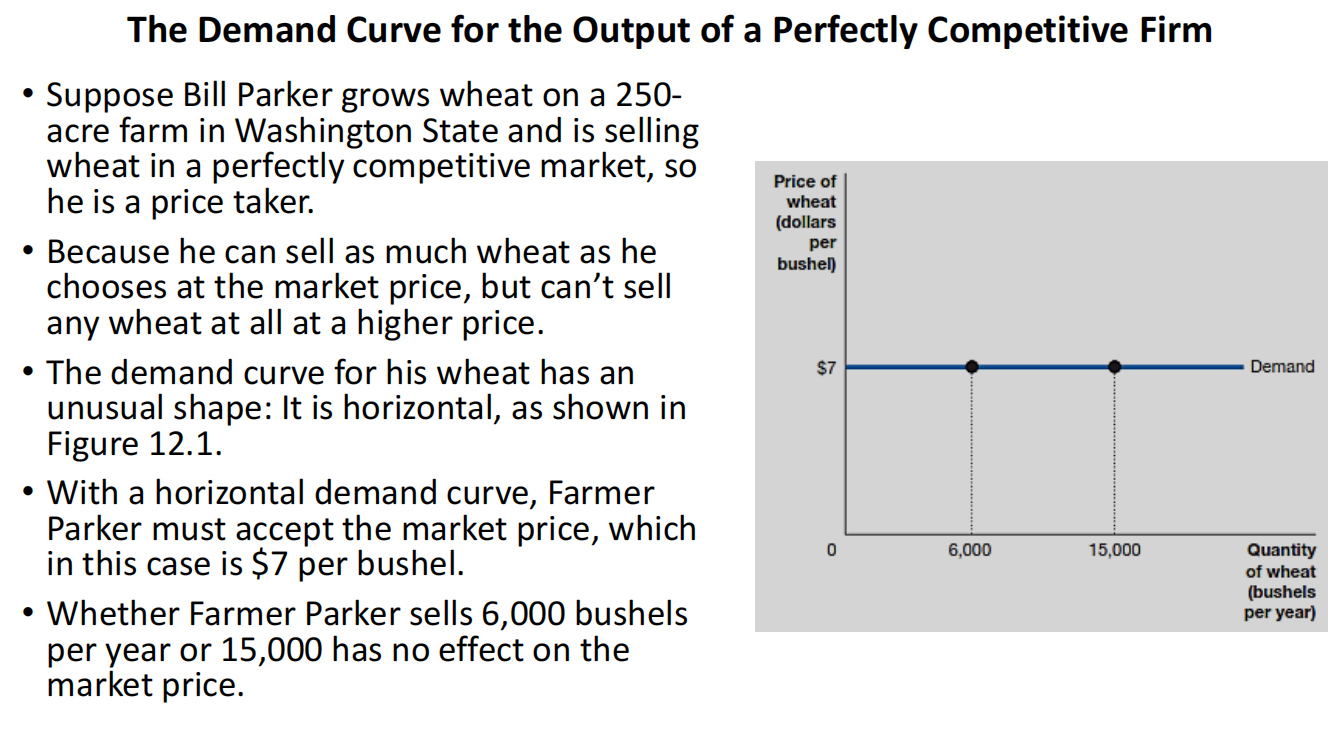
Suppose Bill Parker grows wheat on a 250-acre farm in Washington State and is selling wheat in a perfectly competitive market, so he is a price taker.
📖 点击查看译文
假设Bill Parker在华盛顿州的250英亩农场种植小麦,并在完全竞争市场中出售小麦,因此他是价格接受者。
Because he can sell as much wheat as he chooses at the market price, but can’t sell any wheat at all at a higher price.
📖 点击查看译文
因为他可以以市场价格出售任意数量的小麦,但如果价格更高,他就根本无法出售任何小麦。
The demand curve for his wheat has an unusual shape: It is horizontal, as shown in Figure 12.1.
📖 点击查看译文
他的需求曲线形状非常独特:它是水平的,如图12.1所示。
With a horizontal demand curve, Farmer Parker must accept the market price, which in this case is $7 per bushel.
📖 点击查看译文
由于需求曲线是水平的,Parker农场主必须接受市场价格,在这种情况下为每蒲式耳7美元。
Whether Farmer Parker sells 6,000 bushels per year or 15,000 has no effect on the market price.
📖 点击查看译文
无论Parker农场主每年出售6,000蒲式耳还是15,000蒲式耳,都不会影响市场价格。
知识点列表与拓展 (Knowledge Points and Extensions):
1. Horizontal Demand Curve (水平需求曲线)
-
解释 (Explanation):
In a perfectly competitive market, the demand curve faced by an individual firm is horizontal because the firm can sell any quantity of the good at the market price, but not at any higher price.
(在完全竞争市场中,个别公司面临的需求曲线是水平的,因为公司可以按市场价格出售任意数量的商品,但不能以更高的价格出售。)
-
例子 (Example):
If Farmer Parker decides to sell 6,000 or 15,000 bushels of wheat, the price per bushel will remain the same at $7, regardless of the quantity he sells.
(如果Parker农场主决定出售6,000或15,000蒲式耳的小麦,无论他出售多少,价格每蒲式耳仍然保持在7美元。)
-
拓展 (Extension):
The horizontal demand curve illustrates that a firm in perfect competition cannot influence the price and must accept the market price, a condition that applies to all firms in such a market.
(水平需求曲线说明完全竞争市场中的公司无法影响价格,必须接受市场价格,这一条件适用于市场中的所有公司。)
2. Perfect Competition in Agricultural Markets (农业市场中的完全竞争)
-
解释 (Explanation):
Agricultural markets, such as wheat farming, often closely resemble perfectly competitive markets because products are homogeneous, and entry barriers are low.
(农业市场,如小麦种植,通常与完全竞争市场非常相似,因为产品同质化,且进入壁垒低。)
-
例子 (Example):
In wheat farming, each farmer sells identical products, and any new farmer can enter the market easily by purchasing land and planting crops.
(在小麦种植中,每个农民出售相同的产品,任何新农民都可以通过购买土地和种植作物轻松进入市场。)
-
拓展 (Extension):
Although many agricultural markets are close to perfect competition, real-world markets often deviate slightly due to factors such as government intervention, monopolistic behavior, or product differentiation.
(尽管许多农业市场接近完全竞争,但由于政府干预、垄断行为或产品差异化等因素,现实中的市场往往有所偏离。)
3. No Price Influence in Perfect Competition (完全竞争市场中无价格影响)
-
解释 (Explanation):
In a perfectly competitive market, individual firms are price takers, meaning they cannot influence the market price because their output is small relative to the total market supply.
(在完全竞争市场中,个别公司是价格接受者,意味着它们无法影响市场价格,因为它们的产出相对于市场总供给来说很小。)
-
例子 (Example):
If a single wheat farmer increases or decreases production, it will not affect the overall supply or price of wheat in the market.
(如果一个小麦农民增加或减少产量,它不会影响市场中小麦的总体供给或价格。)
-
拓展 (Extension):
The lack of price influence is a defining characteristic of perfectly competitive markets, distinguishing them from monopolistic or oligopolistic markets where firms have some control over pricing.
(缺乏价格影响是完全竞争市场的一个定义特征,它将完全竞争市场与垄断或寡头市场区分开来,后者中的公司对定价有一定控制权。)
4
5
The Demand Curve for Farmer Parker’s Wheat (Parker农场主的小麦需求曲线)
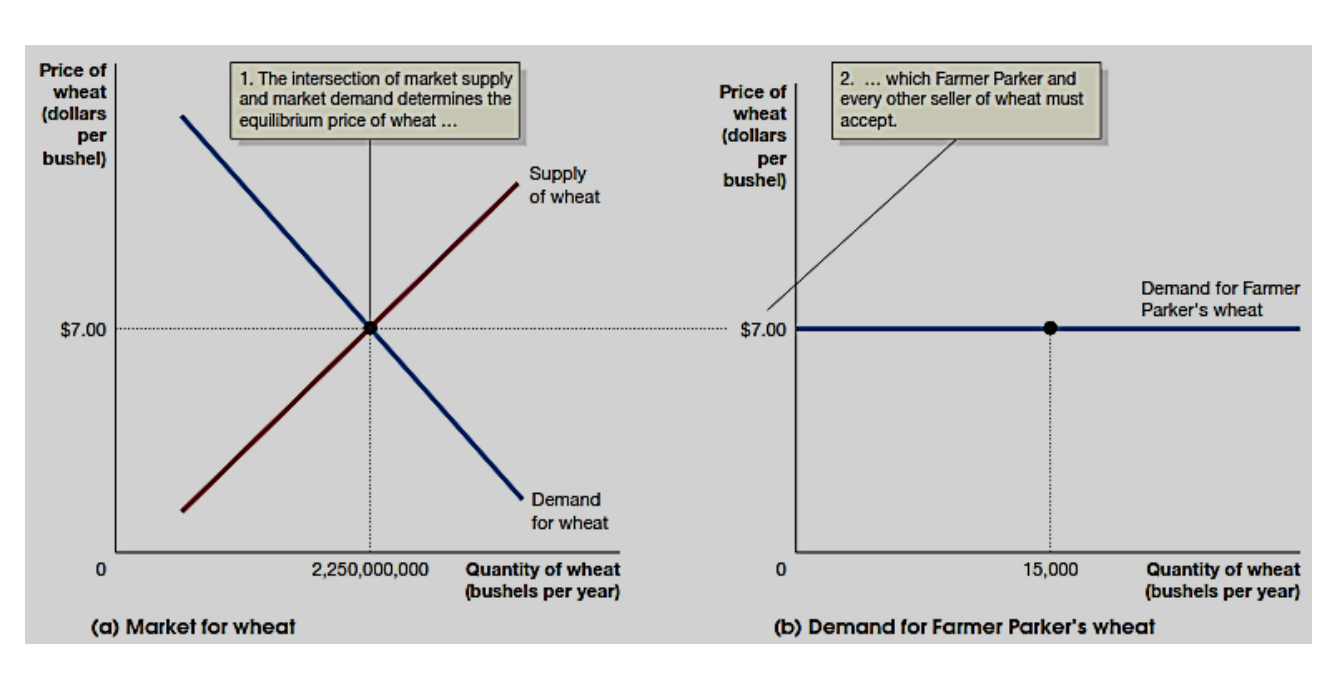
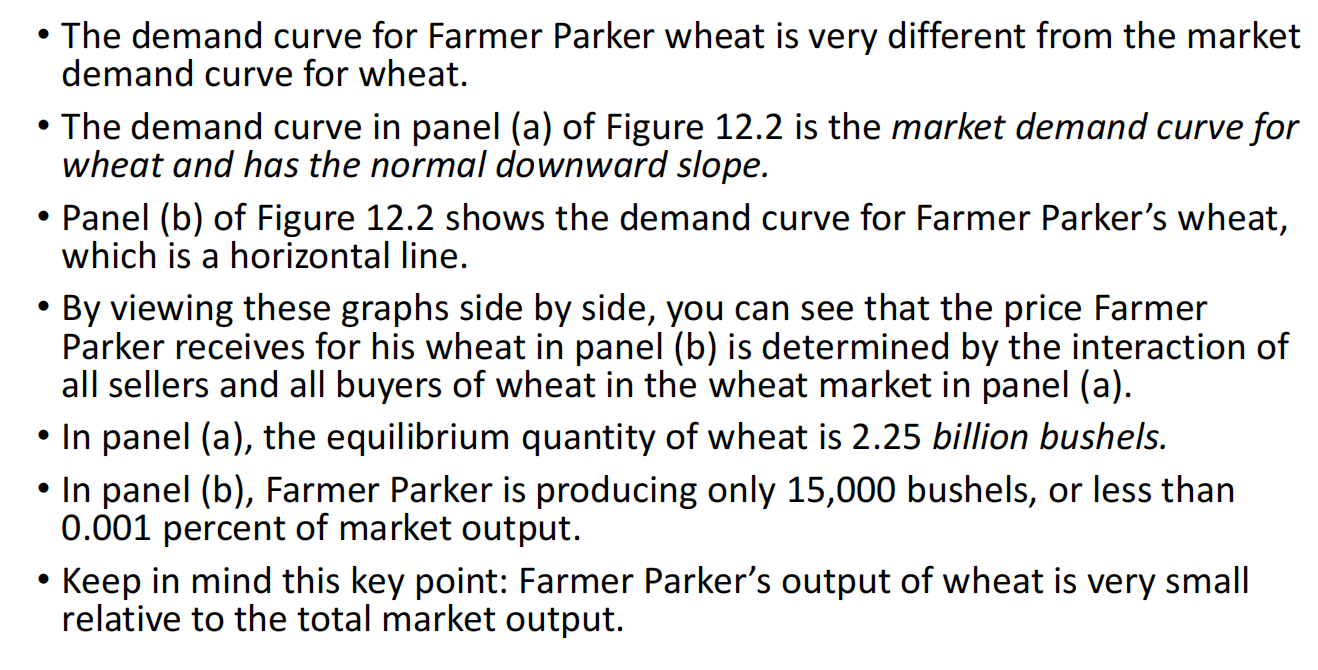
The demand curve for Farmer Parker’s wheat is very different from the market demand curve for wheat.
📖 点击查看译文
Parker农场主的小麦需求曲线与市场小麦需求曲线非常不同。
The demand curve in panel (a) of Figure 12.2 is the market demand curve for wheat and has the normal downward slope.
📖 点击查看译文
图12.2中面板(a)中的需求曲线是市场小麦需求曲线,并具有正常的向下倾斜。
Panel (b) of Figure 12.2 shows the demand curve for Farmer Parker’s wheat, which is a horizontal line.
📖 点击查看译文
图12.2中面板(b)显示了Parker农场主的小麦需求曲线,它是一条水平线。
By viewing these graphs side by side, you can see that the price Farmer Parker receives for his wheat in panel (b) is determined by the interaction of all sellers and all buyers of wheat in the wheat market in panel (a).
📖 点击查看译文
通过并排查看这些图表,您可以看到,Parker农场主在面板(b)中获得的小麦价格是由面板(a)中所有卖家和所有买家之间的相互作用决定的。
In panel (a), the equilibrium quantity of wheat is 2.25 billion bushels.
📖 点击查看译文
在面板(a)中,小麦的均衡数量为22.5亿蒲式耳。
In panel (b), Farmer Parker is producing only 15,000 bushels, or less than 0.001 percent of market output.
📖 点击查看译文
在面板(b)中,Parker农场主仅生产15,000蒲式耳小麦,占市场产量的不到0.001%。
Keep in mind this key point: Farmer Parker’s output of wheat is very small relative to the total market output.
📖 点击查看译文
记住这一关键点:Parker农场主的小麦产量相对于市场的总产量非常小。
知识点列表与拓展 (Knowledge Points and Extensions):
1. Market Demand vs. Individual Firm Demand (市场需求与个别公司需求)
-
解释 (Explanation):
The market demand curve shows the relationship between the price of a good and the total quantity demanded by all consumers in the market. In contrast, the demand curve for an individual firm in a perfectly competitive market is horizontal because the firm is a price taker.
(市场需求曲线展示了商品价格与市场中所有消费者的总需求量之间的关系。相比之下,完全竞争市场中个别公司的需求曲线是水平的,因为该公司是价格接受者。)
-
例子 (Example):
In the wheat market, the price is determined by the interaction of all buyers and sellers, while Farmer Parker can only sell wheat at the market price, without any influence on the price.
(在小麦市场中,价格由所有买卖双方的互动决定,而Parker农场主只能按市场价格出售小麦,无法影响价格。)
-
拓展 (Extension):
The key difference between the market demand curve and the individual firm demand curve is that the latter is perfectly elastic at the market price, whereas the former typically slopes downward due to the law of demand.
(市场需求曲线与个别公司需求曲线之间的关键区别在于,后者在市场价格下是完全弹性的,而前者由于需求法则通常呈向下倾斜。)
2. Market Share in Perfect Competition (完全竞争中的市场份额)
-
解释 (Explanation):
In a perfectly competitive market, the share of the market that any individual firm holds is extremely small, meaning their production decisions do not affect the overall market price.
(在完全竞争市场中,任何个别公司所占的市场份额非常小,这意味着它们的生产决策不会影响整体市场价格。)
-
例子 (Example):
Farmer Parker produces less than 0.001 percent of the total wheat in the market, so his output cannot influence the market price.
(Parker农场主生产的小麦不到市场总量的0.001%,因此他的产量无法影响市场价格。)
-
拓展 (Extension):
The concept of a firm’s minimal market share is a fundamental feature of perfect competition, illustrating why firms in such markets are considered price takers.
(公司最小市场份额的概念是完全竞争的一个基本特征,说明为什么此类市场中的公司被认为是价格接受者。)
6
How a Firm Maximizes Profit in a Perfectly Competitive Market (完全竞争市场中企业如何最大化利润)
To determine how Farmer Parker can maximize profit, we have to consider his costs as well as his revenue.
📖 点击查看译文
为了确定Parker农场主如何最大化利润,我们需要考虑他的成本和收入。
**We assume that all firms try to maximize profits—including perfectly competitive ones. We know that:
Profit = Total Revenue – Total Cost**
📖 点击查看译文
我们假设所有公司都试图最大化利润,包括完全竞争的公司。我们知道:
利润 = 总收入 - 总成本
**Revenue for a perfectly competitive firm is easy: the firm receives the same amount of money for every unit of output it sells. So:
Price = Average Revenue = Marginal Revenue**
📖 点击查看译文
完全竞争市场中的公司收入很简单:公司为每单位销售的产出获得相同的金额。因此:
价格 = 平均收入 = 边际收入
**Average revenue (AR) is total revenue divided by the quantity of the product sold;
Marginal revenue (MR) is the change in total revenue from selling one more unit of a product.**
📖 点击查看译文
平均收入(AR)是总收入除以销售的产品数量;
边际收入(MR)是销售一单位产品所带来的总收入变化。
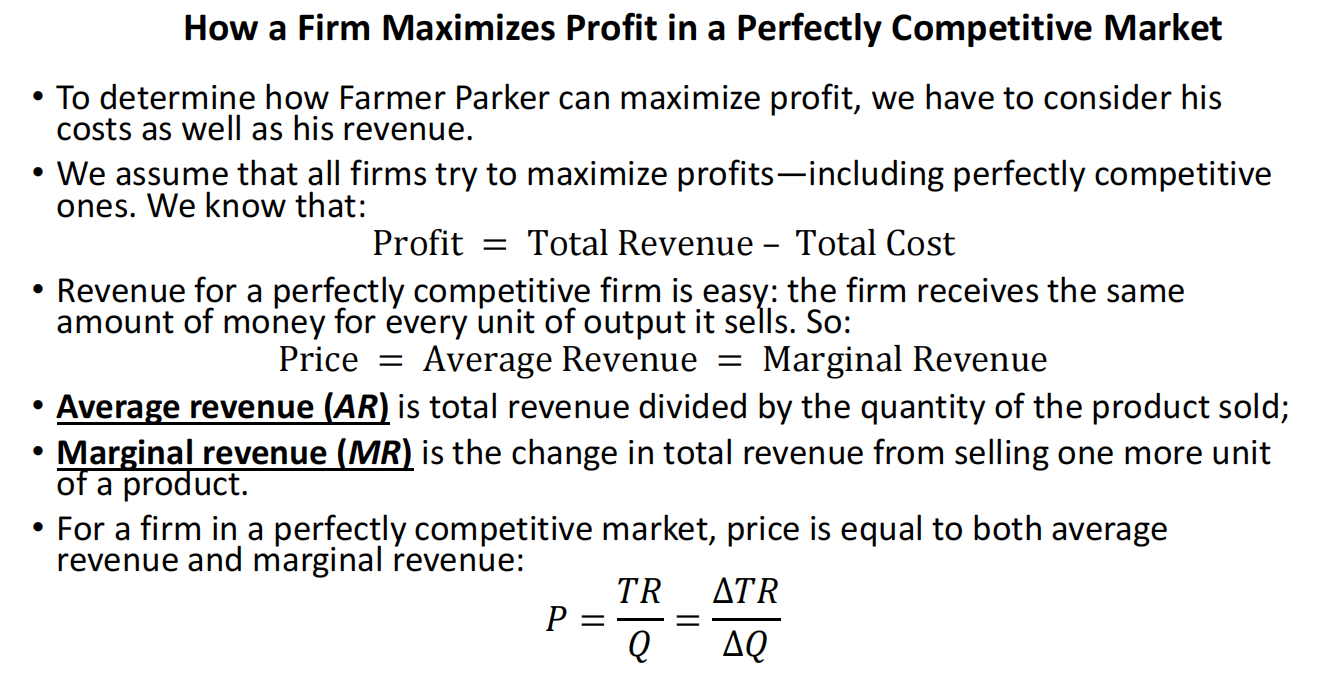
For a firm in a perfectly competitive market, price is equal to both average revenue and marginal revenue:
📖 点击查看译文
对于完全竞争市场中的公司,价格等于平均收入和边际收入:
知识点列表与拓展 (Knowledge Points and Extensions):
1. Profit Maximization (利润最大化)
-
解释 (Explanation):
Profit maximization occurs when a firm determines the quantity of output at which the difference between total revenue and total cost is the greatest.
(利润最大化是指公司确定生产数量,使得总收入与总成本之间的差异最大。)
-
例子 (Example):
A firm maximizes its profit by producing at the level where marginal revenue equals marginal cost.
(公司通过在边际收入等于边际成本的水平上生产来最大化利润。)
-
拓展 (Extension):
In a perfectly competitive market, the firm will continue to produce until marginal revenue equals marginal cost, as long as it covers its variable costs.
(在完全竞争市场中,公司将继续生产,直到边际收入等于边际成本,只要它能够覆盖其变动成本。)
2. Total Revenue and Total Cost (总收入与总成本)
-
解释 (Explanation):
Total revenue is the price of the product multiplied by the quantity sold, while total cost is the sum of fixed and variable costs of production.
(总收入是产品的价格与销售数量的乘积,而总成本是生产的固定成本和变动成本之和。)
-
例子 (Example):
If Farmer Parker sells 10,000 bushels of wheat at $7 per bushel, his total revenue would be $70,000.
(如果Parker农场主以每蒲式耳7美元的价格销售10,000蒲式耳小麦,他的总收入将是70,000美元。)
-
拓展 (Extension):
A firm’s objective in a perfectly competitive market is to maximize profit by adjusting output so that marginal cost equals marginal revenue.
(完全竞争市场中公司的目标是通过调整产量,使边际成本等于边际收入,从而最大化利润。)
7
Determining the Profit-Maximizing Level of Output (确定利润最大化的产量水平)
A wheat farmer has many costs, alongside revenue, including the costs of seed and fertilizer, as well as the wages of farm workers.
📖 点击查看译文
一位小麦农场主有许多成本,除了收入外,还包括种子和肥料的成本,以及农场工人的工资。
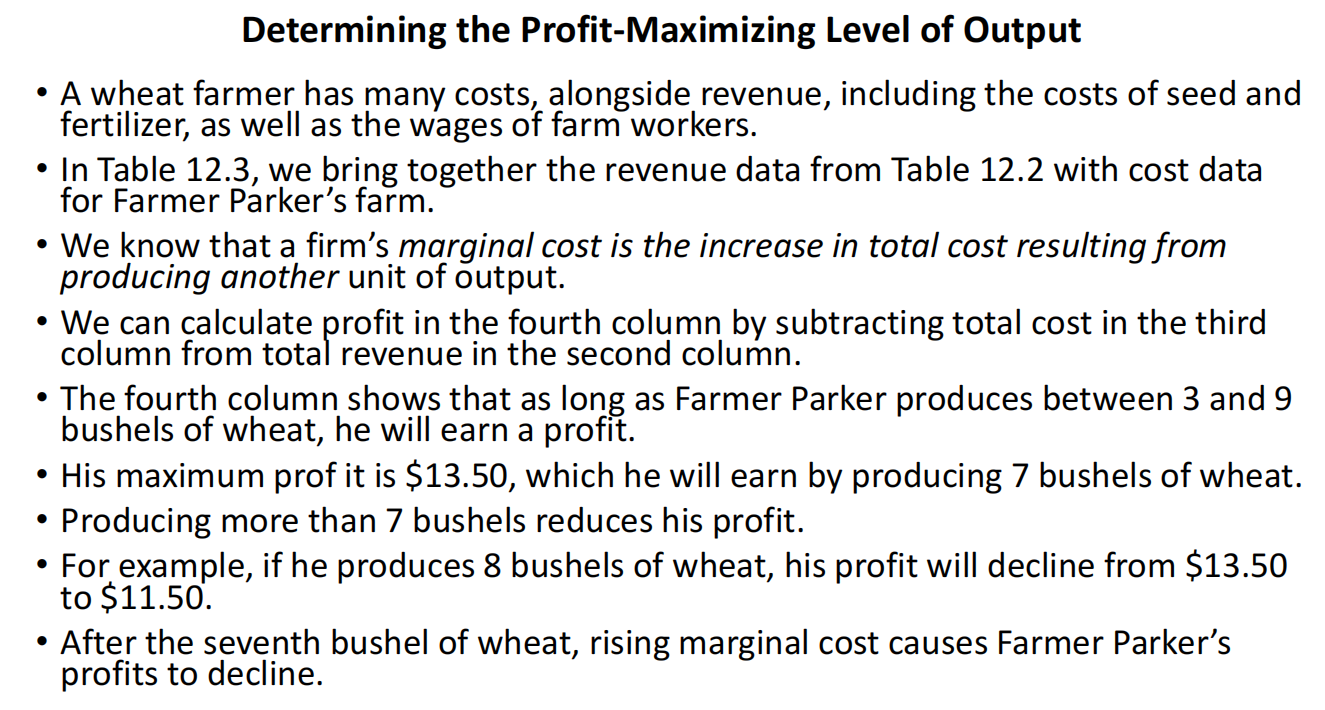
In Table 12.3, we bring together the revenue data from Table 12.2 with cost data for Farmer Parker’s farm.
📖 点击查看译文
在表格12.3中,我们将表格12.2中的收入数据与Parker农场的成本数据结合在一起。
We know that a firm’s marginal cost is the increase in total cost resulting from producing another unit of output.
📖 点击查看译文
我们知道,公司的边际成本是生产额外一单位产出所导致的总成本的增加。
We can calculate profit in the fourth column by subtracting total cost in the third column from total revenue in the second column.
📖 点击查看译文
我们可以通过从总收入的第二列中减去总成本的第三列来计算利润。
The fourth column shows that as long as Farmer Parker produces between 3 and 9 bushels of wheat, he will earn a profit.
📖 点击查看译文
第四列显示,只要Parker农场主生产3到9蒲式耳的小麦,他将获得利润。
His maximum profit is $13.50, which he will earn by producing 7 bushels of wheat.
📖 点击查看译文
他的最大利润是13.50美元,他通过生产7蒲式耳小麦来赚取这笔利润。
Producing more than 7 bushels reduces his profit.
📖 点击查看译文
生产超过7蒲式耳会减少他的利润。
For example, if he produces 8 bushels of wheat, his profit will decline from $13.50 to $11.50.
📖 点击查看译文
例如,如果他生产8蒲式耳小麦,他的利润将从13.50美元下降到11.50美元。
After the seventh bushel of wheat, rising marginal cost causes Farmer Parker’s profits to decline.
📖 点击查看译文
在生产第七蒲式耳小麦后,边际成本上升导致Parker农场主的利润下降。
知识点列表与拓展 (Knowledge Points and Extensions):
1. Marginal Cost (边际成本)
-
解释 (Explanation):
Marginal cost is the increase in total cost resulting from producing one more unit of output.
(边际成本是生产额外一单位产出所导致的总成本的增加。)
-
例子 (Example):
If the total cost of producing 5 bushels of wheat is $50 and the total cost of producing 6 bushels is $55, the marginal cost of producing the 6th bushel is $5.
(如果生产5蒲式耳小麦的总成本是50美元,生产6蒲式耳的小麦的总成本是55美元,那么生产第6蒲式耳小麦的边际成本是5美元。)
-
拓展 (Extension):
Marginal cost tends to rise as more units of output are produced, reflecting the law of diminishing returns.
(边际成本随着产出单位的增加而上升,这反映了收益递减法则。)
2. Profit Maximization (利润最大化)
-
解释 (Explanation):
A firm maximizes profit by producing the quantity of output at which marginal revenue equals marginal cost.
(公司通过生产边际收入等于边际成本的产量来最大化利润。)
-
例子 (Example):
A company will stop increasing production once the marginal cost of production exceeds the marginal revenue, as this would decrease profit.
(当生产的边际成本超过边际收入时,公司将停止增加生产,因为这会减少利润。)
-
拓展 (Extension):
In a perfectly competitive market, price is equal to marginal revenue, and firms maximize profit where marginal cost equals price.
(在完全竞争市场中,价格等于边际收入,公司在边际成本等于价格时最大化利润。)
8
Alternate Method Comparing MR and MC (通过比较边际收入与边际成本的方式)
Comparing the marginal cost and marginal revenue at each level of output is an alternative method of calculating Farmer Parker’s profit.
📖 点击查看译文
比较每个产出水平的边际成本和边际收入是计算Parker农场主利润的另一种方法。
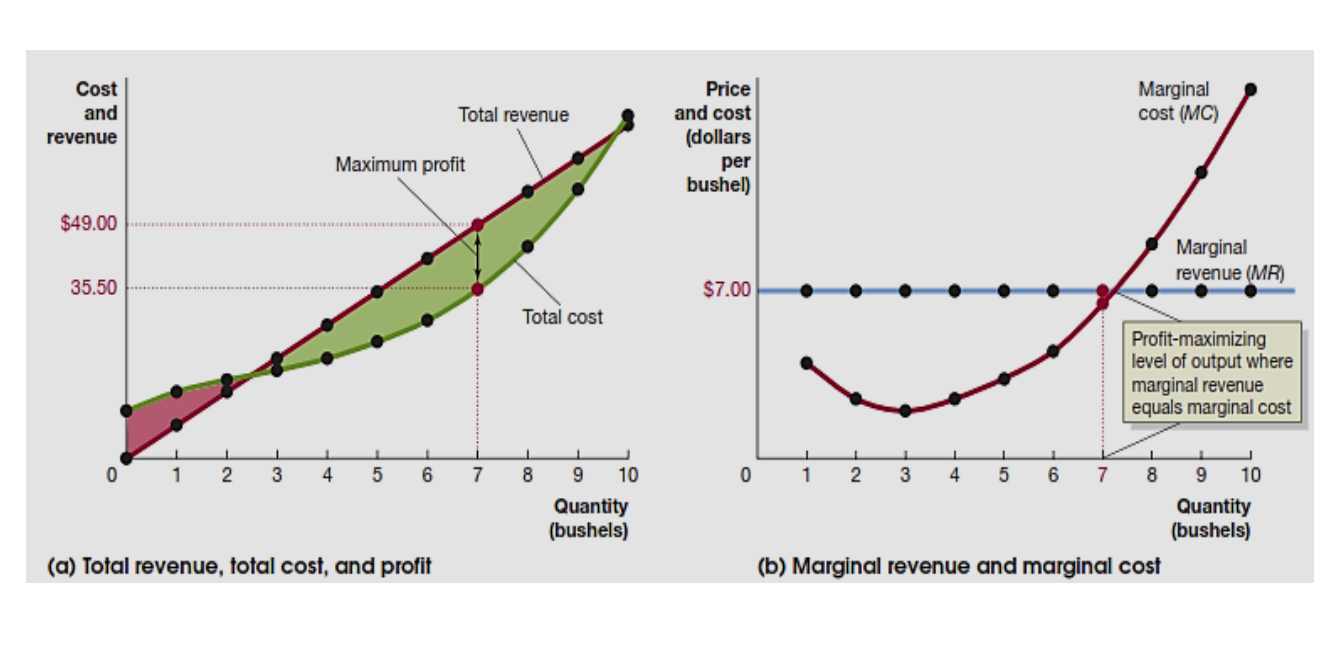
We illustrate the two methods of calculating profit in Figure 12.3.
📖 点击查看译文
我们在图12.3中展示了两种计算利润的方法。
We show the total revenue and total cost approach in panel (a) and the marginal revenue and marginal cost approach in panel (b).
📖 点击查看译文
我们在面板(a)中展示了总收入和总成本的方法,在面板(b)中展示了边际收入和边际成本的方法。
Total revenue is a straight line on the graph in panel (a) because total revenue increases at a constant rate of $7 for each additional bushel sold.
📖 点击查看译文
在面板(a)中的图表中,总收入是一条直线,因为每卖出一蒲式耳小麦,总收入以7美元的固定速率增加。
Farmer Parker’s profit is maximized when the vertical distance between the line representing total revenue and the total cost curve is as large as possible.
📖 点击查看译文
当表示总收入的直线与总成本曲线之间的垂直距离最大时,Parker农场主的利润最大化。
Just as we saw in Table 12.3, his maximum profit occurs at an output of 7 bushels.
📖 点击查看译文
正如我们在表12.3中看到的,他的最大利润发生在生产7蒲式耳时。
Because marginal revenue is always equal to $7, it is a horizontal line at the market price.
📖 点击查看译文
由于边际收入始终等于7美元,它在市场价格处是一条水平线。
Therefore, the marginal revenue curve for a perfectly competitive firm is the same as its demand curve.
📖 点击查看译文
因此,完全竞争市场中公司的边际收入曲线与其需求曲线相同。
Farmer Parker’s marginal cost of producing wheat first falls and then rises.
📖 点击查看译文
生产小麦的Parker农场主的边际成本先下降,然后上升。
9
10
Rules for Profit Maximization (利润最大化的规则)
1. The profit-maximizing level of output is where the positive difference between total revenue and total cost is the greatest.
📖 点击查看译文
利润最大化的产出水平是总收入与总成本之间正差值最大的地方。
2. The profit-maximizing level of output is also where marginal revenue equals marginal cost, or MR = MC.
📖 点击查看译文
利润最大化的产出水平也是边际收入等于边际成本的地方,即MR = MC。
However neither of these rules require the assumption of perfect competition; they are true for every firm!
📖 点击查看译文
然而,这些规则并不需要假设完全竞争;它们对每个公司都适用!
We can draw one other conclusion about profit maximization that is true only of firms in perfectly competitive industries:
📖 点击查看译文
我们还可以得出一个关于利润最大化的结论,这只对完全竞争行业的公司适用:
For a firm in a perfectly competitive industry, price is equal to marginal revenue, or P = MR.
📖 点击查看译文
在完全竞争行业中,对于一个公司,价格等于边际收入,即P = MR。
So we can restate the MR = MC condition as P = MC.
📖 点击查看译文
因此,我们可以将MR = MC条件重述为P = MC。
知识点列表与拓展 (Knowledge Points and Extensions):
1. Profit Maximization (利润最大化)
-
解释 (Explanation):
Profit maximization is the level of output where the firm achieves the highest possible difference between total revenue and total cost.
(利润最大化是公司在产出水平上实现总收入与总成本之间最高可能差额的地方。)
-
例子 (Example):
A company maximizes profit when it produces enough units to generate the greatest gap between its total revenue and total cost.
(当一家公司生产足够的单位产品,以产生总收入与总成本之间的最大差额时,它就实现了利润最大化。)
-
拓展 (Extension):
While the condition of profit maximization applies universally, the method of achieving it depends on the market structure and the cost structure of the firm.
(虽然利润最大化的条件适用于所有公司,但实现这一目标的方法取决于市场结构和公司成本结构。)
11
Illustrating Profit or Loss on the Cost Curve Graph (在成本曲线图上说明利润或亏损)
1. To begin, we need to work through several steps to determine the relationship between profit and average total cost.
📖 点击查看译文
首先,我们需要通过几个步骤来确定利润与平均总成本之间的关系。
2. Because profit is equal to total revenue (TR) minus total cost (TC) and total revenue is price times quantity, we can write the following:
📖 点击查看译文
因为利润等于总收入(TR)减去总成本(TC),而总收入是价格乘以数量,我们可以写出以下公式:
Profit = P × Q − TC
📖 点击查看译文
利润 = 价格 × 数量 − 总成本
3. If we divide both sides of this equation by Q, we have:
📖 点击查看译文
如果我们将这个方程两边都除以数量Q,就得到:
Profit / Q = (P × Q) / Q − TC / Q
📖 点击查看译文
利润 / 数量 = (价格 × 数量) / 数量 − 总成本 / 数量
4. Profit / Q = P − ATC
📖 点击查看译文
利润 / 数量 = 价格 − 平均总成本
5. This equation tells us that profit per unit (or average profit) equals price minus average total cost.
📖 点击查看译文
这个方程告诉我们每单位的利润(或平均利润)等于价格减去平均总成本。
6. Finally, we obtain the equation for the relationship between total profit and average total cost by multiplying by Q:
📖 点击查看译文
最后,通过乘以数量Q,我们得到了总利润与平均总成本之间关系的方程:
Profit = (P − ATC) × Q
📖 点击查看译文
利润 = (价格 − 平均总成本) × 数量
7. The right hand side is the area of a rectangle with height (P − ATC) and length Q. We can use this to illustrate profit on a graph.
📖 点击查看译文
右侧是一个矩形的面积,矩形的高度是(价格 − 平均总成本),长度是数量。我们可以用这个来在图上说明利润。
知识点列表与拓展 (Knowledge Points and Extensions):
1. Economic Profit vs. Accounting Profit (经济利润与会计利润)
-
解释 (Explanation):
Economic profit takes both explicit and implicit costs into account, whereas accounting profit only considers explicit costs. Implicit costs are the opportunity costs of resources used in production.
(经济利润考虑了显性成本和隐性成本,而会计利润只考虑显性成本。隐性成本是生产中使用资源的机会成本。)
-
例子 (Example):
If a firm has a total revenue of $1000, explicit costs of $600, and implicit costs (opportunity costs) of $200, the economic profit would be $200, while the accounting profit would be $400.
(如果一家公司总收入为1000美元,显性成本为600美元,隐性成本(机会成本)为200美元,那么经济利润将是200美元,而会计利润为400美元。)
-
拓展 (Extension):
Economic profit provides a more comprehensive picture of a firm’s success because it factors in the opportunity cost of using resources in one way rather than the next best alternative. A firm earning zero economic profit is still efficient, as it covers both explicit and implicit costs but is not making an excess return above its opportunity cost.
(经济利润提供了公司成功的更全面视角,因为它考虑了将资源以某种方式使用而不是使用最佳替代方案的机会成本。一个经济利润为零的公司仍然是有效率的,因为它覆盖了显性成本和隐性成本,但并没有超过机会成本的额外回报。)
2. The Short-Run vs. Long-Run Profit Maximization (短期与长期利润最大化)
-
解释 (Explanation):
In the short run, firms can adjust their production levels to maximize profit but cannot change all inputs (like plant size or equipment). In the long run, firms can adjust all factors of production, leading to an optimal scale of production.
(在短期内,企业可以调整生产水平以最大化利润,但不能改变所有生产要素(如工厂规模或设备)。在长期内,企业可以调整所有生产要素,从而达到最佳生产规模。)
-
例子 (Example):
A firm may decide to increase labor in the short run to meet demand, but in the long run, it may invest in automation or expand its production capacity to reduce costs.
(一家企业可能决定在短期内增加劳动力以满足需求,但在长期内,它可能会投资于自动化或扩大生产能力以降低成本。)
-
拓展 (Extension):
The distinction between short-run and long-run profit maximization is central to understanding dynamic market behavior. In the long run, firms enter and exit the market based on the economic profits or losses observed in the short run, which leads to a tendency toward normal profits (zero economic profit) in perfectly competitive markets.
(短期与长期利润最大化的区别是理解动态市场行为的核心。在长期内,企业根据短期内观察到的经济利润或亏损进出市场,从而导致在完全竞争市场中趋向于正常利润(零经济利润)。)
3. The Role of Marginal Analysis in Profit Maximization (边际分析在利润最大化中的作用)
-
解释 (Explanation):
Marginal analysis involves comparing marginal cost (MC) with marginal revenue (MR) to determine the optimal level of production. When MC = MR, firms achieve profit maximization because any additional unit of production beyond this point will result in diminishing returns.
(边际分析涉及比较边际成本(MC)和边际收入(MR)以确定最佳生产水平。当MC = MR时,企业实现了利润最大化,因为在此点之后的任何额外生产单位将导致收益递减。)
-
例子 (Example):
If the marginal cost of producing an additional unit of output is $5, and the marginal revenue from selling it is $7, the firm can increase profit by producing more. However, once the marginal cost exceeds the marginal revenue, further production will reduce overall profit.
(如果生产额外单位产出的边际成本为5美元,而销售该单位的边际收入为7美元,则企业可以通过增加生产来增加利润。然而,一旦边际成本超过边际收入,进一步生产将减少整体利润。)
-
拓展 (Extension):
Marginal analysis plays a crucial role in determining not just profit maximization but also cost efficiency and market strategy. A firm may optimize its product mix, production methods, and pricing strategies based on marginal returns. In industries with economies of scale, marginal analysis helps firms understand how expanding production leads to lower average costs.
(边际分析在确定利润最大化、成本效率和市场策略方面起着至关重要的作用。公司可以根据边际收益优化其产品组合、生产方法和定价策略。在具有规模经济的行业中,边际分析帮助公司理解如何通过扩大生产来降低平均成本。)
4. The Concept of “Normal Profit” and Its Implications (“正常利润”概念及其影响)
-
解释 (Explanation):
Normal profit occurs when total revenue equals total cost, including both explicit and implicit costs. It represents the minimum level of profit required to keep a firm in business. When a firm earns normal profit, it is covering all its costs, including the opportunity cost of the resources employed.
(正常利润是指总收入等于总成本,包括显性成本和隐性成本。这代表着保持企业经营所需的最低利润水平。当一家公司赚取正常利润时,它涵盖了所有成本,包括使用资源的机会成本。)
-
例子 (Example):
If a firm’s total revenue is $5000, and its total cost (including both explicit and implicit costs) is also $5000, the firm is earning normal profit. It is not making any excess profit beyond covering the opportunity cost of its resources.
(如果一家公司总收入为5000美元,总成本(包括显性和隐性成本)也是5000美元,那么该公司正在赚取正常利润。它没有赚取超出覆盖其资源机会成本的额外利润。)
-
拓展 (Extension):
In the context of perfectly competitive markets, the concept of normal profit is crucial in the long run. When firms in such markets earn only normal profits, it indicates that resources are being allocated efficiently, and no firm has the incentive to enter or exit the market. The condition of normal profit helps maintain equilibrium in a competitive industry.
(在完全竞争市场的背景下,正常利润的概念在长期内至关重要。当这些市场中的公司只赚取正常利润时,这表明资源得到了有效配置,且没有公司有动机进入或退出市场。正常利润的条件有助于维持竞争性行业的均衡。)
5. The Impact of Fixed Costs on Profit Maximization (固定成本对利润最大化的影响)
-
解释 (Explanation):
Fixed costs are costs that do not change with the level of output, such as rent or machinery. Although fixed costs affect the total cost structure, they do not directly affect the marginal cost or the decision-making process for profit maximization, which is primarily concerned with variable costs.
(固定成本是与产出水平无关的成本,例如租金或机械设备。尽管固定成本会影响总成本结构,但它们不会直接影响边际成本或利润最大化的决策过程,后者主要关注变动成本。)
-
例子 (Example):
A factory might have fixed costs of $5000 per month for rent and machinery. Regardless of whether the factory produces 100 or 1000 units, these fixed costs remain the same.
(一家工厂每月可能有5000美元的固定成本用于租金和机械设备。无论工厂生产100个还是1000个单位,这些固定成本都保持不变。)
-
拓展 (Extension):
In the short run, fixed costs contribute to the firm’s total cost, but they do not affect decisions regarding the marginal cost of production. However, in the long run, firms can adjust fixed costs by changing their scale of operations. Thus, understanding the relationship between fixed costs and profit maximization is vital for long-term business planning.
(在短期内,固定成本会影响公司的总成本,但不会影响有关生产边际成本的决策。然而,在长期内,公司可以通过改变经营规模来调整固定成本。因此,理解固定成本与利润最大化之间的关系对长期商业规划至关重要。)
12
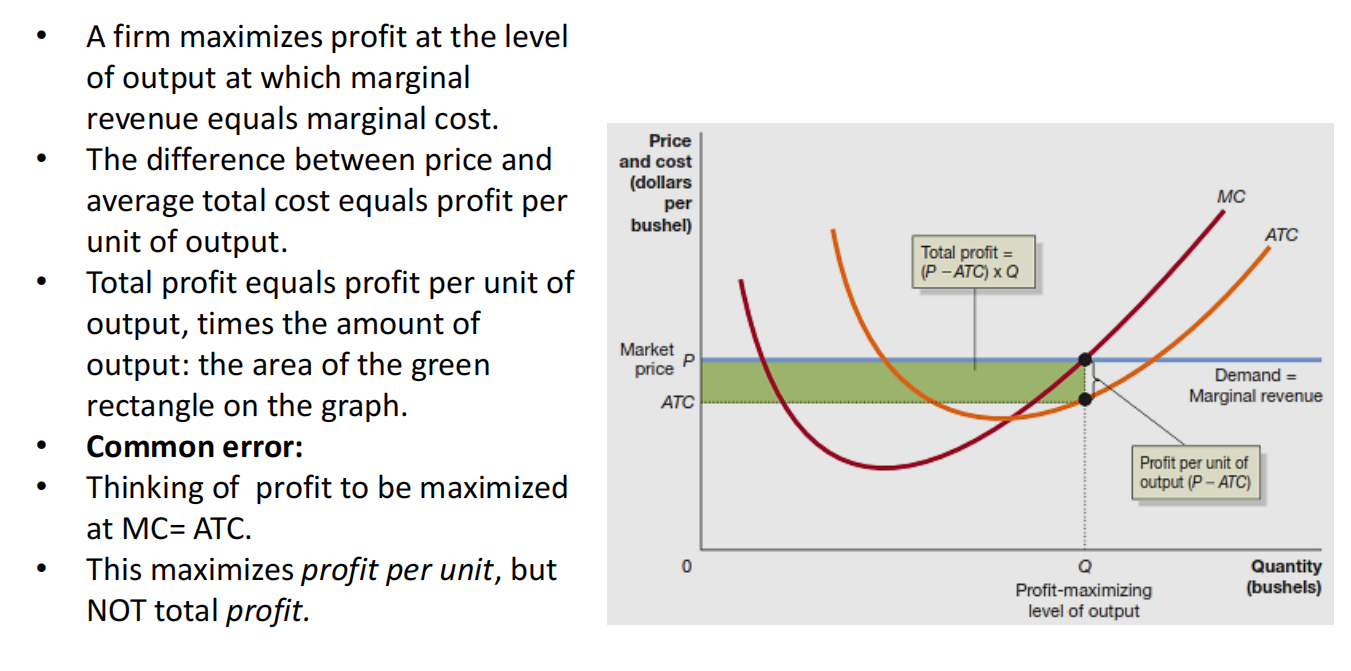
Profit Maximization and the Role of Marginal Revenue and Marginal Cost (利润最大化及边际收入与边际成本的作用)
A firm maximizes profit at the level of output at which marginal revenue equals marginal cost.
📖 点击查看译文
公司在边际收入等于边际成本的产出水平上最大化利润。
The difference between price and average total cost equals profit per unit of output.
📖 点击查看译文
价格与平均总成本之间的差额等于每单位产出的利润。
Total profit equals profit per unit of output, times the amount of output: the area of the green rectangle on the graph.
📖 点击查看译文
总利润等于每单位产出的利润乘以产量:图表上绿色矩形的面积。
Common error: Thinking of profit to be maximized at MC = ATC. This maximizes profit per unit, but NOT total profit.
📖 点击查看译文
常见错误:认为利润在MC = ATC时最大化。这最大化了每单位的利润,但并没有最大化总利润。
If Farmer Parker decides to sell 6,000 or 15,000 bushels of wheat, the price per bushel will remain the same at $7, regardless of the quantity he sells.
(如果Parker农场主决定出售6,000或15,000蒲式耳的小麦,无论他出售多少,价格每蒲式耳仍然保持在7美元。)
-
拓展 (Extension):
The horizontal demand curve illustrates that a firm in perfect competition cannot influence the price and must accept the market price, a condition that applies to all firms in such a market.
(水平需求曲线说明完全竞争市场中的公司无法影响价格,必须接受市场价格,这一条件适用于市场中的所有公司。)
2. Perfect Competition in Agricultural Markets (农业市场中的完全竞争)
-
解释 (Explanation):
Agricultural markets, such as wheat farming, often closely resemble perfectly competitive markets because products are homogeneous, and entry barriers are low.
(农业市场,如小麦种植,通常与完全竞争市场非常相似,因为产品同质化,且进入壁垒低。)
-
例子 (Example):
In wheat farming, each farmer sells identical products, and any new farmer can enter the market easily by purchasing land and planting crops.
(在小麦种植中,每个农民出售相同的产品,任何新农民都可以通过购买土地和种植作物轻松进入市场。)
-
拓展 (Extension):
Although many agricultural markets are close to perfect competition, real-world markets often deviate slightly due to factors such as government intervention, monopolistic behavior, or product differentiation.
(尽管许多农业市场接近完全竞争,但由于政府干预、垄断行为或产品差异化等因素,现实中的市场往往有所偏离。)
3. No Price Influence in Perfect Competition (完全竞争市场中无价格影响)
-
解释 (Explanation):
In a perfectly competitive market, individual firms are price takers, meaning they cannot influence the market price because their output is small relative to the total market supply.
(在完全竞争市场中,个别公司是价格接受者,意味着它们无法影响市场价格,因为它们的产出相对于市场总供给来说很小。)
-
例子 (Example):
If a single wheat farmer increases or decreases production, it will not affect the overall supply or price of wheat in the market.
(如果一个小麦农民增加或减少产量,它不会影响市场中小麦的总体供给或价格。)
-
拓展 (Extension):
The lack of price influence is a defining characteristic of perfectly competitive markets, distinguishing them from monopolistic or oligopolistic markets where firms have some control over pricing.
(缺乏价格影响是完全竞争市场的一个定义特征,它将完全竞争市场与垄断或寡头市场区分开来,后者中的公司对定价有一定控制权。)
4

5

The Demand Curve for Farmer Parker’s Wheat (Parker农场主的小麦需求曲线)
The demand curve for Farmer Parker’s wheat is very different from the market demand curve for wheat.
📖 点击查看译文
Parker农场主的小麦需求曲线与市场小麦需求曲线非常不同。
The demand curve in panel (a) of Figure 12.2 is the market demand curve for wheat and has the normal downward slope.
📖 点击查看译文
图12.2中面板(a)中的需求曲线是市场小麦需求曲线,并具有正常的向下倾斜。
Panel (b) of Figure 12.2 shows the demand curve for Farmer Parker’s wheat, which is a horizontal line.
📖 点击查看译文
图12.2中面板(b)显示了Parker农场主的小麦需求曲线,它是一条水平线。
By viewing these graphs side by side, you can see that the price Farmer Parker receives for his wheat in panel (b) is determined by the interaction of all sellers and all buyers of wheat in the wheat market in panel (a).
📖 点击查看译文
通过并排查看这些图表,您可以看到,Parker农场主在面板(b)中获得的小麦价格是由面板(a)中所有卖家和所有买家之间的相互作用决定的。
In panel (a), the equilibrium quantity of wheat is 2.25 billion bushels.
📖 点击查看译文
在面板(a)中,小麦的均衡数量为22.5亿蒲式耳。
In panel (b), Farmer Parker is producing only 15,000 bushels, or less than 0.001 percent of market output.
📖 点击查看译文
在面板(b)中,Parker农场主仅生产15,000蒲式耳小麦,占市场产量的不到0.001%。
Keep in mind this key point: Farmer Parker’s output of wheat is very small relative to the total market output.
📖 点击查看译文
记住这一关键点:Parker农场主的小麦产量相对于市场的总产量非常小。
知识点列表与拓展 (Knowledge Points and Extensions):
1. Market Demand vs. Individual Firm Demand (市场需求与个别公司需求)
-
解释 (Explanation):
The market demand curve shows the relationship between the price of a good and the total quantity demanded by all consumers in the market. In contrast, the demand curve for an individual firm in a perfectly competitive market is horizontal because the firm is a price taker.
(市场需求曲线展示了商品价格与市场中所有消费者的总需求量之间的关系。相比之下,完全竞争市场中个别公司的需求曲线是水平的,因为该公司是价格接受者。)
-
例子 (Example):
In the wheat market, the price is determined by the interaction of all buyers and sellers, while Farmer Parker can only sell wheat at the market price, without any influence on the price.
(在小麦市场中,价格由所有买卖双方的互动决定,而Parker农场主只能按市场价格出售小麦,无法影响价格。)
-
拓展 (Extension):
The key difference between the market demand curve and the individual firm demand curve is that the latter is perfectly elastic at the market price, whereas the former typically slopes downward due to the law of demand.
(市场需求曲线与个别公司需求曲线之间的关键区别在于,后者在市场价格下是完全弹性的,而前者由于需求法则通常呈向下倾斜。)
2. Market Share in Perfect Competition (完全竞争中的市场份额)
-
解释 (Explanation):
In a perfectly competitive market, the share of the market that any individual firm holds is extremely small, meaning their production decisions do not affect the overall market price.
(在完全竞争市场中,任何个别公司所占的市场份额非常小,这意味着它们的生产决策不会影响整体市场价格。)
-
例子 (Example):
Farmer Parker produces less than 0.001 percent of the total wheat in the market, so his output cannot influence the market price.
(Parker农场主生产的小麦不到市场总量的0.001%,因此他的产量无法影响市场价格。)
-
拓展 (Extension):
The concept of a firm’s minimal market share is a fundamental feature of perfect competition, illustrating why firms in such markets are considered price takers.
(公司最小市场份额的概念是完全竞争的一个基本特征,说明为什么此类市场中的公司被认为是价格接受者。)
6

How a Firm Maximizes Profit in a Perfectly Competitive Market (完全竞争市场中企业如何最大化利润)
To determine how Farmer Parker can maximize profit, we have to consider his costs as well as his revenue.
📖 点击查看译文
为了确定Parker农场主如何最大化利润,我们需要考虑他的成本和收入。
**We assume that all firms try to maximize profits—including perfectly competitive ones. We know that:
Profit = Total Revenue – Total Cost**
📖 点击查看译文
我们假设所有公司都试图最大化利润,包括完全竞争的公司。我们知道:
利润 = 总收入 - 总成本
**Revenue for a perfectly competitive firm is easy: the firm receives the same amount of money for every unit of output it sells. So:
Price = Average Revenue = Marginal Revenue**
📖 点击查看译文
完全竞争市场中的公司收入很简单:公司为每单位销售的产出获得相同的金额。因此:
价格 = 平均收入 = 边际收入
**Average revenue (AR) is total revenue divided by the quantity of the product sold;
Marginal revenue (MR) is the change in total revenue from selling one more unit of a product.**
📖 点击查看译文
平均收入(AR)是总收入除以销售的产品数量;
边际收入(MR)是销售一单位产品所带来的总收入变化。
For a firm in a perfectly competitive market, price is equal to both average revenue and marginal revenue:
📖 点击查看译文
对于完全竞争市场中的公司,价格等于平均收入和边际收入:
知识点列表与拓展 (Knowledge Points and Extensions):
1. Profit Maximization (利润最大化)
-
解释 (Explanation):
Profit maximization occurs when a firm determines the quantity of output at which the difference between total revenue and total cost is the greatest.
(利润最大化是指公司确定生产数量,使得总收入与总成本之间的差异最大。)
-
例子 (Example):
A firm maximizes its profit by producing at the level where marginal revenue equals marginal cost.
(公司通过在边际收入等于边际成本的水平上生产来最大化利润。)
-
拓展 (Extension):
In a perfectly competitive market, the firm will continue to produce until marginal revenue equals marginal cost, as long as it covers its variable costs.
(在完全竞争市场中,公司将继续生产,直到边际收入等于边际成本,只要它能够覆盖其变动成本。)
2. Total Revenue and Total Cost (总收入与总成本)
-
解释 (Explanation):
Total revenue is the price of the product multiplied by the quantity sold, while total cost is the sum of fixed and variable costs of production.
(总收入是产品的价格与销售数量的乘积,而总成本是生产的固定成本和变动成本之和。)
-
例子 (Example):
If Farmer Parker sells 10,000 bushels of wheat at $7 per bushel, his total revenue would be $70,000.
(如果Parker农场主以每蒲式耳7美元的价格销售10,000蒲式耳小麦,他的总收入将是70,000美元。)
-
拓展 (Extension):
A firm’s objective in a perfectly competitive market is to maximize profit by adjusting output so that marginal cost equals marginal revenue.
(完全竞争市场中公司的目标是通过调整产量,使边际成本等于边际收入,从而最大化利润。)
7

Determining the Profit-Maximizing Level of Output (确定利润最大化的产量水平)
A wheat farmer has many costs, alongside revenue, including the costs of seed and fertilizer, as well as the wages of farm workers.
📖 点击查看译文
一位小麦农场主有许多成本,除了收入外,还包括种子和肥料的成本,以及农场工人的工资。
In Table 12.3, we bring together the revenue data from Table 12.2 with cost data for Farmer Parker’s farm.
📖 点击查看译文
在表格12.3中,我们将表格12.2中的收入数据与Parker农场的成本数据结合在一起。
We know that a firm’s marginal cost is the increase in total cost resulting from producing another unit of output.
📖 点击查看译文
我们知道,公司的边际成本是生产额外一单位产出所导致的总成本的增加。
We can calculate profit in the fourth column by subtracting total cost in the third column from total revenue in the second column.
📖 点击查看译文
我们可以通过从总收入的第二列中减去总成本的第三列来计算利润。
The fourth column shows that as long as Farmer Parker produces between 3 and 9 bushels of wheat, he will earn a profit.
📖 点击查看译文
第四列显示,只要Parker农场主生产3到9蒲式耳的小麦,他将获得利润。
His maximum profit is $13.50, which he will earn by producing 7 bushels of wheat.
📖 点击查看译文
他的最大利润是13.50美元,他通过生产7蒲式耳小麦来赚取这笔利润。
Producing more than 7 bushels reduces his profit.
📖 点击查看译文
生产超过7蒲式耳会减少他的利润。
For example, if he produces 8 bushels of wheat, his profit will decline from $13.50 to $11.50.
📖 点击查看译文
例如,如果他生产8蒲式耳小麦,他的利润将从13.50美元下降到11.50美元。
After the seventh bushel of wheat, rising marginal cost causes Farmer Parker’s profits to decline.
📖 点击查看译文
在生产第七蒲式耳小麦后,边际成本上升导致Parker农场主的利润下降。
知识点列表与拓展 (Knowledge Points and Extensions):
1. Marginal Cost (边际成本)
-
解释 (Explanation):
Marginal cost is the increase in total cost resulting from producing one more unit of output.
(边际成本是生产额外一单位产出所导致的总成本的增加。)
-
例子 (Example):
If the total cost of producing 5 bushels of wheat is $50 and the total cost of producing 6 bushels is $55, the marginal cost of producing the 6th bushel is $5.
(如果生产5蒲式耳小麦的总成本是50美元,生产6蒲式耳的小麦的总成本是55美元,那么生产第6蒲式耳小麦的边际成本是5美元。)
-
拓展 (Extension):
Marginal cost tends to rise as more units of output are produced, reflecting the law of diminishing returns.
(边际成本随着产出单位的增加而上升,这反映了收益递减法则。)
2. Profit Maximization (利润最大化)
-
解释 (Explanation):
A firm maximizes profit by producing the quantity of output at which marginal revenue equals marginal cost.
(公司通过生产边际收入等于边际成本的产量来最大化利润。)
-
例子 (Example):
A company will stop increasing production once the marginal cost of production exceeds the marginal revenue, as this would decrease profit.
(当生产的边际成本超过边际收入时,公司将停止增加生产,因为这会减少利润。)
-
拓展 (Extension):
In a perfectly competitive market, price is equal to marginal revenue, and firms maximize profit where marginal cost equals price.
(在完全竞争市场中,价格等于边际收入,公司在边际成本等于价格时最大化利润。)
8

Alternate Method Comparing MR and MC (通过比较边际收入与边际成本的方式)
Comparing the marginal cost and marginal revenue at each level of output is an alternative method of calculating Farmer Parker’s profit.
📖 点击查看译文
比较每个产出水平的边际成本和边际收入是计算Parker农场主利润的另一种方法。
We illustrate the two methods of calculating profit in Figure 12.3.
📖 点击查看译文
我们在图12.3中展示了两种计算利润的方法。
We show the total revenue and total cost approach in panel (a) and the marginal revenue and marginal cost approach in panel (b).
📖 点击查看译文
我们在面板(a)中展示了总收入和总成本的方法,在面板(b)中展示了边际收入和边际成本的方法。
Total revenue is a straight line on the graph in panel (a) because total revenue increases at a constant rate of $7 for each additional bushel sold.
📖 点击查看译文
在面板(a)中的图表中,总收入是一条直线,因为每卖出一蒲式耳小麦,总收入以7美元的固定速率增加。
Farmer Parker’s profit is maximized when the vertical distance between the line representing total revenue and the total cost curve is as large as possible.
📖 点击查看译文
当表示总收入的直线与总成本曲线之间的垂直距离最大时,Parker农场主的利润最大化。
Just as we saw in Table 12.3, his maximum profit occurs at an output of 7 bushels.
📖 点击查看译文
正如我们在表12.3中看到的,他的最大利润发生在生产7蒲式耳时。
Because marginal revenue is always equal to $7, it is a horizontal line at the market price.
📖 点击查看译文
由于边际收入始终等于7美元,它在市场价格处是一条水平线。
Therefore, the marginal revenue curve for a perfectly competitive firm is the same as its demand curve.
📖 点击查看译文
因此,完全竞争市场中公司的边际收入曲线与其需求曲线相同。
Farmer Parker’s marginal cost of producing wheat first falls and then rises.
📖 点击查看译文
生产小麦的Parker农场主的边际成本先下降,然后上升。
9

10

Rules for Profit Maximization (利润最大化的规则)
1. The profit-maximizing level of output is where the positive difference between total revenue and total cost is the greatest.
📖 点击查看译文
利润最大化的产出水平是总收入与总成本之间正差值最大的地方。
2. The profit-maximizing level of output is also where marginal revenue equals marginal cost, or MR = MC.
📖 点击查看译文
利润最大化的产出水平也是边际收入等于边际成本的地方,即MR = MC。
However neither of these rules require the assumption of perfect competition; they are true for every firm!
📖 点击查看译文
然而,这些规则并不需要假设完全竞争;它们对每个公司都适用!
We can draw one other conclusion about profit maximization that is true only of firms in perfectly competitive industries:
📖 点击查看译文
我们还可以得出一个关于利润最大化的结论,这只对完全竞争行业的公司适用:
For a firm in a perfectly competitive industry, price is equal to marginal revenue, or P = MR.
📖 点击查看译文
在完全竞争行业中,对于一个公司,价格等于边际收入,即P = MR。
So we can restate the MR = MC condition as P = MC.
📖 点击查看译文
因此,我们可以将MR = MC条件重述为P = MC。
知识点列表与拓展 (Knowledge Points and Extensions):
1. Profit Maximization (利润最大化)
-
解释 (Explanation):
Profit maximization is the level of output where the firm achieves the highest possible difference between total revenue and total cost.
(利润最大化是公司在产出水平上实现总收入与总成本之间最高可能差额的地方。)
-
例子 (Example):
A company maximizes profit when it produces enough units to generate the greatest gap between its total revenue and total cost.
(当一家公司生产足够的单位产品,以产生总收入与总成本之间的最大差额时,它就实现了利润最大化。)
-
拓展 (Extension):
While the condition of profit maximization applies universally, the method of achieving it depends on the market structure and the cost structure of the firm.
(虽然利润最大化的条件适用于所有公司,但实现这一目标的方法取决于市场结构和公司成本结构。)
11

Illustrating Profit or Loss on the Cost Curve Graph (在成本曲线图上说明利润或亏损)
1. To begin, we need to work through several steps to determine the relationship between profit and average total cost.
📖 点击查看译文
首先,我们需要通过几个步骤来确定利润与平均总成本之间的关系。
2. Because profit is equal to total revenue (TR) minus total cost (TC) and total revenue is price times quantity, we can write the following:
📖 点击查看译文
因为利润等于总收入(TR)减去总成本(TC),而总收入是价格乘以数量,我们可以写出以下公式:
Profit = P × Q − TC
📖 点击查看译文
利润 = 价格 × 数量 − 总成本
3. If we divide both sides of this equation by Q, we have:
📖 点击查看译文
如果我们将这个方程两边都除以数量Q,就得到:
Profit / Q = (P × Q) / Q − TC / Q
📖 点击查看译文
利润 / 数量 = (价格 × 数量) / 数量 − 总成本 / 数量
4. Profit / Q = P − ATC
📖 点击查看译文
利润 / 数量 = 价格 − 平均总成本
5. This equation tells us that profit per unit (or average profit) equals price minus average total cost.
📖 点击查看译文
这个方程告诉我们每单位的利润(或平均利润)等于价格减去平均总成本。
6. Finally, we obtain the equation for the relationship between total profit and average total cost by multiplying by Q:
📖 点击查看译文
最后,通过乘以数量Q,我们得到了总利润与平均总成本之间关系的方程:
Profit = (P − ATC) × Q
📖 点击查看译文
利润 = (价格 − 平均总成本) × 数量
7. The right hand side is the area of a rectangle with height (P − ATC) and length Q. We can use this to illustrate profit on a graph.
📖 点击查看译文
右侧是一个矩形的面积,矩形的高度是(价格 − 平均总成本),长度是数量。我们可以用这个来在图上说明利润。
知识点列表与拓展 (Knowledge Points and Extensions):
1. Economic Profit vs. Accounting Profit (经济利润与会计利润)
-
解释 (Explanation):
Economic profit takes both explicit and implicit costs into account, whereas accounting profit only considers explicit costs. Implicit costs are the opportunity costs of resources used in production.
(经济利润考虑了显性成本和隐性成本,而会计利润只考虑显性成本。隐性成本是生产中使用资源的机会成本。)
-
例子 (Example):
If a firm has a total revenue of $1000, explicit costs of $600, and implicit costs (opportunity costs) of $200, the economic profit would be $200, while the accounting profit would be $400.
(如果一家公司总收入为1000美元,显性成本为600美元,隐性成本(机会成本)为200美元,那么经济利润将是200美元,而会计利润为400美元。)
-
拓展 (Extension):
Economic profit provides a more comprehensive picture of a firm’s success because it factors in the opportunity cost of using resources in one way rather than the next best alternative. A firm earning zero economic profit is still efficient, as it covers both explicit and implicit costs but is not making an excess return above its opportunity cost.
(经济利润提供了公司成功的更全面视角,因为它考虑了将资源以某种方式使用而不是使用最佳替代方案的机会成本。一个经济利润为零的公司仍然是有效率的,因为它覆盖了显性成本和隐性成本,但并没有超过机会成本的额外回报。)
2. The Short-Run vs. Long-Run Profit Maximization (短期与长期利润最大化)
-
解释 (Explanation):
In the short run, firms can adjust their production levels to maximize profit but cannot change all inputs (like plant size or equipment). In the long run, firms can adjust all factors of production, leading to an optimal scale of production.
(在短期内,企业可以调整生产水平以最大化利润,但不能改变所有生产要素(如工厂规模或设备)。在长期内,企业可以调整所有生产要素,从而达到最佳生产规模。)
-
例子 (Example):
A firm may decide to increase labor in the short run to meet demand, but in the long run, it may invest in automation or expand its production capacity to reduce costs.
(一家企业可能决定在短期内增加劳动力以满足需求,但在长期内,它可能会投资于自动化或扩大生产能力以降低成本。)
-
拓展 (Extension):
The distinction between short-run and long-run profit maximization is central to understanding dynamic market behavior. In the long run, firms enter and exit the market based on the economic profits or losses observed in the short run, which leads to a tendency toward normal profits (zero economic profit) in perfectly competitive markets.
(短期与长期利润最大化的区别是理解动态市场行为的核心。在长期内,企业根据短期内观察到的经济利润或亏损进出市场,从而导致在完全竞争市场中趋向于正常利润(零经济利润)。)
3. The Role of Marginal Analysis in Profit Maximization (边际分析在利润最大化中的作用)
-
解释 (Explanation):
Marginal analysis involves comparing marginal cost (MC) with marginal revenue (MR) to determine the optimal level of production. When MC = MR, firms achieve profit maximization because any additional unit of production beyond this point will result in diminishing returns.
(边际分析涉及比较边际成本(MC)和边际收入(MR)以确定最佳生产水平。当MC = MR时,企业实现了利润最大化,因为在此点之后的任何额外生产单位将导致收益递减。)
-
例子 (Example):
If the marginal cost of producing an additional unit of output is $5, and the marginal revenue from selling it is $7, the firm can increase profit by producing more. However, once the marginal cost exceeds the marginal revenue, further production will reduce overall profit.
(如果生产额外单位产出的边际成本为5美元,而销售该单位的边际收入为7美元,则企业可以通过增加生产来增加利润。然而,一旦边际成本超过边际收入,进一步生产将减少整体利润。)
-
拓展 (Extension):
Marginal analysis plays a crucial role in determining not just profit maximization but also cost efficiency and market strategy. A firm may optimize its product mix, production methods, and pricing strategies based on marginal returns. In industries with economies of scale, marginal analysis helps firms understand how expanding production leads to lower average costs.
(边际分析在确定利润最大化、成本效率和市场策略方面起着至关重要的作用。公司可以根据边际收益优化其产品组合、生产方法和定价策略。在具有规模经济的行业中,边际分析帮助公司理解如何通过扩大生产来降低平均成本。)
4. The Concept of “Normal Profit” and Its Implications (“正常利润”概念及其影响)
-
解释 (Explanation):
Normal profit occurs when total revenue equals total cost, including both explicit and implicit costs. It represents the minimum level of profit required to keep a firm in business. When a firm earns normal profit, it is covering all its costs, including the opportunity cost of the resources employed.
(正常利润是指总收入等于总成本,包括显性成本和隐性成本。这代表着保持企业经营所需的最低利润水平。当一家公司赚取正常利润时,它涵盖了所有成本,包括使用资源的机会成本。)
-
例子 (Example):
If a firm’s total revenue is $5000, and its total cost (including both explicit and implicit costs) is also $5000, the firm is earning normal profit. It is not making any excess profit beyond covering the opportunity cost of its resources.
(如果一家公司总收入为5000美元,总成本(包括显性和隐性成本)也是5000美元,那么该公司正在赚取正常利润。它没有赚取超出覆盖其资源机会成本的额外利润。)
-
拓展 (Extension):
In the context of perfectly competitive markets, the concept of normal profit is crucial in the long run. When firms in such markets earn only normal profits, it indicates that resources are being allocated efficiently, and no firm has the incentive to enter or exit the market. The condition of normal profit helps maintain equilibrium in a competitive industry.
(在完全竞争市场的背景下,正常利润的概念在长期内至关重要。当这些市场中的公司只赚取正常利润时,这表明资源得到了有效配置,且没有公司有动机进入或退出市场。正常利润的条件有助于维持竞争性行业的均衡。)
5. The Impact of Fixed Costs on Profit Maximization (固定成本对利润最大化的影响)
-
解释 (Explanation):
Fixed costs are costs that do not change with the level of output, such as rent or machinery. Although fixed costs affect the total cost structure, they do not directly affect the marginal cost or the decision-making process for profit maximization, which is primarily concerned with variable costs.
(固定成本是与产出水平无关的成本,例如租金或机械设备。尽管固定成本会影响总成本结构,但它们不会直接影响边际成本或利润最大化的决策过程,后者主要关注变动成本。)
-
例子 (Example):
A factory might have fixed costs of $5000 per month for rent and machinery. Regardless of whether the factory produces 100 or 1000 units, these fixed costs remain the same.
(一家工厂每月可能有5000美元的固定成本用于租金和机械设备。无论工厂生产100个还是1000个单位,这些固定成本都保持不变。)
-
拓展 (Extension):
In the short run, fixed costs contribute to the firm’s total cost, but they do not affect decisions regarding the marginal cost of production. However, in the long run, firms can adjust fixed costs by changing their scale of operations. Thus, understanding the relationship between fixed costs and profit maximization is vital for long-term business planning.
(在短期内,固定成本会影响公司的总成本,但不会影响有关生产边际成本的决策。然而,在长期内,公司可以通过改变经营规模来调整固定成本。因此,理解固定成本与利润最大化之间的关系对长期商业规划至关重要。)
12

Profit Maximization and the Role of Marginal Revenue and Marginal Cost (利润最大化及边际收入与边际成本的作用)
A firm maximizes profit at the level of output at which marginal revenue equals marginal cost.
📖 点击查看译文
公司在边际收入等于边际成本的产出水平上最大化利润。
The difference between price and average total cost equals profit per unit of output.
📖 点击查看译文
价格与平均总成本之间的差额等于每单位产出的利润。
Total profit equals profit per unit of output, times the amount of output: the area of the green rectangle on the graph.
📖 点击查看译文
总利润等于每单位产出的利润乘以产量:图表上绿色矩形的面积。
Common error: Thinking of profit to be maximized at MC = ATC. This maximizes profit per unit, but NOT total profit.
📖 点击查看译文
常见错误:认为利润在MC = ATC时最大化。这最大化了每单位的利润,但并没有最大化总利润。
评论
0 条正在加载评论...