1
Illustrating When a Firm Is Breaking Even or Operating at a Loss(企业盈亏平衡或亏损的判断)
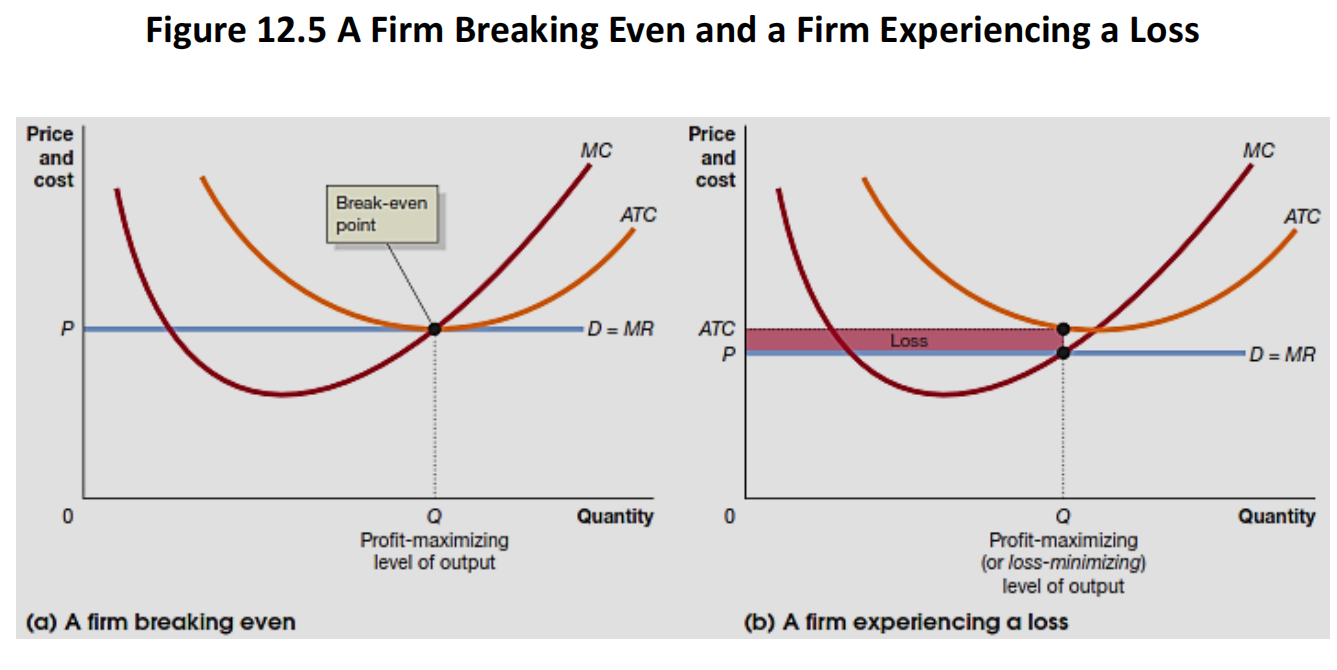
We have already seen that to maximize profit, a firm produces the level of output where marginal revenue equals marginal cost. But will the firm actually make a profit at that level of output? It depends on the relationship of price to average total cost.
📖 点击查看译文
我们已经知道,为了实现利润最大化,企业会选择使边际收益等于边际成本的产量。但企业在这个产量水平下是否真正盈利,取决于价格与平均总成本之间的关系。
**There are three possibilities:
-
P ˃ ATC, the firm will make a profit.
-
P = ATC, the firm will break even (its total cost equals its total revenue).
-
P ˂ ATC, the firm will experience a loss.**
📖 点击查看译文
存在三种可能情况:
-
P ˃ ATC,企业将获得利润;
-
P = ATC,企业将盈亏平衡(总成本等于总收入);
-
P ˂ ATC,企业将遭受亏损。
In panel (a) of Figure 12.5, at the level of output at which MR = MC, price is equal to average total cost. Therefore, total revenue is equal to total cost, and the firm will break even, making zero economic profit.
📖 点击查看译文
在图12.5的(a)图中,在 MR = MC 的产量水平下,价格等于平均总成本。因此,总收入等于总成本,企业实现盈亏平衡,经济利润为零。
In panel (b), at the level of output at which MR = MC, price is less than average total cost. Therefore, total revenue is less than total cost, and the firm suffers a loss. In this case, maximizing profit amounts to minimizing loss.
📖 点击查看译文
在图12.5的(b)图中,在 MR = MC 的产量水平下,价格低于平均总成本。因此,总收入小于总成本,企业发生亏损。在这种情况下,利润最大化实际上等同于最小化亏损。
知识点列表与拓展 (Knowledge Points and Extensions):
1. Break-Even Point(盈亏平衡点)
-
解释 (Explanation):
A firm breaks even when its total revenue equals its total cost, meaning it earns zero economic profit.
(当企业的总收入等于总成本时,就实现了盈亏平衡,即经济利润为零。)
-
例子 (Example):
If the price of a product equals the average total cost at the output where MR = MC, the firm breaks even.
(如果在边际收益等于边际成本的产量下,产品价格等于平均总成本,企业就实现盈亏平衡。)
-
拓展 (Extension):
The break-even point is a key indicator for assessing a firm’s financial viability, especially for startups and in budgeting analysis.
(盈亏平衡点是评估企业财务可行性的关键指标,特别适用于初创企业和预算分析。)
2. Economic Loss(经济亏损)
-
解释 (Explanation):
A firm experiences an economic loss when total cost exceeds total revenue at the profit-maximizing output.
(当企业在利润最大化的产量下,总成本超过总收入时,就发生了经济亏损。)
-
例子 (Example):
If the price is lower than the average total cost at the MR = MC output level, the firm suffers a loss.
(如果在边际收益等于边际成本的产量水平下,价格低于平均总成本,企业就会遭受亏损。)
-
拓展 (Extension):
In the short run, firms may continue operating under a loss if they can cover their variable costs, minimizing losses instead of shutting down.
(在短期内,如果企业能够覆盖其变动成本,即使亏损也可能继续经营,以实现最小亏损而不是停产。)
2
3
Deciding Whether to Produce or to Shut Down in the Short Run(短期内决定继续生产还是暂时停产)
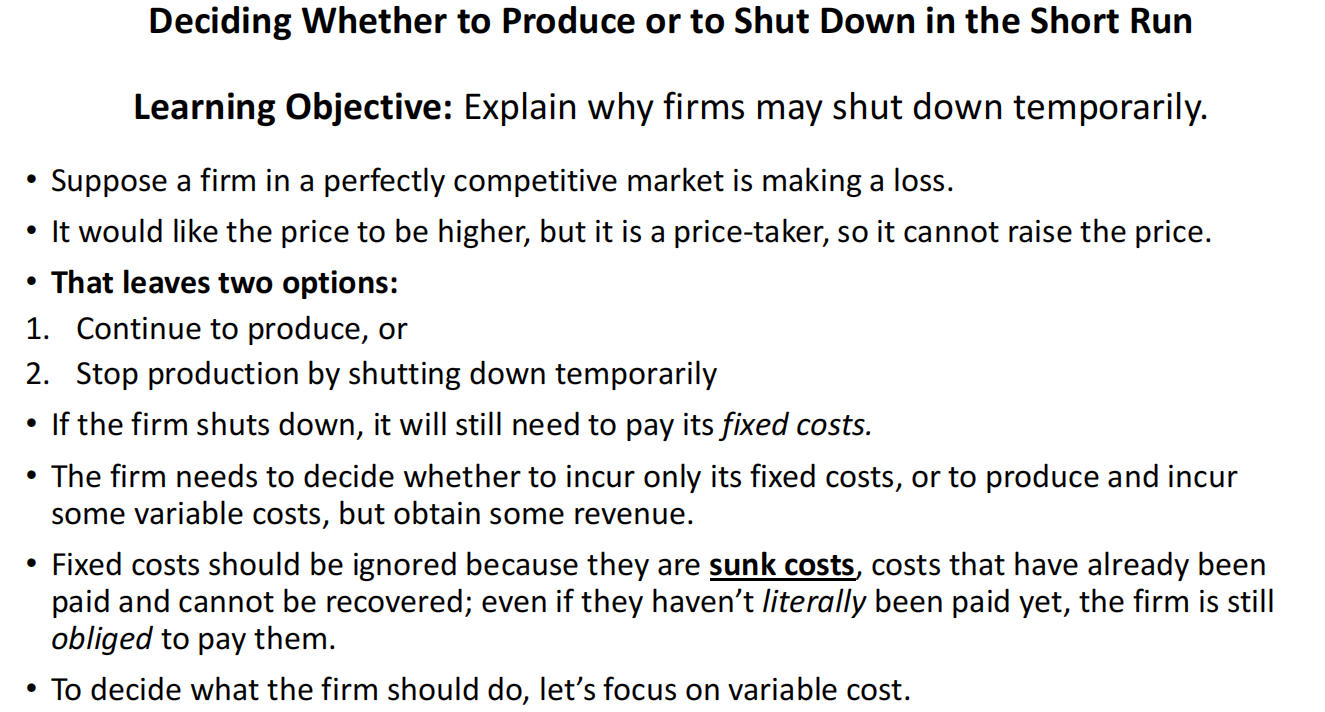
**Suppose a firm in a perfectly competitive market is making a loss. It would like the price to be higher, but it is a price-taker, so it cannot raise the price. That leaves two options:
-
Continue to produce, or
-
Stop production by shutting down temporarily**
📖 点击查看译文
假设一家处于完全竞争市场中的企业正在亏损。它希望价格更高,但由于是价格接受者,无法自行提高价格。此时企业有两个选择:
-
继续生产;
-
暂时停产。
If the firm shuts down, it will still need to pay its fixed costs. The firm needs to decide whether to incur only its fixed costs, or to produce and incur some variable costs, but obtain some revenue.
📖 点击查看译文
如果企业选择停产,它仍然需要支付固定成本。企业必须决定是仅承担固定成本,还是继续生产,承担一部分变动成本,同时获得一定的收入。
Fixed costs should be ignored because they are sunk costs, costs that have already been paid and cannot be recovered; even if they haven’t literally been paid yet, the firm is still obliged to pay them.
📖 点击查看译文
固定成本应被忽略,因为它们属于沉没成本,即已经支付且无法收回的成本;即使这些成本尚未实际支付,企业也必须承担。
To decide what the firm should do, let’s focus on variable cost.
📖 点击查看译文
为了判断企业应该怎么做,我们应当关注变动成本。
知识点列表与拓展 (Knowledge Points and Extensions):
1. Shut-Down Rule(停产规则)
-
解释 (Explanation):
A firm should continue producing in the short run if the price covers average variable cost (P ≥ AVC); otherwise, it should shut down.
(短期内,只要价格不低于平均变动成本(P ≥ AVC),企业就应继续生产;否则应选择停产。)
-
例子 (Example):
If the market price is $8, and the firm’s AVC is $7, it should keep producing because it can cover variable costs and reduce losses.
(如果市场价格为 $8,企业的平均变动成本为 $7,那么它应继续生产,因为可以覆盖变动成本并减少亏损。)
-
拓展 (Extension):
This rule reflects that fixed costs are sunk in the short run, and thus irrelevant to the shutdown decision.
(这一规则体现了固定成本在短期内已成沉没成本,因此在停产决策中不再具有参考意义。)
2. Sunk Cost(沉没成本)
-
解释 (Explanation):
A sunk cost is a cost that has already been incurred and cannot be recovered, regardless of future actions.
(沉没成本是指已经发生且无法收回的成本,无论未来采取何种行动,都无法改变。)
-
例子 (Example):
Rent on a factory building under a year-long lease is a sunk cost in the short run—even if unused, it must still be paid.
(在短期内,租用一年期工厂的租金即使工厂未被使用,也必须支付,因此属于沉没成本。)
-
拓展 (Extension):
Sunk cost fallacy occurs when decision-makers consider past, irrecoverable costs in future choices, leading to inefficient outcomes.
(“沉没成本谬误”是指在决策中错误地考虑了过去已无法收回的成本,往往会导致非理性或低效的选择。)
4
以下是你提供内容的整理输出版本,继续遵循你要求的格式,并确保知识点与拓展部分不重复之前内容:
Shut Down Condition and the Firm’s Supply Curve(停产条件与企业的供给曲线)
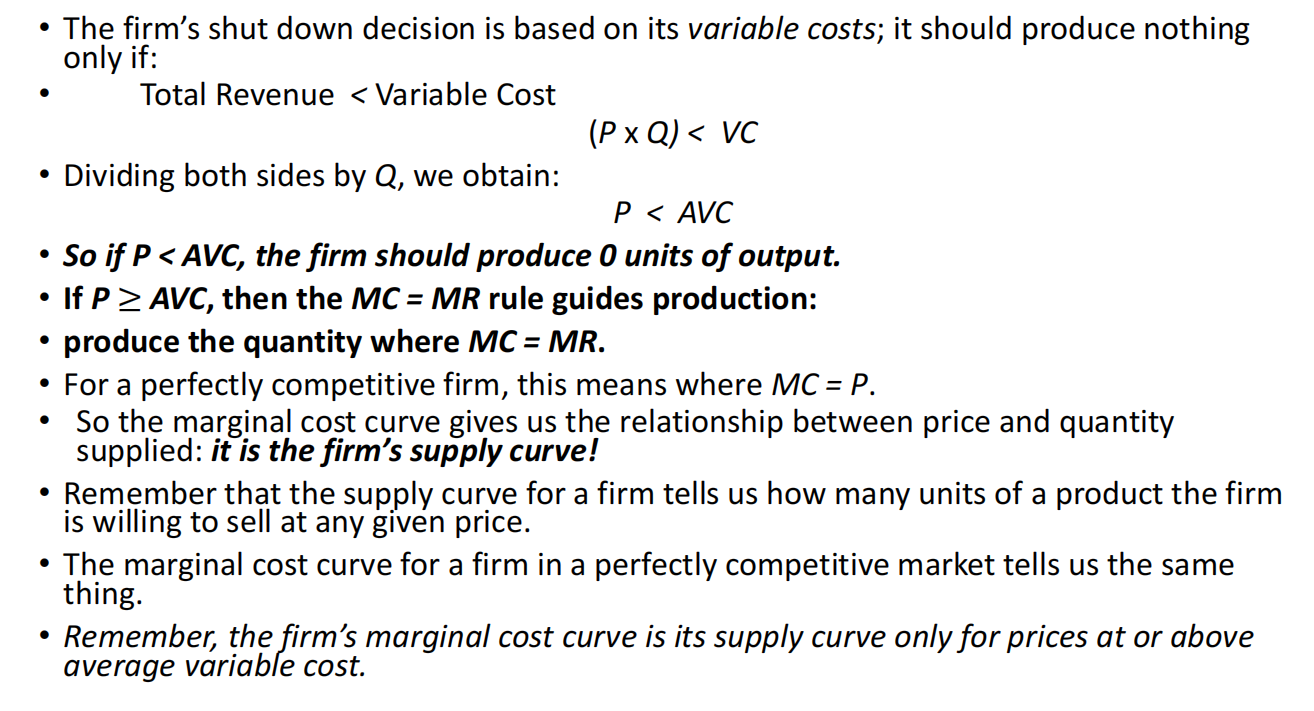
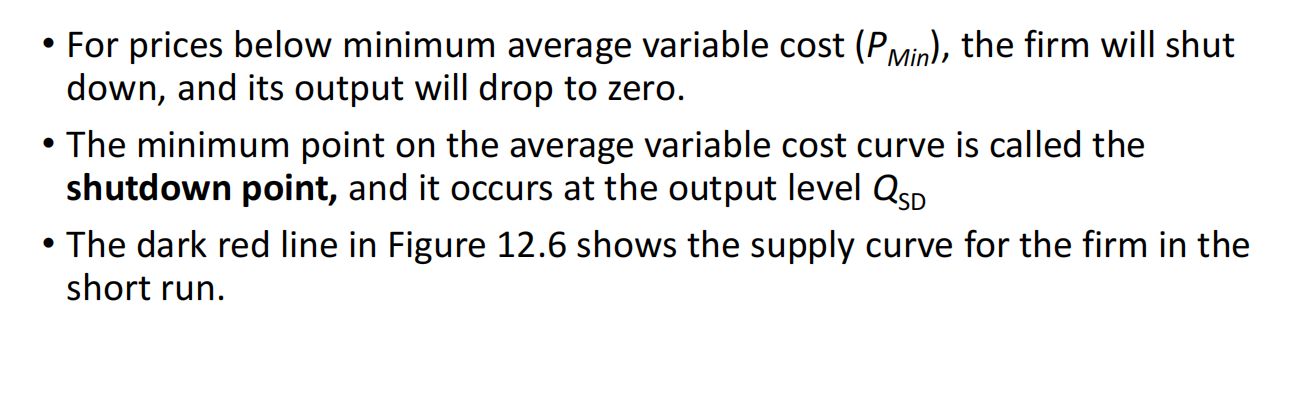
The firm’s shut down decision is based on its variable costs; it should produce nothing only if Total Revenue < Variable Cost (P × Q < VC).
📖 点击查看译文
企业是否停产的决策取决于其变动成本;仅当总收入小于变动成本(P × Q < VC)时,企业才应选择不生产。
Dividing both sides by Q, we obtain: P < AVC. So if P < AVC, the firm should produce 0 units of output.
📖 点击查看译文
两边同时除以产量 Q,可得:P < AVC。因此如果价格低于平均变动成本,企业应当选择不生产。
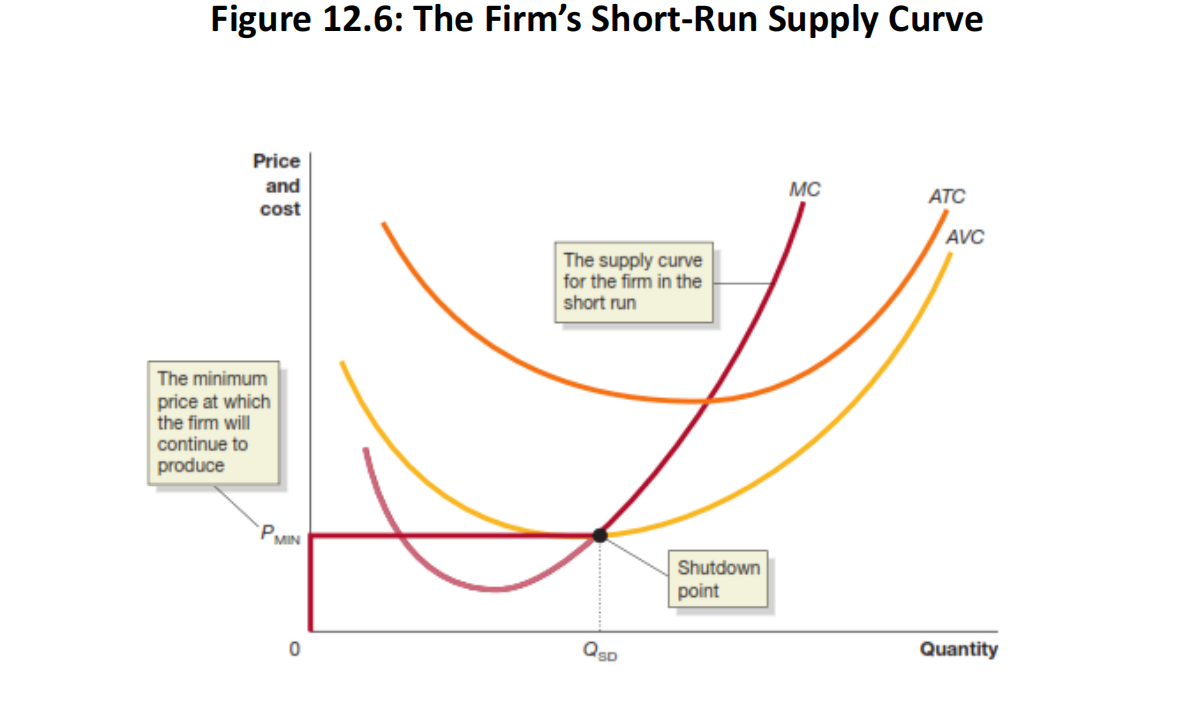
If P ≥ AVC, then the MC = MR rule guides production: produce the quantity where MC = MR. For a perfectly competitive firm, this means where MC = P.
📖 点击查看译文
如果 P ≥ AVC,则生产应遵循边际成本等于边际收益的原则:生产使得 MC = MR 的产量。对于完全竞争企业而言,这意味着 MC = P 的产量。
So the marginal cost curve gives us the relationship between price and quantity supplied: it is the firm’s supply curve!
📖 点击查看译文
因此,边际成本曲线揭示了价格与供给量之间的关系:它就是企业的供给曲线!
Remember that the firm’s marginal cost curve is its supply curve only for prices at or above average variable cost.
📖 点击查看译文
请记住,企业的边际成本曲线只有在价格不低于平均变动成本时才是其供给曲线。
知识点列表与拓展 (Knowledge Points and Extensions):
1. Shut Down Condition(停产条件)
-
解释 (Explanation):
A firm will shut down in the short run if the market price is lower than the average variable cost (P < AVC).
(如果市场价格低于平均变动成本(P < AVC),企业在短期内将选择停产。)
-
例子 (Example):
Suppose AVC is $10, and market price is $8. The firm should shut down, since each unit sold brings in less revenue than it costs to produce.
(假设平均变动成本为 $10,而市场价格为 $8,则每售出一单位产品的收益不足以覆盖生产成本,企业应停产。)
-
拓展 (Extension):
This condition helps firms avoid making decisions based on sunk costs and focuses only on avoidable losses.
(这一条件帮助企业避免因沉没成本做出错误决策,而是聚焦于可避免的损失。)
2. Supply Curve in Perfect Competition(完全竞争下的供给曲线)
-
解释 (Explanation):
In a perfectly competitive market, a firm’s marginal cost curve above AVC represents its short-run supply curve.
(在完全竞争市场中,企业在 AVC 以上的边际成本曲线即为其短期供给曲线。)
-
例子 (Example):
If marginal cost equals price at an output level of 100 units, and price is above AVC, the firm will supply 100 units.
(如果某产量下边际成本等于市场价格,且该价格高于平均变动成本,企业将供应该数量的产品。)
-
拓展 (Extension):
The aggregate of all firms’ marginal cost curves (above AVC) forms the market supply curve.
(所有企业在 AVC 以上的边际成本曲线的总和构成市场的供给曲线。)
5
6
7
The Market Supply Curve in a Perfectly Competitive Industry(完全竞争市场中的市场供给曲线)
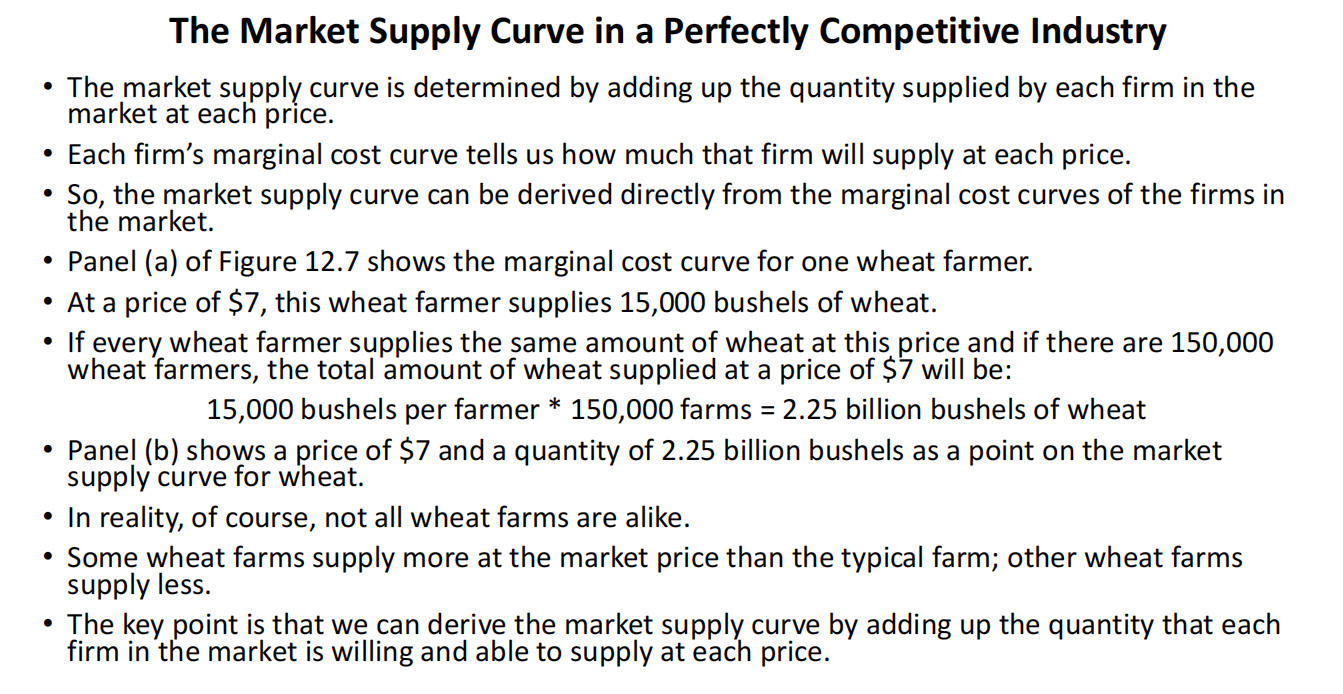
The market supply curve is determined by adding up the quantity supplied by each firm in the market at each price. Each firm’s marginal cost curve tells us how much that firm will supply at each price. So, the market supply curve can be derived directly from the marginal cost curves of the firms in the market.
📖 点击查看译文
市场供给曲线是通过将市场中每家企业在每个价格下的供给量相加得到的。每家企业的边际成本曲线告诉我们该企业在每个价格下的供给量。因此,市场供给曲线可以直接从市场中各企业的边际成本曲线得出。
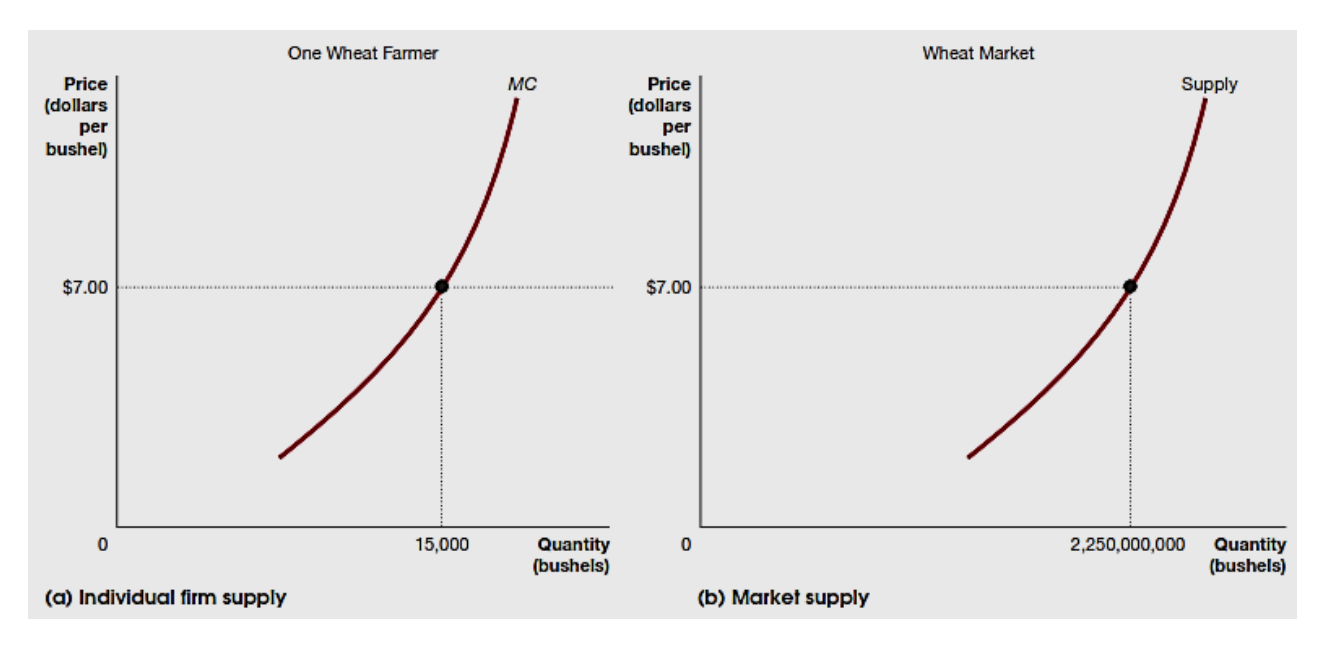
**Panel (a) of Figure 12.7 shows the marginal cost curve for one wheat farmer. At a price of $7, this wheat farmer supplies 15,000 bushels of wheat. If every wheat farmer supplies the same amount of wheat at this price and if there are 150,000 wheat farmers, the total amount of wheat supplied at a price of $7 will be:
15,000 bushels per farmer × 150,000 farms = 2.25 billion bushels of wheat.**
📖 点击查看译文
图 12.7 (a) 显示了一个小麦农场的边际成本曲线。在价格为 7 时,总供给的小麦数量为:
每个农场 15,000 蒲式耳 × 150,000 个农场 = 22.5 亿蒲式耳的小麦。
Panel (b) shows a price of $7 and a quantity of 2.25 billion bushels as a point on the market supply curve for wheat.
📖 点击查看译文
图 12.7 (b) 显示了 $7 的价格和 22.5 亿蒲式耳的小麦作为市场小麦供给曲线上的一个点。
In reality, of course, not all wheat farms are alike. Some wheat farms supply more at the market price than the typical farm; other wheat farms supply less.
📖 点击查看译文
实际上,当然并不是所有的小麦农场都相同。一些小麦农场在市场价格下提供的数量超过了典型农场,而其他小麦农场提供的数量较少。
The key point is that we can derive the market supply curve by adding up the quantity that each firm in the market is willing and able to supply at each price.
📖 点击查看译文
关键点是,我们可以通过将市场中每个企业在每个价格下愿意且能够提供的数量加总来推导出市场供给曲线。
知识点列表与拓展 (Knowledge Points and Extensions):
1. Market Supply Curve(市场供给曲线)
-
解释 (Explanation):
The market supply curve represents the total quantity of a good or service that all firms in the market are willing to supply at each price.
(市场供给曲线表示市场中所有企业在每个价格下愿意提供的商品或服务的总量。)
-
例子 (Example):
If each wheat farm in a region supplies 15,000 bushels at a price of $7, and there are 150,000 wheat farms, the market supply curve at that price is the sum of all the farms’ supply.
(如果一个地区的每个小麦农场在价格为 $7 时提供 15,000 蒲式耳小麦,并且总共有 150,000 个小麦农场,那么该价格下的市场供给曲线就是所有农场供给量的总和。)
-
拓展 (Extension):
The shape of the market supply curve is influenced by the number of firms in the market and the responsiveness of firms to price changes.
(市场供给曲线的形状受市场中企业数量和企业对价格变化反应程度的影响。)
2. Marginal Cost Curve as the Supply Curve(边际成本曲线作为供给曲线)
-
解释 (Explanation):
A firm’s marginal cost curve (above the average variable cost) is its supply curve in a perfectly competitive market.
(企业的边际成本曲线(在平均变动成本以上)在完全竞争市场中就是其供给曲线。)
-
例子 (Example):
If a firm’s marginal cost curve shows that it is willing to supply 100 units at a price of $10, this is part of the firm’s supply curve.
(如果企业的边际成本曲线显示它愿意以 $10 的价格供应 100 个单位的产品,这就构成了企业的供给曲线的一部分。)
-
拓展 (Extension):
The market supply curve can be derived by horizontally summing the individual firms’ supply curves at each price level.
(市场供给曲线可以通过在每个价格水平上将各个企业的供给曲线水平加总得到。)
7
8
**“If Everyone Can Do It, You Can’t Make Money at It”: the Entry and Exit of Firms in the Long Run
(“如果每个人都能做,那你就无法从中赚钱”:企业在长期中的进入与退出)**
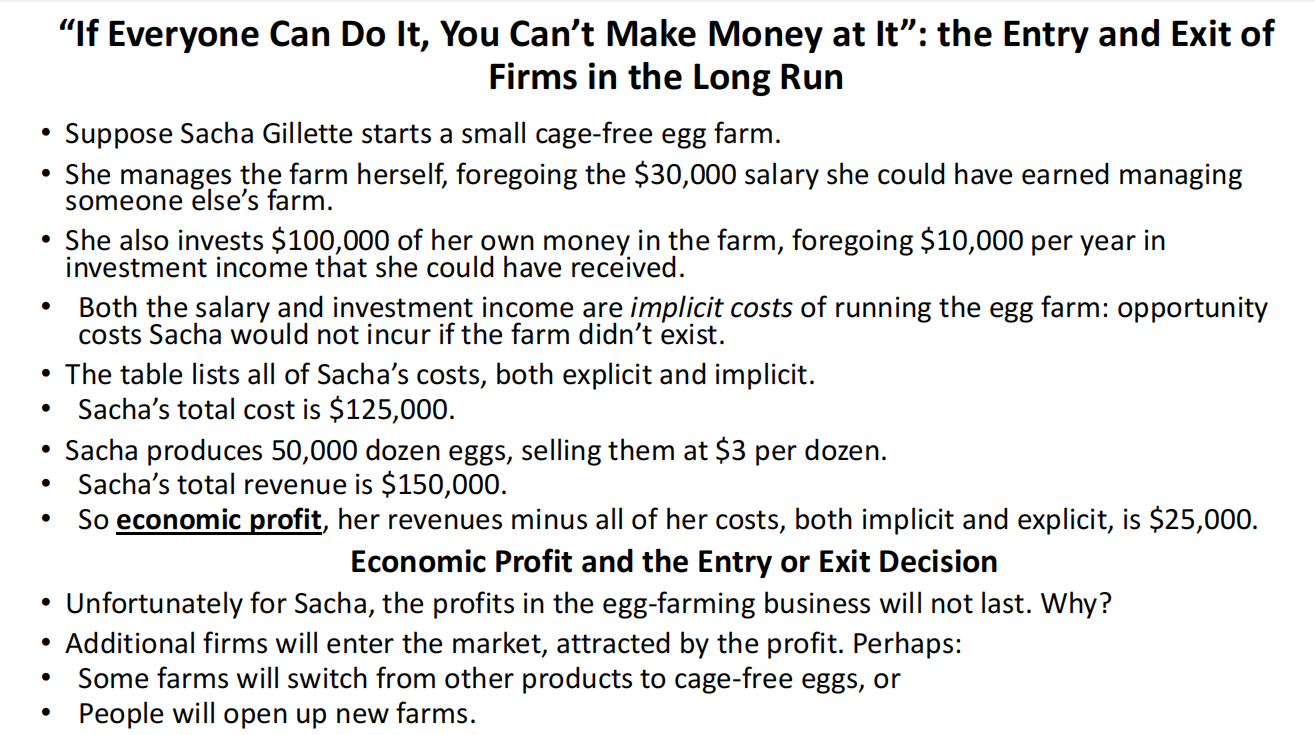
Suppose Sacha Gillette starts a small cage-free egg farm. She manages the farm herself, foregoing the $30,000 salary she could have earned managing someone else’s farm. She also invests $100,000 of her own money in the farm, foregoing $10,000 per year in investment income that she could have received.
📖 点击查看译文
假设 Sacha Gillette 开设了一家小型的无笼蛋农场。她自己经营这个农场,放弃了她本来可以通过管理别人农场获得的 100,000 自己的钱投资到农场,放弃了每年 $10,000 的投资收入,这些本来是她可以得到的。
Both the salary and investment income are costs Sacha would not incur if the farm didn’t exist: opportunity costs of running the egg farm.
📖 点击查看译文
工资和投资收入是 Sacha 在农场不存在时不会承担的成本:经营鸡蛋农场的机会成本。
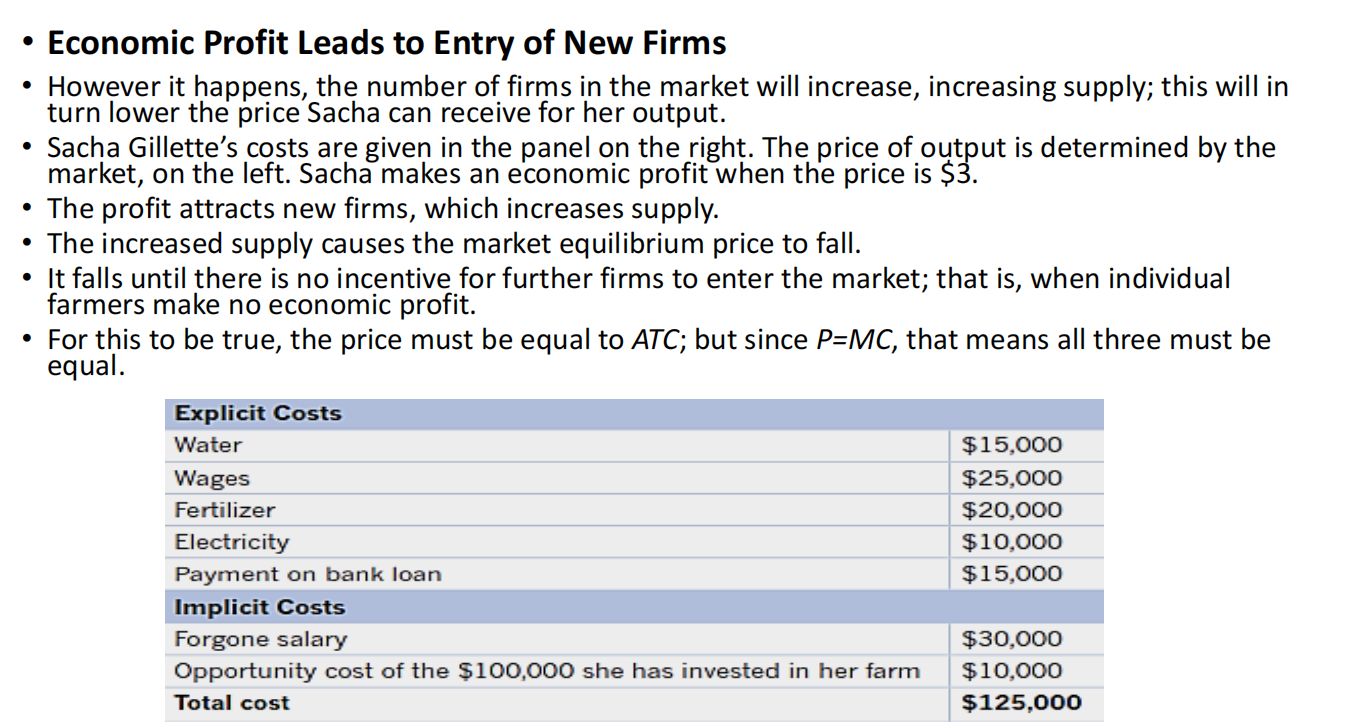
The table lists all of Sacha’s costs, both explicit and implicit. Sacha’s total cost is $125,000. Sacha produces 50,000 dozen eggs, selling them at $3 per dozen. Sacha’s total revenue is $150,000. So economic profit, her revenues minus all of her costs, both implicit and explicit, is $25,000.
📖 点击查看译文
表格列出了 Sacha 所有的成本,包括显性成本和隐性成本。Sacha 的总成本是 3 销售。Sacha 的总收入是 25,000。
Economic Profit and the Entry or Exit Decision(经济利润与企业的进入或退出决策)
Unfortunately for Sacha, the profits in the egg-farming business will not last. Why? Additional firms will enter the market, attracted by the profit. Perhaps: Some farms will switch from other products to cage-free eggs, or People will open up new farms.
📖 点击查看译文
不幸的是,Sacha 在鸡蛋养殖业中的利润不会持续。为什么?其他企业会进入市场,被利润吸引。可能是:一些农场会从其他产品转向无笼蛋,或者有人会开设新的农场。
知识点列表与拓展 (Knowledge Points and Extensions):
1. Implicit Costs (隐性成本)
-
解释 (Explanation):
Implicit costs are the opportunity costs of using resources that the firm already owns, such as foregone income from a job or interest from invested capital.
(隐性成本是使用企业已拥有的资源所产生的机会成本,比如放弃的工作收入或投资资本的利息。)
-
例子 (Example):
Sacha’s implicit costs include the salary she could have earned managing someone else’s farm and the investment income she could have received from her $100,000.
(Sacha 的隐性成本包括她本可以通过管理别人农场赚到的工资和她 100,000 美元投资本可以获得的投资收入。)
-
拓展 (Extension):
In economics, implicit costs are essential for calculating economic profit, which takes both explicit and implicit costs into account.
(在经济学中,隐性成本对于计算经济利润至关重要,经济利润考虑了显性成本和隐性成本。)
2. Economic Profit (经济利润)
-
解释 (Explanation):
Economic profit is the difference between total revenue and total costs, including both explicit and implicit costs. It reflects the true profitability of a business.
(经济利润是总收入与总成本(包括显性成本和隐性成本)之间的差额。它反映了一个企业的真实盈利能力。)
-
例子 (Example):
Sacha’s economic profit is $25,000, calculated as her total revenue ($150,000) minus her total costs ($125,000), which include both explicit and implicit costs.
(Sacha 的经济利润是 $25,000,计算方法是她的总收入($150,000)减去她的总成本($125,000),其中包括显性成本和隐性成本。)
-
拓展 (Extension):
Economic profit is a key indicator for firms in a competitive market. If firms earn positive economic profit, it attracts new firms to enter the market.
(经济利润是竞争市场中企业的关键指标。如果企业获得正的经济利润,会吸引新企业进入市场。)
3. Entry and Exit in the Long Run (长期中的进入与退出)
-
解释 (Explanation):
In the long run, firms can enter or exit a market based on the profitability of the industry. If firms are making a profit, new firms will enter; if they are making a loss, firms will exit.
(在长期中,企业可以根据行业的盈利能力进入或退出市场。如果企业赚取利润,新企业将进入;如果企业亏损,企业将退出。)
-
例子 (Example):
Sacha’s farm attracts new entrants due to its economic profit, but as more farms enter the market, the price of eggs might drop, leading to reduced profits.
(Sacha 的农场因其经济利润吸引了新的进入者,但随着更多农场进入市场,鸡蛋价格可能下降,导致利润减少。)
-
拓展 (Extension):
The process of entry and exit in the market leads to a long-run equilibrium where firms make zero economic profit, meaning they cover all their costs, including implicit ones.
(市场中的进入和退出过程会导致长期均衡,在这一均衡下,企业赚取零经济利润,即它们能覆盖所有成本,包括隐性成本。)
9
**Economic Profit Leads to Entry of New Firms
(经济利润导致新企业进入)**
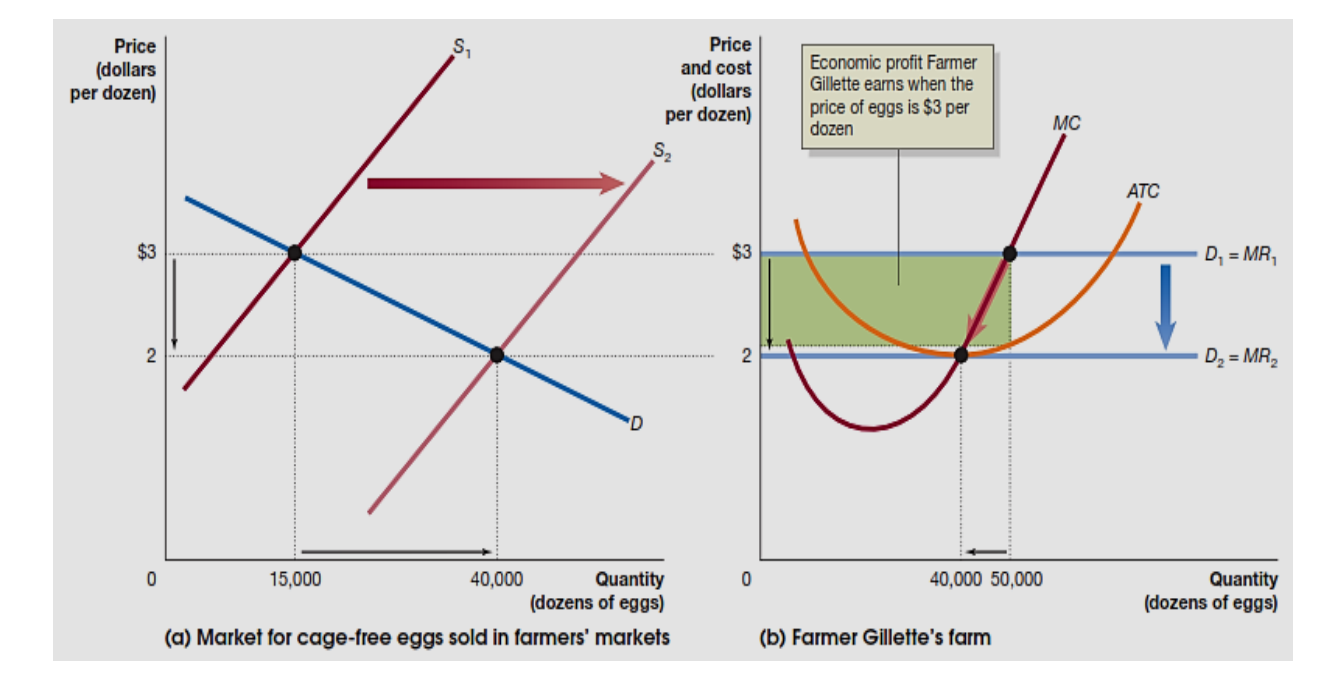
However it happens, the number of firms in the market will increase, increasing supply; this will in turn lower the price Sacha can receive for her output.
📖 点击查看译文
无论以何种方式发生,市场中的企业数量将增加,供应量也会增加;这将反过来降低 Sacha 能够为其产品获得的价格。
Sacha Gillette’s costs are given in the panel on the right. The price of output is determined by the market, on the left. Sacha makes an economic profit when the price is $3.
📖 点击查看译文
Sacha Gillette 的成本在右侧面板中列出。产品的价格由市场决定,在左侧。Sacha 在价格为 $3 时获得经济利润。
The profit attracts new firms, which increases supply.
📖 点击查看译文
利润吸引了新企业进入,从而增加了供应。
The increased supply causes the market equilibrium price to fall.
📖 点击查看译文
供应增加导致市场均衡价格下降。
It falls until there is no incentive for further firms to enter the market; that is, when individual farmers make no economic profit.
📖 点击查看译文
价格下降直到没有更多企业进入市场的动力;即,当个体农民没有经济利润时。
For this to be true, the price must be equal to ATC; but since P=MC, that means all three must be equal.
📖 点击查看译文
为了使这一点成立,价格必须等于平均总成本(ATC);但由于 P=MC,这意味着所有三个(价格、边际成本和平均总成本)必须相等。
知识点列表与拓展 (Knowledge Points and Extensions):
1. Market Entry and Exit (市场进入与退出)
-
解释 (Explanation):
In a competitive market, economic profits attract new firms, while losses cause firms to exit. This process affects the supply curve and ultimately the equilibrium price in the market.
(在竞争市场中,经济利润会吸引新企业进入,而亏损则导致企业退出。这个过程会影响供给曲线,并最终影响市场均衡价格。)
-
例子 (Example):
When Sacha makes a profit, other farmers are incentivized to start their own egg farms, increasing the overall supply of eggs and driving the price down.
(当 Sacha 获得利润时,其他农民受到激励开始自己的鸡蛋农场,增加鸡蛋的总体供应,从而压低价格。)
-
拓展 (Extension):
This dynamic of entry and exit leads to a long-run equilibrium where firms earn zero economic profit, as the price adjusts to the average total cost.
(进入和退出的动态过程导致长期均衡,在该均衡下,企业赚取零经济利润,因为价格会调整到平均总成本。)
2. Long-Run Equilibrium (长期均衡)
-
解释 (Explanation):
Long-run equilibrium occurs when the price equals the average total cost (ATC), and firms earn zero economic profit. This is the point at which no firm has an incentive to either enter or exit the market.
(长期均衡是指价格等于平均总成本(ATC),并且企业赚取零经济利润。此时,没有企业有动力进入或退出市场。)
-
例子 (Example):
As more farms enter the egg market, the price falls until it equals the average total cost, at which point Sacha and other farmers make no economic profit.
(随着更多农场进入鸡蛋市场,价格下降直到等于平均总成本,此时 Sacha 和其他农民没有经济利润。)
-
拓展 (Extension):
In a perfectly competitive market, long-run equilibrium ensures that firms operate at an efficient scale, where resources are allocated optimally and there are no incentives for market entry or exit.
(在完全竞争市场中,长期均衡确保企业在有效规模上运营,在这一规模下资源得到最优分配,并且没有企业进入或退出市场的动力。)
10
11
**Farmers Will Continue Entering the Market Until the Market Supply Curve Shifts
(农民会继续进入市场,直到市场供给曲线发生变化)**
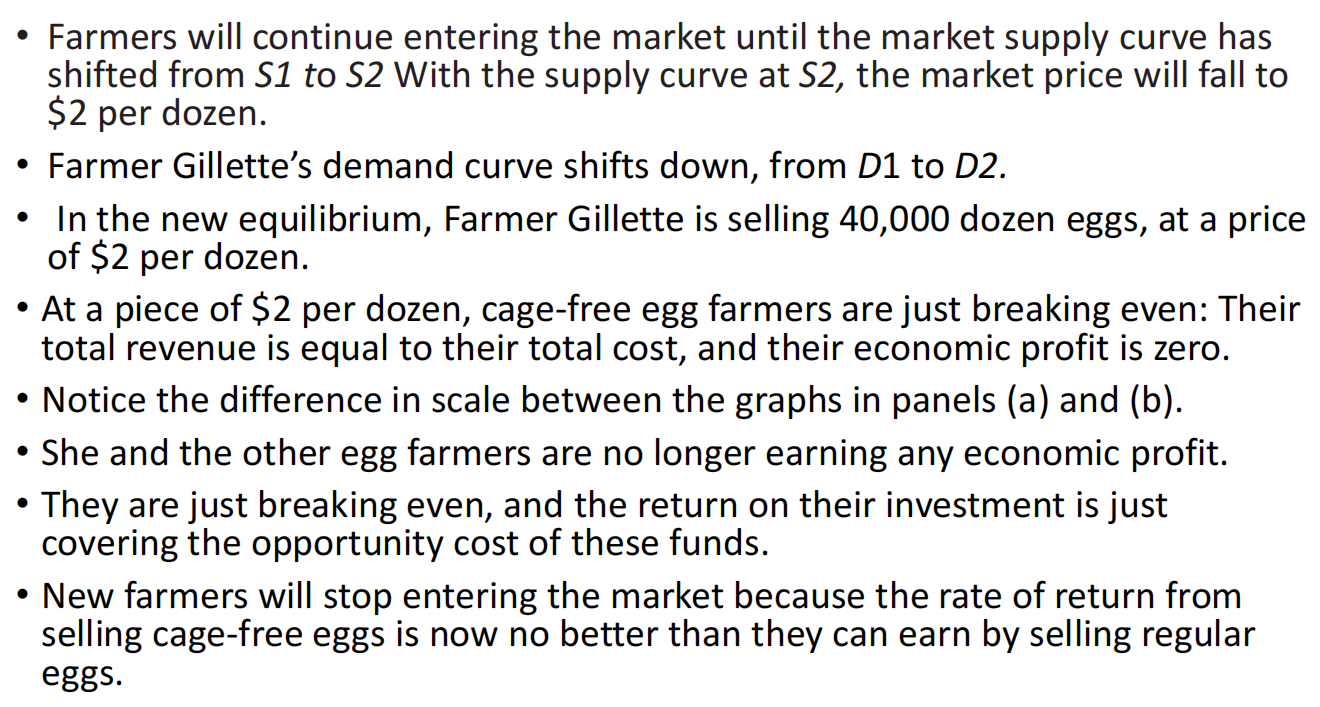
Farmers will continue entering the market until the market supply curve has shifted from S1 to S2. With the supply curve at S2, the market price will fall to $2 per dozen.
📖 点击查看译文
农民会继续进入市场,直到市场供给曲线从 S1 移动到 S2。供给曲线在 S2 时,市场价格将降至每打 2 美元。
Farmer Gillette’s demand curve shifts down, from D1 to D2.
📖 点击查看译文
Gillette 农场的需求曲线向下移动,从 D1 移动到 D2。
In the new equilibrium, Farmer Gillette is selling 40,000 dozen eggs, at a price of $2 per dozen.
📖 点击查看译文
在新的均衡下,Gillette 农场以每打 2 美元的价格出售 40,000 打鸡蛋。
At a price of $2 per dozen, cage-free egg farmers are just breaking even: Their total revenue is equal to their total cost, and their economic profit is zero.
📖 点击查看译文
在每打 2 美元的价格下,无笼鸡蛋农民刚好实现盈亏平衡:他们的总收入等于总成本,经济利润为零。
Notice the difference in scale between the graphs in panels (a) and (b).
📖 点击查看译文
注意面板(a)和(b)中的图表比例差异。
She and the other egg farmers are no longer earning any economic profit. They are just breaking even, and the return on their investment is just covering the opportunity cost of these funds.
📖 点击查看译文
她和其他鸡蛋农民不再赚取任何经济利润。他们只是盈亏平衡,投资的回报仅仅覆盖了这些资金的机会成本。
New farmers will stop entering the market because the rate of return from selling cage-free eggs is now no better than they can earn by selling regular eggs.
📖 点击查看译文
新的农民将停止进入市场,因为出售无笼鸡蛋的回报率现在与出售常规鸡蛋的回报率没有区别。
知识点列表与拓展 (Knowledge Points and Extensions):
1. Market Entry and Long-Run Equilibrium (市场进入与长期均衡)
-
解释 (Explanation):
The process of market entry continues until firms earn zero economic profit, leading to a long-run equilibrium where the market price reflects average total cost (ATC).
(市场进入的过程会持续,直到企业赚取零经济利润,从而导致长期均衡,在这个均衡下,市场价格反映了平均总成本(ATC)。)
-
例子 (Example):
As new farmers enter the egg market, the increased supply drives the price down, and ultimately all firms in the market make zero economic profit, breaking even.
(随着新农民进入鸡蛋市场,供应增加导致价格下降,最终市场上的所有企业赚取零经济利润,实现盈亏平衡。)
-
拓展 (Extension):
In the long run, competitive markets reach an equilibrium where firms earn zero economic profit, meaning they cover all costs, including opportunity costs.
(在长期内,竞争市场达到一种均衡状态,在这种状态下,企业赚取零经济利润,即他们覆盖了所有成本,包括机会成本。)
2. The Role of Price in Market Equilibrium (价格在市场均衡中的作用)
-
解释 (Explanation):
Price adjusts in response to supply and demand changes, and in the long run, it aligns with the average total cost (ATC), ensuring that firms earn no economic profit.
(价格会随着供需变化进行调整,长期来看,价格与平均总成本(ATC)一致,确保企业赚取零经济利润。)
-
例子 (Example):
When the market price of eggs falls to $2 per dozen, farmers are no longer earning an economic profit, just covering their costs.
(当鸡蛋的市场价格降到每打 2 美元时,农民不再赚取经济利润,只是覆盖了他们的成本。)
-
拓展 (Extension):
The adjustment of price in a competitive market helps achieve long-run equilibrium, where firms operate efficiently and no one has an incentive to enter or exit the market.
(竞争市场中价格的调整有助于实现长期均衡,在这种均衡下,企业高效运营,没有人有动力进入或退出市场。)
11
**Economic Losses Lead to Exit of Firms
(经济亏损导致企业退出市场)**
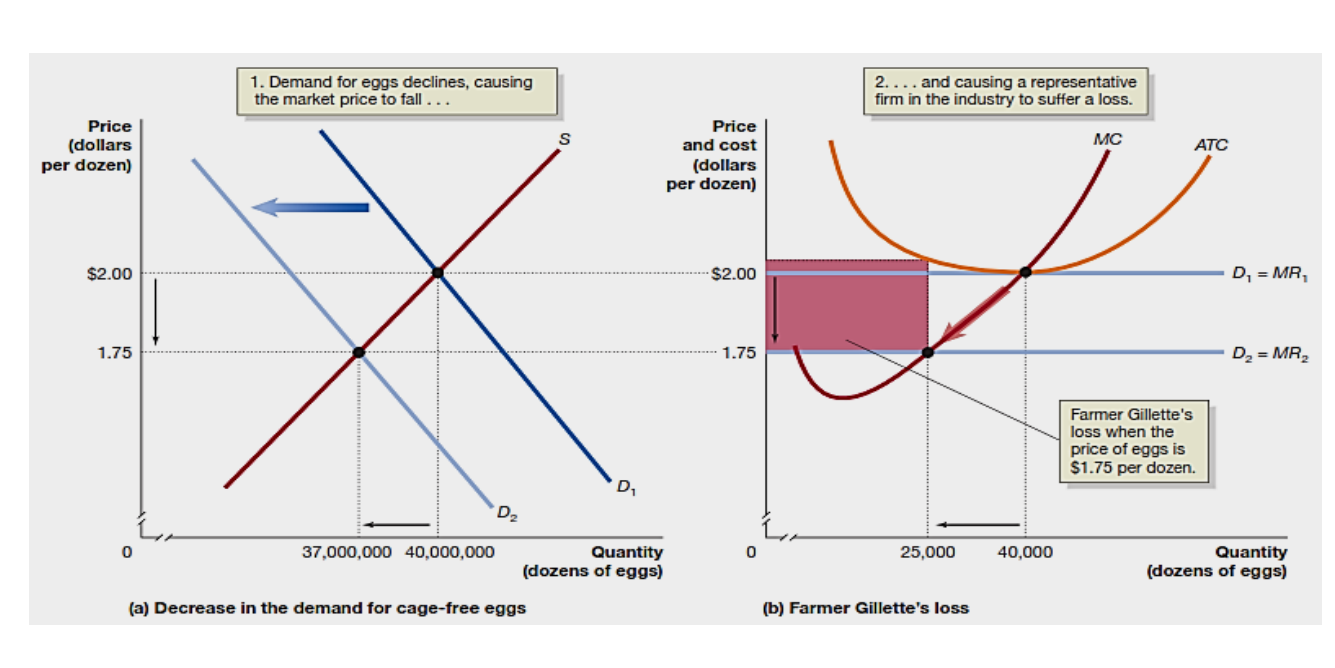
Suppose some consumers decide that they no longer want to eat eggs whether cage-free or not.
📖 点击查看译文
假设一些消费者决定不再食用鸡蛋,无论是否为无笼鸡蛋。
Panel (a) of Figure 12.9 shows that the demand curve for cage-free eggs will shift to the left, from D1 to D2, and the market price will fall from $2 per dozen to $1.75.
📖 点击查看译文
图12.9面板(a)显示,无笼鸡蛋的需求曲线将从 D1 向左移动到 D2,市场价格将从每打 2 美元下降到 1.75 美元。
Panel (b) shows that as the price falls, a farmer like Sacha Gillette will move down her marginal cost curve to a lower level of output.
📖 点击查看译文
面板(b)显示,随着价格的下降,像 Sacha Gillette 这样的农民将沿着其边际成本曲线下移,减少产量。
At the lower level of output and lower price, she will be suffering an economic loss because she will not cover all her costs.
📖 点击查看译文
在较低的产量和较低的价格下,她将遭受经济损失,因为她无法覆盖所有成本。
As long as price is above average variable cost, she will continue to produce in the short run, even when suffering losses.
📖 点击查看译文
只要价格高于平均变动成本,她将在短期内继续生产,即使遭受损失。
But in the long run, firms will exit an industry if they are unable to cover all their costs.
📖 点击查看译文
但在长期内,如果企业无法覆盖所有成本,它们将退出行业。
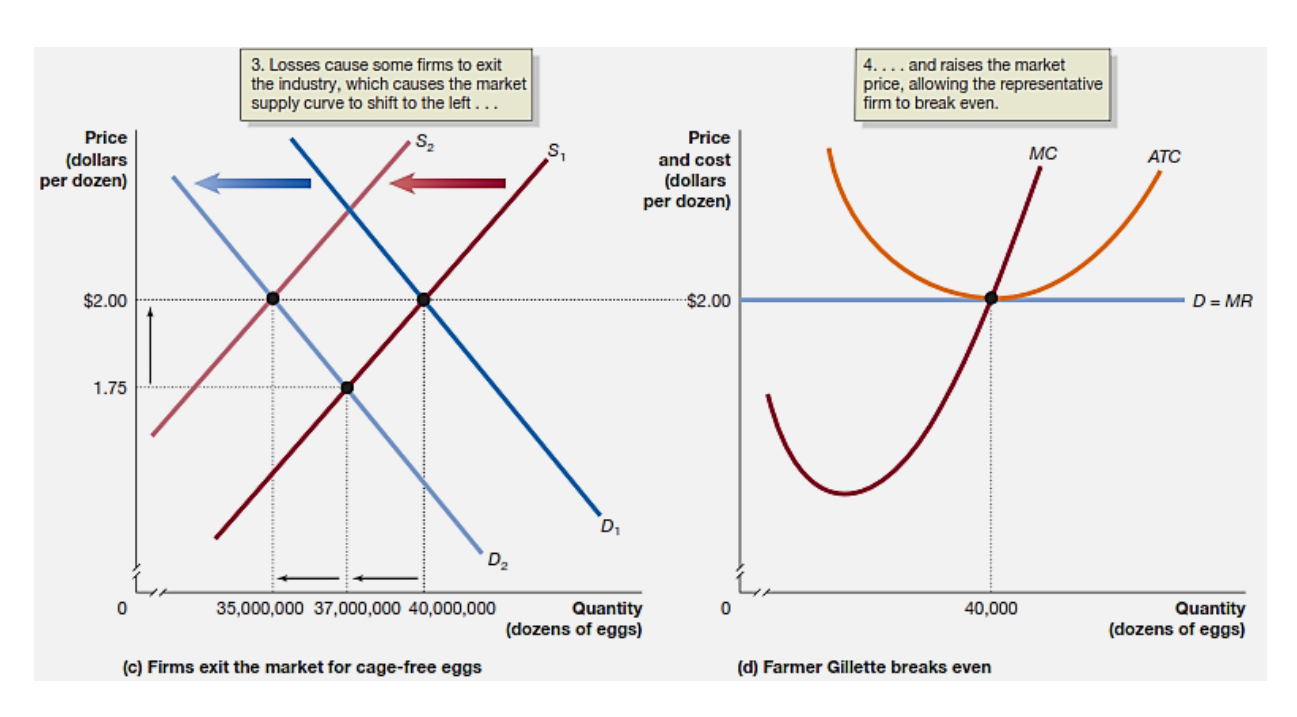
In this case, some farmers will switch from producing eggs to producing other agricultural products or will leave farming.
📖 点击查看译文
在这种情况下,一些农民将从生产鸡蛋转向生产其他农产品,或者退出农业生产。
Panel (c) of Figure 12.9 shows that as firms exit from selling cage-free eggs, the market supply curve shifts to the left.
📖 点击查看译文
图12.9面板(c)显示,随着企业退出无笼鸡蛋的销售,市场供给曲线向左移动。
Firms will continue to exit, and the supply curve will continue to shift to the left until the price has risen back to $2 and the market supply curve is at S2.
📖 点击查看译文
企业将继续退出,供给曲线将继续向左移动,直到价格回升至每打 2 美元,市场供给曲线达到 S2。
Panel (d) shows that when the price is back to $2, the remaining firms in the industry will be breaking even.
📖 点击查看译文
面板(d)显示,当价格回升至每打 2 美元时,行业中剩余的企业将实现盈亏平衡。
知识点列表与拓展 (Knowledge Points and Extensions):
1. Exit of Firms in the Long Run (长期内企业的退出)
-
解释 (Explanation):
In the long run, firms that cannot cover all their costs will exit the market. This reduces supply and raises prices until the remaining firms break even.
(在长期内,无法覆盖所有成本的企业将退出市场。这减少了供给并提高了价格,直到剩余的企业实现盈亏平衡。)
-
例子 (Example):
As the price of eggs falls to $1.75, farmers like Sacha Gillette start suffering economic losses. Over time, some will exit the market, reducing supply and bringing the price back up to $2.
(随着鸡蛋价格降至每打 1.75 美元,像 Sacha Gillette 这样的农民开始遭受经济损失。随着时间推移,一些农民将退出市场,减少供给,并将价格带回到每打 2 美元。)
-
拓展 (Extension):
The exit of firms from a competitive industry restores market equilibrium, where firms earn zero economic profit.
(企业从竞争性行业退出恢复了市场均衡,在这一均衡下,企业赚取零经济利润。)
2. The Role of Price in Firm Exit (价格在企业退出中的作用)
-
解释 (Explanation):
Price changes are key to determining whether firms stay in or exit the market. If the price falls below average total cost (ATC), firms will eventually exit.
(价格变化是决定企业是否留在市场或退出市场的关键。如果价格低于平均总成本(ATC),企业最终将退出。)
-
例子 (Example):
When the price of cage-free eggs falls to $1.75, farmers like Gillette cannot cover their costs, leading to their exit from the market.
(当无笼鸡蛋的价格降到每打 1.75 美元时,像 Gillette 这样的农民无法覆盖其成本,导致他们退出市场。)
-
拓展 (Extension):
Market entry and exit processes drive the long-run supply curve, ensuring that firms in a perfectly competitive market make zero economic profit in the long run.
(市场的进入和退出过程推动了长期供给曲线的变化,确保完全竞争市场中的企业在长期内实现零经济利润。)
12
13
14
**Long-run Equilibrium in a Perfectly Competitive Market
(完全竞争市场中的长期均衡)**
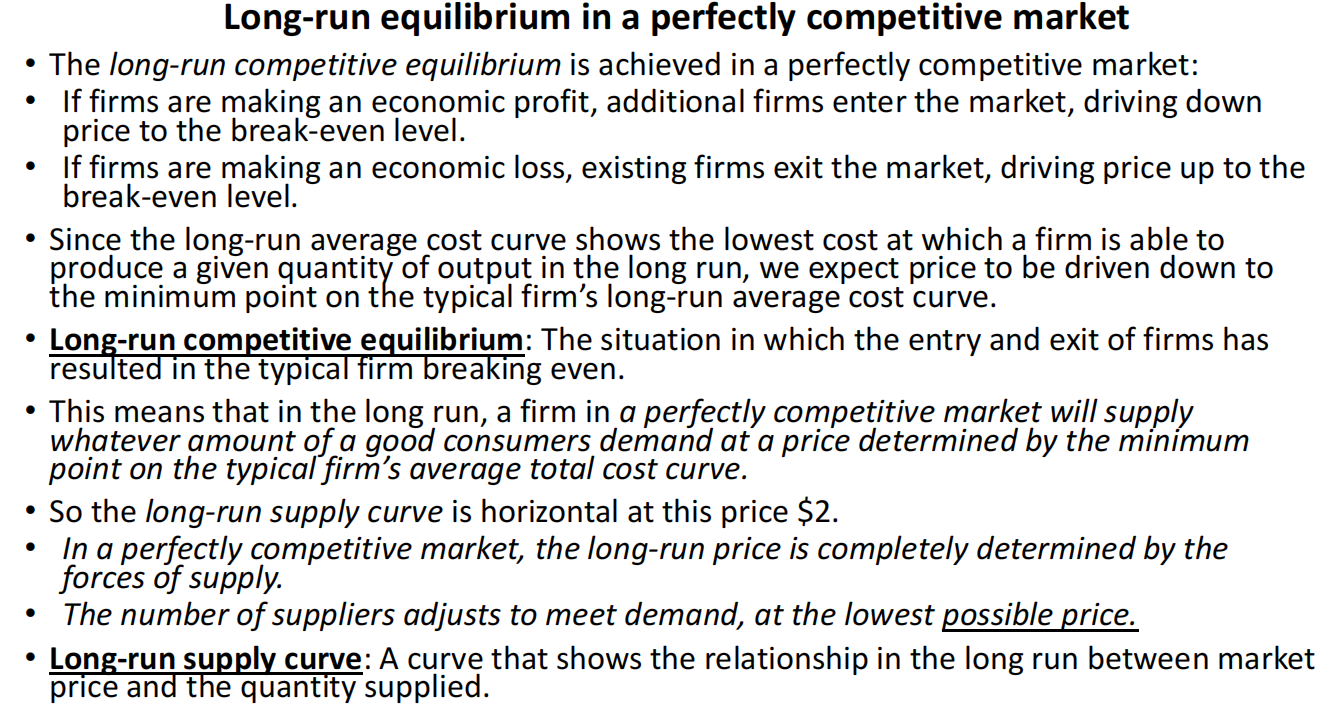
The long-run competitive equilibrium is achieved in a perfectly competitive market:
📖 点击查看译文
完全竞争市场中的长期竞争均衡是通过以下方式实现的:
If firms are making an economic profit, additional firms enter the market, driving down price to the break-even level.
📖 点击查看译文
如果企业获得经济利润,新的企业将进入市场,从而将价格压低至盈亏平衡水平。
If firms are making an economic loss, existing firms exit the market, driving price up to the break-even level.
📖 点击查看译文
如果企业遭受经济亏损,现有企业将退出市场,从而将价格提高至盈亏平衡水平。
Since the long-run average cost curve shows the lowest cost at which a firm is able to produce a given quantity of output in the long run, we expect price to be driven down to the minimum point on the typical firm’s long-run average cost curve.
📖 点击查看译文
由于长期平均成本曲线表示企业在长期内能够以最低成本生产一定数量产出的水平,我们预计价格将被压低至典型企业长期平均成本曲线的最低点。
Long-run competitive equilibrium: The situation in which the entry and exit of firms has resulted in the typical firm breaking even.
📖 点击查看译文
长期竞争均衡:企业的进入与退出导致典型企业实现盈亏平衡的情形。
This means that in the long run, a firm in a perfectly competitive market will supply whatever amount of a good consumers demand at a price determined by the minimum point on the typical firm’s average total cost curve.
📖 点击查看译文
这意味着在长期内,完全竞争市场中的企业将以典型企业平均总成本曲线的最低点所决定的价格,提供消费者所需的任意数量的商品。
So the long-run supply curve is horizontal at this price $2.
📖 点击查看译文
因此,长期供给曲线在这个价格(2美元)处是水平的。
In a perfectly competitive market, the long-run price is completely determined by the forces of supply.
📖 点击查看译文
在完全竞争市场中,长期价格完全由供给力量决定。
The number of suppliers adjusts to meet demand, at the lowest possible price.
📖 点击查看译文
供给者的数量会调整以满足需求,且价格是尽可能低的。
Long-run supply curve: A curve that shows the relationship in the long run between market price and the quantity supplied.
📖 点击查看译文
长期供给曲线:显示市场价格与长期内供给量之间关系的曲线。
知识点列表与拓展 (Knowledge Points and Extensions):
1. Long-Run Competitive Equilibrium (长期竞争均衡)
-
解释 (Explanation):
Occurs when all firms in a perfectly competitive market are earning zero economic profit due to free entry and exit.
(当完全竞争市场中的所有企业因自由进入与退出而获得零经济利润时,就达到了长期均衡。)
-
例子 (Example):
If firms are making profits, new firms enter → supply increases → price falls → zero profit.
(若企业获利,新企业进入 → 供给增加 → 价格下降 → 无经济利润。)
-
拓展 (Extension):
Long-run equilibrium ensures allocative and productive efficiency.
(长期均衡确保了资源配置效率和生产效率。)
2. Long-Run Supply Curve (长期供给曲线)
-
解释 (Explanation):
A horizontal line at the minimum average total cost in a constant-cost industry.
(在成本不变行业中,是一条位于最小平均总成本的水平线。)
-
例子 (Example):
If the minimum ATC is $2, the long-run supply curve will be horizontal at $2.
(若最小ATC为2美元,长期供给曲线就在2美元处水平。)
-
拓展 (Extension):
In increasing-cost industries, the long-run supply curve is upward sloping.
(在成本递增行业中,长期供给曲线向上倾斜。)
15
以下是你提供的段落《The Long-Run Effect of a Change in Demand》的中英文整理输出:
**The Long-Run Effect of a Change in Demand
(需求变动的长期效应)**
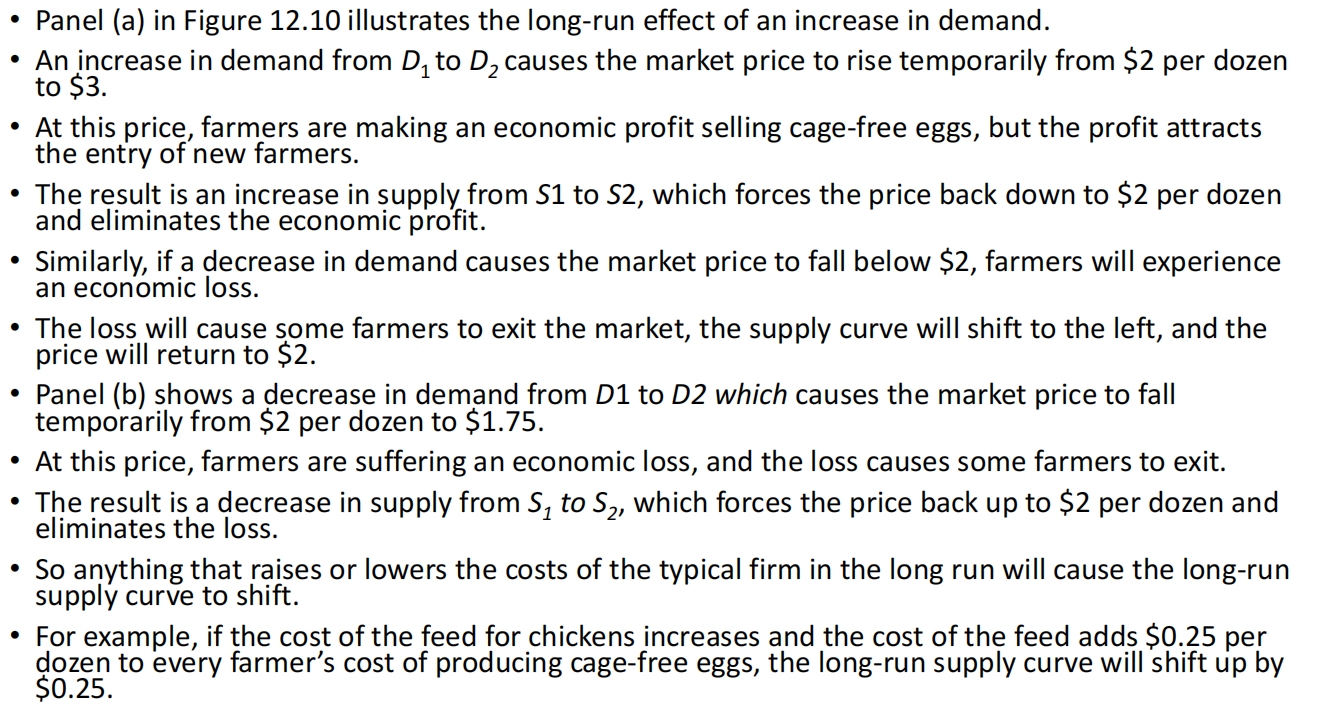
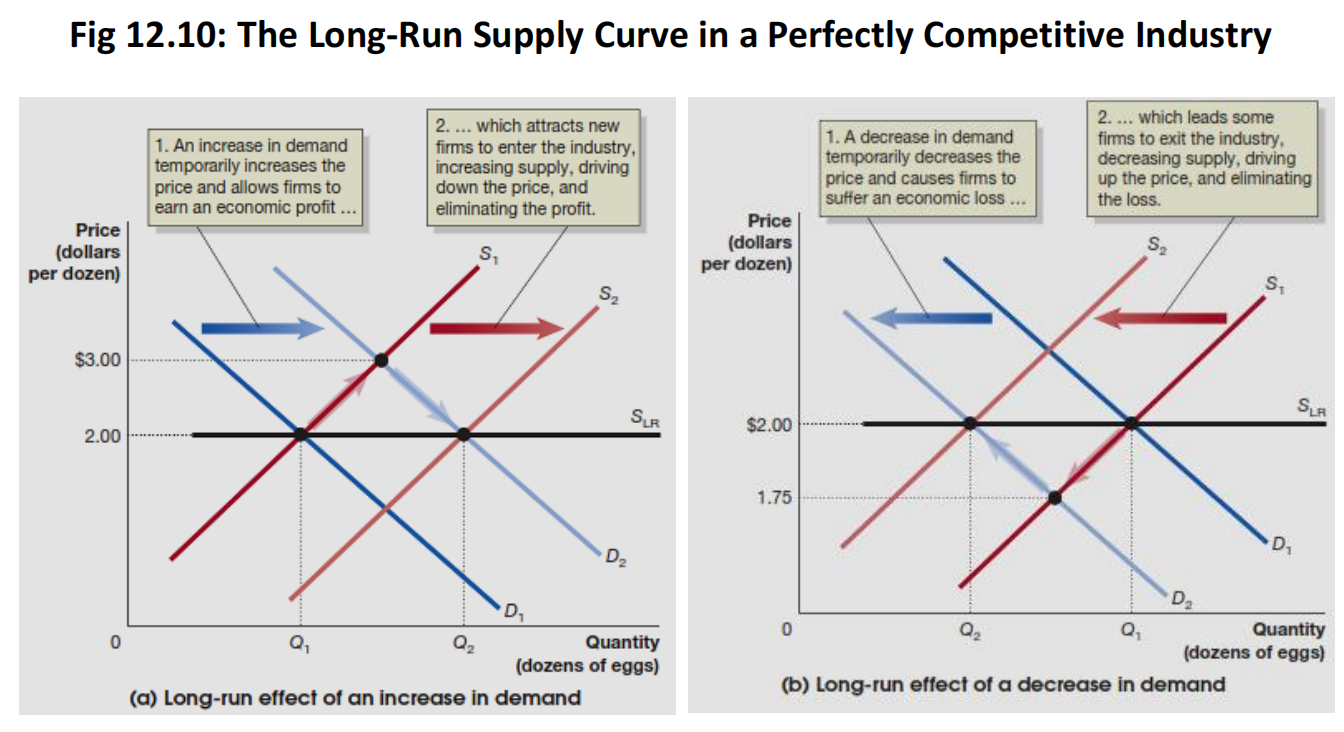
Panel (a) in Figure 12.10 illustrates the long-run effect of an increase in demand.
📖 点击查看译文
图12.10中的图(a)展示了需求增加在长期中的影响。
An increase in demand from D1 to D2 causes the market price to rise temporarily from $2 per dozen to $3.
📖 点击查看译文
当需求从D1增加到D2时,市场价格会从每打2美元暂时上升到3美元。
At this price, farmers are making an economic profit selling cage-free eggs, but the profit attracts the entry of new farmers.
📖 点击查看译文
在这个价格下,农民销售散养鸡蛋可以获得经济利润,但利润会吸引新农民进入市场。
The result is an increase in supply from S1 to S2, which forces the price back down to $2 per dozen and eliminates the economic profit.
📖 点击查看译文
结果是供给从S1增加到S2,使价格被压回每打2美元,并消除了经济利润。
Similarly, if a decrease in demand causes the market price to fall below $2, farmers will experience an economic loss.
📖 点击查看译文
同样地,如果需求减少使市场价格降至2美元以下,农民就会面临经济亏损。
The loss will cause some farmers to exit the market, the supply curve will shift to the left, and the price will return to $2.
📖 点击查看译文
亏损将导致一些农民退出市场,供给曲线向左移动,价格将回升至2美元。
Panel (b) shows a decrease in demand from D1 to D2 which causes the market price to fall temporarily from $2 per dozen to $1.75.
📖 点击查看译文
图(b)显示需求从D1下降到D2,使市场价格从每打2美元暂时下降到1.75美元。
At this price, farmers are suffering an economic loss, and the loss causes some farmers to exit.
📖 点击查看译文
在这个价格下,农民遭受经济亏损,这种亏损促使部分农民退出市场。
The result is a decrease in supply from S1 to S2, which forces the price back up to $2 per dozen and eliminates the loss.
📖 点击查看译文
结果是供给从S1减少到S2,使价格回升至每打2美元,从而消除了亏损。
So anything that raises or lowers the costs of the typical firm in the long run will cause the long-run supply curve to shift.
📖 点击查看译文
因此,任何长期内提高或降低典型企业成本的因素都会导致长期供给曲线的移动。
For example, if the cost of the feed for chickens increases and the cost of the feed adds $0.25 per dozen to every farmer’s cost of producing cage-free eggs, the long-run supply curve will shift up by $0.25.
📖 点击查看译文
例如,如果鸡饲料的成本上升,并使每位农民每打鸡蛋的成本增加0.25美元,长期供给曲线将整体上移0.25美元。
知识点列表与拓展 (Knowledge Points and Extensions):
1. Demand Shocks and Market Adjustment(需求冲击与市场调整)
-
解释 (Explanation):
A positive or negative demand shock shifts the price temporarily, but market entry or exit brings it back to equilibrium.
(正向或负向的需求冲击会暂时改变价格,但企业的进入或退出会使市场重新回到均衡。)
-
拓展 (Extension):
This reflects the self-correcting nature of perfectly competitive markets.
(体现了完全竞争市场的“自我调节”特征。)
2. Long-Run Supply Curve Shifts(长期供给曲线的移动)
-
解释 (Explanation):
Cost changes (e.g. inputs like feed) affect the cost structure and thus shift the long-run supply curve.
(成本变动如饲料价格的变化,会影响成本结构,导致长期供给曲线移动。)
-
例子 (Example):
Feed costs rise → costs increase by $0.25/dozen → supply curve shifts up.
(饲料成本上升 → 每打鸡蛋成本增加0.25美元 → 供给曲线上移。)
16
17
**Perfect Competition and Efficiency
(完全竞争与效率)**
Efficiency in economics refers to two separate but related concepts:
📖 点击查看译文
经济学中的效率指的是两个密切相关但又不同的概念:
Productive efficiency is a situation in which a good or service is produced at the lowest possible cost.
📖 点击查看译文
生产效率是指以最低可能成本生产商品或服务的情形。
Allocative efficiency is a state of the economy in which production represents consumer preferences; in particular, every good or service is produced up to the point where the last unit provides a marginal benefit to consumers equal to the marginal cost of producing it.
📖 点击查看译文
配置效率是指经济的生产活动体现了消费者的偏好,尤其是每种商品或服务都生产到其最后一单位带来的边际效用正好等于其边际成本为止。
We have shown that in the long run, perfectly competitive markets are productively efficient.
📖 点击查看译文
我们已经说明,长期来看,完全竞争市场具有生产效率。
But they are allocatively efficient also:
📖 点击查看译文
但它们也具有配置效率:
1. The price of a good represents the marginal benefit consumers receive from consuming the last unit of the good sold.
📖 点击查看译文
1. 商品的价格反映了消费者从消费最后一单位商品中获得的边际效用。
2. Perfectly competitive firms produce up to the point where the price of the good equals the marginal cost of producing the good.
📖 点击查看译文
2. 完全竞争企业生产到商品价格等于其边际成本的水平。
3. Therefore, firms produce up to the point where the last unit provides a marginal benefit to consumers equal to the marginal cost of producing it.
📖 点击查看译文
3. 因此,企业生产到最后一单位商品带给消费者的边际效用正好等于其生产边际成本的位置。
Productive and allocative efficiency are useful benchmarks against which to measure the actual performance of other markets.
📖 点击查看译文
生产效率和配置效率是衡量其他市场实际表现的重要参照标准。
知识点列表与拓展 (Knowledge Points and Extensions):
1. Productive Efficiency(生产效率)
-
定义 (Definition):
Producing goods at the lowest possible cost.
(以最低可能的成本生产商品。)
-
完全竞争下的表现 (In Perfect Competition):
Firms operate at the minimum point on the long-run average cost curve.
(企业在长期平均成本曲线的最低点运作。)
2. Allocative Efficiency(配置效率)
-
定义 (Definition):
Producing goods that match consumer preferences, where P = MC.
(生产与消费者偏好一致的商品,且价格等于边际成本。)
-
完全竞争下的表现 (In Perfect Competition):
Firms produce until marginal benefit = marginal cost, ensuring optimal allocation.
(企业生产到边际效用等于边际成本,确保资源最优配置。)
3. Benchmarking Other Markets(其他市场的参照标准)
-
解释 (Explanation):
The dual efficiency of perfect competition sets a standard for assessing market failures or imperfections elsewhere.
(完全竞争的双重效率为评估其他市场的失灵或缺陷提供了参照。)
Economic Profit and the Entry or Exit Decision(经济利润与企业的进入或退出决策)
Unfortunately for Sacha, the profits in the egg-farming business will not last. Why? Additional firms will enter the market, attracted by the profit. Perhaps: Some farms will switch from other products to cage-free eggs, or People will open up new farms.
📖 点击查看译文
不幸的是,Sacha 在鸡蛋养殖业中的利润不会持续。为什么?其他企业会进入市场,被利润吸引。可能是:一些农场会从其他产品转向无笼蛋,或者有人会开设新的农场。
知识点列表与拓展 (Knowledge Points and Extensions):
1. Implicit Costs (隐性成本)
-
解释 (Explanation):
Implicit costs are the opportunity costs of using resources that the firm already owns, such as foregone income from a job or interest from invested capital.
(隐性成本是使用企业已拥有的资源所产生的机会成本,比如放弃的工作收入或投资资本的利息。)
-
例子 (Example):
Sacha’s implicit costs include the salary she could have earned managing someone else’s farm and the investment income she could have received from her $100,000.
(Sacha 的隐性成本包括她本可以通过管理别人农场赚到的工资和她 100,000 美元投资本可以获得的投资收入。)
-
拓展 (Extension):
In economics, implicit costs are essential for calculating economic profit, which takes both explicit and implicit costs into account.
(在经济学中,隐性成本对于计算经济利润至关重要,经济利润考虑了显性成本和隐性成本。)
2. Economic Profit (经济利润)
-
解释 (Explanation):
Economic profit is the difference between total revenue and total costs, including both explicit and implicit costs. It reflects the true profitability of a business.
(经济利润是总收入与总成本(包括显性成本和隐性成本)之间的差额。它反映了一个企业的真实盈利能力。)
-
例子 (Example):
Sacha’s economic profit is $25,000, calculated as her total revenue ($150,000) minus her total costs ($125,000), which include both explicit and implicit costs.
(Sacha 的经济利润是 $25,000,计算方法是她的总收入($150,000)减去她的总成本($125,000),其中包括显性成本和隐性成本。)
-
拓展 (Extension):
Economic profit is a key indicator for firms in a competitive market. If firms earn positive economic profit, it attracts new firms to enter the market.
(经济利润是竞争市场中企业的关键指标。如果企业获得正的经济利润,会吸引新企业进入市场。)
3. Entry and Exit in the Long Run (长期中的进入与退出)
-
解释 (Explanation):
In the long run, firms can enter or exit a market based on the profitability of the industry. If firms are making a profit, new firms will enter; if they are making a loss, firms will exit.
(在长期中,企业可以根据行业的盈利能力进入或退出市场。如果企业赚取利润,新企业将进入;如果企业亏损,企业将退出。)
-
例子 (Example):
Sacha’s farm attracts new entrants due to its economic profit, but as more farms enter the market, the price of eggs might drop, leading to reduced profits.
(Sacha 的农场因其经济利润吸引了新的进入者,但随着更多农场进入市场,鸡蛋价格可能下降,导致利润减少。)
-
拓展 (Extension):
The process of entry and exit in the market leads to a long-run equilibrium where firms make zero economic profit, meaning they cover all their costs, including implicit ones.
(市场中的进入和退出过程会导致长期均衡,在这一均衡下,企业赚取零经济利润,即它们能覆盖所有成本,包括隐性成本。)
9

**Economic Profit Leads to Entry of New Firms
(经济利润导致新企业进入)**
However it happens, the number of firms in the market will increase, increasing supply; this will in turn lower the price Sacha can receive for her output.
📖 点击查看译文
无论以何种方式发生,市场中的企业数量将增加,供应量也会增加;这将反过来降低 Sacha 能够为其产品获得的价格。
Sacha Gillette’s costs are given in the panel on the right. The price of output is determined by the market, on the left. Sacha makes an economic profit when the price is $3.
📖 点击查看译文
Sacha Gillette 的成本在右侧面板中列出。产品的价格由市场决定,在左侧。Sacha 在价格为 $3 时获得经济利润。
The profit attracts new firms, which increases supply.
📖 点击查看译文
利润吸引了新企业进入,从而增加了供应。
The increased supply causes the market equilibrium price to fall.
📖 点击查看译文
供应增加导致市场均衡价格下降。
It falls until there is no incentive for further firms to enter the market; that is, when individual farmers make no economic profit.
📖 点击查看译文
价格下降直到没有更多企业进入市场的动力;即,当个体农民没有经济利润时。
For this to be true, the price must be equal to ATC; but since P=MC, that means all three must be equal.
📖 点击查看译文
为了使这一点成立,价格必须等于平均总成本(ATC);但由于 P=MC,这意味着所有三个(价格、边际成本和平均总成本)必须相等。
知识点列表与拓展 (Knowledge Points and Extensions):
1. Market Entry and Exit (市场进入与退出)
-
解释 (Explanation):
In a competitive market, economic profits attract new firms, while losses cause firms to exit. This process affects the supply curve and ultimately the equilibrium price in the market.
(在竞争市场中,经济利润会吸引新企业进入,而亏损则导致企业退出。这个过程会影响供给曲线,并最终影响市场均衡价格。)
-
例子 (Example):
When Sacha makes a profit, other farmers are incentivized to start their own egg farms, increasing the overall supply of eggs and driving the price down.
(当 Sacha 获得利润时,其他农民受到激励开始自己的鸡蛋农场,增加鸡蛋的总体供应,从而压低价格。)
-
拓展 (Extension):
This dynamic of entry and exit leads to a long-run equilibrium where firms earn zero economic profit, as the price adjusts to the average total cost.
(进入和退出的动态过程导致长期均衡,在该均衡下,企业赚取零经济利润,因为价格会调整到平均总成本。)
2. Long-Run Equilibrium (长期均衡)
-
解释 (Explanation):
Long-run equilibrium occurs when the price equals the average total cost (ATC), and firms earn zero economic profit. This is the point at which no firm has an incentive to either enter or exit the market.
(长期均衡是指价格等于平均总成本(ATC),并且企业赚取零经济利润。此时,没有企业有动力进入或退出市场。)
-
例子 (Example):
As more farms enter the egg market, the price falls until it equals the average total cost, at which point Sacha and other farmers make no economic profit.
(随着更多农场进入鸡蛋市场,价格下降直到等于平均总成本,此时 Sacha 和其他农民没有经济利润。)
-
拓展 (Extension):
In a perfectly competitive market, long-run equilibrium ensures that firms operate at an efficient scale, where resources are allocated optimally and there are no incentives for market entry or exit.
(在完全竞争市场中,长期均衡确保企业在有效规模上运营,在这一规模下资源得到最优分配,并且没有企业进入或退出市场的动力。)
10

11

**Farmers Will Continue Entering the Market Until the Market Supply Curve Shifts
(农民会继续进入市场,直到市场供给曲线发生变化)**
Farmers will continue entering the market until the market supply curve has shifted from S1 to S2. With the supply curve at S2, the market price will fall to $2 per dozen.
📖 点击查看译文
农民会继续进入市场,直到市场供给曲线从 S1 移动到 S2。供给曲线在 S2 时,市场价格将降至每打 2 美元。
Farmer Gillette’s demand curve shifts down, from D1 to D2.
📖 点击查看译文
Gillette 农场的需求曲线向下移动,从 D1 移动到 D2。
In the new equilibrium, Farmer Gillette is selling 40,000 dozen eggs, at a price of $2 per dozen.
📖 点击查看译文
在新的均衡下,Gillette 农场以每打 2 美元的价格出售 40,000 打鸡蛋。
At a price of $2 per dozen, cage-free egg farmers are just breaking even: Their total revenue is equal to their total cost, and their economic profit is zero.
📖 点击查看译文
在每打 2 美元的价格下,无笼鸡蛋农民刚好实现盈亏平衡:他们的总收入等于总成本,经济利润为零。
Notice the difference in scale between the graphs in panels (a) and (b).
📖 点击查看译文
注意面板(a)和(b)中的图表比例差异。
She and the other egg farmers are no longer earning any economic profit. They are just breaking even, and the return on their investment is just covering the opportunity cost of these funds.
📖 点击查看译文
她和其他鸡蛋农民不再赚取任何经济利润。他们只是盈亏平衡,投资的回报仅仅覆盖了这些资金的机会成本。
New farmers will stop entering the market because the rate of return from selling cage-free eggs is now no better than they can earn by selling regular eggs.
📖 点击查看译文
新的农民将停止进入市场,因为出售无笼鸡蛋的回报率现在与出售常规鸡蛋的回报率没有区别。
知识点列表与拓展 (Knowledge Points and Extensions):
1. Market Entry and Long-Run Equilibrium (市场进入与长期均衡)
-
解释 (Explanation):
The process of market entry continues until firms earn zero economic profit, leading to a long-run equilibrium where the market price reflects average total cost (ATC).
(市场进入的过程会持续,直到企业赚取零经济利润,从而导致长期均衡,在这个均衡下,市场价格反映了平均总成本(ATC)。)
-
例子 (Example):
As new farmers enter the egg market, the increased supply drives the price down, and ultimately all firms in the market make zero economic profit, breaking even.
(随着新农民进入鸡蛋市场,供应增加导致价格下降,最终市场上的所有企业赚取零经济利润,实现盈亏平衡。)
-
拓展 (Extension):
In the long run, competitive markets reach an equilibrium where firms earn zero economic profit, meaning they cover all costs, including opportunity costs.
(在长期内,竞争市场达到一种均衡状态,在这种状态下,企业赚取零经济利润,即他们覆盖了所有成本,包括机会成本。)
2. The Role of Price in Market Equilibrium (价格在市场均衡中的作用)
-
解释 (Explanation):
Price adjusts in response to supply and demand changes, and in the long run, it aligns with the average total cost (ATC), ensuring that firms earn no economic profit.
(价格会随着供需变化进行调整,长期来看,价格与平均总成本(ATC)一致,确保企业赚取零经济利润。)
-
例子 (Example):
When the market price of eggs falls to $2 per dozen, farmers are no longer earning an economic profit, just covering their costs.
(当鸡蛋的市场价格降到每打 2 美元时,农民不再赚取经济利润,只是覆盖了他们的成本。)
-
拓展 (Extension):
The adjustment of price in a competitive market helps achieve long-run equilibrium, where firms operate efficiently and no one has an incentive to enter or exit the market.
(竞争市场中价格的调整有助于实现长期均衡,在这种均衡下,企业高效运营,没有人有动力进入或退出市场。)
11

**Economic Losses Lead to Exit of Firms
(经济亏损导致企业退出市场)**
Suppose some consumers decide that they no longer want to eat eggs whether cage-free or not.
📖 点击查看译文
假设一些消费者决定不再食用鸡蛋,无论是否为无笼鸡蛋。
Panel (a) of Figure 12.9 shows that the demand curve for cage-free eggs will shift to the left, from D1 to D2, and the market price will fall from $2 per dozen to $1.75.
📖 点击查看译文
图12.9面板(a)显示,无笼鸡蛋的需求曲线将从 D1 向左移动到 D2,市场价格将从每打 2 美元下降到 1.75 美元。
Panel (b) shows that as the price falls, a farmer like Sacha Gillette will move down her marginal cost curve to a lower level of output.
📖 点击查看译文
面板(b)显示,随着价格的下降,像 Sacha Gillette 这样的农民将沿着其边际成本曲线下移,减少产量。
At the lower level of output and lower price, she will be suffering an economic loss because she will not cover all her costs.
📖 点击查看译文
在较低的产量和较低的价格下,她将遭受经济损失,因为她无法覆盖所有成本。
As long as price is above average variable cost, she will continue to produce in the short run, even when suffering losses.
📖 点击查看译文
只要价格高于平均变动成本,她将在短期内继续生产,即使遭受损失。
But in the long run, firms will exit an industry if they are unable to cover all their costs.
📖 点击查看译文
但在长期内,如果企业无法覆盖所有成本,它们将退出行业。
In this case, some farmers will switch from producing eggs to producing other agricultural products or will leave farming.
📖 点击查看译文
在这种情况下,一些农民将从生产鸡蛋转向生产其他农产品,或者退出农业生产。
Panel (c) of Figure 12.9 shows that as firms exit from selling cage-free eggs, the market supply curve shifts to the left.
📖 点击查看译文
图12.9面板(c)显示,随着企业退出无笼鸡蛋的销售,市场供给曲线向左移动。
Firms will continue to exit, and the supply curve will continue to shift to the left until the price has risen back to $2 and the market supply curve is at S2.
📖 点击查看译文
企业将继续退出,供给曲线将继续向左移动,直到价格回升至每打 2 美元,市场供给曲线达到 S2。
Panel (d) shows that when the price is back to $2, the remaining firms in the industry will be breaking even.
📖 点击查看译文
面板(d)显示,当价格回升至每打 2 美元时,行业中剩余的企业将实现盈亏平衡。
知识点列表与拓展 (Knowledge Points and Extensions):
1. Exit of Firms in the Long Run (长期内企业的退出)
-
解释 (Explanation):
In the long run, firms that cannot cover all their costs will exit the market. This reduces supply and raises prices until the remaining firms break even.
(在长期内,无法覆盖所有成本的企业将退出市场。这减少了供给并提高了价格,直到剩余的企业实现盈亏平衡。)
-
例子 (Example):
As the price of eggs falls to $1.75, farmers like Sacha Gillette start suffering economic losses. Over time, some will exit the market, reducing supply and bringing the price back up to $2.
(随着鸡蛋价格降至每打 1.75 美元,像 Sacha Gillette 这样的农民开始遭受经济损失。随着时间推移,一些农民将退出市场,减少供给,并将价格带回到每打 2 美元。)
-
拓展 (Extension):
The exit of firms from a competitive industry restores market equilibrium, where firms earn zero economic profit.
(企业从竞争性行业退出恢复了市场均衡,在这一均衡下,企业赚取零经济利润。)
2. The Role of Price in Firm Exit (价格在企业退出中的作用)
-
解释 (Explanation):
Price changes are key to determining whether firms stay in or exit the market. If the price falls below average total cost (ATC), firms will eventually exit.
(价格变化是决定企业是否留在市场或退出市场的关键。如果价格低于平均总成本(ATC),企业最终将退出。)
-
例子 (Example):
When the price of cage-free eggs falls to $1.75, farmers like Gillette cannot cover their costs, leading to their exit from the market.
(当无笼鸡蛋的价格降到每打 1.75 美元时,像 Gillette 这样的农民无法覆盖其成本,导致他们退出市场。)
-
拓展 (Extension):
Market entry and exit processes drive the long-run supply curve, ensuring that firms in a perfectly competitive market make zero economic profit in the long run.
(市场的进入和退出过程推动了长期供给曲线的变化,确保完全竞争市场中的企业在长期内实现零经济利润。)
12

13

14

**Long-run Equilibrium in a Perfectly Competitive Market
(完全竞争市场中的长期均衡)**
The long-run competitive equilibrium is achieved in a perfectly competitive market:
📖 点击查看译文
完全竞争市场中的长期竞争均衡是通过以下方式实现的:
If firms are making an economic profit, additional firms enter the market, driving down price to the break-even level.
📖 点击查看译文
如果企业获得经济利润,新的企业将进入市场,从而将价格压低至盈亏平衡水平。
If firms are making an economic loss, existing firms exit the market, driving price up to the break-even level.
📖 点击查看译文
如果企业遭受经济亏损,现有企业将退出市场,从而将价格提高至盈亏平衡水平。
Since the long-run average cost curve shows the lowest cost at which a firm is able to produce a given quantity of output in the long run, we expect price to be driven down to the minimum point on the typical firm’s long-run average cost curve.
📖 点击查看译文
由于长期平均成本曲线表示企业在长期内能够以最低成本生产一定数量产出的水平,我们预计价格将被压低至典型企业长期平均成本曲线的最低点。
Long-run competitive equilibrium: The situation in which the entry and exit of firms has resulted in the typical firm breaking even.
📖 点击查看译文
长期竞争均衡:企业的进入与退出导致典型企业实现盈亏平衡的情形。
This means that in the long run, a firm in a perfectly competitive market will supply whatever amount of a good consumers demand at a price determined by the minimum point on the typical firm’s average total cost curve.
📖 点击查看译文
这意味着在长期内,完全竞争市场中的企业将以典型企业平均总成本曲线的最低点所决定的价格,提供消费者所需的任意数量的商品。
So the long-run supply curve is horizontal at this price $2.
📖 点击查看译文
因此,长期供给曲线在这个价格(2美元)处是水平的。
In a perfectly competitive market, the long-run price is completely determined by the forces of supply.
📖 点击查看译文
在完全竞争市场中,长期价格完全由供给力量决定。
The number of suppliers adjusts to meet demand, at the lowest possible price.
📖 点击查看译文
供给者的数量会调整以满足需求,且价格是尽可能低的。
Long-run supply curve: A curve that shows the relationship in the long run between market price and the quantity supplied.
📖 点击查看译文
长期供给曲线:显示市场价格与长期内供给量之间关系的曲线。
知识点列表与拓展 (Knowledge Points and Extensions):
1. Long-Run Competitive Equilibrium (长期竞争均衡)
-
解释 (Explanation):
Occurs when all firms in a perfectly competitive market are earning zero economic profit due to free entry and exit.
(当完全竞争市场中的所有企业因自由进入与退出而获得零经济利润时,就达到了长期均衡。)
-
例子 (Example):
If firms are making profits, new firms enter → supply increases → price falls → zero profit.
(若企业获利,新企业进入 → 供给增加 → 价格下降 → 无经济利润。)
-
拓展 (Extension):
Long-run equilibrium ensures allocative and productive efficiency.
(长期均衡确保了资源配置效率和生产效率。)
2. Long-Run Supply Curve (长期供给曲线)
-
解释 (Explanation):
A horizontal line at the minimum average total cost in a constant-cost industry.
(在成本不变行业中,是一条位于最小平均总成本的水平线。)
-
例子 (Example):
If the minimum ATC is $2, the long-run supply curve will be horizontal at $2.
(若最小ATC为2美元,长期供给曲线就在2美元处水平。)
-
拓展 (Extension):
In increasing-cost industries, the long-run supply curve is upward sloping.
(在成本递增行业中,长期供给曲线向上倾斜。)
15

以下是你提供的段落《The Long-Run Effect of a Change in Demand》的中英文整理输出:
**The Long-Run Effect of a Change in Demand
(需求变动的长期效应)**
Panel (a) in Figure 12.10 illustrates the long-run effect of an increase in demand.
📖 点击查看译文
图12.10中的图(a)展示了需求增加在长期中的影响。
An increase in demand from D1 to D2 causes the market price to rise temporarily from $2 per dozen to $3.
📖 点击查看译文
当需求从D1增加到D2时,市场价格会从每打2美元暂时上升到3美元。
At this price, farmers are making an economic profit selling cage-free eggs, but the profit attracts the entry of new farmers.
📖 点击查看译文
在这个价格下,农民销售散养鸡蛋可以获得经济利润,但利润会吸引新农民进入市场。
The result is an increase in supply from S1 to S2, which forces the price back down to $2 per dozen and eliminates the economic profit.
📖 点击查看译文
结果是供给从S1增加到S2,使价格被压回每打2美元,并消除了经济利润。
Similarly, if a decrease in demand causes the market price to fall below $2, farmers will experience an economic loss.
📖 点击查看译文
同样地,如果需求减少使市场价格降至2美元以下,农民就会面临经济亏损。
The loss will cause some farmers to exit the market, the supply curve will shift to the left, and the price will return to $2.
📖 点击查看译文
亏损将导致一些农民退出市场,供给曲线向左移动,价格将回升至2美元。
Panel (b) shows a decrease in demand from D1 to D2 which causes the market price to fall temporarily from $2 per dozen to $1.75.
📖 点击查看译文
图(b)显示需求从D1下降到D2,使市场价格从每打2美元暂时下降到1.75美元。
At this price, farmers are suffering an economic loss, and the loss causes some farmers to exit.
📖 点击查看译文
在这个价格下,农民遭受经济亏损,这种亏损促使部分农民退出市场。
The result is a decrease in supply from S1 to S2, which forces the price back up to $2 per dozen and eliminates the loss.
📖 点击查看译文
结果是供给从S1减少到S2,使价格回升至每打2美元,从而消除了亏损。
So anything that raises or lowers the costs of the typical firm in the long run will cause the long-run supply curve to shift.
📖 点击查看译文
因此,任何长期内提高或降低典型企业成本的因素都会导致长期供给曲线的移动。
For example, if the cost of the feed for chickens increases and the cost of the feed adds $0.25 per dozen to every farmer’s cost of producing cage-free eggs, the long-run supply curve will shift up by $0.25.
📖 点击查看译文
例如,如果鸡饲料的成本上升,并使每位农民每打鸡蛋的成本增加0.25美元,长期供给曲线将整体上移0.25美元。
知识点列表与拓展 (Knowledge Points and Extensions):
1. Demand Shocks and Market Adjustment(需求冲击与市场调整)
-
解释 (Explanation):
A positive or negative demand shock shifts the price temporarily, but market entry or exit brings it back to equilibrium.
(正向或负向的需求冲击会暂时改变价格,但企业的进入或退出会使市场重新回到均衡。)
-
拓展 (Extension):
This reflects the self-correcting nature of perfectly competitive markets.
(体现了完全竞争市场的“自我调节”特征。)
2. Long-Run Supply Curve Shifts(长期供给曲线的移动)
-
解释 (Explanation):
Cost changes (e.g. inputs like feed) affect the cost structure and thus shift the long-run supply curve.
(成本变动如饲料价格的变化,会影响成本结构,导致长期供给曲线移动。)
-
例子 (Example):
Feed costs rise → costs increase by $0.25/dozen → supply curve shifts up.
(饲料成本上升 → 每打鸡蛋成本增加0.25美元 → 供给曲线上移。)
16

17

**Perfect Competition and Efficiency
(完全竞争与效率)**
Efficiency in economics refers to two separate but related concepts:
📖 点击查看译文
经济学中的效率指的是两个密切相关但又不同的概念:
Productive efficiency is a situation in which a good or service is produced at the lowest possible cost.
📖 点击查看译文
生产效率是指以最低可能成本生产商品或服务的情形。
Allocative efficiency is a state of the economy in which production represents consumer preferences; in particular, every good or service is produced up to the point where the last unit provides a marginal benefit to consumers equal to the marginal cost of producing it.
📖 点击查看译文
配置效率是指经济的生产活动体现了消费者的偏好,尤其是每种商品或服务都生产到其最后一单位带来的边际效用正好等于其边际成本为止。
We have shown that in the long run, perfectly competitive markets are productively efficient.
📖 点击查看译文
我们已经说明,长期来看,完全竞争市场具有生产效率。
But they are allocatively efficient also:
📖 点击查看译文
但它们也具有配置效率:
1. The price of a good represents the marginal benefit consumers receive from consuming the last unit of the good sold.
📖 点击查看译文
1. 商品的价格反映了消费者从消费最后一单位商品中获得的边际效用。
2. Perfectly competitive firms produce up to the point where the price of the good equals the marginal cost of producing the good.
📖 点击查看译文
2. 完全竞争企业生产到商品价格等于其边际成本的水平。
3. Therefore, firms produce up to the point where the last unit provides a marginal benefit to consumers equal to the marginal cost of producing it.
📖 点击查看译文
3. 因此,企业生产到最后一单位商品带给消费者的边际效用正好等于其生产边际成本的位置。
Productive and allocative efficiency are useful benchmarks against which to measure the actual performance of other markets.
📖 点击查看译文
生产效率和配置效率是衡量其他市场实际表现的重要参照标准。
知识点列表与拓展 (Knowledge Points and Extensions):
1. Productive Efficiency(生产效率)
-
定义 (Definition):
Producing goods at the lowest possible cost.
(以最低可能的成本生产商品。)
-
完全竞争下的表现 (In Perfect Competition):
Firms operate at the minimum point on the long-run average cost curve.
(企业在长期平均成本曲线的最低点运作。)
2. Allocative Efficiency(配置效率)
-
定义 (Definition):
Producing goods that match consumer preferences, where P = MC.
(生产与消费者偏好一致的商品,且价格等于边际成本。)
-
完全竞争下的表现 (In Perfect Competition):
Firms produce until marginal benefit = marginal cost, ensuring optimal allocation.
(企业生产到边际效用等于边际成本,确保资源最优配置。)
3. Benchmarking Other Markets(其他市场的参照标准)
-
解释 (Explanation):
The dual efficiency of perfect competition sets a standard for assessing market failures or imperfections elsewhere.
(完全竞争的双重效率为评估其他市场的失灵或缺陷提供了参照。)
评论
0 条正在加载评论...