1
Optimal Decisions are Made at the Margin (最优决策是在边际上做出的)
You must decide how many minutes to allocate to each activity.
📖 点击查看译文
你必须决定如何分配每项活动的时间。
For instance, when an entrepreneur decides whether to open a new restaurant, she starts the new restaurant or she doesn’t.
📖 点击查看译文
例如,当一位企业家决定是否开设一家新餐馆时,她会决定开设新餐馆或不开设。
But rather than being all or nothing, most decisions in life involve doing a little more or a little less.
📖 点击查看译文
但与其是非全有或全无的决策,大多数生活中的决策是做得多一点或少一点。
If you are trying to decrease your spending and increase your saving, the decision is not really between saving all the money you earn or spending it all.
📖 点击查看译文
如果你试图减少支出并增加储蓄,决策其实并不是在存下你所有赚到的钱和花掉它之间做选择。
You can allocate the next hour between studying and instant messaging your friends, but the choice is not all or nothing.
📖 点击查看译文
你可以在接下来的一个小时内在学习和即时通讯聊天之间做出选择,但这并非全有或全无。
To make this decision, you compare the benefit of a little bit more study time with its cost you make your choice at the margin.
📖 点击查看译文
做出这一决策时,你会将额外学习时间的收益与其成本进行比较,然后在边际上做出选择。
The benefit that arises from an increase in an activity is called marginal benefit.
📖 点击查看译文
从某项活动增加中获得的收益称为边际效益。
For example, your marginal benefit from one more night of study before a test is the boost it gives to your grade.
📖 点击查看译文
例如,你在考试前多学习一晚的边际效益是它对你成绩的提升。
The opportunity cost of an increase in an activity is called marginal cost.
📖 点击查看译文
活动增加的机会成本称为边际成本。
For you, the marginal cost of studying one more night is the cost of not spending that night on your favorite leisure activity.
📖 点击查看译文
对于你来说,额外学习一个晚上的边际成本是你不能在那个夜晚享受你最喜欢的休闲活动的成本。
知识点列表与拓展 (Knowledge Points and Extensions):
1. Marginal Benefit (边际效益)
-
解释 (Explanation):
Marginal benefit refers to the additional satisfaction or utility gained from consuming one more unit of a good or service.
(边际效益是指消费一单位商品或服务所带来的额外满足感或效用。)
-
例子 (Example):
If you’re studying for an exam and each additional hour spent studying leads to a higher test score, the marginal benefit of studying increases.
(如果你正在为考试学习,每多花一小时学习就能提高考试成绩,那么学习的边际效益就会增加。)
-
拓展 (Extension):
In economics, marginal benefit is used to evaluate decisions that involve incremental changes, such as how much more effort to put into a task to improve results.
(在经济学中,边际效益用于评估涉及增量变化的决策,例如为提高结果需要投入多少更多的努力。)
2. Marginal Cost (边际成本)
-
解释 (Explanation):
Marginal cost is the additional cost incurred from consuming or producing one more unit of a good or service.
(边际成本是指消费或生产一单位商品或服务所产生的额外成本。)
-
例子 (Example):
The marginal cost of producing one more unit of a product might be the cost of raw materials and labor for that unit.
(生产一个额外产品的边际成本可能是该产品所需的原材料和劳动力成本。)
-
拓展 (Extension):
Marginal cost is a critical concept in pricing and production decisions. Companies aim to produce where marginal cost equals marginal revenue to maximize profits.
(边际成本是定价和生产决策中的关键概念。公司旨在使边际成本等于边际收入,以最大化利润。)
3. Opportunity Cost (机会成本)
-
解释 (Explanation):
Opportunity cost is the value of the next best alternative that you must give up when you make a decision.
(机会成本是做出决策时必须放弃的下一个最佳替代方案的价值。)
-
例子 (Example):
If you decide to study instead of going to a concert, the opportunity cost is the enjoyment and experiences you missed at the concert.
(如果你决定学习而不是去参加音乐会,机会成本就是你错过的音乐会的乐趣和经历。)
-
拓展 (Extension):
Opportunity cost is fundamental to economics and helps individuals and businesses make informed decisions by considering the value of alternatives.
(机会成本是经济学的基础,帮助个人和企业通过考虑替代方案的价值做出明智的决策。)
4. Rational Decision-Making (理性决策)
-
解释 (Explanation):
Rational decision-making involves evaluating the costs and benefits of different choices and selecting the one that provides the highest net benefit.
(理性决策包括评估不同选择的成本和收益,并选择提供最大净收益的选项。)
-
例子 (Example):
A person choosing between two job offers will weigh the salary, benefits, job satisfaction, and work-life balance to make a rational choice.
(一个人在两份工作之间做出选择时,会权衡薪水、福利、工作满意度和工作与生活的平衡,以做出理性选择。)
-
拓展 (Extension):
Rational decision-making assumes that individuals have complete information and make decisions that maximize their utility or benefit.
(理性决策假设个人拥有完整的信息,并做出最大化效用或收益的决策。)
5. Diminishing Marginal Returns (边际效益递减)
-
解释 (Explanation):
Diminishing marginal returns refers to the decrease in additional output or benefit gained from each additional unit of input or effort.
(边际效益递减指的是每增加一单位投入或努力所带来的额外产出或效益的减少。)
-
例子 (Example):
After studying for several hours, you may find that the additional benefit of each extra hour of study is less than the previous one.
(学习几个小时后,你可能会发现每增加一小时的学习所带来的额外收益小于之前的小时。)
-
拓展 (Extension):
This principle is key in understanding how businesses optimize production and individuals allocate their time for maximum efficiency.
(这一原则是理解企业如何优化生产以及个人如何分配时间以达到最大效率的关键。)
2
Optimal Decisions Are Made at the Margin (最优决策是在边际上做出的)
To make your decisions, you compare marginal benefit and marginal cost.
📖 点击查看译文
做出决策时,你会将边际效益和边际成本进行比较。
Example: Should you watch an extra hour of TV, or study instead?
📖 点击查看译文
例如:你是应该多看一小时电视,还是选择学习呢?
Economists think about decisions like this in terms of the marginal cost and benefit (MC and MB): the additional cost or benefit associated with a small amount extra of some action.
📖 点击查看译文
经济学家通过边际成本和边际效益(MC和MB)的角度来思考类似的决策:即与某项行动的少量增量相关的额外成本或效益。
Comparing MC and MB is known as marginal analysis.
📖 点击查看译文
将边际成本和边际效益进行比较被称为边际分析。
Marginal benefit is the benefit from each additional increment or unit.
📖 点击查看译文
边际效益是指每增加一单位或增量所带来的效益。
Marginal cost is the cost from each additional increment or unit.
📖 点击查看译文
边际成本是指每增加一单位或增量所带来的成本。
知识点列表与拓展 (Knowledge Points and Extensions):
1. Marginal Benefit (边际效益)
-
解释 (Explanation):
Marginal benefit refers to the additional satisfaction or utility gained from consuming one more unit of a good or service.
(边际效益是指消费一单位商品或服务所带来的额外满足感或效用。)
-
例子 (Example):
If you’re studying for an exam and each additional hour spent studying leads to a higher test score, the marginal benefit of studying increases.
(如果你正在为考试学习,每多花一小时学习就能提高考试成绩,那么学习的边际效益就会增加。)
-
拓展 (Extension):
In economics, marginal benefit is used to evaluate decisions that involve incremental changes, such as how much more effort to put into a task to improve results.
(在经济学中,边际效益用于评估涉及增量变化的决策,例如为提高结果需要投入多少更多的努力。)
2. Marginal Cost (边际成本)
-
解释 (Explanation):
Marginal cost is the additional cost incurred from consuming or producing one more unit of a good or service.
(边际成本是指消费或生产一单位商品或服务所产生的额外成本。)
-
例子 (Example):
The marginal cost of producing one more unit of a product might be the cost of raw materials and labor for that unit.
(生产一个额外产品的边际成本可能是该产品所需的原材料和劳动力成本。)
-
拓展 (Extension):
Marginal cost is a critical concept in pricing and production decisions. Companies aim to produce where marginal cost equals marginal revenue to maximize profits.
(边际成本是定价和生产决策中的关键概念。公司旨在使边际成本等于边际收入,以最大化利润。)
3. Opportunity Cost (机会成本)
-
解释 (Explanation):
Opportunity cost is the value of the next best alternative that you must give up when you make a decision.
(机会成本是做出决策时必须放弃的下一个最佳替代方案的价值。)
-
例子 (Example):
If you decide to study instead of going to a concert, the opportunity cost is the enjoyment and experiences you missed at the concert.
(如果你决定学习而不是去参加音乐会,机会成本就是你错过的音乐会的乐趣和经历。)
-
拓展 (Extension):
Opportunity cost is fundamental to economics and helps individuals and businesses make informed decisions by considering the value of alternatives.
(机会成本是经济学的基础,帮助个人和企业通过考虑替代方案的价值做出明智的决策。)
4. Rational Decision-Making (理性决策)
-
解释 (Explanation):
Rational decision-making involves evaluating the costs and benefits of different choices and selecting the one that provides the highest net benefit.
(理性决策包括评估不同选择的成本和收益,并选择提供最大净收益的选项。)
-
例子 (Example):
A person choosing between two job offers will weigh the salary, benefits, job satisfaction, and work-life balance to make a rational choice.
(一个人在两份工作之间做出选择时,会权衡薪水、福利、工作满意度和工作与生活的平衡,以做出理性选择。)
-
拓展 (Extension):
Rational decision-making assumes that individuals have complete information and make decisions that maximize their utility or benefit.
(理性决策假设个人拥有完整的信息,并做出最大化效用或收益的决策。)
5. Diminishing Marginal Returns (边际效益递减)
-
解释 (Explanation):
Diminishing marginal returns refers to the decrease in additional output or benefit gained from each additional unit of input or effort.
(边际效益递减指的是每增加一单位投入或努力所带来的额外产出或效益的减少。)
-
例子 (Example):
After studying for several hours, you may find that the additional benefit of each extra hour of study is less than the previous one.
(学习几个小时后,你可能会发现每增加一小时的学习所带来的额外收益小于之前的小时。)
-
拓展 (Extension):
This principle is key in understanding how businesses optimize production and individuals allocate their time for maximum efficiency.
(这一原则是理解企业如何优化生产以及个人如何分配时间以达到最大效率的关键。)
3
Examples (例子)
1. Should Apple produce an additional 300,000 iPhones?
📖 点击查看译文
1. 苹果是否应该生产额外的30万部iPhone?
Firms receive revenue from selling goods. Apple’s marginal benefit is the additional revenue it receives from selling 300,000 more iPhones.
📖 点击查看译文
企业通过销售商品获得收入。苹果的边际效益是从销售额外30万部iPhone中获得的额外收入。
Apple’s marginal cost is the additional cost—for wages, parts, and so forth—of producing 300,000 more iPhones.
📖 点击查看译文
苹果的边际成本是生产额外30万部iPhone所产生的额外成本——例如工资、零部件等。
2. Should you watch another hour of television or spend that hour studying?
📖 点击查看译文
2. 你是应该再看一小时电视,还是把这一个小时用来学习?
The marginal benefit of watching more television is the additional enjoyment you receive.
📖 点击查看译文
观看更多电视的边际效益是你从中获得的额外乐趣。
The marginal cost is the reduction in your test score from having studied a little less.
📖 点击查看译文
边际成本是由于学习时间减少而导致的考试成绩下降。
Economists reason that the optimal decision is to continue any activity up to the point where the marginal benefit equals the marginal cost—that is, to the point where MB = MC.
📖 点击查看译文
经济学家认为,最优决策是在边际效益等于边际成本的点上继续进行任何活动——也就是说,当MB = MC时。
知识点列表与拓展 (Knowledge Points and Extensions):
1. Marginal Benefit and Marginal Cost in Decision Making (决策中的边际效益与边际成本)
-
解释 (Explanation):
The marginal benefit and marginal cost guide decisions by comparing the additional benefits and costs of an activity or choice.
(边际效益与边际成本通过比较活动或选择的额外收益和成本来指导决策。)
-
例子 (Example):
If the benefit of studying one more hour outweighs the cost of reduced leisure time, then you should continue studying.
(如果多学习一小时的收益大于减少休闲时间的成本,那么你应该继续学习。)
-
拓展 (Extension):
These concepts are widely applied in business, economics, and personal decision-making to optimize resources and outcomes.
(这些概念广泛应用于商业、经济学和个人决策中,以优化资源和结果。)
2. Opportunity Cost in Production (生产中的机会成本)
-
解释 (Explanation):
The opportunity cost in production refers to the value of the next best alternative forgone when resources are allocated to producing a good.
(生产中的机会成本是指资源用于生产某个商品时所放弃的下一个最佳替代方案的价值。)
-
例子 (Example):
If Apple decides to allocate resources to producing 300,000 more iPhones, the opportunity cost may be the production of other products, such as iPads or Macs.
(如果苹果决定将资源用于生产额外30万部iPhone,那么机会成本可能是生产其他产品,如iPad或Mac。)
-
拓展 (Extension):
Opportunity cost helps businesses prioritize their actions and allocate resources efficiently by considering the potential value lost from alternative choices.
(机会成本帮助企业通过考虑替代选择可能失去的价值来优先安排行动和高效配置资源。)
3. Diminishing Returns (递减收益)
-
解释 (Explanation):
Diminishing returns occur when the marginal benefit or output from an additional unit of input decreases as more units are added.
(递减收益是指随着投入单位的增加,额外单位所带来的边际效益或产出减少的现象。)
-
例子 (Example):
If Apple continues to produce more iPhones without increasing efficiency, each additional phone produced may generate less profit.
(如果苹果继续生产更多iPhone而不提高效率,每增加一部手机的生产可能会带来更少的利润。)
-
拓展 (Extension):
Understanding diminishing returns is crucial for businesses to optimize production and avoid inefficient scaling.
(理解递减收益对企业优化生产和避免低效扩张至关重要。)
4
Examples (例子)
Example 1: Deciding Whether to Work Overtime (是否加班的决策)
📖 点击查看译文
例子1:是否加班的决策
Scenario: You have the option to work an extra hour after your regular shift.
📖 点击查看译文
情境:你可以选择在正常工作时间后加班一小时。
Marginal Benefit: You will earn an additional $20 for the extra hour of work.
📖 点击查看译文
边际效益:你将通过额外的工作时间赚取20美元。
Marginal Cost: You give up one hour of leisure time, which you value at $15.
📖 点击查看译文
边际成本:你放弃了一小时的休闲时间,你把这段时间的价值定为15美元。
Decision: Since the marginal benefit (15), working the extra hour is a rational decision.
📖 点击查看译文
决策:由于边际效益(20美元)大于边际成本(15美元),加班是一个合理的决策。
However, if you value your leisure time at $25, the marginal cost would outweigh the benefit, and you would decline the overtime.
📖 点击查看译文
然而,如果你将休闲时间的价值定为25美元,边际成本将超过边际效益,你就会拒绝加班。
Example 2: Environmental Regulation on Pollution (关于污染的环境监管)
📖 点击查看译文
例子2:关于污染的环境监管
Scenario: A factory is considering reducing its pollution emissions by one additional unit.
📖 点击查看译文
情境:一家工厂正在考虑减少一单位的污染排放。
Marginal Benefit: Reducing pollution improves public health and the environment, saving $100 in healthcare and cleanup costs.
📖 点击查看译文
边际效益:减少污染改善了公共健康和环境,节省了100美元的医疗和清理费用。
Marginal Cost: Installing equipment to reduce pollution by one unit costs $80.
📖 点击查看译文
边际成本:安装设备以减少一单位污染的费用为80美元。
Decision: Since the marginal benefit (80), the factory should reduce pollution by one unit.
📖 点击查看译文
决策:由于边际效益(100美元)大于边际成本(80美元),工厂应该减少一单位的污染排放。
However, if the cost of reducing an additional unit of pollution rises to $120, the marginal cost would surpass the marginal benefit, making it inefficient to reduce further.
📖 点击查看译文
然而,如果减少额外一单位污染的费用升高到120美元,边际成本将超过边际效益,此时继续减少污染将变得低效。
知识点列表与拓展 (Knowledge Points and Extensions):
1. Marginal Analysis in Decision Making (决策中的边际分析)
-
解释 (Explanation):
Marginal analysis involves comparing the additional benefits and costs of a decision. It helps individuals and businesses determine whether a decision leads to a net gain or loss.
(边际分析涉及比较决策的额外收益和成本。它帮助个人和企业判断某个决策是否会带来净收益或净损失。)
-
例子 (Example):
Deciding whether to work overtime or spend time with friends can be analyzed using marginal analysis by comparing the extra earnings against the value of leisure time.
(决定是否加班或与朋友共度时光可以通过边际分析来评估,比较额外的收入与休闲时间的价值。)
-
拓展 (Extension):
Marginal analysis is a key tool in economics, business strategy, and personal decision-making, used to optimize resource allocation and maximize utility.
(边际分析是经济学、商业战略和个人决策中的关键工具,用于优化资源配置和最大化效用。)
2. Opportunity Cost and Trade-offs (机会成本与权衡取舍)
-
解释 (Explanation):
Opportunity cost represents the value of the best alternative forgone when a decision is made. Every decision involves trade-offs, where one choice is prioritized over another.
(机会成本代表了做出决策时放弃的最佳替代方案的价值。每个决策都涉及权衡取舍,某个选择被优先于另一个选择。)
-
例子 (Example):
Choosing to work overtime at the cost of missing a social event reflects an opportunity cost—the enjoyment you give up by not attending the event.
(选择加班而错过社交活动反映了一个机会成本——你放弃了参加活动的乐趣。)
-
拓展 (Extension):
Understanding opportunity cost is critical for making informed decisions in both personal and professional contexts, as it helps prioritize what is truly valuable.
(理解机会成本对于在个人和职业情境中做出明智决策至关重要,它帮助优先考虑真正重要的事物。)
3. Marginal Cost in Environmental Regulation (环境监管中的边际成本)
-
解释 (Explanation):
Marginal cost in environmental regulation refers to the cost of reducing one additional unit of pollution. It helps governments and businesses determine the most efficient level of environmental protection.
(环境监管中的边际成本是指减少一单位污染的成本。它帮助政府和企业确定最有效的环境保护水平。)
-
例子 (Example):
If the cost of reducing pollution is high, such as in the case where it rises to $120 per unit, it may no longer be efficient to pursue further reductions.
(如果减少污染的成本较高,例如每单位120美元的情况,那么继续减少污染可能就不再高效。)
-
拓展 (Extension):
By analyzing marginal costs and benefits, businesses and policymakers can identify when additional environmental regulations become inefficient and counterproductive.
(通过分析边际成本和边际效益,企业和政策制定者可以识别出何时额外的环境监管变得低效甚至适得其反。)
5
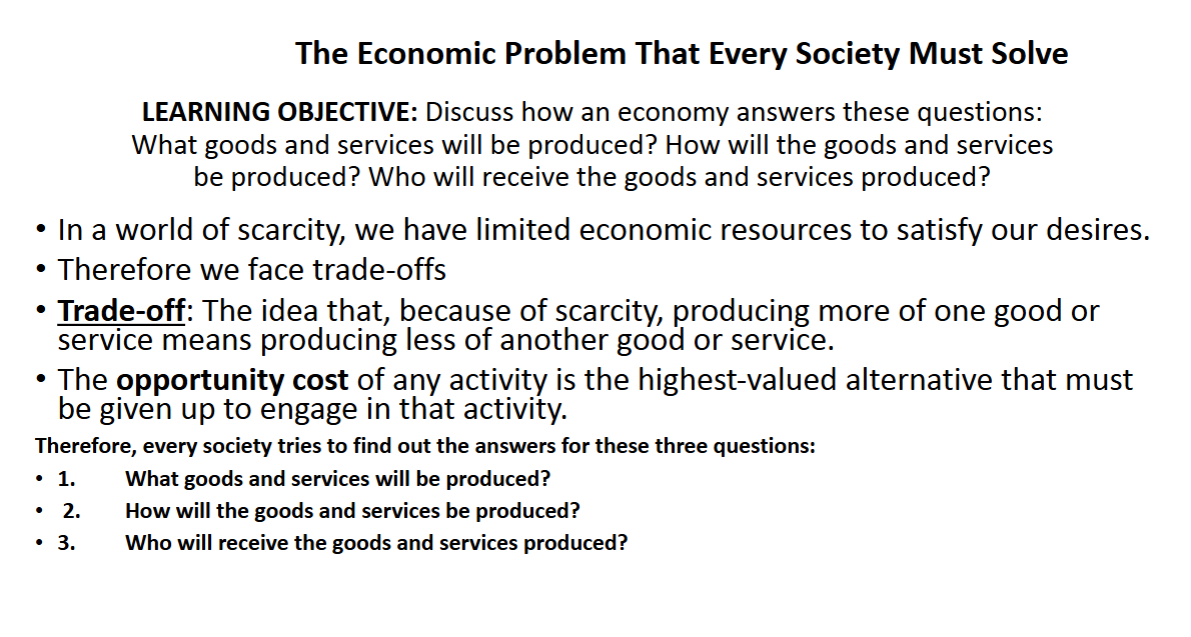
The Economic Problem That Every Society Must Solve (每个社会必须解决的经济问题)
LEARNING OBJECTIVE: Discuss how an economy answers these questions:
📖 点击查看译文
学习目标:讨论一个经济体如何回答以下问题:
What goods and services will be produced? How will the goods and services be produced? Who will receive the goods and services produced?
📖 点击查看译文
哪些商品和服务将被生产?这些商品和服务将如何生产?谁将获得生产的商品和服务?
In a world of scarcity, we have limited economic resources to satisfy our desires.
📖 点击查看译文
在稀缺的世界中,我们拥有有限的经济资源来满足我们的需求。
Therefore we face trade-offs
📖 点击查看译文
因此,我们面临权衡取舍。
Trade-off: The idea that, because of scarcity, producing more of one good or service means producing less of another good or service.
📖 点击查看译文
权衡取舍:由于资源的稀缺,生产更多的一种商品或服务意味着要减少生产另一种商品或服务。
The opportunity cost of any activity is the highest-valued alternative that must be given up to engage in that activity.
📖 点击查看译文
任何活动的机会成本是为了从事该活动而必须放弃的最高价值的替代方案。
Therefore, every society tries to find out the answers for these three questions:
📖 点击查看译文
因此,每个社会都试图找到这三个问题的答案:
1. What goods and services will be produced?
📖 点击查看译文
1. 哪些商品和服务将被生产?
2. How will the goods and services be produced?
📖 点击查看译文
2. 这些商品和服务将如何生产?
3. Who will receive the goods and services produced?
📖 点击查看译文
3. 谁将获得生产的商品和服务?
知识点列表与拓展 (Knowledge Points and Extensions):
1. Scarcity and Its Implications (稀缺性及其影响)
-
解释 (Explanation):
Scarcity means that the resources available are limited, and cannot fully satisfy all human wants and needs.
(稀缺性意味着可用资源是有限的,无法完全满足所有人类的需求和欲望。)
-
例子 (Example):
There is only a limited amount of land, labor, and capital to produce goods, so societies must prioritize their production choices.
(土地、劳动力和资本的数量有限,因此社会必须优先考虑其生产选择。)
-
拓展 (Extension):
Scarcity leads to the need for trade-offs, and is a fundamental concept in economics that drives decision-making in both individual and societal contexts.
(稀缺性导致了权衡取舍的需求,是经济学中的一个基本概念,推动了个人和社会情境中的决策。)
2. Opportunity Cost and Decision Making (机会成本与决策制定)
-
解释 (Explanation):
Opportunity cost is a key principle in economics, representing the value of the best alternative given up when making a choice.
(机会成本是经济学中的一个关键原理,代表在做出选择时放弃的最佳替代方案的价值。)
-
例子 (Example):
If you spend your money on a vacation, the opportunity cost could be the savings you could have accumulated or other goods you could have purchased.
(如果你把钱花在度假上,机会成本可能是你本可以积累的储蓄或本可以购买的其他商品。)
-
拓展 (Extension):
Opportunity cost helps individuals and organizations make informed decisions, guiding them towards the most beneficial options based on their priorities and resources.
(机会成本帮助个人和组织做出明智决策,指导他们根据优先级和资源选择最有利的选项。)
3. The Economic Questions (经济学中的问题)
-
解释 (Explanation):
Every society must decide how to allocate its scarce resources to produce goods and services that satisfy human wants. The three central economic questions—what, how, and for whom—guide this allocation process.
(每个社会都必须决定如何分配稀缺资源,以生产满足人类需求的商品和服务。这三个核心的经济问题——什么、如何、为谁——指导着这一分配过程。)
-
例子 (Example):
In a market economy, producers decide what goods to make based on consumer demand, how to produce them based on available resources, and who receives the goods based on market prices and income distribution.
(在市场经济中,生产者根据消费者需求决定生产什么商品,基于可用资源决定如何生产,以及根据市场价格和收入分配决定谁将获得商品。)
-
拓展 (Extension):
The way these three questions are answered varies across different economic systems (market economy, planned economy, mixed economy), influencing how resources are allocated and goods are distributed.
(这三个问题的回答方式在不同的经济体制(市场经济、计划经济、混合经济)中有所不同,影响资源的分配和商品的分发方式。)
6
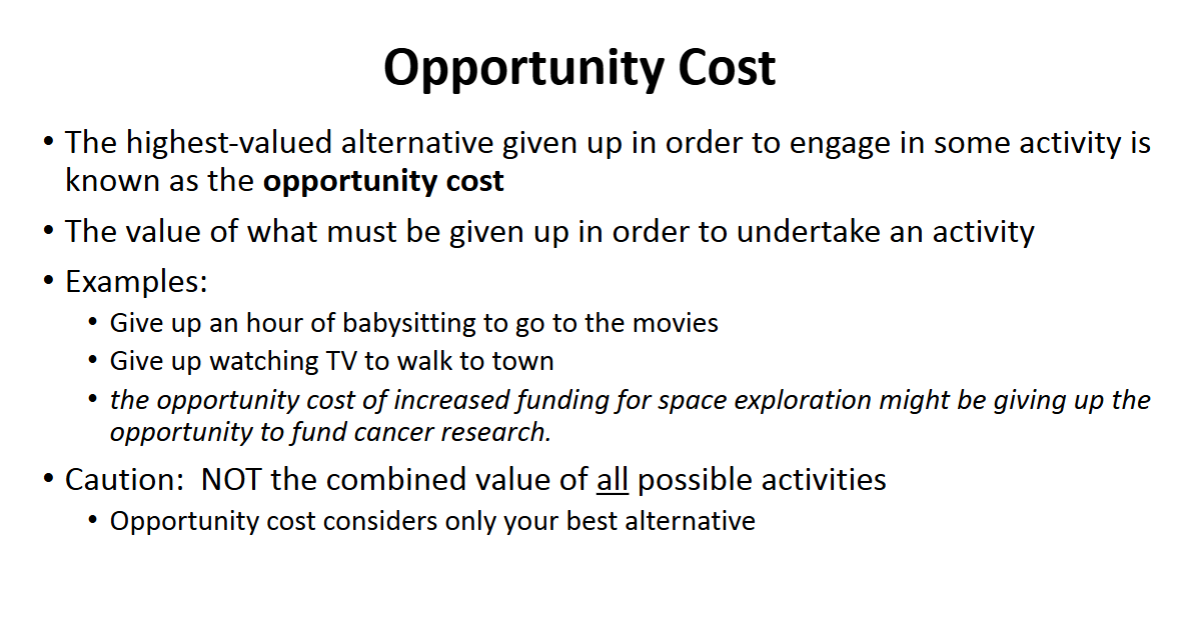
Opportunity Cost (机会成本)
The highest-valued alternative given up in order to engage in some activity is known as the opportunity cost.
📖 点击查看译文
为了从事某项活动而放弃的最高价值的替代方案被称为机会成本。
The value of what must be given up in order to undertake an activity
📖 点击查看译文
为了从事某项活动而必须放弃的价值。
Examples (例子):
- Give up an hour of babysitting to go to the movies.
📖 点击查看译文
放弃一小时的保姆工作去看电影。
- Give up watching TV to walk to town.
📖 点击查看译文
放弃看电视去步行去城镇。
- The opportunity cost of increased funding for space exploration might be giving up the opportunity to fund cancer research.
📖 点击查看译文
增加对太空探索的资助的机会成本可能是放弃资助癌症研究的机会。
Caution: NOT the combined value of all possible activities.
📖 点击查看译文
注意:这不是所有可能活动的综合价值。
Opportunity cost considers only your best alternative.
📖 点击查看译文
机会成本只考虑你最好的替代方案。
知识点列表与拓展 (Knowledge Points and Extensions):
1. Opportunity Cost and Decision Making (机会成本与决策制定)
-
解释 (Explanation):
Opportunity cost is an essential concept in economics that helps guide decision-making by highlighting what is sacrificed when a choice is made.
(机会成本是经济学中的一个核心概念,通过突出做出选择时所牺牲的内容来指导决策。)
-
例子 (Example):
When deciding whether to study or go out with friends, the opportunity cost of studying is the enjoyment and social time you miss out on.
(在决定是否学习或和朋友外出时,学习的机会成本是你错过的娱乐和社交时间。)
-
拓展 (Extension):
Opportunity cost is not only a financial consideration but also involves time, resources, and personal preferences. It helps to prioritize actions based on the most valuable alternatives.
(机会成本不仅是一个财务考量,还涉及时间、资源和个人偏好。它帮助根据最有价值的替代方案来优先考虑行动。)
2. Implications of Opportunity Cost (机会成本的影响)
-
解释 (Explanation):
Every decision comes with trade-offs, and understanding opportunity cost helps individuals and businesses make more informed and rational choices.
(每个决策都有权衡,理解机会成本有助于个人和企业做出更明智和理性的选择。)
-
例子 (Example):
For a business, the opportunity cost of investing in a new product line might be the potential profits from investing in a different area, like marketing.
(对于企业而言,投资新产品线的机会成本可能是投资于不同领域(如市场营销)的潜在利润。)
-
拓展 (Extension):
Opportunity cost plays a role in various economic systems, helping societies determine how resources should be allocated and what activities are most beneficial.
(机会成本在各种经济体制中都起着作用,帮助社会决定如何分配资源以及哪些活动最有益。)
7
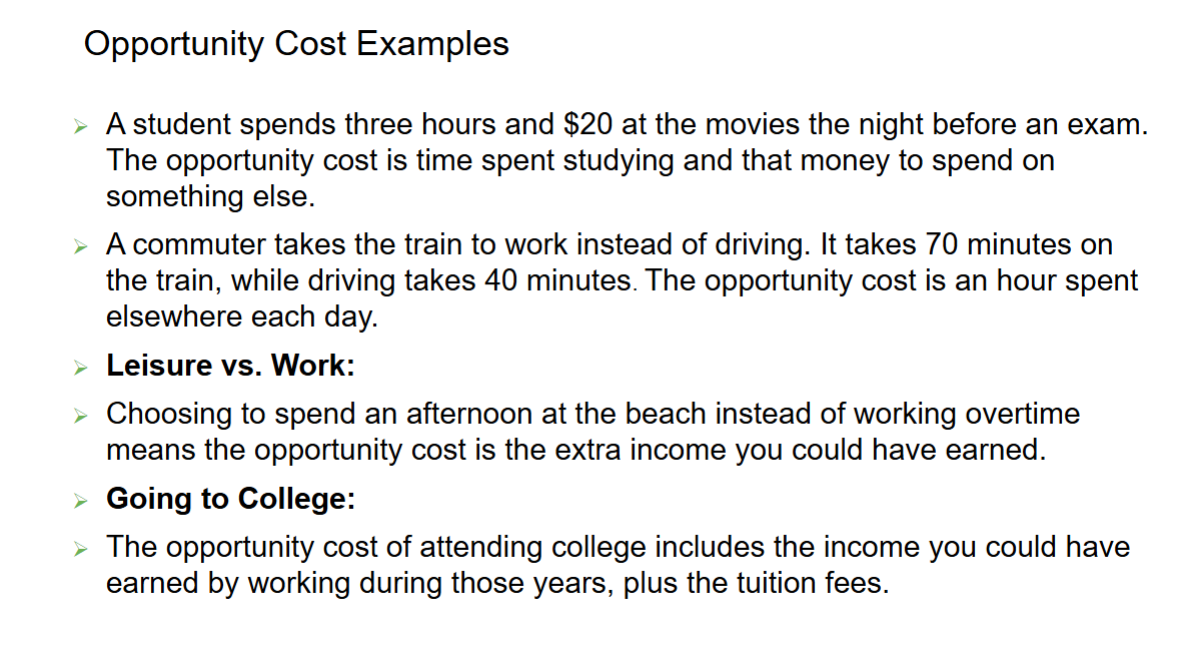
Opportunity Cost Examples (机会成本的例子)
A student spends three hours and $20 at the movies the night before an exam. The opportunity cost is time spent studying and that money to spend on something else.
📖 点击查看译文
一名学生在考试前一晚花费三小时和20美元去看电影。机会成本是本可以用于学习的时间和那笔可以用来做其他事情的钱。
A commuter takes the train to work instead of driving. It takes 70 minutes on the train, while driving takes 40 minutes. The opportunity cost is an hour spent elsewhere each day.
📖 点击查看译文
一名通勤者选择乘火车上班,而不是开车。乘火车需要70分钟,而开车只需40分钟。机会成本是每天花费在其他地方的一小时。
Leisure vs. Work (休闲与工作):
📖 点击查看译文
休闲与工作:
Choosing to spend an afternoon at the beach instead of working overtime means the opportunity cost is the extra income you could have earned.
📖 点击查看译文
选择花一个下午在海滩上,而不是加班工作,意味着机会成本是你本可以赚到的额外收入。
Going to College (上大学):
📖 点击查看译文
上大学:
The opportunity cost of attending college includes the income you could have earned by working during those years, plus the tuition fees.
📖 点击查看译文
上大学的机会成本包括你本可以在那些年份里通过工作赚取的收入,以及学费。
知识点列表与拓展 (Knowledge Points and Extensions):
1. The Role of Opportunity Cost in Decision Making (机会成本在决策中的作用)
-
解释 (Explanation):
Opportunity cost is an important factor in decision-making because it helps evaluate the trade-offs of different choices. Understanding what is sacrificed allows for better planning.
(机会成本在决策中是一个重要的因素,因为它有助于评估不同选择的权衡。理解放弃的内容可以帮助更好地规划。)
-
例子 (Example):
When deciding whether to spend money on a vacation or save for future goals, the opportunity cost includes the potential benefits of saving that money for something more important.
(在决定是否花钱度假或为未来目标存钱时,机会成本包括将钱存起来以用于更重要的事情的潜在收益。)
-
拓展 (Extension):
Opportunity cost applies not only to personal decisions but also to business and government policies, where the allocation of resources needs to be justified by their highest-value use.
(机会成本不仅适用于个人决策,还适用于商业和政府政策,在这些情况下,资源的分配需要通过其最高价值的使用来证明。)
2. Implications of Ignoring Opportunity Cost (忽视机会成本的影响)
-
解释 (Explanation):
Ignoring opportunity costs can lead to suboptimal choices, as the full consequences of alternatives are not considered. It can cause misallocation of resources and lost opportunities.
(忽视机会成本可能导致次优选择,因为没有考虑到替代方案的全部后果。这可能导致资源的错误配置和错失机会。)
-
例子 (Example):
If a company invests in a project without considering the opportunity cost of not investing in more profitable ventures, it may miss out on higher returns.
(如果一家公司在没有考虑不投资于更有利可图的项目的机会成本的情况下投资于某个项目,它可能会错失更高的回报。)
-
拓展 (Extension):
Awareness of opportunity cost encourages more thoughtful decision-making and helps in prioritizing actions that align with long-term goals and the best use of available resources.
(意识到机会成本有助于更深思熟虑的决策,并帮助优先考虑与长期目标一致的行动,以及最有效利用可用资源的方式。)
8
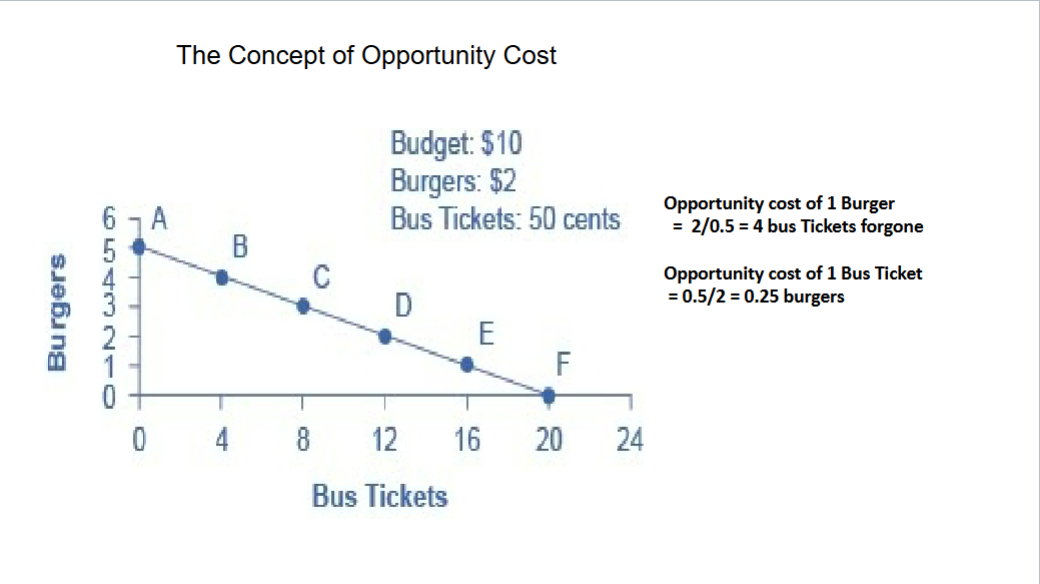

在这张图中,X 轴代表购买的公交票(Bus Tickets)数量,Y 轴代表购买的汉堡(Burgers)数量。整个图表描述了预算约束下的选择,其中每个点(A、B、C、D、E、F)代表不同的消费组合。
为什么 FED 向上的趋势表示 Opportunity Cost of 1 Burger
-
预算约束线的斜率代表机会成本
-
由于预算固定为 2,而一张公交票只需 $0.5,因此买一个汉堡的成本可以换算成放弃的公交票数量。
-
计算:
-
这意味着购买一个汉堡需要放弃 4 张公交票。
-
从 F 到 E 到 D(FED)的移动
-
从 F → E → D 方向向上,意味着减少了购买的公交票(X 轴值减小),而增加了汉堡的购买量(Y 轴值增加)。
-
这种变化说明,为了获得额外的汉堡,需要放弃一定数量的公交票,即汉堡的机会成本是放弃公交票的数量。
-
-
机会成本的定义
-
机会成本指的是为了获得某种物品而必须放弃的其他物品数量。
-
在这里,每增加一个汉堡,就必须减少 4 张公交票的购买。
-
这正是 FED 这部分图表所表示的内容:向上的趋势说明购买更多汉堡的机会成本是减少公交票的数量(即 4 张)。
-
总结
FED 段的趋势表示 增加汉堡的同时减少公交票,这反映了购买 1 个汉堡的机会成本是 4 张公交票。
9
What Goods and Services Will Be Produced? (将生产哪些商品和服务?)
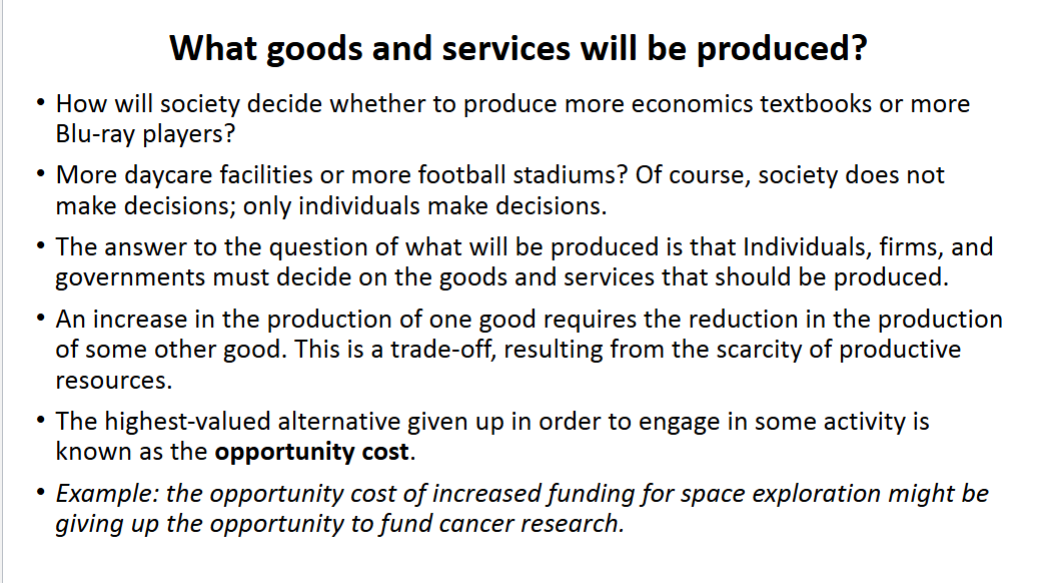
How will society decide whether to produce more economics textbooks or more Blu-ray players?
📖 点击查看译文
社会将如何决定是生产更多的经济学教材还是更多的蓝光播放器?
More daycare facilities or more football stadiums? Of course, society does not make decisions; only individuals make decisions.
📖 点击查看译文
更多的日托设施还是更多的足球场?当然,社会本身并不做决定,只有个人才能做出决定。
The answer to the question of what will be produced is that individuals, firms, and governments must decide on the goods and services that should be produced.
📖 点击查看译文
关于“将生产哪些商品和服务”这一问题的答案是:个人、企业和政府必须决定应生产哪些商品和服务。
An increase in the production of one good requires the reduction in the production of some other good. This is a trade-off, resulting from the scarcity of productive resources.
📖 点击查看译文
增加一种商品的生产需要减少其他商品的生产。这是一种权衡,源于生产资源的稀缺性。
The highest-valued alternative given up in order to engage in some activity is known as the opportunity cost.
📖 点击查看译文
为了从事某项活动而放弃的最高价值的替代选择称为机会成本。
Example: The opportunity cost of increased funding for space exploration might be giving up the opportunity to fund cancer research.
📖 点击查看译文
例子:增加对太空探索的资金投入的机会成本可能是放弃资助癌症研究的机会。
知识点列表与拓展 (Knowledge Points and Extensions):
1. Scarcity and Trade-Offs (稀缺性与权衡)
-
解释 (Explanation):
Since resources are limited, producing more of one good means sacrificing the production of another. This necessitates trade-offs in decision-making.
(由于资源有限,生产更多一种商品意味着要牺牲另一种商品的生产。这使得决策过程中必须进行权衡。)
-
例子 (Example):
If a country invests more in military defense, it may have fewer resources for education and healthcare.
(如果一个国家增加国防开支,它可能会减少对教育和医疗的投入。)
-
拓展 (Extension):
Understanding trade-offs helps individuals, businesses, and governments allocate resources more efficiently to maximize overall benefits.
(理解权衡有助于个人、企业和政府更有效地分配资源,以最大化整体利益。)
2. Opportunity Cost in Economic Decisions (经济决策中的机会成本)
-
解释 (Explanation):
Opportunity cost helps evaluate the real cost of a decision by considering what is sacrificed. It is a fundamental concept in economics.
(机会成本帮助评估决策的实际成本,即考虑为了某一选择所放弃的东西。这是经济学中的基本概念。)
-
例子 (Example):
If a student chooses to spend time working instead of studying, the opportunity cost is the lost learning and potential academic performance.
(如果一名学生选择花时间工作而不是学习,其机会成本就是失去的学习机会和可能的学术表现。)
-
拓展 (Extension):
Opportunity cost analysis is essential for businesses in investment decisions and for governments in policy-making.
(机会成本分析对企业的投资决策和政府的政策制定至关重要。)
10
How Will the Goods Be Produced? (商品将如何生产?)
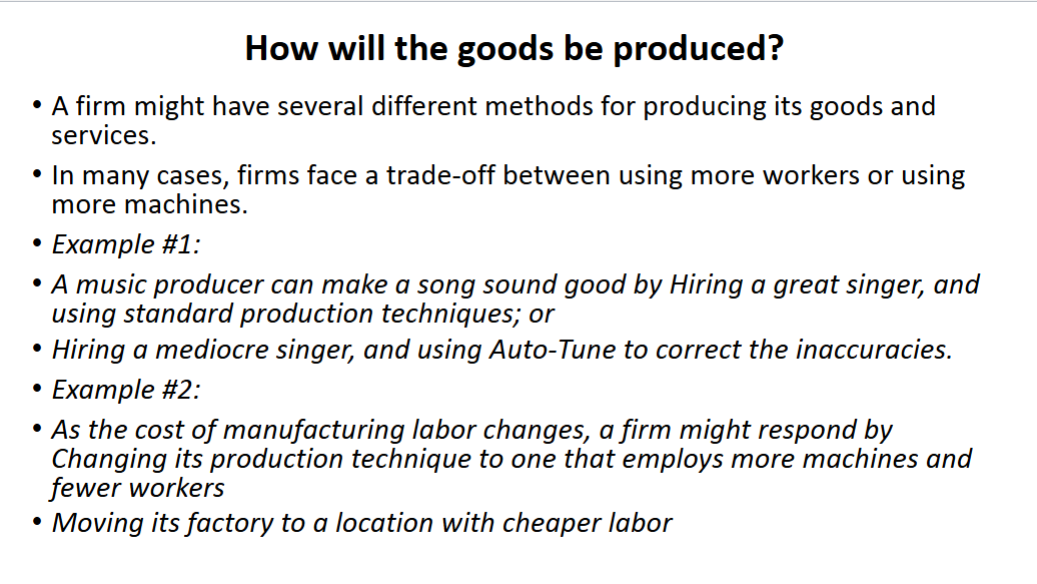
A firm might have several different methods for producing its goods and services.
📖 点击查看译文
一家公司可能有几种不同的方法来生产其商品和服务。
In many cases, firms face a trade-off between using more workers or using more machines.
📖 点击查看译文
在许多情况下,公司需要在使用更多工人或更多机器之间做出权衡。
Example #1:
📖 点击查看译文
例子 1:
A music producer can make a song sound good by hiring a great singer and using standard production techniques; or
📖 点击查看译文
音乐制作人可以通过雇佣一位优秀的歌手,并使用标准的制作技术,使歌曲听起来更好;或者
Hiring a mediocre singer and using Auto-Tune to correct the inaccuracies.
📖 点击查看译文
雇佣一位普通的歌手,并使用自动调音软件来修正音准。
Example #2:
📖 点击查看译文
例子 2:
As the cost of manufacturing labor changes, a firm might respond by changing its production technique to one that employs more machines and fewer workers.
📖 点击查看译文
随着制造业劳动力成本的变化,公司可能会调整生产技术,采用更多机器、减少工人的方案。
Moving its factory to a location with cheaper labor.
📖 点击查看译文
将工厂迁至劳动力成本更低的地区。
知识点列表与拓展 (Knowledge Points and Extensions):
1. Trade-Offs in Production Methods (生产方式的权衡)
-
解释 (Explanation):
Firms must decide whether to rely more on labor or capital (machines). This decision depends on costs, efficiency, and technological advancements.
(公司必须决定更多依赖劳动力还是资本(机器)。这一决策取决于成本、效率和技术进步。)
-
例子 (Example):
In labor-intensive industries like textile manufacturing, firms in high-wage countries may invest in automation, while firms in low-wage countries may continue using more workers.
(在纺织制造等劳动密集型行业,高工资国家的公司可能会投资自动化,而低工资国家的公司可能会继续使用更多工人。)
-
拓展 (Extension):
Advances in AI and robotics are shifting the balance toward automation, even in traditionally labor-intensive industries.
(人工智能和机器人技术的进步正在将生产方式向自动化倾斜,即使是在传统的劳动密集型行业中也是如此。)
2. The Role of Globalization in Production Decisions (全球化对生产决策的影响)
-
解释 (Explanation):
Companies consider global labor and resource costs when deciding where to produce goods. Outsourcing and offshoring are common strategies.
(公司在决定生产地点时会考虑全球的劳动力和资源成本。外包和离岸生产是常见的策略。)
-
例子 (Example):
Many tech companies manufacture their products in countries with lower production costs, such as China and Vietnam.
(许多科技公司选择在生产成本较低的国家(如中国和越南)制造产品。)
-
拓展 (Extension):
Political and economic factors, such as tariffs and supply chain risks, can influence where companies decide to locate their factories.
(政治和经济因素,如关税和供应链风险,可能会影响公司决定在哪里设立工厂。)
11
Who Will Receive the Goods and Services Produced? (谁将获得所生产的商品和服务?)
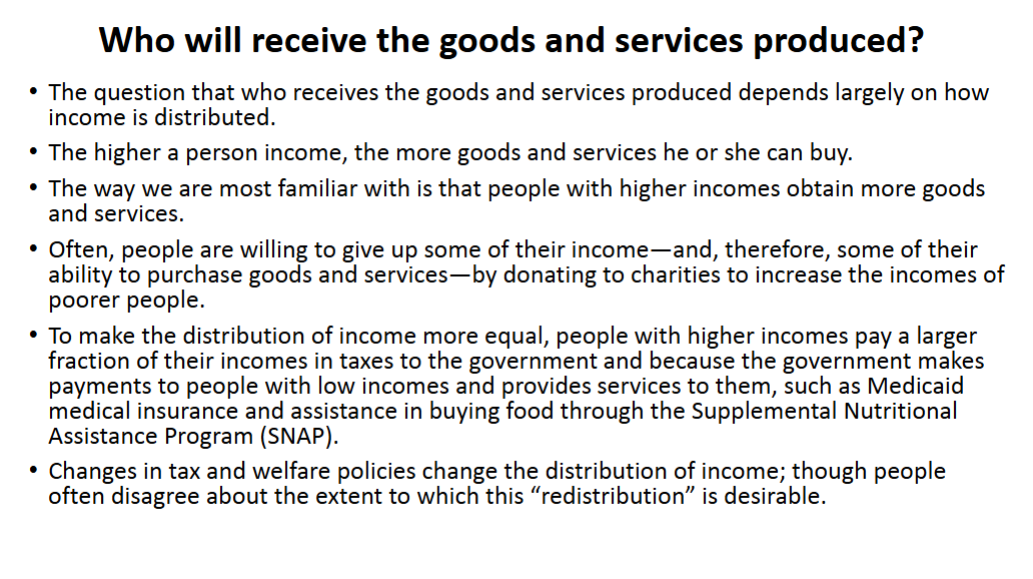
The question of who receives the goods and services produced depends largely on how income is distributed.
📖 点击查看译文
谁能获得所生产的商品和服务在很大程度上取决于收入的分配方式。
The higher a person’s income, the more goods and services he or she can buy.
📖 点击查看译文
一个人的收入越高,他或她能购买的商品和服务就越多。
The way we are most familiar with is that people with higher incomes obtain more goods and services.
📖 点击查看译文
我们最熟悉的方式是,高收入者获得更多的商品和服务。
Often, people are willing to give up some of their income—and, therefore, some of their ability to purchase goods and services—by donating to charities to increase the incomes of poorer people.
📖 点击查看译文
通常,人们愿意放弃部分收入,也就是放弃一部分购买商品和服务的能力,通过向慈善机构捐款来提高贫困群体的收入。
To make the distribution of income more equal, people with higher incomes pay a larger fraction of their incomes in taxes to the government.
📖 点击查看译文
为了使收入分配更加公平,高收入者需向政府缴纳更大比例的税款。
The government makes payments to people with low incomes and provides services to them, such as Medicaid medical insurance and assistance in buying food through the Supplemental Nutritional Assistance Program (SNAP).
📖 点击查看译文
政府向低收入人群提供补助,并为他们提供服务,例如医疗补助保险(Medicaid)以及通过补充营养援助计划(SNAP)提供食品补助。
Changes in tax and welfare policies change the distribution of income; though people often disagree about the extent to which this “redistribution” is desirable.
📖 点击查看译文
税收和福利政策的变化会影响收入分配,尽管人们对于这种“再分配”在多大程度上是合理的往往存在分歧。
知识点列表与拓展 (Knowledge Points and Extensions):
1. Income Distribution and Economic Equity (收入分配与经济公平)
-
解释 (Explanation):
Income distribution refers to how a nation’s total income is divided among its population. Economic equity aims to balance efficiency with fairness.
(收入分配指的是一个国家的总收入如何在其人口中分配。经济公平的目标是在效率与公平之间取得平衡。)
-
例子 (Example):
Scandinavian countries use progressive taxation and extensive welfare programs to reduce income inequality.
(北欧国家采用累进税制和广泛的福利计划来减少收入不平等。)
-
拓展 (Extension):
While redistribution can reduce poverty, excessive taxation might discourage investment and economic growth.
(尽管再分配可以减少贫困,但过高的税收可能会抑制投资和经济增长。)
2. The Debate on Redistribution Policies (再分配政策的争议)
-
解释 (Explanation):
Governments implement redistribution through progressive taxation and welfare programs, but opinions differ on how much redistribution is appropriate.
(政府通过累进税制和福利计划进行收入再分配,但人们对于再分配的合理程度存在不同观点。)
-
例子 (Example):
The U.S. has debates over the expansion of social programs like universal healthcare, with arguments balancing economic freedom and social welfare.
(美国在扩大全民医疗等社会项目方面存在争议,争论的焦点在于经济自由与社会福利的平衡。)
-
拓展 (Extension):
Some argue that too much redistribution can reduce work incentives, while others believe it’s necessary for social stability.
(有人认为过度的再分配会降低工作积极性,而另一些人则认为这是社会稳定的必要措施。)
12
What, How, and Who… (什么、如何、谁……)
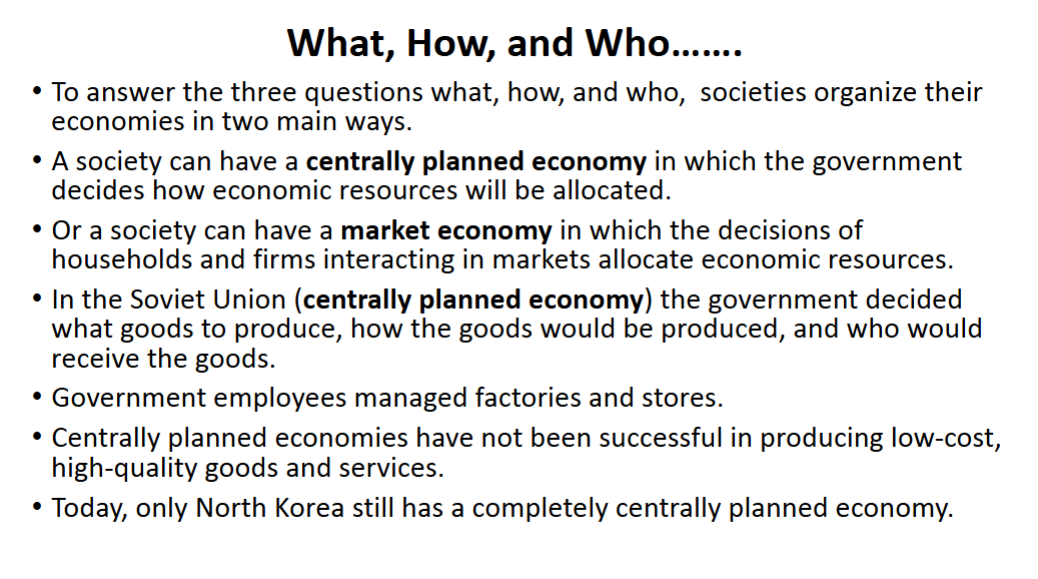
To answer the three questions: what, how, and who, societies organize their economies in two main ways.
📖 点击查看译文
为了回答“什么、如何、谁”这三个问题,社会通过两种主要方式组织经济。
A society can have a centrally planned economy in which the government decides how economic resources will be allocated.
📖 点击查看译文
一个社会可以拥有一个中央计划经济体制,在这种体制下,政府决定如何分配经济资源。
Or a society can have a market economy in which the decisions of households and firms interacting in markets allocate economic resources.
📖 点击查看译文
或者一个社会可以拥有市场经济体制,在这种体制下,家庭和企业在市场中互动,决定经济资源的分配。
In the Soviet Union (centrally planned economy) the government decided what goods to produce, how the goods would be produced, and who would receive the goods.
📖 点击查看译文
在苏联(中央计划经济体制)中,政府决定生产什么商品、如何生产这些商品以及谁将获得这些商品。
Government employees managed factories and stores.
📖 点击查看译文
政府雇员管理工厂和商店。
Centrally planned economies have not been successful in producing low-cost, high-quality goods and services.
📖 点击查看译文
中央计划经济体制在生产低成本、高质量商品和服务方面未取得成功。
Today, only North Korea still has a completely centrally planned economy.
📖 点击查看译文
今天,只有朝鲜仍然拥有完全的中央计划经济体制。
知识点列表与拓展 (Knowledge Points and Extensions):
1. Centrally Planned vs. Market Economies (中央计划经济与市场经济)
-
解释 (Explanation):
A centrally planned economy is characterized by government control over the allocation of resources, while a market economy relies on the interaction of supply and demand to allocate resources.
(中央计划经济的特点是政府控制资源的分配,而市场经济则依赖于供求关系来分配资源。)
-
例子 (Example):
In a market economy, prices of goods and services are determined by consumers and producers, as seen in countries like the United States.
(在市场经济中,商品和服务的价格由消费者和生产者决定,如美国等国所见。)
-
拓展 (Extension):
Centrally planned economies often struggle with inefficiency and lack of innovation, as seen in the collapse of the Soviet Union.
(中央计划经济往往面临低效和缺乏创新的问题,正如苏联解体所示。)
2. Advantages and Disadvantages of Market Economies (市场经济的优缺点)
-
解释 (Explanation):
Market economies promote efficiency and innovation but can also lead to income inequality and market failures.
(市场经济促进了效率和创新,但也可能导致收入不平等和市场失灵。)
-
例子 (Example):
The rapid technological advancements in the U.S. economy are largely driven by market forces.
(美国经济中的快速技术进步在很大程度上是由市场力量推动的。)
-
拓展 (Extension):
A mixed economy, combining elements of both market and centrally planned economies, is often seen in countries like China and most Western nations.
(混合经济,结合了市场经济和中央计划经济的元素,通常出现在中国和大多数西方国家。)
13
Market Economies and Their Characteristics (市场经济及其特点)
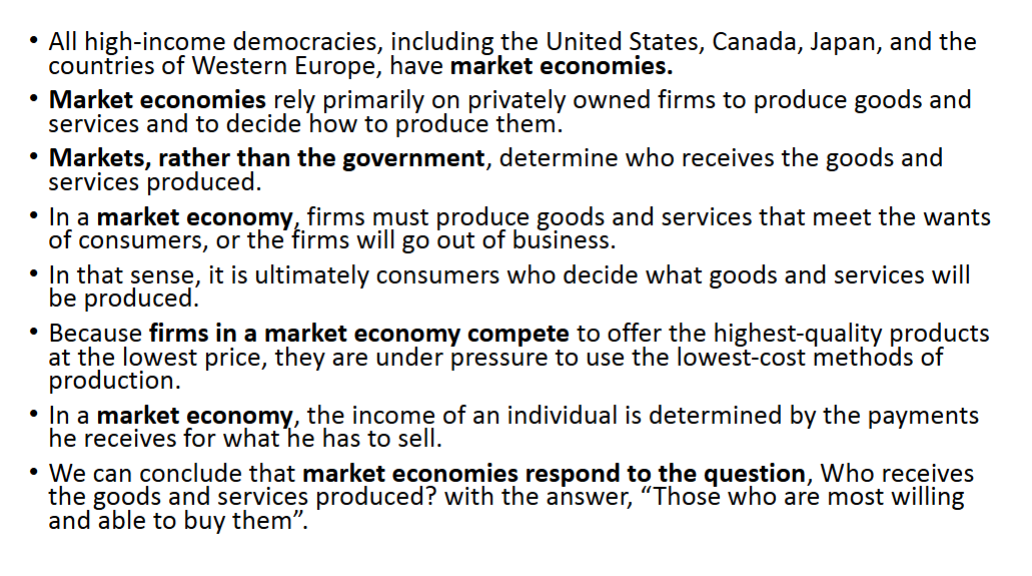
All high-income democracies, including the United States, Canada, Japan, and the countries of Western Europe, have market economies.
📖 点击查看译文
所有高收入民主国家,包括美国、加拿大、日本以及西欧国家,都是市场经济。
Market economies rely primarily on privately owned firms to produce goods and services and to decide how to produce them.
📖 点击查看译文
市场经济主要依赖私人拥有的公司来生产商品和服务,并决定如何生产这些商品和服务。
Markets, rather than the government, determine who receives the goods and services produced.
📖 点击查看译文
市场而不是政府决定谁将获得生产的商品和服务。
In a market economy, firms must produce goods and services that meet the wants of consumers, or the firms will go out of business.
📖 点击查看译文
在市场经济中,企业必须生产符合消费者需求的商品和服务,否则企业将倒闭。
In that sense, it is ultimately consumers who decide what goods and services will be produced.
📖 点击查看译文
从这个意义上说,最终是消费者决定生产什么商品和服务。
Because firms in a market economy compete to offer the highest-quality products at the lowest price, they are under pressure to use the lowest-cost methods of production.
📖 点击查看译文
因为市场经济中的企业竞争提供最高质量的产品,以最低价格出售,所以它们面临使用最低成本生产方法的压力。
In a market economy, the income of an individual is determined by the payments he receives for what he has to sell.
📖 点击查看译文
在市场经济中,个人的收入由他出售的商品或服务所获得的报酬决定。
We can conclude that market economies respond to the question, Who receives the goods and services produced? with the answer, “Those who are most willing and able to buy them”.
📖 点击查看译文
我们可以得出结论,市场经济对“谁将获得生产的商品和服务?”这个问题的回答是:“那些最愿意并有能力购买它们的人。”
知识点列表与拓展 (Knowledge Points and Extensions):
1. Characteristics of Market Economies (市场经济的特点)
-
解释 (Explanation):
A market economy is characterized by private ownership of resources and a competitive marketplace where decisions on what, how, and who to produce are made by consumers and firms.
(市场经济的特点是资源的私人拥有和竞争市场,在这种市场中,生产什么、如何生产以及由谁生产的决策由消费者和企业作出。)
-
例子 (Example):
In the U.S., companies like Apple and Amazon decide what products to produce based on consumer demand, rather than the government dictating production.
(在美国,像苹果和亚马逊这样的公司根据消费者需求决定生产什么产品,而不是政府规定生产。)
-
拓展 (Extension):
Market economies foster innovation and efficiency due to competition, but they may also lead to inequalities in income and access to resources.
(市场经济由于竞争促进了创新和效率,但也可能导致收入不平等和资源获取不平等。)
2. Consumer Power in Market Economies (市场经济中的消费者权力)
-
解释 (Explanation):
In a market economy, consumers drive production by expressing their preferences and purchasing decisions. Firms must respond to these preferences to stay in business.
(在市场经济中,消费者通过表达偏好和购买决定来推动生产。企业必须响应这些偏好才能保持运营。)
-
例子 (Example):
If consumers demand more sustainable products, companies like Tesla may shift to producing electric cars to meet that demand.
(如果消费者需求更多可持续产品,像特斯拉这样的公司可能会转向生产电动汽车,以满足这一需求。)
-
拓展 (Extension):
While consumer power drives markets, it can also create challenges, such as when demand leads to overproduction or environmental degradation.
(尽管消费者权力推动了市场,但它也可能带来挑战,例如当需求导致过度生产或环境退化时。)
3. The Role of Competition in Market Economies (竞争在市场经济中的作用)
-
解释 (Explanation):
Competition among firms encourages lower prices, better quality, and innovation, benefiting consumers and driving economic growth.
(企业之间的竞争鼓励降低价格、提高质量和创新,从而惠及消费者并推动经济增长。)
-
例子 (Example):
In the smartphone market, companies like Samsung, Apple, and Huawei constantly innovate to offer better features at competitive prices.
(在智能手机市场,像三星、苹果和华为这样的公司不断创新,提供更好的功能和具有竞争力的价格。)
-
拓展 (Extension):
Although competition improves efficiency and innovation, it can also lead to monopolies if a single firm dominates, reducing the benefits to consumers.
(尽管竞争提高了效率和创新,但如果某一公司占据主导地位,可能会导致垄断,从而减少消费者的利益。)
14
Mixed Economy (混合经济)
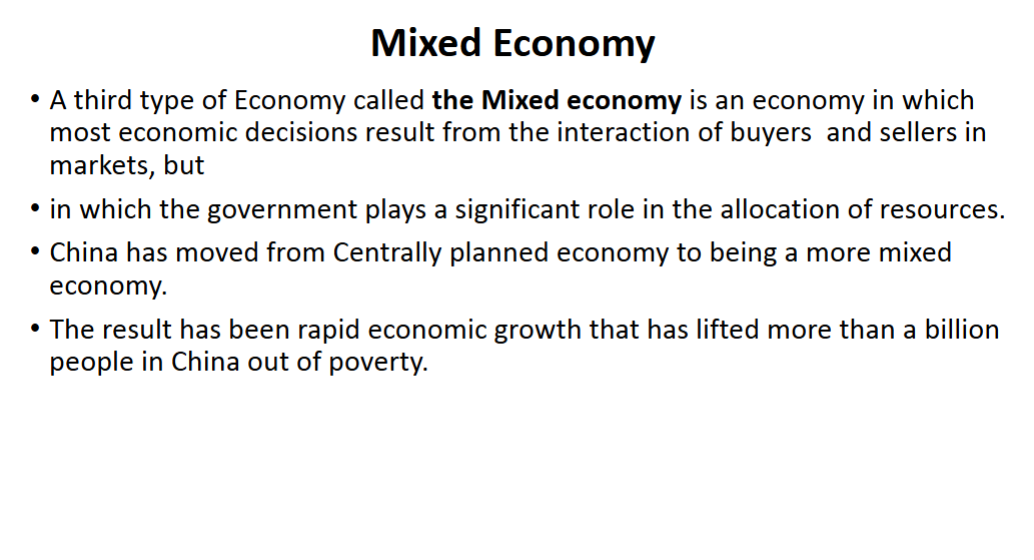
A third type of Economy called the Mixed economy is an economy in which most economic decisions result from the interaction of buyers and sellers in markets, but in which the government plays a significant role in the allocation of resources.
📖 点击查看译文
第三种经济类型叫做混合经济,它是一种大部分经济决策来源于买卖双方在市场中的互动,但政府在资源配置中发挥着重要作用的经济。
China has moved from Centrally planned economy to being a more mixed economy.
📖 点击查看译文
中国已经从计划经济转向更加混合的经济体制。
The result has been rapid economic growth that has lifted more than a billion people in China out of poverty.
📖 点击查看译文
其结果是中国实现了快速的经济增长,使超过十亿人摆脱了贫困。
知识点列表与拓展 (Knowledge Points and Extensions):
1. Characteristics of a Mixed Economy (混合经济的特点)
-
解释 (Explanation):
A mixed economy blends elements of both market economies and planned economies. It allows market forces to guide most production and distribution decisions but includes significant government intervention in areas like public services and resource allocation.
(混合经济融合了市场经济和计划经济的元素。它允许市场力量引导大多数生产和分配决策,但在公共服务和资源配置等领域有着重要的政府干预。)
-
例子 (Example):
In the U.S., the government regulates industries like healthcare and education, ensuring access and equity, while the private sector drives innovation and market competition.
(在美国,政府对医疗保健和教育等行业进行监管,确保其可获取性和公平性,而私营部门则推动创新和市场竞争。)
-
拓展 (Extension):
Mixed economies can strike a balance between economic efficiency and social welfare, but the extent of government involvement can vary significantly between countries.
(混合经济可以在经济效率和社会福利之间找到平衡,但政府参与的程度在不同国家之间可能会有很大差异。)
2. China’s Economic Transition (中国的经济转型)
-
解释 (Explanation):
China’s shift from a centrally planned economy to a more mixed economy has enabled its rapid economic growth, where the state plays a guiding role while private enterprises and markets contribute significantly to economic development.
(中国从计划经济转型为更加混合的经济体制,使其实现了快速的经济增长,国家发挥着指导作用,而私营企业和市场在经济发展中发挥着重要作用。)
-
例子 (Example):
The economic reforms in the late 20th century, such as the opening of markets and encouragement of private businesses, have been central to China’s modernization.
(20世纪末的经济改革,如市场开放和鼓励私营企业,成为中国现代化的关键。)
-
拓展 (Extension):
While China’s mixed economy has fueled rapid growth, challenges such as inequality and environmental concerns still require government intervention to address.
(虽然中国的混合经济推动了快速增长,但收入不平等和环境问题等挑战仍然需要政府的干预来解决。)
15
Efficiency and Equity (效率与公平)
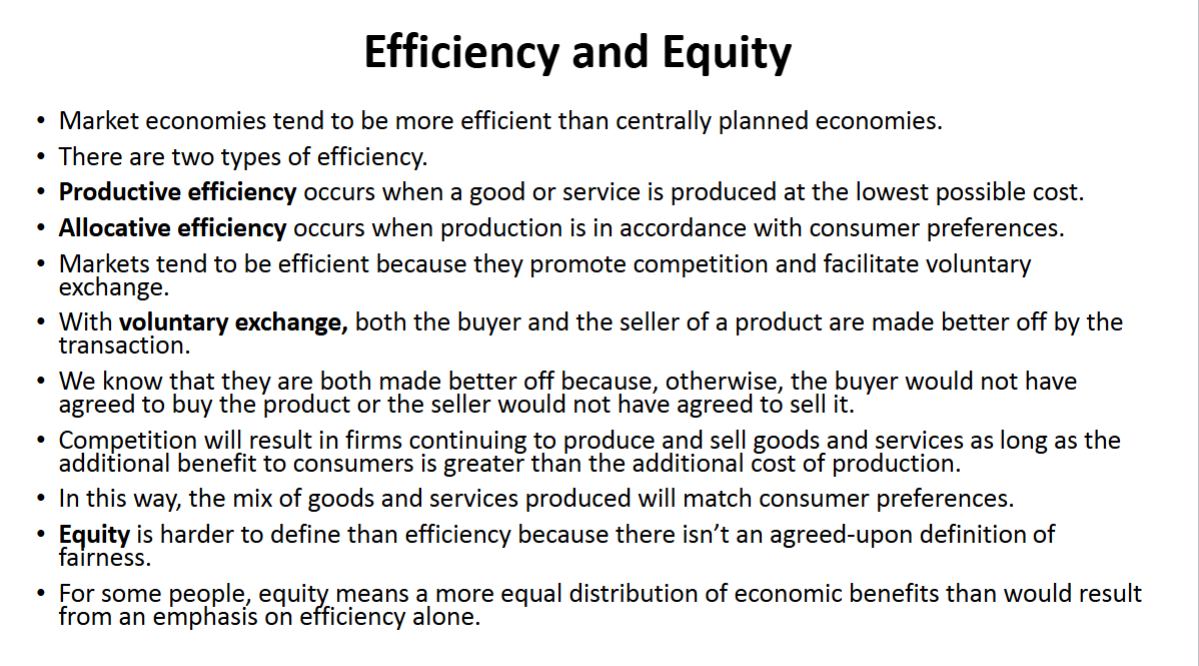
Market economies tend to be more efficient than centrally planned economies.
📖 点击查看译文
市场经济往往比计划经济更高效。
There are two types of efficiency.
📖 点击查看译文
效率有两种类型。
Productive efficiency occurs when a good or service is produced at the lowest possible cost.
📖 点击查看译文
生产效率是指商品或服务以最低可能成本生产。
Allocative efficiency occurs when production is in accordance with consumer preferences.
📖 点击查看译文
配置效率是指生产符合消费者偏好的商品或服务。
Markets tend to be efficient because they promote competition and facilitate voluntary exchange.
📖 点击查看译文
市场通常很高效,因为它们促进了竞争并便利了自愿交换。
With voluntary exchange, both the buyer and the seller of a product are made better off by the transaction.
📖 点击查看译文
通过自愿交换,产品的买卖双方都能从交易中受益。
We know that they are both made better off because, otherwise, the buyer would not have agreed to buy the product or the seller would not have agreed to sell it.
📖 点击查看译文
我们知道他们都能从中受益,因为否则买方不会同意购买产品,卖方也不会同意出售。
Competition will result in firms continuing to produce and sell goods and services as long as the additional benefit to consumers is greater than the additional cost of production.
📖 点击查看译文
竞争将促使企业继续生产和销售商品和服务,只要对消费者的额外利益大于生产的额外成本。
In this way, the mix of goods and services produced will match consumer preferences.
📖 点击查看译文
通过这种方式,生产的商品和服务的组合将符合消费者的偏好。
Equity is harder to define than efficiency because there isn’t an agreed-upon definition of fairness.
📖 点击查看译文
公平比效率更难定义,因为没有统一的公平定义。
For some people, equity means a more equal distribution of economic benefits than would result from an emphasis on efficiency alone.
📖 点击查看译文
对一些人来说,公平意味着比仅仅强调效率所产生的更为平等的经济利益分配。
知识点列表与拓展 (Knowledge Points and Extensions):
1. Types of Efficiency (效率的种类)
-
解释 (Explanation):
Efficiency in economics refers to how well resources are used to meet consumer needs. Productive efficiency is when goods are made at the lowest cost, and allocative efficiency occurs when resources are allocated according to consumer preferences.
(经济学中的效率指的是资源如何有效地满足消费者需求。生产效率是指商品以最低成本生产,而配置效率发生在资源按照消费者偏好进行配置时。)
-
例子 (Example):
In a competitive market, firms like Walmart strive for productive efficiency by minimizing operational costs while offering products that consumers demand, ensuring both low costs and high consumer satisfaction.
(在竞争市场中,像沃尔玛这样的公司通过最小化运营成本同时提供消费者需求的产品,来追求生产效率,确保低成本和高消费者满意度。)
-
拓展 (Extension):
Achieving both productive and allocative efficiency in markets leads to optimal resource use, but it requires ongoing competition and innovation.
(在市场中实现生产效率和配置效率可以实现资源的最优利用,但这需要持续的竞争和创新。)
2. Role of Competition in Efficiency (竞争在效率中的作用)
-
解释 (Explanation):
Competition drives efficiency by pushing firms to lower prices, improve quality, and innovate to meet consumer demands, thereby enhancing overall market performance.
(竞争通过促使企业降低价格、提高质量和创新以满足消费者需求,推动了效率,从而提升了整体市场表现。)
-
例子 (Example):
In the tech industry, companies like Microsoft and Google constantly innovate and compete to offer better software, resulting in improvements in both performance and consumer satisfaction.
(在科技行业,像微软和谷歌这样的公司不断创新和竞争,提供更好的软件,导致性能和消费者满意度的提升。)
-
拓展 (Extension):
While competition boosts efficiency, it can sometimes lead to market failures or monopolies if not regulated, reducing overall welfare.
(虽然竞争提升了效率,但如果没有适当的监管,有时会导致市场失灵或垄断,减少整体福利。)
3. Defining Equity (公平的定义)
-
解释 (Explanation):
Equity in economics refers to the fair distribution of economic benefits. Unlike efficiency, equity is subjective, with different people and cultures defining fairness in different ways.
(经济中的公平指的是经济利益的公平分配。与效率不同,公平是主观的,不同的人和文化对公平的定义各不相同。)
-
例子 (Example):
Progressive taxation is one way to address equity, where higher-income individuals pay a larger share of their income in taxes, aiming for a more equal distribution of wealth.
(累进税制是一种解决公平的方式,其中高收入者支付更多的税款,旨在实现更平等的财富分配。)
-
拓展 (Extension):
Achieving equity in markets can be challenging because it often requires redistributing resources or imposing regulations, which may conflict with the goals of efficiency.
(在市场中实现公平可能是具有挑战性的,因为它通常需要重新分配资源或实施规制,这可能与效率目标发生冲突。)
-
拓展 (Extension):
Understanding opportunity cost is critical for making informed decisions in both personal and professional contexts, as it helps prioritize what is truly valuable.
(理解机会成本对于在个人和职业情境中做出明智决策至关重要,它帮助优先考虑真正重要的事物。)
3. Marginal Cost in Environmental Regulation (环境监管中的边际成本)
-
解释 (Explanation):
Marginal cost in environmental regulation refers to the cost of reducing one additional unit of pollution. It helps governments and businesses determine the most efficient level of environmental protection.
(环境监管中的边际成本是指减少一单位污染的成本。它帮助政府和企业确定最有效的环境保护水平。)
-
例子 (Example):
If the cost of reducing pollution is high, such as in the case where it rises to $120 per unit, it may no longer be efficient to pursue further reductions.
(如果减少污染的成本较高,例如每单位120美元的情况,那么继续减少污染可能就不再高效。)
-
拓展 (Extension):
By analyzing marginal costs and benefits, businesses and policymakers can identify when additional environmental regulations become inefficient and counterproductive.
(通过分析边际成本和边际效益,企业和政策制定者可以识别出何时额外的环境监管变得低效甚至适得其反。)
5

The Economic Problem That Every Society Must Solve (每个社会必须解决的经济问题)
LEARNING OBJECTIVE: Discuss how an economy answers these questions:
📖 点击查看译文
学习目标:讨论一个经济体如何回答以下问题:
What goods and services will be produced? How will the goods and services be produced? Who will receive the goods and services produced?
📖 点击查看译文
哪些商品和服务将被生产?这些商品和服务将如何生产?谁将获得生产的商品和服务?
In a world of scarcity, we have limited economic resources to satisfy our desires.
📖 点击查看译文
在稀缺的世界中,我们拥有有限的经济资源来满足我们的需求。
Therefore we face trade-offs
📖 点击查看译文
因此,我们面临权衡取舍。
Trade-off: The idea that, because of scarcity, producing more of one good or service means producing less of another good or service.
📖 点击查看译文
权衡取舍:由于资源的稀缺,生产更多的一种商品或服务意味着要减少生产另一种商品或服务。
The opportunity cost of any activity is the highest-valued alternative that must be given up to engage in that activity.
📖 点击查看译文
任何活动的机会成本是为了从事该活动而必须放弃的最高价值的替代方案。
Therefore, every society tries to find out the answers for these three questions:
📖 点击查看译文
因此,每个社会都试图找到这三个问题的答案:
1. What goods and services will be produced?
📖 点击查看译文
1. 哪些商品和服务将被生产?
2. How will the goods and services be produced?
📖 点击查看译文
2. 这些商品和服务将如何生产?
3. Who will receive the goods and services produced?
📖 点击查看译文
3. 谁将获得生产的商品和服务?
知识点列表与拓展 (Knowledge Points and Extensions):
1. Scarcity and Its Implications (稀缺性及其影响)
-
解释 (Explanation):
Scarcity means that the resources available are limited, and cannot fully satisfy all human wants and needs.
(稀缺性意味着可用资源是有限的,无法完全满足所有人类的需求和欲望。)
-
例子 (Example):
There is only a limited amount of land, labor, and capital to produce goods, so societies must prioritize their production choices.
(土地、劳动力和资本的数量有限,因此社会必须优先考虑其生产选择。)
-
拓展 (Extension):
Scarcity leads to the need for trade-offs, and is a fundamental concept in economics that drives decision-making in both individual and societal contexts.
(稀缺性导致了权衡取舍的需求,是经济学中的一个基本概念,推动了个人和社会情境中的决策。)
2. Opportunity Cost and Decision Making (机会成本与决策制定)
-
解释 (Explanation):
Opportunity cost is a key principle in economics, representing the value of the best alternative given up when making a choice.
(机会成本是经济学中的一个关键原理,代表在做出选择时放弃的最佳替代方案的价值。)
-
例子 (Example):
If you spend your money on a vacation, the opportunity cost could be the savings you could have accumulated or other goods you could have purchased.
(如果你把钱花在度假上,机会成本可能是你本可以积累的储蓄或本可以购买的其他商品。)
-
拓展 (Extension):
Opportunity cost helps individuals and organizations make informed decisions, guiding them towards the most beneficial options based on their priorities and resources.
(机会成本帮助个人和组织做出明智决策,指导他们根据优先级和资源选择最有利的选项。)
3. The Economic Questions (经济学中的问题)
-
解释 (Explanation):
Every society must decide how to allocate its scarce resources to produce goods and services that satisfy human wants. The three central economic questions—what, how, and for whom—guide this allocation process.
(每个社会都必须决定如何分配稀缺资源,以生产满足人类需求的商品和服务。这三个核心的经济问题——什么、如何、为谁——指导着这一分配过程。)
-
例子 (Example):
In a market economy, producers decide what goods to make based on consumer demand, how to produce them based on available resources, and who receives the goods based on market prices and income distribution.
(在市场经济中,生产者根据消费者需求决定生产什么商品,基于可用资源决定如何生产,以及根据市场价格和收入分配决定谁将获得商品。)
-
拓展 (Extension):
The way these three questions are answered varies across different economic systems (market economy, planned economy, mixed economy), influencing how resources are allocated and goods are distributed.
(这三个问题的回答方式在不同的经济体制(市场经济、计划经济、混合经济)中有所不同,影响资源的分配和商品的分发方式。)
6

Opportunity Cost (机会成本)
The highest-valued alternative given up in order to engage in some activity is known as the opportunity cost.
📖 点击查看译文
为了从事某项活动而放弃的最高价值的替代方案被称为机会成本。
The value of what must be given up in order to undertake an activity
📖 点击查看译文
为了从事某项活动而必须放弃的价值。
Examples (例子):
- Give up an hour of babysitting to go to the movies.
📖 点击查看译文
放弃一小时的保姆工作去看电影。
- Give up watching TV to walk to town.
📖 点击查看译文
放弃看电视去步行去城镇。
- The opportunity cost of increased funding for space exploration might be giving up the opportunity to fund cancer research.
📖 点击查看译文
增加对太空探索的资助的机会成本可能是放弃资助癌症研究的机会。
Caution: NOT the combined value of all possible activities.
📖 点击查看译文
注意:这不是所有可能活动的综合价值。
Opportunity cost considers only your best alternative.
📖 点击查看译文
机会成本只考虑你最好的替代方案。
知识点列表与拓展 (Knowledge Points and Extensions):
1. Opportunity Cost and Decision Making (机会成本与决策制定)
-
解释 (Explanation):
Opportunity cost is an essential concept in economics that helps guide decision-making by highlighting what is sacrificed when a choice is made.
(机会成本是经济学中的一个核心概念,通过突出做出选择时所牺牲的内容来指导决策。)
-
例子 (Example):
When deciding whether to study or go out with friends, the opportunity cost of studying is the enjoyment and social time you miss out on.
(在决定是否学习或和朋友外出时,学习的机会成本是你错过的娱乐和社交时间。)
-
拓展 (Extension):
Opportunity cost is not only a financial consideration but also involves time, resources, and personal preferences. It helps to prioritize actions based on the most valuable alternatives.
(机会成本不仅是一个财务考量,还涉及时间、资源和个人偏好。它帮助根据最有价值的替代方案来优先考虑行动。)
2. Implications of Opportunity Cost (机会成本的影响)
-
解释 (Explanation):
Every decision comes with trade-offs, and understanding opportunity cost helps individuals and businesses make more informed and rational choices.
(每个决策都有权衡,理解机会成本有助于个人和企业做出更明智和理性的选择。)
-
例子 (Example):
For a business, the opportunity cost of investing in a new product line might be the potential profits from investing in a different area, like marketing.
(对于企业而言,投资新产品线的机会成本可能是投资于不同领域(如市场营销)的潜在利润。)
-
拓展 (Extension):
Opportunity cost plays a role in various economic systems, helping societies determine how resources should be allocated and what activities are most beneficial.
(机会成本在各种经济体制中都起着作用,帮助社会决定如何分配资源以及哪些活动最有益。)
7

Opportunity Cost Examples (机会成本的例子)
A student spends three hours and $20 at the movies the night before an exam. The opportunity cost is time spent studying and that money to spend on something else.
📖 点击查看译文
一名学生在考试前一晚花费三小时和20美元去看电影。机会成本是本可以用于学习的时间和那笔可以用来做其他事情的钱。
A commuter takes the train to work instead of driving. It takes 70 minutes on the train, while driving takes 40 minutes. The opportunity cost is an hour spent elsewhere each day.
📖 点击查看译文
一名通勤者选择乘火车上班,而不是开车。乘火车需要70分钟,而开车只需40分钟。机会成本是每天花费在其他地方的一小时。
Leisure vs. Work (休闲与工作):
📖 点击查看译文
休闲与工作:
Choosing to spend an afternoon at the beach instead of working overtime means the opportunity cost is the extra income you could have earned.
📖 点击查看译文
选择花一个下午在海滩上,而不是加班工作,意味着机会成本是你本可以赚到的额外收入。
Going to College (上大学):
📖 点击查看译文
上大学:
The opportunity cost of attending college includes the income you could have earned by working during those years, plus the tuition fees.
📖 点击查看译文
上大学的机会成本包括你本可以在那些年份里通过工作赚取的收入,以及学费。
知识点列表与拓展 (Knowledge Points and Extensions):
1. The Role of Opportunity Cost in Decision Making (机会成本在决策中的作用)
-
解释 (Explanation):
Opportunity cost is an important factor in decision-making because it helps evaluate the trade-offs of different choices. Understanding what is sacrificed allows for better planning.
(机会成本在决策中是一个重要的因素,因为它有助于评估不同选择的权衡。理解放弃的内容可以帮助更好地规划。)
-
例子 (Example):
When deciding whether to spend money on a vacation or save for future goals, the opportunity cost includes the potential benefits of saving that money for something more important.
(在决定是否花钱度假或为未来目标存钱时,机会成本包括将钱存起来以用于更重要的事情的潜在收益。)
-
拓展 (Extension):
Opportunity cost applies not only to personal decisions but also to business and government policies, where the allocation of resources needs to be justified by their highest-value use.
(机会成本不仅适用于个人决策,还适用于商业和政府政策,在这些情况下,资源的分配需要通过其最高价值的使用来证明。)
2. Implications of Ignoring Opportunity Cost (忽视机会成本的影响)
-
解释 (Explanation):
Ignoring opportunity costs can lead to suboptimal choices, as the full consequences of alternatives are not considered. It can cause misallocation of resources and lost opportunities.
(忽视机会成本可能导致次优选择,因为没有考虑到替代方案的全部后果。这可能导致资源的错误配置和错失机会。)
-
例子 (Example):
If a company invests in a project without considering the opportunity cost of not investing in more profitable ventures, it may miss out on higher returns.
(如果一家公司在没有考虑不投资于更有利可图的项目的机会成本的情况下投资于某个项目,它可能会错失更高的回报。)
-
拓展 (Extension):
Awareness of opportunity cost encourages more thoughtful decision-making and helps in prioritizing actions that align with long-term goals and the best use of available resources.
(意识到机会成本有助于更深思熟虑的决策,并帮助优先考虑与长期目标一致的行动,以及最有效利用可用资源的方式。)
8


在这张图中,X 轴代表购买的公交票(Bus Tickets)数量,Y 轴代表购买的汉堡(Burgers)数量。整个图表描述了预算约束下的选择,其中每个点(A、B、C、D、E、F)代表不同的消费组合。
为什么 FED 向上的趋势表示 Opportunity Cost of 1 Burger
-
预算约束线的斜率代表机会成本
-
由于预算固定为 2,而一张公交票只需 $0.5,因此买一个汉堡的成本可以换算成放弃的公交票数量。
-
计算:
-
这意味着购买一个汉堡需要放弃 4 张公交票。
-
从 F 到 E 到 D(FED)的移动
-
从 F → E → D 方向向上,意味着减少了购买的公交票(X 轴值减小),而增加了汉堡的购买量(Y 轴值增加)。
-
这种变化说明,为了获得额外的汉堡,需要放弃一定数量的公交票,即汉堡的机会成本是放弃公交票的数量。
-
-
机会成本的定义
-
机会成本指的是为了获得某种物品而必须放弃的其他物品数量。
-
在这里,每增加一个汉堡,就必须减少 4 张公交票的购买。
-
这正是 FED 这部分图表所表示的内容:向上的趋势说明购买更多汉堡的机会成本是减少公交票的数量(即 4 张)。
-
总结
FED 段的趋势表示 增加汉堡的同时减少公交票,这反映了购买 1 个汉堡的机会成本是 4 张公交票。
9

What Goods and Services Will Be Produced? (将生产哪些商品和服务?)
How will society decide whether to produce more economics textbooks or more Blu-ray players?
📖 点击查看译文
社会将如何决定是生产更多的经济学教材还是更多的蓝光播放器?
More daycare facilities or more football stadiums? Of course, society does not make decisions; only individuals make decisions.
📖 点击查看译文
更多的日托设施还是更多的足球场?当然,社会本身并不做决定,只有个人才能做出决定。
The answer to the question of what will be produced is that individuals, firms, and governments must decide on the goods and services that should be produced.
📖 点击查看译文
关于“将生产哪些商品和服务”这一问题的答案是:个人、企业和政府必须决定应生产哪些商品和服务。
An increase in the production of one good requires the reduction in the production of some other good. This is a trade-off, resulting from the scarcity of productive resources.
📖 点击查看译文
增加一种商品的生产需要减少其他商品的生产。这是一种权衡,源于生产资源的稀缺性。
The highest-valued alternative given up in order to engage in some activity is known as the opportunity cost.
📖 点击查看译文
为了从事某项活动而放弃的最高价值的替代选择称为机会成本。
Example: The opportunity cost of increased funding for space exploration might be giving up the opportunity to fund cancer research.
📖 点击查看译文
例子:增加对太空探索的资金投入的机会成本可能是放弃资助癌症研究的机会。
知识点列表与拓展 (Knowledge Points and Extensions):
1. Scarcity and Trade-Offs (稀缺性与权衡)
-
解释 (Explanation):
Since resources are limited, producing more of one good means sacrificing the production of another. This necessitates trade-offs in decision-making.
(由于资源有限,生产更多一种商品意味着要牺牲另一种商品的生产。这使得决策过程中必须进行权衡。)
-
例子 (Example):
If a country invests more in military defense, it may have fewer resources for education and healthcare.
(如果一个国家增加国防开支,它可能会减少对教育和医疗的投入。)
-
拓展 (Extension):
Understanding trade-offs helps individuals, businesses, and governments allocate resources more efficiently to maximize overall benefits.
(理解权衡有助于个人、企业和政府更有效地分配资源,以最大化整体利益。)
2. Opportunity Cost in Economic Decisions (经济决策中的机会成本)
-
解释 (Explanation):
Opportunity cost helps evaluate the real cost of a decision by considering what is sacrificed. It is a fundamental concept in economics.
(机会成本帮助评估决策的实际成本,即考虑为了某一选择所放弃的东西。这是经济学中的基本概念。)
-
例子 (Example):
If a student chooses to spend time working instead of studying, the opportunity cost is the lost learning and potential academic performance.
(如果一名学生选择花时间工作而不是学习,其机会成本就是失去的学习机会和可能的学术表现。)
-
拓展 (Extension):
Opportunity cost analysis is essential for businesses in investment decisions and for governments in policy-making.
(机会成本分析对企业的投资决策和政府的政策制定至关重要。)
10

How Will the Goods Be Produced? (商品将如何生产?)
A firm might have several different methods for producing its goods and services.
📖 点击查看译文
一家公司可能有几种不同的方法来生产其商品和服务。
In many cases, firms face a trade-off between using more workers or using more machines.
📖 点击查看译文
在许多情况下,公司需要在使用更多工人或更多机器之间做出权衡。
Example #1:
📖 点击查看译文
例子 1:
A music producer can make a song sound good by hiring a great singer and using standard production techniques; or
📖 点击查看译文
音乐制作人可以通过雇佣一位优秀的歌手,并使用标准的制作技术,使歌曲听起来更好;或者
Hiring a mediocre singer and using Auto-Tune to correct the inaccuracies.
📖 点击查看译文
雇佣一位普通的歌手,并使用自动调音软件来修正音准。
Example #2:
📖 点击查看译文
例子 2:
As the cost of manufacturing labor changes, a firm might respond by changing its production technique to one that employs more machines and fewer workers.
📖 点击查看译文
随着制造业劳动力成本的变化,公司可能会调整生产技术,采用更多机器、减少工人的方案。
Moving its factory to a location with cheaper labor.
📖 点击查看译文
将工厂迁至劳动力成本更低的地区。
知识点列表与拓展 (Knowledge Points and Extensions):
1. Trade-Offs in Production Methods (生产方式的权衡)
-
解释 (Explanation):
Firms must decide whether to rely more on labor or capital (machines). This decision depends on costs, efficiency, and technological advancements.
(公司必须决定更多依赖劳动力还是资本(机器)。这一决策取决于成本、效率和技术进步。)
-
例子 (Example):
In labor-intensive industries like textile manufacturing, firms in high-wage countries may invest in automation, while firms in low-wage countries may continue using more workers.
(在纺织制造等劳动密集型行业,高工资国家的公司可能会投资自动化,而低工资国家的公司可能会继续使用更多工人。)
-
拓展 (Extension):
Advances in AI and robotics are shifting the balance toward automation, even in traditionally labor-intensive industries.
(人工智能和机器人技术的进步正在将生产方式向自动化倾斜,即使是在传统的劳动密集型行业中也是如此。)
2. The Role of Globalization in Production Decisions (全球化对生产决策的影响)
-
解释 (Explanation):
Companies consider global labor and resource costs when deciding where to produce goods. Outsourcing and offshoring are common strategies.
(公司在决定生产地点时会考虑全球的劳动力和资源成本。外包和离岸生产是常见的策略。)
-
例子 (Example):
Many tech companies manufacture their products in countries with lower production costs, such as China and Vietnam.
(许多科技公司选择在生产成本较低的国家(如中国和越南)制造产品。)
-
拓展 (Extension):
Political and economic factors, such as tariffs and supply chain risks, can influence where companies decide to locate their factories.
(政治和经济因素,如关税和供应链风险,可能会影响公司决定在哪里设立工厂。)
11

Who Will Receive the Goods and Services Produced? (谁将获得所生产的商品和服务?)
The question of who receives the goods and services produced depends largely on how income is distributed.
📖 点击查看译文
谁能获得所生产的商品和服务在很大程度上取决于收入的分配方式。
The higher a person’s income, the more goods and services he or she can buy.
📖 点击查看译文
一个人的收入越高,他或她能购买的商品和服务就越多。
The way we are most familiar with is that people with higher incomes obtain more goods and services.
📖 点击查看译文
我们最熟悉的方式是,高收入者获得更多的商品和服务。
Often, people are willing to give up some of their income—and, therefore, some of their ability to purchase goods and services—by donating to charities to increase the incomes of poorer people.
📖 点击查看译文
通常,人们愿意放弃部分收入,也就是放弃一部分购买商品和服务的能力,通过向慈善机构捐款来提高贫困群体的收入。
To make the distribution of income more equal, people with higher incomes pay a larger fraction of their incomes in taxes to the government.
📖 点击查看译文
为了使收入分配更加公平,高收入者需向政府缴纳更大比例的税款。
The government makes payments to people with low incomes and provides services to them, such as Medicaid medical insurance and assistance in buying food through the Supplemental Nutritional Assistance Program (SNAP).
📖 点击查看译文
政府向低收入人群提供补助,并为他们提供服务,例如医疗补助保险(Medicaid)以及通过补充营养援助计划(SNAP)提供食品补助。
Changes in tax and welfare policies change the distribution of income; though people often disagree about the extent to which this “redistribution” is desirable.
📖 点击查看译文
税收和福利政策的变化会影响收入分配,尽管人们对于这种“再分配”在多大程度上是合理的往往存在分歧。
知识点列表与拓展 (Knowledge Points and Extensions):
1. Income Distribution and Economic Equity (收入分配与经济公平)
-
解释 (Explanation):
Income distribution refers to how a nation’s total income is divided among its population. Economic equity aims to balance efficiency with fairness.
(收入分配指的是一个国家的总收入如何在其人口中分配。经济公平的目标是在效率与公平之间取得平衡。)
-
例子 (Example):
Scandinavian countries use progressive taxation and extensive welfare programs to reduce income inequality.
(北欧国家采用累进税制和广泛的福利计划来减少收入不平等。)
-
拓展 (Extension):
While redistribution can reduce poverty, excessive taxation might discourage investment and economic growth.
(尽管再分配可以减少贫困,但过高的税收可能会抑制投资和经济增长。)
2. The Debate on Redistribution Policies (再分配政策的争议)
-
解释 (Explanation):
Governments implement redistribution through progressive taxation and welfare programs, but opinions differ on how much redistribution is appropriate.
(政府通过累进税制和福利计划进行收入再分配,但人们对于再分配的合理程度存在不同观点。)
-
例子 (Example):
The U.S. has debates over the expansion of social programs like universal healthcare, with arguments balancing economic freedom and social welfare.
(美国在扩大全民医疗等社会项目方面存在争议,争论的焦点在于经济自由与社会福利的平衡。)
-
拓展 (Extension):
Some argue that too much redistribution can reduce work incentives, while others believe it’s necessary for social stability.
(有人认为过度的再分配会降低工作积极性,而另一些人则认为这是社会稳定的必要措施。)
12

What, How, and Who… (什么、如何、谁……)
To answer the three questions: what, how, and who, societies organize their economies in two main ways.
📖 点击查看译文
为了回答“什么、如何、谁”这三个问题,社会通过两种主要方式组织经济。
A society can have a centrally planned economy in which the government decides how economic resources will be allocated.
📖 点击查看译文
一个社会可以拥有一个中央计划经济体制,在这种体制下,政府决定如何分配经济资源。
Or a society can have a market economy in which the decisions of households and firms interacting in markets allocate economic resources.
📖 点击查看译文
或者一个社会可以拥有市场经济体制,在这种体制下,家庭和企业在市场中互动,决定经济资源的分配。
In the Soviet Union (centrally planned economy) the government decided what goods to produce, how the goods would be produced, and who would receive the goods.
📖 点击查看译文
在苏联(中央计划经济体制)中,政府决定生产什么商品、如何生产这些商品以及谁将获得这些商品。
Government employees managed factories and stores.
📖 点击查看译文
政府雇员管理工厂和商店。
Centrally planned economies have not been successful in producing low-cost, high-quality goods and services.
📖 点击查看译文
中央计划经济体制在生产低成本、高质量商品和服务方面未取得成功。
Today, only North Korea still has a completely centrally planned economy.
📖 点击查看译文
今天,只有朝鲜仍然拥有完全的中央计划经济体制。
知识点列表与拓展 (Knowledge Points and Extensions):
1. Centrally Planned vs. Market Economies (中央计划经济与市场经济)
-
解释 (Explanation):
A centrally planned economy is characterized by government control over the allocation of resources, while a market economy relies on the interaction of supply and demand to allocate resources.
(中央计划经济的特点是政府控制资源的分配,而市场经济则依赖于供求关系来分配资源。)
-
例子 (Example):
In a market economy, prices of goods and services are determined by consumers and producers, as seen in countries like the United States.
(在市场经济中,商品和服务的价格由消费者和生产者决定,如美国等国所见。)
-
拓展 (Extension):
Centrally planned economies often struggle with inefficiency and lack of innovation, as seen in the collapse of the Soviet Union.
(中央计划经济往往面临低效和缺乏创新的问题,正如苏联解体所示。)
2. Advantages and Disadvantages of Market Economies (市场经济的优缺点)
-
解释 (Explanation):
Market economies promote efficiency and innovation but can also lead to income inequality and market failures.
(市场经济促进了效率和创新,但也可能导致收入不平等和市场失灵。)
-
例子 (Example):
The rapid technological advancements in the U.S. economy are largely driven by market forces.
(美国经济中的快速技术进步在很大程度上是由市场力量推动的。)
-
拓展 (Extension):
A mixed economy, combining elements of both market and centrally planned economies, is often seen in countries like China and most Western nations.
(混合经济,结合了市场经济和中央计划经济的元素,通常出现在中国和大多数西方国家。)
13

Market Economies and Their Characteristics (市场经济及其特点)
All high-income democracies, including the United States, Canada, Japan, and the countries of Western Europe, have market economies.
📖 点击查看译文
所有高收入民主国家,包括美国、加拿大、日本以及西欧国家,都是市场经济。
Market economies rely primarily on privately owned firms to produce goods and services and to decide how to produce them.
📖 点击查看译文
市场经济主要依赖私人拥有的公司来生产商品和服务,并决定如何生产这些商品和服务。
Markets, rather than the government, determine who receives the goods and services produced.
📖 点击查看译文
市场而不是政府决定谁将获得生产的商品和服务。
In a market economy, firms must produce goods and services that meet the wants of consumers, or the firms will go out of business.
📖 点击查看译文
在市场经济中,企业必须生产符合消费者需求的商品和服务,否则企业将倒闭。
In that sense, it is ultimately consumers who decide what goods and services will be produced.
📖 点击查看译文
从这个意义上说,最终是消费者决定生产什么商品和服务。
Because firms in a market economy compete to offer the highest-quality products at the lowest price, they are under pressure to use the lowest-cost methods of production.
📖 点击查看译文
因为市场经济中的企业竞争提供最高质量的产品,以最低价格出售,所以它们面临使用最低成本生产方法的压力。
In a market economy, the income of an individual is determined by the payments he receives for what he has to sell.
📖 点击查看译文
在市场经济中,个人的收入由他出售的商品或服务所获得的报酬决定。
We can conclude that market economies respond to the question, Who receives the goods and services produced? with the answer, “Those who are most willing and able to buy them”.
📖 点击查看译文
我们可以得出结论,市场经济对“谁将获得生产的商品和服务?”这个问题的回答是:“那些最愿意并有能力购买它们的人。”
知识点列表与拓展 (Knowledge Points and Extensions):
1. Characteristics of Market Economies (市场经济的特点)
-
解释 (Explanation):
A market economy is characterized by private ownership of resources and a competitive marketplace where decisions on what, how, and who to produce are made by consumers and firms.
(市场经济的特点是资源的私人拥有和竞争市场,在这种市场中,生产什么、如何生产以及由谁生产的决策由消费者和企业作出。)
-
例子 (Example):
In the U.S., companies like Apple and Amazon decide what products to produce based on consumer demand, rather than the government dictating production.
(在美国,像苹果和亚马逊这样的公司根据消费者需求决定生产什么产品,而不是政府规定生产。)
-
拓展 (Extension):
Market economies foster innovation and efficiency due to competition, but they may also lead to inequalities in income and access to resources.
(市场经济由于竞争促进了创新和效率,但也可能导致收入不平等和资源获取不平等。)
2. Consumer Power in Market Economies (市场经济中的消费者权力)
-
解释 (Explanation):
In a market economy, consumers drive production by expressing their preferences and purchasing decisions. Firms must respond to these preferences to stay in business.
(在市场经济中,消费者通过表达偏好和购买决定来推动生产。企业必须响应这些偏好才能保持运营。)
-
例子 (Example):
If consumers demand more sustainable products, companies like Tesla may shift to producing electric cars to meet that demand.
(如果消费者需求更多可持续产品,像特斯拉这样的公司可能会转向生产电动汽车,以满足这一需求。)
-
拓展 (Extension):
While consumer power drives markets, it can also create challenges, such as when demand leads to overproduction or environmental degradation.
(尽管消费者权力推动了市场,但它也可能带来挑战,例如当需求导致过度生产或环境退化时。)
3. The Role of Competition in Market Economies (竞争在市场经济中的作用)
-
解释 (Explanation):
Competition among firms encourages lower prices, better quality, and innovation, benefiting consumers and driving economic growth.
(企业之间的竞争鼓励降低价格、提高质量和创新,从而惠及消费者并推动经济增长。)
-
例子 (Example):
In the smartphone market, companies like Samsung, Apple, and Huawei constantly innovate to offer better features at competitive prices.
(在智能手机市场,像三星、苹果和华为这样的公司不断创新,提供更好的功能和具有竞争力的价格。)
-
拓展 (Extension):
Although competition improves efficiency and innovation, it can also lead to monopolies if a single firm dominates, reducing the benefits to consumers.
(尽管竞争提高了效率和创新,但如果某一公司占据主导地位,可能会导致垄断,从而减少消费者的利益。)
14

Mixed Economy (混合经济)
A third type of Economy called the Mixed economy is an economy in which most economic decisions result from the interaction of buyers and sellers in markets, but in which the government plays a significant role in the allocation of resources.
📖 点击查看译文
第三种经济类型叫做混合经济,它是一种大部分经济决策来源于买卖双方在市场中的互动,但政府在资源配置中发挥着重要作用的经济。
China has moved from Centrally planned economy to being a more mixed economy.
📖 点击查看译文
中国已经从计划经济转向更加混合的经济体制。
The result has been rapid economic growth that has lifted more than a billion people in China out of poverty.
📖 点击查看译文
其结果是中国实现了快速的经济增长,使超过十亿人摆脱了贫困。
知识点列表与拓展 (Knowledge Points and Extensions):
1. Characteristics of a Mixed Economy (混合经济的特点)
-
解释 (Explanation):
A mixed economy blends elements of both market economies and planned economies. It allows market forces to guide most production and distribution decisions but includes significant government intervention in areas like public services and resource allocation.
(混合经济融合了市场经济和计划经济的元素。它允许市场力量引导大多数生产和分配决策,但在公共服务和资源配置等领域有着重要的政府干预。)
-
例子 (Example):
In the U.S., the government regulates industries like healthcare and education, ensuring access and equity, while the private sector drives innovation and market competition.
(在美国,政府对医疗保健和教育等行业进行监管,确保其可获取性和公平性,而私营部门则推动创新和市场竞争。)
-
拓展 (Extension):
Mixed economies can strike a balance between economic efficiency and social welfare, but the extent of government involvement can vary significantly between countries.
(混合经济可以在经济效率和社会福利之间找到平衡,但政府参与的程度在不同国家之间可能会有很大差异。)
2. China’s Economic Transition (中国的经济转型)
-
解释 (Explanation):
China’s shift from a centrally planned economy to a more mixed economy has enabled its rapid economic growth, where the state plays a guiding role while private enterprises and markets contribute significantly to economic development.
(中国从计划经济转型为更加混合的经济体制,使其实现了快速的经济增长,国家发挥着指导作用,而私营企业和市场在经济发展中发挥着重要作用。)
-
例子 (Example):
The economic reforms in the late 20th century, such as the opening of markets and encouragement of private businesses, have been central to China’s modernization.
(20世纪末的经济改革,如市场开放和鼓励私营企业,成为中国现代化的关键。)
-
拓展 (Extension):
While China’s mixed economy has fueled rapid growth, challenges such as inequality and environmental concerns still require government intervention to address.
(虽然中国的混合经济推动了快速增长,但收入不平等和环境问题等挑战仍然需要政府的干预来解决。)
15

Efficiency and Equity (效率与公平)
Market economies tend to be more efficient than centrally planned economies.
📖 点击查看译文
市场经济往往比计划经济更高效。
There are two types of efficiency.
📖 点击查看译文
效率有两种类型。
Productive efficiency occurs when a good or service is produced at the lowest possible cost.
📖 点击查看译文
生产效率是指商品或服务以最低可能成本生产。
Allocative efficiency occurs when production is in accordance with consumer preferences.
📖 点击查看译文
配置效率是指生产符合消费者偏好的商品或服务。
Markets tend to be efficient because they promote competition and facilitate voluntary exchange.
📖 点击查看译文
市场通常很高效,因为它们促进了竞争并便利了自愿交换。
With voluntary exchange, both the buyer and the seller of a product are made better off by the transaction.
📖 点击查看译文
通过自愿交换,产品的买卖双方都能从交易中受益。
We know that they are both made better off because, otherwise, the buyer would not have agreed to buy the product or the seller would not have agreed to sell it.
📖 点击查看译文
我们知道他们都能从中受益,因为否则买方不会同意购买产品,卖方也不会同意出售。
Competition will result in firms continuing to produce and sell goods and services as long as the additional benefit to consumers is greater than the additional cost of production.
📖 点击查看译文
竞争将促使企业继续生产和销售商品和服务,只要对消费者的额外利益大于生产的额外成本。
In this way, the mix of goods and services produced will match consumer preferences.
📖 点击查看译文
通过这种方式,生产的商品和服务的组合将符合消费者的偏好。
Equity is harder to define than efficiency because there isn’t an agreed-upon definition of fairness.
📖 点击查看译文
公平比效率更难定义,因为没有统一的公平定义。
For some people, equity means a more equal distribution of economic benefits than would result from an emphasis on efficiency alone.
📖 点击查看译文
对一些人来说,公平意味着比仅仅强调效率所产生的更为平等的经济利益分配。
知识点列表与拓展 (Knowledge Points and Extensions):
1. Types of Efficiency (效率的种类)
-
解释 (Explanation):
Efficiency in economics refers to how well resources are used to meet consumer needs. Productive efficiency is when goods are made at the lowest cost, and allocative efficiency occurs when resources are allocated according to consumer preferences.
(经济学中的效率指的是资源如何有效地满足消费者需求。生产效率是指商品以最低成本生产,而配置效率发生在资源按照消费者偏好进行配置时。)
-
例子 (Example):
In a competitive market, firms like Walmart strive for productive efficiency by minimizing operational costs while offering products that consumers demand, ensuring both low costs and high consumer satisfaction.
(在竞争市场中,像沃尔玛这样的公司通过最小化运营成本同时提供消费者需求的产品,来追求生产效率,确保低成本和高消费者满意度。)
-
拓展 (Extension):
Achieving both productive and allocative efficiency in markets leads to optimal resource use, but it requires ongoing competition and innovation.
(在市场中实现生产效率和配置效率可以实现资源的最优利用,但这需要持续的竞争和创新。)
2. Role of Competition in Efficiency (竞争在效率中的作用)
-
解释 (Explanation):
Competition drives efficiency by pushing firms to lower prices, improve quality, and innovate to meet consumer demands, thereby enhancing overall market performance.
(竞争通过促使企业降低价格、提高质量和创新以满足消费者需求,推动了效率,从而提升了整体市场表现。)
-
例子 (Example):
In the tech industry, companies like Microsoft and Google constantly innovate and compete to offer better software, resulting in improvements in both performance and consumer satisfaction.
(在科技行业,像微软和谷歌这样的公司不断创新和竞争,提供更好的软件,导致性能和消费者满意度的提升。)
-
拓展 (Extension):
While competition boosts efficiency, it can sometimes lead to market failures or monopolies if not regulated, reducing overall welfare.
(虽然竞争提升了效率,但如果没有适当的监管,有时会导致市场失灵或垄断,减少整体福利。)
3. Defining Equity (公平的定义)
-
解释 (Explanation):
Equity in economics refers to the fair distribution of economic benefits. Unlike efficiency, equity is subjective, with different people and cultures defining fairness in different ways.
(经济中的公平指的是经济利益的公平分配。与效率不同,公平是主观的,不同的人和文化对公平的定义各不相同。)
-
例子 (Example):
Progressive taxation is one way to address equity, where higher-income individuals pay a larger share of their income in taxes, aiming for a more equal distribution of wealth.
(累进税制是一种解决公平的方式,其中高收入者支付更多的税款,旨在实现更平等的财富分配。)
-
拓展 (Extension):
Achieving equity in markets can be challenging because it often requires redistributing resources or imposing regulations, which may conflict with the goals of efficiency.
(在市场中实现公平可能是具有挑战性的,因为它通常需要重新分配资源或实施规制,这可能与效率目标发生冲突。)
评论
0 条正在加载评论...