1
Perfect Competition vs. Monopolistic Competition(完全竞争 vs. 垄断性竞争)
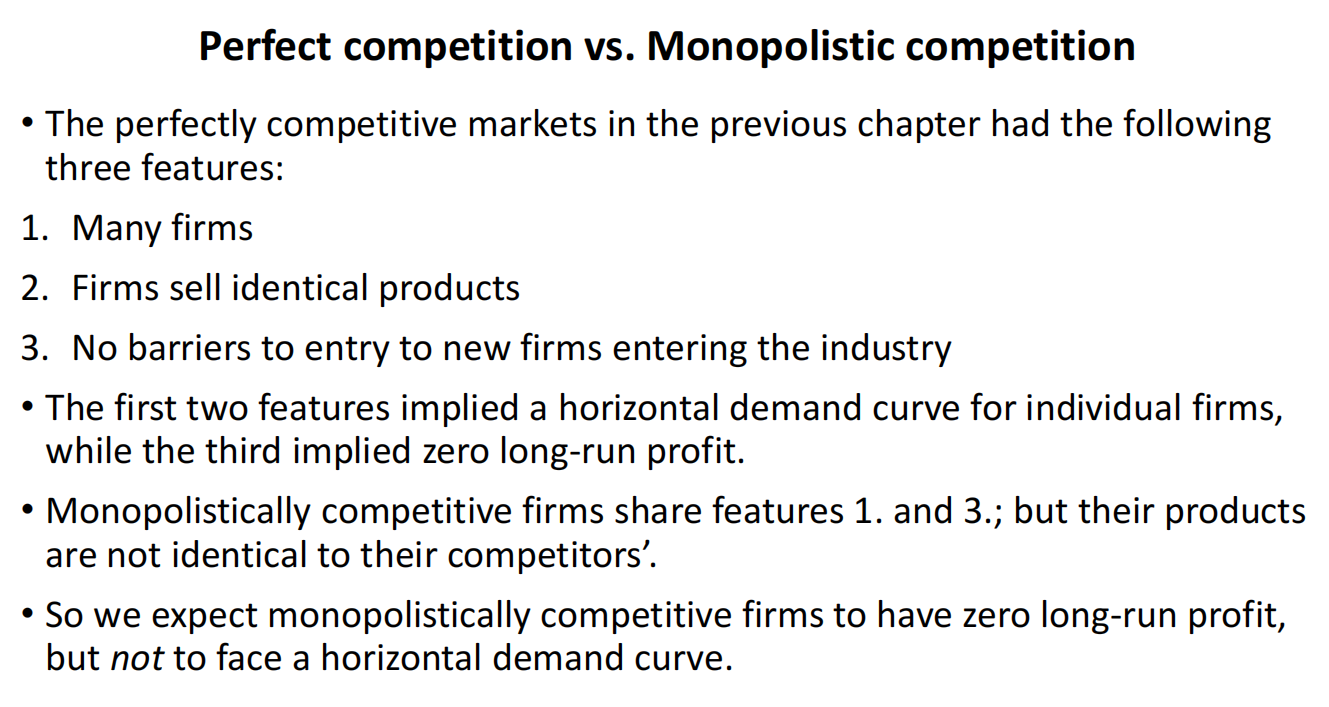
The perfectly competitive markets in the previous chapter had the following three features:
📖 点击查看译文
上一章中提到的完全竞争市场具有以下三个特征:
1. 众多企业;
2. 企业销售同质产品;
3. 新企业进入行业没有障碍。
The first two features implied a horizontal demand curve for individual firms, while the third implied zero long-run profit.
📖 点击查看译文
前两个特征意味着个别企业面对的是一条水平的需求曲线,而第三个特征意味着长期利润为零。
Monopolistically competitive firms share features 1 and 3; but their products are not identical to their competitors’.
📖 点击查看译文
垄断性竞争企业具有第1和第3个特征;但它们的产品与竞争对手的产品并不完全相同。
So we expect monopolistically competitive firms to have zero long-run profit, but not to face a horizontal demand curve.
📖 点击查看译文
因此,我们预计垄断性竞争企业在长期中也不会有利润,但它们面对的需求曲线不是水平的。
知识点列表与拓展 (Knowledge Points and Extensions):
1. Product Differentiation(产品差异化)
-
解释 (Explanation):
In monopolistic competition, firms differentiate their products from others through branding, quality, or features.
(在垄断性竞争中,企业通过品牌、质量或功能等方式使其产品与其他企业的产品有所区别。)
-
例子 (Example):
Coffee shops may all sell coffee, but each one may offer a unique blend or customer experience.
(咖啡店都卖咖啡,但每家店可能提供独特的配方或顾客体验。)
-
拓展 (Extension):
Product differentiation gives firms some price-setting power, leading to a downward-sloping demand curve for each firm.
(产品差异化赋予企业一定的定价权,从而导致其面临向下倾斜的需求曲线。)
2. Long-Run Zero Economic Profit(长期零经济利润)
-
解释 (Explanation):
In both perfect and monopolistic competition, free entry and exit drive economic profit to zero in the long run.
(在完全竞争和垄断性竞争中,企业可以自由进入或退出,导致长期经济利润为零。)
-
例子 (Example):
If a clothing brand earns high profits, new firms may enter with similar offerings, increasing competition and reducing profit.
(如果一家服装品牌赚取高额利润,其他企业可能会推出类似产品进入市场,从而增加竞争并降低利润。)
-
拓展 (Extension):
Firms in monopolistic competition may still enjoy short-run profits due to product uniqueness, but these are eroded as new entrants offer substitutes.
(垄断性竞争企业因产品独特性可能在短期内获得利润,但随着新竞争者推出替代品,这些利润会逐渐被侵蚀。)
2
Demand and Marginal Revenue in Monopolistic Competition(垄断性竞争市场中的需求与边际收益)
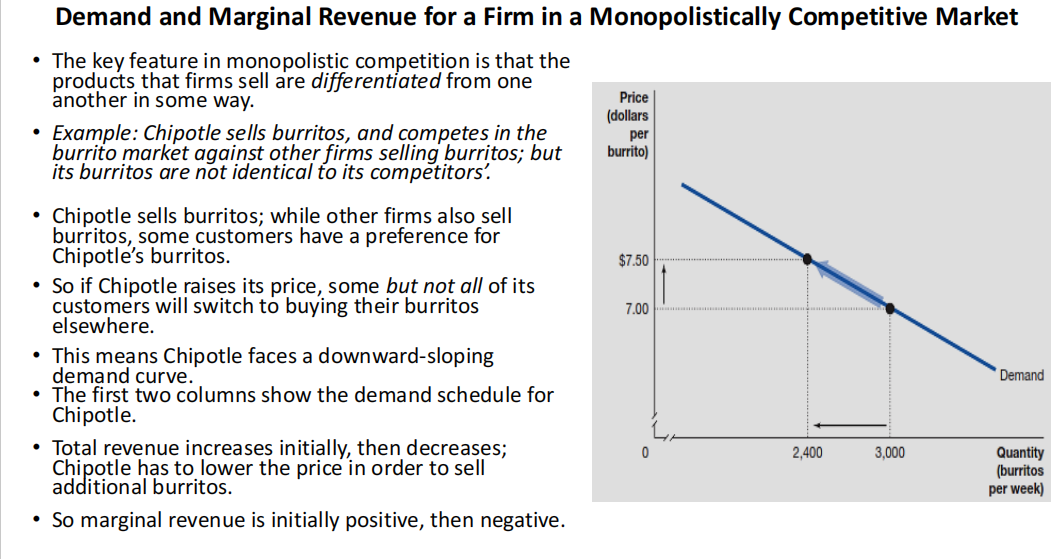
The key feature in monopolistic competition is that the products that firms sell are differentiated from one another in some way.
📖 点击查看译文
垄断性竞争的关键特征是,各企业销售的产品在某种程度上是有差异的。
Example: Chipotle sells burritos, and competes in the burrito market against other firms selling burritos; but its burritos are not identical to its competitors’.
📖 点击查看译文
例如:Chipotle卖卷饼,与其他卖卷饼的公司在同一市场竞争;但其卷饼与竞争对手的不完全相同。
Some customers have a preference for Chipotle’s burritos. So if Chipotle raises its price, some but not all of its customers will switch.
📖 点击查看译文
部分顾客偏好Chipotle的卷饼,因此如果Chipotle提价,一部分顾客会转向其他品牌,但不是全部。
This means Chipotle faces a downward-sloping demand curve.
📖 点击查看译文
这意味着Chipotle面对一条向下倾斜的需求曲线。
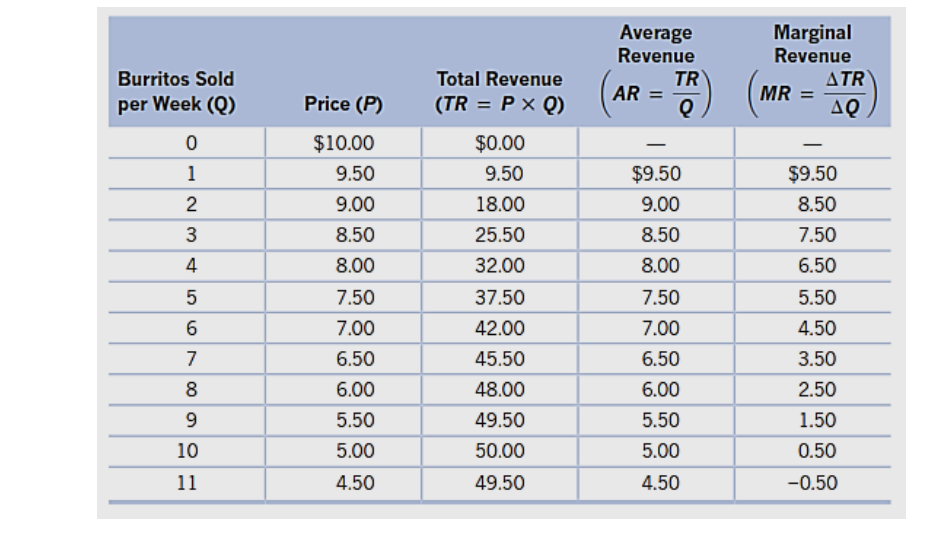
Total revenue increases initially, then decreases; marginal revenue is initially positive, then negative.
📖 点击查看译文
总收益起初上升,随后下降;边际收益开始为正,之后变为负。
知识点列表与拓展 (Knowledge Points and Extensions):
1. Downward-Sloping Demand Curve(向下倾斜的需求曲线)
-
解释 (Explanation):
Unlike perfect competition, firms in monopolistic competition face a downward-sloping demand curve due to product differentiation.
(与完全竞争不同,垄断性竞争中的企业由于产品差异化,会面对一条向下倾斜的需求曲线。)
-
例子 (Example):
Chipotle can increase price and still retain some customers who prefer its burritos, though others may switch.
(即使Chipotle提价,一些偏好其卷饼的顾客仍会继续购买,虽然其他顾客可能会转向别的品牌。)
-
拓展 (Extension):
This gives the firm some market power and the ability to influence price, unlike firms in perfect competition.
(这使得企业拥有一定的市场力量,可以影响价格,而这在完全竞争中是不存在的。)
2. Marginal Revenue Behavior(边际收益的变化规律)
-
解释 (Explanation):
As a firm lowers price to sell more units, marginal revenue declines and may become negative if the price cut reduces total revenue.
(企业为了多卖产品而降低价格时,边际收益会下降,若价格降低导致总收益减少,则边际收益可能变为负数。)
-
例子 (Example):
Chipotle may sell more burritos at a lower price, but the added revenue from those sales may not compensate for the lower price on all units.
(Chipotle虽然通过降价卖出更多卷饼,但由于所有卷饼都降价,总收益可能下降。)
-
拓展 (Extension):
Understanding marginal revenue is essential for firms to decide optimal output and pricing in monopolistic competition.
(理解边际收益对于垄断性竞争企业决定最优产量和定价至关重要。)
3
4
Output and Price Effects on Marginal Revenue(产出效应与价格效应对边际收益的影响)
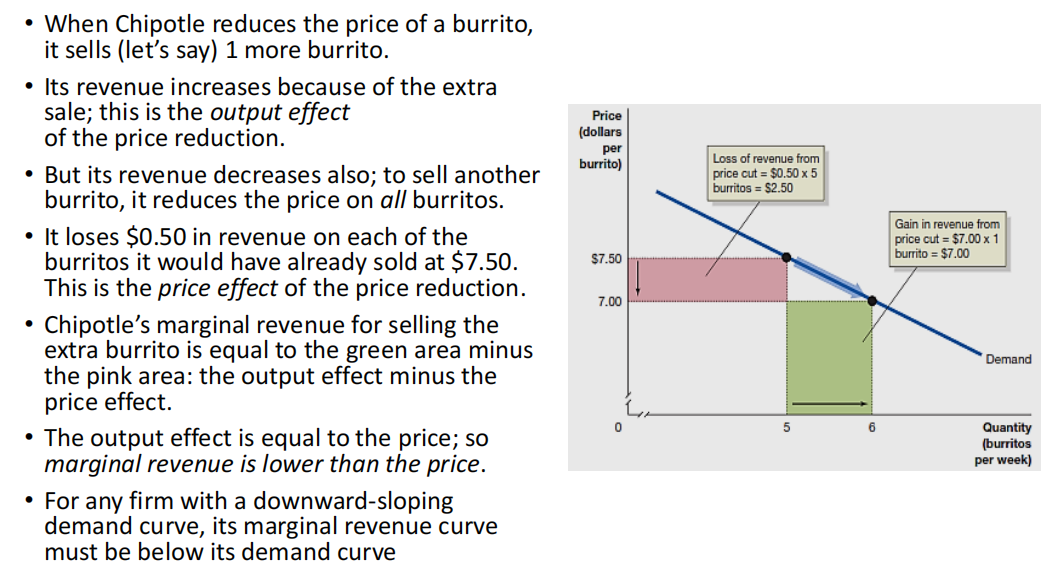
When Chipotle reduces the price of a burrito, it sells (let’s say) 1 more burrito.
📖 点击查看译文
当Chipotle降低卷饼价格时,比如说,它能多卖出1个卷饼。
Its revenue increases because of the extra sale; this is the output effect of the price reduction.
📖 点击查看译文
由于额外销售所带来的收入增长就是价格降低的“产出效应”。
But its revenue decreases also; to sell another burrito, it reduces the price on all burritos.
📖 点击查看译文
但其收入也会减少;为了多卖一个卷饼,Chipotle必须降低所有卷饼的价格。
It loses $0.50 in revenue on each of the burritos it would have already sold at $7.50. This is the price effect of the price reduction.
📖 点击查看译文
原本可以以0.50,这就是价格降低的“价格效应”。
Chipotle’s marginal revenue for selling the extra burrito is equal to the green area minus the pink area: the output effect minus the price effect.
📖 点击查看译文
Chipotle销售额外一个卷饼的边际收益等于绿色区域减去粉色区域:即产出效应减去价格效应。
The output effect is equal to the price; so marginal revenue is lower than the price.
📖 点击查看译文
产出效应等于价格,因此边际收益低于价格。
For any firm with a downward-sloping demand curve, its marginal revenue curve must be below its demand curve.
📖 点击查看译文
对于任何面临向下倾斜需求曲线的企业,其边际收益曲线都必须在需求曲线之下。
知识点列表与拓展 (Knowledge Points and Extensions):
1. Output Effect(产出效应)
-
解释 (Explanation):
The additional revenue from selling one more unit of a good.
(销售多一单位产品所带来的额外收入。)
-
例子 (Example):
Selling one more burrito at $7 adds $7 in revenue.
(以$7卖出一份额外的卷饼可增加$7的收入。)
-
拓展 (Extension):
This effect always increases total revenue and equals the price of the additional unit sold.
(该效应始终增加总收入,并等于额外销售产品的价格。)
2. Price Effect(价格效应)
-
解释 (Explanation):
The revenue lost from having to lower the price on all units sold.
(为多卖一单位而降低所有商品价格所造成的收入损失。)
-
例子 (Example):
Lowering price from $7.50 to $7 means losing $0.50 on each burrito that would have sold at $7.50.
(将价格从$7.50降至$7,每个本来可卖$7.50的卷饼损失$0.50。)
-
拓展 (Extension):
This effect grows larger as more units are sold, which is why marginal revenue eventually becomes negative.
(销售量越多,该效应损失越大,这就是为什么边际收益最终可能变为负值的原因。)
3. Marginal Revenue Curve Below Demand Curve(边际收益曲线在需求曲线之下)
-
解释 (Explanation):
Because of the price effect, marginal revenue is always less than price when demand is downward-sloping.
(由于价格效应的存在,在需求曲线向下倾斜时,边际收益总是低于价格。)
-
例子 (Example):
A firm sells at $7 but only gains $5.50 in marginal revenue because of the loss on previous units.
(企业售价为$7,但由于先前销量的损失,边际收益只有$5.50。)
-
拓展 (Extension):
The gap between demand and marginal revenue widens as price cuts affect more units.
(随着价格下调影响到更多商品单位,需求曲线与边际收益曲线之间的差距会加大。)
5
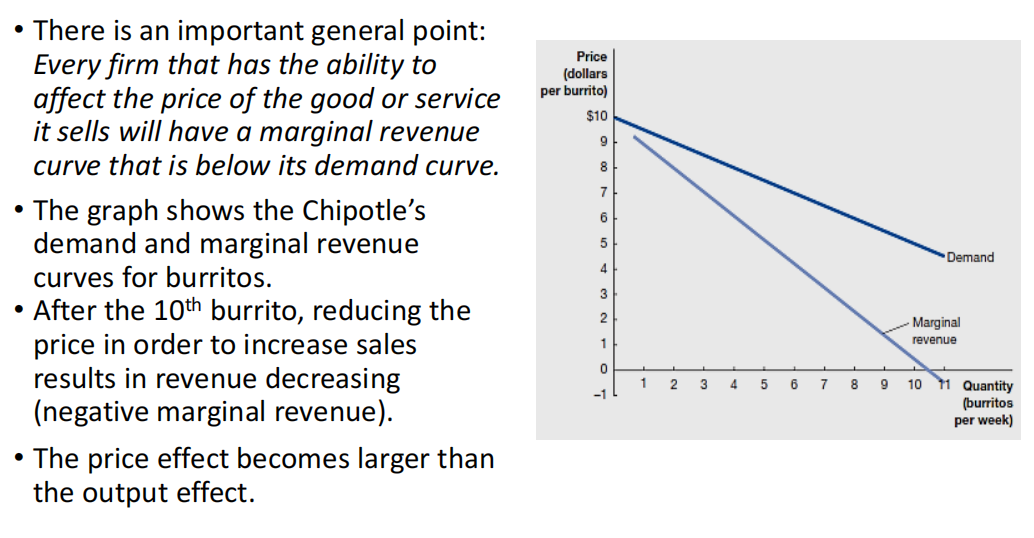
Price Makers and Marginal Revenue(价格制定者与边际收益)
Every firm that has the ability to affect the price of the good or service it sells will have a marginal revenue curve that is below its demand curve.
📖 点击查看译文
每一个能够影响其所销售商品或服务价格的企业,其边际收益曲线都会低于其需求曲线。
The graph shows Chipotle’s demand and marginal revenue curves for burritos.
📖 点击查看译文
图中显示了Chipotle的卷饼需求曲线与边际收益曲线。
After the 10th burrito, reducing the price in order to increase sales results in revenue decreasing (negative marginal revenue).
📖 点击查看译文
在第10个卷饼之后,为了增加销量而降价会导致收入减少(即边际收益为负)。
The price effect becomes larger than the output effect.
📖 点击查看译文
价格效应超过了产出效应。
知识点列表与拓展 (Knowledge Points and Extensions):
1. Price Makers(价格制定者)
-
解释 (Explanation):
A firm that has the ability to influence the market price of its product.
(能影响其产品市场价格的企业。)
-
例子 (Example):
Chipotle can raise or lower burrito prices and still retain some customers due to product differentiation.
(由于产品差异化,Chipotle可以上调或下调卷饼价格,仍保留部分顾客。)
-
拓展 (Extension):
Unlike in perfect competition, price makers face a downward-sloping demand curve and a marginal revenue curve beneath it.
(与完全竞争不同,价格制定者面临向下倾斜的需求曲线及其下方的边际收益曲线。)
2. Negative Marginal Revenue(负边际收益)
-
解释 (Explanation):
When the revenue from selling an additional unit is less than the revenue lost on prior units due to price reduction.
(当销售额外一单位带来的收入小于因降价对原有销售的损失时,边际收益为负。)
-
例子 (Example):
After the 10th burrito, each price cut decreases total revenue for Chipotle.
(在第10个卷饼之后,每次降价都会使Chipotle的总收入下降。)
-
拓展 (Extension):
Negative marginal revenue indicates the firm has passed the revenue-maximizing quantity and should not produce more.
(边际收益为负表明企业已超过最大收入产量,不应继续增加产量。)
6
Short-Run Profit Maximization in Monopolistic Competition(垄断竞争企业的短期利润最大化)
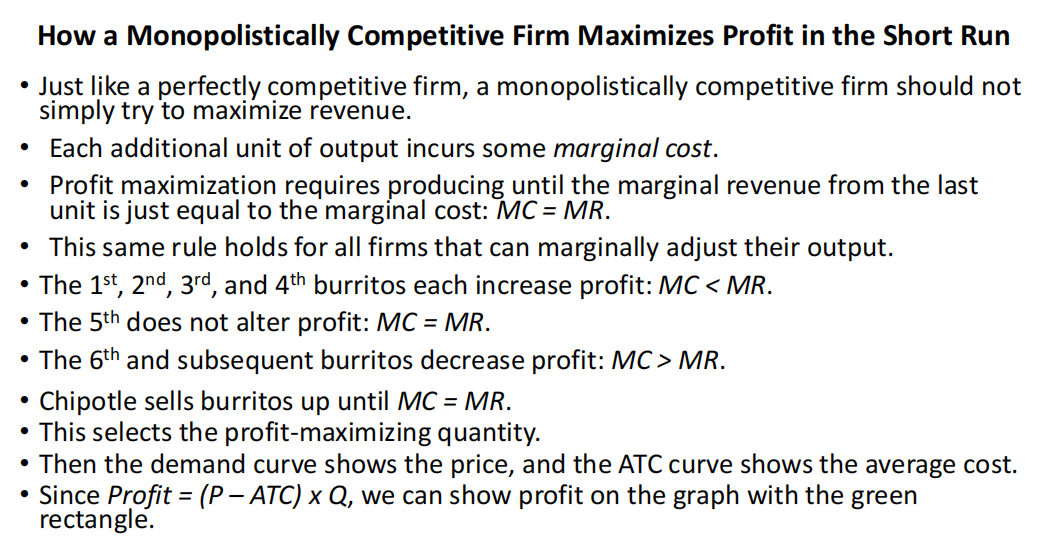
Profit maximization requires producing until the marginal revenue from the last unit is just equal to the marginal cost: MC = MR.
📖 点击查看译文
利润最大化要求生产到最后一单位的边际收益正好等于边际成本,即 MC = MR。
Chipotle sells burritos up until MC = MR. This selects the profit-maximizing quantity.
📖 点击查看译文
Chipotle 会一直销售卷饼,直到边际成本等于边际收益。这一产量就是使利润最大化的水平。
Then the demand curve shows the price, and the ATC curve shows the average cost.
📖 点击查看译文
此时,需求曲线决定价格,平均总成本(ATC)曲线显示平均成本。
Since Profit = (P – ATC) × Q, we can show profit on the graph with the green rectangle.
📖 点击查看译文
由于利润 =(价格 – 平均成本)× 数量,因此图中用绿色矩形可以表示利润。
知识点列表与拓展 (Knowledge Points and Extensions):
1. Profit Maximization Rule: MR = MC(利润最大化规则:边际收益等于边际成本)
-
解释 (Explanation):
A firm maximizes its profit by producing the quantity of output at which marginal revenue equals marginal cost.
(企业通过生产使边际收益等于边际成本的产量,实现利润最大化。)
-
例子 (Example):
When Chipotle evaluates whether to produce a 6th burrito, it compares the additional cost with the additional revenue. If MC > MR, it stops increasing output.
(当 Chipotle 考虑是否生产第6个卷饼时,会比较该卷饼的边际成本与边际收益;若成本高于收益,便不再增产。)
-
拓展 (Extension):
This rule is fundamental across market structures where firms have output decision power. In dynamic models, MR = MC can also incorporate intertemporal decisions and discounting.
(这一规则适用于所有有产量决策权的市场结构。在动态模型中,MR = MC 也可以结合跨期决策与贴现因子进行分析。)
2. Economic Profit in the Short Run(短期经济利润)
-
解释 (Explanation):
Economic profit is the difference between total revenue and total cost, including both explicit and implicit costs.
(经济利润是总收益减去总成本的差额,总成本包括显性成本和隐性成本。)
-
例子 (Example):
If Chipotle sells burritos at a price above average total cost, it earns positive short-run economic profit.
(如果 Chipotle 的售价高于平均总成本,它在短期内就获得正的经济利润。)
-
拓展 (Extension):
In the short run, monopolistically competitive firms may earn positive economic profit, but in the long run, free entry erodes it. This insight is critical to understanding firm turnover and innovation incentives.
(在短期内,垄断竞争企业可能获得经济利润;但长期中,自由进入会抹平利润。这一结论对于理解企业更替和创新激励机制至关重要。)
7
Identifying Profit in Monopolistic Competition (在垄断竞争中识别利润)
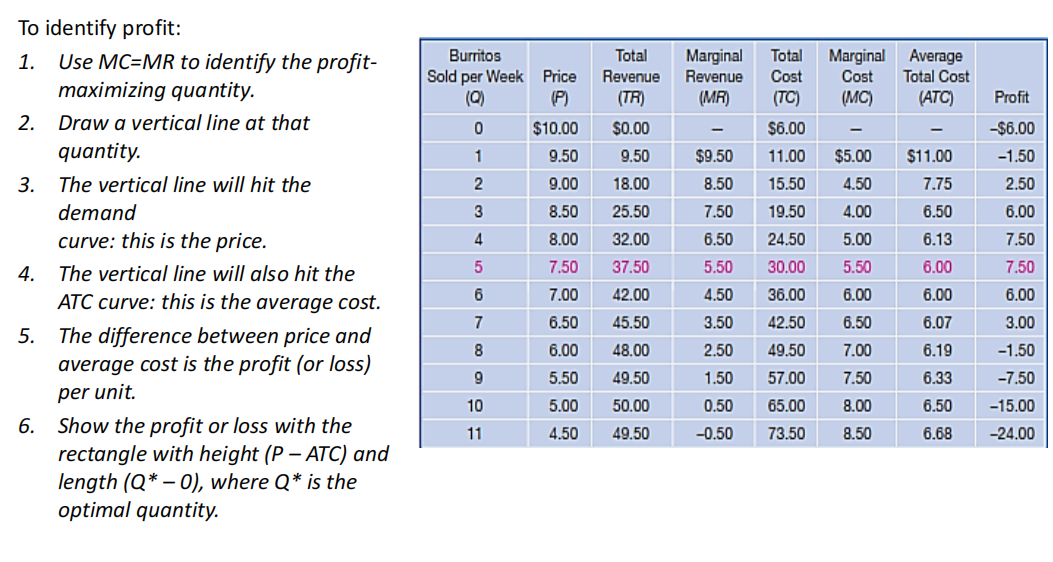
To identify profit:
📖 点击查看译文
识别利润的步骤如下:
- 使用 MC=MR 规则确定利润最大化产量。
- 在该产量处画一条垂直线。
- 这条垂直线与需求曲线的交点对应的是价格。
- 它与平均总成本(ATC)曲线的交点对应的是平均成本。
- 价格与平均成本的差额就是每单位产品的利润(或亏损)。
- 将高度为 (P – ATC)、长度为 (Q* – 0) 的矩形画在图上,即表示总利润或亏损。
知识点列表与拓展 (Knowledge Points and Extensions):
1. Price-Cost Margin & Market Power (价格-成本加成与市场势力)
-
解释 (Explanation):
The price-cost margin (P – MC)/P reflects the degree of market power a firm holds. In monopolistic competition, this margin is positive, indicating some pricing power due to product differentiation.
(价格-成本加成 (P – MC)/P 表示企业拥有的市场势力程度。在垄断竞争中,该加成为正,表明企业因产品差异化而具备一定的定价能力。)
-
拓展 (Extension):
The Lerner Index is often used to quantify market power using this margin. A higher index means greater market power and less allocative efficiency, implying a deadweight loss.
(勒纳指数常用于通过该加成衡量市场势力。指数越高,表明市场势力越强,资源配置效率越低,意味着存在无谓损失。)
2. Graphical Profit Representation & Welfare Implications (图形中的利润表达与福利影响)
-
解释 (Explanation):
Representing profit with a rectangle of area (P – ATC) × Q* helps visualize short-run profitability. However, since price exceeds marginal cost (P > MC), there is underproduction from a welfare perspective.
(用面积为 (P – ATC) × Q* 的矩形来表示利润,有助于可视化短期盈利。但由于价格高于边际成本(P > MC),从社会福利角度看存在产量不足。)
-
拓展 (Extension):
This inefficiency leads to deadweight loss in monopolistic competition, highlighting the trade-off between product variety and allocative efficiency.
(这种低效率在垄断竞争中会造成无谓损失,反映出产品多样性与资源配置效率之间的权衡关系。)
8
Short-Run Profit Maximization in Practice (实践中的短期利润最大化)
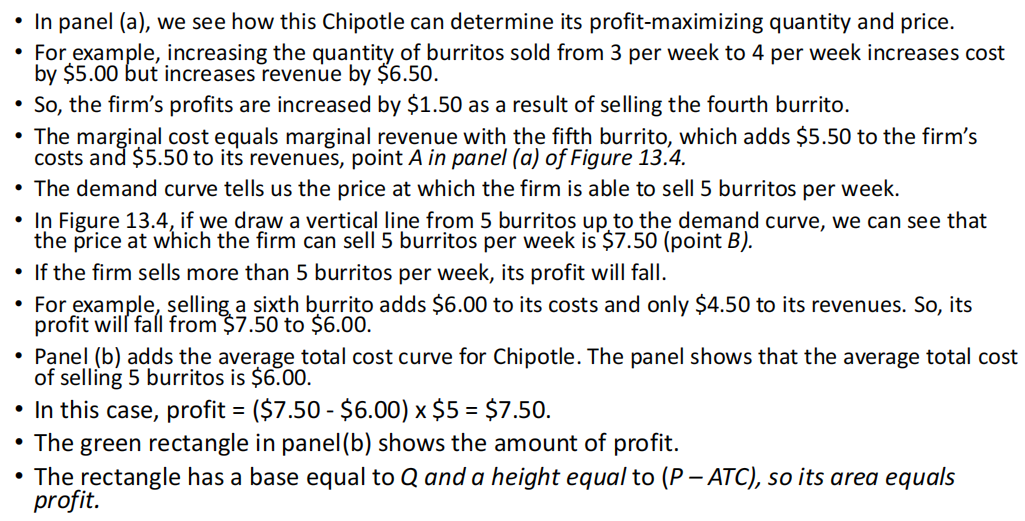
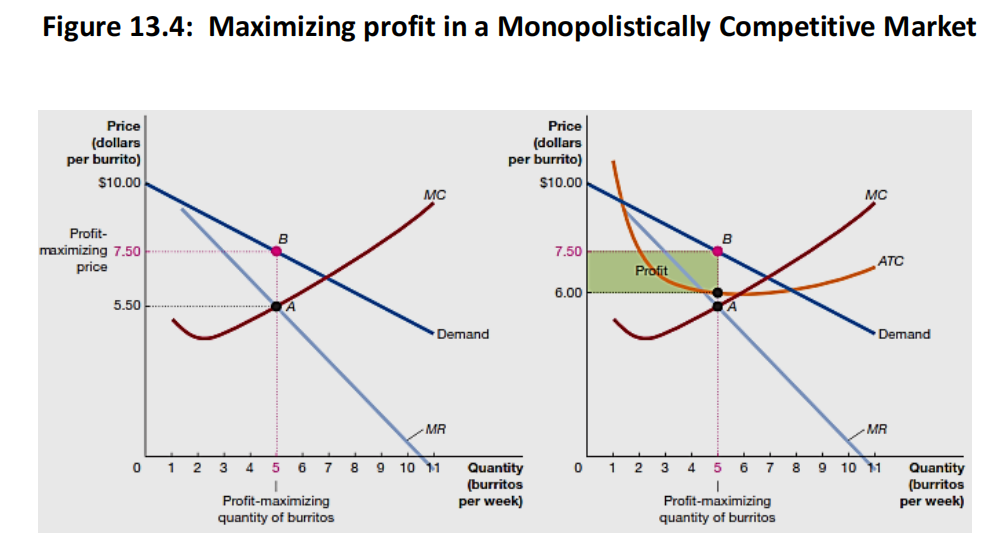
In panel (a), Chipotle identifies the profit-maximizing quantity and price by comparing marginal cost and marginal revenue.
📖 点击查看译文
在图(a)中,Chipotle通过比较边际成本和边际收益来确定利润最大化的产量和价格。
- 例如,每周将销售数量从3个增加到4个,成本增加$5.00,收入增加$6.50,利润因此上升$1.50。
- 第五个墨西哥卷饼使边际成本等于边际收益(均为$5.50),对应图(a)中的点A。
- 从5的产量处向上画垂直线至需求曲线,我们可以找到每周销售5个墨西哥卷饼的价格为$7.50(点B)。
- 超过该数量会导致利润下降,例如第六个的收益仅为$4.50,但成本为$6.00。
图(b)加入了平均总成本曲线,显示了利润的图形表示。
- 平均总成本为$6.00,售价为$7.50,因此单个利润为$1.50。
- 总利润 = ($7.50 - $6.00) × 5 = $7.50,用绿色矩形表示。
知识点列表与拓展 (Knowledge Points and Extensions):
1. Profit Box Geometry & Comparative Statics (利润矩形几何与比较静态分析)
-
解释 (Explanation):
The green rectangle representing profit in a cost-revenue diagram encapsulates both firm performance and equilibrium. Its size is sensitive to changes in price, average cost, or quantity.
(成本-收益图中表示利润的绿色矩形同时体现了企业表现与均衡状态。该矩形面积对价格、平均成本或产量的变化非常敏感。)
-
拓展 (Extension):
Comparative statics can analyze how changes in input prices, demand elasticity, or fixed costs shift ATC or demand curves, altering the shape and area of the profit rectangle.
(比较静态分析可用来研究投入价格、需求弹性或固定成本的变化如何移动ATC或需求曲线,从而改变利润矩形的形状和面积。)
2. Efficiency Loss in Output Expansion (产量扩张中的效率损失)
-
解释 (Explanation):
Selling beyond the profit-maximizing quantity leads to diminishing returns: marginal cost exceeds marginal revenue, reducing total profit.
(超过利润最大化产量的销售会导致收益递减:边际成本大于边际收益,从而减少总利润。)
-
拓展 (Extension):
This concept connects with the idea of productive efficiency. A monopolistically competitive firm may not operate at the minimum point of the ATC curve, indicating underutilization of resources.
(这一概念关联到生产效率问题。垄断竞争企业可能不会在ATC曲线的最低点运行,表明资源利用不足。)
9
10
Price and Marginal Cost in Monopolistic Competition (垄断竞争中的价格与边际成本关系)
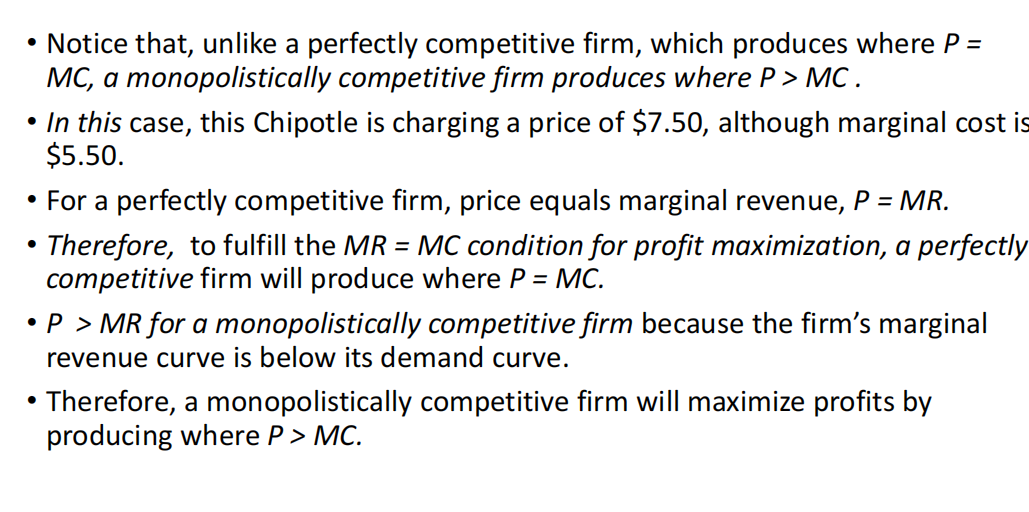
Unlike a perfectly competitive firm, a monopolistically competitive firm produces where price is greater than marginal cost (P > MC).
📖 点击查看译文
与完全竞争企业不同,垄断竞争企业的产量选择使得价格高于边际成本(P > MC)。
- 例如,Chipotle定价为$7.50,而边际成本为$5.50。
- 完全竞争企业的价格等于边际收益(P = MR),利润最大化时满足MR = MC,因此产生于P = MC点。
- 垄断竞争企业的边际收益曲线低于需求曲线,导致P > MR。
- 因此,垄断竞争企业的利润最大化产量对应P > MC的情况。
知识点列表与拓展 (Knowledge Points and Extensions):
1. Markup Pricing and Market Power (加价定价与市场势力)
-
解释 (Explanation):
The condition P > MC indicates that firms possess some degree of market power, enabling them to set prices above marginal costs.
(P > MC表明企业拥有一定市场势力,能够将价格设定在边际成本之上。)
-
拓展 (Extension):
Markup pricing reflects product differentiation and downward-sloping demand, leading to allocative inefficiency compared to perfect competition where P = MC.
(加价定价反映了产品差异化和向下倾斜的需求曲线,导致相较于P = MC的完全竞争存在配置效率低下。)
2. Economic Implications of P > MC (P > MC的经济含义)
-
解释 (Explanation):
Producing where P > MC implies a deadweight loss, as the firm restricts output to raise prices above marginal costs, reducing total surplus.
(在P > MC点生产意味着存在无谓损失,因为企业限制产量以提高价格,降低了总社会福利。)
-
拓展 (Extension):
This deadweight loss is a key argument for regulation or policies encouraging competition and reducing barriers to entry in monopolistically competitive markets.
(无谓损失是监管或鼓励竞争、降低垄断竞争市场进入壁垒政策的重要理论依据。)
11
Long-Run Profit Adjustments in Monopolistic Competition (垄断竞争的长期利润调整)
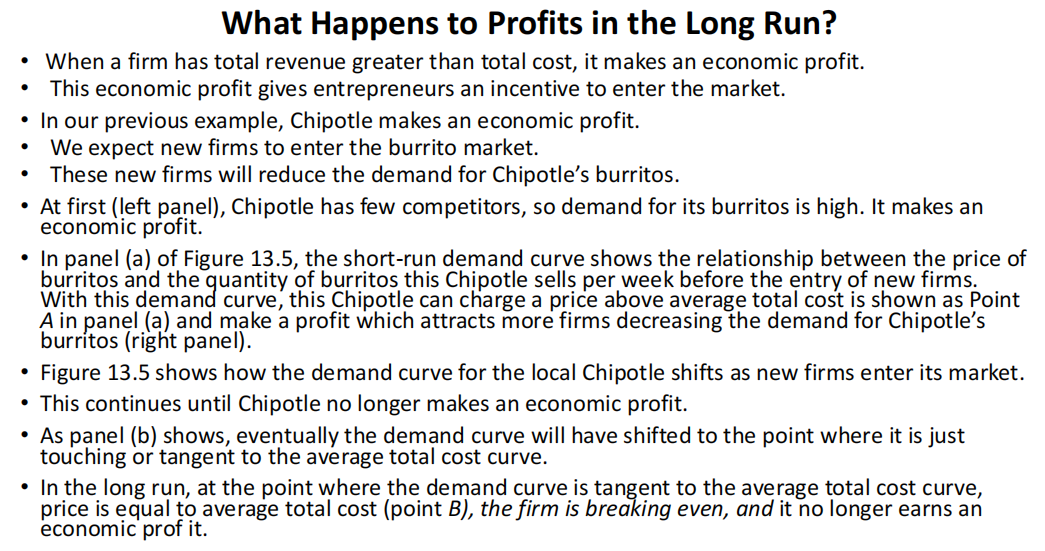
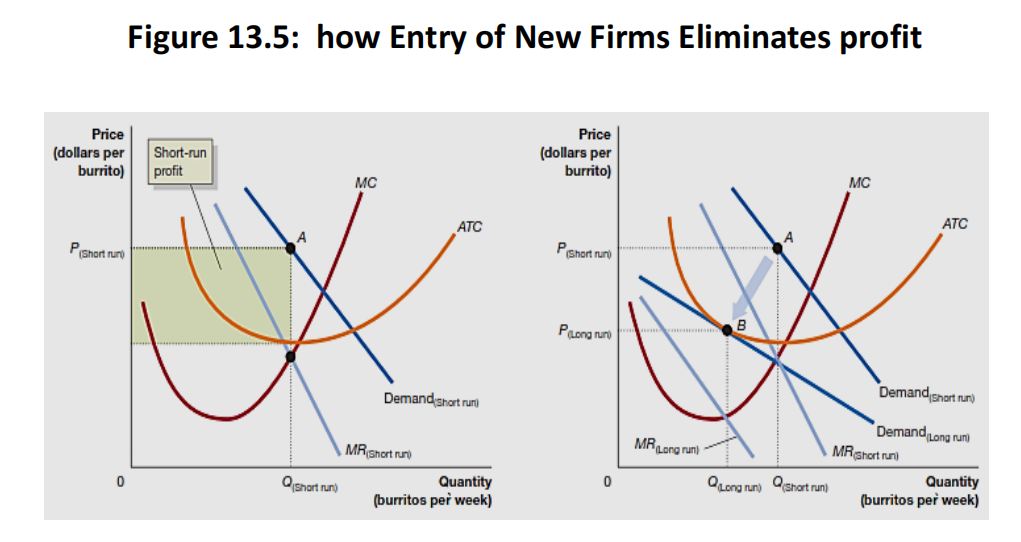
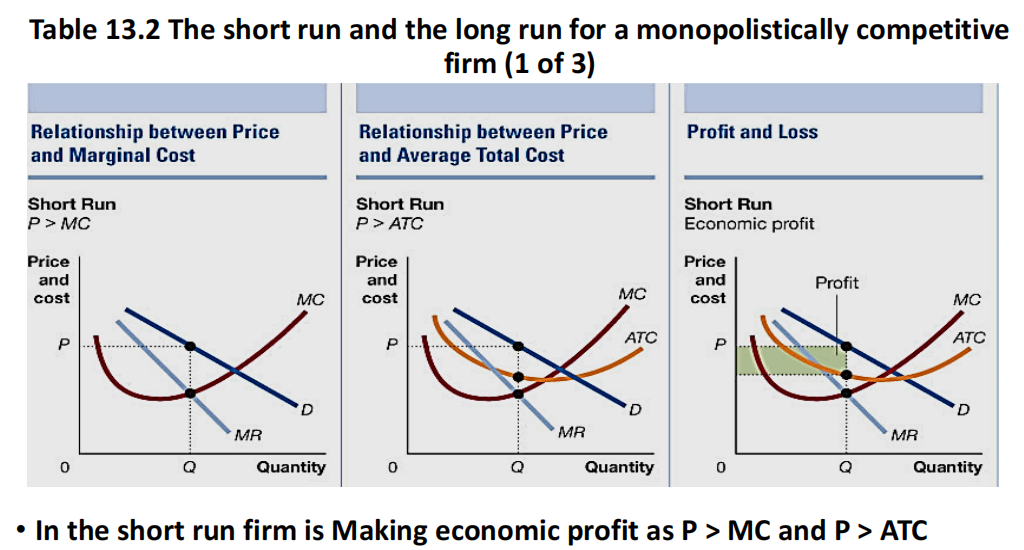
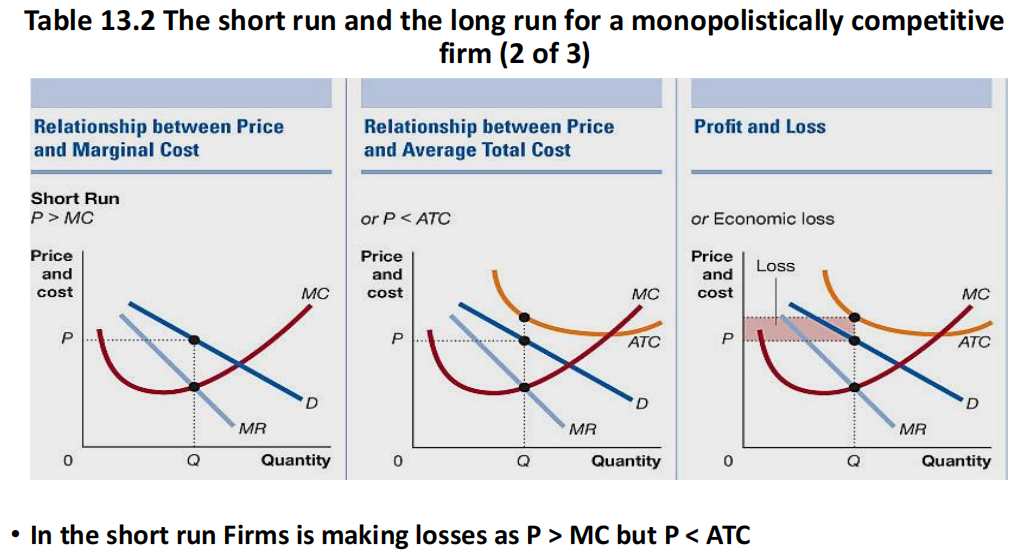
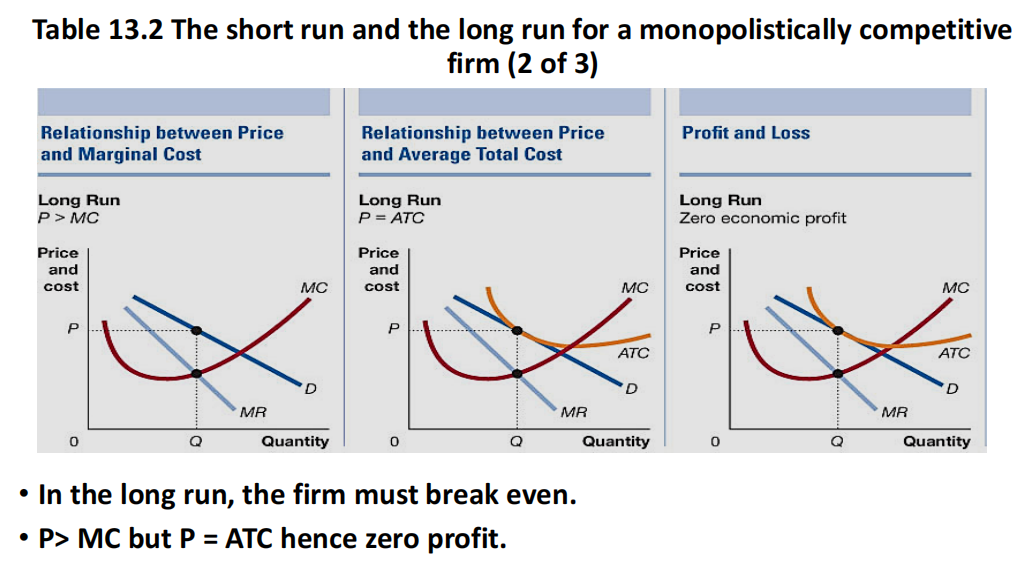
When firms earn economic profit, new entrants are attracted, increasing competition and reducing demand for existing firms’ products, driving profits to zero in the long run.
📖 点击查看译文
当企业获得经济利润时,会吸引新进入者,增加竞争,减少现有企业产品的需求,长期利润趋于零。
- 起初,Chipotle由于竞争者少,需求较高,获得经济利润。
- 新企业进入市场,需求曲线向左移动,Chipotle的需求减少。
- 最终需求曲线与平均总成本曲线相切,价格等于平均总成本,企业仅盈亏平衡,不再赚取经济利润。
知识点列表与拓展 (Knowledge Points and Extensions):
1. Free Entry and Exit in Monopolistic Competition (自由进出机制)
-
解释 (Explanation):
The absence of barriers allows firms to enter when profits exist and exit when profits are negative, pushing economic profit toward zero in the long run.
(无进入壁垒使得利润存在时企业进入,亏损时退出,长期使经济利润趋近于零。)
-
拓展 (Extension):
This dynamic equilibrium illustrates the role of contestable markets, where potential competition disciplines pricing and output even if firms have some market power.
(这一动态均衡体现了可竞争市场的作用,即使企业有市场势力,潜在竞争仍制约定价和产量。)
2. Demand Curve Tangency to ATC and Zero Economic Profit (需求曲线与ATC相切及零经济利润)
-
解释 (Explanation):
The tangency point means the firm sets price equal to average total cost but still has a downward-sloping demand curve and some market power.
(相切点表示价格等于平均总成本,但需求曲线仍向下倾斜,企业具备一定市场势力。)
-
拓展 (Extension):
Unlike perfect competition, zero economic profit here does not imply productive efficiency since the firm does not produce at minimum ATC, highlighting excess capacity in monopolistic competition.
(不同于完全竞争,这里的零经济利润不等同于生产效率最大化,企业未达到最小ATC,体现出垄断竞争中的过剩产能。)
12
13
14
15
16
Zero Profit in the Long Run? (长期零利润?)
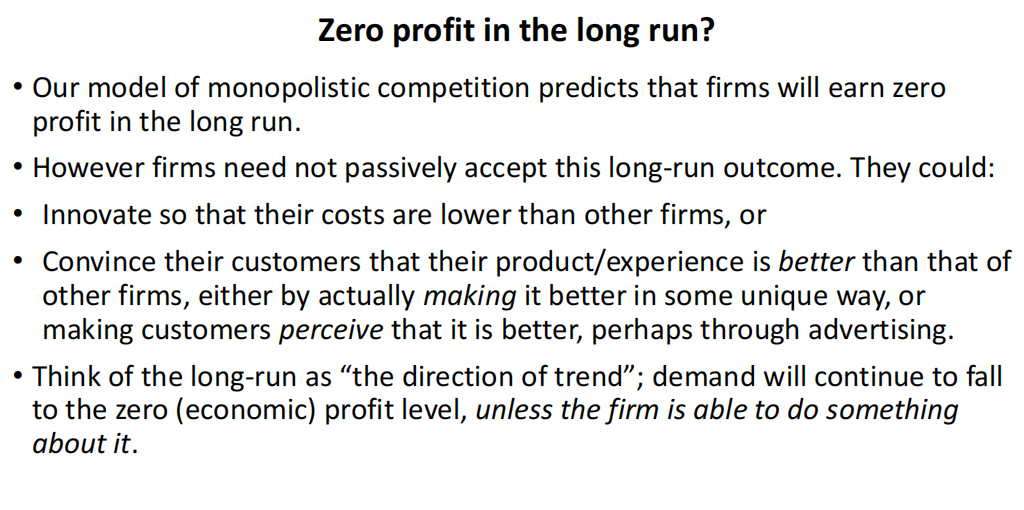
Our model of monopolistic competition predicts that firms will earn zero profit in the long run.
📖 点击查看译文
我们的垄断竞争模型预测,企业在长期内将获得零利润。
However firms need not passively accept this long-run outcome.
📖 点击查看译文
然而,企业不必被动接受这一长期结果。
They could innovate so that their costs are lower than other firms, or
📖 点击查看译文
它们可以通过创新使成本低于其他企业,或者
Convince their customers that their product/experience is better than that of other firms, either by actually making it better in some unique way, or making customers perceive that it is better, perhaps through advertising.
📖 点击查看译文
说服顾客他们的产品或体验优于其他企业,可能是通过某种独特方式实际提升产品质量,或者通过广告等方式让顾客感知其更优。
Think of the long-run as “the direction of trend”; demand will continue to fall to the zero (economic) profit level, unless the firm is able to do something about it.
📖 点击查看译文
可以将长期视为“趋势方向”;除非企业采取措施,否则需求将持续下降至零(经济)利润水平。
知识点列表与拓展 (Knowledge Points and Extensions):
1. Product Differentiation and Market Power (产品差异化与市场势力)
-
解释 (Explanation):
Firms that successfully differentiate their products can maintain some market power, allowing them to sustain profits above zero by reducing direct competition.
(成功差异化产品的企业可以维持一定的市场势力,通过减少直接竞争维持正利润。)
-
拓展 (Extension):
Differentiation strategies include product innovation, branding, customer experience, and marketing, all of which influence consumers’ willingness to pay and reduce price elasticity of demand.
(差异化策略包括产品创新、品牌建设、客户体验和市场营销,这些都影响消费者的支付意愿并降低需求的价格弹性。)
2. Dynamic Competition and Innovation (动态竞争与创新)
-
解释 (Explanation):
In monopolistic competition, firms engage in dynamic competition where continuous innovation is essential to sustain profitability and avoid long-run zero economic profits.
(在垄断竞争中,企业参与动态竞争,持续创新对于保持盈利能力和避免长期零经济利润至关重要。)
-
拓展 (Extension):
This dynamic process promotes technological progress and improved product quality but may also lead to increased marketing costs and advertising expenditures as firms compete for customer loyalty.
(这一动态过程促进技术进步和产品质量提升,但也可能导致营销成本和广告开支增加,因为企业争夺客户忠诚度。)
17
Comparing Monopolistic Competition and Perfect Competition (垄断竞争与完全竞争的比较)
We know that perfectly competitive firms achieved productive and allocative efficiency.
📖 点击查看译文
我们知道完全竞争的企业实现了生产效率和配置效率。
Productive efficiency refers to producing items at the lowest possible cost.
📖 点击查看译文
生产效率是指以最低可能成本生产产品。
Allocative efficiency refers to producing all goods up to the point where the marginal benefit to consumers is just equal to the marginal cost to firms.
📖 点击查看译文
配置效率是指生产所有商品直到消费者的边际效益刚好等于企业的边际成本。
Monopolistic competition results in neither productive nor allocative efficiency.
📖 点击查看译文
垄断竞争既不产生生产效率,也不产生配置效率。
Excess Capacity under Monopolistic Competition (垄断竞争下的过剩产能)
A firm in a perfectly competitive market faces a perfectly elastic demand curve that is also its marginal revenue curve.
📖 点击查看译文
完全竞争市场中的企业面临完全弹性的需求曲线,这条曲线同时也是其边际收益曲线。
Therefore, the firm maximizes profit by producing the quantity where price equals marginal cost.
📖 点击查看译文
因此,企业通过生产价格等于边际成本的产量来实现利润最大化。
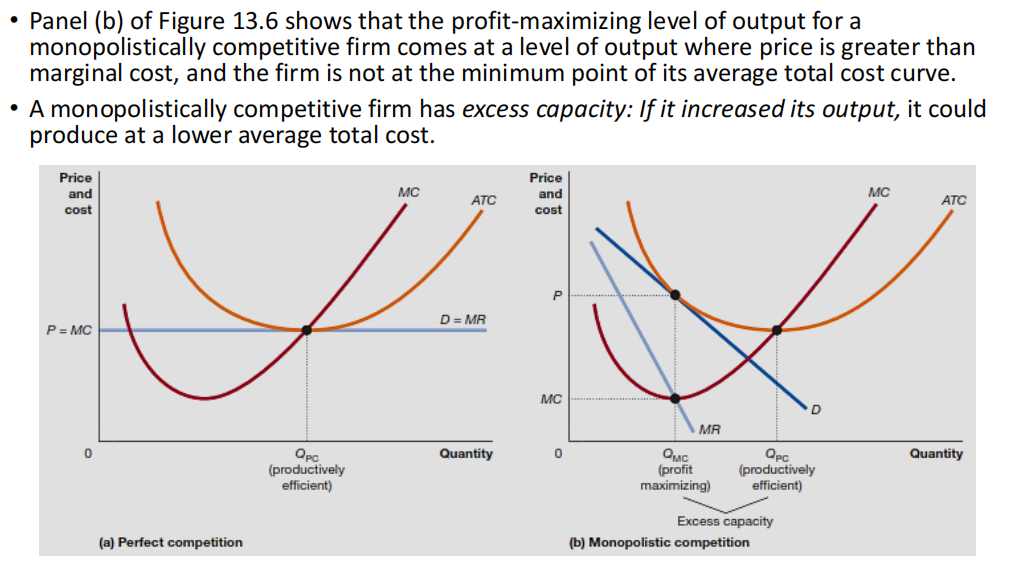
As panel (a) of Figure 13.6 shows, in long-run equilibrium, a perfectly competitive firm produces at the minimum point of its average total cost curve.
📖 点击查看译文
如图13.6(a)面板所示,在长期均衡中,完全竞争企业在其平均总成本曲线的最低点生产。
A perfectly competitive firm in long-run equilibrium produces at QPC, where price equals marginal cost, and average total cost is at a minimum.
📖 点击查看译文
完全竞争企业在长期均衡时生产于QPC点,价格等于边际成本,且平均总成本达到最低。
The perfectly competitive firm is both allocatively efficient and productively efficient.
📖 点击查看译文
完全竞争企业既实现了配置效率,也实现了生产效率。
知识点列表与拓展 (Knowledge Points and Extensions):
1. Efficiency Concepts in Market Structures (市场结构中的效率概念)
-
解释 (Explanation):
Productive efficiency occurs when firms produce at minimum average total cost; allocative efficiency occurs when the price consumers pay equals the marginal cost of production.
(生产效率发生在企业以最低平均总成本生产时;配置效率发生在消费者支付的价格等于生产的边际成本时。)
-
拓展 (Extension):
Perfect competition uniquely achieves both efficiencies due to price-taking behavior and absence of market power, while monopolistic competition fails because of product differentiation and downward-sloping demand curves.
(完全竞争因价格接受者行为和缺乏市场势力而独特地实现了这两种效率,而垄断竞争因产品差异化和需求曲线向下倾斜而未能实现。)
2. Excess Capacity and Its Implications (过剩产能及其影响)
-
解释 (Explanation):
Firms in monopolistic competition produce below their minimum average total cost, creating excess capacity and higher average costs compared to perfectly competitive firms.
(垄断竞争企业的生产量低于其平均总成本最低点,导致过剩产能和比完全竞争企业更高的平均成本。)
-
拓展 (Extension):
Excess capacity reflects inefficiency and suggests resources are underutilized; it also implies that firms cannot fully exploit economies of scale due to market power constraints and product variety preferences.
(过剩产能反映了效率低下,表明资源未被充分利用;这也意味着企业因市场势力限制和产品多样性偏好而无法充分利用规模经济。)
18
19
Efficiency and Consumer Welfare in Monopolistic Competition (垄断竞争中的效率与消费者福利)
In a perfectly competitive market, both productive efficiency and allocative efficiency are achieved, but in a monopolistically competitive market, neither is achieved.
📖 点击查看译文
在完全竞争市场中,既实现了生产效率又实现了配置效率,而在垄断竞争市场中,两者均未实现。
Does it matter?
📖 点击查看译文
这是否重要?
Economists have debated whether monopolistically competitive markets being neither productively nor allocatively efficient results in a significant loss of well-being to society in these markets compared with perfectly competitive markets.
📖 点击查看译文
经济学家们争论过,垄断竞争市场既不具备生产效率也不具备配置效率,是否会导致与完全竞争市场相比,社会福利出现显著损失。
Is Monopolistic Competition Bad for Consumers? (垄断竞争对消费者有害吗?)
The lack of efficiency suggests that monopolistic competition is a bad situation for consumers.
📖 点击查看译文
效率的缺失表明垄断竞争对消费者来说可能是不利的。
But consumers might benefit from the product differentiation.
📖 点击查看译文
但是消费者可能会从产品差异化中受益。
Example: If you were buying a car, would you prefer one
📖 点击查看译文
举例:如果你在买车,你会更倾向于买哪一种?
a. Produced and sold at the lowest possible cost, but not well-suited to your tastes and preferences; or
📖 点击查看译文
a. 以最低可能成本生产和销售,但不符合你的品味和偏好;还是
b. Produced and sold at a higher cost, but designed to attract you to purchasing it?
📖 点击查看译文
b. 以更高成本生产和销售,但设计上能吸引你购买?
Many consumers are willing to accept a higher price for a differentiated product. So monopolistic competition is not necessarily bad for consumers.
📖 点击查看译文
许多消费者愿意为差异化产品支付更高的价格,因此垄断竞争不一定对消费者不利。
知识点列表与拓展 (Knowledge Points and Extensions):
1. Trade-offs Between Efficiency and Product Differentiation (效率与产品差异化之间的权衡)
-
解释 (Explanation):
While monopolistic competition sacrifices some productive and allocative efficiency, it introduces variety and innovation through product differentiation, which can increase consumer satisfaction.
(垄断竞争虽然牺牲了部分生产效率和配置效率,但通过产品差异化引入了多样性和创新,从而提升了消费者满意度。)
-
拓展 (Extension):
This trade-off reflects a fundamental economic dilemma where markets must balance efficiency with diversity; product differentiation may justify a welfare loss by catering better to heterogeneous consumer preferences.
(这种权衡反映了一个根本的经济学难题,即市场必须在效率与多样性之间取得平衡;产品差异化通过更好地满足异质消费者偏好,可能弥补效率损失带来的福利缺口。)
2. Consumer Surplus and Monopolistic Competition (消费者剩余与垄断竞争)
-
解释 (Explanation):
Consumer surplus might be affected negatively by higher prices but positively by increased product variety and perceived value.
(消费者剩余可能因价格上涨而减少,但因产品多样性和感知价值提升而增加。)
-
拓展 (Extension):
Economic welfare analyses of monopolistic competition consider both price effects and utility gains from product variety, often finding that differentiated products contribute positively to overall consumer welfare despite inefficiencies.
(对垄断竞争的经济福利分析同时考虑价格效应和产品多样性带来的效用收益,常发现尽管存在效率损失,差异化产品仍对整体消费者福利有积极贡献。)
20
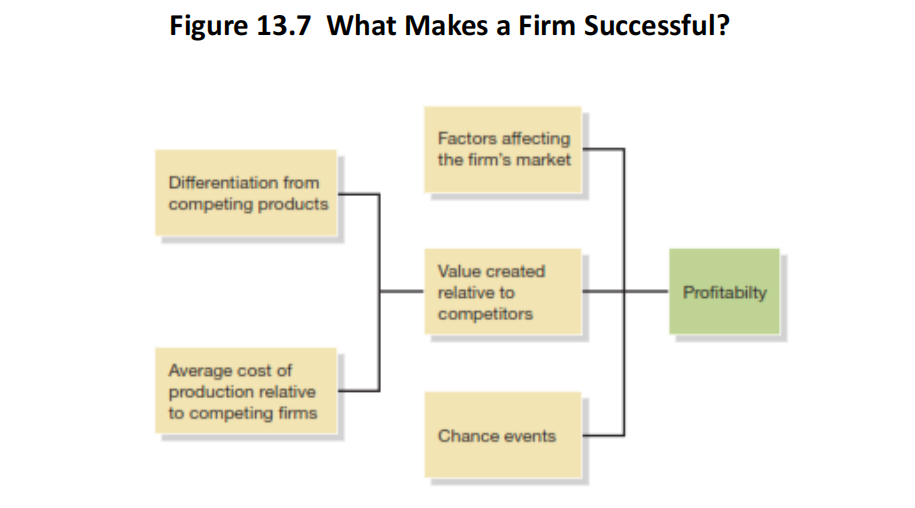
What Makes a Firm Successful? 什么因素使企业成功?
• A firm’s ability to differentiate its product and to produce it at a lower average cost than competing firms creates value for its customers.
📖 点击查看译文
企业能够区分其产品并以低于竞争对手的平均成本生产,这为客户创造了价值。
• Some factors that affect a firm’s profitability are not directly under the firm’s control. Certain factors will affect all the firms in a market.
📖 点击查看译文
影响企业盈利能力的一些因素并非由企业直接控制,某些因素会影响市场上所有企业。
• For example, rising prices for jet fuel will reduce the profitability of all airlines. When many consumers decided that rather than buy DVDs, they preferred to download or stream movies from Netflix, iTunes, or Amazon, the profitability of all stores selling DVDs was reduced.
📖 点击查看译文
例如,喷气燃料价格上涨会降低所有航空公司的盈利能力。当许多消费者决定不再购买DVD,而选择从Netflix、iTunes或Amazon下载或在线播放电影时,所有销售DVD的商店的盈利能力都受到影响。
• The factors under a firm’s control—the ability to differentiate its product and the ability to produce it at lower cost—combine with the factors beyond its control to determine the firm’s profitability.
📖 点击查看译文
企业能够控制的因素——产品差异化能力和以较低成本生产的能力——与其无法控制的因素共同决定了企业的盈利能力。
知识点列表与拓展 (Knowledge Points and Extensions):
1. Internal vs External Factors Affecting Profitability (影响盈利能力的内部与外部因素)
-
解释 (Explanation):
Profitability depends on both internal capabilities like cost control and product differentiation, and external market conditions such as input costs or consumer preferences.
(盈利能力取决于内部能力如成本控制和产品差异化,以及外部市场条件如投入成本或消费者偏好。)
-
拓展 (Extension):
Firms that excel in managing internal factors while adapting to external changes tend to sustain long-term competitive advantage.
(能够管理好内部因素并适应外部变化的企业,往往能保持长期竞争优势。)
2. Market-Wide Shocks and Firm Performance (市场冲击与企业表现)
-
解释 (Explanation):
External shocks, like rising fuel prices or shifts in consumer technology preferences, affect all firms in an industry similarly, impacting overall profitability.
(外部冲击,如燃料价格上涨或消费者技术偏好的变化,会类似地影响行业内所有企业的盈利能力。)
-
拓展 (Extension):
Understanding industry trends helps firms anticipate these shocks and adjust strategies proactively.
(了解行业趋势有助于企业预见这些冲击并主动调整战略。)
21
2. Negative Marginal Revenue(负边际收益)
-
解释 (Explanation):
When the revenue from selling an additional unit is less than the revenue lost on prior units due to price reduction.
(当销售额外一单位带来的收入小于因降价对原有销售的损失时,边际收益为负。)
-
例子 (Example):
After the 10th burrito, each price cut decreases total revenue for Chipotle.
(在第10个卷饼之后,每次降价都会使Chipotle的总收入下降。)
-
拓展 (Extension):
Negative marginal revenue indicates the firm has passed the revenue-maximizing quantity and should not produce more.
(边际收益为负表明企业已超过最大收入产量,不应继续增加产量。)
6

Short-Run Profit Maximization in Monopolistic Competition(垄断竞争企业的短期利润最大化)
Profit maximization requires producing until the marginal revenue from the last unit is just equal to the marginal cost: MC = MR.
📖 点击查看译文
利润最大化要求生产到最后一单位的边际收益正好等于边际成本,即 MC = MR。
Chipotle sells burritos up until MC = MR. This selects the profit-maximizing quantity.
📖 点击查看译文
Chipotle 会一直销售卷饼,直到边际成本等于边际收益。这一产量就是使利润最大化的水平。
Then the demand curve shows the price, and the ATC curve shows the average cost.
📖 点击查看译文
此时,需求曲线决定价格,平均总成本(ATC)曲线显示平均成本。
Since Profit = (P – ATC) × Q, we can show profit on the graph with the green rectangle.
📖 点击查看译文
由于利润 =(价格 – 平均成本)× 数量,因此图中用绿色矩形可以表示利润。
知识点列表与拓展 (Knowledge Points and Extensions):
1. Profit Maximization Rule: MR = MC(利润最大化规则:边际收益等于边际成本)
-
解释 (Explanation):
A firm maximizes its profit by producing the quantity of output at which marginal revenue equals marginal cost.
(企业通过生产使边际收益等于边际成本的产量,实现利润最大化。)
-
例子 (Example):
When Chipotle evaluates whether to produce a 6th burrito, it compares the additional cost with the additional revenue. If MC > MR, it stops increasing output.
(当 Chipotle 考虑是否生产第6个卷饼时,会比较该卷饼的边际成本与边际收益;若成本高于收益,便不再增产。)
-
拓展 (Extension):
This rule is fundamental across market structures where firms have output decision power. In dynamic models, MR = MC can also incorporate intertemporal decisions and discounting.
(这一规则适用于所有有产量决策权的市场结构。在动态模型中,MR = MC 也可以结合跨期决策与贴现因子进行分析。)
2. Economic Profit in the Short Run(短期经济利润)
-
解释 (Explanation):
Economic profit is the difference between total revenue and total cost, including both explicit and implicit costs.
(经济利润是总收益减去总成本的差额,总成本包括显性成本和隐性成本。)
-
例子 (Example):
If Chipotle sells burritos at a price above average total cost, it earns positive short-run economic profit.
(如果 Chipotle 的售价高于平均总成本,它在短期内就获得正的经济利润。)
-
拓展 (Extension):
In the short run, monopolistically competitive firms may earn positive economic profit, but in the long run, free entry erodes it. This insight is critical to understanding firm turnover and innovation incentives.
(在短期内,垄断竞争企业可能获得经济利润;但长期中,自由进入会抹平利润。这一结论对于理解企业更替和创新激励机制至关重要。)
7

Identifying Profit in Monopolistic Competition (在垄断竞争中识别利润)
To identify profit:
📖 点击查看译文
识别利润的步骤如下:
- 使用 MC=MR 规则确定利润最大化产量。
- 在该产量处画一条垂直线。
- 这条垂直线与需求曲线的交点对应的是价格。
- 它与平均总成本(ATC)曲线的交点对应的是平均成本。
- 价格与平均成本的差额就是每单位产品的利润(或亏损)。
- 将高度为 (P – ATC)、长度为 (Q* – 0) 的矩形画在图上,即表示总利润或亏损。
知识点列表与拓展 (Knowledge Points and Extensions):
1. Price-Cost Margin & Market Power (价格-成本加成与市场势力)
-
解释 (Explanation):
The price-cost margin (P – MC)/P reflects the degree of market power a firm holds. In monopolistic competition, this margin is positive, indicating some pricing power due to product differentiation.
(价格-成本加成 (P – MC)/P 表示企业拥有的市场势力程度。在垄断竞争中,该加成为正,表明企业因产品差异化而具备一定的定价能力。)
-
拓展 (Extension):
The Lerner Index is often used to quantify market power using this margin. A higher index means greater market power and less allocative efficiency, implying a deadweight loss.
(勒纳指数常用于通过该加成衡量市场势力。指数越高,表明市场势力越强,资源配置效率越低,意味着存在无谓损失。)
2. Graphical Profit Representation & Welfare Implications (图形中的利润表达与福利影响)
-
解释 (Explanation):
Representing profit with a rectangle of area (P – ATC) × Q* helps visualize short-run profitability. However, since price exceeds marginal cost (P > MC), there is underproduction from a welfare perspective.
(用面积为 (P – ATC) × Q* 的矩形来表示利润,有助于可视化短期盈利。但由于价格高于边际成本(P > MC),从社会福利角度看存在产量不足。)
-
拓展 (Extension):
This inefficiency leads to deadweight loss in monopolistic competition, highlighting the trade-off between product variety and allocative efficiency.
(这种低效率在垄断竞争中会造成无谓损失,反映出产品多样性与资源配置效率之间的权衡关系。)
8

Short-Run Profit Maximization in Practice (实践中的短期利润最大化)
In panel (a), Chipotle identifies the profit-maximizing quantity and price by comparing marginal cost and marginal revenue.
📖 点击查看译文
在图(a)中,Chipotle通过比较边际成本和边际收益来确定利润最大化的产量和价格。
- 例如,每周将销售数量从3个增加到4个,成本增加$5.00,收入增加$6.50,利润因此上升$1.50。
- 第五个墨西哥卷饼使边际成本等于边际收益(均为$5.50),对应图(a)中的点A。
- 从5的产量处向上画垂直线至需求曲线,我们可以找到每周销售5个墨西哥卷饼的价格为$7.50(点B)。
- 超过该数量会导致利润下降,例如第六个的收益仅为$4.50,但成本为$6.00。
图(b)加入了平均总成本曲线,显示了利润的图形表示。
- 平均总成本为$6.00,售价为$7.50,因此单个利润为$1.50。
- 总利润 = ($7.50 - $6.00) × 5 = $7.50,用绿色矩形表示。
知识点列表与拓展 (Knowledge Points and Extensions):
1. Profit Box Geometry & Comparative Statics (利润矩形几何与比较静态分析)
-
解释 (Explanation):
The green rectangle representing profit in a cost-revenue diagram encapsulates both firm performance and equilibrium. Its size is sensitive to changes in price, average cost, or quantity.
(成本-收益图中表示利润的绿色矩形同时体现了企业表现与均衡状态。该矩形面积对价格、平均成本或产量的变化非常敏感。)
-
拓展 (Extension):
Comparative statics can analyze how changes in input prices, demand elasticity, or fixed costs shift ATC or demand curves, altering the shape and area of the profit rectangle.
(比较静态分析可用来研究投入价格、需求弹性或固定成本的变化如何移动ATC或需求曲线,从而改变利润矩形的形状和面积。)
2. Efficiency Loss in Output Expansion (产量扩张中的效率损失)
-
解释 (Explanation):
Selling beyond the profit-maximizing quantity leads to diminishing returns: marginal cost exceeds marginal revenue, reducing total profit.
(超过利润最大化产量的销售会导致收益递减:边际成本大于边际收益,从而减少总利润。)
-
拓展 (Extension):
This concept connects with the idea of productive efficiency. A monopolistically competitive firm may not operate at the minimum point of the ATC curve, indicating underutilization of resources.
(这一概念关联到生产效率问题。垄断竞争企业可能不会在ATC曲线的最低点运行,表明资源利用不足。)
9

10

Price and Marginal Cost in Monopolistic Competition (垄断竞争中的价格与边际成本关系)
Unlike a perfectly competitive firm, a monopolistically competitive firm produces where price is greater than marginal cost (P > MC).
📖 点击查看译文
与完全竞争企业不同,垄断竞争企业的产量选择使得价格高于边际成本(P > MC)。
- 例如,Chipotle定价为$7.50,而边际成本为$5.50。
- 完全竞争企业的价格等于边际收益(P = MR),利润最大化时满足MR = MC,因此产生于P = MC点。
- 垄断竞争企业的边际收益曲线低于需求曲线,导致P > MR。
- 因此,垄断竞争企业的利润最大化产量对应P > MC的情况。
知识点列表与拓展 (Knowledge Points and Extensions):
1. Markup Pricing and Market Power (加价定价与市场势力)
-
解释 (Explanation):
The condition P > MC indicates that firms possess some degree of market power, enabling them to set prices above marginal costs.
(P > MC表明企业拥有一定市场势力,能够将价格设定在边际成本之上。)
-
拓展 (Extension):
Markup pricing reflects product differentiation and downward-sloping demand, leading to allocative inefficiency compared to perfect competition where P = MC.
(加价定价反映了产品差异化和向下倾斜的需求曲线,导致相较于P = MC的完全竞争存在配置效率低下。)
2. Economic Implications of P > MC (P > MC的经济含义)
-
解释 (Explanation):
Producing where P > MC implies a deadweight loss, as the firm restricts output to raise prices above marginal costs, reducing total surplus.
(在P > MC点生产意味着存在无谓损失,因为企业限制产量以提高价格,降低了总社会福利。)
-
拓展 (Extension):
This deadweight loss is a key argument for regulation or policies encouraging competition and reducing barriers to entry in monopolistically competitive markets.
(无谓损失是监管或鼓励竞争、降低垄断竞争市场进入壁垒政策的重要理论依据。)
11

Long-Run Profit Adjustments in Monopolistic Competition (垄断竞争的长期利润调整)
When firms earn economic profit, new entrants are attracted, increasing competition and reducing demand for existing firms’ products, driving profits to zero in the long run.
📖 点击查看译文
当企业获得经济利润时,会吸引新进入者,增加竞争,减少现有企业产品的需求,长期利润趋于零。
- 起初,Chipotle由于竞争者少,需求较高,获得经济利润。
- 新企业进入市场,需求曲线向左移动,Chipotle的需求减少。
- 最终需求曲线与平均总成本曲线相切,价格等于平均总成本,企业仅盈亏平衡,不再赚取经济利润。
知识点列表与拓展 (Knowledge Points and Extensions):
1. Free Entry and Exit in Monopolistic Competition (自由进出机制)
-
解释 (Explanation):
The absence of barriers allows firms to enter when profits exist and exit when profits are negative, pushing economic profit toward zero in the long run.
(无进入壁垒使得利润存在时企业进入,亏损时退出,长期使经济利润趋近于零。)
-
拓展 (Extension):
This dynamic equilibrium illustrates the role of contestable markets, where potential competition disciplines pricing and output even if firms have some market power.
(这一动态均衡体现了可竞争市场的作用,即使企业有市场势力,潜在竞争仍制约定价和产量。)
2. Demand Curve Tangency to ATC and Zero Economic Profit (需求曲线与ATC相切及零经济利润)
-
解释 (Explanation):
The tangency point means the firm sets price equal to average total cost but still has a downward-sloping demand curve and some market power.
(相切点表示价格等于平均总成本,但需求曲线仍向下倾斜,企业具备一定市场势力。)
-
拓展 (Extension):
Unlike perfect competition, zero economic profit here does not imply productive efficiency since the firm does not produce at minimum ATC, highlighting excess capacity in monopolistic competition.
(不同于完全竞争,这里的零经济利润不等同于生产效率最大化,企业未达到最小ATC,体现出垄断竞争中的过剩产能。)
12

13

14

15

16

Zero Profit in the Long Run? (长期零利润?)
Our model of monopolistic competition predicts that firms will earn zero profit in the long run.
📖 点击查看译文
我们的垄断竞争模型预测,企业在长期内将获得零利润。
However firms need not passively accept this long-run outcome.
📖 点击查看译文
然而,企业不必被动接受这一长期结果。
They could innovate so that their costs are lower than other firms, or
📖 点击查看译文
它们可以通过创新使成本低于其他企业,或者
Convince their customers that their product/experience is better than that of other firms, either by actually making it better in some unique way, or making customers perceive that it is better, perhaps through advertising.
📖 点击查看译文
说服顾客他们的产品或体验优于其他企业,可能是通过某种独特方式实际提升产品质量,或者通过广告等方式让顾客感知其更优。
Think of the long-run as “the direction of trend”; demand will continue to fall to the zero (economic) profit level, unless the firm is able to do something about it.
📖 点击查看译文
可以将长期视为“趋势方向”;除非企业采取措施,否则需求将持续下降至零(经济)利润水平。
知识点列表与拓展 (Knowledge Points and Extensions):
1. Product Differentiation and Market Power (产品差异化与市场势力)
-
解释 (Explanation):
Firms that successfully differentiate their products can maintain some market power, allowing them to sustain profits above zero by reducing direct competition.
(成功差异化产品的企业可以维持一定的市场势力,通过减少直接竞争维持正利润。)
-
拓展 (Extension):
Differentiation strategies include product innovation, branding, customer experience, and marketing, all of which influence consumers’ willingness to pay and reduce price elasticity of demand.
(差异化策略包括产品创新、品牌建设、客户体验和市场营销,这些都影响消费者的支付意愿并降低需求的价格弹性。)
2. Dynamic Competition and Innovation (动态竞争与创新)
-
解释 (Explanation):
In monopolistic competition, firms engage in dynamic competition where continuous innovation is essential to sustain profitability and avoid long-run zero economic profits.
(在垄断竞争中,企业参与动态竞争,持续创新对于保持盈利能力和避免长期零经济利润至关重要。)
-
拓展 (Extension):
This dynamic process promotes technological progress and improved product quality but may also lead to increased marketing costs and advertising expenditures as firms compete for customer loyalty.
(这一动态过程促进技术进步和产品质量提升,但也可能导致营销成本和广告开支增加,因为企业争夺客户忠诚度。)
17

Comparing Monopolistic Competition and Perfect Competition (垄断竞争与完全竞争的比较)
We know that perfectly competitive firms achieved productive and allocative efficiency.
📖 点击查看译文
我们知道完全竞争的企业实现了生产效率和配置效率。
Productive efficiency refers to producing items at the lowest possible cost.
📖 点击查看译文
生产效率是指以最低可能成本生产产品。
Allocative efficiency refers to producing all goods up to the point where the marginal benefit to consumers is just equal to the marginal cost to firms.
📖 点击查看译文
配置效率是指生产所有商品直到消费者的边际效益刚好等于企业的边际成本。
Monopolistic competition results in neither productive nor allocative efficiency.
📖 点击查看译文
垄断竞争既不产生生产效率,也不产生配置效率。
Excess Capacity under Monopolistic Competition (垄断竞争下的过剩产能)
A firm in a perfectly competitive market faces a perfectly elastic demand curve that is also its marginal revenue curve.
📖 点击查看译文
完全竞争市场中的企业面临完全弹性的需求曲线,这条曲线同时也是其边际收益曲线。
Therefore, the firm maximizes profit by producing the quantity where price equals marginal cost.
📖 点击查看译文
因此,企业通过生产价格等于边际成本的产量来实现利润最大化。
As panel (a) of Figure 13.6 shows, in long-run equilibrium, a perfectly competitive firm produces at the minimum point of its average total cost curve.
📖 点击查看译文
如图13.6(a)面板所示,在长期均衡中,完全竞争企业在其平均总成本曲线的最低点生产。
A perfectly competitive firm in long-run equilibrium produces at QPC, where price equals marginal cost, and average total cost is at a minimum.
📖 点击查看译文
完全竞争企业在长期均衡时生产于QPC点,价格等于边际成本,且平均总成本达到最低。
The perfectly competitive firm is both allocatively efficient and productively efficient.
📖 点击查看译文
完全竞争企业既实现了配置效率,也实现了生产效率。
知识点列表与拓展 (Knowledge Points and Extensions):
1. Efficiency Concepts in Market Structures (市场结构中的效率概念)
-
解释 (Explanation):
Productive efficiency occurs when firms produce at minimum average total cost; allocative efficiency occurs when the price consumers pay equals the marginal cost of production.
(生产效率发生在企业以最低平均总成本生产时;配置效率发生在消费者支付的价格等于生产的边际成本时。)
-
拓展 (Extension):
Perfect competition uniquely achieves both efficiencies due to price-taking behavior and absence of market power, while monopolistic competition fails because of product differentiation and downward-sloping demand curves.
(完全竞争因价格接受者行为和缺乏市场势力而独特地实现了这两种效率,而垄断竞争因产品差异化和需求曲线向下倾斜而未能实现。)
2. Excess Capacity and Its Implications (过剩产能及其影响)
-
解释 (Explanation):
Firms in monopolistic competition produce below their minimum average total cost, creating excess capacity and higher average costs compared to perfectly competitive firms.
(垄断竞争企业的生产量低于其平均总成本最低点,导致过剩产能和比完全竞争企业更高的平均成本。)
-
拓展 (Extension):
Excess capacity reflects inefficiency and suggests resources are underutilized; it also implies that firms cannot fully exploit economies of scale due to market power constraints and product variety preferences.
(过剩产能反映了效率低下,表明资源未被充分利用;这也意味着企业因市场势力限制和产品多样性偏好而无法充分利用规模经济。)
18

19

Efficiency and Consumer Welfare in Monopolistic Competition (垄断竞争中的效率与消费者福利)
In a perfectly competitive market, both productive efficiency and allocative efficiency are achieved, but in a monopolistically competitive market, neither is achieved.
📖 点击查看译文
在完全竞争市场中,既实现了生产效率又实现了配置效率,而在垄断竞争市场中,两者均未实现。
Does it matter?
📖 点击查看译文
这是否重要?
Economists have debated whether monopolistically competitive markets being neither productively nor allocatively efficient results in a significant loss of well-being to society in these markets compared with perfectly competitive markets.
📖 点击查看译文
经济学家们争论过,垄断竞争市场既不具备生产效率也不具备配置效率,是否会导致与完全竞争市场相比,社会福利出现显著损失。
Is Monopolistic Competition Bad for Consumers? (垄断竞争对消费者有害吗?)
The lack of efficiency suggests that monopolistic competition is a bad situation for consumers.
📖 点击查看译文
效率的缺失表明垄断竞争对消费者来说可能是不利的。
But consumers might benefit from the product differentiation.
📖 点击查看译文
但是消费者可能会从产品差异化中受益。
Example: If you were buying a car, would you prefer one
📖 点击查看译文
举例:如果你在买车,你会更倾向于买哪一种?
a. Produced and sold at the lowest possible cost, but not well-suited to your tastes and preferences; or
📖 点击查看译文
a. 以最低可能成本生产和销售,但不符合你的品味和偏好;还是
b. Produced and sold at a higher cost, but designed to attract you to purchasing it?
📖 点击查看译文
b. 以更高成本生产和销售,但设计上能吸引你购买?
Many consumers are willing to accept a higher price for a differentiated product. So monopolistic competition is not necessarily bad for consumers.
📖 点击查看译文
许多消费者愿意为差异化产品支付更高的价格,因此垄断竞争不一定对消费者不利。
知识点列表与拓展 (Knowledge Points and Extensions):
1. Trade-offs Between Efficiency and Product Differentiation (效率与产品差异化之间的权衡)
-
解释 (Explanation):
While monopolistic competition sacrifices some productive and allocative efficiency, it introduces variety and innovation through product differentiation, which can increase consumer satisfaction.
(垄断竞争虽然牺牲了部分生产效率和配置效率,但通过产品差异化引入了多样性和创新,从而提升了消费者满意度。)
-
拓展 (Extension):
This trade-off reflects a fundamental economic dilemma where markets must balance efficiency with diversity; product differentiation may justify a welfare loss by catering better to heterogeneous consumer preferences.
(这种权衡反映了一个根本的经济学难题,即市场必须在效率与多样性之间取得平衡;产品差异化通过更好地满足异质消费者偏好,可能弥补效率损失带来的福利缺口。)
2. Consumer Surplus and Monopolistic Competition (消费者剩余与垄断竞争)
-
解释 (Explanation):
Consumer surplus might be affected negatively by higher prices but positively by increased product variety and perceived value.
(消费者剩余可能因价格上涨而减少,但因产品多样性和感知价值提升而增加。)
-
拓展 (Extension):
Economic welfare analyses of monopolistic competition consider both price effects and utility gains from product variety, often finding that differentiated products contribute positively to overall consumer welfare despite inefficiencies.
(对垄断竞争的经济福利分析同时考虑价格效应和产品多样性带来的效用收益,常发现尽管存在效率损失,差异化产品仍对整体消费者福利有积极贡献。)
20

What Makes a Firm Successful? 什么因素使企业成功?
• A firm’s ability to differentiate its product and to produce it at a lower average cost than competing firms creates value for its customers.
📖 点击查看译文
企业能够区分其产品并以低于竞争对手的平均成本生产,这为客户创造了价值。
• Some factors that affect a firm’s profitability are not directly under the firm’s control. Certain factors will affect all the firms in a market.
📖 点击查看译文
影响企业盈利能力的一些因素并非由企业直接控制,某些因素会影响市场上所有企业。
• For example, rising prices for jet fuel will reduce the profitability of all airlines. When many consumers decided that rather than buy DVDs, they preferred to download or stream movies from Netflix, iTunes, or Amazon, the profitability of all stores selling DVDs was reduced.
📖 点击查看译文
例如,喷气燃料价格上涨会降低所有航空公司的盈利能力。当许多消费者决定不再购买DVD,而选择从Netflix、iTunes或Amazon下载或在线播放电影时,所有销售DVD的商店的盈利能力都受到影响。
• The factors under a firm’s control—the ability to differentiate its product and the ability to produce it at lower cost—combine with the factors beyond its control to determine the firm’s profitability.
📖 点击查看译文
企业能够控制的因素——产品差异化能力和以较低成本生产的能力——与其无法控制的因素共同决定了企业的盈利能力。
知识点列表与拓展 (Knowledge Points and Extensions):
1. Internal vs External Factors Affecting Profitability (影响盈利能力的内部与外部因素)
-
解释 (Explanation):
Profitability depends on both internal capabilities like cost control and product differentiation, and external market conditions such as input costs or consumer preferences.
(盈利能力取决于内部能力如成本控制和产品差异化,以及外部市场条件如投入成本或消费者偏好。)
-
拓展 (Extension):
Firms that excel in managing internal factors while adapting to external changes tend to sustain long-term competitive advantage.
(能够管理好内部因素并适应外部变化的企业,往往能保持长期竞争优势。)
2. Market-Wide Shocks and Firm Performance (市场冲击与企业表现)
-
解释 (Explanation):
External shocks, like rising fuel prices or shifts in consumer technology preferences, affect all firms in an industry similarly, impacting overall profitability.
(外部冲击,如燃料价格上涨或消费者技术偏好的变化,会类似地影响行业内所有企业的盈利能力。)
-
拓展 (Extension):
Understanding industry trends helps firms anticipate these shocks and adjust strategies proactively.
(了解行业趋势有助于企业预见这些冲击并主动调整战略。)
21

评论
0 条正在加载评论...