1
Oligopoly: A Very Different Market Structure(寡头垄断:一种截然不同的市场结构)
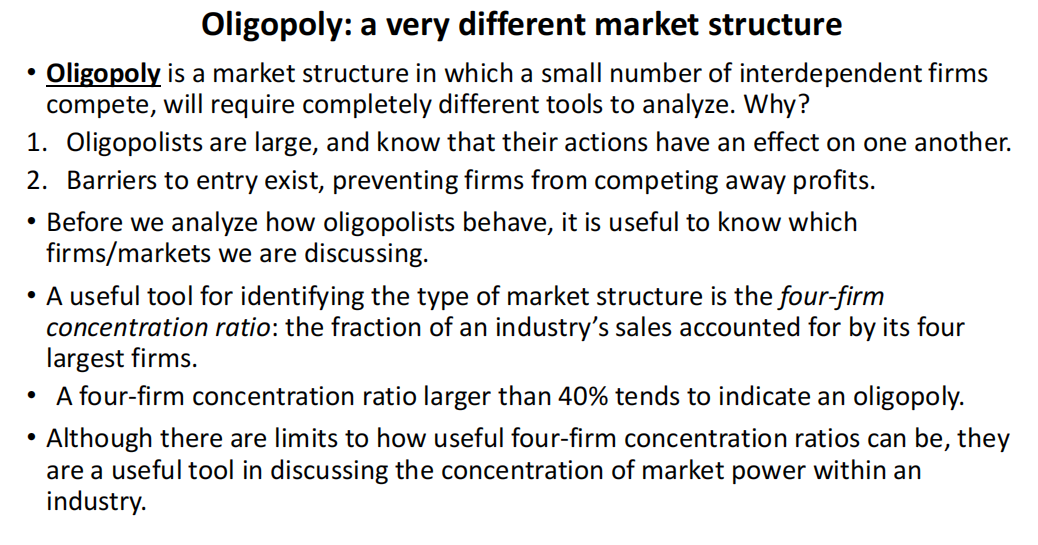
Oligopoly is a market structure in which a small number of interdependent firms compete, will require completely different tools to analyze. Why?
📖 点击查看译文
寡头垄断是一种市场结构,其中少数几家相互依赖的企业展开竞争,因此需要完全不同的分析工具。为什么?
1. Oligopolists are large, and know that their actions have an effect on one another.
📖 点击查看译文
寡头企业规模庞大,且知道自己的行为会影响其他企业。
2. Barriers to entry exist, preventing firms from competing away profits.
📖 点击查看译文
市场存在进入壁垒,阻止其他企业进入并分走利润。
Before we analyze how oligopolists behave, it is useful to know which firms/markets we are discussing.
📖 点击查看译文
在分析寡头企业行为之前,了解我们所讨论的企业或市场是很有帮助的。
A useful tool for identifying the type of market structure is the four-firm concentration ratio: the fraction of an industry’s sales accounted for by its four largest firms.
📖 点击查看译文
识别市场结构类型的一个有用工具是“四家集中度”:即行业中销售额由前四大企业占据的比例。
A four-firm concentration ratio larger than 40% tends to indicate an oligopoly.
📖 点击查看译文
如果四家集中度超过40%,通常表明该市场为寡头垄断市场。
Although there are limits to how useful four-firm concentration ratios can be, they are a useful tool in discussing the concentration of market power within an industry.
📖 点击查看译文
尽管四家集中度的用途有限,但它在讨论一个行业中市场力量集中程度时仍是一个有用工具。
知识点列表与拓展 (Knowledge Points and Extensions):
1. Strategic Interdependence(战略相互依赖)
-
解释 (Explanation):
In an oligopoly, firms must consider the potential reactions of rivals when making pricing or output decisions, due to their mutual influence.
(在寡头垄断中,企业在制定价格或产量决策时必须考虑竞争对手的潜在反应,因为彼此之间具有相互影响力。)
-
拓展 (Extension):
This interdependence leads to models like the Cournot, Bertrand, and Stackelberg frameworks, where firms use game theory to predict outcomes.
(这种相互依赖性催生了如古诺模型、伯特兰德模型和斯塔克伯格模型等理论框架,企业利用博弈论预测竞争结果。)
2. Non-Price Competition(非价格竞争)
-
解释 (Explanation):
Oligopolistic firms often compete through advertising, product differentiation, or customer service rather than changing prices.
(寡头企业通常通过广告、产品差异化或客户服务等方式进行竞争,而不是改变价格。)
-
拓展 (Extension):
Such behavior aligns with the kinked demand curve theory, which explains price rigidity in oligopolistic markets due to expected asymmetric rival reactions.
(这种行为与“折弯需求曲线”理论相符,该理论解释了寡头市场中价格刚性的原因,即企业预期竞争对手对价格变动的反应具有不对称性。)
3. Collusion and Cartels(合谋与卡特尔)
-
解释 (Explanation):
Firms in oligopolies may collude—explicitly or tacitly—to restrict output and raise prices, maximizing joint profits.
(寡头企业可能通过显性或默契方式合谋,限制产量并提高价格,以最大化联合利润。)
-
拓展 (Extension):
While illegal in many jurisdictions, tacit collusion is difficult to detect and is analyzed using repeated game models in industrial organization theory.
(尽管在许多地区明示合谋是违法的,但默契合谋难以被发现,且在产业组织理论中通过重复博弈模型进行分析。)
2
Limitations of Four-Firm Concentration Ratios(四家集中度的局限性)
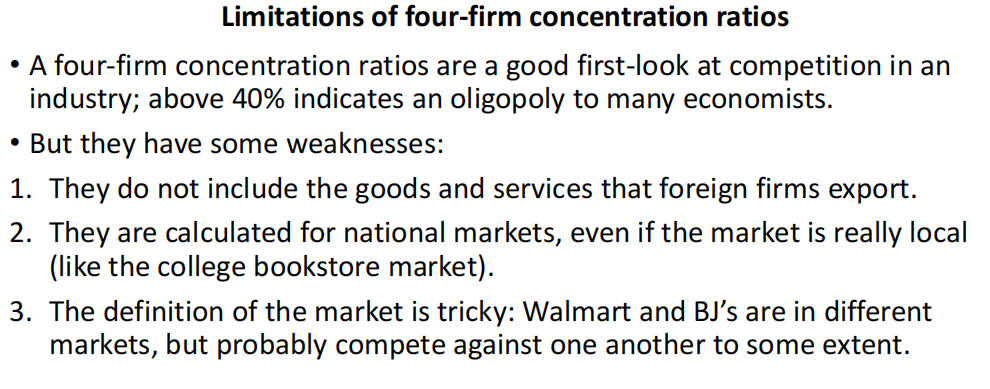
A four-firm concentration ratio is a good first-look at competition in an industry; above 40% indicates an oligopoly to many economists.
📖 点击查看译文
四家集中度是观察一个行业竞争情况的良好起点;在许多经济学家看来,超过40%意味着可能存在寡头垄断。
But they have some weaknesses:
📖 点击查看译文
但这种指标也存在一些弱点:
1. They do not include the goods and services that foreign firms export.
📖 点击查看译文
它们不包含外国公司出口的商品和服务。
2. They are calculated for national markets, even if the market is really local (like the college bookstore market).
📖 点击查看译文
它们以国家市场为基础进行计算,即使实际市场是本地化的(例如大学书店市场)。
3. The definition of the market is tricky: Walmart and BJ’s are in different markets, but probably compete against one another to some extent.
📖 点击查看译文
市场的定义存在困难:沃尔玛和BJ’s可能被归为不同市场,但在某种程度上彼此之间确实存在竞争。
知识点列表与拓展 (Knowledge Points and Extensions):
1. Market Definition Problem(市场界定问题)
-
解释 (Explanation):
Properly defining a market requires considering substitutability from the consumer’s perspective, which is often ambiguous in empirical work.
(合理界定市场需要从消费者替代性的角度进行考虑,但在实证研究中这一点往往较为模糊。)
-
拓展 (Extension):
Economists sometimes apply the SSNIP test (Small but Significant and Non-transitory Increase in Price) to determine market boundaries, which assesses if a price increase would lead consumers to switch to alternatives.
(经济学家有时使用“SSNIP测试”(小幅但持续的价格上涨)来界定市场边界,判断价格上升是否会导致消费者转向替代产品。)
2. Geographic Market Scope(地理市场范围)
-
解释 (Explanation):
National-level concentration ratios may obscure regional monopolies or competition in local markets.
(基于国家层面的集中度可能会掩盖区域性垄断或地方市场中的竞争情况。)
-
拓展 (Extension):
In antitrust analysis, authorities often rely on regional data and transportation cost considerations to more accurately assess market power.
(在反垄断分析中,监管机构常依据区域数据和运输成本来更准确地评估市场势力。)
3. International Trade Effects(国际贸易的影响)
-
解释 (Explanation):
Domestic concentration ratios ignore competitive pressure from imports, which can significantly alter actual market dynamics.
(国内集中度指标忽视了来自进口商品的竞争压力,而这种压力可能显著改变实际市场动态。)
-
拓展 (Extension):
Some economists advocate for the inclusion of foreign supply elasticity and trade-adjusted concentration measures when evaluating market competitiveness in open economies.
(一些经济学家主张在开放经济体中评估市场竞争性时,应纳入外国供给弹性和经贸易调整的集中度指标。)
3
Why Do Oligopolies Exist?(为什么会存在寡头垄断?)
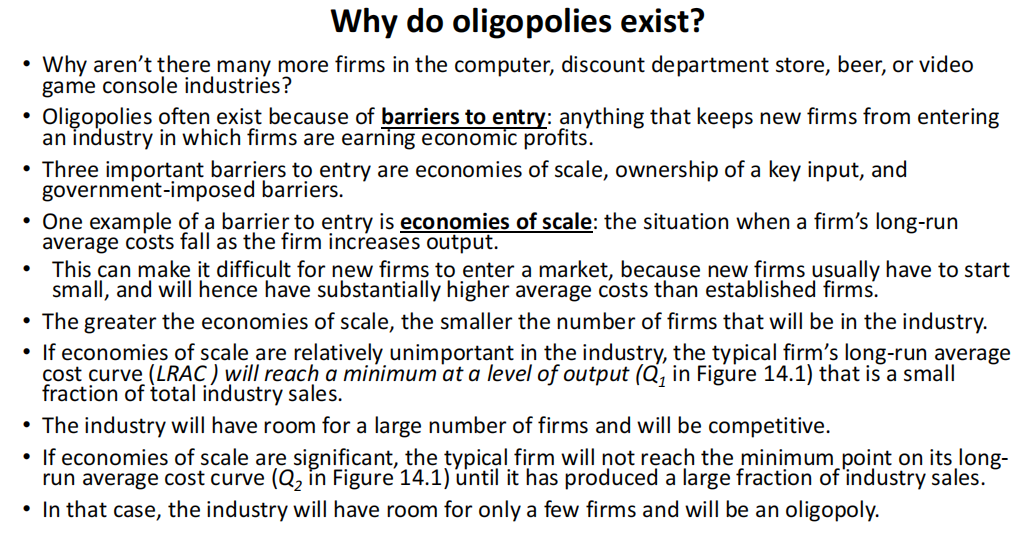
Oligopolies often exist because of barriers to entry: anything that keeps new firms from entering an industry in which firms are earning economic profits.
📖 点击查看译文
寡头垄断通常是由于进入壁垒的存在:任何阻止新企业进入一个已有企业获得经济利润的行业的因素。
Three important barriers to entry are economies of scale, ownership of a key input, and government-imposed barriers.
📖 点击查看译文
三种主要的进入壁垒包括规模经济、关键投入品的拥有权以及政府设置的限制。
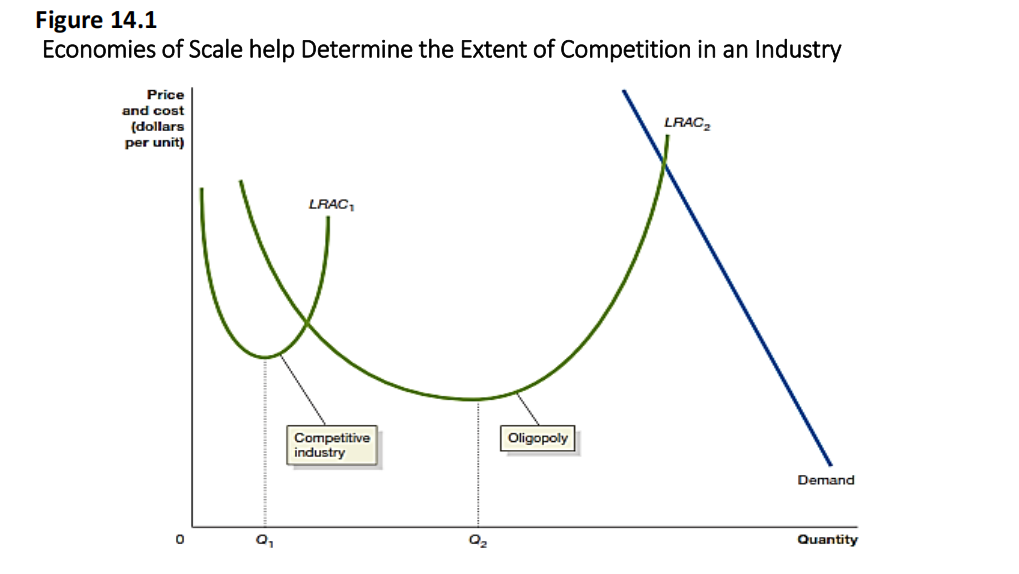
One example of a barrier to entry is economies of scale: the situation when a firm’s long-run average costs fall as the firm increases output.
📖 点击查看译文
进入壁垒的一个例子是规模经济:指的是企业在产量增加时长期平均成本下降的情形。
This can make it difficult for new firms to enter a market, because new firms usually have to start small, and will hence have substantially higher average costs than established firms.
📖 点击查看译文
这会使得新企业难以进入市场,因为它们通常需要从小规模开始,因此其平均成本远高于已建立的企业。
The greater the economies of scale, the smaller the number of firms that will be in the industry.
📖 点击查看译文
规模经济越强,该行业内的企业数量就越少。
If economies of scale are relatively unimportant, the typical firm’s LRAC will reach a minimum at a low output level, and the industry can support many firms.
📖 点击查看译文
如果规模经济并不显著,典型企业的长期平均成本在较低的产量水平就会达到最低点,行业可以容纳许多企业。
If economies of scale are significant, firms must produce a large share of industry output to reach the minimum LRAC, resulting in an oligopoly.
📖 点击查看译文
如果规模经济显著,企业必须生产行业中较大比例的产量才能达到最低平均成本,这将导致行业成为寡头垄断。
知识点列表与拓展 (Knowledge Points and Extensions):
1. Minimum Efficient Scale (MES, 最小有效规模)
-
解释 (Explanation):
MES is the lowest point at which a firm can produce such that its long-run average costs are minimized.
(最小有效规模是指企业能够使其长期平均成本达到最小的最低产量水平。)
-
拓展 (Extension):
In industries where MES is large relative to total market demand, few firms can operate efficiently, leading to oligopolistic structures.
(如果MES相对于市场总需求较大,只有少数企业能有效运作,从而形成寡头结构。)
2. Strategic Entry Deterrence(战略性进入威慑)
-
解释 (Explanation):
Established firms may take deliberate actions—like excess capacity investment or limit pricing—to deter new entrants.
(已有企业可能采取故意行为,如投资过剩产能或采取限制性定价策略,以阻止新企业进入市场。)
-
拓展 (Extension):
Game-theoretic models such as Stackelberg and limit pricing illustrate how firms manipulate market conditions to preserve oligopoly power.
(博弈论模型如斯塔克伯格模型和限制性定价理论说明企业如何操纵市场环境以维持寡头势力。)
3. Natural Oligopoly(自然寡头垄断)
-
解释 (Explanation):
A market becomes a natural oligopoly when the structure of production and cost advantages inherently support only a few large firms.
(当生产结构与成本优势内在地只支持少数几家大型企业存在时,该市场形成自然寡头垄断。)
-
拓展 (Extension):
This is common in industries like utilities or telecommunications, where high fixed costs and low marginal costs dominate.
(这种现象常见于公用事业或电信等行业,因其具有高固定成本和低边际成本的特征。)
4
5
Ownership of a Key Input & Government-Imposed Barriers(关键投入品所有权与政府设置的进入壁垒)
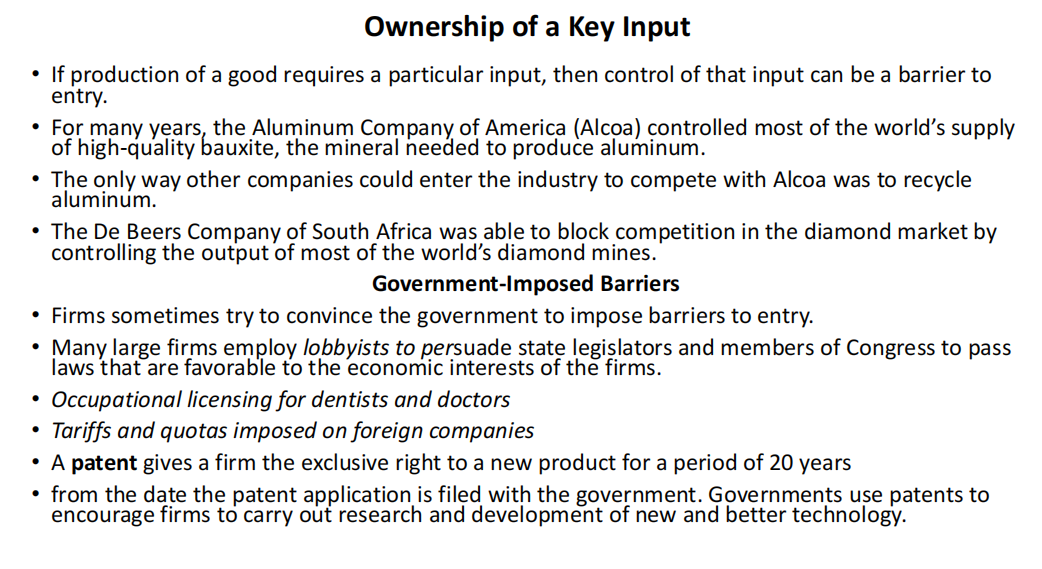
If production of a good requires a particular input, then control of that input can be a barrier to entry.
📖 点击查看译文
如果某种商品的生产需要特定的投入品,那么对该投入品的控制就可以成为进入壁垒。
For many years, Alcoa controlled most of the world’s supply of high-quality bauxite, the mineral needed to produce aluminum.
📖 点击查看译文
多年来,美国铝业公司(Alcoa)控制了大部分用于生产铝的优质铝土矿资源。
The only way other companies could enter the industry to compete with Alcoa was to recycle aluminum.
📖 点击查看译文
其他公司唯一能与Alcoa竞争的方式是回收铝资源。
De Beers was able to block competition in the diamond market by controlling most of the world’s diamond mine output.
📖 点击查看译文
南非的戴比尔斯公司通过控制全球大部分钻石矿产出,阻止了其他企业进入钻石市场。
Firms sometimes try to convince the government to impose barriers to entry.
📖 点击查看译文
企业有时会试图说服政府设置进入壁垒。
Large firms employ lobbyists to persuade legislators to pass laws favorable to their interests.
📖 点击查看译文
大型企业通常雇佣说客游说立法机构制定有利于其经济利益的法律。
Examples include occupational licensing, tariffs, quotas, and patents.
📖 点击查看译文
典型例子包括职业许可制度、关税、配额和专利制度。
A patent gives a firm exclusive rights to a new product for 20 years from the application date, encouraging innovation.
📖 点击查看译文
专利从申请之日起授予企业对新产品20年的专有权利,以鼓励其进行技术研发与创新。
知识点列表与拓展 (Knowledge Points and Extensions):
1. Input Control as Strategic Barrier(关键资源控制作为战略性壁垒)
-
解释 (Explanation):
Firms that secure exclusive rights to rare or essential inputs can prevent market entry and maintain monopoly or oligopoly status.
(掌控稀缺或关键投入品的企业可阻止其他企业进入市场,从而维持垄断或寡头地位。)
-
拓展 (Extension):
This form of barrier is especially effective when there are no viable substitutes or when technology for alternative sourcing is underdeveloped.
(当没有可行替代品或替代技术尚未成熟时,这种壁垒尤为有效。)
2. Regulatory Capture(监管俘获)
-
解释 (Explanation):
Occurs when regulatory agencies are influenced by the industries they are supposed to regulate, often due to lobbying or political connections.
(指的是原本负责监管的机构反被被监管行业所影响,常因游说或政治联系而发生。)
-
拓展 (Extension):
Regulatory capture may lead to laws that favor incumbents by raising entry barriers, reducing competition, and protecting profits.
(监管俘获可能导致制定有利于既有企业的法律,通过提高进入壁垒来削弱竞争,保障利润。)
3. Legal Monopoly through Patents(通过专利形成的合法垄断)
-
解释 (Explanation):
A patent creates a time-limited monopoly by law, allowing firms to recover R&D costs and earn profits without competition.
(专利通过法律赋予企业短期垄断地位,使其可以在无竞争的情况下回收研发成本并获得利润。)
-
拓展 (Extension):
While patents encourage innovation, they may also delay industry-wide technological diffusion and create entry deterrence.
(虽然专利鼓励创新,但也可能延缓技术在整个行业的传播,并构成进入威慑。)
6
Game Theory and Oligopoly: Using Game Theory to Analyze Oligopoly(博弈论与寡头市场:运用博弈论分析寡头行为)
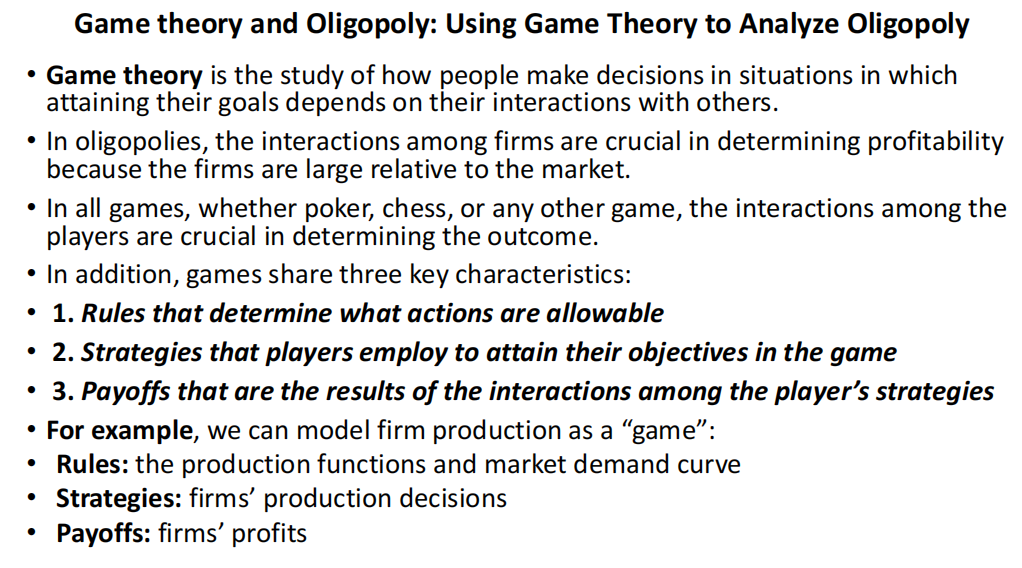
Game theory is the study of how people make decisions in situations in which attaining their goals depends on their interactions with others.
📖 点击查看译文
博弈论研究的是人们在自身目标达成依赖于他人互动的情况下如何做决策。
In oligopolies, the interactions among firms are crucial in determining profitability because the firms are large relative to the market.
📖 点击查看译文
在寡头市场中,由于企业在市场中占比较大,它们之间的互动对利润水平具有决定性影响。
In all games, whether poker, chess, or any other game, the interactions among the players are crucial in determining the outcome.
📖 点击查看译文
无论是扑克、国际象棋还是其他任何游戏,参与者之间的互动都决定了游戏结果。
In addition, games share three key characteristics:
📖 点击查看译文
此外,博弈都有三个关键特征:
-
Rules that determine what actions are allowable(规则决定哪些行动是允许的)
-
Strategies that players employ to attain their objectives(策略是参与者为达目标所采用的方法)
-
Payoffs that result from the interactions among the players’ strategies(收益是玩家策略互动的结果)
For example, we can model firm production as a “game”:
📖 点击查看译文
例如,我们可以将企业的生产行为建模为一个“博弈”:
-
Rules: the production functions and market demand curve(规则:生产函数和市场需求曲线)
-
Strategies: firms’ production decisions(策略:企业的产量决策)
-
Payoffs: firms’ profits(收益:企业利润)
知识点列表与拓展 (Knowledge Points and Extensions):
1. Strategic Interdependence in Oligopoly(寡头市场中的战略相互依赖)
-
解释 (Explanation):
In oligopoly, one firm’s decisions affect others’ outcomes, creating a scenario where firms must anticipate rivals’ actions.
(在寡头市场中,一家企业的决策会影响其他企业的收益,导致企业必须预测对手的行动。)
-
拓展 (Extension):
This contrasts with perfect competition, where firms are price-takers and do not consider competitors’ reactions.
(这不同于完全竞争市场,后者中企业是价格接受者,不考虑竞争对手的反应。)
2. Dominant Strategies and Nash Equilibrium(主导策略与纳什均衡)
-
解释 (Explanation):
A dominant strategy is one that is best regardless of what the other player does. A Nash equilibrium occurs when no player can improve their outcome by unilaterally changing strategy.
(主导策略是指无论对方怎么行动,某一策略都是最优的;纳什均衡则指没有任何一方可以通过单方面改变策略来改善自身收益。)
-
拓展 (Extension):
In many oligopoly models, such as the Cournot model, the outcome is a Nash equilibrium where firms choose output levels that are best responses to each other.
(在许多寡头模型中,如古诺模型,均衡结果是各企业选择的产量是彼此的最优反应。)
3. Repeated Games and Cooperation(重复博弈与合作)
-
解释 (Explanation):
When games are repeated, firms may sustain cooperation (like price fixing) through strategies such as “tit for tat.”
(在重复博弈中,企业可以通过“以牙还牙”等策略维持如价格串通等合作行为。)
-
拓展 (Extension):
This helps explain why cartels like OPEC may remain stable over time, despite incentives to cheat.
(这有助于解释为何像OPEC这样的卡特尔尽管存在作弊动机,却能长时间维持稳定。)
7
Business Strategy and Payoffs in Game Theory(博弈论中的商业战略与收益)
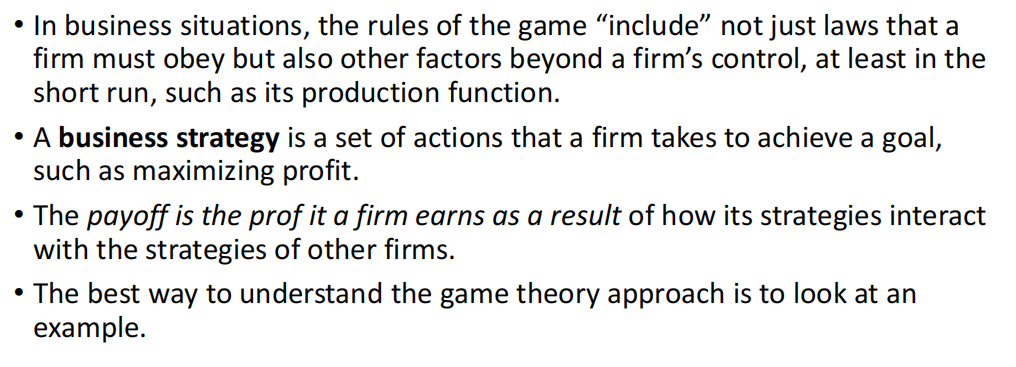
In business situations, the rules of the game “include” not just laws that a firm must obey but also other factors beyond a firm’s control, at least in the short run, such as its production function.
📖 点击查看译文
在商业环境中,博弈的规则不仅包括企业必须遵守的法律,还包括一些在短期内企业无法控制的因素,如其生产函数。
A business strategy is a set of actions that a firm takes to achieve a goal, such as maximizing profit.
📖 点击查看译文
商业战略是一系列企业为实现某一目标(如利润最大化)所采取的行动。
The payoff is the profit a firm earns as a result of how its strategies interact with the strategies of other firms.
📖 点击查看译文
收益是企业的利润,它由企业自身战略与其他企业战略之间的互动所决定。
The best way to understand the game theory approach is to look at an example.
📖 点击查看译文
理解博弈论方法的最佳方式是通过具体例子。
知识点列表与拓展 (Knowledge Points and Extensions):
1. Business “Rules of the Game”(商业“博弈规则”)
-
解释 (Explanation):
In business, rules include legal requirements, economic conditions, and technological constraints like production functions.
(在商业中,规则包括法律要求、经济环境及如生产函数等技术约束。)
-
拓展 (Extension):
These rules shape the firm’s strategic possibilities and define the limits within which decisions are made.
(这些规则决定了企业战略选择的范围,是决策的边界条件。)
2. Business Strategy in Game Theory(博弈论视角下的商业战略)
-
解释 (Explanation):
A strategy involves choices like pricing, output levels, advertising, or entering a new market.
(战略涉及价格、产量、广告、市场进入等决策。)
-
拓展 (Extension):
Strategies are evaluated not in isolation, but in anticipation of competitors’ likely actions.
(企业的战略不是孤立评价的,而是基于对竞争对手可能行动的预测。)
3. Strategic Payoffs and Profit Outcomes(战略收益与利润结果)
-
解释 (Explanation):
The profit a firm earns depends on the interaction of its strategy with those of rivals—this defines the game’s payoff.
(企业获得的利润取决于其战略与竞争对手战略的互动——这定义了博弈的收益。)
-
拓展 (Extension):
The concept of payoff underlies game-theoretical models like the payoff matrix, where each combination of strategies yields a different result.
(收益概念是博弈模型的核心,如收益矩阵,每种策略组合对应一个不同结果。)
8
A Duopoly Game: Price Competition between Two Firms(双头垄断博弈:两家公司的价格竞争)
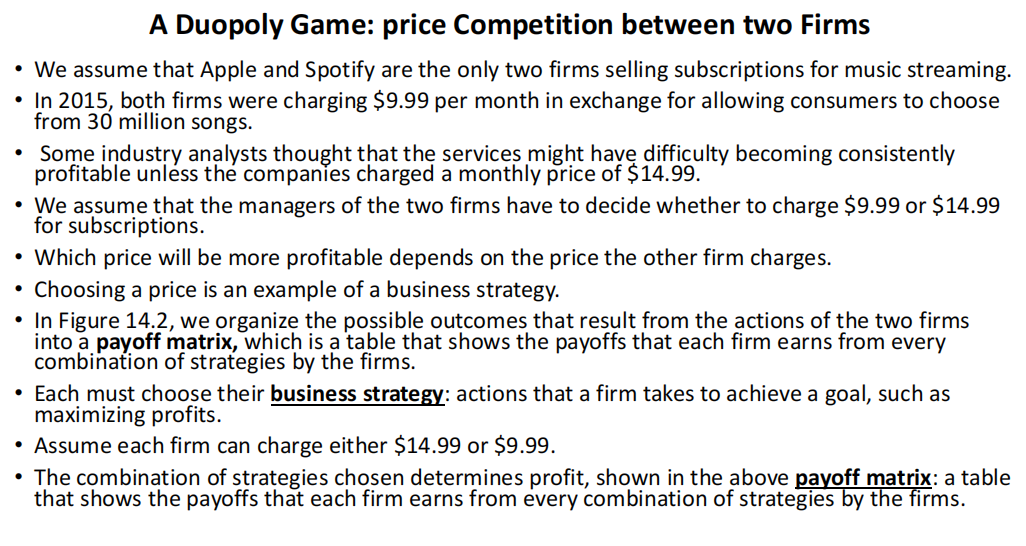
We assume that Apple and Spotify are the only two firms selling subscriptions for music streaming.
📖 点击查看译文
我们假设 Apple 和 Spotify 是仅有的两家提供音乐流媒体订阅服务的公司。
In 2015, both firms were charging $9.99 per month in exchange for allowing consumers to choose from 30 million songs.
📖 点击查看译文
2015 年,这两家公司每月都收取 9.99 美元的费用,用户可选择播放 3000 万首歌曲。
Some industry analysts thought that the services might have difficulty becoming consistently profitable unless the companies charged a monthly price of $14.99.
📖 点击查看译文
一些行业分析师认为,除非这些公司将月订阅价格定为 14.99 美元,否则它们很难持续盈利。
We assume that the managers of the two firms have to decide whether to charge $9.99 or $14.99 for subscriptions.
📖 点击查看译文
我们假设两家公司的管理层必须决定是收取 9.99 美元还是 14.99 美元的订阅费用。
Which price will be more profitable depends on the price the other firm charges.
📖 点击查看译文
哪个价格更能带来利润,取决于另一家公司所设定的价格。
Choosing a price is an example of a business strategy.
📖 点击查看译文
设定价格是商业战略的一个例子。
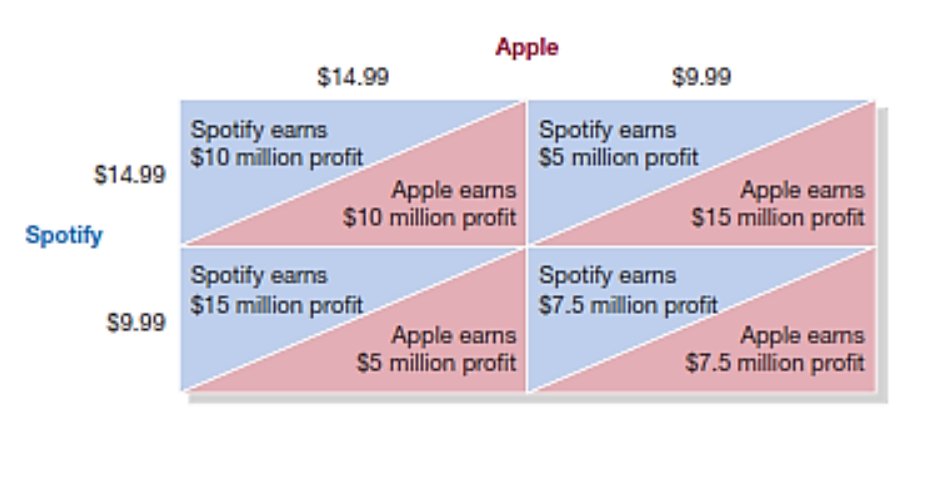
In Figure 14.2, we organize the possible outcomes that result from the actions of the two firms into a payoff matrix, which is a table that shows the payoffs that each firm earns from every combination of strategies by the firms.
📖 点击查看译文
在图 14.2 中,我们将两家公司的行为所导致的可能结果组织成一个收益矩阵,该矩阵展示了每种策略组合下各公司获得的收益。
Each must choose their business strategy: actions that a firm takes to achieve a goal, such as maximizing profits.
📖 点击查看译文
每家公司都必须选择其商业战略:即为了实现某一目标(如利润最大化)所采取的行动。
Assume each firm can charge either $14.99 or $9.99.
📖 点击查看译文
假设每家公司都可以选择收取 14.99 美元或 9.99 美元。
The combination of strategies chosen determines profit, shown in the above payoff matrix: a table that shows the payoffs that each firm earns from every combination of strategies by the firms.
📖 点击查看译文
所选策略的组合决定了利润,收益矩阵展示了每家公司在不同策略组合下获得的收益。
知识点列表与拓展 (Knowledge Points and Extensions):
1. Duopoly(双头垄断)
-
解释:
A market structure with exactly two dominant firms.
(一种市场结构,只有两家主要企业主导市场。)
-
拓展:
The decisions of each firm significantly affect the other, leading to strategic interdependence.
(每家企业的决策都会显著影响另一家,因此形成战略互赖关系。)
2. Price Strategy as Game Theory Decision(价格决策作为博弈选择)
-
解释:
Firms choose between high and low prices while anticipating competitors’ moves.
(企业在设定高价或低价时会预判对方的决策。)
-
拓展:
This models classic price competition and often mirrors the “prisoner’s dilemma.”
(这类博弈模拟典型的价格竞争,常表现为“囚徒困境”。)
3. Payoff Matrix(收益矩阵)
-
解释:
A table showing outcomes (profits) for each firm under every possible strategy combination.
(展示每种策略组合下各企业收益的表格。)
-
拓展:
It helps visualize and analyze best responses and potential equilibria.
(用于可视化分析最优反应与可能的均衡点。)
9
10
Dominant Strategies and Nash Equilibrium in the Duopoly Game(双头垄断博弈中的占优策略与纳什均衡)
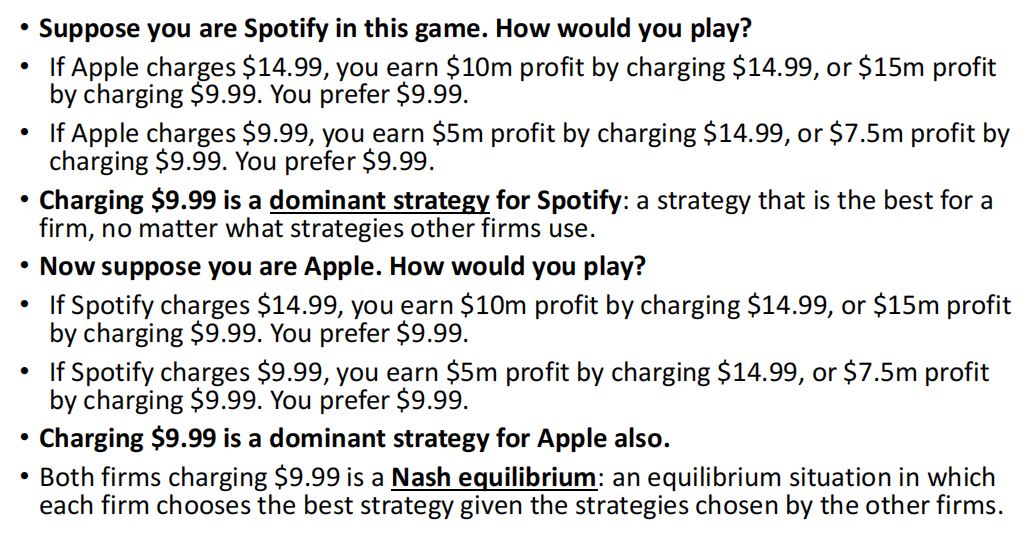
Suppose you are Spotify in this game. How would you play?
📖 点击查看译文
假设你是 Spotify,你会怎么选择策略?
If Apple charges $14.99, you earn $10m profit by charging $14.99, or $15m profit by charging $9.99. You prefer $9.99.
📖 点击查看译文
如果 Apple 定价为 14.99 美元,你定价 14.99 美元可获利 1000 万美元,定价 9.99 美元可获利 1500 万美元。你会偏好 9.99 美元。
If Apple charges $9.99, you earn $5m profit by charging $14.99, or $7.5m profit by charging $9.99. You prefer $9.99.
📖 点击查看译文
如果 Apple 定价为 9.99 美元,你定价 14.99 美元可获利 500 万美元,定价 9.99 美元可获利 750 万美元。你还是偏好 9.99 美元。
Charging $9.99 is a dominant strategy for Spotify: a strategy that is the best for a firm, no matter what strategies other firms use.
📖 点击查看译文
因此,对 Spotify 而言,收取 9.99 美元是一个占优策略:无论其他公司采取什么策略,这都是最优选择。
Now suppose you are Apple. How would you play?
📖 点击查看译文
现在假设你是 Apple,你会怎么做?
If Spotify charges $14.99, you earn $10m profit by charging $14.99, or $15m profit by charging $9.99. You prefer $9.99.
📖 点击查看译文
如果 Spotify 定价为 14.99 美元,你定价 14.99 美元可获利 1000 万美元,定价 9.99 美元可获利 1500 万美元。你会偏好 9.99 美元。
If Spotify charges $9.99, you earn $5m profit by charging $14.99, or $7.5m profit by charging $9.99. You prefer $9.99.
📖 点击查看译文
如果 Spotify 定价为 9.99 美元,你定价 14.99 美元可获利 500 万美元,定价 9.99 美元可获利 750 万美元。你还是偏好 9.99 美元。
Charging $9.99 is a dominant strategy for Apple also.
📖 点击查看译文
因此,对 Apple 而言,收取 9.99 美元也是一个占优策略。
Both firms charging $9.99 is a Nash equilibrium: an equilibrium situation in which each firm chooses the best strategy given the strategies chosen by the other firms.
📖 点击查看译文
两家公司都选择收取 9.99 美元是一个纳什均衡:在此均衡中,每家公司都选择了在给定对方策略下自身最优的策略。
知识点列表与拓展 (Knowledge Points and Extensions):
1. Dominant Strategy(占优策略)
-
解释:
A strategy that yields the highest payoff for a firm regardless of the other player’s strategy.
(无论对方选择什么策略,该策略总能带来最高收益。)
-
拓展:
If both firms have dominant strategies, the game outcome becomes easier to predict.
(如果双方都有占优策略,博弈结果更易预测。)
2. Nash Equilibrium(纳什均衡)
-
解释:
A situation where each player’s strategy is optimal, given the strategy of the other.
(在对方策略已定的前提下,每一方都选择了自身最优策略。)
-
拓展:
No player has an incentive to change strategy unilaterally.
(在均衡状态下,任何一方都不愿意单独改变策略。)
3. The Prisoner’s Dilemma Analogy(囚徒困境类比)
-
解释:
Although both firms would earn higher profit by cooperating (choosing $14.99), the dominant strategy leads them to a less profitable equilibrium.
(虽然合作设定 14.99 美元可带来更高利润,但占优策略导致两者最终落入更低利润的均衡。)
-
拓展:
This demonstrates the tension between individual rationality and collective optimality.
(体现了个体理性与集体最优之间的矛盾。)
11
Collusion and Its Implications(合谋及其影响)
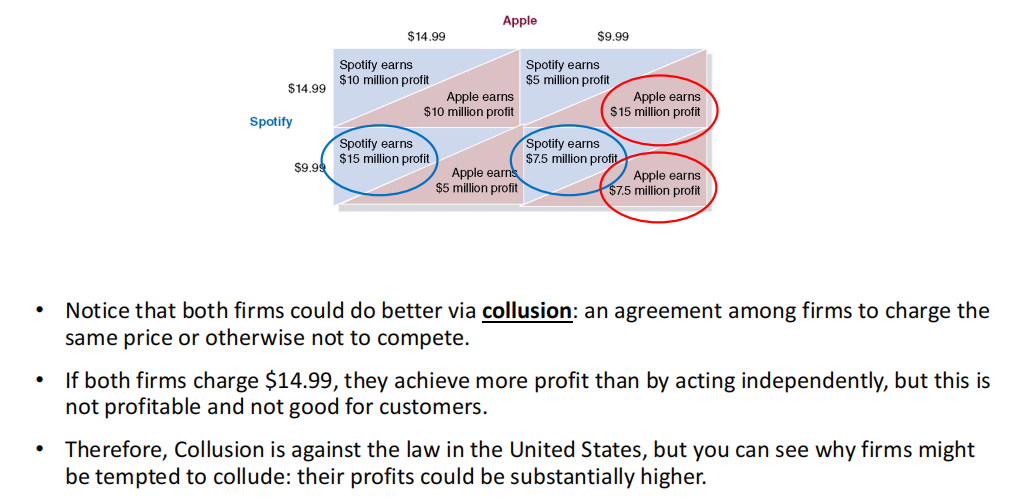
Notice that both firms could do better via collusion: an agreement among firms to charge the same price or otherwise not to compete.
📖 点击查看译文
注意:如果两家公司通过合谋(即协议设定相同价格或不展开竞争)来协作,它们的盈利情况可能会更好。
If both firms charge $14.99, they achieve more profit than by acting independently, but this is not profitable and not good for customers.
📖 点击查看译文
如果两家公司都设定 14.99 美元的价格,它们的利润比独立竞争时更高,但这对消费者而言既不划算也不利。
Therefore, Collusion is against the law in the United States, but you can see why firms might be tempted to collude: their profits could be substantially higher.
📖 点击查看译文
因此,在美国,合谋是违法行为。但你可以理解为何企业会有合谋的冲动:因为那样它们的利润可能大幅增加。
知识点列表与拓展 (Knowledge Points and Extensions)
1. Collusion(合谋)
-
解释:
A (usually secret) agreement between firms to avoid competition, often by fixing prices or output.
(企业之间达成的避免竞争的协议,通常包括定价或限制产量。)
-
拓展:
-
Explicit Collusion(明示合谋): e.g., forming a cartel like OPEC.
-
Tacit Collusion(默契合谋): no direct agreement, but firms behave in a coordinated way.
-
合谋常见于寡头市场,但在多数国家属于反垄断法律禁止的行为。
-
2. Consumer Welfare and Collusion(合谋对消费者福利的影响)
-
解释:
Collusion typically reduces consumer welfare by raising prices and reducing choices.
(合谋行为通常通过抬高价格、减少选择损害消费者福利。)
-
拓展:
-
价格上升 → 消费者支出增加。
-
产品缺乏差异化 → 市场效率降低。
-
3. Legal and Regulatory Framework(法律与监管框架)
-
解释:
In the U.S., collusion violates the Sherman Antitrust Act.
(在美国,合谋行为违反《谢尔曼反托拉斯法》)
-
拓展:
-
各国普遍设有反垄断法来限制寡头和垄断行为。
-
企业如被查出合谋,可能被处以巨额罚款并面临诉讼。
-
4. Incentive to Cheat(违约动机)
-
解释:
Even if firms agree to collude, each has an incentive to undercut the other and gain more market share.
(即便企业合谋,也存在偷偷降价以扩大市场份额的动机。)
-
拓展:
-
合谋往往不稳定,因为背叛可带来短期高回报。
-
此机制与“囚徒困境”相似——合作是最优,但个体有动机背叛。
-
12
Firm Behavior and the Prisoner’s Dilemma
公司行为与囚徒困境
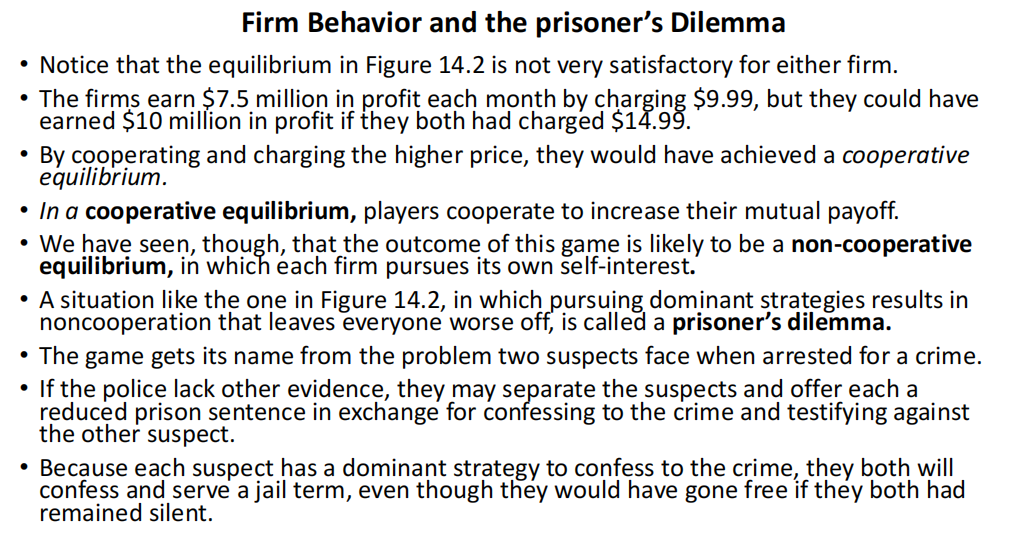
Notice that the equilibrium in Figure 14.2 is not very satisfactory for either firm.
📖 点击查看译文
注意图14.2中的均衡对任何一家公司来说都不太理想。
The firms earn $7.5 million in profit each month by charging $9.99, but they could have earned $10 million in profit if they both had charged $14.99.
📖 点击查看译文
两家公司通过定价9.99美元每月利润是750万美元,但如果都定价14.99美元,则利润可达1000万美元。
By cooperating and charging the higher price, they would have achieved a cooperative equilibrium.
📖 点击查看译文
通过合作并定高价,他们可以实现合作均衡。
In a cooperative equilibrium, players cooperate to increase their mutual payoff.
📖 点击查看译文
合作均衡中,参与者合作以提高共同收益。
We have seen, though, that the outcome of this game is likely to be a non-cooperative equilibrium, in which each firm pursues its own self-interest.
📖 点击查看译文
然而,这个游戏的结果更可能是非合作均衡,即每家公司都追求自身利益。
A situation like the one in Figure 14.2, in which pursuing dominant strategies results in noncooperation that leaves everyone worse off, is called a prisoner’s dilemma.
📖 点击查看译文
图14.2中的这种情形,即追求占优策略导致非合作、使所有人都处于更坏境地的局面,称为囚徒困境。
The game gets its name from the problem two suspects face when arrested for a crime.
📖 点击查看译文
该博弈源自两个犯罪嫌疑人在被捕时面临的问题。
If the police lack other evidence, they may separate the suspects and offer each a reduced prison sentence in exchange for confessing to the crime and testifying against the other suspect.
📖 点击查看译文
如果警方没有其他证据,可能会将两名嫌疑人分开,并以认罪并指控对方为条件减刑。
Because each suspect has a dominant strategy to confess to the crime, they both will confess and serve a jail term, even though they would have gone free if they both had remained silent.
📖 点击查看译文
由于认罪是每个嫌疑人的占优策略,他们都会认罪服刑,尽管如果两人都保持沉默则可以获释。
Knowledge Points and Extensions 知识点与拓展
-
Prisoner’s Dilemma (囚徒困境)
-
A game where individual rational strategies lead to a worse collective outcome.
-
囚徒困境是指各方按照自身最佳策略行动,结果却导致整体利益受损的情形。
-
-
Dominant Strategy (占优策略)
-
The best strategy for a player regardless of what others do.
-
不论对手选择何种策略,始终为最优的策略。
-
-
Non-Cooperative Equilibrium (非合作均衡)
-
Equilibrium where no player cooperates and everyone acts in self-interest.
-
玩家均不合作,各自为政达到的均衡状态。
-
-
Cooperative Equilibrium (合作均衡)
-
Players cooperate to achieve higher collective payoffs, often unstable without enforcement.
-
通过合作获得更高的共同收益,但通常缺乏强制执行机制,容易瓦解。
-
-
Application to Oligopoly (寡头垄断中的应用)
-
Firms in oligopoly face prisoner’s dilemma-type situations when setting prices or output.
-
寡头企业在定价或产量决策时面临类似囚徒困境的局面,难以实现最大化集体利益。
-
13
Prisoner’s Dilemma in Business Pricing
囚徒困境在商业定价中的应用
Economists and other social scientists refer to the situation with Spotify and Apple as a prisoner’s dilemma: a game in which pursuing dominant strategies results in noncooperation that leaves everyone worse off.
📖 点击查看译文
经济学家和社会科学家将Spotify和Apple的情况称为囚徒困境:在该博弈中,追求占优策略导致非合作,使每个人都变得更糟。
The name comes from a problem faced by two suspects the police arrest for a crime.
📖 点击查看译文
这个名字来源于警方逮捕的两个犯罪嫌疑人所面临的问题。
The police offer each suspect a suspended prison sentence in exchange for confessing to the crime and testifying against the other suspect.
📖 点击查看译文
警方向每个嫌疑人提供缓刑,以换取他们认罪并指控对方。
Each suspect has a dominant strategy to confess; but if both confess, they both go to jail for a long time, while they both could have gone to jail for a short time if they had both remained silent.
📖 点击查看译文
每个嫌疑人都有认罪的占优策略;但如果双方都认罪,他们都会被判长期监禁,而如果双方都保持沉默,则只会被判短期监禁。
Suppose Domino’s and Pizza Hut are deciding how to price a pizza: $12 or $10.
📖 点击查看译文
假设必胜客和达美乐正在决定披萨价格,是定12美元还是10美元。
This game gets played not once, but every day.
📖 点击查看译文
这个博弈不是只玩一次,而是每天都在进行。
A clever way to avoid the low-profit Nash equilibrium is to advertise a price-match guarantee.
📖 点击查看译文
避免低利润纳什均衡的一个聪明方法是宣传价格匹配保证。
Then if either firm cuts prices, the other has guaranteed to do so as well.
📖 点击查看译文
这样如果任何一家公司降价,另一家公司也会保证降价。
Now neither firm will have an incentive to cut prices.
📖 点击查看译文
现在双方都没有降价的动机了。
Do price-match guarantees really benefit consumers?
📖 点击查看译文
价格匹配保证真的对消费者有利吗?
Knowledge Points and Extensions 知识点与拓展
-
Repeated Games (重复博弈)
-
Unlike one-time games, many business decisions are repeated, affecting strategy choices over time.
-
与一次性博弈不同,商业决策多为重复博弈,影响长期策略选择。
-
-
Price-Match Guarantee (价格匹配保证)
-
A strategy to discourage price cutting by promising to match competitors’ lower prices, helping firms avoid a price war.
-
通过承诺匹配竞争对手的低价,阻止降价竞争,避免价格战的策略。
-
-
Consumer Impact (对消费者的影响)
-
While price-match guarantees can stabilize prices, they may reduce competition, potentially leading to higher prices overall.
-
价格匹配保证虽然稳定价格,但可能减少竞争,导致整体价格升高。
-
-
Nash Equilibrium in Oligopoly (寡头垄断中的纳什均衡)
-
The stable state where no firm can improve profits by unilaterally changing its price given the other firm’s price.
-
在对方价格不变的情况下,单方改变价格无法获得更大利润的稳定状态。
-
14
Price-Match Guarantee Changes the Payoff Matrix 价格匹配保证改变收益矩阵
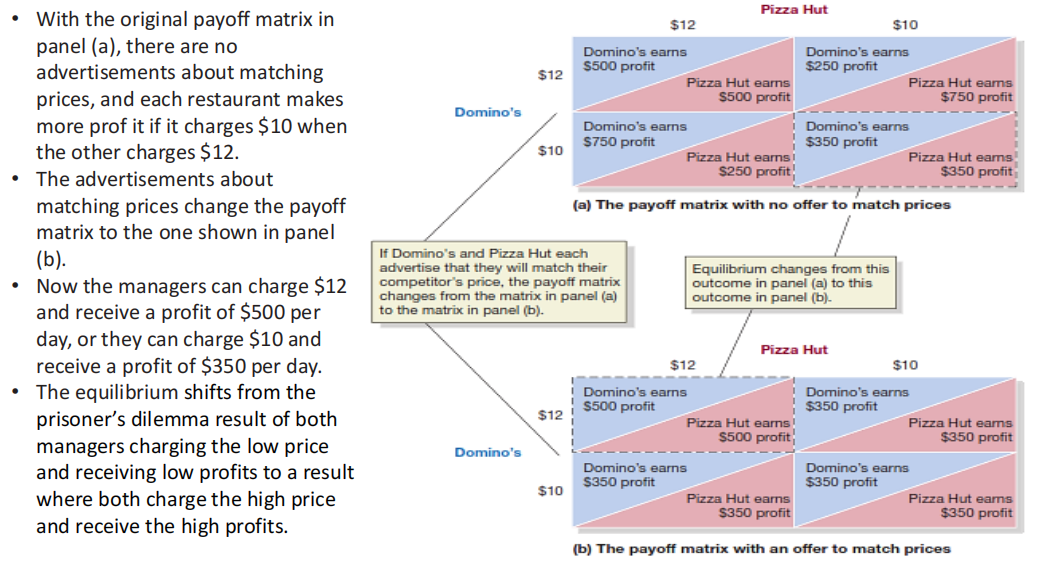
With the original payoff matrix in panel (a), there are no advertisements about matching prices, and each restaurant makes more profit if it charges $10 when the other charges $12.
📖 点击查看译文
在面板(a)中的原始收益矩阵里,没有价格匹配广告,当另一家餐厅定价为12美元时,每家餐厅如果定价为10美元就能获得更多利润。
The advertisements about matching prices change the payoff matrix to the one shown in panel (b).
📖 点击查看译文
关于价格匹配的广告将收益矩阵变成了面板(b)所示的样子。
Now the managers can charge $12 and receive a profit of $500 per day, or they can charge $10 and receive a profit of $350 per day.
📖 点击查看译文
现在,管理者可以定价12美元,每天获得500美元利润,或者定价10美元,每天获得350美元利润。
The equilibrium shifts from the prisoner’s dilemma result of both managers charging the low price and receiving low profits to a result where both charge the high price and receive the high profits.
📖 点击查看译文
均衡由囚徒困境中双方都定低价且利润低的结果,转变为双方都定高价且获得高利润的结果。
15
Other Methods for Avoiding Price Competition 避免价格竞争的其他方法
A price-match guarantee is an enforcement mechanism, making automatic the decision about whether to punish a competing firm for charging a low price.
📖 点击查看译文
价格匹配保证是一种执行机制,可以自动决定是否惩罚以低价竞争的对手公司。
Another method is price leadership, a form of implicit collusion in which one firm in an oligopoly announces a price change and the other firms in the industry match the change.
📖 点击查看译文
另一种方法是价格领导,这是隐性合谋的一种形式,其中寡头市场中的一家公司宣布价格变动,其他公司跟随调整价格。
Example: In the 1970s, General Motors would announce a price change at the beginning of a model year, and Ford and Chrysler would match GM’s price change.
📖 点击查看译文
举例:在1970年代,通用汽车会在新车型年初宣布价格变动,福特和克莱斯勒会跟随通用汽车调整价格。
In some cases, such as in the airline industry, firms have attempted to act as price leaders but failed when other firms in the industry have refused to cooperate.
📖 点击查看译文
在某些行业,如航空业,企业尝试充当价格领导者,但当行业内其他公司拒绝合作时,这种尝试失败了。
16
Cartels: The Case of OPEC(卡特尔:以OPEC为例)
A cartel is a group of firms that collude by restricting output to raise prices and profits.
📖 点击查看译文
卡特尔是一组通过协同限制产量来提高价格和利润的企业。
The Organization of Petroleum Exporting Countries (OPEC) is the best known cartel.
📖 点击查看译文
石油输出国组织(OPEC)是最著名的卡特尔。
OPEC colluded to restrict output and raise prices in the 1970s and 1980s.
📖 点击查看译文
OPEC在1970和1980年代合谋限制产量并提高油价。
But collusion has proved difficult to maintain over time.
📖 点击查看译文
但随着时间推移,维持合谋关系变得十分困难。
Together, these countries own more than 75 percent of the world’s proven crude oil reserves, although they supply only about 35 percent of the total oil sold each year.
📖 点击查看译文
这些国家合计拥有全球超过75%的已探明原油储量,尽管它们每年仅供应大约35%的全球石油销售总量。
OPEC operates as a cartel, which is a group of firms that collude by agreeing to restrict output to increase prices and profits.
📖 点击查看译文
OPEC作为一个卡特尔运作,成员企业通过协同限制产量以提高价格和利润。
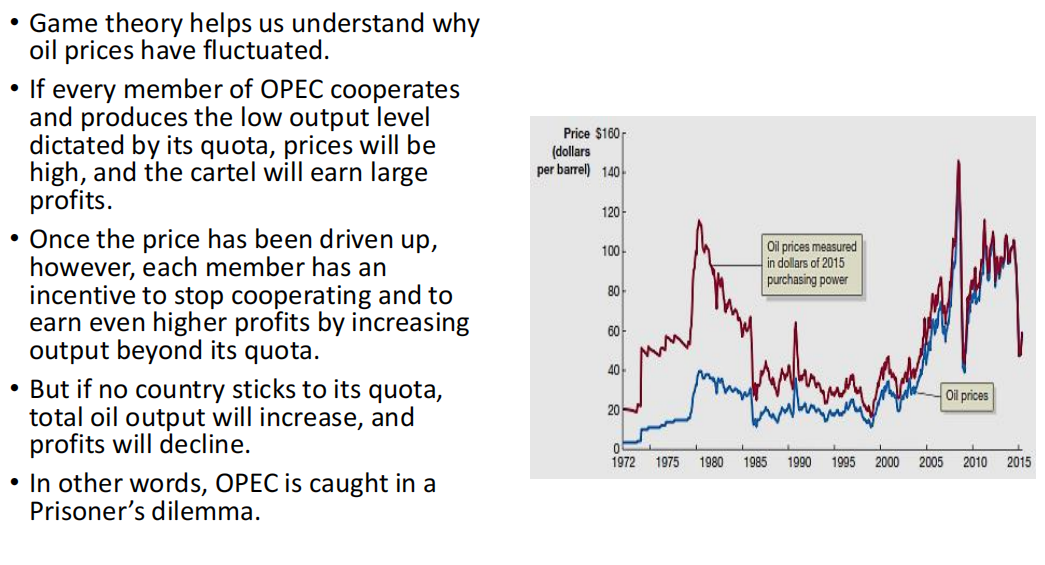
Figure 14.4 shows oil prices from 1972 to mid-2015.
📖 点击查看译文
图14.4显示了1972年至2015年中期的石油价格。
The blue line shows the price of a barrel of oil in each year. Prices in general have risen since 1972, which has reduced the amount of goods and services that consumers can purchase with a dollar.
📖 点击查看译文
蓝色线条显示每年的每桶石油价格。自1972年以来,价格总体上涨,这减少了消费者用一美元能购买的商品和服务数量。
The red line corrects for general price increases by measuring oil prices in terms of the dollar’s purchasing power in 2015.
📖 点击查看译文
红色线条通过以2015年美元购买力来衡量石油价格,修正了总体价格上涨的影响。
The figure shows that OPEC succeeded in raising the price of oil during the mid-1970s and early 1980s, although political unrest in the Middle East and other factors also affected the price of oil during these years.
📖 点击查看译文
图中显示,OPEC在1970年代中期和1980年代初成功提高了石油价格,尽管中东的政治动荡及其他因素也在这些年影响了石油价格。
Oil prices had been below $3 per barrel in 1972 but rose to more than $39 per barrel in 1980, which was more than $115 measured in dollars of 2015 purchasing power.
📖 点击查看译文
1972年石油价格低于每桶3美元,但1980年升至每桶39美元以上,按2015年美元购买力计算则超过115美元。
The figure also shows that OPEC has had difficulty sustaining the high prices of 1980 in later years.
📖 点击查看译文
图中还显示,OPEC在后来几年难以维持1980年的高价水平。
知识点列表与拓展 (Knowledge Points and Extensions):
1. Cartel Dynamics and Stability (卡特尔的动态与稳定性)
-
解释 (Explanation):
Cartels rely on cooperation to restrict output and raise prices, but individual members have incentives to cheat by secretly increasing production, leading to instability over time.
(卡特尔依赖合作限制产量和提高价格,但成员往往有秘密增加产量以获取更大利润的动机,导致卡特尔难以长期稳定。)
-
拓展 (Extension):
Economic theory uses game theory models like repeated prisoner’s dilemma to analyze why cartels often break down and how enforcement mechanisms or punishments can help sustain collusion.
(经济学使用重复囚徒困境等博弈论模型来分析卡特尔为何易瓦解,以及惩罚机制如何帮助维持合谋。)
2. Price Elasticity and Cartel Pricing Power (价格弹性与卡特尔定价权)
-
解释 (Explanation):
Cartels exert pricing power when the demand for their product is relatively inelastic, allowing them to raise prices without losing too many customers.
(当产品需求弹性较低时,卡特尔能更有效地提高价格而不会失去太多客户,从而拥有较强的定价权。)
-
拓展 (Extension):
In OPEC’s case, the global dependency on oil and limited substitutes give it some price-setting power, but external factors like political unrest and alternative energy sources affect its influence.
(以OPEC为例,全球对石油的依赖和替代品有限赋予其一定的定价权,但政治动荡和新能源等外部因素会削弱其影响力。)
3. Real vs Nominal Prices (实际价格与名义价格)
-
解释 (Explanation):
Real prices adjust for inflation and reflect the true purchasing power, whereas nominal prices are the current market prices without inflation adjustment.
(实际价格调整了通货膨胀,反映真实购买力,而名义价格是未调整通胀的当前市场价格。)
-
拓展 (Extension):
Understanding the distinction is crucial in analyzing long-term trends, such as OPEC’s pricing power, where rising nominal prices might mask changes in real economic value.
(理解两者区别对分析长期趋势至关重要,比如OPEC定价权的分析中,名义价格上涨可能掩盖实际经济价值的变化。)
4. Impact of Political and External Factors on Cartels (政治及外部因素对卡特尔的影响)
-
解释 (Explanation):
Political instability, international relations, and global economic events can disrupt cartel agreements and influence prices beyond pure market mechanisms.
(政治不稳定、国际关系和全球经济事件会扰乱卡特尔协议,影响价格走势,超出纯市场机制范畴。)
-
拓展 (Extension):
The Middle East unrest during the 1970s exemplifies how non-economic factors can cause volatility in commodity prices even when cartels attempt to control supply.
(1970年代中东动荡即是非经济因素导致大宗商品价格波动的典型案例,卡特尔试图控制供应也难以完全抵消这种影响。)
17
Game Theory and OPEC’s Price Fluctuations(博弈论与OPEC油价波动)
Game theory helps us understand why oil prices have fluctuated.
📖 点击查看译文
博弈论帮助我们理解油价为何波动。
If every member of OPEC cooperates and produces the low output level dictated by its quota, prices will be high, and the cartel will earn large profits.
📖 点击查看译文
如果每个OPEC成员都合作,按照配额生产较低产量,价格将保持高位,卡特尔获得丰厚利润。
Once the price has been driven up, however, each member has an incentive to stop cooperating and to earn even higher profits by increasing output beyond its quota.
📖 点击查看译文
然而,价格上涨后,每个成员都有动力停止合作,通过超出配额增加产量来获取更高利润。
But if no country sticks to its quota, total oil output will increase, and profits will decline.
📖 点击查看译文
如果没有国家遵守配额,总产量将增加,利润会下降。
In other words, OPEC is caught in a Prisoner’s dilemma.
📖 点击查看译文
换句话说,OPEC陷入了囚徒困境。
知识点列表与拓展 (Knowledge Points and Extensions):
1. Prisoner’s Dilemma in Oligopoly Cartels(寡头卡特尔中的囚徒困境)
-
解释 (Explanation):
The Prisoner’s dilemma is a game theory concept where individual rationality leads to a worse collective outcome, explaining why cartel members cheat despite mutual benefits from cooperation.
(囚徒困境是博弈论概念,个体理性导致集体结果变差,解释了为何卡特尔成员尽管合作能获益,却选择作弊。)
-
拓展 (Extension):
In OPEC’s case, each country’s incentive to defect from the quota leads to cyclical instability in oil prices, demonstrating the difficulty in sustaining cartel agreements without external enforcement.
(在OPEC案例中,各国违背配额的动机导致油价周期性波动,表明没有外部强制,卡特尔协议难以持久。)
2. Nash Equilibrium in Cartel Behavior(卡特尔行为中的纳什均衡)
-
解释 (Explanation):
The Nash equilibrium occurs when no player can improve their payoff by unilaterally changing their strategy, often resulting in a suboptimal outcome for all cartel members in a Prisoner’s dilemma scenario.
(纳什均衡是指当没有玩家能通过单方面改变策略获得更好收益时达到的均衡状态,在囚徒困境中通常导致所有成员的次优结果。)
-
拓展 (Extension):
Understanding Nash equilibrium helps explain why cartel members settle into non-cooperative behavior, as deviating to cooperation risks individual loss if others cheat.
(理解纳什均衡有助于解释为何卡特尔成员常陷入非合作行为,因为合作若遭遇他人作弊则会损失。)
3. Incentive Compatibility and Enforcement Mechanisms(激励相容与执行机制)
-
解释 (Explanation):
Incentive compatibility means designing rules or punishments so that it is in each member’s best interest to adhere to the cartel agreement.
(激励相容指设计规则或惩罚机制,使每个成员遵守卡特尔协议成为自身最佳选择。)
-
拓展 (Extension):
Effective enforcement—such as monitoring output, penalties for cheating, or external regulation—can help stabilize cartels by aligning individual incentives with group goals.
(有效的执行机制如产量监控、作弊惩罚或外部监管能通过使个体激励与集体目标一致,帮助稳定卡特尔。)
4. Repeated Games and Long-Term Cooperation(重复博弈与长期合作)
-
解释 (Explanation):
When cartels interact repeatedly over time, future punishment or reward strategies can encourage members to cooperate, mitigating the Prisoner’s dilemma.
(卡特尔成员长期反复互动时,未来的惩罚或奖励策略可以促进合作,缓解囚徒困境。)
-
拓展 (Extension):
This concept explains why some cartels survive longer than others depending on their ability to enforce cooperation and the discount rate applied to future payoffs.
(该概念解释了部分卡特尔能存续较久,取决于其执行合作能力及对未来收益的折现率。)
18
OPEC’s Cartel Success Factors and Strategic Interactions(OPEC卡特尔成功因素与战略互动)
Two factors explain OPEC’s occasional success at behaving as a cartel.
📖 点击查看译文
有两个因素解释了OPEC偶尔作为卡特尔成功运作的原因。
First, the members of OPEC are participating in a repeated game.
📖 点击查看译文
首先,OPEC成员参与了重复博弈。
As we have seen, being in a repeated game increases the likelihood of a cooperative outcome.
📖 点击查看译文
正如我们所见,重复博弈增加了合作结果的可能性。
Second, Saudi Arabia has far larger oil reserves than any other member of OPEC.
📖 点击查看译文
其次,沙特阿拉伯的石油储量远大于其他任何OPEC成员国。
Therefore, it has the most to gain from high oil prices and a greater incentive to cooperate.
📖 点击查看译文
因此,它在高油价中获得的利益最大,合作的动力也更强。
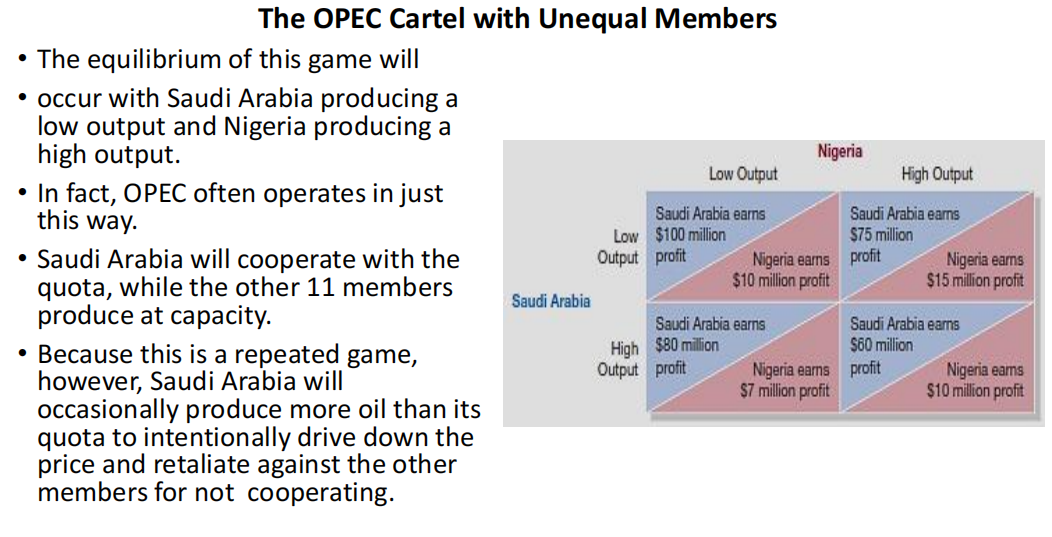
To see this, consider the payoff matrix shown in Figure 14.5.
📖 点击查看译文
对此,可以参考图14.5中的收益矩阵。
Let’s assume that OPEC has only two members: Saudi Arabia and Nigeria.
📖 点击查看译文
假设OPEC只有两个成员国:沙特阿拉伯和尼日利亚。
In Figure 14.5, Low Output corresponds to cooperating with the OPEC-assigned output quota, and High Output corresponds to producing at maximum capacity.
📖 点击查看译文
图中,“低产量”对应遵守OPEC分配的产量配额,“高产量”对应按最大产能生产。
The payoff matrix shows the profits received per day by each country.
📖 点击查看译文
收益矩阵展示了每个国家每日获得的利润。
Because Saudi Arabia can produce much more oil than Nigeria, its output decisions have a much larger effect on the price of oil.
📖 点击查看译文
由于沙特产油量远大于尼日利亚,其产量决策对油价影响更大。
Saudi Arabia has a dominant strategy to cooperate and produce a low output.
📖 点击查看译文
沙特阿拉伯拥有合作且生产低产量的占优策略。
Nigeria, however, has a dominant strategy not to cooperate and instead produce a high output.
📖 点击查看译文
然而,尼日利亚的占优策略是不合作,选择高产量生产。
In order to punish Nigeria for defecting, Saudi Arabia would have to hurt itself substantially.
📖 点击查看译文
为了惩罚尼日利亚的违约,沙特阿拉伯不得不承受重大损失。
知识点列表与拓展 (Knowledge Points and Extensions):
1. Repeated Games and Cooperation Stability(重复博弈与合作稳定性)
-
解释 (Explanation):
Repeated interactions among players can sustain cooperation by enabling strategies contingent on past behavior, such as punishment for defection.
(玩家间的重复互动通过基于过去行为的策略(如对背叛的惩罚)维持合作。)
-
拓展 (Extension):
The Folk Theorem in game theory formalizes that multiple cooperative equilibria can exist in infinitely repeated games, explaining cartels’ occasional success.
(博弈论中的民谣定理表明无限重复博弈中可能存在多种合作均衡,解释了卡特尔偶尔的成功。)
2. Dominant Strategy and Strategic Asymmetry(占优策略与战略非对称性)
-
解释 (Explanation):
A dominant strategy is a choice that yields a higher payoff regardless of the opponent’s action; asymmetry arises when players differ in capabilities or stakes.
(占优策略是无论对手行动如何均能获得更高收益的选择;战略非对称指玩家能力或利益差异。)
-
拓展 (Extension):
Saudi Arabia’s dominant strategy to cooperate contrasts with Nigeria’s dominant defection strategy due to differences in oil reserves, illustrating strategic asymmetry in cartels.
(由于储量差异,沙特合作的占优策略与尼日利亚背叛的占优策略形成对比,体现卡特尔的战略非对称。)
3. Punishment Strategies and Self-Harm in Cartels(卡特尔中的惩罚策略与自我伤害)
-
解释 (Explanation):
Punishing defectors can deter cheating but may require harming oneself, creating a dilemma on the extent and feasibility of enforcement.
(惩罚背叛者能阻止作弊,但可能需要自我伤害,造成执行力度和可行性上的两难。)
-
拓展 (Extension):
The cost of punishment may limit cartel enforcement, especially when dominant members have more to lose by retaliating, as seen with Saudi Arabia’s dilemma.
(惩罚成本限制卡特尔执行力度,尤其当占主导地位成员因报复而损失更大时,如沙特的困境。)
4. Strategic Role of Large Players in Cartels(卡特尔中大玩家的战略角色)
-
解释 (Explanation):
Large members with substantial market power can influence cartel outcomes disproportionately and stabilize cooperation by bearing enforcement costs.
(拥有较大市场力量的成员能不成比例地影响卡特尔结果,并通过承担执行成本稳定合作。)
-
拓展 (Extension):
Saudi Arabia’s role exemplifies how a dominant firm’s cooperation is critical, while smaller members face incentives to defect, complicating cartel cohesion.
(沙特的角色展示了主导企业合作的重要性,而小成员有背叛激励,增加卡特尔内部协调难度。)
19
The OPEC Cartel with Unequal Members(成员不平等的OPEC卡特尔)
The equilibrium of this game will occur with Saudi Arabia producing a low output and Nigeria producing a high output.
📖 点击查看译文
该博弈的均衡是沙特阿拉伯生产低产量,而尼日利亚生产高产量。
In fact, OPEC often operates in just this way.
📖 点击查看译文
实际上,OPEC常常以这种方式运作。
Saudi Arabia will cooperate with the quota, while the other 11 members produce at capacity.
📖 点击查看译文
沙特会遵守配额合作,而其他11个成员国则按最大产能生产。
Because this is a repeated game, however, Saudi Arabia will occasionally produce more oil than its quota to intentionally drive down the price and retaliate against the other members for not cooperating.
📖 点击查看译文
但由于这是重复博弈,沙特会偶尔超出配额生产更多石油,故意压低油价,以惩罚不合作的成员。
知识点列表与拓展 (Knowledge Points and Extensions):
1. Asymmetric Equilibria in Oligopolistic Cartels(寡头卡特尔中的非对称均衡)
-
解释 (Explanation):
In cartels with members of unequal size or capacity, equilibrium outcomes may feature dominant players cooperating while smaller players defect.
(在成员规模或产能不均的卡特尔中,均衡结果可能是主导者合作,小成员背叛。)
-
拓展 (Extension):
Such asymmetric equilibria reflect real-world cartel behavior, where dominant firms bear disproportionate enforcement burdens to sustain cooperation.
(这种非对称均衡反映现实卡特尔行为,主导企业承担不成比例的执行负担以维持合作。)
2. Strategic Retaliation in Repeated Games(重复博弈中的战略报复)
-
解释 (Explanation):
Retaliation strategies in repeated interactions can deter defection by punishing non-cooperative behavior in future rounds.
(重复博弈中的报复策略通过惩罚未来的不合作行为阻止背叛。)
-
拓展 (Extension):
Saudi Arabia’s occasional overproduction to lower prices serves as a credible threat to enforce discipline within OPEC, illustrating punishment equilibrium concepts.
(沙特偶尔超产压价作为可信威胁,执行OPEC内部纪律,体现惩罚均衡概念。)
3. Capacity Constraints and Cooperation Incentives(产能限制与合作激励)
-
解释 (Explanation):
Members with less capacity have stronger incentives to defect as their individual overproduction impacts market price less.
(产能较小的成员因其超产对市场价格影响较小,背叛激励更强。)
-
拓展 (Extension):
This dynamic complicates cartel stability, forcing dominant members to tolerate some defection or employ costly punishment mechanisms.
(这种动态加剧卡特尔稳定性难题,主导成员需容忍部分背叛或采用昂贵惩罚机制。)
4. Repeated Game Dynamics and Cartel Sustainability(重复博弈动态与卡特尔可持续性)
-
解释 (Explanation):
The repeated nature of interactions allows for enforcement of cooperative norms via threat of future punishment.
(重复互动使得通过未来惩罚威胁来执行合作规范成为可能。)
-
拓展 (Extension):
However, imperfect monitoring and discounting of future payoffs can weaken the credibility of such threats, risking cartel breakdown.
(但信息不完全和未来收益折现削弱威胁可信度,增加卡特尔瓦解风险。)
20
Sequential Games and Business Strategy(序贯博弈与商业策略)
The game theory models we have analyzed so far have been simultaneous: the players have made their decisions at the same time.
📖 点击查看译文
到目前为止我们分析的博弈论模型都是同时决策:玩家们同时做出决策。
But some games are sequential in nature: one firm makes a decision, and the other makes its decision having observed the first firm’s decision.
📖 点击查看译文
但有些博弈是序贯性质:一家公司先做决策,另一家公司在观察到该决策后再做出自己的决策。
We analyze such games using a decision tree, indicating who gets to make a decision at what point, and what the consequences of their decision will be.
📖 点击查看译文
我们用决策树分析此类博弈,标明谁在何时做决策及其后果。
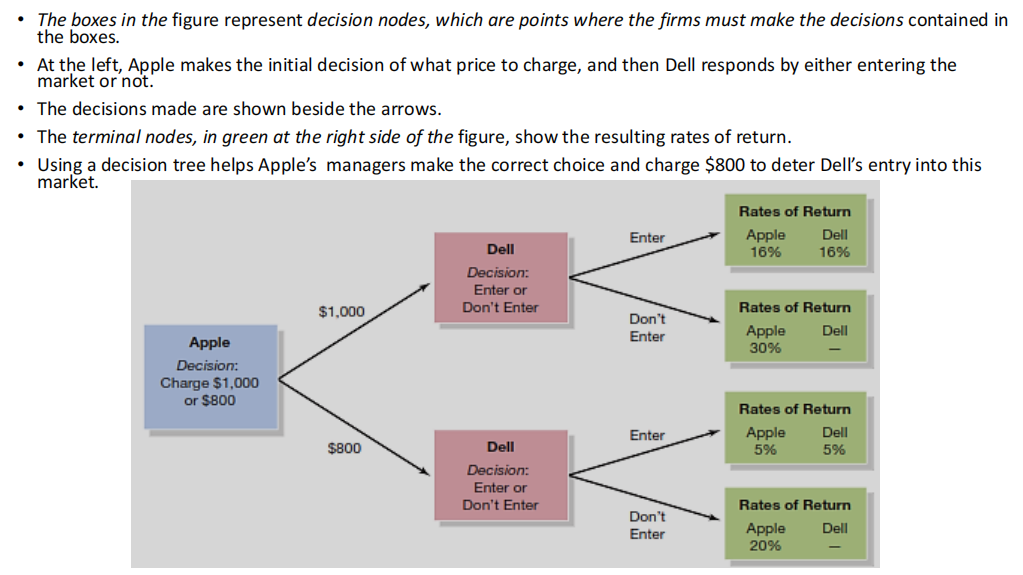
Assume that managers at Apple have developed a very thin, light laptop before Dell has and are considering what price to charge.
📖 点击查看译文
假设苹果的管理层比戴尔先开发出一款超薄轻便笔记本,正在考虑定价。
To break even by covering the opportunity cost of the funds used, laptops must provide a minimum rate of return of 15 percent on Apple’s investment.
📖 点击查看译文
为了覆盖资金的机会成本并实现盈亏平衡,笔记本的投资回报率至少要达到15%。
If Apple has the market for this type of laptop to itself and charges a price of $800, it will earn an economic profit by receiving a return of 20 percent.
📖 点击查看译文
如果苹果独占该款笔记本市场并定价800美元,将获得20%的经济利润回报。
If Apple charges a price of $1,000 and has the market to itself, it will receive a higher return of 30 percent.
📖 点击查看译文
如果苹果定价1000美元并独占市场,回报率将升至30%。
If Apple charges $800 and Dell enters the market, Apple and Dell will divide up the market, and both will earn only 5 percent on their investments, which is below the 15 percent return each firm needs to break even.
📖 点击查看译文
如果苹果定价800美元,戴尔进入市场,两者分市场,但投资回报率均仅为5%,低于盈亏平衡所需的15%。
If Apple charges $1,000 and Dell enters, although the market will still be divided, the higher price means that each firm will earn 16 percent on its investment.
📖 点击查看译文
如果苹果定价1000美元,戴尔进入市场,市场虽被分割,但较高定价使两家公司投资回报率达16%。
Apple and Dell are playing a sequential game because Apple makes the first move, deciding what price to charge, and Dell responds.
📖 点击查看译文
苹果和戴尔玩的是序贯博弈,因为苹果先行动,决定价格,戴尔随后响应。
We can analyze a sequential game by using a decision tree, like the one shown in Figure 14.6.
📖 点击查看译文
我们可以用决策树分析序贯博弈,见图14.6所示。
知识点列表与拓展 (Knowledge Points and Extensions):
1. Sequential Games and Decision Trees(序贯博弈与决策树)
-
解释 (Explanation):
Sequential games involve players making decisions one after another, with later players observing earlier actions. Decision trees graphically represent choices and outcomes at each stage.
(序贯博弈中玩家依次做决策,后行动者观察先行动者。决策树图示各阶段选择与结果。)
-
拓展 (Extension):
Decision trees facilitate backward induction, a method to find subgame perfect equilibrium by reasoning from the end of the game back to the start.
(决策树方便逆向归纳法,通过从博弈终点反推找到子博弈完美均衡。)
2. Subgame Perfect Equilibrium (子博弈完美均衡)
-
解释 (Explanation):
A refinement of Nash equilibrium where players’ strategies constitute a Nash equilibrium in every subgame of the original game.
(纳什均衡的细化,要求策略在原博弈的每个子博弈中均为纳什均衡。)
-
拓展 (Extension):
In sequential pricing games like Apple-Dell, subgame perfect equilibrium predicts optimal pricing strategies considering future competitive responses.
(在类似苹果-戴尔的定价序贯博弈中,子博弈完美均衡预测考虑未来竞争反应的最优定价策略。)
3. First-Mover Advantage and Strategic Commitment(先动优势与战略承诺)
-
解释 (Explanation):
The first player can gain advantage by committing to a strategy early, influencing the second player’s choices.
(先行动者通过早期承诺策略获得优势,影响后行动者决策。)
-
拓展 (Extension):
Apple’s initial pricing decision serves as a strategic commitment that shapes Dell’s market entry and pricing decisions.
(苹果的首个定价决策是战略承诺,影响戴尔是否进入市场及其定价。)
4. Opportunity Cost and Minimum Required Return(机会成本与最低回报率)
-
解释 (Explanation):
Investments must cover opportunity costs, setting a minimum required rate of return to justify the project.
(投资需覆盖机会成本,设定最低回报率以保证项目合理性。)
-
拓展 (Extension):
Firms use these financial benchmarks to decide pricing and market entry strategies in competitive environments.
(企业用财务基准决定竞争环境下的定价与市场进入策略。)
21
Explanation of the Decision Tree in Sequential Games
(序贯博弈中决策树的说明)
• The boxes in the figure represent decision nodes, which are points where the firms must make the decisions contained in the boxes.
📖 点击查看译文
图中的方框代表决策节点,表示企业必须在这些节点做出相应决策。
• At the left, Apple makes the initial decision of what price to charge, and then Dell responds by either entering the market or not.
📖 点击查看译文
左侧苹果首先决定定价,随后戴尔决定是否进入市场。
• The decisions made are shown beside the arrows.
📖 点击查看译文
做出的决策标示在箭头旁边。
• The terminal nodes, in green at the right side of the figure, show the resulting rates of return.
📖 点击查看译文
图右侧绿色的终端节点显示各自的投资回报率。
• Using a decision tree helps Apple’s managers make the correct choice and charge $800 to deter Dell’s entry into this market.
📖 点击查看译文
使用决策树帮助苹果管理层做出正确选择——定价800美元以阻止戴尔进入市场。
知识点列表与拓展 (Knowledge Points and Extensions):
1. Decision Nodes in Decision Trees(决策树中的决策节点)
-
解释 (Explanation):
Decision nodes represent points where a player must choose an action; they are key in modeling sequential decisions.
(决策节点表示玩家必须选择行动的节点,是建模序贯决策的关键。)
-
拓展 (Extension):
Each node branches into possible actions, and players anticipate reactions at subsequent nodes.
(每个节点分支代表可能动作,玩家预期后续节点的反应。)
2. Terminal Nodes and Payoffs(终端节点与收益)
-
解释 (Explanation):
Terminal nodes show outcomes of the sequence of decisions, often in terms of payoffs or returns.
(终端节点显示一系列决策后的结果,通常是收益或回报。)
-
拓展 (Extension):
Analyzing payoffs at terminal nodes enables backward induction to determine optimal earlier decisions.
(分析终端收益可用逆向归纳法确定最优前期决策。)
3. Strategic Deterrence (战略威慑)
-
解释 (Explanation):
Firms may set prices or strategies to deter competitors from entering the market.
(企业通过定价或战略阻止竞争者进入市场。)
-
拓展 (Extension):
Apple’s choice to price at $800, despite lower immediate return, acts as a deterrent to Dell’s market entry.
(苹果定价800美元虽回报较低,但用以阻止戴尔进入市场,体现战略威慑。)
4. Visualization Tools in Game Theory (博弈论中的可视化工具)
-
解释 (Explanation):
Decision trees are effective visual aids to understand sequential games and the consequences of decisions.
(决策树是理解序贯博弈及决策后果的有效可视化工具。)
-
拓展 (Extension):
They clarify complex strategic interactions and assist managers in making informed decisions.
(有助于理清复杂战略互动,帮助管理者做出明智决策。)
22
Bargaining 谈判
• The success of many firms depends on how well they bargain with other firms.
许多企业的成功取决于它们与其他企业谈判的能力。
• For example, firms often must bargain with their suppliers over the prices they pay for inputs.
例如,企业经常需要与供应商就投入品价格进行谈判。
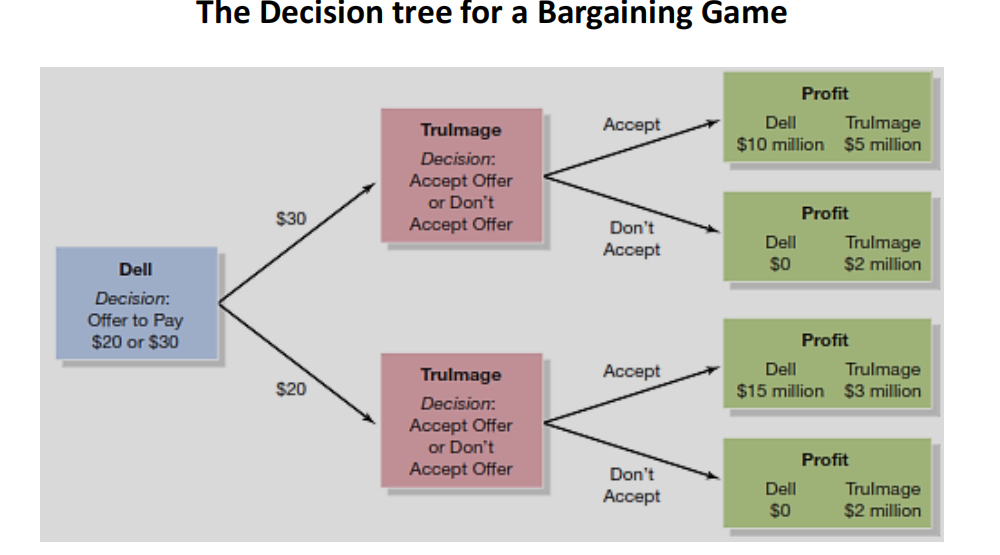
• Suppose that TruImage is a small firm that has developed software that improves how pictures from digital cameras or smartphones are displayed on computers and scanners.
假设TruImage是一家小公司,开发了一款能改进数字相机或智能手机上的图片在电脑和扫描仪上显示效果的软件。
• TruImage currently sells its software only on its Web site and earns a profit of $2 million per year.
TruImage目前只在自己的网站上销售软件,每年盈利200万美元。
• Dell informs TruImage that it is considering installing the software on every new computer Dell sells.
戴尔通知TruImage,考虑在其每台新电脑中预装该软件。
-
Dell can offer $20 or $30 per copy for TruImage’s software.
戴尔可以为TruImage的软件每份出价20美元或30美元。
-
Then TruImage can accept or reject the offer.
然后TruImage可以接受或拒绝报价。
• Dell will look ahead, and realize that TruImage is better off accepting Dell’s offer, no matter what price Dell offers.
戴尔会预见到,不论报价多少,TruImage接受都更有利。
• Therefore Dell should offer the low price, anticipating that TruImage will accept the offer.
因此,戴尔应该出低价,预计TruImage会接受。
• Notice that TruImage would like to threaten to reject an offer of $20.
注意,TruImage想威胁拒绝20美元的报价。
• If Dell believed the threat, its best action would be to offer $30.
如果戴尔相信这一威胁,最优策略是出价30美元。
• But Dell shouldn’t believe the threat; it is not credible, because if TruImage rejects the offer it will earn $2 million and will earn $3 million if accept the offer.
但戴尔不应该相信这个威胁;它不可信,因为如果TruImage拒绝报价,利润是200万美元,接受报价则能赚300万美元。
• Only the original outcome is a subgame-perfect equilibrium: where no player can improve their outcome by changing their decision at any decision node.
只有原始结果是子博弈完美均衡:任何决策节点的玩家都无法通过改变决策改善自己的结果。
知识点列表与拓展 Knowledge Points and Extensions
1. Bargaining in Business (商业谈判)
-
解释: 谈判能力对企业间合作和利润分配至关重要。
-
拓展: 谈判不仅影响输入价格,也影响合同条款、合作伙伴关系等。
2. Subgame-Perfect Equilibrium (子博弈完美均衡)
-
解释: 一种均衡,要求在游戏的每个子博弈中,玩家的策略都是最优的。
-
拓展: 它排除了不可信威胁,使策略在每一步都理性且可信。
3. Credible Threats in Bargaining (谈判中的可信威胁)
-
解释: 只有当威胁实施符合参与者利益时,威胁才可信。
-
拓展: 不可信的威胁不会影响对方的策略选择,可能被忽视。
4. Anticipation and Strategic Offers (预期与战略报价)
-
解释: 出价方预期对方反应,制定对自己最有利的报价。
-
拓展: 这种预测能力是博弈论中“前瞻性思考”的体现。
23
24
The Five Competitive Forces Model 五力竞争模型
• Michael Porter of Harvard Business School identifies five separate competitive forces that determine the overall level of competition in an industry:
哈佛商学院的迈克尔·波特指出,行业内总体竞争水平由五种不同的竞争力量决定:
1. Existing firms
- 现有企业
-
We have already seen that competition among firms in an industry can lower prices and profits.
我们已经看到,行业内企业之间的竞争会压低价格和利润。
-
Educational Testing Service (ETS) produces the Scholastic Aptitude Test (SAT) and the Graduate Record Exam (GRE).
教育考试服务中心(ETS)制作学术能力评估考试(SAT)和研究生入学考试(GRE)。
-
Educational Testing Service administers the price at ($52.50) for SAT and at ($195) for GRE tests.
ETS对SAT定价为52.50美元,GRE定价为195美元。
-
The SAT has competition from the ACT, helping keep its price low.
SAT面临ACT的竞争,帮助其保持低价。
-
The GRE has no competitor.
GRE没有竞争对手。
2. Threat from new entrants
2. 新进入者的威胁
-
Firms face competition from companies that currently are not in the market but might enter.
企业面临来自尚未进入市场但可能进入的公司的竞争。
-
Example: In the previous section, Apple charged a low price to deter Dell from entering its market.
例如:上一节中,苹果通过定低价来阻止戴尔进入其市场。
-
Apple charged a lower price and earned less profit to deter Dell’s entry.
苹果通过低价降低利润以阻止戴尔进入。
-
Business managers often take actions aimed at deterring entry.
企业管理者通常采取措施阻止新进入者。
-
Some of these actions include advertising to create product loyalty, introducing new products, such as slightly different cereals or toothpastes to fill market niches, and setting lower prices to keep profits at a level that makes entry less attractive.
这些措施包括广告以建立产品忠诚度、推出新产品(如稍有差异的谷物或牙膏以填补市场空缺)以及设定较低价格以保持利润水平,使市场进入不具吸引力。
知识点列表与拓展 Knowledge Points and Extensions
1. Michael Porter’s Five Forces (波特五力模型)
-
解释: 用于分析行业竞争结构的框架,包括五种竞争力量。
-
拓展: 这五力影响行业利润水平和企业战略制定。
2. Competition Among Existing Firms (现有企业间的竞争)
-
解释: 现有企业之间的竞争通常会降低价格和利润。
-
拓展: 竞争激烈的市场迫使企业不断创新和降低成本。
3. Threat of New Entrants (新进入者的威胁)
-
解释: 潜在新进入者会增加市场竞争压力。
-
拓展: 企业通过构建进入壁垒(如品牌忠诚度、产品差异化、规模经济)来防御新进入者。
4. Strategic Pricing and Product Differentiation (战略定价与产品差异化)
-
解释: 通过定价策略和产品创新,企业能影响市场竞争态势。
-
拓展: 低价策略虽降低短期利润,但有助于保护市场份额。
25
3. Competition from substitutes
- 替代品的竞争
-
Example: Printed encyclopedia sets used to cost well over $1000, but parents would buy them because there were no good substitutes.
例如:印刷版百科全书套装价格超过1000美元,但家长们仍购买,因为没有好的替代品。
-
But the advent of cheap computer-based encyclopedias helped drive printed encyclopedia producers out of business.
但廉价的电脑版百科全书的出现,使印刷百科全书生产商破产。
4. Bargaining power of buyers
- 买方议价能力
-
Example: Large companies like Wal-Mart can threaten to buy goods from competitors, forcing suppliers to keep their prices low.
例如:像沃尔玛这样的大公司可以威胁从竞争对手处采购,迫使供应商保持低价。
5. Bargaining power of suppliers
- 供应商议价能力
-
Example: As a start-up, Microsoft couldn’t force IBM to pay a high price for its operating system.
例如:微软作为创业公司时,无法迫使IBM为其操作系统支付高价。
-
But as Microsoft became the dominant player in operating systems, it could charge much more to computer manufacturers.
但随着微软成为操作系统领域的主导者,它能向电脑制造商收取更高的费用。
知识点列表与拓展 Knowledge Points and Extensions
5. Competition from Substitutes (替代品竞争)
-
解释: 替代产品的出现会削弱原产品的市场需求和定价能力。
-
拓展: 技术进步常导致替代品出现,迫使企业调整战略以应对威胁。
6. Bargaining Power of Buyers (买方议价能力)
-
解释: 买方通过其采购规模或选择权影响供应商定价和条件。
-
拓展: 买方集中度高或信息透明度高时,议价能力增强。
7. Bargaining Power of Suppliers (供应商议价能力)
-
解释: 供应商凭借独特资源或市场地位影响价格和交易条件。
-
拓展: 行业供应商集中度高或替代品少时,议价能力更强。
📖 点击查看译文
假设你是 Spotify,你会怎么选择策略?
If Apple charges $14.99, you earn $10m profit by charging $14.99, or $15m profit by charging $9.99. You prefer $9.99.
📖 点击查看译文
如果 Apple 定价为 14.99 美元,你定价 14.99 美元可获利 1000 万美元,定价 9.99 美元可获利 1500 万美元。你会偏好 9.99 美元。
If Apple charges $9.99, you earn $5m profit by charging $14.99, or $7.5m profit by charging $9.99. You prefer $9.99.
📖 点击查看译文
如果 Apple 定价为 9.99 美元,你定价 14.99 美元可获利 500 万美元,定价 9.99 美元可获利 750 万美元。你还是偏好 9.99 美元。
Charging $9.99 is a dominant strategy for Spotify: a strategy that is the best for a firm, no matter what strategies other firms use.
📖 点击查看译文
因此,对 Spotify 而言,收取 9.99 美元是一个占优策略:无论其他公司采取什么策略,这都是最优选择。
Now suppose you are Apple. How would you play?
📖 点击查看译文
现在假设你是 Apple,你会怎么做?
If Spotify charges $14.99, you earn $10m profit by charging $14.99, or $15m profit by charging $9.99. You prefer $9.99.
📖 点击查看译文
如果 Spotify 定价为 14.99 美元,你定价 14.99 美元可获利 1000 万美元,定价 9.99 美元可获利 1500 万美元。你会偏好 9.99 美元。
If Spotify charges $9.99, you earn $5m profit by charging $14.99, or $7.5m profit by charging $9.99. You prefer $9.99.
📖 点击查看译文
如果 Spotify 定价为 9.99 美元,你定价 14.99 美元可获利 500 万美元,定价 9.99 美元可获利 750 万美元。你还是偏好 9.99 美元。
Charging $9.99 is a dominant strategy for Apple also.
📖 点击查看译文
因此,对 Apple 而言,收取 9.99 美元也是一个占优策略。
Both firms charging $9.99 is a Nash equilibrium: an equilibrium situation in which each firm chooses the best strategy given the strategies chosen by the other firms.
📖 点击查看译文
两家公司都选择收取 9.99 美元是一个纳什均衡:在此均衡中,每家公司都选择了在给定对方策略下自身最优的策略。
知识点列表与拓展 (Knowledge Points and Extensions):
1. Dominant Strategy(占优策略)
-
解释:
A strategy that yields the highest payoff for a firm regardless of the other player’s strategy.
(无论对方选择什么策略,该策略总能带来最高收益。)
-
拓展:
If both firms have dominant strategies, the game outcome becomes easier to predict.
(如果双方都有占优策略,博弈结果更易预测。)
2. Nash Equilibrium(纳什均衡)
-
解释:
A situation where each player’s strategy is optimal, given the strategy of the other.
(在对方策略已定的前提下,每一方都选择了自身最优策略。)
-
拓展:
No player has an incentive to change strategy unilaterally.
(在均衡状态下,任何一方都不愿意单独改变策略。)
3. The Prisoner’s Dilemma Analogy(囚徒困境类比)
-
解释:
Although both firms would earn higher profit by cooperating (choosing $14.99), the dominant strategy leads them to a less profitable equilibrium.
(虽然合作设定 14.99 美元可带来更高利润,但占优策略导致两者最终落入更低利润的均衡。)
-
拓展:
This demonstrates the tension between individual rationality and collective optimality.
(体现了个体理性与集体最优之间的矛盾。)
11

Collusion and Its Implications(合谋及其影响)
Notice that both firms could do better via collusion: an agreement among firms to charge the same price or otherwise not to compete.
📖 点击查看译文
注意:如果两家公司通过合谋(即协议设定相同价格或不展开竞争)来协作,它们的盈利情况可能会更好。
If both firms charge $14.99, they achieve more profit than by acting independently, but this is not profitable and not good for customers.
📖 点击查看译文
如果两家公司都设定 14.99 美元的价格,它们的利润比独立竞争时更高,但这对消费者而言既不划算也不利。
Therefore, Collusion is against the law in the United States, but you can see why firms might be tempted to collude: their profits could be substantially higher.
📖 点击查看译文
因此,在美国,合谋是违法行为。但你可以理解为何企业会有合谋的冲动:因为那样它们的利润可能大幅增加。
知识点列表与拓展 (Knowledge Points and Extensions)
1. Collusion(合谋)
-
解释:
A (usually secret) agreement between firms to avoid competition, often by fixing prices or output.
(企业之间达成的避免竞争的协议,通常包括定价或限制产量。)
-
拓展:
-
Explicit Collusion(明示合谋): e.g., forming a cartel like OPEC.
-
Tacit Collusion(默契合谋): no direct agreement, but firms behave in a coordinated way.
-
合谋常见于寡头市场,但在多数国家属于反垄断法律禁止的行为。
-
2. Consumer Welfare and Collusion(合谋对消费者福利的影响)
-
解释:
Collusion typically reduces consumer welfare by raising prices and reducing choices.
(合谋行为通常通过抬高价格、减少选择损害消费者福利。)
-
拓展:
-
价格上升 → 消费者支出增加。
-
产品缺乏差异化 → 市场效率降低。
-
3. Legal and Regulatory Framework(法律与监管框架)
-
解释:
In the U.S., collusion violates the Sherman Antitrust Act.
(在美国,合谋行为违反《谢尔曼反托拉斯法》)
-
拓展:
-
各国普遍设有反垄断法来限制寡头和垄断行为。
-
企业如被查出合谋,可能被处以巨额罚款并面临诉讼。
-
4. Incentive to Cheat(违约动机)
-
解释:
Even if firms agree to collude, each has an incentive to undercut the other and gain more market share.
(即便企业合谋,也存在偷偷降价以扩大市场份额的动机。)
-
拓展:
-
合谋往往不稳定,因为背叛可带来短期高回报。
-
此机制与“囚徒困境”相似——合作是最优,但个体有动机背叛。
-
12

Firm Behavior and the Prisoner’s Dilemma
公司行为与囚徒困境
Notice that the equilibrium in Figure 14.2 is not very satisfactory for either firm.
📖 点击查看译文
注意图14.2中的均衡对任何一家公司来说都不太理想。
The firms earn $7.5 million in profit each month by charging $9.99, but they could have earned $10 million in profit if they both had charged $14.99.
📖 点击查看译文
两家公司通过定价9.99美元每月利润是750万美元,但如果都定价14.99美元,则利润可达1000万美元。
By cooperating and charging the higher price, they would have achieved a cooperative equilibrium.
📖 点击查看译文
通过合作并定高价,他们可以实现合作均衡。
In a cooperative equilibrium, players cooperate to increase their mutual payoff.
📖 点击查看译文
合作均衡中,参与者合作以提高共同收益。
We have seen, though, that the outcome of this game is likely to be a non-cooperative equilibrium, in which each firm pursues its own self-interest.
📖 点击查看译文
然而,这个游戏的结果更可能是非合作均衡,即每家公司都追求自身利益。
A situation like the one in Figure 14.2, in which pursuing dominant strategies results in noncooperation that leaves everyone worse off, is called a prisoner’s dilemma.
📖 点击查看译文
图14.2中的这种情形,即追求占优策略导致非合作、使所有人都处于更坏境地的局面,称为囚徒困境。
The game gets its name from the problem two suspects face when arrested for a crime.
📖 点击查看译文
该博弈源自两个犯罪嫌疑人在被捕时面临的问题。
If the police lack other evidence, they may separate the suspects and offer each a reduced prison sentence in exchange for confessing to the crime and testifying against the other suspect.
📖 点击查看译文
如果警方没有其他证据,可能会将两名嫌疑人分开,并以认罪并指控对方为条件减刑。
Because each suspect has a dominant strategy to confess to the crime, they both will confess and serve a jail term, even though they would have gone free if they both had remained silent.
📖 点击查看译文
由于认罪是每个嫌疑人的占优策略,他们都会认罪服刑,尽管如果两人都保持沉默则可以获释。
Knowledge Points and Extensions 知识点与拓展
-
Prisoner’s Dilemma (囚徒困境)
-
A game where individual rational strategies lead to a worse collective outcome.
-
囚徒困境是指各方按照自身最佳策略行动,结果却导致整体利益受损的情形。
-
-
Dominant Strategy (占优策略)
-
The best strategy for a player regardless of what others do.
-
不论对手选择何种策略,始终为最优的策略。
-
-
Non-Cooperative Equilibrium (非合作均衡)
-
Equilibrium where no player cooperates and everyone acts in self-interest.
-
玩家均不合作,各自为政达到的均衡状态。
-
-
Cooperative Equilibrium (合作均衡)
-
Players cooperate to achieve higher collective payoffs, often unstable without enforcement.
-
通过合作获得更高的共同收益,但通常缺乏强制执行机制,容易瓦解。
-
-
Application to Oligopoly (寡头垄断中的应用)
-
Firms in oligopoly face prisoner’s dilemma-type situations when setting prices or output.
-
寡头企业在定价或产量决策时面临类似囚徒困境的局面,难以实现最大化集体利益。
-
13

Prisoner’s Dilemma in Business Pricing
囚徒困境在商业定价中的应用
Economists and other social scientists refer to the situation with Spotify and Apple as a prisoner’s dilemma: a game in which pursuing dominant strategies results in noncooperation that leaves everyone worse off.
📖 点击查看译文
经济学家和社会科学家将Spotify和Apple的情况称为囚徒困境:在该博弈中,追求占优策略导致非合作,使每个人都变得更糟。
The name comes from a problem faced by two suspects the police arrest for a crime.
📖 点击查看译文
这个名字来源于警方逮捕的两个犯罪嫌疑人所面临的问题。
The police offer each suspect a suspended prison sentence in exchange for confessing to the crime and testifying against the other suspect.
📖 点击查看译文
警方向每个嫌疑人提供缓刑,以换取他们认罪并指控对方。
Each suspect has a dominant strategy to confess; but if both confess, they both go to jail for a long time, while they both could have gone to jail for a short time if they had both remained silent.
📖 点击查看译文
每个嫌疑人都有认罪的占优策略;但如果双方都认罪,他们都会被判长期监禁,而如果双方都保持沉默,则只会被判短期监禁。
Suppose Domino’s and Pizza Hut are deciding how to price a pizza: $12 or $10.
📖 点击查看译文
假设必胜客和达美乐正在决定披萨价格,是定12美元还是10美元。
This game gets played not once, but every day.
📖 点击查看译文
这个博弈不是只玩一次,而是每天都在进行。
A clever way to avoid the low-profit Nash equilibrium is to advertise a price-match guarantee.
📖 点击查看译文
避免低利润纳什均衡的一个聪明方法是宣传价格匹配保证。
Then if either firm cuts prices, the other has guaranteed to do so as well.
📖 点击查看译文
这样如果任何一家公司降价,另一家公司也会保证降价。
Now neither firm will have an incentive to cut prices.
📖 点击查看译文
现在双方都没有降价的动机了。
Do price-match guarantees really benefit consumers?
📖 点击查看译文
价格匹配保证真的对消费者有利吗?
Knowledge Points and Extensions 知识点与拓展
-
Repeated Games (重复博弈)
-
Unlike one-time games, many business decisions are repeated, affecting strategy choices over time.
-
与一次性博弈不同,商业决策多为重复博弈,影响长期策略选择。
-
-
Price-Match Guarantee (价格匹配保证)
-
A strategy to discourage price cutting by promising to match competitors’ lower prices, helping firms avoid a price war.
-
通过承诺匹配竞争对手的低价,阻止降价竞争,避免价格战的策略。
-
-
Consumer Impact (对消费者的影响)
-
While price-match guarantees can stabilize prices, they may reduce competition, potentially leading to higher prices overall.
-
价格匹配保证虽然稳定价格,但可能减少竞争,导致整体价格升高。
-
-
Nash Equilibrium in Oligopoly (寡头垄断中的纳什均衡)
-
The stable state where no firm can improve profits by unilaterally changing its price given the other firm’s price.
-
在对方价格不变的情况下,单方改变价格无法获得更大利润的稳定状态。
-
14

Price-Match Guarantee Changes the Payoff Matrix 价格匹配保证改变收益矩阵
With the original payoff matrix in panel (a), there are no advertisements about matching prices, and each restaurant makes more profit if it charges $10 when the other charges $12.
📖 点击查看译文
在面板(a)中的原始收益矩阵里,没有价格匹配广告,当另一家餐厅定价为12美元时,每家餐厅如果定价为10美元就能获得更多利润。
The advertisements about matching prices change the payoff matrix to the one shown in panel (b).
📖 点击查看译文
关于价格匹配的广告将收益矩阵变成了面板(b)所示的样子。
Now the managers can charge $12 and receive a profit of $500 per day, or they can charge $10 and receive a profit of $350 per day.
📖 点击查看译文
现在,管理者可以定价12美元,每天获得500美元利润,或者定价10美元,每天获得350美元利润。
The equilibrium shifts from the prisoner’s dilemma result of both managers charging the low price and receiving low profits to a result where both charge the high price and receive the high profits.
📖 点击查看译文
均衡由囚徒困境中双方都定低价且利润低的结果,转变为双方都定高价且获得高利润的结果。
15

Other Methods for Avoiding Price Competition 避免价格竞争的其他方法
A price-match guarantee is an enforcement mechanism, making automatic the decision about whether to punish a competing firm for charging a low price.
📖 点击查看译文
价格匹配保证是一种执行机制,可以自动决定是否惩罚以低价竞争的对手公司。
Another method is price leadership, a form of implicit collusion in which one firm in an oligopoly announces a price change and the other firms in the industry match the change.
📖 点击查看译文
另一种方法是价格领导,这是隐性合谋的一种形式,其中寡头市场中的一家公司宣布价格变动,其他公司跟随调整价格。
Example: In the 1970s, General Motors would announce a price change at the beginning of a model year, and Ford and Chrysler would match GM’s price change.
📖 点击查看译文
举例:在1970年代,通用汽车会在新车型年初宣布价格变动,福特和克莱斯勒会跟随通用汽车调整价格。
In some cases, such as in the airline industry, firms have attempted to act as price leaders but failed when other firms in the industry have refused to cooperate.
📖 点击查看译文
在某些行业,如航空业,企业尝试充当价格领导者,但当行业内其他公司拒绝合作时,这种尝试失败了。
16

Cartels: The Case of OPEC(卡特尔:以OPEC为例)
A cartel is a group of firms that collude by restricting output to raise prices and profits.
📖 点击查看译文
卡特尔是一组通过协同限制产量来提高价格和利润的企业。
The Organization of Petroleum Exporting Countries (OPEC) is the best known cartel.
📖 点击查看译文
石油输出国组织(OPEC)是最著名的卡特尔。
OPEC colluded to restrict output and raise prices in the 1970s and 1980s.
📖 点击查看译文
OPEC在1970和1980年代合谋限制产量并提高油价。
But collusion has proved difficult to maintain over time.
📖 点击查看译文
但随着时间推移,维持合谋关系变得十分困难。
Together, these countries own more than 75 percent of the world’s proven crude oil reserves, although they supply only about 35 percent of the total oil sold each year.
📖 点击查看译文
这些国家合计拥有全球超过75%的已探明原油储量,尽管它们每年仅供应大约35%的全球石油销售总量。
OPEC operates as a cartel, which is a group of firms that collude by agreeing to restrict output to increase prices and profits.
📖 点击查看译文
OPEC作为一个卡特尔运作,成员企业通过协同限制产量以提高价格和利润。
Figure 14.4 shows oil prices from 1972 to mid-2015.
📖 点击查看译文
图14.4显示了1972年至2015年中期的石油价格。
The blue line shows the price of a barrel of oil in each year. Prices in general have risen since 1972, which has reduced the amount of goods and services that consumers can purchase with a dollar.
📖 点击查看译文
蓝色线条显示每年的每桶石油价格。自1972年以来,价格总体上涨,这减少了消费者用一美元能购买的商品和服务数量。
The red line corrects for general price increases by measuring oil prices in terms of the dollar’s purchasing power in 2015.
📖 点击查看译文
红色线条通过以2015年美元购买力来衡量石油价格,修正了总体价格上涨的影响。
The figure shows that OPEC succeeded in raising the price of oil during the mid-1970s and early 1980s, although political unrest in the Middle East and other factors also affected the price of oil during these years.
📖 点击查看译文
图中显示,OPEC在1970年代中期和1980年代初成功提高了石油价格,尽管中东的政治动荡及其他因素也在这些年影响了石油价格。
Oil prices had been below $3 per barrel in 1972 but rose to more than $39 per barrel in 1980, which was more than $115 measured in dollars of 2015 purchasing power.
📖 点击查看译文
1972年石油价格低于每桶3美元,但1980年升至每桶39美元以上,按2015年美元购买力计算则超过115美元。
The figure also shows that OPEC has had difficulty sustaining the high prices of 1980 in later years.
📖 点击查看译文
图中还显示,OPEC在后来几年难以维持1980年的高价水平。
知识点列表与拓展 (Knowledge Points and Extensions):
1. Cartel Dynamics and Stability (卡特尔的动态与稳定性)
-
解释 (Explanation):
Cartels rely on cooperation to restrict output and raise prices, but individual members have incentives to cheat by secretly increasing production, leading to instability over time.
(卡特尔依赖合作限制产量和提高价格,但成员往往有秘密增加产量以获取更大利润的动机,导致卡特尔难以长期稳定。)
-
拓展 (Extension):
Economic theory uses game theory models like repeated prisoner’s dilemma to analyze why cartels often break down and how enforcement mechanisms or punishments can help sustain collusion.
(经济学使用重复囚徒困境等博弈论模型来分析卡特尔为何易瓦解,以及惩罚机制如何帮助维持合谋。)
2. Price Elasticity and Cartel Pricing Power (价格弹性与卡特尔定价权)
-
解释 (Explanation):
Cartels exert pricing power when the demand for their product is relatively inelastic, allowing them to raise prices without losing too many customers.
(当产品需求弹性较低时,卡特尔能更有效地提高价格而不会失去太多客户,从而拥有较强的定价权。)
-
拓展 (Extension):
In OPEC’s case, the global dependency on oil and limited substitutes give it some price-setting power, but external factors like political unrest and alternative energy sources affect its influence.
(以OPEC为例,全球对石油的依赖和替代品有限赋予其一定的定价权,但政治动荡和新能源等外部因素会削弱其影响力。)
3. Real vs Nominal Prices (实际价格与名义价格)
-
解释 (Explanation):
Real prices adjust for inflation and reflect the true purchasing power, whereas nominal prices are the current market prices without inflation adjustment.
(实际价格调整了通货膨胀,反映真实购买力,而名义价格是未调整通胀的当前市场价格。)
-
拓展 (Extension):
Understanding the distinction is crucial in analyzing long-term trends, such as OPEC’s pricing power, where rising nominal prices might mask changes in real economic value.
(理解两者区别对分析长期趋势至关重要,比如OPEC定价权的分析中,名义价格上涨可能掩盖实际经济价值的变化。)
4. Impact of Political and External Factors on Cartels (政治及外部因素对卡特尔的影响)
-
解释 (Explanation):
Political instability, international relations, and global economic events can disrupt cartel agreements and influence prices beyond pure market mechanisms.
(政治不稳定、国际关系和全球经济事件会扰乱卡特尔协议,影响价格走势,超出纯市场机制范畴。)
-
拓展 (Extension):
The Middle East unrest during the 1970s exemplifies how non-economic factors can cause volatility in commodity prices even when cartels attempt to control supply.
(1970年代中东动荡即是非经济因素导致大宗商品价格波动的典型案例,卡特尔试图控制供应也难以完全抵消这种影响。)
17

Game Theory and OPEC’s Price Fluctuations(博弈论与OPEC油价波动)
Game theory helps us understand why oil prices have fluctuated.
📖 点击查看译文
博弈论帮助我们理解油价为何波动。
If every member of OPEC cooperates and produces the low output level dictated by its quota, prices will be high, and the cartel will earn large profits.
📖 点击查看译文
如果每个OPEC成员都合作,按照配额生产较低产量,价格将保持高位,卡特尔获得丰厚利润。
Once the price has been driven up, however, each member has an incentive to stop cooperating and to earn even higher profits by increasing output beyond its quota.
📖 点击查看译文
然而,价格上涨后,每个成员都有动力停止合作,通过超出配额增加产量来获取更高利润。
But if no country sticks to its quota, total oil output will increase, and profits will decline.
📖 点击查看译文
如果没有国家遵守配额,总产量将增加,利润会下降。
In other words, OPEC is caught in a Prisoner’s dilemma.
📖 点击查看译文
换句话说,OPEC陷入了囚徒困境。
知识点列表与拓展 (Knowledge Points and Extensions):
1. Prisoner’s Dilemma in Oligopoly Cartels(寡头卡特尔中的囚徒困境)
-
解释 (Explanation):
The Prisoner’s dilemma is a game theory concept where individual rationality leads to a worse collective outcome, explaining why cartel members cheat despite mutual benefits from cooperation.
(囚徒困境是博弈论概念,个体理性导致集体结果变差,解释了为何卡特尔成员尽管合作能获益,却选择作弊。)
-
拓展 (Extension):
In OPEC’s case, each country’s incentive to defect from the quota leads to cyclical instability in oil prices, demonstrating the difficulty in sustaining cartel agreements without external enforcement.
(在OPEC案例中,各国违背配额的动机导致油价周期性波动,表明没有外部强制,卡特尔协议难以持久。)
2. Nash Equilibrium in Cartel Behavior(卡特尔行为中的纳什均衡)
-
解释 (Explanation):
The Nash equilibrium occurs when no player can improve their payoff by unilaterally changing their strategy, often resulting in a suboptimal outcome for all cartel members in a Prisoner’s dilemma scenario.
(纳什均衡是指当没有玩家能通过单方面改变策略获得更好收益时达到的均衡状态,在囚徒困境中通常导致所有成员的次优结果。)
-
拓展 (Extension):
Understanding Nash equilibrium helps explain why cartel members settle into non-cooperative behavior, as deviating to cooperation risks individual loss if others cheat.
(理解纳什均衡有助于解释为何卡特尔成员常陷入非合作行为,因为合作若遭遇他人作弊则会损失。)
3. Incentive Compatibility and Enforcement Mechanisms(激励相容与执行机制)
-
解释 (Explanation):
Incentive compatibility means designing rules or punishments so that it is in each member’s best interest to adhere to the cartel agreement.
(激励相容指设计规则或惩罚机制,使每个成员遵守卡特尔协议成为自身最佳选择。)
-
拓展 (Extension):
Effective enforcement—such as monitoring output, penalties for cheating, or external regulation—can help stabilize cartels by aligning individual incentives with group goals.
(有效的执行机制如产量监控、作弊惩罚或外部监管能通过使个体激励与集体目标一致,帮助稳定卡特尔。)
4. Repeated Games and Long-Term Cooperation(重复博弈与长期合作)
-
解释 (Explanation):
When cartels interact repeatedly over time, future punishment or reward strategies can encourage members to cooperate, mitigating the Prisoner’s dilemma.
(卡特尔成员长期反复互动时,未来的惩罚或奖励策略可以促进合作,缓解囚徒困境。)
-
拓展 (Extension):
This concept explains why some cartels survive longer than others depending on their ability to enforce cooperation and the discount rate applied to future payoffs.
(该概念解释了部分卡特尔能存续较久,取决于其执行合作能力及对未来收益的折现率。)
18

OPEC’s Cartel Success Factors and Strategic Interactions(OPEC卡特尔成功因素与战略互动)
Two factors explain OPEC’s occasional success at behaving as a cartel.
📖 点击查看译文
有两个因素解释了OPEC偶尔作为卡特尔成功运作的原因。
First, the members of OPEC are participating in a repeated game.
📖 点击查看译文
首先,OPEC成员参与了重复博弈。
As we have seen, being in a repeated game increases the likelihood of a cooperative outcome.
📖 点击查看译文
正如我们所见,重复博弈增加了合作结果的可能性。
Second, Saudi Arabia has far larger oil reserves than any other member of OPEC.
📖 点击查看译文
其次,沙特阿拉伯的石油储量远大于其他任何OPEC成员国。
Therefore, it has the most to gain from high oil prices and a greater incentive to cooperate.
📖 点击查看译文
因此,它在高油价中获得的利益最大,合作的动力也更强。
To see this, consider the payoff matrix shown in Figure 14.5.
📖 点击查看译文
对此,可以参考图14.5中的收益矩阵。
Let’s assume that OPEC has only two members: Saudi Arabia and Nigeria.
📖 点击查看译文
假设OPEC只有两个成员国:沙特阿拉伯和尼日利亚。
In Figure 14.5, Low Output corresponds to cooperating with the OPEC-assigned output quota, and High Output corresponds to producing at maximum capacity.
📖 点击查看译文
图中,“低产量”对应遵守OPEC分配的产量配额,“高产量”对应按最大产能生产。
The payoff matrix shows the profits received per day by each country.
📖 点击查看译文
收益矩阵展示了每个国家每日获得的利润。
Because Saudi Arabia can produce much more oil than Nigeria, its output decisions have a much larger effect on the price of oil.
📖 点击查看译文
由于沙特产油量远大于尼日利亚,其产量决策对油价影响更大。
Saudi Arabia has a dominant strategy to cooperate and produce a low output.
📖 点击查看译文
沙特阿拉伯拥有合作且生产低产量的占优策略。
Nigeria, however, has a dominant strategy not to cooperate and instead produce a high output.
📖 点击查看译文
然而,尼日利亚的占优策略是不合作,选择高产量生产。
In order to punish Nigeria for defecting, Saudi Arabia would have to hurt itself substantially.
📖 点击查看译文
为了惩罚尼日利亚的违约,沙特阿拉伯不得不承受重大损失。
知识点列表与拓展 (Knowledge Points and Extensions):
1. Repeated Games and Cooperation Stability(重复博弈与合作稳定性)
-
解释 (Explanation):
Repeated interactions among players can sustain cooperation by enabling strategies contingent on past behavior, such as punishment for defection.
(玩家间的重复互动通过基于过去行为的策略(如对背叛的惩罚)维持合作。)
-
拓展 (Extension):
The Folk Theorem in game theory formalizes that multiple cooperative equilibria can exist in infinitely repeated games, explaining cartels’ occasional success.
(博弈论中的民谣定理表明无限重复博弈中可能存在多种合作均衡,解释了卡特尔偶尔的成功。)
2. Dominant Strategy and Strategic Asymmetry(占优策略与战略非对称性)
-
解释 (Explanation):
A dominant strategy is a choice that yields a higher payoff regardless of the opponent’s action; asymmetry arises when players differ in capabilities or stakes.
(占优策略是无论对手行动如何均能获得更高收益的选择;战略非对称指玩家能力或利益差异。)
-
拓展 (Extension):
Saudi Arabia’s dominant strategy to cooperate contrasts with Nigeria’s dominant defection strategy due to differences in oil reserves, illustrating strategic asymmetry in cartels.
(由于储量差异,沙特合作的占优策略与尼日利亚背叛的占优策略形成对比,体现卡特尔的战略非对称。)
3. Punishment Strategies and Self-Harm in Cartels(卡特尔中的惩罚策略与自我伤害)
-
解释 (Explanation):
Punishing defectors can deter cheating but may require harming oneself, creating a dilemma on the extent and feasibility of enforcement.
(惩罚背叛者能阻止作弊,但可能需要自我伤害,造成执行力度和可行性上的两难。)
-
拓展 (Extension):
The cost of punishment may limit cartel enforcement, especially when dominant members have more to lose by retaliating, as seen with Saudi Arabia’s dilemma.
(惩罚成本限制卡特尔执行力度,尤其当占主导地位成员因报复而损失更大时,如沙特的困境。)
4. Strategic Role of Large Players in Cartels(卡特尔中大玩家的战略角色)
-
解释 (Explanation):
Large members with substantial market power can influence cartel outcomes disproportionately and stabilize cooperation by bearing enforcement costs.
(拥有较大市场力量的成员能不成比例地影响卡特尔结果,并通过承担执行成本稳定合作。)
-
拓展 (Extension):
Saudi Arabia’s role exemplifies how a dominant firm’s cooperation is critical, while smaller members face incentives to defect, complicating cartel cohesion.
(沙特的角色展示了主导企业合作的重要性,而小成员有背叛激励,增加卡特尔内部协调难度。)
19

The OPEC Cartel with Unequal Members(成员不平等的OPEC卡特尔)
The equilibrium of this game will occur with Saudi Arabia producing a low output and Nigeria producing a high output.
📖 点击查看译文
该博弈的均衡是沙特阿拉伯生产低产量,而尼日利亚生产高产量。
In fact, OPEC often operates in just this way.
📖 点击查看译文
实际上,OPEC常常以这种方式运作。
Saudi Arabia will cooperate with the quota, while the other 11 members produce at capacity.
📖 点击查看译文
沙特会遵守配额合作,而其他11个成员国则按最大产能生产。
Because this is a repeated game, however, Saudi Arabia will occasionally produce more oil than its quota to intentionally drive down the price and retaliate against the other members for not cooperating.
📖 点击查看译文
但由于这是重复博弈,沙特会偶尔超出配额生产更多石油,故意压低油价,以惩罚不合作的成员。
知识点列表与拓展 (Knowledge Points and Extensions):
1. Asymmetric Equilibria in Oligopolistic Cartels(寡头卡特尔中的非对称均衡)
-
解释 (Explanation):
In cartels with members of unequal size or capacity, equilibrium outcomes may feature dominant players cooperating while smaller players defect.
(在成员规模或产能不均的卡特尔中,均衡结果可能是主导者合作,小成员背叛。)
-
拓展 (Extension):
Such asymmetric equilibria reflect real-world cartel behavior, where dominant firms bear disproportionate enforcement burdens to sustain cooperation.
(这种非对称均衡反映现实卡特尔行为,主导企业承担不成比例的执行负担以维持合作。)
2. Strategic Retaliation in Repeated Games(重复博弈中的战略报复)
-
解释 (Explanation):
Retaliation strategies in repeated interactions can deter defection by punishing non-cooperative behavior in future rounds.
(重复博弈中的报复策略通过惩罚未来的不合作行为阻止背叛。)
-
拓展 (Extension):
Saudi Arabia’s occasional overproduction to lower prices serves as a credible threat to enforce discipline within OPEC, illustrating punishment equilibrium concepts.
(沙特偶尔超产压价作为可信威胁,执行OPEC内部纪律,体现惩罚均衡概念。)
3. Capacity Constraints and Cooperation Incentives(产能限制与合作激励)
-
解释 (Explanation):
Members with less capacity have stronger incentives to defect as their individual overproduction impacts market price less.
(产能较小的成员因其超产对市场价格影响较小,背叛激励更强。)
-
拓展 (Extension):
This dynamic complicates cartel stability, forcing dominant members to tolerate some defection or employ costly punishment mechanisms.
(这种动态加剧卡特尔稳定性难题,主导成员需容忍部分背叛或采用昂贵惩罚机制。)
4. Repeated Game Dynamics and Cartel Sustainability(重复博弈动态与卡特尔可持续性)
-
解释 (Explanation):
The repeated nature of interactions allows for enforcement of cooperative norms via threat of future punishment.
(重复互动使得通过未来惩罚威胁来执行合作规范成为可能。)
-
拓展 (Extension):
However, imperfect monitoring and discounting of future payoffs can weaken the credibility of such threats, risking cartel breakdown.
(但信息不完全和未来收益折现削弱威胁可信度,增加卡特尔瓦解风险。)
20

Sequential Games and Business Strategy(序贯博弈与商业策略)
The game theory models we have analyzed so far have been simultaneous: the players have made their decisions at the same time.
📖 点击查看译文
到目前为止我们分析的博弈论模型都是同时决策:玩家们同时做出决策。
But some games are sequential in nature: one firm makes a decision, and the other makes its decision having observed the first firm’s decision.
📖 点击查看译文
但有些博弈是序贯性质:一家公司先做决策,另一家公司在观察到该决策后再做出自己的决策。
We analyze such games using a decision tree, indicating who gets to make a decision at what point, and what the consequences of their decision will be.
📖 点击查看译文
我们用决策树分析此类博弈,标明谁在何时做决策及其后果。
Assume that managers at Apple have developed a very thin, light laptop before Dell has and are considering what price to charge.
📖 点击查看译文
假设苹果的管理层比戴尔先开发出一款超薄轻便笔记本,正在考虑定价。
To break even by covering the opportunity cost of the funds used, laptops must provide a minimum rate of return of 15 percent on Apple’s investment.
📖 点击查看译文
为了覆盖资金的机会成本并实现盈亏平衡,笔记本的投资回报率至少要达到15%。
If Apple has the market for this type of laptop to itself and charges a price of $800, it will earn an economic profit by receiving a return of 20 percent.
📖 点击查看译文
如果苹果独占该款笔记本市场并定价800美元,将获得20%的经济利润回报。
If Apple charges a price of $1,000 and has the market to itself, it will receive a higher return of 30 percent.
📖 点击查看译文
如果苹果定价1000美元并独占市场,回报率将升至30%。
If Apple charges $800 and Dell enters the market, Apple and Dell will divide up the market, and both will earn only 5 percent on their investments, which is below the 15 percent return each firm needs to break even.
📖 点击查看译文
如果苹果定价800美元,戴尔进入市场,两者分市场,但投资回报率均仅为5%,低于盈亏平衡所需的15%。
If Apple charges $1,000 and Dell enters, although the market will still be divided, the higher price means that each firm will earn 16 percent on its investment.
📖 点击查看译文
如果苹果定价1000美元,戴尔进入市场,市场虽被分割,但较高定价使两家公司投资回报率达16%。
Apple and Dell are playing a sequential game because Apple makes the first move, deciding what price to charge, and Dell responds.
📖 点击查看译文
苹果和戴尔玩的是序贯博弈,因为苹果先行动,决定价格,戴尔随后响应。
We can analyze a sequential game by using a decision tree, like the one shown in Figure 14.6.
📖 点击查看译文
我们可以用决策树分析序贯博弈,见图14.6所示。
知识点列表与拓展 (Knowledge Points and Extensions):
1. Sequential Games and Decision Trees(序贯博弈与决策树)
-
解释 (Explanation):
Sequential games involve players making decisions one after another, with later players observing earlier actions. Decision trees graphically represent choices and outcomes at each stage.
(序贯博弈中玩家依次做决策,后行动者观察先行动者。决策树图示各阶段选择与结果。)
-
拓展 (Extension):
Decision trees facilitate backward induction, a method to find subgame perfect equilibrium by reasoning from the end of the game back to the start.
(决策树方便逆向归纳法,通过从博弈终点反推找到子博弈完美均衡。)
2. Subgame Perfect Equilibrium (子博弈完美均衡)
-
解释 (Explanation):
A refinement of Nash equilibrium where players’ strategies constitute a Nash equilibrium in every subgame of the original game.
(纳什均衡的细化,要求策略在原博弈的每个子博弈中均为纳什均衡。)
-
拓展 (Extension):
In sequential pricing games like Apple-Dell, subgame perfect equilibrium predicts optimal pricing strategies considering future competitive responses.
(在类似苹果-戴尔的定价序贯博弈中,子博弈完美均衡预测考虑未来竞争反应的最优定价策略。)
3. First-Mover Advantage and Strategic Commitment(先动优势与战略承诺)
-
解释 (Explanation):
The first player can gain advantage by committing to a strategy early, influencing the second player’s choices.
(先行动者通过早期承诺策略获得优势,影响后行动者决策。)
-
拓展 (Extension):
Apple’s initial pricing decision serves as a strategic commitment that shapes Dell’s market entry and pricing decisions.
(苹果的首个定价决策是战略承诺,影响戴尔是否进入市场及其定价。)
4. Opportunity Cost and Minimum Required Return(机会成本与最低回报率)
-
解释 (Explanation):
Investments must cover opportunity costs, setting a minimum required rate of return to justify the project.
(投资需覆盖机会成本,设定最低回报率以保证项目合理性。)
-
拓展 (Extension):
Firms use these financial benchmarks to decide pricing and market entry strategies in competitive environments.
(企业用财务基准决定竞争环境下的定价与市场进入策略。)
21

Explanation of the Decision Tree in Sequential Games
(序贯博弈中决策树的说明)
• The boxes in the figure represent decision nodes, which are points where the firms must make the decisions contained in the boxes.
📖 点击查看译文
图中的方框代表决策节点,表示企业必须在这些节点做出相应决策。
• At the left, Apple makes the initial decision of what price to charge, and then Dell responds by either entering the market or not.
📖 点击查看译文
左侧苹果首先决定定价,随后戴尔决定是否进入市场。
• The decisions made are shown beside the arrows.
📖 点击查看译文
做出的决策标示在箭头旁边。
• The terminal nodes, in green at the right side of the figure, show the resulting rates of return.
📖 点击查看译文
图右侧绿色的终端节点显示各自的投资回报率。
• Using a decision tree helps Apple’s managers make the correct choice and charge $800 to deter Dell’s entry into this market.
📖 点击查看译文
使用决策树帮助苹果管理层做出正确选择——定价800美元以阻止戴尔进入市场。
知识点列表与拓展 (Knowledge Points and Extensions):
1. Decision Nodes in Decision Trees(决策树中的决策节点)
-
解释 (Explanation):
Decision nodes represent points where a player must choose an action; they are key in modeling sequential decisions.
(决策节点表示玩家必须选择行动的节点,是建模序贯决策的关键。)
-
拓展 (Extension):
Each node branches into possible actions, and players anticipate reactions at subsequent nodes.
(每个节点分支代表可能动作,玩家预期后续节点的反应。)
2. Terminal Nodes and Payoffs(终端节点与收益)
-
解释 (Explanation):
Terminal nodes show outcomes of the sequence of decisions, often in terms of payoffs or returns.
(终端节点显示一系列决策后的结果,通常是收益或回报。)
-
拓展 (Extension):
Analyzing payoffs at terminal nodes enables backward induction to determine optimal earlier decisions.
(分析终端收益可用逆向归纳法确定最优前期决策。)
3. Strategic Deterrence (战略威慑)
-
解释 (Explanation):
Firms may set prices or strategies to deter competitors from entering the market.
(企业通过定价或战略阻止竞争者进入市场。)
-
拓展 (Extension):
Apple’s choice to price at $800, despite lower immediate return, acts as a deterrent to Dell’s market entry.
(苹果定价800美元虽回报较低,但用以阻止戴尔进入市场,体现战略威慑。)
4. Visualization Tools in Game Theory (博弈论中的可视化工具)
-
解释 (Explanation):
Decision trees are effective visual aids to understand sequential games and the consequences of decisions.
(决策树是理解序贯博弈及决策后果的有效可视化工具。)
-
拓展 (Extension):
They clarify complex strategic interactions and assist managers in making informed decisions.
(有助于理清复杂战略互动,帮助管理者做出明智决策。)
22

Bargaining 谈判
• The success of many firms depends on how well they bargain with other firms.
许多企业的成功取决于它们与其他企业谈判的能力。
• For example, firms often must bargain with their suppliers over the prices they pay for inputs.
例如,企业经常需要与供应商就投入品价格进行谈判。
• Suppose that TruImage is a small firm that has developed software that improves how pictures from digital cameras or smartphones are displayed on computers and scanners.
假设TruImage是一家小公司,开发了一款能改进数字相机或智能手机上的图片在电脑和扫描仪上显示效果的软件。
• TruImage currently sells its software only on its Web site and earns a profit of $2 million per year.
TruImage目前只在自己的网站上销售软件,每年盈利200万美元。
• Dell informs TruImage that it is considering installing the software on every new computer Dell sells.
戴尔通知TruImage,考虑在其每台新电脑中预装该软件。
-
Dell can offer $20 or $30 per copy for TruImage’s software.
戴尔可以为TruImage的软件每份出价20美元或30美元。
-
Then TruImage can accept or reject the offer.
然后TruImage可以接受或拒绝报价。
• Dell will look ahead, and realize that TruImage is better off accepting Dell’s offer, no matter what price Dell offers.
戴尔会预见到,不论报价多少,TruImage接受都更有利。
• Therefore Dell should offer the low price, anticipating that TruImage will accept the offer.
因此,戴尔应该出低价,预计TruImage会接受。
• Notice that TruImage would like to threaten to reject an offer of $20.
注意,TruImage想威胁拒绝20美元的报价。
• If Dell believed the threat, its best action would be to offer $30.
如果戴尔相信这一威胁,最优策略是出价30美元。
• But Dell shouldn’t believe the threat; it is not credible, because if TruImage rejects the offer it will earn $2 million and will earn $3 million if accept the offer.
但戴尔不应该相信这个威胁;它不可信,因为如果TruImage拒绝报价,利润是200万美元,接受报价则能赚300万美元。
• Only the original outcome is a subgame-perfect equilibrium: where no player can improve their outcome by changing their decision at any decision node.
只有原始结果是子博弈完美均衡:任何决策节点的玩家都无法通过改变决策改善自己的结果。
知识点列表与拓展 Knowledge Points and Extensions
1. Bargaining in Business (商业谈判)
-
解释: 谈判能力对企业间合作和利润分配至关重要。
-
拓展: 谈判不仅影响输入价格,也影响合同条款、合作伙伴关系等。
2. Subgame-Perfect Equilibrium (子博弈完美均衡)
-
解释: 一种均衡,要求在游戏的每个子博弈中,玩家的策略都是最优的。
-
拓展: 它排除了不可信威胁,使策略在每一步都理性且可信。
3. Credible Threats in Bargaining (谈判中的可信威胁)
-
解释: 只有当威胁实施符合参与者利益时,威胁才可信。
-
拓展: 不可信的威胁不会影响对方的策略选择,可能被忽视。
4. Anticipation and Strategic Offers (预期与战略报价)
-
解释: 出价方预期对方反应,制定对自己最有利的报价。
-
拓展: 这种预测能力是博弈论中“前瞻性思考”的体现。
23

24

The Five Competitive Forces Model 五力竞争模型
• Michael Porter of Harvard Business School identifies five separate competitive forces that determine the overall level of competition in an industry:
哈佛商学院的迈克尔·波特指出,行业内总体竞争水平由五种不同的竞争力量决定:
1. Existing firms
- 现有企业
-
We have already seen that competition among firms in an industry can lower prices and profits.
我们已经看到,行业内企业之间的竞争会压低价格和利润。
-
Educational Testing Service (ETS) produces the Scholastic Aptitude Test (SAT) and the Graduate Record Exam (GRE).
教育考试服务中心(ETS)制作学术能力评估考试(SAT)和研究生入学考试(GRE)。
-
Educational Testing Service administers the price at ($52.50) for SAT and at ($195) for GRE tests.
ETS对SAT定价为52.50美元,GRE定价为195美元。
-
The SAT has competition from the ACT, helping keep its price low.
SAT面临ACT的竞争,帮助其保持低价。
-
The GRE has no competitor.
GRE没有竞争对手。
2. Threat from new entrants
2. 新进入者的威胁
-
Firms face competition from companies that currently are not in the market but might enter.
企业面临来自尚未进入市场但可能进入的公司的竞争。
-
Example: In the previous section, Apple charged a low price to deter Dell from entering its market.
例如:上一节中,苹果通过定低价来阻止戴尔进入其市场。
-
Apple charged a lower price and earned less profit to deter Dell’s entry.
苹果通过低价降低利润以阻止戴尔进入。
-
Business managers often take actions aimed at deterring entry.
企业管理者通常采取措施阻止新进入者。
-
Some of these actions include advertising to create product loyalty, introducing new products, such as slightly different cereals or toothpastes to fill market niches, and setting lower prices to keep profits at a level that makes entry less attractive.
这些措施包括广告以建立产品忠诚度、推出新产品(如稍有差异的谷物或牙膏以填补市场空缺)以及设定较低价格以保持利润水平,使市场进入不具吸引力。
知识点列表与拓展 Knowledge Points and Extensions
1. Michael Porter’s Five Forces (波特五力模型)
-
解释: 用于分析行业竞争结构的框架,包括五种竞争力量。
-
拓展: 这五力影响行业利润水平和企业战略制定。
2. Competition Among Existing Firms (现有企业间的竞争)
-
解释: 现有企业之间的竞争通常会降低价格和利润。
-
拓展: 竞争激烈的市场迫使企业不断创新和降低成本。
3. Threat of New Entrants (新进入者的威胁)
-
解释: 潜在新进入者会增加市场竞争压力。
-
拓展: 企业通过构建进入壁垒(如品牌忠诚度、产品差异化、规模经济)来防御新进入者。
4. Strategic Pricing and Product Differentiation (战略定价与产品差异化)
-
解释: 通过定价策略和产品创新,企业能影响市场竞争态势。
-
拓展: 低价策略虽降低短期利润,但有助于保护市场份额。
25

3. Competition from substitutes
- 替代品的竞争
-
Example: Printed encyclopedia sets used to cost well over $1000, but parents would buy them because there were no good substitutes.
例如:印刷版百科全书套装价格超过1000美元,但家长们仍购买,因为没有好的替代品。
-
But the advent of cheap computer-based encyclopedias helped drive printed encyclopedia producers out of business.
但廉价的电脑版百科全书的出现,使印刷百科全书生产商破产。
4. Bargaining power of buyers
- 买方议价能力
-
Example: Large companies like Wal-Mart can threaten to buy goods from competitors, forcing suppliers to keep their prices low.
例如:像沃尔玛这样的大公司可以威胁从竞争对手处采购,迫使供应商保持低价。
5. Bargaining power of suppliers
- 供应商议价能力
-
Example: As a start-up, Microsoft couldn’t force IBM to pay a high price for its operating system.
例如:微软作为创业公司时,无法迫使IBM为其操作系统支付高价。
-
But as Microsoft became the dominant player in operating systems, it could charge much more to computer manufacturers.
但随着微软成为操作系统领域的主导者,它能向电脑制造商收取更高的费用。
知识点列表与拓展 Knowledge Points and Extensions
5. Competition from Substitutes (替代品竞争)
-
解释: 替代产品的出现会削弱原产品的市场需求和定价能力。
-
拓展: 技术进步常导致替代品出现,迫使企业调整战略以应对威胁。
6. Bargaining Power of Buyers (买方议价能力)
-
解释: 买方通过其采购规模或选择权影响供应商定价和条件。
-
拓展: 买方集中度高或信息透明度高时,议价能力增强。
7. Bargaining Power of Suppliers (供应商议价能力)
-
解释: 供应商凭借独特资源或市场地位影响价格和交易条件。
-
拓展: 行业供应商集中度高或替代品少时,议价能力更强。
评论
0 条正在加载评论...