16
Efficiency and Equity Trade-off (效率与公平的权衡)
Example: If income tax increases, people might work less or open fewer businesses; but those tax receipts can fund programs that aid the poor.
📖 点击查看译文
例如,如果收入税增加,人们可能会减少工作或开设更少的企业;但这些税收可以用于资助帮助贫困的项目。
Although governments may increase equity by reducing the incomes of high-income people and increasing the incomes of the poor, efficiency may be reduced.
📖 点击查看译文
虽然政府通过减少高收入人群的收入并增加贫困人口的收入来提高公平性,但效率可能会降低。
The result is that fewer goods and services are produced, and less saving takes place.
📖 点击查看译文
结果是生产的商品和服务减少,储蓄减少。
As this example illustrates, there is often a trade-off between efficiency and equity.
📖 点击查看译文
正如这个例子所示,效率与公平之间常常存在权衡。
Government policymakers frequently confront this trade-off.
📖 点击查看译文
政府政策制定者经常面临这种权衡。
知识点列表与拓展 (Knowledge Points and Extensions):
1. Trade-off Between Efficiency and Equity (效率与公平之间的权衡)
-
解释 (Explanation):
A trade-off occurs when achieving one objective (e.g., efficiency) makes it harder to achieve another objective (e.g., equity). Governments often face this trade-off when making policies that balance economic growth with fairness.
(当实现一个目标(例如效率)使得实现另一个目标(例如公平)变得更加困难时,就会发生权衡。政府在制定平衡经济增长和公平的政策时,常常面临这种权衡。)
-
例子 (Example):
A government might increase taxes on the wealthy to fund social welfare programs, but this might reduce overall productivity and investment, as higher taxes can discourage work and entrepreneurship.
(政府可能会提高对富人的税收以资助社会福利项目,但这可能会减少整体生产力和投资,因为更高的税收可能会抑制工作和创业精神。)
-
拓展 (Extension):
Policymakers must balance efficiency and equity, carefully considering the effects of taxes, subsidies, and regulations to achieve a desirable outcome without undermining economic performance.
(政策制定者必须平衡效率与公平,仔细考虑税收、补贴和规制的影响,以在不破坏经济表现的情况下实现理想结果。)
2. The Impact of Taxation on Efficiency (税收对效率的影响)
-
解释 (Explanation):
Taxation can reduce efficiency by creating disincentives for work and investment. High taxes may discourage individuals and businesses from engaging in productive activities, leading to lower output.
(税收通过为工作和投资创造激励不足的情况来降低效率。高税收可能会使个人和企业减少参与生产性活动,从而导致产出下降。)
-
例子 (Example):
If the government increases corporate taxes, businesses might reduce investment or hire fewer workers, ultimately decreasing the economy’s overall output.
(如果政府提高企业税收,企业可能会减少投资或雇佣更少的工人,最终减少经济的整体产出。)
-
拓展 (Extension):
Policymakers often use progressive tax systems to mitigate the negative impact on efficiency while ensuring a fair distribution of wealth.
(政策制定者通常使用累进税制来缓解对效率的负面影响,同时确保财富的公平分配。)
17
How Economists Use Theories and Models to Understand Economic Issues (经济学家如何使用理论和模型来理解经济问题)
By the end of this section, you will be able to:
📖 点击查看译文
到本节结束时,您将能够:
Interpret a circular flow diagram
📖 点击查看译文
解释循环流动图
Explain the importance of economic theories and models
📖 点击查看译文
解释经济理论和模型的重要性
Describe goods and services markets and labor markets
📖 点击查看译文
描述商品和服务市场以及劳动市场
知识点列表与拓展 (Knowledge Points and Extensions):
1. Circular Flow Diagram (循环流动图)
-
解释 (Explanation):
The circular flow diagram is a model that shows the flow of goods, services, and money between households and firms in an economy. It helps visualize how different sectors of the economy are interconnected.
(循环流动图是一个模型,展示了商品、服务和货币在家庭和企业之间的流动。它有助于直观地了解经济中不同部门是如何相互联系的。)
-
例子 (Example):
In the circular flow diagram, households provide labor to firms, and in return, they receive wages. Firms produce goods and services, which are then sold to households in exchange for money.
(在循环流动图中,家庭向企业提供劳动力,作为回报,他们获得工资。企业生产商品和服务,然后将其销售给家庭,换取货币。)
-
拓展 (Extension):
The diagram also shows the flow of capital, such as investments and savings, between different sectors of the economy, providing a broader view of economic activity.
(该图还展示了资本(如投资和储蓄)在经济各个部门之间的流动,从而提供了更广泛的经济活动视角。)
2. Importance of Economic Theories and Models (经济理论和模型的重要性)
-
解释 (Explanation):
Economic theories and models help economists understand complex economic systems, predict outcomes, and make policy recommendations. They provide simplified representations of reality that can be analyzed and tested.
(经济理论和模型帮助经济学家理解复杂的经济系统、预测结果并提出政策建议。它们提供了现实的简化表示,便于分析和验证。)
-
例子 (Example):
The supply and demand model helps predict how changes in market conditions, such as price changes, affect the quantity of goods and services produced and consumed.
(供求模型有助于预测市场条件变化(如价格变化)如何影响商品和服务的生产和消费数量。)
-
拓展 (Extension):
While models are simplified, they provide useful insights for policymakers to develop strategies for improving economic efficiency and fairness.
(尽管模型是简化的,但它们为政策制定者提供了有价值的见解,帮助制定提高经济效率和公平的策略。)
3. Goods and Services Markets and Labor Markets (商品和服务市场以及劳动市场)
-
解释 (Explanation):
Goods and services markets involve the exchange of finished products between firms and households. Labor markets refer to the exchange of labor for wages, where workers supply their services to firms.
(商品和服务市场涉及企业与家庭之间的成品交换。劳动市场指的是劳动力与工资的交换,工人将自己的服务提供给企业。)
-
例子 (Example):
In the goods and services market, a firm sells products like smartphones to households in exchange for money. In the labor market, a worker provides their skills to a firm in exchange for a salary.
(在商品和服务市场中,企业将智能手机等产品出售给家庭,以换取货币。在劳动市场中,工人将自己的技能提供给企业,换取薪水。)
-
拓展 (Extension):
Both markets are crucial to the functioning of the economy, with labor markets directly affecting production capacities and goods and services markets determining what is available for consumption.
(这两个市场对于经济的运作至关重要,劳动市场直接影响生产能力,而商品和服务市场则决定了可供消费的产品。)
18
How Economists Use Theories and Models to Understand Economic Issues (经济学家如何使用理论和模型来理解经济问题)
The famous Economist John Maynard Keynes pointed out that economics is not just a subject area but also a way of thinking.
📖 点击查看译文
著名经济学家约翰·梅纳德·凯恩斯指出,经济学不仅仅是一个学科领域,更是一种思维方式。
“Economics is a method rather than a doctrine, an apparatus of the mind, a technique of thinking, which helps its possessor to draw correct conclusions.”
📖 点击查看译文
“经济学是一种方法,而非教义,是一种思维工具,一种思考技巧,帮助其拥有者得出正确的结论。”
In other words, economics teaches you how to think, not what to think.
📖 点击查看译文
换句话说,经济学教你如何思考,而不是教你思考什么。
Economists analyze issues and problems using economic theories that are based on particular assumptions about human behavior.
📖 点击查看译文
经济学家通过使用基于特定人类行为假设的经济理论来分析问题和难题。
A theory is a simplified representation of how two or more variables interact with each other.
📖 点击查看译文
理论是两个或多个变量如何相互作用的简化表示。
The purpose of a theory is to take a complex, real-world issue and simplify it down to its essentials.
📖 点击查看译文
理论的目的是将一个复杂的现实问题简化到其本质。
Sometimes economists use the term model instead of theory.
📖 点击查看译文
有时经济学家使用“模型”一词而不是“理论”。
Strictly speaking, a theory is a more abstract representation, while a model is a more applied or empirical representation.
📖 点击查看译文
严格来说,理论是更抽象的表示,而模型则是更应用或经验的表示。
We use models to test theories.
📖 点击查看译文
我们使用模型来检验理论。
Today, most models are mathematical and are analyzed with computer programs.
📖 点击查看译文
如今,大多数模型是数学模型,并通过计算机程序进行分析。
For example:
📖 点击查看译文
例如:
An engineer may use a computer model of a bridge to help test whether it will withstand high winds.
📖 点击查看译文
一名工程师可能使用一座桥梁的计算机模型来帮助测试它是否能抵御强风。
A biologist may use a computer model of a nucleic acid to better understand its properties.
📖 点击查看译文
一名生物学家可能使用核酸的计算机模型来更好地理解其特性。
知识点列表与拓展 (Knowledge Points and Extensions):
1. Theories and Models in Economics (经济学中的理论和模型)
-
解释 (Explanation):
Economic theories and models simplify real-world complexities to understand and predict economic behavior. Theories are abstract representations, while models are more applied and tested representations.
(经济学中的理论和模型简化了现实世界的复杂性,用于理解和预测经济行为。理论是抽象的表示,而模型则是更应用和经过测试的表示。)
-
例子 (Example):
The supply and demand model is a simplified version of how the market for a good works, assuming factors like price and quantity are the main variables affecting it.
(供求模型是市场如何运作的简化版,假设价格和数量等因素是影响市场的主要变量。)
-
拓展 (Extension):
While models help test theories, they also evolve over time as more data becomes available, leading to refinements and more accurate representations of economic behavior.
(尽管模型有助于检验理论,但随着更多数据的出现,它们也会随着时间的推移而发展,导致理论的完善和对经济行为的更准确表示。)
19
How Economists Develop and Use Economic Models (经济学家如何开发和使用经济模型)
Sometimes economists use an existing model to analyze a real-world problem or issue, but in other cases, they have to develop a new model.
📖 点击查看译文
有时经济学家使用现有模型来分析现实世界的问题或议题,但在其他情况下,他们必须开发一个新的模型。
To develop a model, economists generally follow these steps:
📖 点击查看译文
开发模型时,经济学家通常遵循以下步骤:
1. Decide on the assumptions to use.
📖 点击查看译文
1. 确定使用的假设。
2. Formulate a testable hypothesis.
📖 点击查看译文
2. 提出可检验的假设。
3. Use economic data to test the hypothesis.
📖 点击查看译文
3. 使用经济数据来检验假设。
4. Revise the model if it fails to explain the economic data well.
📖 点击查看译文
4. 如果模型未能很好地解释经济数据,则修改模型。
5. Retain the revised model to help answer similar economic questions in the future.
📖 点击查看译文
5. 保留修改后的模型,以帮助解答未来类似的经济问题。
Any model is based on assumptions because models have to be simplified to be useful.
📖 点击查看译文
任何模型都基于假设,因为模型必须简化才能发挥作用。
Economic models make behavioral assumptions about the motives of consumers and firms.
📖 点击查看译文
经济模型对消费者和企业的动机做出行为假设。
Economists assume that consumers will buy the goods and services that will maximize their well-being or their satisfaction.
📖 点击查看译文
经济学家假设消费者会购买能够最大化其福祉或满足感的商品和服务。
Similarly, economists assume that firms act to maximize their profits. These assumptions are simplifications because they do not describe the motives of every consumer and every firm.
📖 点击查看译文
类似地,经济学家假设企业的行为是为了最大化其利润。这些假设是简化的,因为它们并未描述每个消费者和每个企业的动机。
In an economic model, a hypothesis is a statement about an economic variable that may be either correct or incorrect.
📖 点击查看译文
在经济模型中,假设是关于经济变量的陈述,可能是正确的,也可能是错误的。
An example of a hypothesis in an economic model is the statement that increased use of industrial robots and information technology in U.S. factories has resulted in a decline in manufacturing employment.
📖 点击查看译文
经济模型中的一个假设例子是:美国工厂中工业机器人和信息技术的使用增加,导致制造业就业下降。
知识点列表与拓展 (Knowledge Points and Extensions):
1. The Development of Economic Models (经济模型的发展)
-
解释 (Explanation):
Economic models are developed to simplify complex real-world issues, with assumptions made about consumer and firm behavior. The development process includes formulating hypotheses, testing them with data, and revising the model as necessary.
(经济模型的开发旨在简化复杂的现实问题,假设消费者和企业的行为。开发过程包括提出假设、用数据检验假设以及根据需要修改模型。)
-
例子 (Example):
A model predicting the impact of a minimum wage increase on employment levels might start with the assumption that higher wages lead to fewer jobs, and then test this hypothesis with labor market data.
(一个预测最低工资上涨对就业水平影响的模型可能从假设更高的工资会导致就业岗位减少开始,然后用劳动力市场数据来检验这个假设。)
-
拓展 (Extension):
While models help simplify and understand economic behaviors, the assumptions they make might not always hold true in the real world, and the models may need constant revision to improve accuracy.
(虽然模型有助于简化和理解经济行为,但它们做出的假设在现实世界中并不总是成立,因此模型可能需要不断修订以提高准确性。)
20
Testing Hypotheses in Economic Models (在经济模型中检验假设)
The hypothesis may be correct if the main effect of industrial robots has been to replace assembly line workers, thereby reducing employment.
📖 点击查看译文
如果工业机器人的主要作用是替代装配线工人,从而减少就业,那么假设可能是正确的。
Or the hypothesis may be incorrect if the use of robots and other information technology has increased firms’ demand for software programmers and other technology workers, thereby increasing employment.
📖 点击查看译文
如果工业机器人和其他信息技术的使用增加了企业对软件程序员和其他技术工人的需求,从而增加了就业,那么假设可能是错误的。
An economic hypothesis is usually about a causal relationship; in this case, the hypothesis states that increased use of robots and information technology causes, or leads to, lower employment in manufacturing.
📖 点击查看译文
经济假设通常是关于因果关系的;在这种情况下,假设指出工业机器人和信息技术的使用增加会导致制造业就业减少。
Before we can accept a hypothesis, we have to test it by analyzing statistics, or data, on the relevant economic variables.
📖 点击查看译文
在我们接受假设之前,必须通过分析相关经济变量的统计数据来检验它。
Note that hypotheses must be statements that could, in principle, turn out to be incorrect.
📖 点击查看译文
请注意,假设必须是可能会被证明是错误的陈述。
Economists accept and use an economic model if it leads to hypotheses that are confirmed by statistical analysis.
📖 点击查看译文
如果经济模型得出的假设经统计分析得到证实,经济学家会接受并使用该模型。
In fact, economists often refer to a hypothesis having been “not rejected” rather than having been “accepted” by statistical analysis.
📖 点击查看译文
事实上,经济学家通常将假设被统计分析“未被拒绝”而不是“被接受”。
But what if statistical analysis clearly rejects a hypothesis? For example, what if a model leads to a hypothesis that increased use of industrial robots will cause a decline in manufacturing employment, but the data reject this hypothesis?
📖 点击查看译文
但是,如果统计分析明确拒绝了一个假设怎么办?例如,如果一个模型提出工业机器人使用增加会导致制造业就业下降的假设,但数据却拒绝了这个假设?
In this case, the model should be reconsidered.
📖 点击查看译文
在这种情况下,模型应该重新考虑。
It may be that an assumption used in the model was too simplified or too limiting.
📖 点击查看译文
可能是模型中使用的某个假设过于简化或过于局限。
知识点列表与拓展 (Knowledge Points and Extensions):
1. Hypothesis Testing in Economic Models (经济模型中的假设检验)
-
解释 (Explanation):
A hypothesis is tested using statistical data to determine if it is valid. If the data supports the hypothesis, the model may be considered useful, but if the hypothesis is rejected, the model should be revised.
(假设通过统计数据进行检验,以确定其是否有效。如果数据支持假设,模型可能被认为是有用的;如果假设被拒绝,模型应进行修订。)
-
例子 (Example):
If a model suggests that increasing robot use reduces factory jobs but the data shows no significant change in employment, economists would need to revise their model assumptions.
(如果一个模型表明增加机器人的使用会减少工厂工作,但数据表明就业没有显著变化,经济学家需要修订他们的模型假设。)
-
拓展 (Extension):
Statistical analysis is crucial in validating hypotheses. Rejected hypotheses can lead to model revisions that may reveal more accurate economic insights.
(统计分析在验证假设中至关重要。被拒绝的假设可能导致模型修订,从而揭示更准确的经济洞察。)
21
Circular Flow Diagram (循环流动图)
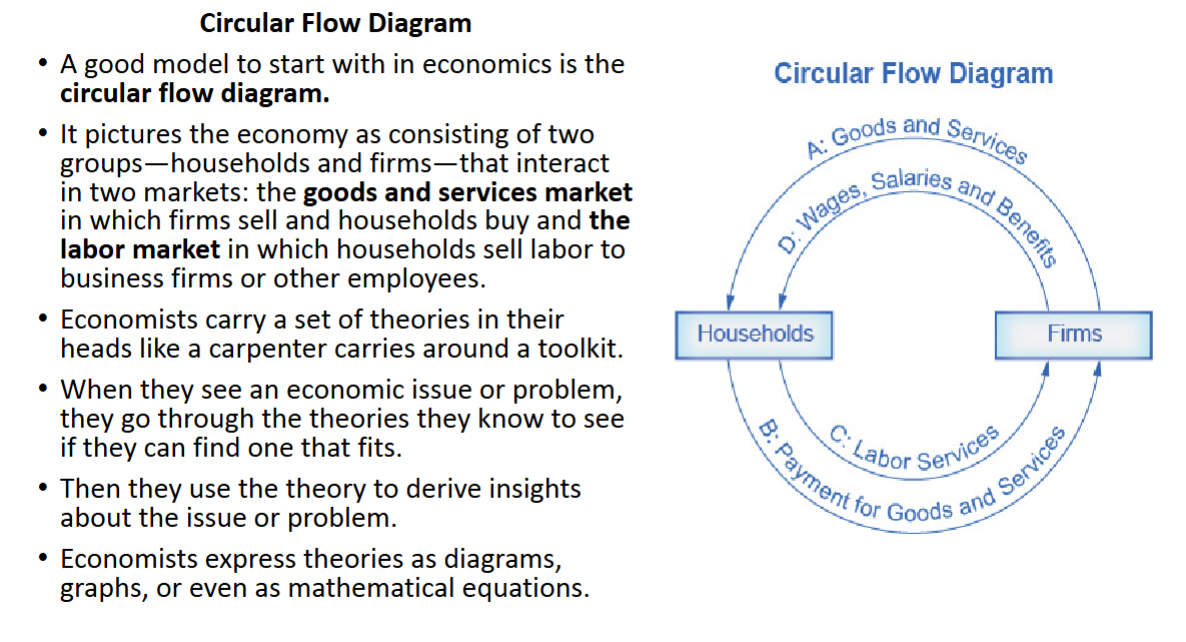
A good model to start with in economics is the circular flow diagram.
📖 点击查看译文
在经济学中,一个很好的起点模型是循环流动图。
It pictures the economy as consisting of two groups—households and firms—that interact in two markets: the goods and services market in which firms sell and households buy and the labor market in which households sell labor to business firms or other employees.
📖 点击查看译文
它将经济描绘为由两个群体——家庭和企业——组成,并在两个市场中互动:商品和服务市场(企业销售,家庭购买)以及劳动力市场(家庭向企业或其他雇主出售劳动力)。
Economists carry a set of theories in their heads like a carpenter carries around a toolkit.
📖 点击查看译文
经济学家就像木匠携带工具箱一样,在脑海中携带一套理论。
When they see an economic issue or problem, they go through the theories they know to see if they can find one that fits.
📖 点击查看译文
当他们看到一个经济问题时,会回顾自己掌握的理论,看看是否能找到适用的理论。
Then they use the theory to derive insights about the issue or problem.
📖 点击查看译文
然后,他们利用该理论得出对该问题的见解。
Economists express theories as diagrams, graphs, or even as mathematical equations.
📖 点击查看译文
经济学家使用图表、图形,甚至数学方程来表达理论。
知识点列表与拓展 (Knowledge Points and Extensions):
1. Circular Flow Diagram (循环流动图)
-
解释 (Explanation):
The circular flow diagram is a basic economic model that illustrates the flow of goods, services, and labor between households and firms in an economy.
(循环流动图是一个基本的经济模型,展示了家庭与企业之间商品、服务和劳动力的流动。)
-
例子 (Example):
A household purchases food from a grocery store (goods and services market) and provides labor to a company as an employee (labor market).
(家庭在超市购买食品(商品和服务市场)并作为雇员为公司提供劳动力(劳动力市场)。)
-
拓展 (Extension):
The model can be expanded to include the government, financial markets, and international trade, making it more comprehensive.
(该模型可以扩展到包括政府、金融市场和国际贸易,使其更加全面。)
22
Circular Flow in Product and Factor Markets (商品市场与要素市场的循环流动)
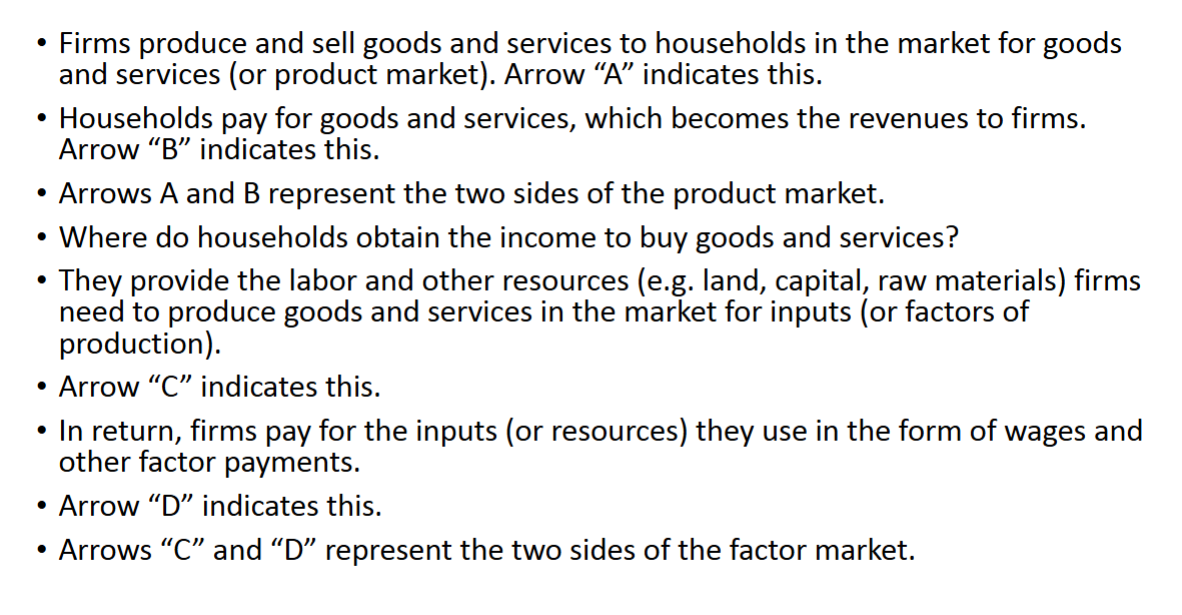
Firms produce and sell goods and services to households in the market for goods and services (or product market). Arrow “A” indicates this.
📖 点击查看译文
企业在商品和服务市场(或产品市场)中向家庭生产并销售商品和服务。箭头“A”表示这一过程。
Households pay for goods and services, which becomes the revenues to firms. Arrow “B” indicates this.
📖 点击查看译文
家庭支付商品和服务的费用,这成为企业的收入。箭头“B”表示这一过程。
Arrows A and B represent the two sides of the product market.
📖 点击查看译文
箭头 A 和 B 代表产品市场的两个方面。
Where do households obtain the income to buy goods and services?
📖 点击查看译文
家庭从哪里获得购买商品和服务的收入?
They provide the labor and other resources (e.g. land, capital, raw materials) firms need to produce goods and services in the market for inputs (or factors of production).
📖 点击查看译文
他们在投入市场(或生产要素市场)中提供企业生产商品和服务所需的劳动力和其他资源(如土地、资本、原材料)。
Arrow “C” indicates this.
📖 点击查看译文
箭头“C”表示这一过程。
In return, firms pay for the inputs (or resources) they use in the form of wages and other factor payments.
📖 点击查看译文
作为回报,企业以工资和其他要素支付的形式为所使用的投入(或资源)支付费用。
Arrow “D” indicates this.
📖 点击查看译文
箭头“D”表示这一过程。
Arrows “C” and “D” represent the two sides of the factor market.
📖 点击查看译文
箭头 C 和 D 代表要素市场的两个方面。
知识点列表与拓展 (Knowledge Points and Extensions):
1. Product Market and Factor Market (产品市场与要素市场)
-
解释 (Explanation):
The product market is where goods and services are exchanged, while the factor market is where firms acquire inputs (e.g., labor, capital, raw materials) for production.
(产品市场是商品和服务交换的场所,而要素市场是企业获取生产所需投入(如劳动力、资本、原材料)的地方。)
-
例子 (Example):
A bakery sells bread to customers in the product market (Arrow A and B), while it hires workers and buys flour in the factor market (Arrow C and D).
(一家面包店在产品市场向顾客销售面包(箭头 A 和 B),同时在要素市场雇佣工人并购买面粉(箭头 C 和 D)。)
-
拓展 (Extension):
In a more complex economy, the government, financial institutions, and international trade also interact within these markets, influencing the flow of resources and money.
(在更复杂的经济体系中,政府、金融机构和国际贸易也参与这些市场的互动,影响资源和资金的流动。)
23
Positive and Normative Analysis (实证分析与规范分析)
Economists try to mimic natural scientists by using the scientific method.
📖 点击查看译文
经济学家试图通过使用科学方法来模仿自然科学家。
But economics is a social science; studying the behavior of people is often tricky.
📖 点击查看译文
但经济学是一门社会科学,研究人类行为通常较为复杂。
When analyzing human behavior, we can perform:
📖 点击查看译文
在分析人类行为时,我们可以进行:
• Positive analysis: analysis concerned with what is
📖 点击查看译文
• 实证分析:关注“是什么”的分析
• Normative analysis: analysis concerned with what ought to be
📖 点击查看译文
• 规范分析:关注“应该是什么”的分析
Economists mostly perform positive analysis.
📖 点击查看译文
经济学家主要进行实证分析。
知识点列表与拓展 (Knowledge Points and Extensions):
1. Positive vs. Normative Analysis (实证分析 vs. 规范分析)
-
解释 (Explanation):
Positive analysis deals with objective statements that can be tested, while normative analysis involves value judgments and subjective opinions.
(实证分析涉及可以检验的客观陈述,而规范分析涉及价值判断和主观意见。)
-
例子 (Example):
-
“An increase in the minimum wage leads to higher unemployment” is a positive statement because it can be tested with data.
(“最低工资的提高会导致更高的失业率”是一个实证陈述,因为它可以用数据检验。)
-
“The government should increase the minimum wage to reduce poverty” is a normative statement because it is based on value judgments.
(“政府应提高最低工资以减少贫困”是一个规范陈述,因为它基于价值判断。)
-
-
拓展 (Extension):
While positive analysis forms the basis of economic research, policymakers often rely on normative analysis to make decisions that align with societal goals.
(虽然实证分析构成了经济研究的基础,但决策者通常依赖规范分析来制定符合社会目标的政策。)
24
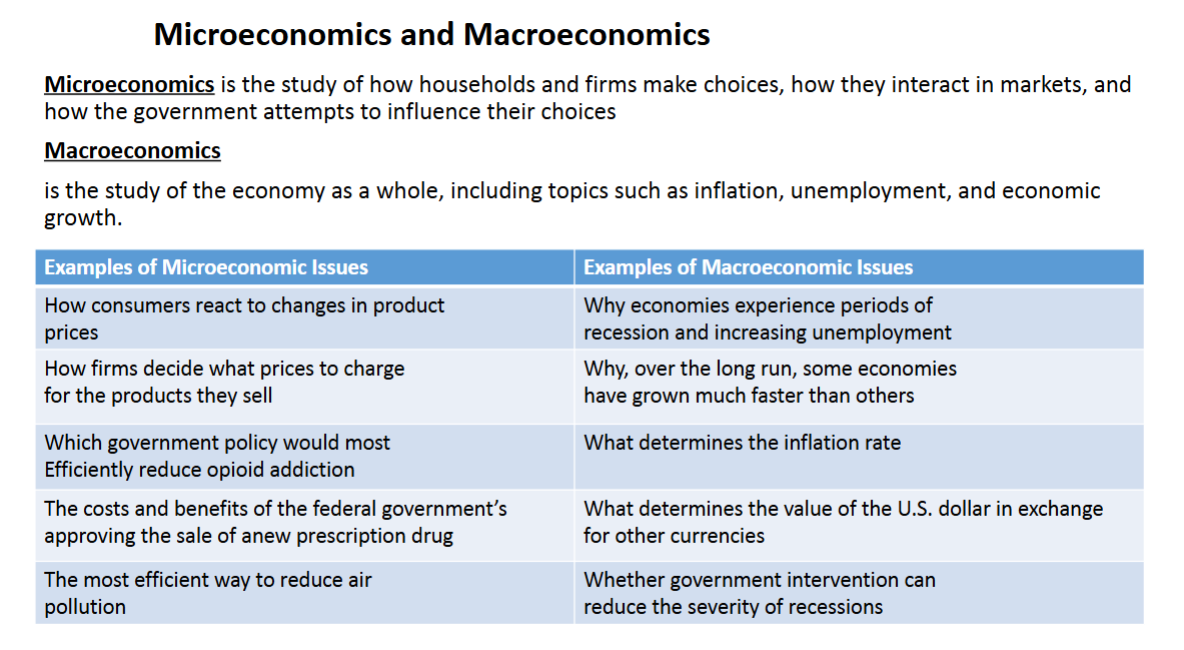
Microeconomics and Macroeconomics (微观经济学与宏观经济学)
Microeconomics is the study of how households and firms make choices, how they interact in markets, and how the government attempts to influence their choices.
📖 点击查看译文
微观经济学研究家庭和企业如何做出选择,它们如何在市场中互动,以及政府如何试图影响它们的选择。
Macroeconomics is the study of the economy as a whole, including topics such as inflation, unemployment, and economic growth.
📖 点击查看译文
宏观经济学研究整体经济,包括通货膨胀、失业和经济增长等主题。
Examples of Microeconomic Issues (微观经济学问题示例)
-
How consumers react to changes in product prices
📖 点击查看译文
消费者如何对产品价格变化做出反应
-
How firms decide what prices to charge for the products they sell
📖 点击查看译文
企业如何决定产品的定价
-
Which government policy would most efficiently reduce opioid addiction
📖 点击查看译文
哪种政府政策能最有效地减少阿片类药物成瘾
-
The costs and benefits of the federal government’s approving the sale of a new prescription drug
📖 点击查看译文
联邦政府批准销售新处方药的成本和收益
-
The most efficient way to reduce air pollution
📖 点击查看译文
减少空气污染的最有效方法
Examples of Macroeconomic Issues (宏观经济学问题示例)
-
Why economies experience periods of recession and increasing unemployment
📖 点击查看译文
为什么经济会经历衰退期并导致失业率上升
-
Why, over the long run, some economies have grown much faster than others
📖 点击查看译文
为什么从长期来看,一些经济体的增长速度远快于其他经济体
-
What determines the inflation rate
📖 点击查看译文
是什么决定了通货膨胀率
-
What determines the value of the U.S. dollar in exchange for other currencies
📖 点击查看译文
是什么决定了美元相对于其他货币的价值
-
Whether government intervention can reduce the severity of recessions
📖 点击查看译文
政府干预是否能减少经济衰退的严重程度
知识点列表与拓展 (Knowledge Points and Extensions):
1. Microeconomics vs. Macroeconomics (微观经济学 vs. 宏观经济学)
-
解释 (Explanation):
Microeconomics focuses on individual decision-making units, such as households and firms, while macroeconomics examines aggregate economic issues like inflation and GDP growth.
(微观经济学关注个体决策单位,如家庭和企业,而宏观经济学研究整体经济问题,如通货膨胀和 GDP 增长。)
-
例子 (Example):
-
A firm setting prices for its new product is a microeconomic decision.
(企业为其新产品设定价格是微观经济学的决策。)
-
The central bank adjusting interest rates to control inflation is a macroeconomic action.
(中央银行调整利率以控制通货膨胀是宏观经济学的行为。)
-
-
拓展 (Extension):
While microeconomics and macroeconomics analyze different levels of the economy, they are interconnected. Policies affecting firms and consumers at the micro level can have large-scale macroeconomic consequences.
(尽管微观经济学和宏观经济学研究的是经济的不同层面,但它们是相互关联的。影响企业和消费者的微观政策可能会带来大规模的宏观经济影响。)
25
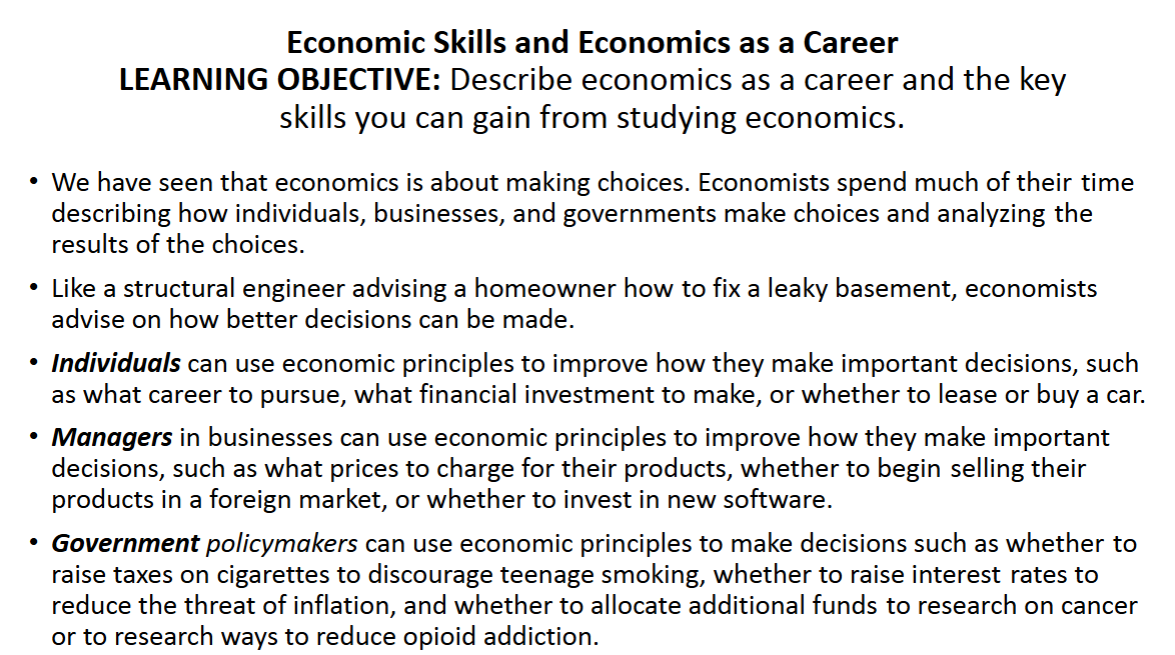
Economic Skills and Economics as a Career (经济学技能与职业发展)
We have seen that economics is about making choices. Economists spend much of their time describing how individuals, businesses, and governments make choices and analyzing the results of the choices.
📖 点击查看译文
我们已经看到,经济学是关于做选择的。经济学家大部分时间都在描述个人、企业和政府如何做出选择,并分析这些选择的结果。
Like a structural engineer advising a homeowner how to fix a leaky basement, economists advise on how better decisions can be made.
📖 点击查看译文
就像结构工程师建议房主如何修复渗水的地下室一样,经济学家提供建议,帮助人们做出更好的决策。
Applications of Economic Principles (经济学原理的应用)
Individuals (个人)
-
Use economic principles to improve important decisions
-
Choosing a career (选择职业)
-
Making financial investments (进行金融投资)
-
Deciding whether to lease or buy a car (决定是租车还是买车)
-
Business Managers (企业管理者)
-
Use economic principles to improve business decisions
-
Setting product prices (确定产品价格)
-
Entering foreign markets (进入国外市场)
-
Investing in new technology or software (投资新技术或软件)
-
Government Policymakers (政府决策者)
-
Use economic principles to guide policy decisions
-
Raising taxes on cigarettes to reduce teenage smoking (提高香烟税以减少青少年吸烟)
-
Adjusting interest rates to control inflation (调整利率以控制通货膨胀)
-
Allocating funds for medical or social research (分配资金用于医学或社会研究)
-
知识点列表与拓展 (Knowledge Points and Extensions):
1. Decision-Making in Economics (经济学中的决策分析)
-
解释 (Explanation):
Economics provides tools and frameworks for analyzing trade-offs, optimizing choices, and evaluating consequences.
(经济学提供了分析权衡、优化选择和评估后果的工具和框架。)
-
例子 (Example):
-
A person deciding whether to buy a house or continue renting based on future interest rates.
(一个人基于未来的利率决定是买房还是继续租房。)
-
A business choosing whether to expand production given expected demand and costs.
(一家企业根据预期需求和成本决定是否扩大生产。)
-
-
拓展 (Extension):
Behavioral economics explores how psychological biases impact decision-making, often leading individuals and firms to make suboptimal choices.
(行为经济学研究心理偏差如何影响决策,导致个人和企业做出次优选择。)
26
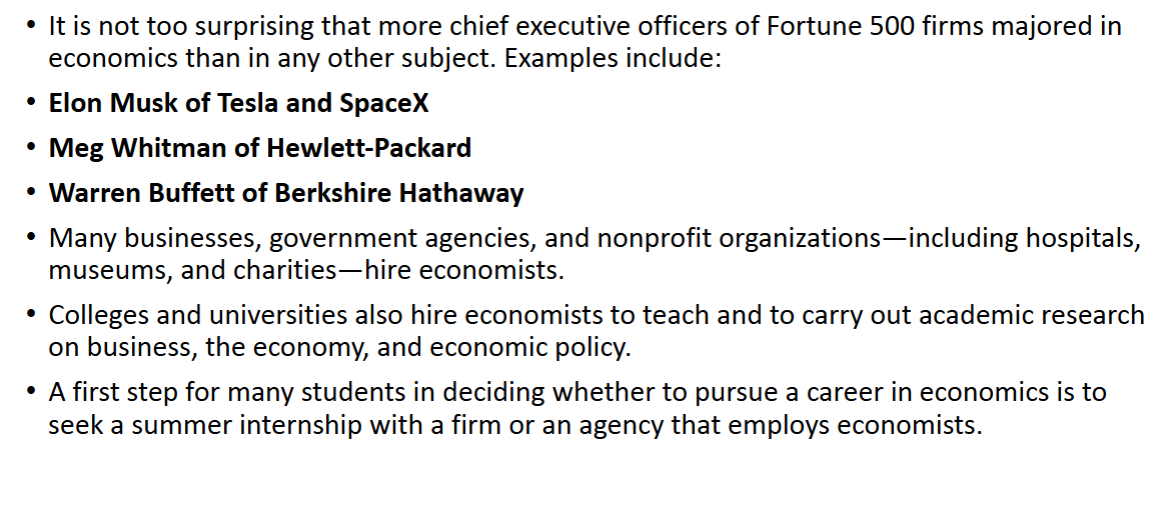
Economic Careers and Prominent Figures (经济学职业与杰出人物)
It is not too surprising that more chief executive officers of Fortune 500 firms majored in economics than in any other subject. Examples include:
📖 点击查看译文
令人不太惊讶的是,财富500强公司的首席执行官中,选择经济学作为专业的人数比任何其他专业都多。以下是一些例子:
-
Elon Musk of Tesla and SpaceX (特斯拉和SpaceX的埃隆·马斯克)
-
Meg Whitman of Hewlett-Packard (惠普的梅格·惠特曼)
-
Warren Buffett of Berkshire Hathaway (伯克希尔·哈撒韦的沃伦·巴菲特)
Many businesses, government agencies, and nonprofit organizations—including hospitals, museums, and charities—hire economists.
📖 点击查看译文
许多企业、政府机构和非营利组织——包括医院、博物馆和慈善机构——都雇佣经济学家。
Colleges and universities also hire economists to teach and to carry out academic research on business, the economy, and economic policy.
📖 点击查看译文
大学和高等院校也雇佣经济学家来教授课程并进行关于商业、经济和经济政策的学术研究。
A first step for many students in deciding whether to pursue a career in economics is to seek a summer internship with a firm or an agency that employs economists.
📖 点击查看译文
许多学生决定是否从事经济学职业的第一步是寻找一份与雇佣经济学家的公司或机构的暑期实习。
知识点列表与拓展 (Knowledge Points and Extensions):
1. Career Opportunities in Economics (经济学职业机会)
-
解释 (Explanation):
Economics provides diverse career opportunities in various sectors, including business, government, and academia. Many successful individuals in these fields have backgrounds in economics.
(经济学提供了在各个领域的多种职业机会,包括商业、政府和学术界。许多成功的行业人士拥有经济学背景。)
-
例子 (Example):
-
Elon Musk’s success in leading innovative tech companies, influenced by his background in economics.
(埃隆·马斯克在领导创新科技公司的成功,受经济学背景的影响。)
-
Economists advising government agencies on economic policy.
(经济学家为政府机构提供经济政策建议。)
-
-
拓展 (Extension):
Internships and hands-on experience are vital for students considering a career in economics, providing exposure to real-world economic challenges.
(对于考虑从事经济学职业的学生来说,实习和实践经验至关重要,可以让学生接触到现实世界中的经济挑战。)
27
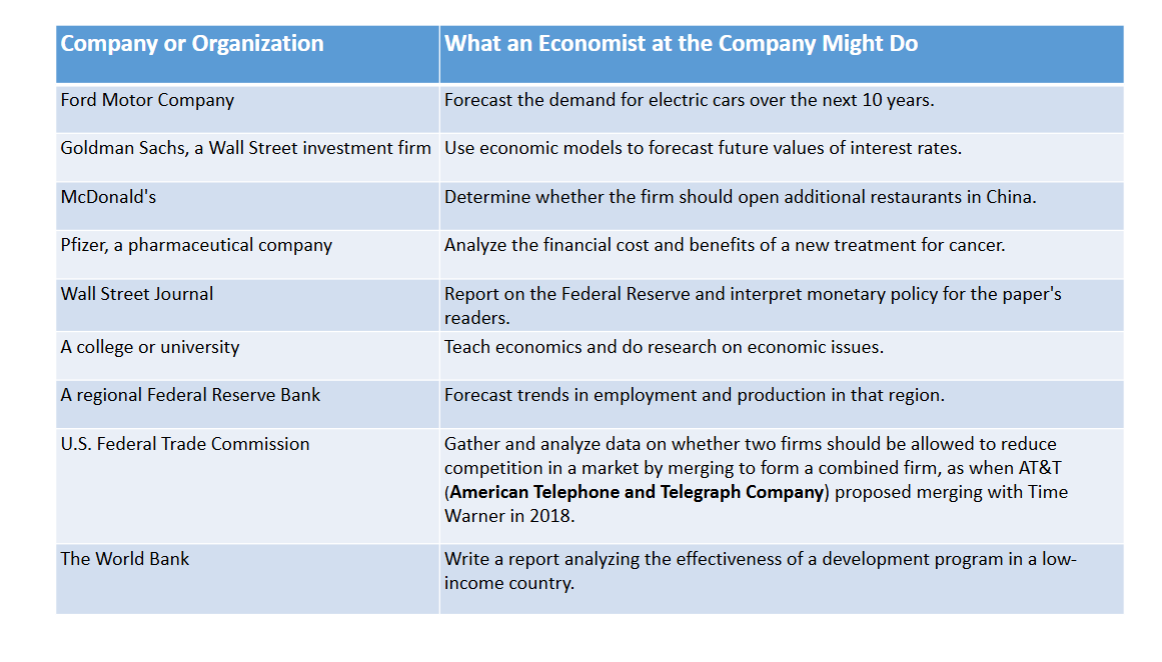
Economists in Various Organizations (不同组织中的经济学家)
| Company or Organization (公司或组织) | What an Economist at the Company Might Do (经济学家在公司中的工作内容) |
|-------------------------------------|---------------------------------------------------------|
| Ford Motor Company (福特汽车公司) | Forecast the demand for electric cars over the next 10 years. (预测未来10年电动汽车的需求) |
| Goldman Sachs, a Wall Street investment firm (高盛,华尔街投资公司) | Use economic models to forecast future values of interest rates. (使用经济模型预测未来利率的变化) |
| McDonald’s (麦当劳) | Determine whether the firm should open additional restaurants in China. (判断公司是否应在中国开设更多的餐厅) |
| Pfizer, a pharmaceutical company (辉瑞制药公司) | Analyze the financial cost and benefits of a new treatment for cancer. (分析一种新的癌症治疗方法的财务成本与效益) |
| Wall Street Journal (华尔街日报) | Report on the Federal Reserve and interpret monetary policy for the paper’s readers. (报道美联储并向读者解读货币政策) |
| A college or university (大学或高等院校) | Teach economics and do research on economic issues. (教授经济学并进行经济学问题的研究) |
| A regional Federal Reserve Bank (地区联邦储备银行) | Forecast trends in employment and production in that region. (预测该地区的就业和生产趋势) |
| U.S. Federal Trade Commission (美国联邦贸易委员会) | Gather and analyze data on whether two firms should be allowed to reduce competition in a market by merging to form a combined firm, as when AT&T proposed merging with Time Warner in 2018. (收集并分析数据,判断两家公司是否应允许通过合并减少市场竞争,例如2018年AT&T提议与时代华纳合并) |
| The World Bank (世界银行) | Write a report analyzing the effectiveness of a development program in a low-income country. (撰写报告分析低收入国家发展项目的有效性) |
知识点列表与拓展 (Knowledge Points and Extensions):
1. Economists’ Roles in Different Sectors (不同领域中经济学家的角色)
-
解释 (Explanation):
Economists apply their expertise in various sectors, ranging from businesses to government agencies and international organizations, using economic analysis to make decisions and forecast future trends.
(经济学家在不同领域运用他们的专业知识,从企业到政府机构再到国际组织,利用经济分析做出决策并预测未来趋势。)
-
例子 (Example):
-
At Ford, economists forecast future demand for electric cars, guiding production decisions.
(在福特,经济学家预测电动汽车的未来需求,指导生产决策。)
-
At The World Bank, economists assess the effectiveness of development programs in low-income countries.
(在世界银行,经济学家评估低收入国家发展项目的有效性。)
-
-
拓展 (Extension):
Different sectors demand different skills from economists. While forecasting and modeling are key for businesses, policy analysis and public welfare are prioritized in government agencies and non-profits.
(不同领域对经济学家的技能要求各不相同。企业侧重于预测和建模,而政府机构和非营利组织则优先考虑政策分析和公共福利。)
Any model is based on assumptions because models have to be simplified to be useful.
📖 点击查看译文
任何模型都基于假设,因为模型必须简化才能发挥作用。
Economic models make behavioral assumptions about the motives of consumers and firms.
📖 点击查看译文
经济模型对消费者和企业的动机做出行为假设。
Economists assume that consumers will buy the goods and services that will maximize their well-being or their satisfaction.
📖 点击查看译文
经济学家假设消费者会购买能够最大化其福祉或满足感的商品和服务。
Similarly, economists assume that firms act to maximize their profits. These assumptions are simplifications because they do not describe the motives of every consumer and every firm.
📖 点击查看译文
类似地,经济学家假设企业的行为是为了最大化其利润。这些假设是简化的,因为它们并未描述每个消费者和每个企业的动机。
In an economic model, a hypothesis is a statement about an economic variable that may be either correct or incorrect.
📖 点击查看译文
在经济模型中,假设是关于经济变量的陈述,可能是正确的,也可能是错误的。
An example of a hypothesis in an economic model is the statement that increased use of industrial robots and information technology in U.S. factories has resulted in a decline in manufacturing employment.
📖 点击查看译文
经济模型中的一个假设例子是:美国工厂中工业机器人和信息技术的使用增加,导致制造业就业下降。
知识点列表与拓展 (Knowledge Points and Extensions):
1. The Development of Economic Models (经济模型的发展)
-
解释 (Explanation):
Economic models are developed to simplify complex real-world issues, with assumptions made about consumer and firm behavior. The development process includes formulating hypotheses, testing them with data, and revising the model as necessary.
(经济模型的开发旨在简化复杂的现实问题,假设消费者和企业的行为。开发过程包括提出假设、用数据检验假设以及根据需要修改模型。)
-
例子 (Example):
A model predicting the impact of a minimum wage increase on employment levels might start with the assumption that higher wages lead to fewer jobs, and then test this hypothesis with labor market data.
(一个预测最低工资上涨对就业水平影响的模型可能从假设更高的工资会导致就业岗位减少开始,然后用劳动力市场数据来检验这个假设。)
-
拓展 (Extension):
While models help simplify and understand economic behaviors, the assumptions they make might not always hold true in the real world, and the models may need constant revision to improve accuracy.
(虽然模型有助于简化和理解经济行为,但它们做出的假设在现实世界中并不总是成立,因此模型可能需要不断修订以提高准确性。)
20

Testing Hypotheses in Economic Models (在经济模型中检验假设)
The hypothesis may be correct if the main effect of industrial robots has been to replace assembly line workers, thereby reducing employment.
📖 点击查看译文
如果工业机器人的主要作用是替代装配线工人,从而减少就业,那么假设可能是正确的。
Or the hypothesis may be incorrect if the use of robots and other information technology has increased firms’ demand for software programmers and other technology workers, thereby increasing employment.
📖 点击查看译文
如果工业机器人和其他信息技术的使用增加了企业对软件程序员和其他技术工人的需求,从而增加了就业,那么假设可能是错误的。
An economic hypothesis is usually about a causal relationship; in this case, the hypothesis states that increased use of robots and information technology causes, or leads to, lower employment in manufacturing.
📖 点击查看译文
经济假设通常是关于因果关系的;在这种情况下,假设指出工业机器人和信息技术的使用增加会导致制造业就业减少。
Before we can accept a hypothesis, we have to test it by analyzing statistics, or data, on the relevant economic variables.
📖 点击查看译文
在我们接受假设之前,必须通过分析相关经济变量的统计数据来检验它。
Note that hypotheses must be statements that could, in principle, turn out to be incorrect.
📖 点击查看译文
请注意,假设必须是可能会被证明是错误的陈述。
Economists accept and use an economic model if it leads to hypotheses that are confirmed by statistical analysis.
📖 点击查看译文
如果经济模型得出的假设经统计分析得到证实,经济学家会接受并使用该模型。
In fact, economists often refer to a hypothesis having been “not rejected” rather than having been “accepted” by statistical analysis.
📖 点击查看译文
事实上,经济学家通常将假设被统计分析“未被拒绝”而不是“被接受”。
But what if statistical analysis clearly rejects a hypothesis? For example, what if a model leads to a hypothesis that increased use of industrial robots will cause a decline in manufacturing employment, but the data reject this hypothesis?
📖 点击查看译文
但是,如果统计分析明确拒绝了一个假设怎么办?例如,如果一个模型提出工业机器人使用增加会导致制造业就业下降的假设,但数据却拒绝了这个假设?
In this case, the model should be reconsidered.
📖 点击查看译文
在这种情况下,模型应该重新考虑。
It may be that an assumption used in the model was too simplified or too limiting.
📖 点击查看译文
可能是模型中使用的某个假设过于简化或过于局限。
知识点列表与拓展 (Knowledge Points and Extensions):
1. Hypothesis Testing in Economic Models (经济模型中的假设检验)
-
解释 (Explanation):
A hypothesis is tested using statistical data to determine if it is valid. If the data supports the hypothesis, the model may be considered useful, but if the hypothesis is rejected, the model should be revised.
(假设通过统计数据进行检验,以确定其是否有效。如果数据支持假设,模型可能被认为是有用的;如果假设被拒绝,模型应进行修订。)
-
例子 (Example):
If a model suggests that increasing robot use reduces factory jobs but the data shows no significant change in employment, economists would need to revise their model assumptions.
(如果一个模型表明增加机器人的使用会减少工厂工作,但数据表明就业没有显著变化,经济学家需要修订他们的模型假设。)
-
拓展 (Extension):
Statistical analysis is crucial in validating hypotheses. Rejected hypotheses can lead to model revisions that may reveal more accurate economic insights.
(统计分析在验证假设中至关重要。被拒绝的假设可能导致模型修订,从而揭示更准确的经济洞察。)
21

Circular Flow Diagram (循环流动图)
A good model to start with in economics is the circular flow diagram.
📖 点击查看译文
在经济学中,一个很好的起点模型是循环流动图。
It pictures the economy as consisting of two groups—households and firms—that interact in two markets: the goods and services market in which firms sell and households buy and the labor market in which households sell labor to business firms or other employees.
📖 点击查看译文
它将经济描绘为由两个群体——家庭和企业——组成,并在两个市场中互动:商品和服务市场(企业销售,家庭购买)以及劳动力市场(家庭向企业或其他雇主出售劳动力)。
Economists carry a set of theories in their heads like a carpenter carries around a toolkit.
📖 点击查看译文
经济学家就像木匠携带工具箱一样,在脑海中携带一套理论。
When they see an economic issue or problem, they go through the theories they know to see if they can find one that fits.
📖 点击查看译文
当他们看到一个经济问题时,会回顾自己掌握的理论,看看是否能找到适用的理论。
Then they use the theory to derive insights about the issue or problem.
📖 点击查看译文
然后,他们利用该理论得出对该问题的见解。
Economists express theories as diagrams, graphs, or even as mathematical equations.
📖 点击查看译文
经济学家使用图表、图形,甚至数学方程来表达理论。
知识点列表与拓展 (Knowledge Points and Extensions):
1. Circular Flow Diagram (循环流动图)
-
解释 (Explanation):
The circular flow diagram is a basic economic model that illustrates the flow of goods, services, and labor between households and firms in an economy.
(循环流动图是一个基本的经济模型,展示了家庭与企业之间商品、服务和劳动力的流动。)
-
例子 (Example):
A household purchases food from a grocery store (goods and services market) and provides labor to a company as an employee (labor market).
(家庭在超市购买食品(商品和服务市场)并作为雇员为公司提供劳动力(劳动力市场)。)
-
拓展 (Extension):
The model can be expanded to include the government, financial markets, and international trade, making it more comprehensive.
(该模型可以扩展到包括政府、金融市场和国际贸易,使其更加全面。)
22

Circular Flow in Product and Factor Markets (商品市场与要素市场的循环流动)
Firms produce and sell goods and services to households in the market for goods and services (or product market). Arrow “A” indicates this.
📖 点击查看译文
企业在商品和服务市场(或产品市场)中向家庭生产并销售商品和服务。箭头“A”表示这一过程。
Households pay for goods and services, which becomes the revenues to firms. Arrow “B” indicates this.
📖 点击查看译文
家庭支付商品和服务的费用,这成为企业的收入。箭头“B”表示这一过程。
Arrows A and B represent the two sides of the product market.
📖 点击查看译文
箭头 A 和 B 代表产品市场的两个方面。
Where do households obtain the income to buy goods and services?
📖 点击查看译文
家庭从哪里获得购买商品和服务的收入?
They provide the labor and other resources (e.g. land, capital, raw materials) firms need to produce goods and services in the market for inputs (or factors of production).
📖 点击查看译文
他们在投入市场(或生产要素市场)中提供企业生产商品和服务所需的劳动力和其他资源(如土地、资本、原材料)。
Arrow “C” indicates this.
📖 点击查看译文
箭头“C”表示这一过程。
In return, firms pay for the inputs (or resources) they use in the form of wages and other factor payments.
📖 点击查看译文
作为回报,企业以工资和其他要素支付的形式为所使用的投入(或资源)支付费用。
Arrow “D” indicates this.
📖 点击查看译文
箭头“D”表示这一过程。
Arrows “C” and “D” represent the two sides of the factor market.
📖 点击查看译文
箭头 C 和 D 代表要素市场的两个方面。
知识点列表与拓展 (Knowledge Points and Extensions):
1. Product Market and Factor Market (产品市场与要素市场)
-
解释 (Explanation):
The product market is where goods and services are exchanged, while the factor market is where firms acquire inputs (e.g., labor, capital, raw materials) for production.
(产品市场是商品和服务交换的场所,而要素市场是企业获取生产所需投入(如劳动力、资本、原材料)的地方。)
-
例子 (Example):
A bakery sells bread to customers in the product market (Arrow A and B), while it hires workers and buys flour in the factor market (Arrow C and D).
(一家面包店在产品市场向顾客销售面包(箭头 A 和 B),同时在要素市场雇佣工人并购买面粉(箭头 C 和 D)。)
-
拓展 (Extension):
In a more complex economy, the government, financial institutions, and international trade also interact within these markets, influencing the flow of resources and money.
(在更复杂的经济体系中,政府、金融机构和国际贸易也参与这些市场的互动,影响资源和资金的流动。)
23

Positive and Normative Analysis (实证分析与规范分析)
Economists try to mimic natural scientists by using the scientific method.
📖 点击查看译文
经济学家试图通过使用科学方法来模仿自然科学家。
But economics is a social science; studying the behavior of people is often tricky.
📖 点击查看译文
但经济学是一门社会科学,研究人类行为通常较为复杂。
When analyzing human behavior, we can perform:
📖 点击查看译文
在分析人类行为时,我们可以进行:
• Positive analysis: analysis concerned with what is
📖 点击查看译文
• 实证分析:关注“是什么”的分析
• Normative analysis: analysis concerned with what ought to be
📖 点击查看译文
• 规范分析:关注“应该是什么”的分析
Economists mostly perform positive analysis.
📖 点击查看译文
经济学家主要进行实证分析。
知识点列表与拓展 (Knowledge Points and Extensions):
1. Positive vs. Normative Analysis (实证分析 vs. 规范分析)
-
解释 (Explanation):
Positive analysis deals with objective statements that can be tested, while normative analysis involves value judgments and subjective opinions.
(实证分析涉及可以检验的客观陈述,而规范分析涉及价值判断和主观意见。)
-
例子 (Example):
-
“An increase in the minimum wage leads to higher unemployment” is a positive statement because it can be tested with data.
(“最低工资的提高会导致更高的失业率”是一个实证陈述,因为它可以用数据检验。)
-
“The government should increase the minimum wage to reduce poverty” is a normative statement because it is based on value judgments.
(“政府应提高最低工资以减少贫困”是一个规范陈述,因为它基于价值判断。)
-
-
拓展 (Extension):
While positive analysis forms the basis of economic research, policymakers often rely on normative analysis to make decisions that align with societal goals.
(虽然实证分析构成了经济研究的基础,但决策者通常依赖规范分析来制定符合社会目标的政策。)
24

Microeconomics and Macroeconomics (微观经济学与宏观经济学)
Microeconomics is the study of how households and firms make choices, how they interact in markets, and how the government attempts to influence their choices.
📖 点击查看译文
微观经济学研究家庭和企业如何做出选择,它们如何在市场中互动,以及政府如何试图影响它们的选择。
Macroeconomics is the study of the economy as a whole, including topics such as inflation, unemployment, and economic growth.
📖 点击查看译文
宏观经济学研究整体经济,包括通货膨胀、失业和经济增长等主题。
Examples of Microeconomic Issues (微观经济学问题示例)
-
How consumers react to changes in product prices
📖 点击查看译文
消费者如何对产品价格变化做出反应
-
How firms decide what prices to charge for the products they sell
📖 点击查看译文
企业如何决定产品的定价
-
Which government policy would most efficiently reduce opioid addiction
📖 点击查看译文
哪种政府政策能最有效地减少阿片类药物成瘾
-
The costs and benefits of the federal government’s approving the sale of a new prescription drug
📖 点击查看译文
联邦政府批准销售新处方药的成本和收益
-
The most efficient way to reduce air pollution
📖 点击查看译文
减少空气污染的最有效方法
Examples of Macroeconomic Issues (宏观经济学问题示例)
-
Why economies experience periods of recession and increasing unemployment
📖 点击查看译文
为什么经济会经历衰退期并导致失业率上升
-
Why, over the long run, some economies have grown much faster than others
📖 点击查看译文
为什么从长期来看,一些经济体的增长速度远快于其他经济体
-
What determines the inflation rate
📖 点击查看译文
是什么决定了通货膨胀率
-
What determines the value of the U.S. dollar in exchange for other currencies
📖 点击查看译文
是什么决定了美元相对于其他货币的价值
-
Whether government intervention can reduce the severity of recessions
📖 点击查看译文
政府干预是否能减少经济衰退的严重程度
知识点列表与拓展 (Knowledge Points and Extensions):
1. Microeconomics vs. Macroeconomics (微观经济学 vs. 宏观经济学)
-
解释 (Explanation):
Microeconomics focuses on individual decision-making units, such as households and firms, while macroeconomics examines aggregate economic issues like inflation and GDP growth.
(微观经济学关注个体决策单位,如家庭和企业,而宏观经济学研究整体经济问题,如通货膨胀和 GDP 增长。)
-
例子 (Example):
-
A firm setting prices for its new product is a microeconomic decision.
(企业为其新产品设定价格是微观经济学的决策。)
-
The central bank adjusting interest rates to control inflation is a macroeconomic action.
(中央银行调整利率以控制通货膨胀是宏观经济学的行为。)
-
-
拓展 (Extension):
While microeconomics and macroeconomics analyze different levels of the economy, they are interconnected. Policies affecting firms and consumers at the micro level can have large-scale macroeconomic consequences.
(尽管微观经济学和宏观经济学研究的是经济的不同层面,但它们是相互关联的。影响企业和消费者的微观政策可能会带来大规模的宏观经济影响。)
25

Economic Skills and Economics as a Career (经济学技能与职业发展)
We have seen that economics is about making choices. Economists spend much of their time describing how individuals, businesses, and governments make choices and analyzing the results of the choices.
📖 点击查看译文
我们已经看到,经济学是关于做选择的。经济学家大部分时间都在描述个人、企业和政府如何做出选择,并分析这些选择的结果。
Like a structural engineer advising a homeowner how to fix a leaky basement, economists advise on how better decisions can be made.
📖 点击查看译文
就像结构工程师建议房主如何修复渗水的地下室一样,经济学家提供建议,帮助人们做出更好的决策。
Applications of Economic Principles (经济学原理的应用)
Individuals (个人)
-
Use economic principles to improve important decisions
-
Choosing a career (选择职业)
-
Making financial investments (进行金融投资)
-
Deciding whether to lease or buy a car (决定是租车还是买车)
-
Business Managers (企业管理者)
-
Use economic principles to improve business decisions
-
Setting product prices (确定产品价格)
-
Entering foreign markets (进入国外市场)
-
Investing in new technology or software (投资新技术或软件)
-
Government Policymakers (政府决策者)
-
Use economic principles to guide policy decisions
-
Raising taxes on cigarettes to reduce teenage smoking (提高香烟税以减少青少年吸烟)
-
Adjusting interest rates to control inflation (调整利率以控制通货膨胀)
-
Allocating funds for medical or social research (分配资金用于医学或社会研究)
-
知识点列表与拓展 (Knowledge Points and Extensions):
1. Decision-Making in Economics (经济学中的决策分析)
-
解释 (Explanation):
Economics provides tools and frameworks for analyzing trade-offs, optimizing choices, and evaluating consequences.
(经济学提供了分析权衡、优化选择和评估后果的工具和框架。)
-
例子 (Example):
-
A person deciding whether to buy a house or continue renting based on future interest rates.
(一个人基于未来的利率决定是买房还是继续租房。)
-
A business choosing whether to expand production given expected demand and costs.
(一家企业根据预期需求和成本决定是否扩大生产。)
-
-
拓展 (Extension):
Behavioral economics explores how psychological biases impact decision-making, often leading individuals and firms to make suboptimal choices.
(行为经济学研究心理偏差如何影响决策,导致个人和企业做出次优选择。)
26

Economic Careers and Prominent Figures (经济学职业与杰出人物)
It is not too surprising that more chief executive officers of Fortune 500 firms majored in economics than in any other subject. Examples include:
📖 点击查看译文
令人不太惊讶的是,财富500强公司的首席执行官中,选择经济学作为专业的人数比任何其他专业都多。以下是一些例子:
-
Elon Musk of Tesla and SpaceX (特斯拉和SpaceX的埃隆·马斯克)
-
Meg Whitman of Hewlett-Packard (惠普的梅格·惠特曼)
-
Warren Buffett of Berkshire Hathaway (伯克希尔·哈撒韦的沃伦·巴菲特)
Many businesses, government agencies, and nonprofit organizations—including hospitals, museums, and charities—hire economists.
📖 点击查看译文
许多企业、政府机构和非营利组织——包括医院、博物馆和慈善机构——都雇佣经济学家。
Colleges and universities also hire economists to teach and to carry out academic research on business, the economy, and economic policy.
📖 点击查看译文
大学和高等院校也雇佣经济学家来教授课程并进行关于商业、经济和经济政策的学术研究。
A first step for many students in deciding whether to pursue a career in economics is to seek a summer internship with a firm or an agency that employs economists.
📖 点击查看译文
许多学生决定是否从事经济学职业的第一步是寻找一份与雇佣经济学家的公司或机构的暑期实习。
知识点列表与拓展 (Knowledge Points and Extensions):
1. Career Opportunities in Economics (经济学职业机会)
-
解释 (Explanation):
Economics provides diverse career opportunities in various sectors, including business, government, and academia. Many successful individuals in these fields have backgrounds in economics.
(经济学提供了在各个领域的多种职业机会,包括商业、政府和学术界。许多成功的行业人士拥有经济学背景。)
-
例子 (Example):
-
Elon Musk’s success in leading innovative tech companies, influenced by his background in economics.
(埃隆·马斯克在领导创新科技公司的成功,受经济学背景的影响。)
-
Economists advising government agencies on economic policy.
(经济学家为政府机构提供经济政策建议。)
-
-
拓展 (Extension):
Internships and hands-on experience are vital for students considering a career in economics, providing exposure to real-world economic challenges.
(对于考虑从事经济学职业的学生来说,实习和实践经验至关重要,可以让学生接触到现实世界中的经济挑战。)
27

Economists in Various Organizations (不同组织中的经济学家)
| Company or Organization (公司或组织) | What an Economist at the Company Might Do (经济学家在公司中的工作内容) |
|-------------------------------------|---------------------------------------------------------|
| Ford Motor Company (福特汽车公司) | Forecast the demand for electric cars over the next 10 years. (预测未来10年电动汽车的需求) |
| Goldman Sachs, a Wall Street investment firm (高盛,华尔街投资公司) | Use economic models to forecast future values of interest rates. (使用经济模型预测未来利率的变化) |
| McDonald’s (麦当劳) | Determine whether the firm should open additional restaurants in China. (判断公司是否应在中国开设更多的餐厅) |
| Pfizer, a pharmaceutical company (辉瑞制药公司) | Analyze the financial cost and benefits of a new treatment for cancer. (分析一种新的癌症治疗方法的财务成本与效益) |
| Wall Street Journal (华尔街日报) | Report on the Federal Reserve and interpret monetary policy for the paper’s readers. (报道美联储并向读者解读货币政策) |
| A college or university (大学或高等院校) | Teach economics and do research on economic issues. (教授经济学并进行经济学问题的研究) |
| A regional Federal Reserve Bank (地区联邦储备银行) | Forecast trends in employment and production in that region. (预测该地区的就业和生产趋势) |
| U.S. Federal Trade Commission (美国联邦贸易委员会) | Gather and analyze data on whether two firms should be allowed to reduce competition in a market by merging to form a combined firm, as when AT&T proposed merging with Time Warner in 2018. (收集并分析数据,判断两家公司是否应允许通过合并减少市场竞争,例如2018年AT&T提议与时代华纳合并) |
| The World Bank (世界银行) | Write a report analyzing the effectiveness of a development program in a low-income country. (撰写报告分析低收入国家发展项目的有效性) |
知识点列表与拓展 (Knowledge Points and Extensions):
1. Economists’ Roles in Different Sectors (不同领域中经济学家的角色)
-
解释 (Explanation):
Economists apply their expertise in various sectors, ranging from businesses to government agencies and international organizations, using economic analysis to make decisions and forecast future trends.
(经济学家在不同领域运用他们的专业知识,从企业到政府机构再到国际组织,利用经济分析做出决策并预测未来趋势。)
-
例子 (Example):
-
At Ford, economists forecast future demand for electric cars, guiding production decisions.
(在福特,经济学家预测电动汽车的未来需求,指导生产决策。)
-
At The World Bank, economists assess the effectiveness of development programs in low-income countries.
(在世界银行,经济学家评估低收入国家发展项目的有效性。)
-
-
拓展 (Extension):
Different sectors demand different skills from economists. While forecasting and modeling are key for businesses, policy analysis and public welfare are prioritized in government agencies and non-profits.
(不同领域对经济学家的技能要求各不相同。企业侧重于预测和建模,而政府机构和非营利组织则优先考虑政策分析和公共福利。)
评论
0 条正在加载评论...