1
Scarcity and Economic Decision-Making (稀缺性与经济决策)
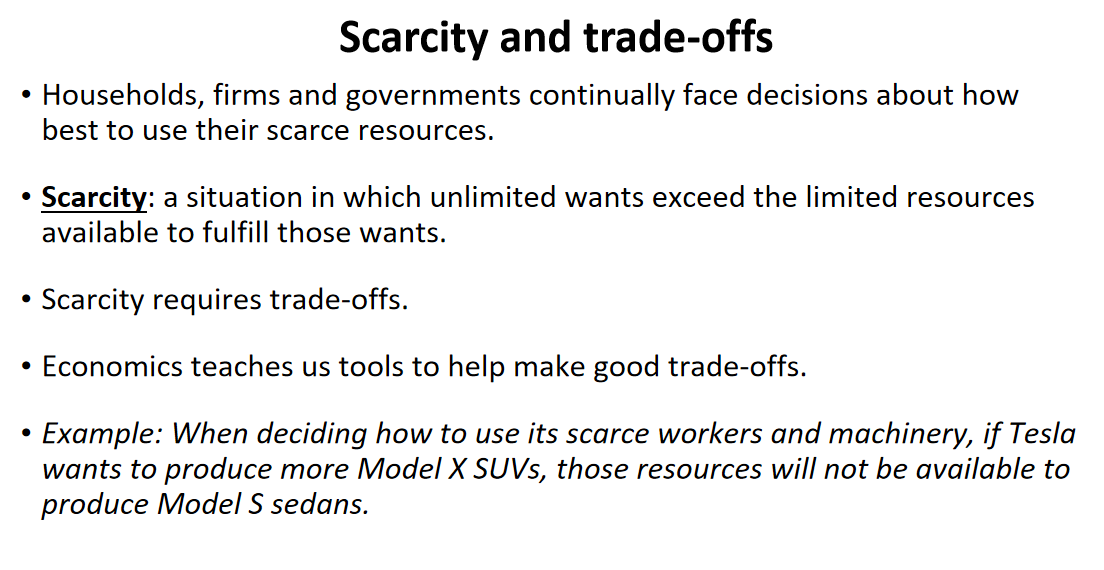
Households, firms, and governments continually face decisions about how best to use their scarce resources.
📖 点击查看译文
家庭、企业和政府不断面临如何最好地利用其稀缺资源的决策。
Scarcity: a situation in which unlimited wants exceed the limited resources available to fulfill those wants.
📖 点击查看译文
稀缺性:指无限的需求超过了可用的有限资源的情况。
Scarcity requires trade-offs.
📖 点击查看译文
稀缺性要求进行权衡取舍。
Economics teaches us tools to help make good trade-offs.
📖 点击查看译文
经济学教会我们工具,以帮助做出合理的权衡取舍。
Example: When deciding how to use its scarce workers and machinery, if Tesla wants to produce more Model X SUVs, those resources will not be available to produce Model S sedans.
📖 点击查看译文
例子:在决定如何使用稀缺的工人和机器时,如果特斯拉想要生产更多的 Model X SUV,那么这些资源将无法用于生产 Model S 轿车。
Testing Economic Hypotheses (检验经济假设)
Before we can accept a hypothesis, we have to test it by analyzing statistics or data on the relevant economic variables.
📖 点击查看译文
在接受一个假设之前,我们必须通过分析相关经济变量的统计数据来进行检验。
Note that hypotheses must be statements that could, in principle, turn out to be incorrect.
📖 点击查看译文
请注意,假设必须是原则上可能被证明是错误的陈述。
Economists accept and use an economic model if it leads to hypotheses that are confirmed by statistical analysis.
📖 点击查看译文
如果经济模型产生的假设能够通过统计分析得到验证,经济学家就会接受并使用该模型。
In fact, economists often refer to a hypothesis having been “not rejected” rather than having been “accepted” by statistical analysis.
📖 点击查看译文
事实上,经济学家通常会说一个假设“未被拒绝”,而不是“被接受”。
But what if statistical analysis clearly rejects a hypothesis? For example, what if a model leads to a hypothesis that increased use of industrial robots will cause a decline in manufacturing employment, but the data reject this hypothesis?
📖 点击查看译文
但如果统计分析明确否定了一个假设怎么办?例如,如果某个模型提出的假设是工业机器人使用的增加将导致制造业就业下降,但数据却否定了这个假设呢?
In this case, the model should be reconsidered.
📖 点击查看译文
在这种情况下,该模型应被重新考虑。
It may be that an assumption used in the model was too simplified or too limiting.
📖 点击查看译文
可能是模型中使用的某个假设过于简化或限制性太强。
知识点列表与拓展 (Knowledge Points and Extensions):
1. The Concept of Scarcity and Trade-Offs (稀缺性与权衡取舍的概念)
-
解释 (Explanation):
Scarcity forces individuals, businesses, and governments to make trade-offs because resources are limited, but human wants are infinite.
(稀缺性迫使个人、企业和政府做出权衡取舍,因为资源是有限的,而人的需求是无限的。)
-
例子 (Example):
A government deciding between allocating funds to education or healthcare is an example of a trade-off.
(政府在教育和医疗之间分配资金的决策是一个权衡取舍的例子。)
-
拓展 (Extension):
Opportunity cost is a key concept in trade-offs—it represents the value of the next best alternative foregone when making a decision.
(机会成本是权衡取舍中的一个关键概念——它代表了做出决策时放弃的下一个最佳选择的价值。)
2. The Role of Economic Models and Hypothesis Testing (经济模型与假设检验的作用)
-
解释 (Explanation):
Economic models help simplify complex real-world situations to test hypotheses and make predictions.
(经济模型有助于简化复杂的现实情况,以测试假设并做出预测。)
-
例子 (Example):
A demand-supply model can be used to predict how an increase in taxes will affect consumer spending.
(供需模型可以用来预测税收增加将如何影响消费者支出。)
-
拓展 (Extension):
Models are constantly revised based on new data, ensuring they remain relevant and useful in changing economic conditions.
(模型会根据新的数据不断修订,以确保它们在不断变化的经济环境中保持相关性和实用性。)
2
Production Possibilities Frontier and Opportunity Costs (生产可能性前沿与机会成本)
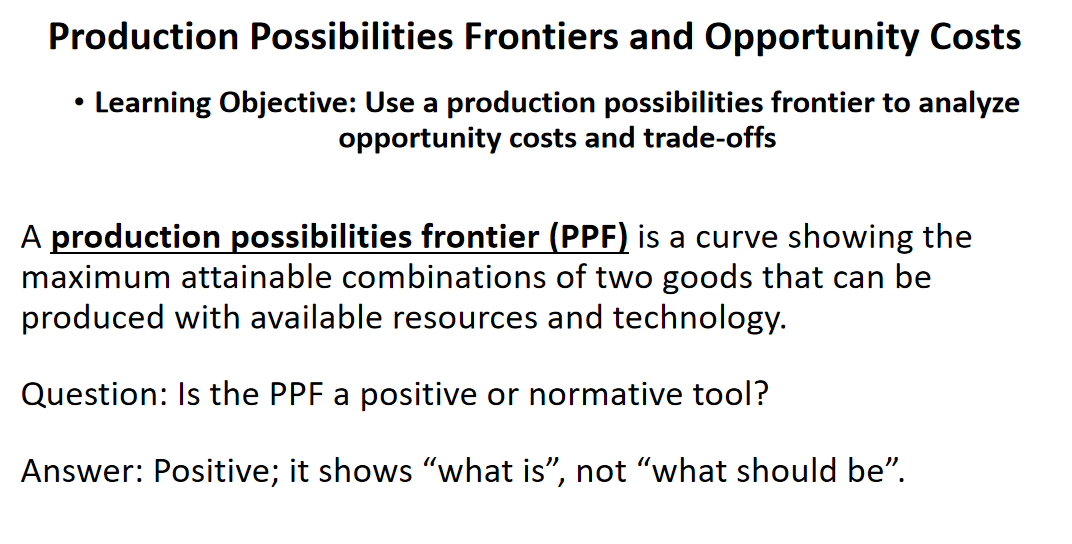
Learning Objective: Use a production possibilities frontier to analyze opportunity costs and trade-offs.
📖 点击查看译文
学习目标:使用生产可能性前沿(PPF)分析机会成本和权衡取舍。
A production possibilities frontier (PPF) is a curve showing the maximum attainable combinations of two goods that can be produced with available resources and technology.
📖 点击查看译文
生产可能性前沿(PPF)是一条曲线,显示在可用资源和技术条件下可以生产的两种商品的最大可实现组合。
Question: Is the PPF a positive or normative tool?
📖 点击查看译文
问题:PPF 是一个实证工具还是规范工具?
Answer: Positive; it shows “what is”, not “what should be”.
📖 点击查看译文
答案:实证工具;它展示的是“是什么”,而不是“应该是什么”。
知识点列表与拓展 (Knowledge Points and Extensions):
1. The Concept of the Production Possibilities Frontier (PPF) (生产可能性前沿的概念)
-
解释 (Explanation):
The PPF represents the trade-offs and opportunity costs associated with production decisions in an economy.
(PPF 代表经济体在生产决策中所涉及的权衡取舍和机会成本。)
-
例子 (Example):
A country that produces both consumer goods and military goods will face trade-offs between allocating resources to each.
(一个同时生产消费品和军需品的国家会面临如何分配资源的权衡取舍。)
-
拓展 (Extension):
-
The PPF can shift outward due to technological advancements or increases in resources.
(由于技术进步或资源增加,PPF 曲线可以向外扩展。)
-
A concave PPF indicates increasing opportunity costs, while a straight-line PPF indicates constant opportunity costs.
(凹形 PPF 说明机会成本递增,而直线型 PPF 说明机会成本恒定。)
-
2. Positive vs. Normative Economics (实证经济学 vs. 规范经济学)
-
解释 (Explanation):
-
Positive economics describes and explains economic phenomena without making value judgments.
(实证经济学描述和解释经济现象,不进行价值判断。)
-
Normative economics involves opinions and value judgments about what the economy should be like.
(规范经济学涉及对经济应该如何发展的观点和价值判断。)
-
-
例子 (Example):
-
“An increase in the minimum wage will lead to higher unemployment” is a positive statement.
(“提高最低工资将导致更高的失业率”是一个实证陈述。)
-
“The government should increase the minimum wage to improve living standards” is a normative statement.
(“政府应该提高最低工资以改善生活水平”是一个规范性陈述。)
-
-
拓展 (Extension):
Economists rely on positive analysis for objective decision-making, but policymakers often incorporate normative perspectives.
(经济学家依靠实证分析进行客观决策,但政策制定者通常会融入规范性视角。)
3
Tesla’s Production Possibilities Frontier (特斯拉的生产可能性前沿)
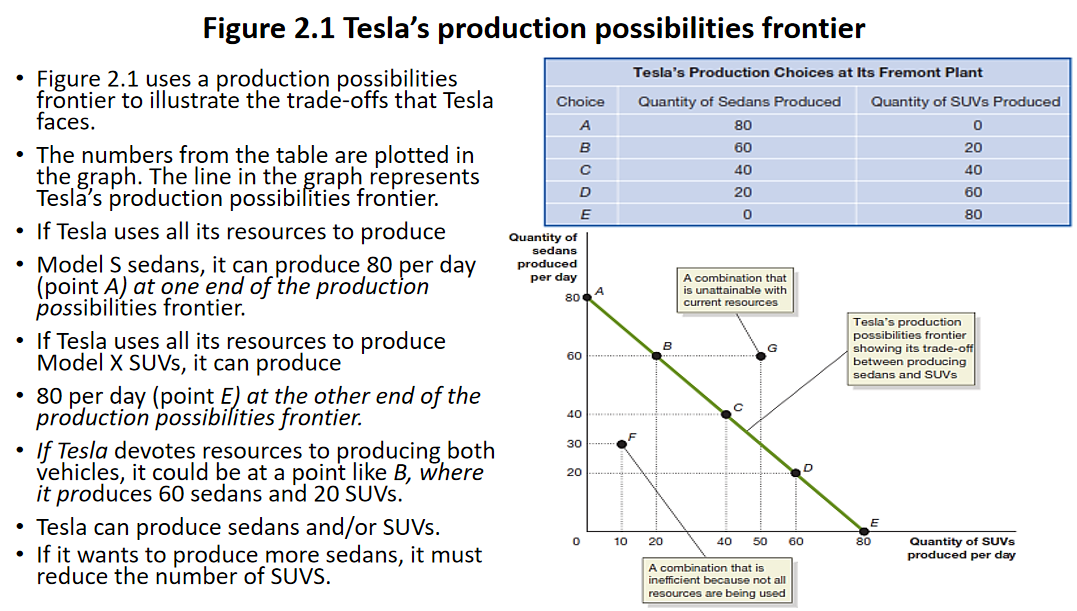
Figure 2.1 uses a production possibilities frontier to illustrate the trade-offs that Tesla faces.
📖 点击查看译文
图 2.1 使用生产可能性前沿(PPF)来说明特斯拉所面临的权衡取舍。
The numbers from the table are plotted in the graph. The line in the graph represents Tesla’s production possibilities frontier.
📖 点击查看译文
表中的数据被绘制到图表中,图表中的曲线代表特斯拉的生产可能性前沿。
If Tesla uses all its resources to produce Model S sedans, it can produce 80 per day (point A) at one end of the production possibilities frontier.
📖 点击查看译文
如果特斯拉将所有资源用于生产 Model S 轿车,它每天可以生产 80 辆(点 A),位于生产可能性前沿的一端。
If Tesla uses all its resources to produce Model X SUVs, it can produce 80 per day (point E) at the other end of the production possibilities frontier.
📖 点击查看译文
如果特斯拉将所有资源用于生产 Model X SUV,它每天可以生产 80 辆(点 E),位于生产可能性前沿的另一端。
If Tesla devotes resources to producing both vehicles, it could be at a point like B, where it produces 60 sedans and 20 SUVs.
📖 点击查看译文
如果特斯拉将资源用于生产两种车型,它可能位于 B 点,例如生产 60 辆轿车和 20 辆 SUV。
Tesla can produce sedans and/or SUVs. If it wants to produce more sedans, it must reduce the number of SUVs.
📖 点击查看译文
特斯拉可以生产轿车和/或 SUV。如果它想生产更多的轿车,就必须减少 SUV 的产量。
知识点列表与拓展 (Knowledge Points and Extensions):
1. Production Possibilities Frontier and Trade-offs (生产可能性前沿与权衡取舍)
-
解释 (Explanation):
The PPF illustrates how an economy (or a firm) must allocate its scarce resources among different production choices.
(PPF 展示了一个经济体(或公司)如何在不同的生产选择之间分配有限资源。)
-
例子 (Example):
If Tesla reallocates resources from Model S to Model X, it will move along the PPF, sacrificing some Model S production.
(如果特斯拉将资源从 Model S 重新分配到 Model X,它将在 PPF 上移动,牺牲部分 Model S 的产量。)
-
拓展 (Extension):
-
Points inside the PPF indicate inefficient use of resources, while points outside are unattainable with current resources.
(PPF 内部的点表示资源利用效率低,而 PPF 外部的点表示当前资源无法达到。)
-
Economic growth or technological advancement can shift the PPF outward.
(经济增长或技术进步可以使 PPF 向外扩展。)
-
2. Opportunity Cost (机会成本)
-
解释 (Explanation):
Opportunity cost refers to the next best alternative that must be forgone when making a choice.
(机会成本是指做出某一选择时必须放弃的下一最佳替代方案。)
-
例子 (Example):
If Tesla increases Model S production from 60 to 80, it must reduce Model X production from 20 to 0. The lost SUVs represent the opportunity cost.
(如果特斯拉将 Model S 产量从 60 增加到 80,则必须将 Model X 产量从 20 降至 0。减少的 SUV 就是机会成本。)
-
拓展 (Extension):
Opportunity costs arise in all economic decisions, from individual choices to national policies.
(机会成本存在于所有经济决策中,从个人选择到国家政策。)
4
Production Possibilities and Efficiency (生产可能性与效率)
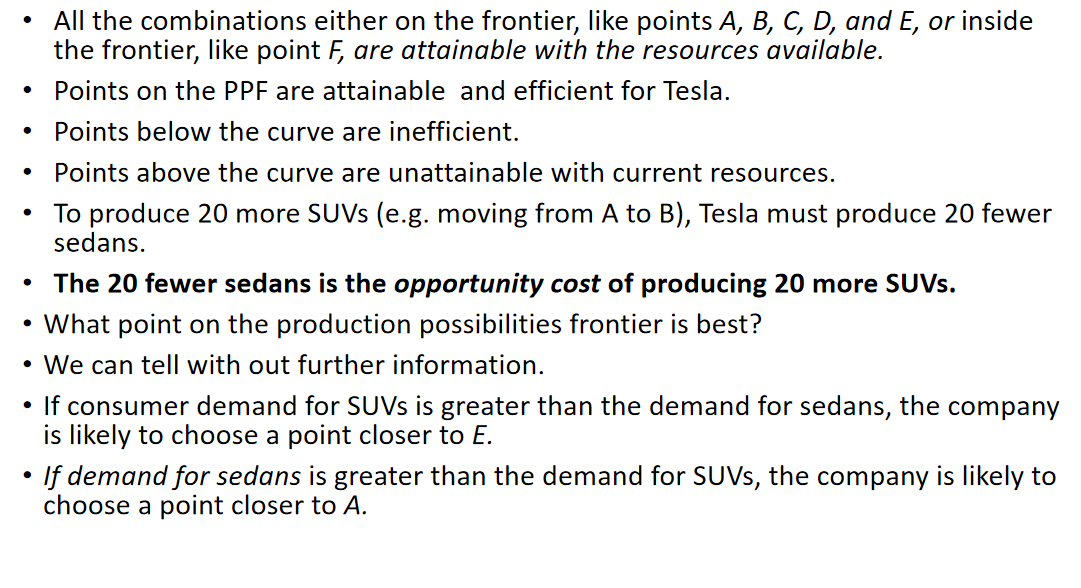
All the combinations either on the frontier, like points A, B, C, D, and E, or inside the frontier, like point F, are attainable with the resources available.
📖 点击查看译文
所有位于前沿(如 A、B、C、D 和 E)或前沿内部(如 F)的组合,都是在可用资源下可以实现的。
Points on the PPF are attainable and efficient for Tesla.
📖 点击查看译文
PPF 上的点对于特斯拉来说是可行且有效率的。
Points below the curve are inefficient.
📖 点击查看译文
PPF 曲线下方的点表示资源利用低效。
Points above the curve are unattainable with current resources.
📖 点击查看译文
PPF 曲线上方的点在当前资源下是无法实现的。
To produce 20 more SUVs (e.g. moving from A to B), Tesla must produce 20 fewer sedans.
📖 点击查看译文
如果要生产多 20 辆 SUV(如从 A 点移动到 B 点),特斯拉必须减少 20 辆轿车的生产。
The 20 fewer sedans is the opportunity cost of producing 20 more SUVs.
📖 点击查看译文
减少的 20 辆轿车是生产额外 20 辆 SUV 的机会成本。
What point on the production possibilities frontier is best?
📖 点击查看译文
PPF 上哪个点是最优的?
We can’t tell without further information.
📖 点击查看译文
在没有进一步信息的情况下,我们无法判断。
If consumer demand for SUVs is greater than the demand for sedans, the company is likely to choose a point closer to E.
📖 点击查看译文
如果消费者对 SUV 的需求大于对轿车的需求,公司可能会选择更接近 E 的点。
If demand for sedans is greater than the demand for SUVs, the company is likely to choose a point closer to A.
📖 点击查看译文
如果消费者对轿车的需求大于对 SUV 的需求,公司可能会选择更接近 A 的点。
知识点列表与拓展 (Knowledge Points and Extensions):
1. Efficiency and Inefficiency on the PPF (PPF 上的效率与低效点)
-
解释 (Explanation):
-
Points on the PPF are efficient because all resources are fully utilized.
(PPF 上的点是有效率的,因为所有资源都被充分利用。)
-
Points inside the PPF are inefficient because resources are underutilized.
(PPF 内部的点是低效的,因为资源未被充分利用。)
-
Points outside the PPF are unattainable with current resources.
(PPF 外部的点在当前资源下是无法实现的。)
-
-
拓展 (Extension):
-
Efficiency improvements, such as better technology or worker training, can shift the PPF outward.
(提高效率,例如更好的技术或员工培训,可以使 PPF 向外扩展。)
-
2. Opportunity Cost and Trade-offs (机会成本与权衡取舍)
-
解释 (Explanation):
-
Opportunity cost is what must be given up to gain something else.
(机会成本是为了获得某物必须放弃的其他东西。)
-
The PPF illustrates trade-offs by showing how increasing production of one good requires reducing production of another.
(PPF 通过展示增加一种商品的生产如何需要减少另一种商品的生产来说明权衡取舍。)
-
-
拓展 (Extension):
-
Real-world examples include government spending (e.g., more military spending means less funding for education).
(现实世界的例子包括政府支出(例如,增加军事支出意味着减少教育资金)。)
-
3. Market Demand and Production Decisions (市场需求与生产决策)
-
解释 (Explanation):
-
The best point on the PPF depends on consumer preferences and market demand.
(PPF 上的最佳点取决于消费者偏好和市场需求。)
-
If demand shifts, companies will adjust production to align with consumer needs.
(如果需求发生变化,公司会调整生产以适应消费者需求。)
-
-
拓展 (Extension):
-
Government policies, subsidies, and market conditions also influence production choices.
(政府政策、补贴和市场条件也会影响生产选择。)
-
5
Increasing Opportunity Costs and the PPF (递增的机会成本与生产可能性曲线)
It is observed that opportunity costs are often increasing. Why?
📖 点击查看译文
观察到机会成本通常是递增的,为什么?
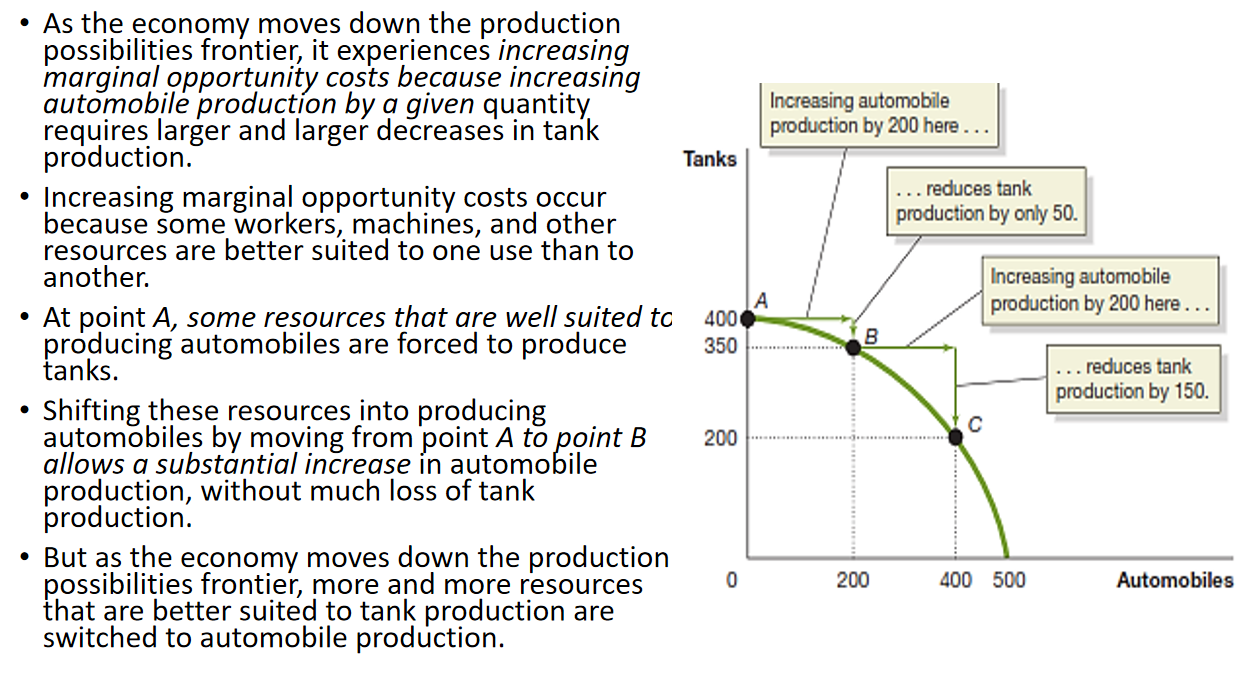
Suppose we divide all the goods and services produced in the economy into just two types: military goods and civilian goods.
📖 点击查看译文
假设我们将经济中生产的所有商品和服务分为两类:军事用品和民用商品。
In Figure 2.2, we let tanks represent military goods and automobiles represent civilian goods.
📖 点击查看译文
在图 2.2 中,我们用坦克代表军事用品,用汽车代表民用商品。
If all the country’s resources are devoted to producing military goods, 400 tanks can be produced in one year.
📖 点击查看译文
如果一个国家的所有资源都用于生产军事用品,则一年可以生产 400 辆坦克。
If all resources are devoted to producing civilian goods, 500 automobiles can be produced in one year.
📖 点击查看译文
如果所有资源都用于生产民用商品,则一年可以生产 500 辆汽车。
Devoting resources to producing both goods results in the economy being at other points along the production possibilities frontier.
📖 点击查看译文
如果资源被用于生产两种商品,经济将处于生产可能性前沿的其他点上。
The production possibilities frontier is bowed outward rather than being a straight line.
📖 点击查看译文
生产可能性前沿(PPF)是向外弯曲的,而不是一条直线。
Because the curve is bowed out, the opportunity cost of automobiles in terms of tanks depends on where the economy currently is on the PPF.
📖 点击查看译文
由于曲线是向外弯曲的,汽车的机会成本(以坦克衡量)取决于经济当前在 PPF 上的位置。
For example, to increase automobile production from 0 to 200 moving from point A to point B, the economy has to give up only 50 tanks.
📖 点击查看译文
例如,如果从 A 点移动到 B 点,将汽车产量从 0 增加到 200,经济只需要放弃 50 辆坦克。
But to increase automobile production by another 200 vehicles, moving from point B to point C, the economy has to give up 150 tanks.
📖 点击查看译文
但如果要再增加 200 辆汽车,即从 B 点移动到 C 点,经济需要放弃 150 辆坦克。
知识点列表与拓展 (Knowledge Points and Extensions):
1. Why Opportunity Costs Increase (为什么机会成本递增)
-
解释 (Explanation):
-
Resources are not equally efficient in producing all goods.
(资源在生产不同商品时的效率不同。)
-
As more resources are shifted toward producing one good, less suitable resources must be used.
(当更多资源被转向生产某种商品时,必须使用效率较低的资源。)
-
This leads to increasing opportunity costs.
(这导致了递增的机会成本。)
-
-
拓展 (Extension):
-
In real economies, labor, land, and capital are specialized, so shifting production always comes with increasing costs.
(在现实经济中,劳动力、土地和资本是专业化的,因此调整生产总会带来递增的成本。)
-
2. The Shape of the PPF (PPF 的形状)
-
解释 (Explanation):
-
A straight-line PPF means opportunity costs are constant.
(直线 PPF 意味着机会成本是恒定的。)
-
A bowed-out PPF means opportunity costs are increasing.
(向外弯曲的 PPF 意味着机会成本是递增的。)
-
-
拓展 (Extension):
-
A bowed-out PPF is common because resources are not perfectly adaptable.
(向外弯曲的 PPF 很常见,因为资源并不完全可替代。)
-
3. Economic Trade-offs and Military vs. Civilian Goods (经济权衡与军事 vs. 民用商品)
-
解释 (Explanation):
-
The decision between military and civilian goods represents a classic economic trade-off.
(军事与民用商品的选择代表了经典的经济权衡。)
-
More military spending means fewer consumer goods, and vice versa.
(更多的军事支出意味着更少的消费品,反之亦然。)
-
-
拓展 (Extension):
-
This is often referred to as the “guns vs. butter” problem in economics.
(这在经济学中通常被称为“枪炮 vs. 黄油”问题。)
-
6
Increasing Marginal Opportunity Costs (递增的边际机会成本)
As the economy moves down the production possibilities frontier, it experiences increasing marginal opportunity costs because increasing automobile production by a given quantity requires larger and larger decreases in tank production.
📖 点击查看译文
当经济沿着生产可能性前沿向下移动时,会经历递增的边际机会成本,因为每增加一定数量的汽车生产,都需要更大幅度地减少坦克的生产。
Increasing marginal opportunity costs occur because some workers, machines, and other resources are better suited to one use than to another.
📖 点击查看译文
递增的边际机会成本发生的原因是,一些工人、机器和其他资源更适合某种特定用途,而不适合另一种用途。
At point A, some resources that are well suited to producing automobiles are forced to produce tanks.
📖 点击查看译文
在 A 点,一些非常适合生产汽车的资源被迫用于生产坦克。
Shifting these resources into producing automobiles by moving from point A to point B allows a substantial increase in automobile production, without much loss of tank production.
📖 点击查看译文
通过从 A 点移动到 B 点,将这些资源转用于生产汽车,可以在坦克生产损失较小的情况下大幅增加汽车产量。
But as the economy moves down the production possibilities frontier, more and more resources that are better suited to tank production are switched to automobile production.
📖 点击查看译文
但是,随着经济沿着生产可能性前沿向下移动,越来越多更适合生产坦克的资源被转用于生产汽车。
知识点列表与拓展 (Knowledge Points and Extensions):
1. Why Do Marginal Opportunity Costs Increase? (为什么边际机会成本递增?)
-
解释 (Explanation):
-
Different resources (e.g., labor, machines) are specialized for different types of production.
(不同的资源(如劳动力、机器)对不同类型的生产有特定的适应性。)
-
As more resources are shifted, less efficient ones must be used, leading to rising opportunity costs.
(随着资源不断转移,必须使用效率较低的资源,导致机会成本上升。)
-
-
拓展 (Extension):
-
This principle applies to real-world industries, such as agriculture and manufacturing.
(这一原则适用于现实世界中的行业,例如农业和制造业。)
-
2. Opportunity Cost and Resource Efficiency (机会成本与资源效率)
-
解释 (Explanation):
-
The best-suited resources should be allocated first to minimize opportunity costs.
(应优先分配最适合的资源,以最小化机会成本。)
-
Misallocation leads to inefficient production and increasing marginal opportunity costs.
(资源分配不当会导致生产效率低下,并导致边际机会成本上升。)
-
-
拓展 (Extension):
-
Countries with diverse industries must manage resource allocation carefully.
(拥有多样化产业的国家必须谨慎管理资源分配。)
-
3. Real-World Implications of Increasing Marginal Costs (递增边际成本的现实影响)
-
解释 (Explanation):
-
As industries expand, they often face diminishing returns due to resource constraints.
(随着产业扩张,资源约束通常会导致收益递减。)
-
This is why diversification and technological innovation are crucial for economic growth.
(这就是为什么多元化和技术创新对经济增长至关重要。)
-
-
拓展 (Extension):
-
Example: Shifting agricultural land to industry reduces farming efficiency and increases food prices.
(例如,将农业用地转为工业用地会降低农业效率,并推高食品价格。)
-
7
The Concept of Increasing Marginal Opportunity Costs (递增的边际机会成本概念)
As a result, the increases in automobile production become increasingly smaller, while the decreases in tank production become increasingly larger.
📖 点击查看译文
因此,汽车产量的增加幅度会越来越小,而坦克产量的减少幅度会越来越大。
We would expect in most situations that production possibilities frontiers will be bowed outward rather than linear, as in the Tesla example discussed earlier.
📖 点击查看译文
在大多数情况下,我们预计生产可能性前沿会呈外凸弯曲,而不是线性,如之前讨论的特斯拉案例。
The idea of increasing marginal opportunity costs illustrates an important economic concept: The more resources already devoted to an activity, the smaller the payoff to devoting additional resources to that activity.
📖 点击查看译文
递增的边际机会成本反映了一个重要的经济学概念:已经投入某项活动的资源越多,额外投入资源所带来的收益就越小。
For example:
📖 点击查看译文
例如:
The more funds a firm has devoted to research and development during a given year, the smaller the amount of useful knowledge it receives from each additional dollar spent, and the greater the opportunity cost of using the funds in that way.
📖 点击查看译文
在某一年中,企业投入研发的资金越多,每额外投入一美元所获得的有用知识就越少,而以这种方式使用资金的机会成本就越高。
The more funds the federal government spends cleaning up the environment during a given year, the smaller the reduction in pollution from each additional dollar spent, and, once again, the greater the opportunity cost of using the funds in that way.
📖 点击查看译文
在某一年中,联邦政府用于环境治理的资金越多,每额外投入一美元所减少的污染量就越小,而以这种方式使用资金的机会成本就越高。
知识点列表与拓展 (Knowledge Points and Extensions):
1. Why Do Opportunity Costs Increase? (为什么机会成本递增?)
-
解释 (Explanation):
-
Resources are not perfectly adaptable between different types of production.
(资源在不同生产活动之间并非完全可替代。)
-
As more resources are reallocated, they become less efficient, increasing the trade-off.
(随着资源的重新分配,效率降低,导致更高的机会成本。)
-
-
拓展 (Extension):
-
Example: Moving highly specialized engineers from software development to farming leads to inefficiencies.
(例如,将高度专业化的软件工程师转为农业工作会降低生产效率。)
-
2. Diminishing Returns in Resource Allocation (资源分配的收益递减法则)
-
解释 (Explanation):
-
The first units of resources allocated provide the highest return.
(最初分配的资源提供最高的回报。)
-
Additional units contribute less and less, leading to diminishing returns.
(额外投入的资源贡献逐渐减少,导致收益递减。)
-
-
拓展 (Extension):
-
Example: A company investing in R&D experiences reduced gains from each additional dollar spent.
(例如,一家公司在研发上的投资,随着投入增加,每一美元带来的新知识减少。)
-
3. Policy Implications (政策影响)
-
解释 (Explanation):
-
Governments must balance spending to maximize social benefits.
(政府必须平衡支出,以实现社会利益最大化。)
-
Over-investment in one sector may lead to inefficiencies and high opportunity costs.
(在某一领域过度投资可能导致低效率和高机会成本。)
-
-
拓展 (Extension):
-
Example: Environmental policies must find the optimal level of pollution reduction without excessive costs.
(例如,环境政策需要找到减少污染的最优点,而不过度增加成本。)
-
8
Comparative Advantage and Trade (比较优势与贸易)
We can use production possibilities frontier and opportunity cost to understand the basic economic activity of trade.
📖 点击查看译文
我们可以使用生产可能性边界和机会成本来理解贸易的基本经济活动。
Markets are fundamentally about trade, which is the act of buying and selling.
📖 点击查看译文
市场本质上是关于交易的,即买卖行为。
Sometimes we trade directly, as when children trade one baseball card for another baseball card.
📖 点击查看译文
有时我们直接交易,比如孩子们交换一张棒球卡与另一张棒球卡。
But often we trade indirectly: We sell our labor services as, say, an accountant, a salesperson, or a nurse for money, and then we use the money earned to buy goods and services.
📖 点击查看译文
但我们往往是间接交易:我们将自己的劳动服务(例如会计、销售员或护士)卖给别人换取金钱,然后用赚来的钱购买商品和服务。
Although in these cases trade takes place indirectly, ultimately the accountant, salesperson, or nurse is trading his or her services for food, clothing, and other goods and services.
📖 点击查看译文
尽管这些交易是间接的,但最终会计师、销售员或护士还是在用自己的服务换取食物、衣物和其他商品与服务。
One of the great benefits of trade is that it makes it possible for people to become better off by increasing both their production and their consumption.
📖 点击查看译文
贸易的一个巨大好处是,它使人们能够通过增加生产和消费而变得更好。
知识点列表与拓展 (Knowledge Points and Extensions):
1. The Role of Opportunity Cost in Trade (机会成本在贸易中的作用)
-
解释 (Explanation):
-
Opportunity cost helps determine the comparative advantage in trade.
(机会成本有助于确定贸易中的比较优势。)
-
Each individual or country has a lower opportunity cost in the production of certain goods, which allows for specialization.
(每个人或每个国家在某些商品生产中的机会成本较低,这使得专业化成为可能。)
-
-
拓展 (Extension):
-
Example: A country with a lower opportunity cost in producing wheat can specialize in it, while another country with a lower opportunity cost in producing cloth can focus on that.
(例如,一个在小麦生产中具有较低机会成本的国家可以专注于生产小麦,而另一个在布料生产中具有较低机会成本的国家可以专注于生产布料。)
-
2. Direct vs Indirect Trade (直接交易与间接交易)
-
解释 (Explanation):
-
Direct trade involves the exchange of goods or services without any intermediaries.
(直接交易涉及无需中介的商品或服务交换。)
-
Indirect trade typically involves earning money through labor and using that money to buy goods.
(间接交易通常是通过劳动赚取金钱,然后用这些钱购买商品。)
-
-
拓展 (Extension):
-
Example: A nurse provides healthcare services (labor) for money, and uses that money to purchase food and other goods.
(例如,一位护士提供医疗服务(劳动)换取金钱,然后用这些钱购买食物和其他商品。)
-
3. Benefits of Specialization in Trade (贸易中专业化的好处)
-
解释 (Explanation):
-
Specialization allows for more efficient production and greater overall output.
(专业化使生产更高效,整体产出更大。)
-
Countries or individuals can focus on producing goods where they have a comparative advantage.
(国家或个人可以专注于生产他们具有比较优势的商品。)
-
-
拓展 (Extension):
-
Example: A country specializing in agriculture can trade its surplus for manufactured goods from another country specializing in industry.
(例如,一个专注于农业的国家可以将其盈余与另一个专注于工业的国家交换制造商品。)
-
9
Specialization and Gains from Trade (专业化与贸易收益)
Consider the following situation: You and your neighbor both have fruit trees on your properties.
📖 点击查看译文
考虑以下情况:你和你的邻居的房产上都有果树。
Initially, suppose you have only apple trees and your neighbor has only cherry trees.
📖 点击查看译文
最初,假设你只有苹果树,而你的邻居只有樱桃树。
In this situation, if you both like apples and cherries, there is an obvious opportunity for both of you to gain from trade: You trade some of your apples for some of your neighbor’s cherries, making you both better off.
📖 点击查看译文
在这种情况下,如果你们都喜欢苹果和樱桃,显然你们都有机会从贸易中获益:你将一些苹果换成你邻居的一些樱桃,这样你们都会更好。
But what if there are apple and cherry trees growing on both of your properties?
📖 点击查看译文
但如果你们两人的房产上都有苹果树和樱桃树呢?
In that case, there can still be gains from trade.
📖 点击查看译文
在这种情况下,仍然可以从贸易中获益。
For example, your neighbor might be very good at picking apples, and you might be very good at picking cherries. It would make sense for your neighbor to concentrate on picking apples and for you to concentrate on picking cherries.
📖 点击查看译文
例如,你的邻居可能非常擅长采摘苹果,而你可能非常擅长采摘樱桃。这样,你的邻居专注于采摘苹果,而你专注于采摘樱桃就很有意义。
You can then trade some of the cherries you pick for some of the apples your neighbor picks.
📖 点击查看译文
然后,你可以把你采摘的一些樱桃换成你邻居采摘的一些苹果。
But what if your neighbor is actually better at picking both apples and cherries than you are?
📖 点击查看译文
但如果你的邻居实际上在采摘苹果和樱桃方面都比你更擅长呢?
We can use production possibilities frontiers (PPFs) to show how your neighbor can benefit from trading with you even though she is better than you are at picking both apples and cherries.
📖 点击查看译文
我们可以使用生产可能性边界(PPF)来展示,尽管你的邻居在采摘苹果和樱桃方面都比你更擅长,但她仍然可以通过和你交易获益。
知识点列表与拓展 (Knowledge Points and Extensions):
1. Specialization and Comparative Advantage (专业化与比较优势)
-
解释 (Explanation):
-
Specialization allows individuals or countries to focus on what they are relatively more efficient at producing.
(专业化使个人或国家能够专注于他们相对更高效生产的领域。)
-
Even if one party is better at producing everything, there can still be gains from trade if each specializes in their comparative advantage.
(即使一方在所有方面都更擅长,只要每方专注于自己的比较优势,仍然可以从贸易中获益。)
-
-
拓展 (Extension):
-
Example: Even if your neighbor is better at both apple and cherry picking, if she specializes in apples and you specialize in cherries, both of you can end up better off.
(例如,尽管你的邻居在采摘苹果和樱桃方面都更擅长,但如果她专注于苹果,而你专注于樱桃,你们都能变得更好。)
-
2. Gains from Trade (贸易收益)
-
解释 (Explanation):
-
Trade allows for an increase in overall welfare by enabling individuals to focus on their strengths and exchange goods and services.
(贸易通过使个人专注于自己的优势并交换商品与服务,从而提高整体福利。)
-
The gains from trade are a direct result of specialization and comparative advantage.
(贸易收益直接来源于专业化与比较优势。)
-
-
拓展 (Extension):
-
Example: By specializing in what each party is relatively better at and trading, both can consume more goods than they could without trade.
(例如,通过专注于每一方相对擅长的领域并进行贸易,双方能够比没有贸易时消费更多的商品。)
-
3. Production Possibilities Frontiers (PPFs) and Trade (生产可能性边界(PPF)与贸易)
-
解释 (Explanation):
-
A production possibilities frontier (PPF) shows the maximum possible output combinations of two goods that can be produced with given resources.
(生产可能性边界(PPF)展示了在给定资源下,可以生产的两种商品的最大可能产出组合。)
-
Even if one party is better at producing both goods, trade can still result in mutual benefit by focusing on the good with the lower opportunity cost.
(即使一方在生产两种商品方面都更擅长,通过专注于机会成本较低的商品,贸易仍然可以带来互利。)
-
-
拓展 (Extension):
-
Example: The PPF can be used to visualize how trading one good for another allows both parties to consume beyond their individual production possibilities.
(例如,可以利用PPF来可视化,通过将一种商品与另一种商品交换,如何使双方的消费超越各自的生产可能性。)
-
10
Production Possibilities Frontiers (PPFs) and Trade (生产可能性边界(PPF)与贸易)
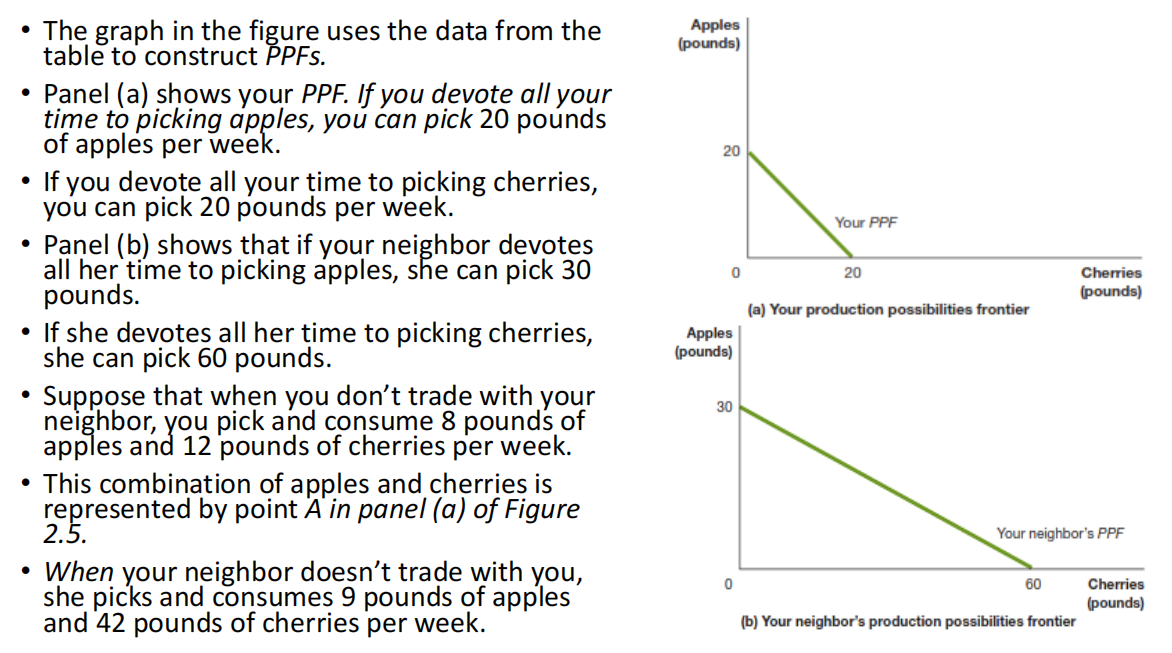
The graph in the figure uses the data from the table to construct PPFs.
📖 点击查看译文
图中的图表使用了表格中的数据来构建生产可能性边界(PPF)。
Panel (a) shows your PPF. If you devote all your time to picking apples, you can pick 20 pounds of apples per week.
📖 点击查看译文
面板(a)展示了你的生产可能性边界。如果你将所有时间都投入到采摘苹果中,每周可以采摘20磅苹果。
If you devote all your time to picking cherries, you can pick 20 pounds per week.
📖 点击查看译文
如果你将所有时间都投入到采摘樱桃中,每周可以采摘20磅樱桃。
Panel (b) shows that if your neighbor devotes all her time to picking apples, she can pick 30 pounds.
📖 点击查看译文
面板(b)显示,如果你的邻居将所有时间都投入到采摘苹果中,她每周可以采摘30磅苹果。
If she devotes all her time to picking cherries, she can pick 60 pounds.
📖 点击查看译文
如果她将所有时间都投入到采摘樱桃中,她每周可以采摘60磅樱桃。
Suppose that when you don’t trade with your neighbor, you pick and consume 8 pounds of apples and 12 pounds of cherries per week. This combination of apples and cherries is represented by point A in panel (a) of Figure 2.5.
📖 点击查看译文
假设当你不和邻居进行贸易时,你每周采摘并消费8磅苹果和12磅樱桃。这个苹果和樱桃的组合在图2.5的面板(a)中由点A表示。
When your neighbor doesn’t trade with you, she picks and consumes 9 pounds of apples and 42 pounds of cherries per week.
📖 点击查看译文
当你的邻居不和你进行贸易时,她每周采摘并消费9磅苹果和42磅樱桃。
知识点列表与拓展 (Knowledge Points and Extensions):
1. PPF and Resource Allocation (生产可能性边界(PPF)与资源分配)
-
解释 (Explanation):
-
The PPF represents the maximum output combinations of two goods that can be produced with given resources.
(生产可能性边界(PPF)表示在给定资源下,可以生产的两种商品的最大输出组合。)
-
If all resources are devoted to one good, the PPF shows the maximum quantity of that good that can be produced.
(如果所有资源都投入到一种商品的生产中,PPF展示了该商品的最大生产数量。)
-
-
拓展 (Extension):
-
Example: In the scenario, you can pick either apples or cherries, and the PPF shows the trade-offs between the two.
(例如,在这个场景中,你可以选择采摘苹果或樱桃,而PPF展示了两者之间的权衡。)
-
2. Trade and Specialization (贸易与专业化)
-
解释 (Explanation):
-
Specialization allows each individual to focus on the good they produce most efficiently, resulting in gains from trade.
(专业化使每个人能够专注于他们最有效率地生产的商品,从而获得贸易收益。)
-
Even when both parties are capable of producing both goods, trade can still be beneficial if each focuses on their comparative advantage.
(即使两方都能够生产这两种商品,只要每方专注于其比较优势,贸易仍然可以带来益处。)
-
-
拓展 (Extension):
-
Example: If you specialize in picking apples and your neighbor specializes in picking cherries, both can trade to improve their overall consumption.
(例如,如果你专注于采摘苹果,而你的邻居专注于采摘樱桃,两者可以通过贸易提高总体消费。)
-
3. Consumption Beyond PPF (超越PPF的消费)
-
解释 (Explanation):
-
Through trade, individuals can consume more than what they could produce on their own, exceeding the PPF.
(通过贸易,个人可以消费超出自己生产能力范围的商品,超过PPF的限制。)
-
This is a result of each party specializing in the good they produce most efficiently and trading for the other good.
(这是因为每方专注于他们最有效率生产的商品,并交换获得另一种商品的结果。)
-
-
拓展 (Extension):
-
Example: After trade, you and your neighbor can both enjoy more apples and cherries than if you each produced them independently.
(例如,经过贸易,你和你的邻居都可以享受到比独立生产时更多的苹果和樱桃。)
-
11
Specialization and Gains from Trade (专业化与贸易的收益)
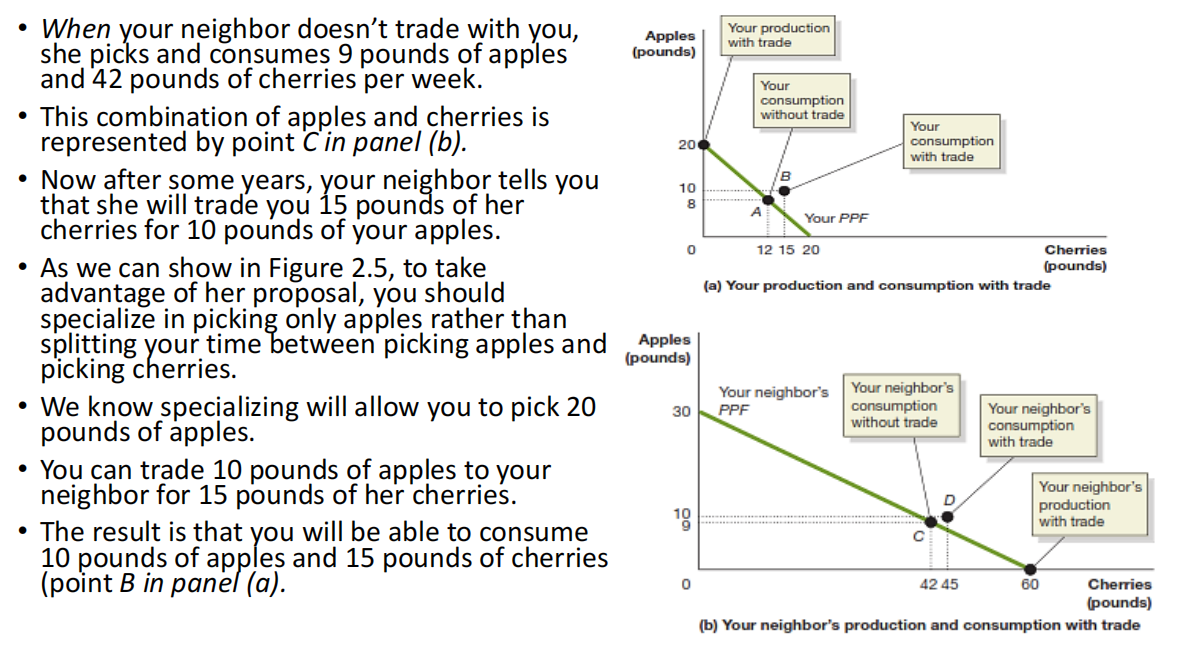
When your neighbor doesn’t trade with you, she picks and consumes 9 pounds of apples and 42 pounds of cherries per week.
📖 点击查看译文
当你的邻居不和你进行贸易时,她每周采摘并消费9磅苹果和42磅樱桃。
This combination of apples and cherries is represented by point C in panel (b).
📖 点击查看译文
这个苹果和樱桃的组合在面板(b)中由点C表示。
Now after some years, your neighbor tells you that she will trade you 15 pounds of her cherries for 10 pounds of your apples.
📖 点击查看译文
几年后,你的邻居告诉你,她愿意用15磅樱桃换你10磅苹果。
As we can show in Figure 2.5, to take advantage of her proposal, you should specialize in picking only apples rather than splitting your time between picking apples and picking cherries.
📖 点击查看译文
如图2.5所示,为了利用她的提议,你应该专注于采摘苹果,而不是将时间分配在采摘苹果和采摘樱桃之间。
We know specializing will allow you to pick 20 pounds of apples.
📖 点击查看译文
我们知道,专注于采摘苹果将允许你每周采摘20磅苹果。
You can trade 10 pounds of apples to your neighbor for 15 pounds of her cherries.
📖 点击查看译文
你可以将10磅苹果交换给邻居,换取她的15磅樱桃。
The result is that you will be able to consume 10 pounds of apples and 15 pounds of cherries (point B in panel (a)).
📖 点击查看译文
结果是,你将能够消费10磅苹果和15磅樱桃(面板(a)中的点B)。
知识点列表与拓展 (Knowledge Points and Extensions):
1. Gains from Trade (贸易带来的收益)
-
解释 (Explanation):
-
Trade allows individuals to consume more than what they could produce on their own.
(贸易使个人能够消费超出自己生产能力的商品。)
-
By specializing in producing one good and trading, each party can enjoy a higher quantity of both goods.
(通过专注于生产某一商品并进行贸易,每方都可以享受更多的商品。)
-
-
拓展 (Extension):
-
Example: Through trade, you and your neighbor can each consume more apples and cherries than if you each produced them independently.
(例如,通过贸易,你和你的邻居可以比各自独立生产时消费更多的苹果和樱桃。)
-
2. Specialization and Efficiency (专业化与效率)
-
解释 (Explanation):
-
Specializing in the good one can produce most efficiently increases overall production and consumption.
(专注于自己最有效率生产的商品可以增加整体的生产和消费。)
-
This concept is central to the theory of comparative advantage.
(这一概念是比较优势理论的核心。)
-
-
拓展 (Extension):
-
Example: By specializing in apples and trading for cherries, you increase your consumption of both goods.
(例如,通过专注于苹果的生产并交换樱桃,你增加了对两种商品的消费。)
-
3. Trade Terms (贸易条件)
-
解释 (Explanation):
-
The terms of trade (e.g., 15 pounds of cherries for 10 pounds of apples) determine the gains from trade.
(贸易条件(例如15磅樱桃换10磅苹果)决定了贸易的收益。)
-
Both parties can benefit as long as the terms of trade are favorable for both.
(只要贸易条件对双方都有利,双方都能从中受益。)
-
-
拓展 (Extension):
-
Example: The agreed trade ratio of apples and cherries allows both parties to improve their consumption relative to what they could produce on their own.
(例如,苹果与樱桃的交换比例使得双方相较于自己独立生产时能够改善消费水平。)
-
12
Further Gains from Specialization and Trade (专业化与贸易的进一步收益)
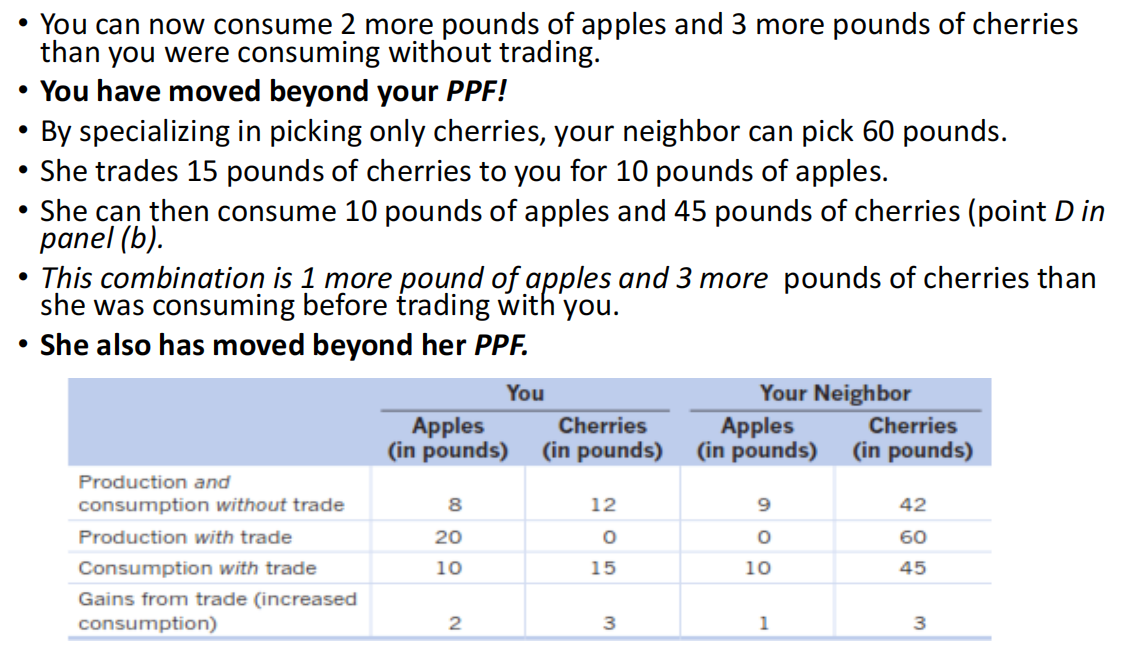
You can now consume 2 more pounds of apples and 3 more pounds of cherries than you were consuming without trading.
📖 点击查看译文
现在,你比未进行贸易时能消费更多2磅苹果和3磅樱桃。
You have moved beyond your PPF!
📖 点击查看译文
你已经超越了自己的生产可能性前沿(PPF)!
By specializing in picking only cherries, your neighbor can pick 60 pounds.
📖 点击查看译文
通过专注于只采摘樱桃,你的邻居可以采摘60磅樱桃。
She trades 15 pounds of cherries to you for 10 pounds of apples.
📖 点击查看译文
她用15磅樱桃换取你10磅苹果。
She can then consume 10 pounds of apples and 45 pounds of cherries (point D in panel (b)).
📖 点击查看译文
然后,她可以消费10磅苹果和45磅樱桃(面板(b)中的点D)。
This combination is 1 more pound of apples and 3 more pounds of cherries than she was consuming before trading with you.
📖 点击查看译文
这种组合比她在未与你交易时消费的苹果多1磅、樱桃多3磅。
She also has moved beyond her PPF.
📖 点击查看译文
她也已经超越了她的生产可能性前沿(PPF)。
知识点列表与拓展 (Knowledge Points and Extensions):
1. Moving Beyond the PPF (超越生产可能性前沿)
-
解释 (Explanation):
-
Trade allows individuals to consume more than their initial production possibility, effectively moving beyond their PPF.
(贸易使个人能够消费超出最初生产可能性前沿的商品,实际上是超越了生产可能性前沿。)
-
Specialization and trade increase the total consumption of goods beyond what each could produce alone.
(专业化与贸易使总消费量超越了每个人单独生产时的水平。)
-
-
拓展 (Extension):
-
Example: Both you and your neighbor move beyond your PPFs by specializing and trading goods.
(例如,通过专业化和贸易,你和你的邻居都超越了各自的生产可能性前沿。)
-
2. Gains for Both Parties (双方的收益)
-
解释 (Explanation):
-
Both parties benefit from trade, as it allows for the consumption of more goods than they could have achieved without trade.
(双方从贸易中受益,因为贸易使他们能够消费更多的商品,超出未进行贸易时的水平。)
-
Specialization in what each party does best maximizes the total benefits of trade.
(每一方专注于自己最擅长的事情,可以最大化贸易的总收益。)
-
-
拓展 (Extension):
-
Example: By trading, both you and your neighbor are able to consume more apples and cherries than before.
(例如,通过贸易,你和你的邻居能够比之前消费更多的苹果和樱桃。)
-
3. Comparative Advantage in Action (比较优势的实际应用)
-
解释 (Explanation):
-
Even if one party is better at producing both goods, trade can still be beneficial if each specializes in the good in which they have a comparative advantage.
(即使一方在生产两种商品上都更擅长,如果每方专注于他们在比较优势上具有优势的商品,贸易仍然是有益的。)
-
Comparative advantage is not about being the best at something, but about being the best relative to others.
(比较优势不仅仅是关于在某项活动上最优秀,而是相对于他人来说最有优势。)
-
-
拓展 (Extension):
-
Example: Despite being better at picking both apples and cherries, your neighbor benefits from specializing in cherries and trading with you.
(例如,尽管你邻居在采摘苹果和樱桃方面都更擅长,她仍然从专注于樱桃并与您进行贸易中获益。)
-
13
Absolute Advantage versus Comparative Advantage (绝对优势与比较优势)
Perhaps the most remarkable aspect of the preceding example is that your neighbor benefits from trading with you even though she is better than you at picking both apples and cherries.
📖 点击查看译文
也许前面例子中最引人注目的方面是,尽管你的邻居在采摘苹果和樱桃方面都比你更擅长,但她仍然通过与你进行贸易获益。
Absolute advantage is the ability of an individual, a firm, or a country to produce more of a good or service than competitors, using the same amount of resources.
📖 点击查看译文
绝对优势是指个人、公司或国家在使用相同资源的情况下,能够生产比竞争对手更多的商品或服务的能力。
Your neighbor has an absolute advantage over you in picking both apples and cherries because she can pick more of each fruit than you can in the same amount of time.
📖 点击查看译文
你的邻居在采摘苹果和樱桃方面具有绝对优势,因为她在相同时间内能够采摘更多的水果。
Although it seems that your neighbor should pick her own apples and her own cherries, we have just seen that she is better off specializing in picking cherries and leaving picking apples to you.
📖 点击查看译文
虽然看起来你的邻居应该采摘她自己的苹果和樱桃,但我们刚刚看到,实际上她最好专注于采摘樱桃,而将苹果的采摘留给你。
As you move down your PPF and shift time away from picking apples to picking cherries, you have to give up 1 pound of apples for each pound of cherries you pick (the slope of your PPF is -1).
📖 点击查看译文
当你沿着生产可能性前沿(PPF)移动并将时间从采摘苹果转移到采摘樱桃时,你每采摘1磅樱桃就需要放弃1磅苹果(你的PPF斜率为-1)。
Therefore, your opportunity cost of picking 1 pound of cherries is 1 pound of apples and vice versa.
📖 点击查看译文
因此,你每采摘1磅樱桃的机会成本是1磅苹果,反之亦然。
Your neighbor’s PPF has a different slope, so she faces a different trade-off:
📖 点击查看译文
你邻居的PPF有不同的斜率,因此她面临不同的权衡:
As she shifts time from picking apples to picking cherries, she has to give up 0.5 pound of apples for every 1 pound of cherries she picks (the slope of your neighbor’s PPF is -0.5).
📖 点击查看译文
当她将时间从采摘苹果转移到采摘樱桃时,她每采摘1磅樱桃就需要放弃0.5磅苹果(她的PPF斜率为-0.5)。
On the other hand, she gives up 2 pounds of cherries for every 1 pound of apples she picks.
📖 点击查看译文
另一方面,她每采摘1磅苹果就需要放弃2磅樱桃。
Therefore, her opportunity cost of picking 1 pound of apples is 2 pounds of cherries, and her opportunity cost of picking 1 pound of cherries is 0.5 pound of apples.
📖 点击查看译文
因此,她每采摘1磅苹果的机会成本是2磅樱桃,每采摘1磅樱桃的机会成本是0.5磅苹果。
知识点列表与拓展 (Knowledge Points and Extensions):
1. Absolute Advantage (绝对优势)
-
解释 (Explanation):
-
Absolute advantage refers to the ability of a person, company, or country to produce more of a good or service than another using the same amount of resources.
(绝对优势指的是一个人、公司或国家在使用相同资源的情况下,能够生产比其他人更多的商品或服务。)
-
-
拓展 (Extension):
-
Example: If your neighbor can pick more apples and cherries than you can in the same time, she has an absolute advantage.
(例如,如果你的邻居在相同时间内能够采摘更多的苹果和樱桃,她就具有绝对优势。)
-
2. Opportunity Cost and Comparative Advantage (机会成本与比较优势)
-
解释 (Explanation):
-
The opportunity cost of an activity is what you give up in order to engage in it.
(一个活动的机会成本是你为了从事该活动而放弃的其他事物。)
-
Comparative advantage is based on the concept of opportunity cost: the person with the lowest opportunity cost for producing a good has a comparative advantage in that good.
(比较优势基于机会成本的概念:生产某种商品机会成本最低的人在该商品上具有比较优势。)
-
-
拓展 (Extension):
-
Example: Despite your neighbor’s absolute advantage in picking both apples and cherries, she has a comparative advantage in picking cherries due to her lower opportunity cost.
(例如,尽管你的邻居在采摘苹果和樱桃方面具有绝对优势,但由于她在采摘樱桃时的机会成本较低,她在采摘樱桃方面具有比较优势。)
-
3. Production Possibility Frontier (生产可能性前沿)
-
解释 (Explanation):
-
The slope of the PPF reflects the trade-off between two goods, showing the opportunity cost of one good in terms of the other.
(生产可能性前沿(PPF)的斜率反映了两种商品之间的权衡,展示了一种商品相对于另一种商品的机会成本。)
-
-
拓展 (Extension):
-
Example: The steeper the PPF, the higher the opportunity cost of the good on the x-axis.
(例如,生产可能性前沿越陡,横轴上商品的机会成本越高。)
-
14
Absolute Advantage versus Comparative Advantage (绝对优势与比较优势)
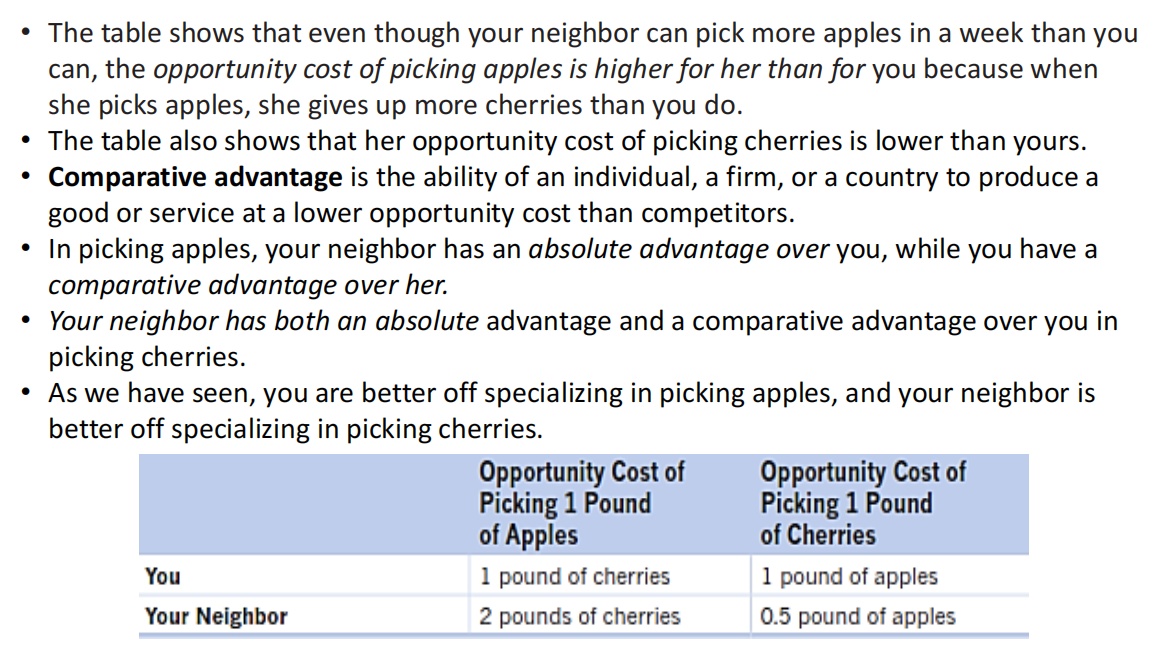
The table shows that even though your neighbor can pick more apples in a week than you can, the opportunity cost of picking apples is higher for her than for you because when she picks apples, she gives up more cherries than you do.
📖 点击查看译文
表格显示,尽管你的邻居一周能采摘更多的苹果,但她在采摘苹果时的机会成本比你高,因为她采摘苹果时放弃了更多的樱桃。
The table also shows that her opportunity cost of picking cherries is lower than yours.
📖 点击查看译文
表格还显示,她在采摘樱桃时的机会成本低于你的。
Comparative advantage is the ability of an individual, a firm, or a country to produce a good or service at a lower opportunity cost than competitors.
📖 点击查看译文
比较优势是指个人、公司或国家以低于竞争对手的机会成本生产商品或服务的能力。
In picking apples, your neighbor has an absolute advantage over you, while you have a comparative advantage over her.
📖 点击查看译文
在采摘苹果方面,你的邻居具有绝对优势,而你在比较优势方面胜过她。
Your neighbor has both an absolute advantage and a comparative advantage over you in picking cherries.
📖 点击查看译文
在采摘樱桃方面,你的邻居既具有绝对优势,也具有比较优势。
As we have seen, you are better off specializing in picking apples, and your neighbor is better off specializing in picking cherries.
📖 点击查看译文
正如我们所看到的,你最好专注于采摘苹果,而你的邻居最好专注于采摘樱桃。
知识点列表与拓展 (Knowledge Points and Extensions):
1. Comparative Advantage (比较优势)
-
解释 (Explanation):
-
Comparative advantage refers to the ability to produce a good or service at a lower opportunity cost than others.
(比较优势指的是以较低的机会成本生产商品或服务的能力。)
-
-
拓展 (Extension):
-
Example: Even though your neighbor is better at picking apples, you are better off specializing in apples, while she specializes in cherries, due to the opportunity cost differences.
(例如,尽管你的邻居在采摘苹果方面更擅长,但由于机会成本的差异,你专注于采摘苹果,而她专注于采摘樱桃,最终你们都能更好地分工合作。)
-
2. Opportunity Cost (机会成本)
-
解释 (Explanation):
-
Opportunity cost is what you give up in order to do something else.
(机会成本是你为了做某件事而放弃的其他选择。)
-
-
拓展 (Extension):
-
Example: Your neighbor’s opportunity cost of picking apples is higher than yours because she gives up more cherries than you when picking apples.
(例如,你的邻居采摘苹果时的机会成本高于你,因为她采摘苹果时放弃了比你更多的樱桃。)
-
3. Absolute Advantage (绝对优势)
-
解释 (Explanation):
-
Absolute advantage refers to the ability to produce more of a good or service using the same amount of resources.
(绝对优势是指使用相同资源生产更多商品或服务的能力。)
-
-
拓展 (Extension):
-
Example: Your neighbor has an absolute advantage in picking both apples and cherries because she can pick more of each in the same time.
(例如,你的邻居在采摘苹果和樱桃方面都具有绝对优势,因为她在相同的时间内能够采摘更多的苹果和樱桃。)
-
4. Specialization (专业化)
-
解释 (Explanation):
-
Specialization occurs when individuals or entities focus on producing a specific good or service to maximize efficiency and output.
(专业化指的是个人或实体专注于生产特定的商品或服务,以最大化效率和产出。)
-
-
拓展 (Extension):
-
Example: You specialize in picking apples, and your neighbor specializes in picking cherries, leading to higher overall production for both.
(例如,你专注于采摘苹果,而你的邻居专注于采摘樱桃,结果是两者的总体生产都提高了。)
-
15
Comparative Advantage and the Gains from Trade (比较优势与贸易收益)
We have just arrived at an important economic principle: The basis for trade is comparative advantage, not absolute advantage.
📖 点击查看译文
我们刚刚得出一个重要的经济学原理:贸易的基础是比较优势,而不是绝对优势。
The fastest apple pickers do not necessarily do much apple picking.
📖 点击查看译文
最快的苹果采摘者不一定会采摘大量苹果。
If the fastest apple pickers have a comparative advantage in some other activity, picking cherries, playing Major League Baseball, or being industrial engineers, they are better off specializing in that activity.
📖 点击查看译文
如果最快的苹果采摘者在其他活动中具有比较优势,比如采摘樱桃、打大联盟棒球或做工业工程师,他们最好专注于这些活动。
Individuals, firms, and countries are better off if they specialize in producing goods and services for which they have a comparative advantage and obtain the other goods and services they need by trading.
📖 点击查看译文
个人、公司和国家如果专注于生产具有比较优势的商品和服务,并通过贸易获取其他商品和服务,将会更好。
知识点列表与拓展 (Knowledge Points and Extensions):
1. Comparative Advantage and Trade (比较优势与贸易)
-
解释 (Explanation):
-
Trade is based on comparative advantage, which means focusing on what one does best at a lower opportunity cost.
(贸易基于比较优势,意味着专注于在较低机会成本下做自己最擅长的事。)
-
-
拓展 (Extension):
-
Example: By specializing in tasks where they have a comparative advantage, individuals or countries can trade for the goods and services they need, resulting in greater efficiency and mutual benefit.
(例如,个人或国家通过专注于他们具有比较优势的任务,可以交换所需的商品和服务,从而实现更高的效率和共同利益。)
-
2. Absolute Advantage vs. Comparative Advantage (绝对优势与比较优势)
-
解释 (Explanation):
-
Absolute advantage refers to the ability to produce more of a good with the same resources, while comparative advantage focuses on lower opportunity costs.
(绝对优势是指使用相同资源生产更多商品的能力,而比较优势关注的是较低的机会成本。)
-
-
拓展 (Extension):
-
Example: Even though your neighbor can pick more apples than you, you have a comparative advantage in apples due to the opportunity cost, making trade beneficial for both.
(例如,尽管你的邻居能采摘更多的苹果,但由于机会成本,你在苹果方面具有比较优势,这使得双方的贸易变得有利。)
-
3. Specialization and Efficiency (专业化与效率)
-
解释 (Explanation):
-
Specialization allows individuals, firms, and countries to focus on what they do best, increasing overall production and efficiency.
(专业化使个人、公司和国家能够专注于他们最擅长的事情,从而提高整体生产和效率。)
-
-
拓展 (Extension):
-
Example: By specializing in apple picking and trading for cherries, you and your neighbor both benefit from increased efficiency.
(例如,通过专注于采摘苹果并交换樱桃,你和你的邻居都从提高效率中受益。)
-
4. The Role of Trade in Economic Growth (贸易在经济增长中的作用)
-
解释 (Explanation):
-
Trade enables economies to access goods and services they are not able to produce efficiently on their own.
(贸易使经济能够获得它们无法高效生产的商品和服务。)
-
-
拓展 (Extension):
-
Example: Countries that specialize in what they do best and trade for other goods can experience faster economic growth and development.
(例如,专注于自己最擅长的领域并进行贸易的国家可以实现更快的经济增长和发展。)
-
In real economies, labor, land, and capital are specialized, so shifting production always comes with increasing costs.
(在现实经济中,劳动力、土地和资本是专业化的,因此调整生产总会带来递增的成本。)
-
2. The Shape of the PPF (PPF 的形状)
-
解释 (Explanation):
-
A straight-line PPF means opportunity costs are constant.
(直线 PPF 意味着机会成本是恒定的。)
-
A bowed-out PPF means opportunity costs are increasing.
(向外弯曲的 PPF 意味着机会成本是递增的。)
-
-
拓展 (Extension):
-
A bowed-out PPF is common because resources are not perfectly adaptable.
(向外弯曲的 PPF 很常见,因为资源并不完全可替代。)
-
3. Economic Trade-offs and Military vs. Civilian Goods (经济权衡与军事 vs. 民用商品)
-
解释 (Explanation):
-
The decision between military and civilian goods represents a classic economic trade-off.
(军事与民用商品的选择代表了经典的经济权衡。)
-
More military spending means fewer consumer goods, and vice versa.
(更多的军事支出意味着更少的消费品,反之亦然。)
-
-
拓展 (Extension):
-
This is often referred to as the “guns vs. butter” problem in economics.
(这在经济学中通常被称为“枪炮 vs. 黄油”问题。)
-
6

Increasing Marginal Opportunity Costs (递增的边际机会成本)
As the economy moves down the production possibilities frontier, it experiences increasing marginal opportunity costs because increasing automobile production by a given quantity requires larger and larger decreases in tank production.
📖 点击查看译文
当经济沿着生产可能性前沿向下移动时,会经历递增的边际机会成本,因为每增加一定数量的汽车生产,都需要更大幅度地减少坦克的生产。
Increasing marginal opportunity costs occur because some workers, machines, and other resources are better suited to one use than to another.
📖 点击查看译文
递增的边际机会成本发生的原因是,一些工人、机器和其他资源更适合某种特定用途,而不适合另一种用途。
At point A, some resources that are well suited to producing automobiles are forced to produce tanks.
📖 点击查看译文
在 A 点,一些非常适合生产汽车的资源被迫用于生产坦克。
Shifting these resources into producing automobiles by moving from point A to point B allows a substantial increase in automobile production, without much loss of tank production.
📖 点击查看译文
通过从 A 点移动到 B 点,将这些资源转用于生产汽车,可以在坦克生产损失较小的情况下大幅增加汽车产量。
But as the economy moves down the production possibilities frontier, more and more resources that are better suited to tank production are switched to automobile production.
📖 点击查看译文
但是,随着经济沿着生产可能性前沿向下移动,越来越多更适合生产坦克的资源被转用于生产汽车。
知识点列表与拓展 (Knowledge Points and Extensions):
1. Why Do Marginal Opportunity Costs Increase? (为什么边际机会成本递增?)
-
解释 (Explanation):
-
Different resources (e.g., labor, machines) are specialized for different types of production.
(不同的资源(如劳动力、机器)对不同类型的生产有特定的适应性。)
-
As more resources are shifted, less efficient ones must be used, leading to rising opportunity costs.
(随着资源不断转移,必须使用效率较低的资源,导致机会成本上升。)
-
-
拓展 (Extension):
-
This principle applies to real-world industries, such as agriculture and manufacturing.
(这一原则适用于现实世界中的行业,例如农业和制造业。)
-
2. Opportunity Cost and Resource Efficiency (机会成本与资源效率)
-
解释 (Explanation):
-
The best-suited resources should be allocated first to minimize opportunity costs.
(应优先分配最适合的资源,以最小化机会成本。)
-
Misallocation leads to inefficient production and increasing marginal opportunity costs.
(资源分配不当会导致生产效率低下,并导致边际机会成本上升。)
-
-
拓展 (Extension):
-
Countries with diverse industries must manage resource allocation carefully.
(拥有多样化产业的国家必须谨慎管理资源分配。)
-
3. Real-World Implications of Increasing Marginal Costs (递增边际成本的现实影响)
-
解释 (Explanation):
-
As industries expand, they often face diminishing returns due to resource constraints.
(随着产业扩张,资源约束通常会导致收益递减。)
-
This is why diversification and technological innovation are crucial for economic growth.
(这就是为什么多元化和技术创新对经济增长至关重要。)
-
-
拓展 (Extension):
-
Example: Shifting agricultural land to industry reduces farming efficiency and increases food prices.
(例如,将农业用地转为工业用地会降低农业效率,并推高食品价格。)
-
7

The Concept of Increasing Marginal Opportunity Costs (递增的边际机会成本概念)
As a result, the increases in automobile production become increasingly smaller, while the decreases in tank production become increasingly larger.
📖 点击查看译文
因此,汽车产量的增加幅度会越来越小,而坦克产量的减少幅度会越来越大。
We would expect in most situations that production possibilities frontiers will be bowed outward rather than linear, as in the Tesla example discussed earlier.
📖 点击查看译文
在大多数情况下,我们预计生产可能性前沿会呈外凸弯曲,而不是线性,如之前讨论的特斯拉案例。
The idea of increasing marginal opportunity costs illustrates an important economic concept: The more resources already devoted to an activity, the smaller the payoff to devoting additional resources to that activity.
📖 点击查看译文
递增的边际机会成本反映了一个重要的经济学概念:已经投入某项活动的资源越多,额外投入资源所带来的收益就越小。
For example:
📖 点击查看译文
例如:
The more funds a firm has devoted to research and development during a given year, the smaller the amount of useful knowledge it receives from each additional dollar spent, and the greater the opportunity cost of using the funds in that way.
📖 点击查看译文
在某一年中,企业投入研发的资金越多,每额外投入一美元所获得的有用知识就越少,而以这种方式使用资金的机会成本就越高。
The more funds the federal government spends cleaning up the environment during a given year, the smaller the reduction in pollution from each additional dollar spent, and, once again, the greater the opportunity cost of using the funds in that way.
📖 点击查看译文
在某一年中,联邦政府用于环境治理的资金越多,每额外投入一美元所减少的污染量就越小,而以这种方式使用资金的机会成本就越高。
知识点列表与拓展 (Knowledge Points and Extensions):
1. Why Do Opportunity Costs Increase? (为什么机会成本递增?)
-
解释 (Explanation):
-
Resources are not perfectly adaptable between different types of production.
(资源在不同生产活动之间并非完全可替代。)
-
As more resources are reallocated, they become less efficient, increasing the trade-off.
(随着资源的重新分配,效率降低,导致更高的机会成本。)
-
-
拓展 (Extension):
-
Example: Moving highly specialized engineers from software development to farming leads to inefficiencies.
(例如,将高度专业化的软件工程师转为农业工作会降低生产效率。)
-
2. Diminishing Returns in Resource Allocation (资源分配的收益递减法则)
-
解释 (Explanation):
-
The first units of resources allocated provide the highest return.
(最初分配的资源提供最高的回报。)
-
Additional units contribute less and less, leading to diminishing returns.
(额外投入的资源贡献逐渐减少,导致收益递减。)
-
-
拓展 (Extension):
-
Example: A company investing in R&D experiences reduced gains from each additional dollar spent.
(例如,一家公司在研发上的投资,随着投入增加,每一美元带来的新知识减少。)
-
3. Policy Implications (政策影响)
-
解释 (Explanation):
-
Governments must balance spending to maximize social benefits.
(政府必须平衡支出,以实现社会利益最大化。)
-
Over-investment in one sector may lead to inefficiencies and high opportunity costs.
(在某一领域过度投资可能导致低效率和高机会成本。)
-
-
拓展 (Extension):
-
Example: Environmental policies must find the optimal level of pollution reduction without excessive costs.
(例如,环境政策需要找到减少污染的最优点,而不过度增加成本。)
-
8

Comparative Advantage and Trade (比较优势与贸易)
We can use production possibilities frontier and opportunity cost to understand the basic economic activity of trade.
📖 点击查看译文
我们可以使用生产可能性边界和机会成本来理解贸易的基本经济活动。
Markets are fundamentally about trade, which is the act of buying and selling.
📖 点击查看译文
市场本质上是关于交易的,即买卖行为。
Sometimes we trade directly, as when children trade one baseball card for another baseball card.
📖 点击查看译文
有时我们直接交易,比如孩子们交换一张棒球卡与另一张棒球卡。
But often we trade indirectly: We sell our labor services as, say, an accountant, a salesperson, or a nurse for money, and then we use the money earned to buy goods and services.
📖 点击查看译文
但我们往往是间接交易:我们将自己的劳动服务(例如会计、销售员或护士)卖给别人换取金钱,然后用赚来的钱购买商品和服务。
Although in these cases trade takes place indirectly, ultimately the accountant, salesperson, or nurse is trading his or her services for food, clothing, and other goods and services.
📖 点击查看译文
尽管这些交易是间接的,但最终会计师、销售员或护士还是在用自己的服务换取食物、衣物和其他商品与服务。
One of the great benefits of trade is that it makes it possible for people to become better off by increasing both their production and their consumption.
📖 点击查看译文
贸易的一个巨大好处是,它使人们能够通过增加生产和消费而变得更好。
知识点列表与拓展 (Knowledge Points and Extensions):
1. The Role of Opportunity Cost in Trade (机会成本在贸易中的作用)
-
解释 (Explanation):
-
Opportunity cost helps determine the comparative advantage in trade.
(机会成本有助于确定贸易中的比较优势。)
-
Each individual or country has a lower opportunity cost in the production of certain goods, which allows for specialization.
(每个人或每个国家在某些商品生产中的机会成本较低,这使得专业化成为可能。)
-
-
拓展 (Extension):
-
Example: A country with a lower opportunity cost in producing wheat can specialize in it, while another country with a lower opportunity cost in producing cloth can focus on that.
(例如,一个在小麦生产中具有较低机会成本的国家可以专注于生产小麦,而另一个在布料生产中具有较低机会成本的国家可以专注于生产布料。)
-
2. Direct vs Indirect Trade (直接交易与间接交易)
-
解释 (Explanation):
-
Direct trade involves the exchange of goods or services without any intermediaries.
(直接交易涉及无需中介的商品或服务交换。)
-
Indirect trade typically involves earning money through labor and using that money to buy goods.
(间接交易通常是通过劳动赚取金钱,然后用这些钱购买商品。)
-
-
拓展 (Extension):
-
Example: A nurse provides healthcare services (labor) for money, and uses that money to purchase food and other goods.
(例如,一位护士提供医疗服务(劳动)换取金钱,然后用这些钱购买食物和其他商品。)
-
3. Benefits of Specialization in Trade (贸易中专业化的好处)
-
解释 (Explanation):
-
Specialization allows for more efficient production and greater overall output.
(专业化使生产更高效,整体产出更大。)
-
Countries or individuals can focus on producing goods where they have a comparative advantage.
(国家或个人可以专注于生产他们具有比较优势的商品。)
-
-
拓展 (Extension):
-
Example: A country specializing in agriculture can trade its surplus for manufactured goods from another country specializing in industry.
(例如,一个专注于农业的国家可以将其盈余与另一个专注于工业的国家交换制造商品。)
-
9

Specialization and Gains from Trade (专业化与贸易收益)
Consider the following situation: You and your neighbor both have fruit trees on your properties.
📖 点击查看译文
考虑以下情况:你和你的邻居的房产上都有果树。
Initially, suppose you have only apple trees and your neighbor has only cherry trees.
📖 点击查看译文
最初,假设你只有苹果树,而你的邻居只有樱桃树。
In this situation, if you both like apples and cherries, there is an obvious opportunity for both of you to gain from trade: You trade some of your apples for some of your neighbor’s cherries, making you both better off.
📖 点击查看译文
在这种情况下,如果你们都喜欢苹果和樱桃,显然你们都有机会从贸易中获益:你将一些苹果换成你邻居的一些樱桃,这样你们都会更好。
But what if there are apple and cherry trees growing on both of your properties?
📖 点击查看译文
但如果你们两人的房产上都有苹果树和樱桃树呢?
In that case, there can still be gains from trade.
📖 点击查看译文
在这种情况下,仍然可以从贸易中获益。
For example, your neighbor might be very good at picking apples, and you might be very good at picking cherries. It would make sense for your neighbor to concentrate on picking apples and for you to concentrate on picking cherries.
📖 点击查看译文
例如,你的邻居可能非常擅长采摘苹果,而你可能非常擅长采摘樱桃。这样,你的邻居专注于采摘苹果,而你专注于采摘樱桃就很有意义。
You can then trade some of the cherries you pick for some of the apples your neighbor picks.
📖 点击查看译文
然后,你可以把你采摘的一些樱桃换成你邻居采摘的一些苹果。
But what if your neighbor is actually better at picking both apples and cherries than you are?
📖 点击查看译文
但如果你的邻居实际上在采摘苹果和樱桃方面都比你更擅长呢?
We can use production possibilities frontiers (PPFs) to show how your neighbor can benefit from trading with you even though she is better than you are at picking both apples and cherries.
📖 点击查看译文
我们可以使用生产可能性边界(PPF)来展示,尽管你的邻居在采摘苹果和樱桃方面都比你更擅长,但她仍然可以通过和你交易获益。
知识点列表与拓展 (Knowledge Points and Extensions):
1. Specialization and Comparative Advantage (专业化与比较优势)
-
解释 (Explanation):
-
Specialization allows individuals or countries to focus on what they are relatively more efficient at producing.
(专业化使个人或国家能够专注于他们相对更高效生产的领域。)
-
Even if one party is better at producing everything, there can still be gains from trade if each specializes in their comparative advantage.
(即使一方在所有方面都更擅长,只要每方专注于自己的比较优势,仍然可以从贸易中获益。)
-
-
拓展 (Extension):
-
Example: Even if your neighbor is better at both apple and cherry picking, if she specializes in apples and you specialize in cherries, both of you can end up better off.
(例如,尽管你的邻居在采摘苹果和樱桃方面都更擅长,但如果她专注于苹果,而你专注于樱桃,你们都能变得更好。)
-
2. Gains from Trade (贸易收益)
-
解释 (Explanation):
-
Trade allows for an increase in overall welfare by enabling individuals to focus on their strengths and exchange goods and services.
(贸易通过使个人专注于自己的优势并交换商品与服务,从而提高整体福利。)
-
The gains from trade are a direct result of specialization and comparative advantage.
(贸易收益直接来源于专业化与比较优势。)
-
-
拓展 (Extension):
-
Example: By specializing in what each party is relatively better at and trading, both can consume more goods than they could without trade.
(例如,通过专注于每一方相对擅长的领域并进行贸易,双方能够比没有贸易时消费更多的商品。)
-
3. Production Possibilities Frontiers (PPFs) and Trade (生产可能性边界(PPF)与贸易)
-
解释 (Explanation):
-
A production possibilities frontier (PPF) shows the maximum possible output combinations of two goods that can be produced with given resources.
(生产可能性边界(PPF)展示了在给定资源下,可以生产的两种商品的最大可能产出组合。)
-
Even if one party is better at producing both goods, trade can still result in mutual benefit by focusing on the good with the lower opportunity cost.
(即使一方在生产两种商品方面都更擅长,通过专注于机会成本较低的商品,贸易仍然可以带来互利。)
-
-
拓展 (Extension):
-
Example: The PPF can be used to visualize how trading one good for another allows both parties to consume beyond their individual production possibilities.
(例如,可以利用PPF来可视化,通过将一种商品与另一种商品交换,如何使双方的消费超越各自的生产可能性。)
-
10

Production Possibilities Frontiers (PPFs) and Trade (生产可能性边界(PPF)与贸易)
The graph in the figure uses the data from the table to construct PPFs.
📖 点击查看译文
图中的图表使用了表格中的数据来构建生产可能性边界(PPF)。
Panel (a) shows your PPF. If you devote all your time to picking apples, you can pick 20 pounds of apples per week.
📖 点击查看译文
面板(a)展示了你的生产可能性边界。如果你将所有时间都投入到采摘苹果中,每周可以采摘20磅苹果。
If you devote all your time to picking cherries, you can pick 20 pounds per week.
📖 点击查看译文
如果你将所有时间都投入到采摘樱桃中,每周可以采摘20磅樱桃。
Panel (b) shows that if your neighbor devotes all her time to picking apples, she can pick 30 pounds.
📖 点击查看译文
面板(b)显示,如果你的邻居将所有时间都投入到采摘苹果中,她每周可以采摘30磅苹果。
If she devotes all her time to picking cherries, she can pick 60 pounds.
📖 点击查看译文
如果她将所有时间都投入到采摘樱桃中,她每周可以采摘60磅樱桃。
Suppose that when you don’t trade with your neighbor, you pick and consume 8 pounds of apples and 12 pounds of cherries per week. This combination of apples and cherries is represented by point A in panel (a) of Figure 2.5.
📖 点击查看译文
假设当你不和邻居进行贸易时,你每周采摘并消费8磅苹果和12磅樱桃。这个苹果和樱桃的组合在图2.5的面板(a)中由点A表示。
When your neighbor doesn’t trade with you, she picks and consumes 9 pounds of apples and 42 pounds of cherries per week.
📖 点击查看译文
当你的邻居不和你进行贸易时,她每周采摘并消费9磅苹果和42磅樱桃。
知识点列表与拓展 (Knowledge Points and Extensions):
1. PPF and Resource Allocation (生产可能性边界(PPF)与资源分配)
-
解释 (Explanation):
-
The PPF represents the maximum output combinations of two goods that can be produced with given resources.
(生产可能性边界(PPF)表示在给定资源下,可以生产的两种商品的最大输出组合。)
-
If all resources are devoted to one good, the PPF shows the maximum quantity of that good that can be produced.
(如果所有资源都投入到一种商品的生产中,PPF展示了该商品的最大生产数量。)
-
-
拓展 (Extension):
-
Example: In the scenario, you can pick either apples or cherries, and the PPF shows the trade-offs between the two.
(例如,在这个场景中,你可以选择采摘苹果或樱桃,而PPF展示了两者之间的权衡。)
-
2. Trade and Specialization (贸易与专业化)
-
解释 (Explanation):
-
Specialization allows each individual to focus on the good they produce most efficiently, resulting in gains from trade.
(专业化使每个人能够专注于他们最有效率地生产的商品,从而获得贸易收益。)
-
Even when both parties are capable of producing both goods, trade can still be beneficial if each focuses on their comparative advantage.
(即使两方都能够生产这两种商品,只要每方专注于其比较优势,贸易仍然可以带来益处。)
-
-
拓展 (Extension):
-
Example: If you specialize in picking apples and your neighbor specializes in picking cherries, both can trade to improve their overall consumption.
(例如,如果你专注于采摘苹果,而你的邻居专注于采摘樱桃,两者可以通过贸易提高总体消费。)
-
3. Consumption Beyond PPF (超越PPF的消费)
-
解释 (Explanation):
-
Through trade, individuals can consume more than what they could produce on their own, exceeding the PPF.
(通过贸易,个人可以消费超出自己生产能力范围的商品,超过PPF的限制。)
-
This is a result of each party specializing in the good they produce most efficiently and trading for the other good.
(这是因为每方专注于他们最有效率生产的商品,并交换获得另一种商品的结果。)
-
-
拓展 (Extension):
-
Example: After trade, you and your neighbor can both enjoy more apples and cherries than if you each produced them independently.
(例如,经过贸易,你和你的邻居都可以享受到比独立生产时更多的苹果和樱桃。)
-
11

Specialization and Gains from Trade (专业化与贸易的收益)
When your neighbor doesn’t trade with you, she picks and consumes 9 pounds of apples and 42 pounds of cherries per week.
📖 点击查看译文
当你的邻居不和你进行贸易时,她每周采摘并消费9磅苹果和42磅樱桃。
This combination of apples and cherries is represented by point C in panel (b).
📖 点击查看译文
这个苹果和樱桃的组合在面板(b)中由点C表示。
Now after some years, your neighbor tells you that she will trade you 15 pounds of her cherries for 10 pounds of your apples.
📖 点击查看译文
几年后,你的邻居告诉你,她愿意用15磅樱桃换你10磅苹果。
As we can show in Figure 2.5, to take advantage of her proposal, you should specialize in picking only apples rather than splitting your time between picking apples and picking cherries.
📖 点击查看译文
如图2.5所示,为了利用她的提议,你应该专注于采摘苹果,而不是将时间分配在采摘苹果和采摘樱桃之间。
We know specializing will allow you to pick 20 pounds of apples.
📖 点击查看译文
我们知道,专注于采摘苹果将允许你每周采摘20磅苹果。
You can trade 10 pounds of apples to your neighbor for 15 pounds of her cherries.
📖 点击查看译文
你可以将10磅苹果交换给邻居,换取她的15磅樱桃。
The result is that you will be able to consume 10 pounds of apples and 15 pounds of cherries (point B in panel (a)).
📖 点击查看译文
结果是,你将能够消费10磅苹果和15磅樱桃(面板(a)中的点B)。
知识点列表与拓展 (Knowledge Points and Extensions):
1. Gains from Trade (贸易带来的收益)
-
解释 (Explanation):
-
Trade allows individuals to consume more than what they could produce on their own.
(贸易使个人能够消费超出自己生产能力的商品。)
-
By specializing in producing one good and trading, each party can enjoy a higher quantity of both goods.
(通过专注于生产某一商品并进行贸易,每方都可以享受更多的商品。)
-
-
拓展 (Extension):
-
Example: Through trade, you and your neighbor can each consume more apples and cherries than if you each produced them independently.
(例如,通过贸易,你和你的邻居可以比各自独立生产时消费更多的苹果和樱桃。)
-
2. Specialization and Efficiency (专业化与效率)
-
解释 (Explanation):
-
Specializing in the good one can produce most efficiently increases overall production and consumption.
(专注于自己最有效率生产的商品可以增加整体的生产和消费。)
-
This concept is central to the theory of comparative advantage.
(这一概念是比较优势理论的核心。)
-
-
拓展 (Extension):
-
Example: By specializing in apples and trading for cherries, you increase your consumption of both goods.
(例如,通过专注于苹果的生产并交换樱桃,你增加了对两种商品的消费。)
-
3. Trade Terms (贸易条件)
-
解释 (Explanation):
-
The terms of trade (e.g., 15 pounds of cherries for 10 pounds of apples) determine the gains from trade.
(贸易条件(例如15磅樱桃换10磅苹果)决定了贸易的收益。)
-
Both parties can benefit as long as the terms of trade are favorable for both.
(只要贸易条件对双方都有利,双方都能从中受益。)
-
-
拓展 (Extension):
-
Example: The agreed trade ratio of apples and cherries allows both parties to improve their consumption relative to what they could produce on their own.
(例如,苹果与樱桃的交换比例使得双方相较于自己独立生产时能够改善消费水平。)
-
12

Further Gains from Specialization and Trade (专业化与贸易的进一步收益)
You can now consume 2 more pounds of apples and 3 more pounds of cherries than you were consuming without trading.
📖 点击查看译文
现在,你比未进行贸易时能消费更多2磅苹果和3磅樱桃。
You have moved beyond your PPF!
📖 点击查看译文
你已经超越了自己的生产可能性前沿(PPF)!
By specializing in picking only cherries, your neighbor can pick 60 pounds.
📖 点击查看译文
通过专注于只采摘樱桃,你的邻居可以采摘60磅樱桃。
She trades 15 pounds of cherries to you for 10 pounds of apples.
📖 点击查看译文
她用15磅樱桃换取你10磅苹果。
She can then consume 10 pounds of apples and 45 pounds of cherries (point D in panel (b)).
📖 点击查看译文
然后,她可以消费10磅苹果和45磅樱桃(面板(b)中的点D)。
This combination is 1 more pound of apples and 3 more pounds of cherries than she was consuming before trading with you.
📖 点击查看译文
这种组合比她在未与你交易时消费的苹果多1磅、樱桃多3磅。
She also has moved beyond her PPF.
📖 点击查看译文
她也已经超越了她的生产可能性前沿(PPF)。
知识点列表与拓展 (Knowledge Points and Extensions):
1. Moving Beyond the PPF (超越生产可能性前沿)
-
解释 (Explanation):
-
Trade allows individuals to consume more than their initial production possibility, effectively moving beyond their PPF.
(贸易使个人能够消费超出最初生产可能性前沿的商品,实际上是超越了生产可能性前沿。)
-
Specialization and trade increase the total consumption of goods beyond what each could produce alone.
(专业化与贸易使总消费量超越了每个人单独生产时的水平。)
-
-
拓展 (Extension):
-
Example: Both you and your neighbor move beyond your PPFs by specializing and trading goods.
(例如,通过专业化和贸易,你和你的邻居都超越了各自的生产可能性前沿。)
-
2. Gains for Both Parties (双方的收益)
-
解释 (Explanation):
-
Both parties benefit from trade, as it allows for the consumption of more goods than they could have achieved without trade.
(双方从贸易中受益,因为贸易使他们能够消费更多的商品,超出未进行贸易时的水平。)
-
Specialization in what each party does best maximizes the total benefits of trade.
(每一方专注于自己最擅长的事情,可以最大化贸易的总收益。)
-
-
拓展 (Extension):
-
Example: By trading, both you and your neighbor are able to consume more apples and cherries than before.
(例如,通过贸易,你和你的邻居能够比之前消费更多的苹果和樱桃。)
-
3. Comparative Advantage in Action (比较优势的实际应用)
-
解释 (Explanation):
-
Even if one party is better at producing both goods, trade can still be beneficial if each specializes in the good in which they have a comparative advantage.
(即使一方在生产两种商品上都更擅长,如果每方专注于他们在比较优势上具有优势的商品,贸易仍然是有益的。)
-
Comparative advantage is not about being the best at something, but about being the best relative to others.
(比较优势不仅仅是关于在某项活动上最优秀,而是相对于他人来说最有优势。)
-
-
拓展 (Extension):
-
Example: Despite being better at picking both apples and cherries, your neighbor benefits from specializing in cherries and trading with you.
(例如,尽管你邻居在采摘苹果和樱桃方面都更擅长,她仍然从专注于樱桃并与您进行贸易中获益。)
-
13

Absolute Advantage versus Comparative Advantage (绝对优势与比较优势)
Perhaps the most remarkable aspect of the preceding example is that your neighbor benefits from trading with you even though she is better than you at picking both apples and cherries.
📖 点击查看译文
也许前面例子中最引人注目的方面是,尽管你的邻居在采摘苹果和樱桃方面都比你更擅长,但她仍然通过与你进行贸易获益。
Absolute advantage is the ability of an individual, a firm, or a country to produce more of a good or service than competitors, using the same amount of resources.
📖 点击查看译文
绝对优势是指个人、公司或国家在使用相同资源的情况下,能够生产比竞争对手更多的商品或服务的能力。
Your neighbor has an absolute advantage over you in picking both apples and cherries because she can pick more of each fruit than you can in the same amount of time.
📖 点击查看译文
你的邻居在采摘苹果和樱桃方面具有绝对优势,因为她在相同时间内能够采摘更多的水果。
Although it seems that your neighbor should pick her own apples and her own cherries, we have just seen that she is better off specializing in picking cherries and leaving picking apples to you.
📖 点击查看译文
虽然看起来你的邻居应该采摘她自己的苹果和樱桃,但我们刚刚看到,实际上她最好专注于采摘樱桃,而将苹果的采摘留给你。
As you move down your PPF and shift time away from picking apples to picking cherries, you have to give up 1 pound of apples for each pound of cherries you pick (the slope of your PPF is -1).
📖 点击查看译文
当你沿着生产可能性前沿(PPF)移动并将时间从采摘苹果转移到采摘樱桃时,你每采摘1磅樱桃就需要放弃1磅苹果(你的PPF斜率为-1)。
Therefore, your opportunity cost of picking 1 pound of cherries is 1 pound of apples and vice versa.
📖 点击查看译文
因此,你每采摘1磅樱桃的机会成本是1磅苹果,反之亦然。
Your neighbor’s PPF has a different slope, so she faces a different trade-off:
📖 点击查看译文
你邻居的PPF有不同的斜率,因此她面临不同的权衡:
As she shifts time from picking apples to picking cherries, she has to give up 0.5 pound of apples for every 1 pound of cherries she picks (the slope of your neighbor’s PPF is -0.5).
📖 点击查看译文
当她将时间从采摘苹果转移到采摘樱桃时,她每采摘1磅樱桃就需要放弃0.5磅苹果(她的PPF斜率为-0.5)。
On the other hand, she gives up 2 pounds of cherries for every 1 pound of apples she picks.
📖 点击查看译文
另一方面,她每采摘1磅苹果就需要放弃2磅樱桃。
Therefore, her opportunity cost of picking 1 pound of apples is 2 pounds of cherries, and her opportunity cost of picking 1 pound of cherries is 0.5 pound of apples.
📖 点击查看译文
因此,她每采摘1磅苹果的机会成本是2磅樱桃,每采摘1磅樱桃的机会成本是0.5磅苹果。
知识点列表与拓展 (Knowledge Points and Extensions):
1. Absolute Advantage (绝对优势)
-
解释 (Explanation):
-
Absolute advantage refers to the ability of a person, company, or country to produce more of a good or service than another using the same amount of resources.
(绝对优势指的是一个人、公司或国家在使用相同资源的情况下,能够生产比其他人更多的商品或服务。)
-
-
拓展 (Extension):
-
Example: If your neighbor can pick more apples and cherries than you can in the same time, she has an absolute advantage.
(例如,如果你的邻居在相同时间内能够采摘更多的苹果和樱桃,她就具有绝对优势。)
-
2. Opportunity Cost and Comparative Advantage (机会成本与比较优势)
-
解释 (Explanation):
-
The opportunity cost of an activity is what you give up in order to engage in it.
(一个活动的机会成本是你为了从事该活动而放弃的其他事物。)
-
Comparative advantage is based on the concept of opportunity cost: the person with the lowest opportunity cost for producing a good has a comparative advantage in that good.
(比较优势基于机会成本的概念:生产某种商品机会成本最低的人在该商品上具有比较优势。)
-
-
拓展 (Extension):
-
Example: Despite your neighbor’s absolute advantage in picking both apples and cherries, she has a comparative advantage in picking cherries due to her lower opportunity cost.
(例如,尽管你的邻居在采摘苹果和樱桃方面具有绝对优势,但由于她在采摘樱桃时的机会成本较低,她在采摘樱桃方面具有比较优势。)
-
3. Production Possibility Frontier (生产可能性前沿)
-
解释 (Explanation):
-
The slope of the PPF reflects the trade-off between two goods, showing the opportunity cost of one good in terms of the other.
(生产可能性前沿(PPF)的斜率反映了两种商品之间的权衡,展示了一种商品相对于另一种商品的机会成本。)
-
-
拓展 (Extension):
-
Example: The steeper the PPF, the higher the opportunity cost of the good on the x-axis.
(例如,生产可能性前沿越陡,横轴上商品的机会成本越高。)
-
14

Absolute Advantage versus Comparative Advantage (绝对优势与比较优势)
The table shows that even though your neighbor can pick more apples in a week than you can, the opportunity cost of picking apples is higher for her than for you because when she picks apples, she gives up more cherries than you do.
📖 点击查看译文
表格显示,尽管你的邻居一周能采摘更多的苹果,但她在采摘苹果时的机会成本比你高,因为她采摘苹果时放弃了更多的樱桃。
The table also shows that her opportunity cost of picking cherries is lower than yours.
📖 点击查看译文
表格还显示,她在采摘樱桃时的机会成本低于你的。
Comparative advantage is the ability of an individual, a firm, or a country to produce a good or service at a lower opportunity cost than competitors.
📖 点击查看译文
比较优势是指个人、公司或国家以低于竞争对手的机会成本生产商品或服务的能力。
In picking apples, your neighbor has an absolute advantage over you, while you have a comparative advantage over her.
📖 点击查看译文
在采摘苹果方面,你的邻居具有绝对优势,而你在比较优势方面胜过她。
Your neighbor has both an absolute advantage and a comparative advantage over you in picking cherries.
📖 点击查看译文
在采摘樱桃方面,你的邻居既具有绝对优势,也具有比较优势。
As we have seen, you are better off specializing in picking apples, and your neighbor is better off specializing in picking cherries.
📖 点击查看译文
正如我们所看到的,你最好专注于采摘苹果,而你的邻居最好专注于采摘樱桃。
知识点列表与拓展 (Knowledge Points and Extensions):
1. Comparative Advantage (比较优势)
-
解释 (Explanation):
-
Comparative advantage refers to the ability to produce a good or service at a lower opportunity cost than others.
(比较优势指的是以较低的机会成本生产商品或服务的能力。)
-
-
拓展 (Extension):
-
Example: Even though your neighbor is better at picking apples, you are better off specializing in apples, while she specializes in cherries, due to the opportunity cost differences.
(例如,尽管你的邻居在采摘苹果方面更擅长,但由于机会成本的差异,你专注于采摘苹果,而她专注于采摘樱桃,最终你们都能更好地分工合作。)
-
2. Opportunity Cost (机会成本)
-
解释 (Explanation):
-
Opportunity cost is what you give up in order to do something else.
(机会成本是你为了做某件事而放弃的其他选择。)
-
-
拓展 (Extension):
-
Example: Your neighbor’s opportunity cost of picking apples is higher than yours because she gives up more cherries than you when picking apples.
(例如,你的邻居采摘苹果时的机会成本高于你,因为她采摘苹果时放弃了比你更多的樱桃。)
-
3. Absolute Advantage (绝对优势)
-
解释 (Explanation):
-
Absolute advantage refers to the ability to produce more of a good or service using the same amount of resources.
(绝对优势是指使用相同资源生产更多商品或服务的能力。)
-
-
拓展 (Extension):
-
Example: Your neighbor has an absolute advantage in picking both apples and cherries because she can pick more of each in the same time.
(例如,你的邻居在采摘苹果和樱桃方面都具有绝对优势,因为她在相同的时间内能够采摘更多的苹果和樱桃。)
-
4. Specialization (专业化)
-
解释 (Explanation):
-
Specialization occurs when individuals or entities focus on producing a specific good or service to maximize efficiency and output.
(专业化指的是个人或实体专注于生产特定的商品或服务,以最大化效率和产出。)
-
-
拓展 (Extension):
-
Example: You specialize in picking apples, and your neighbor specializes in picking cherries, leading to higher overall production for both.
(例如,你专注于采摘苹果,而你的邻居专注于采摘樱桃,结果是两者的总体生产都提高了。)
-
15

Comparative Advantage and the Gains from Trade (比较优势与贸易收益)
We have just arrived at an important economic principle: The basis for trade is comparative advantage, not absolute advantage.
📖 点击查看译文
我们刚刚得出一个重要的经济学原理:贸易的基础是比较优势,而不是绝对优势。
The fastest apple pickers do not necessarily do much apple picking.
📖 点击查看译文
最快的苹果采摘者不一定会采摘大量苹果。
If the fastest apple pickers have a comparative advantage in some other activity, picking cherries, playing Major League Baseball, or being industrial engineers, they are better off specializing in that activity.
📖 点击查看译文
如果最快的苹果采摘者在其他活动中具有比较优势,比如采摘樱桃、打大联盟棒球或做工业工程师,他们最好专注于这些活动。
Individuals, firms, and countries are better off if they specialize in producing goods and services for which they have a comparative advantage and obtain the other goods and services they need by trading.
📖 点击查看译文
个人、公司和国家如果专注于生产具有比较优势的商品和服务,并通过贸易获取其他商品和服务,将会更好。
知识点列表与拓展 (Knowledge Points and Extensions):
1. Comparative Advantage and Trade (比较优势与贸易)
-
解释 (Explanation):
-
Trade is based on comparative advantage, which means focusing on what one does best at a lower opportunity cost.
(贸易基于比较优势,意味着专注于在较低机会成本下做自己最擅长的事。)
-
-
拓展 (Extension):
-
Example: By specializing in tasks where they have a comparative advantage, individuals or countries can trade for the goods and services they need, resulting in greater efficiency and mutual benefit.
(例如,个人或国家通过专注于他们具有比较优势的任务,可以交换所需的商品和服务,从而实现更高的效率和共同利益。)
-
2. Absolute Advantage vs. Comparative Advantage (绝对优势与比较优势)
-
解释 (Explanation):
-
Absolute advantage refers to the ability to produce more of a good with the same resources, while comparative advantage focuses on lower opportunity costs.
(绝对优势是指使用相同资源生产更多商品的能力,而比较优势关注的是较低的机会成本。)
-
-
拓展 (Extension):
-
Example: Even though your neighbor can pick more apples than you, you have a comparative advantage in apples due to the opportunity cost, making trade beneficial for both.
(例如,尽管你的邻居能采摘更多的苹果,但由于机会成本,你在苹果方面具有比较优势,这使得双方的贸易变得有利。)
-
3. Specialization and Efficiency (专业化与效率)
-
解释 (Explanation):
-
Specialization allows individuals, firms, and countries to focus on what they do best, increasing overall production and efficiency.
(专业化使个人、公司和国家能够专注于他们最擅长的事情,从而提高整体生产和效率。)
-
-
拓展 (Extension):
-
Example: By specializing in apple picking and trading for cherries, you and your neighbor both benefit from increased efficiency.
(例如,通过专注于采摘苹果并交换樱桃,你和你的邻居都从提高效率中受益。)
-
4. The Role of Trade in Economic Growth (贸易在经济增长中的作用)
-
解释 (Explanation):
-
Trade enables economies to access goods and services they are not able to produce efficiently on their own.
(贸易使经济能够获得它们无法高效生产的商品和服务。)
-
-
拓展 (Extension):
-
Example: Countries that specialize in what they do best and trade for other goods can experience faster economic growth and development.
(例如,专注于自己最擅长的领域并进行贸易的国家可以实现更快的经济增长和发展。)
-
评论
0 条正在加载评论...