1
The Market System (市场体系)
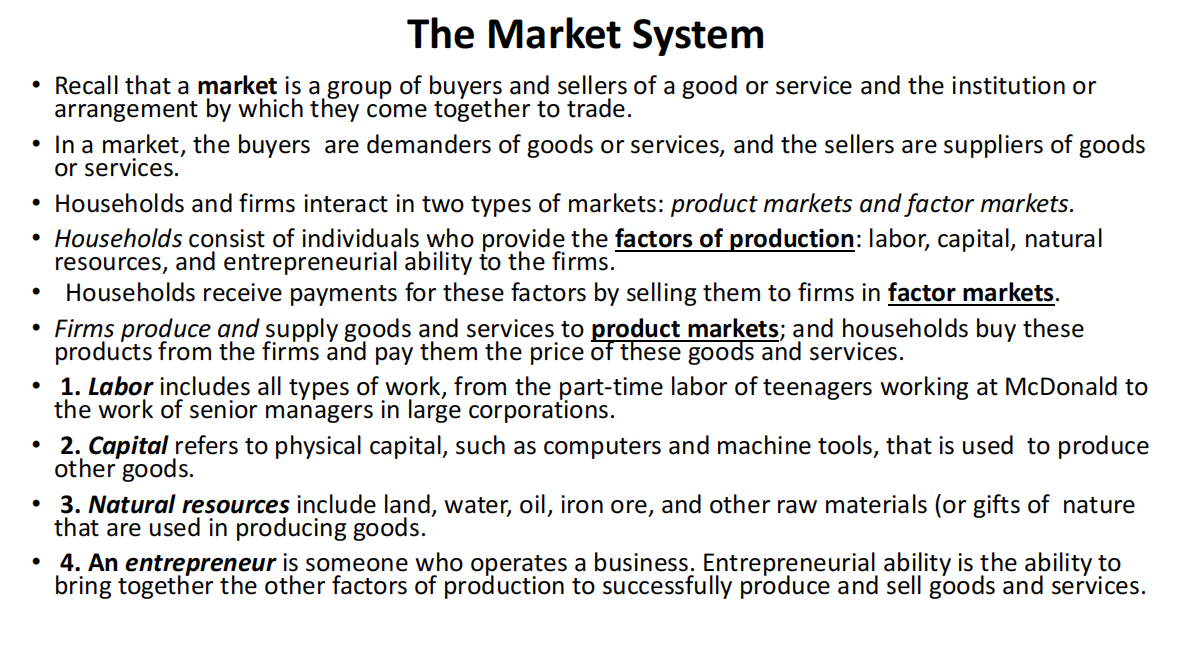
A market is a group of buyers and sellers of a good or service and the institution or arrangement by which they come together to trade.
📖 点击查看译文
市场是由商品或服务的买卖双方组成的群体,以及使他们聚集在一起进行交易的制度或安排。
In a market, the buyers are demanders of goods or services, and the sellers are suppliers of goods or services.
📖 点击查看译文
在市场中,买方是商品或服务的需求者,而卖方是商品或服务的供应者。
Households and firms interact in two types of markets: product markets and factor markets.
📖 点击查看译文
家庭和企业在两类市场中进行互动:产品市场和要素市场。
Households consist of individuals who provide the factors of production: labor, capital, natural resources, and entrepreneurial ability to the firms.
📖 点击查看译文
家庭由个人组成,这些个人向企业提供生产要素:劳动力、资本、自然资源和企业才能。
Households receive payments for these factors by selling them to firms in factor markets.
📖 点击查看译文
家庭通过在要素市场上向企业出售这些生产要素来获得报酬。
Firms produce and supply goods and services to product markets; and households buy these products from the firms and pay them the price of these goods and services.
📖 点击查看译文
企业生产并向产品市场供应商品和服务;家庭从企业购买这些商品,并支付其价格。
Labor includes all types of work, from the part-time labor of teenagers working at McDonald’s to the work of senior managers in large corporations.
📖 点击查看译文
劳动力包括所有类型的工作,从在麦当劳打工的青少年兼职工作,到大型企业的高级管理人员的工作。
Capital refers to physical capital, such as computers and machine tools, that is used to produce other goods.
📖 点击查看译文
资本指的是物质资本,例如用于生产其他商品的计算机和机床。
Natural resources include land, water, oil, iron ore, and other raw materials (or gifts of nature) that are used in producing goods.
📖 点击查看译文
自然资源包括土地、水、石油、铁矿石和其他用于生产商品的原材料(或自然赋予的资源)。
An entrepreneur is someone who operates a business. Entrepreneurial ability is the ability to bring together the other factors of production to successfully produce and sell goods and services.
📖 点击查看译文
企业家是经营企业的人。企业才能指的是整合其他生产要素,以成功生产和销售商品和服务的能力。
知识点列表与拓展 (Knowledge Points and Extensions):
1. Market System (市场体系)
-
解释 (Explanation):
-
The market system is an economic structure where buyers and sellers interact to exchange goods and services through markets.
(市场体系是一种经济结构,买卖双方通过市场进行商品和服务的交换。)
-
-
拓展 (Extension):
-
Example: The stock market is a marketplace where investors buy and sell shares of companies.
(例如,股票市场是一个投资者买卖公司股票的市场。)
-
2. Types of Markets (市场类型)
-
解释 (Explanation):
-
Product markets deal with goods and services, while factor markets deal with production inputs like labor and capital.
(产品市场交易商品和服务,而要素市场交易劳动力和资本等生产投入。)
-
-
拓展 (Extension):
-
Example: A supermarket is a product market, while a job recruitment platform is a factor market.
(例如,超市是产品市场,而招聘平台是要素市场。)
-
3. Factors of Production (生产要素)
-
解释 (Explanation):
-
The four factors of production—labor, capital, natural resources, and entrepreneurial ability—are essential for economic activity.
(四种生产要素——劳动力、资本、自然资源和企业才能——是经济活动的基础。)
-
-
拓展 (Extension):
-
Example: A bakery needs workers (labor), ovens (capital), wheat (natural resource), and a business owner (entrepreneur) to operate.
(例如,一家面包店需要工人(劳动力)、烤箱(资本)、小麦(自然资源)和企业主(企业才能)来运营。)
-
2
Circular-Flow Diagram (循环流动图)
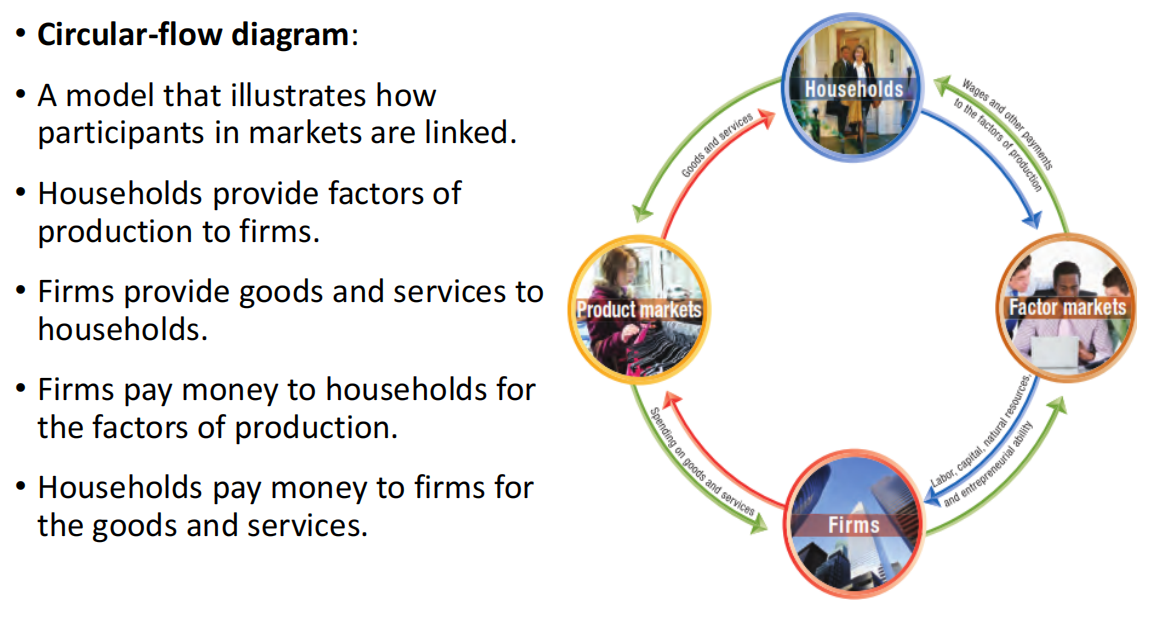
A model that illustrates how participants in markets are linked.
📖 点击查看译文
一个展示市场参与者如何相互联系的模型。
Households provide factors of production to firms.
📖 点击查看译文
家庭向企业提供生产要素。
Firms provide goods and services to households.
📖 点击查看译文
企业向家庭提供商品和服务。
Firms pay money to households for the factors of production.
📖 点击查看译文
企业向家庭支付生产要素的报酬。
Households pay money to firms for the goods and services.
📖 点击查看译文
家庭向企业支付商品和服务的费用。
知识点列表与拓展 (Knowledge Points and Extensions):
1. Circular-Flow Diagram (循环流动图模型)
-
解释 (Explanation):
-
This model shows how money, resources, and goods/services move between households and firms in an economy.
(该模型展示了货币、资源和商品/服务在家庭和企业之间的流动方式。)
-
-
拓展 (Extension):
-
Example: Households supply labor to firms, receive wages, and then use the income to buy goods and services from firms, forming a continuous cycle.
(例如,家庭向企业提供劳动力,获得工资,然后用收入购买企业的商品和服务,形成一个持续循环。)
-
2. The Role of Households and Firms (家庭与企业的角色)
-
解释 (Explanation):
-
Households act as suppliers of production factors and consumers of goods, while firms act as producers and employers.
(家庭是生产要素的提供者和商品的消费者,而企业是生产者和雇主。)
-
-
拓展 (Extension):
-
Example: A worker (household) provides labor to a car manufacturer (firm), earns a salary, and then spends money buying a car from the same firm.
(例如,一名工人(家庭)向汽车制造商(企业)提供劳动力,获得工资,然后用钱购买该企业生产的汽车。)
-
3. The Flow of Money and Resources (货币与资源的流动)
-
解释 (Explanation):
-
Money flows from firms to households as wages, rent, and profits, and then back to firms as households purchase goods and services.
(货币以工资、租金和利润的形式从企业流向家庭,然后以家庭购买商品和服务的方式流回企业。)
-
-
拓展 (Extension):
-
Example: A supermarket pays wages to employees, who then use their earnings to buy groceries from the same supermarket.
(例如,超市向员工支付工资,员工再用收入在同一家超市购买食品。)
-
3
The Gains from Free Markets (自由市场的收益)
A free market is one with few government restrictions on how a good or service can be produced or sold, or on how a factor of production can be employed.
📖 点击查看译文
自由市场是指政府对商品或服务的生产和销售方式,或生产要素的使用方式施加很少限制的市场。
Countries that come closest to the free market benchmark have been more successful than those with centrally planned economies in providing their people with rising living standards.
📖 点击查看译文
接近自由市场标准的国家,在提高人民生活水平方面比实行中央计划经济的国家更成功。
This concept is not new: Adam Smith argued for free markets in his 1776 article, An Inquiry into the Nature and Causes of the Wealth of Nations.
📖 点击查看译文
这一概念并不新鲜:亚当·斯密在他1776年的著作《国富论》中主张自由市场。
Smith argued that such restrictions reduced the income and wealth of a country and its people by restricting the quantity of goods produced.
📖 点击查看译文
斯密认为,这些限制通过减少商品的生产数量,降低了国家和人民的收入与财富。
知识点列表与拓展 (Knowledge Points and Extensions):
1. Definition of a Free Market (自由市场的定义)
-
解释 (Explanation):
-
A free market operates with minimal government intervention, allowing supply and demand to determine production, pricing, and employment.
(自由市场在政府干预最少的情况下运行,让供需关系决定生产、定价和就业。)
-
-
拓展 (Extension):
-
Example: In a free-market economy, companies decide what to produce based on consumer demand rather than government directives.
(例如,在自由市场经济中,公司根据消费者需求决定生产什么,而不是遵循政府指令。)
-
2. The Benefits of Free Markets (自由市场的优势)
-
解释 (Explanation):
-
Free markets often lead to higher efficiency, innovation, and economic growth compared to centrally planned economies.
(自由市场通常比中央计划经济更能促进高效、创新和经济增长。)
-
-
拓展 (Extension):
-
Example: Countries with fewer trade restrictions tend to have stronger economies and higher standards of living.
(例如,贸易限制较少的国家通常拥有更强的经济和更高的生活水平。)
-
3. Adam Smith and the Wealth of Nations (亚当·斯密与《国富论》)
-
解释 (Explanation):
-
Adam Smith advocated for free markets, arguing that government restrictions reduce economic output and overall wealth.
(亚当·斯密提倡自由市场,认为政府限制会降低经济产出和整体财富。)
-
-
拓展 (Extension):
-
Example: Smith’s idea of the “invisible hand” suggests that individuals pursuing their own interests unintentionally contribute to economic prosperity.
(例如,斯密的“看不见的手”理论表明,个人追求自身利益会无意中促进经济繁荣。)
-
4. Free Markets vs. Centrally Planned Economies (自由市场与中央计划经济的对比)
-
解释 (Explanation):
-
Free markets allocate resources based on supply and demand, whereas centrally planned economies rely on government decisions.
(自由市场根据供需关系分配资源,而中央计划经济依赖政府决策。)
-
-
拓展 (Extension):
-
Example: Historical evidence shows that market-driven economies generally outperform centrally planned economies in terms of growth and innovation.
(例如,历史证明,以市场驱动的经济在增长和创新方面通常优于中央计划经济。)
-
4
The Beauty of the Market Mechanism (市场机制的美妙之处)
It is not immediately obvious that markets will do better than centrally-planned systems for satisfying human desires.
📖 点击查看译文
市场在满足人类需求方面优于中央计划系统这一点并不是显而易见的。
After all, individuals are acting only in their own rational self-interest.
📖 点击查看译文
毕竟,个人只是按照自己的理性自利原则行事。
For example, suppose that a significant number of consumers switch from buying conventional gasoline-powered cars to buying either gasoline/electric-powered hybrid cars, such as the Toyota Prius, or all-electric cars, such as the Tesla Model 3.
📖 点击查看译文
例如,假设大量消费者从购买传统燃油车转向购买油电混合动力车(如丰田普锐斯)或纯电动车(如特斯拉Model 3)。
Firms will find that they can charge relatively higher prices for hybrid cars and electric cars than they can for gasoline-powered cars.
📖 点击查看译文
企业会发现,与燃油车相比,它们可以对混合动力车和电动车收取相对更高的价格。
The self-interest of these firms will lead them to respond to consumers’ wishes by producing more hybrid and electric cars and fewer gasoline-powered cars.
📖 点击查看译文
这些企业的自利动机会促使它们响应消费者需求,生产更多混合动力车和电动车,减少燃油车的生产。
Note that for the market mechanism to work in response to changes in consumers’ wants, prices must be flexible.
📖 点击查看译文
需要注意的是,市场机制要想根据消费者需求变化发挥作用,价格必须具有灵活性。
But markets with flexible prices allow the collective actions of households and firms to signal the relative worth of goods and services.
📖 点击查看译文
但价格灵活的市场允许家庭和企业的集体行为传递商品和服务的相对价值信号。
通俗理解:
如果某个商品很受欢迎(比如新款手机),很多人愿意买,商家就会提高价格;如果没人买(比如过季衣服),商家就会降价。这种价格的涨跌反映了商品的受欢迎程度,也就是它的“相对价值”。市场里的买卖行为就像“信号”,告诉商家哪些东西值钱,哪些东西不值钱。
知识点列表与拓展 (Knowledge Points and Extensions):
1. Market Mechanism and Consumer Demand (市场机制与消费者需求)
-
解释 (Explanation):
-
The market mechanism works by adjusting supply and demand through price signals, influencing production decisions.
(市场机制通过价格信号调整供需,从而影响生产决策。)
-
-
拓展 (Extension):
-
Example: As demand for electric cars rises, firms increase production and invest in new technology to meet consumer preferences.
(例如,随着电动车需求上升,企业增加生产并投资新技术以满足消费者偏好。)
-
2. Role of Self-Interest in the Market (市场中的自利动机)
-
解释 (Explanation):
-
Firms and individuals act in their own self-interest, but this often leads to efficient resource allocation and innovation.
(企业和个人按照自利动机行事,但这通常会带来高效的资源配置和创新。)
-
-
拓展 (Extension):
-
Example: Car manufacturers develop fuel-efficient and electric vehicles due to rising consumer demand and profit incentives.
(例如,汽车制造商因消费者需求上升和利润激励而研发节能和电动车。)
-
3. Price Flexibility and Market Efficiency (价格灵活性与市场效率)
-
解释 (Explanation):
-
Flexible prices allow markets to adapt quickly to changes in supply and demand, leading to efficient distribution of resources.
(灵活的价格使市场能快速适应供需变化,从而实现资源的高效分配。)
-
-
拓展 (Extension):
-
Example: When the demand for electric cars increases, higher prices incentivize firms to invest more in their production.
(例如,当电动车需求增加时,更高的价格激励企业加大生产投资。)
-
4. Market Signaling and Economic Coordination (市场信号与经济协调)
-
解释 (Explanation):
-
Prices serve as signals that help coordinate decisions between consumers and producers, ensuring optimal production levels.
(价格作为信号,帮助消费者和生产者协调决策,确保最优生产水平。)
-
-
拓展 (Extension):
-
Example: Rising oil prices signal consumers to switch to fuel-efficient vehicles, leading to shifts in production strategies.
(例如,油价上涨会促使消费者转向节能型汽车,从而改变生产策略。)
-
5
Market Signals and Consumer Preferences (市场信号与消费者偏好)
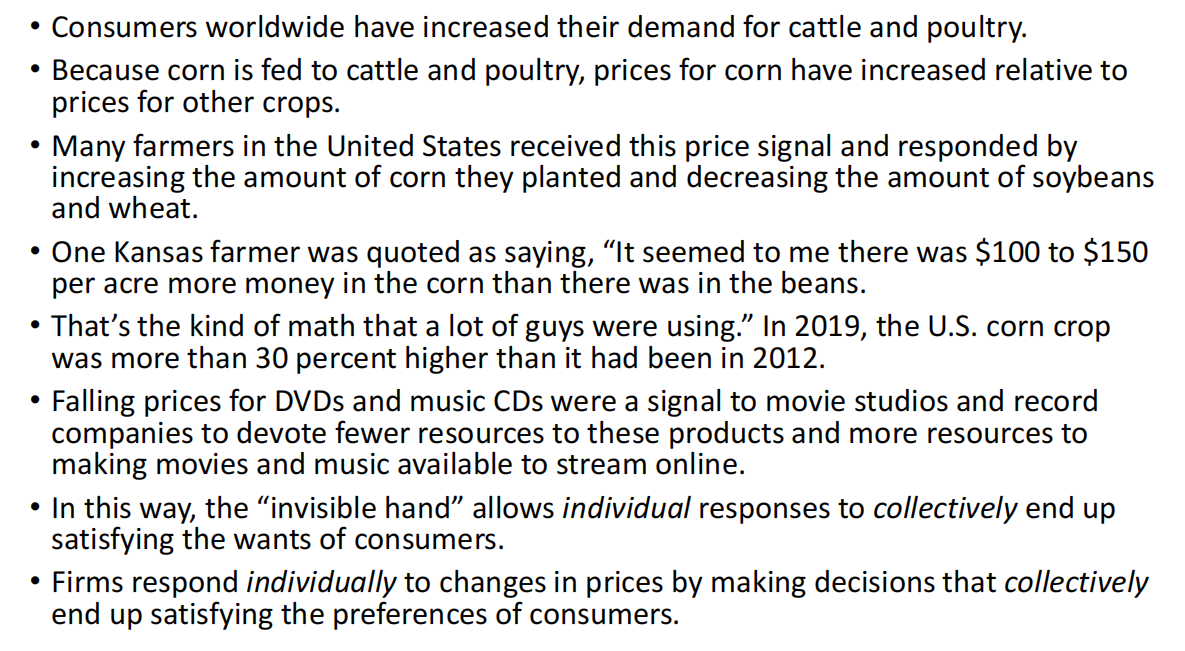
Consumers worldwide have increased their demand for cattle and poultry.
📖 点击查看译文
全球消费者对牛肉和家禽的需求增加了。
Because corn is fed to cattle and poultry, prices for corn have increased relative to prices for other crops.
📖 点击查看译文
由于玉米被用作牛肉和家禽的饲料,其价格相对于其他农作物上涨了。
Many farmers in the United States received this price signal and responded by increasing the amount of corn they planted and decreasing the amount of soybeans and wheat.
📖 点击查看译文
许多美国农民接收到这一价格信号,增加了玉米种植面积,同时减少了大豆和小麦的种植量。
One Kansas farmer was quoted as saying, “It seemed to me there was 150 per acre more money in the corn than there was in the beans.”
📖 点击查看译文
一位堪萨斯州的农民表示:“在我看来,每英亩玉米比大豆能多赚100到150美元。”
That’s the kind of math that a lot of guys were using.” In 2019, the U.S. corn crop was more than 30 percent higher than it had been in 2012.
📖 点击查看译文
“很多人都是这么算的。”2019年,美国的玉米产量比2012年增长了30%以上。
Falling prices for DVDs and music CDs were a signal to movie studios and record companies to devote fewer resources to these products and more resources to making movies and music available to stream online.
📖 点击查看译文
DVD和音乐CD价格下降,向电影公司和唱片公司发出了信号,让它们减少对这些产品的投入,并更多地投资于在线流媒体电影和音乐的制作。
In this way, the “invisible hand” allows individual responses to collectively end up satisfying the wants of consumers.
📖 点击查看译文
这样,“看不见的手”促使个体的市场反应最终满足了消费者的需求。
Firms respond individually to changes in prices by making decisions that collectively end up satisfying the preferences of consumers.
📖 点击查看译文
企业通过对价格变化作出个体决策,最终集体上满足了消费者的偏好。
知识点列表与拓展 (Knowledge Points and Extensions):
1. Price Signals and Resource Allocation (价格信号与资源配置)
-
解释 (Explanation):
-
Price changes serve as signals for producers to allocate resources more efficiently based on profitability.
(价格变动作为信号,引导生产者根据盈利能力更高效地分配资源。)
-
-
拓展 (Extension):
-
Example: The rise in corn prices led U.S. farmers to plant more corn while reducing soybean and wheat production.
(例如,玉米价格上涨导致美国农民增加玉米种植,同时减少大豆和小麦的生产。)
-
2. Opportunity Cost and Decision-Making (机会成本与决策制定)
-
解释 (Explanation):
-
Farmers compare potential earnings from different crops and choose the most profitable one.
(农民会比较不同作物的潜在收益,并选择最赚钱的作物。)
-
-
拓展 (Extension):
-
Example: A Kansas farmer calculated that corn brought 150 more per acre than soybeans, influencing his planting decision.
(例如,一位堪萨斯农民计算出玉米每英亩比大豆多赚100-150美元,因此选择种植更多玉米。)
-
3. Technological Shifts in Market Responses (市场反应中的技术变革)
-
解释 (Explanation):
-
Firms shift resources from declining industries to growing ones based on market trends and price changes.
(企业会根据市场趋势和价格变化,从衰退行业转向增长行业。)
-
-
拓展 (Extension):
-
Example: As DVD and CD prices fell, media companies shifted resources to streaming services like Netflix and Spotify.
(例如,随着DVD和CD价格下降,媒体公司将资源转向Netflix和Spotify等流媒体服务。)
-
4. The Invisible Hand in Market Coordination (市场协调中的“看不见的手”)
-
解释 (Explanation):
-
Individual decision-making, driven by price incentives, leads to an efficient market outcome that satisfies consumer needs.
(由价格激励驱动的个体决策,会促使市场实现满足消费者需求的高效结果。)
-
-
拓展 (Extension):
-
Example: Farmers, without central planning, collectively increased corn production in response to higher demand, showcasing the power of the “invisible hand.”
(例如,农民在没有中央计划的情况下,集体增加了玉米产量,以响应更高的需求,展示了“看不见的手”的力量。)
-
6
The Role of the Entrepreneur (企业家的角色)
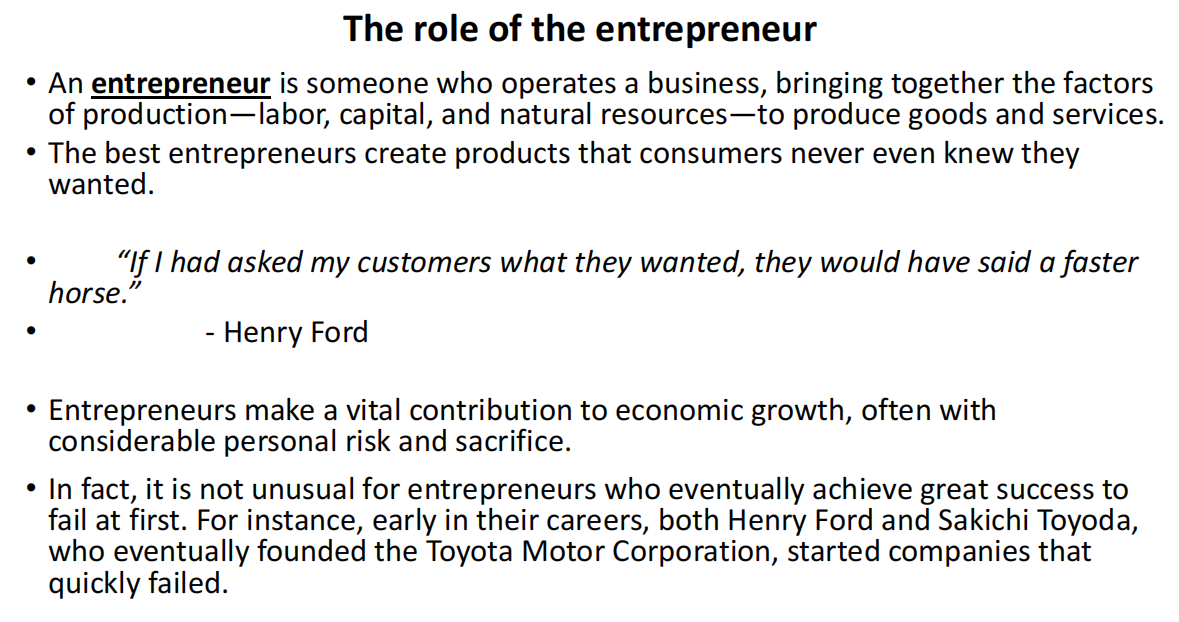
An entrepreneur is someone who operates a business, bringing together the factors of production—labor, capital, and natural resources—to produce goods and services.
📖 点击查看译文
企业家是经营企业的人,整合生产要素——劳动力、资本和自然资源,以生产商品和服务。
The best entrepreneurs create products that consumers never even knew they wanted.
📖 点击查看译文
最优秀的企业家能够创造出消费者甚至未曾意识到自己需要的产品。
“If I had asked my customers what they wanted, they would have said a faster horse.”
📖 点击查看译文
“如果我问顾客他们想要什么,他们会说‘一匹更快的马’。”
- Henry Ford
📖 点击查看译文
- 亨利·福特
Entrepreneurs make a vital contribution to economic growth, often with considerable personal risk and sacrifice.
📖 点击查看译文
企业家对经济增长作出至关重要的贡献,通常伴随着巨大的个人风险和牺牲。
In fact, it is not unusual for entrepreneurs who eventually achieve great success to fail at first. For instance, early in their careers, both Henry Ford and Sakichi Toyoda, who eventually founded the Toyota Motor Corporation, started companies that quickly failed.
📖 点击查看译文
事实上,最终取得巨大成功的企业家,最初失败并不罕见。例如,亨利·福特和丰田佐吉(后来创立了丰田汽车公司)在职业生涯早期,都创办了很快失败的公司。
知识点列表与拓展 (Knowledge Points and Extensions):
1. Definition and Role of Entrepreneurs (企业家的定义与作用)
-
解释 (Explanation):
-
Entrepreneurs combine labor, capital, and resources to create goods and services, driving innovation and economic progress.
(企业家整合劳动力、资本和资源,创造商品和服务,推动创新和经济进步。)
-
-
拓展 (Extension):
-
Example: Steve Jobs and Elon Musk revolutionized industries by introducing innovative products like the iPhone and Tesla electric vehicles.
(例如,史蒂夫·乔布斯和埃隆·马斯克通过推出iPhone和特斯拉电动车革新了行业。)
-
2. Innovation Beyond Consumer Expectations (超越消费者预期的创新)
-
解释 (Explanation):
-
Entrepreneurs anticipate future needs rather than just responding to existing demands.
(企业家预见未来需求,而不仅仅是响应现有需求。)
-
-
拓展 (Extension):
-
Example: Henry Ford introduced mass production of automobiles when people only imagined faster horses.
(例如,亨利·福特在大众只想到更快的马匹时,推出了汽车的大规模生产。)
-
3. Risk and Failure in Entrepreneurship (创业的风险与失败)
-
解释 (Explanation):
-
Many successful entrepreneurs experience early failures before achieving breakthroughs.
(许多成功企业家在取得突破前,经历过早期失败。)
-
-
拓展 (Extension):
-
Example: Jeff Bezos initially faced skepticism about Amazon’s viability before it became a global e-commerce giant.
(例如,杰夫·贝索斯最初面对外界对亚马逊可持续性的质疑,但最终成为全球电商巨头。)
-
4. Economic Growth Driven by Entrepreneurs (企业家推动的经济增长)
-
解释 (Explanation):
-
Entrepreneurial activities generate employment, drive competition, and enhance productivity.
(创业活动创造就业、推动竞争,并提高生产力。)
-
-
拓展 (Extension):
-
Example: The rapid growth of the tech industry in Silicon Valley has significantly contributed to U.S. GDP.
(例如,硅谷科技行业的快速增长对美国GDP作出了重大贡献。)
-
7
Important Products Introduced by Entrepreneurs at Small Firms (小型企业企业家推出的重要产品)
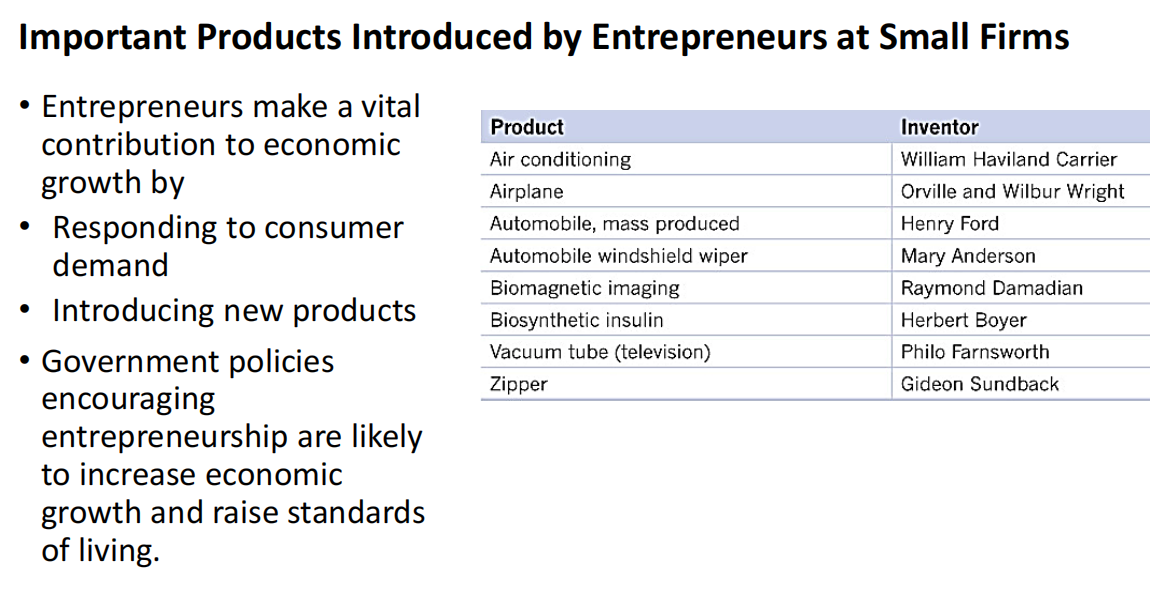
Entrepreneurs make a vital contribution to economic growth by
📖 点击查看译文
企业家通过以下方式对经济增长作出重要贡献:
•Responding to consumer demand
📖 点击查看译文
• 响应消费者需求
• Introducing new products
📖 点击查看译文
• 推出新产品
• Government policies encouraging entrepreneurship are likely to increase economic growth and raise standards of living
📖 点击查看译文
• 鼓励创业的政府政策可能会促进经济增长并提高生活水平
知识点列表与拓展 (Knowledge Points and Extensions):
1. Entrepreneurial Response to Consumer Demand (企业家对消费者需求的响应)
-
解释 (Explanation):
-
Entrepreneurs identify market gaps and develop solutions to meet consumer needs.
(企业家识别市场空缺,并开发解决方案以满足消费者需求。)
-
-
拓展 (Extension):
-
Example: Airbnb was created to address the demand for affordable short-term lodging.
(例如,Airbnb 的诞生是为了满足对经济型短租住宿的需求。)
-
2. Innovation and New Product Development (创新与新产品开发)
-
解释 (Explanation):
-
Many groundbreaking products originated from small businesses led by entrepreneurs.
(许多革命性产品最初由小型企业的企业家推出。)
-
-
拓展 (Extension):
-
Example: Steve Jobs and Steve Wozniak founded Apple in a garage, introducing the personal computer revolution.
(例如,史蒂夫·乔布斯和史蒂夫·沃兹尼亚克在车库创办苹果,引领了个人计算机革命。)
-
3. Government Policies Supporting Entrepreneurship (支持创业的政府政策)
-
解释 (Explanation):
-
Policies such as tax incentives, startup funding, and business-friendly regulations can encourage entrepreneurship.
(税收激励、创业资金和有利于企业的法规等政策可以促进创业。)
-
-
拓展 (Extension):
-
Example: Countries like the U.S. and Singapore offer startup-friendly environments, leading to rapid tech industry growth.
(例如,美国和新加坡提供有利的创业环境,促进了科技产业的快速发展。)
-
4. Economic Growth and Improved Living Standards (经济增长与生活水平提高)
-
解释 (Explanation):
-
Successful entrepreneurial ventures create jobs, boost innovation, and drive national economic expansion.
(成功的创业企业创造就业机会,推动创新,并促进国家经济扩张。)
-
-
拓展 (Extension):
-
Example: The rise of e-commerce platforms like Alibaba and Amazon has transformed global retail and logistics industries.
(例如,阿里巴巴和亚马逊等电商平台的崛起,改变了全球零售和物流行业。)
-
8
The Legal Basis of a Successful Market System (成功市场体系的法律基础)
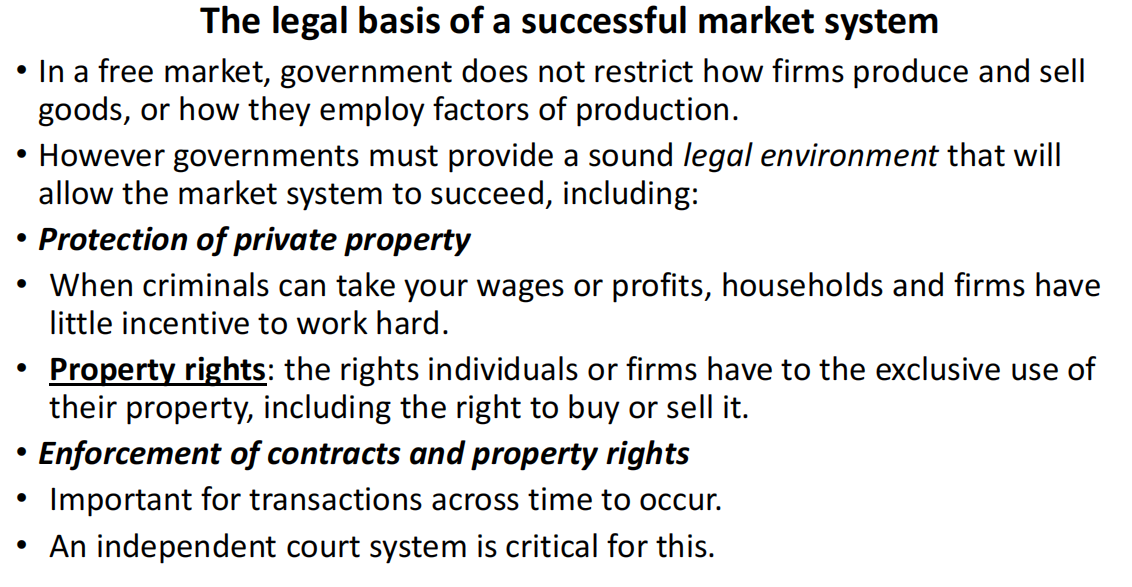
In a free market, government does not restrict how firms produce and sell goods, or how they employ factors of production.
📖 点击查看译文
在自由市场中,政府不会限制企业如何生产和销售商品,也不会限制其如何使用生产要素。
However, governments must provide a sound legal environment that will allow the market system to succeed, including:
📖 点击查看译文
然而,政府必须提供良好的法律环境,以确保市场体系的成功,包括:
• Protection of private property
📖 点击查看译文
• 保护私有财产
• When criminals can take your wages or profits, households and firms have little incentive to work hard.
📖 点击查看译文
• 如果犯罪分子可以夺取你的工资或利润,家庭和企业就没有动力努力工作。
• Property rights: the rights individuals or firms have to the exclusive use of their property, including the right to buy or sell it.
📖 点击查看译文
• 财产权:个人或企业对其财产的专属使用权,包括买卖权。
• Enforcement of contracts and property rights
📖 点击查看译文
• 执行合同与财产权
• Important for transactions across time to occur.
📖 点击查看译文
• 这对于跨时间的交易至关重要。
• An independent court system is critical for this.
📖 点击查看译文
• 独立的法院体系对此至关重要。
知识点列表与拓展 (Knowledge Points and Extensions):
1. Role of Government in Free Markets (政府在自由市场中的作用)
-
解释 (Explanation):
-
While free markets minimize government interference, a legal framework is necessary to ensure fair competition and protect property rights.
(尽管自由市场减少了政府干预,但需要法律框架来确保公平竞争并保护财产权。)
-
-
拓展 (Extension):
-
Example: The U.S. legal system enforces intellectual property rights to protect innovation.
(例如,美国法律体系执行知识产权保护,以保护创新。)
-
2. Protection of Private Property (私有财产保护)
-
解释 (Explanation):
-
Secure property rights encourage investment, innovation, and economic stability.
(稳定的财产权鼓励投资、创新,并促进经济稳定。)
-
-
拓展 (Extension):
-
Example: Countries with strong property rights, like Switzerland, attract global investors.
(例如,瑞士等财产权保护良好的国家吸引全球投资者。)
-
3. Enforcement of Contracts (合同执行)
-
解释 (Explanation):
-
Reliable contract enforcement ensures trust in economic transactions.
(可靠的合同执行确保经济交易的信任。)
-
-
拓展 (Extension):
-
Example: The World Bank’s “Ease of Doing Business” index ranks countries based on contract enforcement efficiency.
(例如,世界银行的“营商环境指数”根据合同执行效率对各国进行排名。)
-
4. Importance of an Independent Judiciary (独立司法体系的重要性)
-
解释 (Explanation):
-
A fair and impartial legal system prevents corruption and upholds market integrity.
(公正独立的法律体系可以防止腐败并维护市场诚信。)
-
-
拓展 (Extension):
-
Example: Nations with weak judicial independence, like Venezuela, face economic instability.
(例如,委内瑞拉等司法独立性较弱的国家容易出现经济不稳定。)
-
9
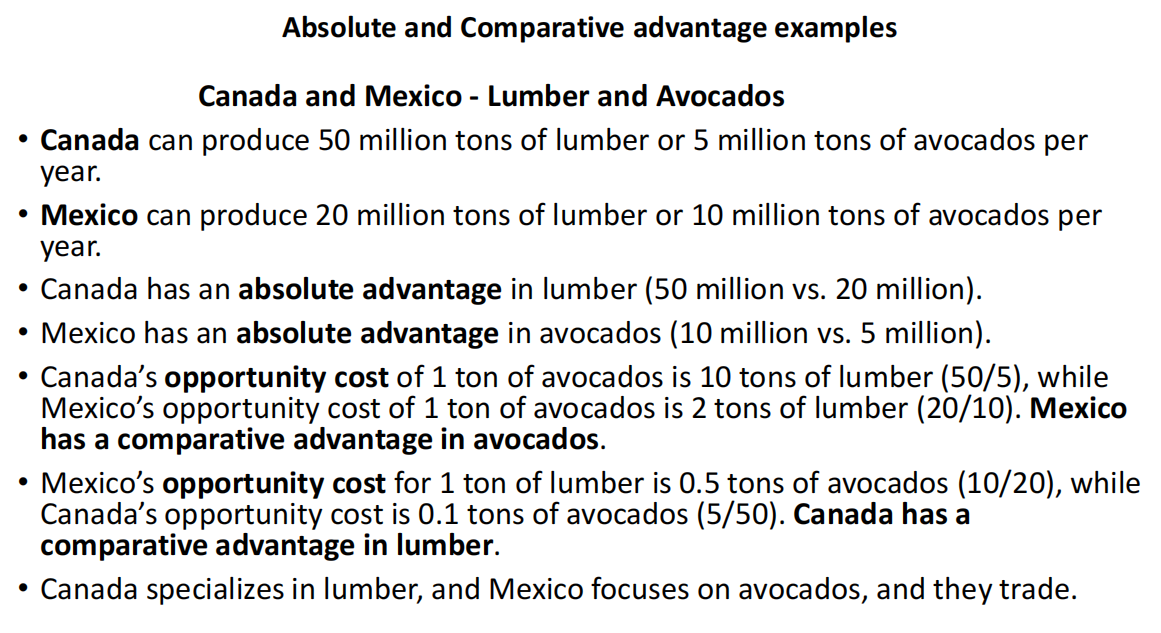
Absolute and Comparative Advantage Examples (绝对优势与比较优势示例)
Canada and Mexico - Lumber and Avocados
📖 点击查看译文
加拿大与墨西哥 - 木材与鳄梨
• Canada can produce 50 million tons of lumber or 5 million tons of avocados per year.
📖 点击查看译文
• 加拿大每年可以生产 5000 万吨木材或 500 万吨鳄梨。
• Mexico can produce 20 million tons of lumber or 10 million tons of avocados per year.
📖 点击查看译文
• 墨西哥每年可以生产 2000 万吨木材或 1000 万吨鳄梨。
• Canada has an absolute advantage in lumber (50 million vs. 20 million).
📖 点击查看译文
• 加拿大在木材生产上具有绝对优势(5000 万吨 vs. 2000 万吨)。
• Mexico has an absolute advantage in avocados (10 million vs. 5 million).
📖 点击查看译文
• 墨西哥在鳄梨生产上具有绝对优势(1000 万吨 vs. 500 万吨)。
• Canada’s opportunity cost of 1 ton of avocados is 10 tons of lumber (50/5), while Mexico’s opportunity cost of 1 ton of avocados is 2 tons of lumber (20/10). Mexico has a comparative advantage in avocados.
📖 点击查看译文
• 加拿大生产 1 吨鳄梨的机会成本是 10 吨木材(50/5),而墨西哥的机会成本是 2 吨木材(20/10)。因此,墨西哥在鳄梨生产上具有比较优势。
• Mexico’s opportunity cost for 1 ton of lumber is 0.5 tons of avocados (10/20), while Canada’s opportunity cost is 0.1 tons of avocados (5/50). Canada has a comparative advantage in lumber.
📖 点击查看译文
• 墨西哥生产 1 吨木材的机会成本是 0.5 吨鳄梨(10/20),而加拿大的机会成本是 0.1 吨鳄梨(5/50)。因此,加拿大在木材生产上具有比较优势。
• Canada specializes in lumber, and Mexico focuses on avocados, and they trade.
📖 点击查看译文
• 加拿大专注于木材生产,墨西哥专注于鳄梨生产,并进行贸易。
知识点列表与拓展 (Knowledge Points and Extensions):
1. Absolute Advantage (绝对优势)
-
解释 (Explanation):
-
A country has an absolute advantage when it can produce more of a good using the same resources.
(当一个国家使用相同资源可以生产更多商品时,它就具有绝对优势。)
-
-
拓展 (Extension):
-
Example: China has an absolute advantage in manufacturing due to its large labor force.
(例如,中国因其庞大劳动力在制造业上具有绝对优势。)
-
2. Comparative Advantage (比较优势)
-
解释 (Explanation):
-
A country has a comparative advantage if it can produce a good at a lower opportunity cost than another country.
(当一个国家生产某商品的机会成本低于另一个国家时,它就具有比较优势。)
-
-
拓展 (Extension):
-
Example: India has a comparative advantage in IT services due to lower labor costs.
(例如,印度因较低的劳动力成本在 IT 服务行业具有比较优势。)
-
3. Opportunity Cost (机会成本)
-
解释 (Explanation):
-
The value of the next best alternative that is forgone when making a choice.
(做出选择时放弃的最佳替代方案的价值。)
-
-
拓展 (Extension):
-
Example: If a farmer uses land for wheat instead of corn, the opportunity cost is the corn that could have been grown.
(例如,如果农民用土地种植小麦而不是玉米,则机会成本就是原本可以种植的玉米。)
-
4. Specialization and Trade (专业化与贸易)
-
解释 (Explanation):
-
Countries benefit by specializing in goods where they have a comparative advantage and trading for others.
(国家通过专注于具有比较优势的商品生产,并通过贸易获取其他商品,从而获益。)
-
-
拓展 (Extension):
-
Example: Japan specializes in high-tech electronics, while Brazil focuses on agricultural exports.
(例如,日本专注于高科技电子产品,而巴西专注于农业出口。)
-
10
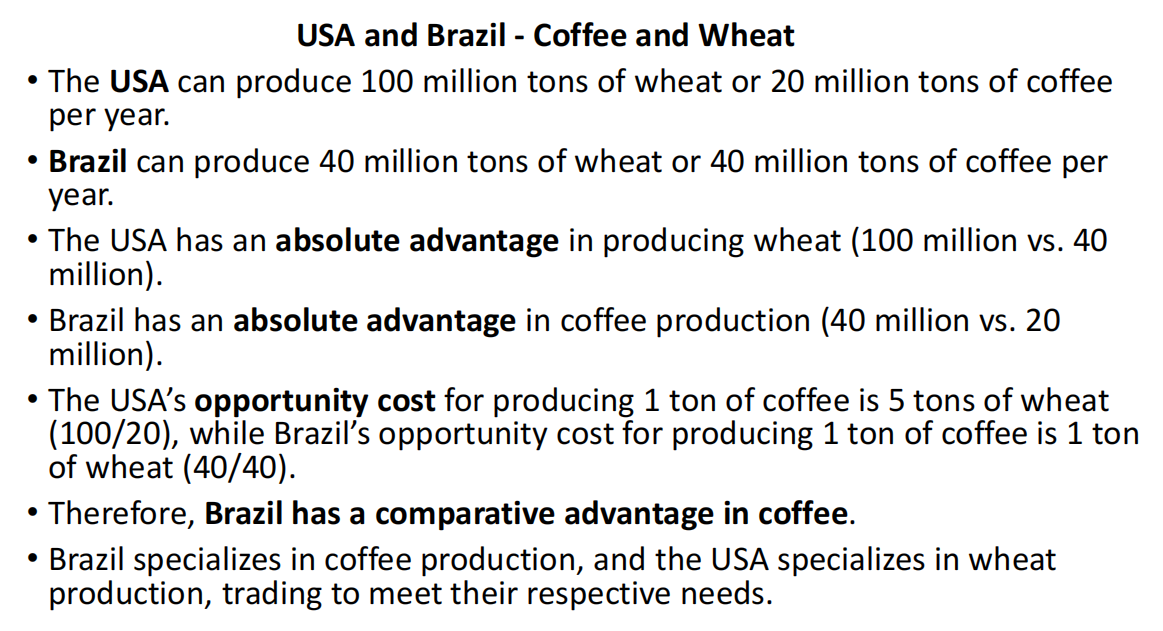
Absolute and Comparative Advantage Examples (绝对优势与比较优势示例)
USA and Brazil - Coffee and Wheat
📖 点击查看译文
美国与巴西 - 咖啡与小麦
• The USA can produce 100 million tons of wheat or 20 million tons of coffee per year.
📖 点击查看译文
• 美国每年可以生产 1 亿吨小麦或 2000 万吨咖啡。
• Brazil can produce 40 million tons of wheat or 40 million tons of coffee per year.
📖 点击查看译文
• 巴西每年可以生产 4000 万吨小麦或 4000 万吨咖啡。
• The USA has an absolute advantage in producing wheat (100 million vs. 40 million).
📖 点击查看译文
• 美国在小麦生产上具有绝对优势(1 亿吨 vs. 4000 万吨)。
• Brazil has an absolute advantage in coffee production (40 million vs. 20 million).
📖 点击查看译文
• 巴西在咖啡生产上具有绝对优势(4000 万吨 vs. 2000 万吨)。
• The USA’s opportunity cost for producing 1 ton of coffee is 5 tons of wheat (100/20), while Brazil’s opportunity cost for producing 1 ton of coffee is 1 ton of wheat (40/40).
📖 点击查看译文
• 美国生产 1 吨咖啡的机会成本是 5 吨小麦(100/20),而巴西生产 1 吨咖啡的机会成本是 1 吨小麦(40/40)。
• Therefore, Brazil has a comparative advantage in coffee.
📖 点击查看译文
• 因此,巴西在咖啡生产上具有比较优势。
• Brazil specializes in coffee production, and the USA specializes in wheat production, trading to meet their respective needs.
📖 点击查看译文
• 巴西专注于咖啡生产,美国专注于小麦生产,并通过贸易满足各自需求。
知识点列表与拓展 (Knowledge Points and Extensions):
1. Absolute Advantage (绝对优势)
-
解释 (Explanation):
-
A country has an absolute advantage when it can produce more of a good using the same resources.
(当一个国家使用相同资源可以生产更多商品时,它就具有绝对优势。)
-
-
拓展 (Extension):
-
Example: The USA has an absolute advantage in wheat production due to advanced agricultural technology.
(例如,美国因先进的农业技术在小麦生产上具有绝对优势。)
-
2. Comparative Advantage (比较优势)
-
解释 (Explanation):
-
A country has a comparative advantage if it can produce a good at a lower opportunity cost than another country.
(当一个国家生产某商品的机会成本低于另一个国家时,它就具有比较优势。)
-
-
拓展 (Extension):
-
Example: Brazil has a comparative advantage in coffee production due to its climate and soil conditions.
(例如,巴西因气候和土壤条件在咖啡生产上具有比较优势。)
-
3. Opportunity Cost (机会成本)
-
解释 (Explanation):
-
The value of the next best alternative that is forgone when making a choice.
(做出选择时放弃的最佳替代方案的价值。)
-
-
拓展 (Extension):
-
Example: If the USA produces coffee instead of wheat, the opportunity cost is the wheat that could have been produced.
(例如,如果美国选择生产咖啡而不是小麦,则机会成本就是原本可以生产的小麦。)
-
4. Specialization and Trade (专业化与贸易)
-
解释 (Explanation):
-
Countries benefit by specializing in goods where they have a comparative advantage and trading for others.
(国家通过专注于具有比较优势的商品生产,并通过贸易获取其他商品,从而获益。)
-
-
拓展 (Extension):
-
Example: The USA exports wheat to Brazil and imports coffee in return.
(例如,美国向巴西出口小麦,并从巴西进口咖啡。)
-
11
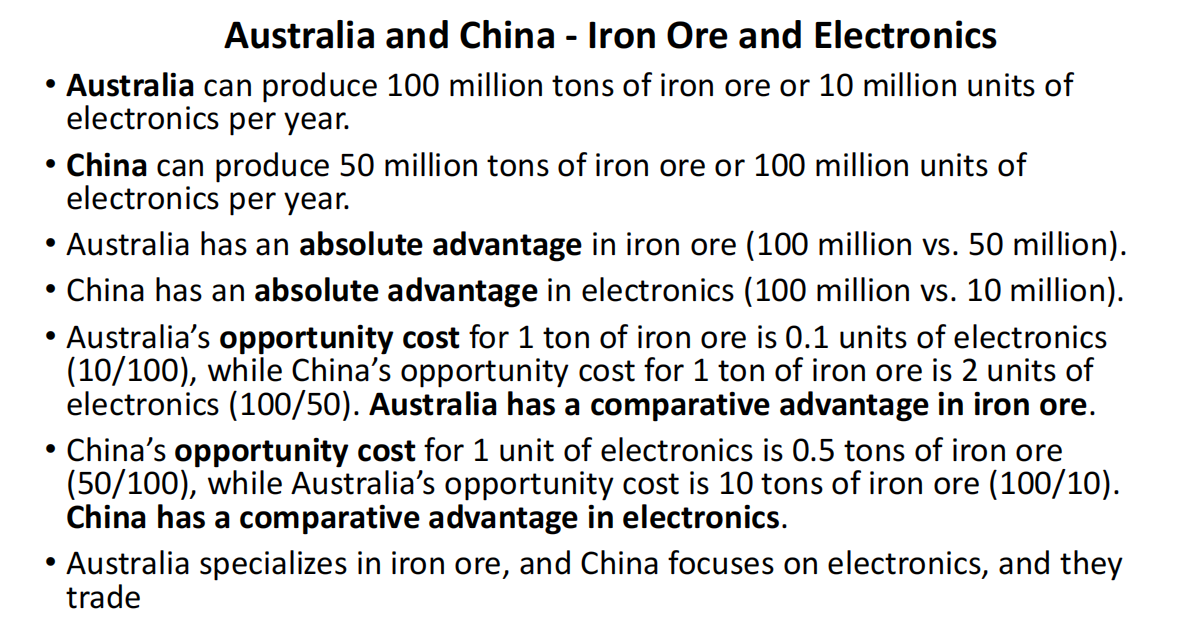
Absolute and Comparative Advantage Examples (绝对优势与比较优势示例)
Australia and China - Iron Ore and Electronics
📖 点击查看译文
澳大利亚与中国 - 铁矿石与电子产品
• Australia can produce 100 million tons of iron ore or 10 million units of electronics per year.
📖 点击查看译文
• 澳大利亚每年可以生产 1 亿吨铁矿石或 1000 万台电子产品。
• China can produce 50 million tons of iron ore or 100 million units of electronics per year.
📖 点击查看译文
• 中国每年可以生产 5000 万吨铁矿石或 1 亿台电子产品。
• Australia has an absolute advantage in iron ore (100 million vs. 50 million).
📖 点击查看译文
• 澳大利亚在铁矿石生产上具有绝对优势(1 亿吨 vs. 5000 万吨)。
• China has an absolute advantage in electronics (100 million vs. 10 million).
📖 点击查看译文
• 中国在电子产品生产上具有绝对优势(1 亿台 vs. 1000 万台)。
• Australia’s opportunity cost for 1 ton of iron ore is 0.1 units of electronics (10/100), while China’s opportunity cost for 1 ton of iron ore is 2 units of electronics (100/50). Australia has a comparative advantage in iron ore.
📖 点击查看译文
• 澳大利亚生产 1 吨铁矿石的机会成本是 0.1 台电子产品(10/100),而中国生产 1 吨铁矿石的机会成本是 2 台电子产品(100/50)。澳大利亚在铁矿石生产上具有比较优势。
• China’s opportunity cost for 1 unit of electronics is 0.5 tons of iron ore (50/100), while Australia’s opportunity cost is 10 tons of iron ore (100/10). China has a comparative advantage in electronics.
📖 点击查看译文
• 中国生产 1 台电子产品的机会成本是 0.5 吨铁矿石(50/100),而澳大利亚生产 1 台电子产品的机会成本是 10 吨铁矿石(100/10)。中国在电子产品生产上具有比较优势。
• Australia specializes in iron ore, and China focuses on electronics, and they trade.
📖 点击查看译文
• 澳大利亚专注于铁矿石生产,中国专注于电子产品生产,并通过贸易满足各自需求。
知识点列表与拓展 (Knowledge Points and Extensions):
1. Absolute Advantage (绝对优势)
-
解释 (Explanation):
-
A country has an absolute advantage when it can produce more of a good using the same resources.
(当一个国家使用相同资源可以生产更多商品时,它就具有绝对优势。)
-
-
拓展 (Extension):
-
Example: Australia has an absolute advantage in iron ore due to its abundant natural resources.
(例如,澳大利亚因丰富的自然资源在铁矿石生产上具有绝对优势。)
-
2. Comparative Advantage (比较优势)
-
解释 (Explanation):
-
A country has a comparative advantage if it can produce a good at a lower opportunity cost than another country.
(当一个国家生产某商品的机会成本低于另一个国家时,它就具有比较优势。)
-
-
拓展 (Extension):
-
Example: China has a comparative advantage in electronics due to its advanced manufacturing industry and skilled labor force.
(例如,中国因先进的制造业和熟练劳动力在电子产品生产上具有比较优势。)
-
3. Opportunity Cost (机会成本)
-
解释 (Explanation):
-
The value of the next best alternative that is forgone when making a choice.
(做出选择时放弃的最佳替代方案的价值。)
-
-
拓展 (Extension):
-
Example: If Australia produces electronics instead of iron ore, the opportunity cost is the iron ore that could have been produced.
(例如,如果澳大利亚选择生产电子产品而不是铁矿石,则机会成本就是原本可以生产的铁矿石。)
-
4. Specialization and Trade (专业化与贸易)
-
解释 (Explanation):
-
Countries benefit by specializing in goods where they have a comparative advantage and trading for others.
(国家通过专注于具有比较优势的商品生产,并通过贸易获取其他商品,从而获益。)
-
-
拓展 (Extension):
-
Example: Australia exports iron ore to China, and China exports electronics to Australia.
(例如,澳大利亚向中国出口铁矿石,中国向澳大利亚出口电子产品。)
-
12
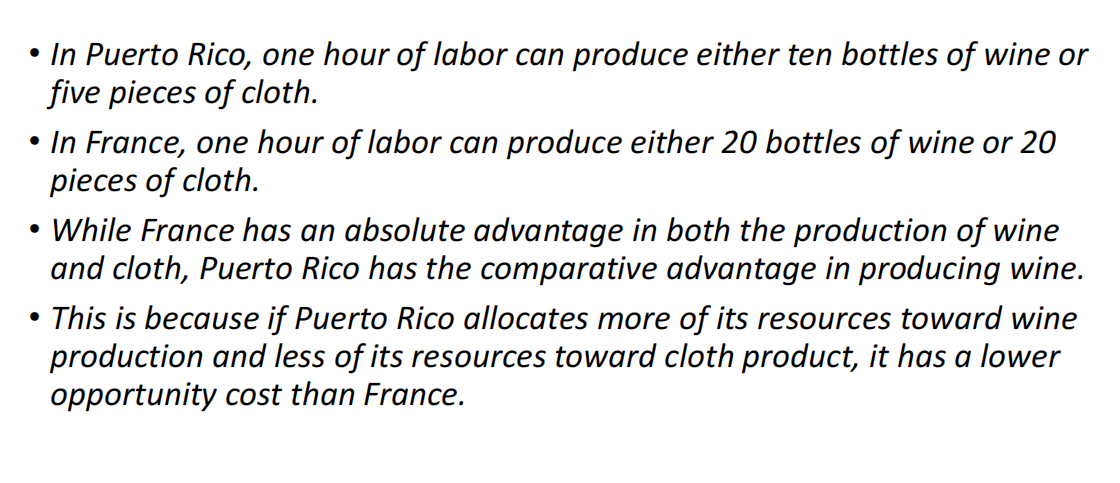
Absolute and Comparative Advantage Example (绝对优势与比较优势示例)
Puerto Rico and France - Wine and Cloth
📖 点击查看译文
波多黎各与法国 - 葡萄酒与布料
• In Puerto Rico, one hour of labor can produce either ten bottles of wine or five pieces of cloth.
📖 点击查看译文
• 在波多黎各,1 小时的劳动可以生产 10 瓶葡萄酒或 5 块布料。
• In France, one hour of labor can produce either 20 bottles of wine or 20 pieces of cloth.
📖 点击查看译文
• 在法国,1 小时的劳动可以生产 20 瓶葡萄酒或 20 块布料。
• While France has an absolute advantage in both the production of wine and cloth, Puerto Rico has the comparative advantage in producing wine.
📖 点击查看译文
• 虽然法国在葡萄酒和布料生产上都具有绝对优势,但波多黎各在葡萄酒生产上具有比较优势。
• This is because if Puerto Rico allocates more of its resources toward wine production and less of its resources toward cloth production, it has a lower opportunity cost than France.
📖 点击查看译文
• 这是因为如果波多黎各将更多资源用于葡萄酒生产而减少布料生产,其机会成本低于法国。
知识点列表与拓展 (Knowledge Points and Extensions):
1. Absolute Advantage (绝对优势)
-
解释 (Explanation):
-
A country has an absolute advantage when it can produce more of a good using the same resources.
(当一个国家使用相同资源可以生产更多商品时,它就具有绝对优势。)
-
-
拓展 (Extension):
-
Example: France has an absolute advantage in both wine and cloth production because it can produce more of each good per hour.
(例如,法国在葡萄酒和布料生产上都具有绝对优势,因为它每小时能生产更多的产品。)
-
2. Comparative Advantage (比较优势)
-
解释 (Explanation):
-
A country has a comparative advantage if it can produce a good at a lower opportunity cost than another country.
(当一个国家生产某商品的机会成本低于另一个国家时,它就具有比较优势。)
-
-
拓展 (Extension):
-
Example: Puerto Rico has a comparative advantage in wine production because its opportunity cost of producing wine is lower than that of France.
(例如,波多黎各在葡萄酒生产上具有比较优势,因为它生产葡萄酒的机会成本低于法国。)
-
3. Opportunity Cost (机会成本)
-
解释 (Explanation):
-
The value of the next best alternative that is forgone when making a choice.
(做出选择时放弃的最佳替代方案的价值。)
-
-
拓展 (Extension):
-
Example: Puerto Rico’s opportunity cost of producing 1 bottle of wine is 0.5 pieces of cloth (5/10), while France’s opportunity cost of producing 1 bottle of wine is 1 piece of cloth (20/20). Puerto Rico has a lower opportunity cost in wine production.
(例如,波多黎各生产 1 瓶葡萄酒的机会成本是 0.5 块布料(5/10),而法国的机会成本是 1 块布料(20/20)。波多黎各在葡萄酒生产上具有较低的机会成本。)
-
4. Specialization and Trade (专业化与贸易)
-
解释 (Explanation):
-
Countries benefit by specializing in goods where they have a comparative advantage and trading for others.
(国家通过专注于具有比较优势的商品生产,并通过贸易获取其他商品,从而获益。)
-
-
拓展 (Extension):
-
Example: Puerto Rico specializes in wine production, and France specializes in cloth production. They trade to maximize efficiency and mutual benefit.
(例如,波多黎各专注于葡萄酒生产,法国专注于布料生产。它们通过贸易实现效率最大化和互利共赢。)
-
Because corn is fed to cattle and poultry, prices for corn have increased relative to prices for other crops.
📖 点击查看译文
由于玉米被用作牛肉和家禽的饲料,其价格相对于其他农作物上涨了。
Many farmers in the United States received this price signal and responded by increasing the amount of corn they planted and decreasing the amount of soybeans and wheat.
📖 点击查看译文
许多美国农民接收到这一价格信号,增加了玉米种植面积,同时减少了大豆和小麦的种植量。
One Kansas farmer was quoted as saying, “It seemed to me there was 150 per acre more money in the corn than there was in the beans.”
📖 点击查看译文
一位堪萨斯州的农民表示:“在我看来,每英亩玉米比大豆能多赚100到150美元。”
That’s the kind of math that a lot of guys were using.” In 2019, the U.S. corn crop was more than 30 percent higher than it had been in 2012.
📖 点击查看译文
“很多人都是这么算的。”2019年,美国的玉米产量比2012年增长了30%以上。
Falling prices for DVDs and music CDs were a signal to movie studios and record companies to devote fewer resources to these products and more resources to making movies and music available to stream online.
📖 点击查看译文
DVD和音乐CD价格下降,向电影公司和唱片公司发出了信号,让它们减少对这些产品的投入,并更多地投资于在线流媒体电影和音乐的制作。
In this way, the “invisible hand” allows individual responses to collectively end up satisfying the wants of consumers.
📖 点击查看译文
这样,“看不见的手”促使个体的市场反应最终满足了消费者的需求。
Firms respond individually to changes in prices by making decisions that collectively end up satisfying the preferences of consumers.
📖 点击查看译文
企业通过对价格变化作出个体决策,最终集体上满足了消费者的偏好。
知识点列表与拓展 (Knowledge Points and Extensions):
1. Price Signals and Resource Allocation (价格信号与资源配置)
-
解释 (Explanation):
-
Price changes serve as signals for producers to allocate resources more efficiently based on profitability.
(价格变动作为信号,引导生产者根据盈利能力更高效地分配资源。)
-
-
拓展 (Extension):
-
Example: The rise in corn prices led U.S. farmers to plant more corn while reducing soybean and wheat production.
(例如,玉米价格上涨导致美国农民增加玉米种植,同时减少大豆和小麦的生产。)
-
2. Opportunity Cost and Decision-Making (机会成本与决策制定)
-
解释 (Explanation):
-
Farmers compare potential earnings from different crops and choose the most profitable one.
(农民会比较不同作物的潜在收益,并选择最赚钱的作物。)
-
-
拓展 (Extension):
-
Example: A Kansas farmer calculated that corn brought 150 more per acre than soybeans, influencing his planting decision.
(例如,一位堪萨斯农民计算出玉米每英亩比大豆多赚100-150美元,因此选择种植更多玉米。)
-
3. Technological Shifts in Market Responses (市场反应中的技术变革)
-
解释 (Explanation):
-
Firms shift resources from declining industries to growing ones based on market trends and price changes.
(企业会根据市场趋势和价格变化,从衰退行业转向增长行业。)
-
-
拓展 (Extension):
-
Example: As DVD and CD prices fell, media companies shifted resources to streaming services like Netflix and Spotify.
(例如,随着DVD和CD价格下降,媒体公司将资源转向Netflix和Spotify等流媒体服务。)
-
4. The Invisible Hand in Market Coordination (市场协调中的“看不见的手”)
-
解释 (Explanation):
-
Individual decision-making, driven by price incentives, leads to an efficient market outcome that satisfies consumer needs.
(由价格激励驱动的个体决策,会促使市场实现满足消费者需求的高效结果。)
-
-
拓展 (Extension):
-
Example: Farmers, without central planning, collectively increased corn production in response to higher demand, showcasing the power of the “invisible hand.”
(例如,农民在没有中央计划的情况下,集体增加了玉米产量,以响应更高的需求,展示了“看不见的手”的力量。)
-
6

The Role of the Entrepreneur (企业家的角色)
An entrepreneur is someone who operates a business, bringing together the factors of production—labor, capital, and natural resources—to produce goods and services.
📖 点击查看译文
企业家是经营企业的人,整合生产要素——劳动力、资本和自然资源,以生产商品和服务。
The best entrepreneurs create products that consumers never even knew they wanted.
📖 点击查看译文
最优秀的企业家能够创造出消费者甚至未曾意识到自己需要的产品。
“If I had asked my customers what they wanted, they would have said a faster horse.”
📖 点击查看译文
“如果我问顾客他们想要什么,他们会说‘一匹更快的马’。”
- Henry Ford
📖 点击查看译文
- 亨利·福特
Entrepreneurs make a vital contribution to economic growth, often with considerable personal risk and sacrifice.
📖 点击查看译文
企业家对经济增长作出至关重要的贡献,通常伴随着巨大的个人风险和牺牲。
In fact, it is not unusual for entrepreneurs who eventually achieve great success to fail at first. For instance, early in their careers, both Henry Ford and Sakichi Toyoda, who eventually founded the Toyota Motor Corporation, started companies that quickly failed.
📖 点击查看译文
事实上,最终取得巨大成功的企业家,最初失败并不罕见。例如,亨利·福特和丰田佐吉(后来创立了丰田汽车公司)在职业生涯早期,都创办了很快失败的公司。
知识点列表与拓展 (Knowledge Points and Extensions):
1. Definition and Role of Entrepreneurs (企业家的定义与作用)
-
解释 (Explanation):
-
Entrepreneurs combine labor, capital, and resources to create goods and services, driving innovation and economic progress.
(企业家整合劳动力、资本和资源,创造商品和服务,推动创新和经济进步。)
-
-
拓展 (Extension):
-
Example: Steve Jobs and Elon Musk revolutionized industries by introducing innovative products like the iPhone and Tesla electric vehicles.
(例如,史蒂夫·乔布斯和埃隆·马斯克通过推出iPhone和特斯拉电动车革新了行业。)
-
2. Innovation Beyond Consumer Expectations (超越消费者预期的创新)
-
解释 (Explanation):
-
Entrepreneurs anticipate future needs rather than just responding to existing demands.
(企业家预见未来需求,而不仅仅是响应现有需求。)
-
-
拓展 (Extension):
-
Example: Henry Ford introduced mass production of automobiles when people only imagined faster horses.
(例如,亨利·福特在大众只想到更快的马匹时,推出了汽车的大规模生产。)
-
3. Risk and Failure in Entrepreneurship (创业的风险与失败)
-
解释 (Explanation):
-
Many successful entrepreneurs experience early failures before achieving breakthroughs.
(许多成功企业家在取得突破前,经历过早期失败。)
-
-
拓展 (Extension):
-
Example: Jeff Bezos initially faced skepticism about Amazon’s viability before it became a global e-commerce giant.
(例如,杰夫·贝索斯最初面对外界对亚马逊可持续性的质疑,但最终成为全球电商巨头。)
-
4. Economic Growth Driven by Entrepreneurs (企业家推动的经济增长)
-
解释 (Explanation):
-
Entrepreneurial activities generate employment, drive competition, and enhance productivity.
(创业活动创造就业、推动竞争,并提高生产力。)
-
-
拓展 (Extension):
-
Example: The rapid growth of the tech industry in Silicon Valley has significantly contributed to U.S. GDP.
(例如,硅谷科技行业的快速增长对美国GDP作出了重大贡献。)
-
7

Important Products Introduced by Entrepreneurs at Small Firms (小型企业企业家推出的重要产品)
Entrepreneurs make a vital contribution to economic growth by
📖 点击查看译文
企业家通过以下方式对经济增长作出重要贡献:
•Responding to consumer demand
📖 点击查看译文
• 响应消费者需求
• Introducing new products
📖 点击查看译文
• 推出新产品
• Government policies encouraging entrepreneurship are likely to increase economic growth and raise standards of living
📖 点击查看译文
• 鼓励创业的政府政策可能会促进经济增长并提高生活水平
知识点列表与拓展 (Knowledge Points and Extensions):
1. Entrepreneurial Response to Consumer Demand (企业家对消费者需求的响应)
-
解释 (Explanation):
-
Entrepreneurs identify market gaps and develop solutions to meet consumer needs.
(企业家识别市场空缺,并开发解决方案以满足消费者需求。)
-
-
拓展 (Extension):
-
Example: Airbnb was created to address the demand for affordable short-term lodging.
(例如,Airbnb 的诞生是为了满足对经济型短租住宿的需求。)
-
2. Innovation and New Product Development (创新与新产品开发)
-
解释 (Explanation):
-
Many groundbreaking products originated from small businesses led by entrepreneurs.
(许多革命性产品最初由小型企业的企业家推出。)
-
-
拓展 (Extension):
-
Example: Steve Jobs and Steve Wozniak founded Apple in a garage, introducing the personal computer revolution.
(例如,史蒂夫·乔布斯和史蒂夫·沃兹尼亚克在车库创办苹果,引领了个人计算机革命。)
-
3. Government Policies Supporting Entrepreneurship (支持创业的政府政策)
-
解释 (Explanation):
-
Policies such as tax incentives, startup funding, and business-friendly regulations can encourage entrepreneurship.
(税收激励、创业资金和有利于企业的法规等政策可以促进创业。)
-
-
拓展 (Extension):
-
Example: Countries like the U.S. and Singapore offer startup-friendly environments, leading to rapid tech industry growth.
(例如,美国和新加坡提供有利的创业环境,促进了科技产业的快速发展。)
-
4. Economic Growth and Improved Living Standards (经济增长与生活水平提高)
-
解释 (Explanation):
-
Successful entrepreneurial ventures create jobs, boost innovation, and drive national economic expansion.
(成功的创业企业创造就业机会,推动创新,并促进国家经济扩张。)
-
-
拓展 (Extension):
-
Example: The rise of e-commerce platforms like Alibaba and Amazon has transformed global retail and logistics industries.
(例如,阿里巴巴和亚马逊等电商平台的崛起,改变了全球零售和物流行业。)
-
8

The Legal Basis of a Successful Market System (成功市场体系的法律基础)
In a free market, government does not restrict how firms produce and sell goods, or how they employ factors of production.
📖 点击查看译文
在自由市场中,政府不会限制企业如何生产和销售商品,也不会限制其如何使用生产要素。
However, governments must provide a sound legal environment that will allow the market system to succeed, including:
📖 点击查看译文
然而,政府必须提供良好的法律环境,以确保市场体系的成功,包括:
• Protection of private property
📖 点击查看译文
• 保护私有财产
• When criminals can take your wages or profits, households and firms have little incentive to work hard.
📖 点击查看译文
• 如果犯罪分子可以夺取你的工资或利润,家庭和企业就没有动力努力工作。
• Property rights: the rights individuals or firms have to the exclusive use of their property, including the right to buy or sell it.
📖 点击查看译文
• 财产权:个人或企业对其财产的专属使用权,包括买卖权。
• Enforcement of contracts and property rights
📖 点击查看译文
• 执行合同与财产权
• Important for transactions across time to occur.
📖 点击查看译文
• 这对于跨时间的交易至关重要。
• An independent court system is critical for this.
📖 点击查看译文
• 独立的法院体系对此至关重要。
知识点列表与拓展 (Knowledge Points and Extensions):
1. Role of Government in Free Markets (政府在自由市场中的作用)
-
解释 (Explanation):
-
While free markets minimize government interference, a legal framework is necessary to ensure fair competition and protect property rights.
(尽管自由市场减少了政府干预,但需要法律框架来确保公平竞争并保护财产权。)
-
-
拓展 (Extension):
-
Example: The U.S. legal system enforces intellectual property rights to protect innovation.
(例如,美国法律体系执行知识产权保护,以保护创新。)
-
2. Protection of Private Property (私有财产保护)
-
解释 (Explanation):
-
Secure property rights encourage investment, innovation, and economic stability.
(稳定的财产权鼓励投资、创新,并促进经济稳定。)
-
-
拓展 (Extension):
-
Example: Countries with strong property rights, like Switzerland, attract global investors.
(例如,瑞士等财产权保护良好的国家吸引全球投资者。)
-
3. Enforcement of Contracts (合同执行)
-
解释 (Explanation):
-
Reliable contract enforcement ensures trust in economic transactions.
(可靠的合同执行确保经济交易的信任。)
-
-
拓展 (Extension):
-
Example: The World Bank’s “Ease of Doing Business” index ranks countries based on contract enforcement efficiency.
(例如,世界银行的“营商环境指数”根据合同执行效率对各国进行排名。)
-
4. Importance of an Independent Judiciary (独立司法体系的重要性)
-
解释 (Explanation):
-
A fair and impartial legal system prevents corruption and upholds market integrity.
(公正独立的法律体系可以防止腐败并维护市场诚信。)
-
-
拓展 (Extension):
-
Example: Nations with weak judicial independence, like Venezuela, face economic instability.
(例如,委内瑞拉等司法独立性较弱的国家容易出现经济不稳定。)
-
9

Absolute and Comparative Advantage Examples (绝对优势与比较优势示例)
Canada and Mexico - Lumber and Avocados
📖 点击查看译文
加拿大与墨西哥 - 木材与鳄梨
• Canada can produce 50 million tons of lumber or 5 million tons of avocados per year.
📖 点击查看译文
• 加拿大每年可以生产 5000 万吨木材或 500 万吨鳄梨。
• Mexico can produce 20 million tons of lumber or 10 million tons of avocados per year.
📖 点击查看译文
• 墨西哥每年可以生产 2000 万吨木材或 1000 万吨鳄梨。
• Canada has an absolute advantage in lumber (50 million vs. 20 million).
📖 点击查看译文
• 加拿大在木材生产上具有绝对优势(5000 万吨 vs. 2000 万吨)。
• Mexico has an absolute advantage in avocados (10 million vs. 5 million).
📖 点击查看译文
• 墨西哥在鳄梨生产上具有绝对优势(1000 万吨 vs. 500 万吨)。
• Canada’s opportunity cost of 1 ton of avocados is 10 tons of lumber (50/5), while Mexico’s opportunity cost of 1 ton of avocados is 2 tons of lumber (20/10). Mexico has a comparative advantage in avocados.
📖 点击查看译文
• 加拿大生产 1 吨鳄梨的机会成本是 10 吨木材(50/5),而墨西哥的机会成本是 2 吨木材(20/10)。因此,墨西哥在鳄梨生产上具有比较优势。
• Mexico’s opportunity cost for 1 ton of lumber is 0.5 tons of avocados (10/20), while Canada’s opportunity cost is 0.1 tons of avocados (5/50). Canada has a comparative advantage in lumber.
📖 点击查看译文
• 墨西哥生产 1 吨木材的机会成本是 0.5 吨鳄梨(10/20),而加拿大的机会成本是 0.1 吨鳄梨(5/50)。因此,加拿大在木材生产上具有比较优势。
• Canada specializes in lumber, and Mexico focuses on avocados, and they trade.
📖 点击查看译文
• 加拿大专注于木材生产,墨西哥专注于鳄梨生产,并进行贸易。
知识点列表与拓展 (Knowledge Points and Extensions):
1. Absolute Advantage (绝对优势)
-
解释 (Explanation):
-
A country has an absolute advantage when it can produce more of a good using the same resources.
(当一个国家使用相同资源可以生产更多商品时,它就具有绝对优势。)
-
-
拓展 (Extension):
-
Example: China has an absolute advantage in manufacturing due to its large labor force.
(例如,中国因其庞大劳动力在制造业上具有绝对优势。)
-
2. Comparative Advantage (比较优势)
-
解释 (Explanation):
-
A country has a comparative advantage if it can produce a good at a lower opportunity cost than another country.
(当一个国家生产某商品的机会成本低于另一个国家时,它就具有比较优势。)
-
-
拓展 (Extension):
-
Example: India has a comparative advantage in IT services due to lower labor costs.
(例如,印度因较低的劳动力成本在 IT 服务行业具有比较优势。)
-
3. Opportunity Cost (机会成本)
-
解释 (Explanation):
-
The value of the next best alternative that is forgone when making a choice.
(做出选择时放弃的最佳替代方案的价值。)
-
-
拓展 (Extension):
-
Example: If a farmer uses land for wheat instead of corn, the opportunity cost is the corn that could have been grown.
(例如,如果农民用土地种植小麦而不是玉米,则机会成本就是原本可以种植的玉米。)
-
4. Specialization and Trade (专业化与贸易)
-
解释 (Explanation):
-
Countries benefit by specializing in goods where they have a comparative advantage and trading for others.
(国家通过专注于具有比较优势的商品生产,并通过贸易获取其他商品,从而获益。)
-
-
拓展 (Extension):
-
Example: Japan specializes in high-tech electronics, while Brazil focuses on agricultural exports.
(例如,日本专注于高科技电子产品,而巴西专注于农业出口。)
-
10

Absolute and Comparative Advantage Examples (绝对优势与比较优势示例)
USA and Brazil - Coffee and Wheat
📖 点击查看译文
美国与巴西 - 咖啡与小麦
• The USA can produce 100 million tons of wheat or 20 million tons of coffee per year.
📖 点击查看译文
• 美国每年可以生产 1 亿吨小麦或 2000 万吨咖啡。
• Brazil can produce 40 million tons of wheat or 40 million tons of coffee per year.
📖 点击查看译文
• 巴西每年可以生产 4000 万吨小麦或 4000 万吨咖啡。
• The USA has an absolute advantage in producing wheat (100 million vs. 40 million).
📖 点击查看译文
• 美国在小麦生产上具有绝对优势(1 亿吨 vs. 4000 万吨)。
• Brazil has an absolute advantage in coffee production (40 million vs. 20 million).
📖 点击查看译文
• 巴西在咖啡生产上具有绝对优势(4000 万吨 vs. 2000 万吨)。
• The USA’s opportunity cost for producing 1 ton of coffee is 5 tons of wheat (100/20), while Brazil’s opportunity cost for producing 1 ton of coffee is 1 ton of wheat (40/40).
📖 点击查看译文
• 美国生产 1 吨咖啡的机会成本是 5 吨小麦(100/20),而巴西生产 1 吨咖啡的机会成本是 1 吨小麦(40/40)。
• Therefore, Brazil has a comparative advantage in coffee.
📖 点击查看译文
• 因此,巴西在咖啡生产上具有比较优势。
• Brazil specializes in coffee production, and the USA specializes in wheat production, trading to meet their respective needs.
📖 点击查看译文
• 巴西专注于咖啡生产,美国专注于小麦生产,并通过贸易满足各自需求。
知识点列表与拓展 (Knowledge Points and Extensions):
1. Absolute Advantage (绝对优势)
-
解释 (Explanation):
-
A country has an absolute advantage when it can produce more of a good using the same resources.
(当一个国家使用相同资源可以生产更多商品时,它就具有绝对优势。)
-
-
拓展 (Extension):
-
Example: The USA has an absolute advantage in wheat production due to advanced agricultural technology.
(例如,美国因先进的农业技术在小麦生产上具有绝对优势。)
-
2. Comparative Advantage (比较优势)
-
解释 (Explanation):
-
A country has a comparative advantage if it can produce a good at a lower opportunity cost than another country.
(当一个国家生产某商品的机会成本低于另一个国家时,它就具有比较优势。)
-
-
拓展 (Extension):
-
Example: Brazil has a comparative advantage in coffee production due to its climate and soil conditions.
(例如,巴西因气候和土壤条件在咖啡生产上具有比较优势。)
-
3. Opportunity Cost (机会成本)
-
解释 (Explanation):
-
The value of the next best alternative that is forgone when making a choice.
(做出选择时放弃的最佳替代方案的价值。)
-
-
拓展 (Extension):
-
Example: If the USA produces coffee instead of wheat, the opportunity cost is the wheat that could have been produced.
(例如,如果美国选择生产咖啡而不是小麦,则机会成本就是原本可以生产的小麦。)
-
4. Specialization and Trade (专业化与贸易)
-
解释 (Explanation):
-
Countries benefit by specializing in goods where they have a comparative advantage and trading for others.
(国家通过专注于具有比较优势的商品生产,并通过贸易获取其他商品,从而获益。)
-
-
拓展 (Extension):
-
Example: The USA exports wheat to Brazil and imports coffee in return.
(例如,美国向巴西出口小麦,并从巴西进口咖啡。)
-
11

Absolute and Comparative Advantage Examples (绝对优势与比较优势示例)
Australia and China - Iron Ore and Electronics
📖 点击查看译文
澳大利亚与中国 - 铁矿石与电子产品
• Australia can produce 100 million tons of iron ore or 10 million units of electronics per year.
📖 点击查看译文
• 澳大利亚每年可以生产 1 亿吨铁矿石或 1000 万台电子产品。
• China can produce 50 million tons of iron ore or 100 million units of electronics per year.
📖 点击查看译文
• 中国每年可以生产 5000 万吨铁矿石或 1 亿台电子产品。
• Australia has an absolute advantage in iron ore (100 million vs. 50 million).
📖 点击查看译文
• 澳大利亚在铁矿石生产上具有绝对优势(1 亿吨 vs. 5000 万吨)。
• China has an absolute advantage in electronics (100 million vs. 10 million).
📖 点击查看译文
• 中国在电子产品生产上具有绝对优势(1 亿台 vs. 1000 万台)。
• Australia’s opportunity cost for 1 ton of iron ore is 0.1 units of electronics (10/100), while China’s opportunity cost for 1 ton of iron ore is 2 units of electronics (100/50). Australia has a comparative advantage in iron ore.
📖 点击查看译文
• 澳大利亚生产 1 吨铁矿石的机会成本是 0.1 台电子产品(10/100),而中国生产 1 吨铁矿石的机会成本是 2 台电子产品(100/50)。澳大利亚在铁矿石生产上具有比较优势。
• China’s opportunity cost for 1 unit of electronics is 0.5 tons of iron ore (50/100), while Australia’s opportunity cost is 10 tons of iron ore (100/10). China has a comparative advantage in electronics.
📖 点击查看译文
• 中国生产 1 台电子产品的机会成本是 0.5 吨铁矿石(50/100),而澳大利亚生产 1 台电子产品的机会成本是 10 吨铁矿石(100/10)。中国在电子产品生产上具有比较优势。
• Australia specializes in iron ore, and China focuses on electronics, and they trade.
📖 点击查看译文
• 澳大利亚专注于铁矿石生产,中国专注于电子产品生产,并通过贸易满足各自需求。
知识点列表与拓展 (Knowledge Points and Extensions):
1. Absolute Advantage (绝对优势)
-
解释 (Explanation):
-
A country has an absolute advantage when it can produce more of a good using the same resources.
(当一个国家使用相同资源可以生产更多商品时,它就具有绝对优势。)
-
-
拓展 (Extension):
-
Example: Australia has an absolute advantage in iron ore due to its abundant natural resources.
(例如,澳大利亚因丰富的自然资源在铁矿石生产上具有绝对优势。)
-
2. Comparative Advantage (比较优势)
-
解释 (Explanation):
-
A country has a comparative advantage if it can produce a good at a lower opportunity cost than another country.
(当一个国家生产某商品的机会成本低于另一个国家时,它就具有比较优势。)
-
-
拓展 (Extension):
-
Example: China has a comparative advantage in electronics due to its advanced manufacturing industry and skilled labor force.
(例如,中国因先进的制造业和熟练劳动力在电子产品生产上具有比较优势。)
-
3. Opportunity Cost (机会成本)
-
解释 (Explanation):
-
The value of the next best alternative that is forgone when making a choice.
(做出选择时放弃的最佳替代方案的价值。)
-
-
拓展 (Extension):
-
Example: If Australia produces electronics instead of iron ore, the opportunity cost is the iron ore that could have been produced.
(例如,如果澳大利亚选择生产电子产品而不是铁矿石,则机会成本就是原本可以生产的铁矿石。)
-
4. Specialization and Trade (专业化与贸易)
-
解释 (Explanation):
-
Countries benefit by specializing in goods where they have a comparative advantage and trading for others.
(国家通过专注于具有比较优势的商品生产,并通过贸易获取其他商品,从而获益。)
-
-
拓展 (Extension):
-
Example: Australia exports iron ore to China, and China exports electronics to Australia.
(例如,澳大利亚向中国出口铁矿石,中国向澳大利亚出口电子产品。)
-
12

Absolute and Comparative Advantage Example (绝对优势与比较优势示例)
Puerto Rico and France - Wine and Cloth
📖 点击查看译文
波多黎各与法国 - 葡萄酒与布料
• In Puerto Rico, one hour of labor can produce either ten bottles of wine or five pieces of cloth.
📖 点击查看译文
• 在波多黎各,1 小时的劳动可以生产 10 瓶葡萄酒或 5 块布料。
• In France, one hour of labor can produce either 20 bottles of wine or 20 pieces of cloth.
📖 点击查看译文
• 在法国,1 小时的劳动可以生产 20 瓶葡萄酒或 20 块布料。
• While France has an absolute advantage in both the production of wine and cloth, Puerto Rico has the comparative advantage in producing wine.
📖 点击查看译文
• 虽然法国在葡萄酒和布料生产上都具有绝对优势,但波多黎各在葡萄酒生产上具有比较优势。
• This is because if Puerto Rico allocates more of its resources toward wine production and less of its resources toward cloth production, it has a lower opportunity cost than France.
📖 点击查看译文
• 这是因为如果波多黎各将更多资源用于葡萄酒生产而减少布料生产,其机会成本低于法国。
知识点列表与拓展 (Knowledge Points and Extensions):
1. Absolute Advantage (绝对优势)
-
解释 (Explanation):
-
A country has an absolute advantage when it can produce more of a good using the same resources.
(当一个国家使用相同资源可以生产更多商品时,它就具有绝对优势。)
-
-
拓展 (Extension):
-
Example: France has an absolute advantage in both wine and cloth production because it can produce more of each good per hour.
(例如,法国在葡萄酒和布料生产上都具有绝对优势,因为它每小时能生产更多的产品。)
-
2. Comparative Advantage (比较优势)
-
解释 (Explanation):
-
A country has a comparative advantage if it can produce a good at a lower opportunity cost than another country.
(当一个国家生产某商品的机会成本低于另一个国家时,它就具有比较优势。)
-
-
拓展 (Extension):
-
Example: Puerto Rico has a comparative advantage in wine production because its opportunity cost of producing wine is lower than that of France.
(例如,波多黎各在葡萄酒生产上具有比较优势,因为它生产葡萄酒的机会成本低于法国。)
-
3. Opportunity Cost (机会成本)
-
解释 (Explanation):
-
The value of the next best alternative that is forgone when making a choice.
(做出选择时放弃的最佳替代方案的价值。)
-
-
拓展 (Extension):
-
Example: Puerto Rico’s opportunity cost of producing 1 bottle of wine is 0.5 pieces of cloth (5/10), while France’s opportunity cost of producing 1 bottle of wine is 1 piece of cloth (20/20). Puerto Rico has a lower opportunity cost in wine production.
(例如,波多黎各生产 1 瓶葡萄酒的机会成本是 0.5 块布料(5/10),而法国的机会成本是 1 块布料(20/20)。波多黎各在葡萄酒生产上具有较低的机会成本。)
-
4. Specialization and Trade (专业化与贸易)
-
解释 (Explanation):
-
Countries benefit by specializing in goods where they have a comparative advantage and trading for others.
(国家通过专注于具有比较优势的商品生产,并通过贸易获取其他商品,从而获益。)
-
-
拓展 (Extension):
-
Example: Puerto Rico specializes in wine production, and France specializes in cloth production. They trade to maximize efficiency and mutual benefit.
(例如,波多黎各专注于葡萄酒生产,法国专注于布料生产。它们通过贸易实现效率最大化和互利共赢。)
-
评论
0 条正在加载评论...