1
Chapter 3: The Market Forces of Supply and Demand (市场供需力量)
3.1 The Demand Side of the Market (市场的需求方)
Demand represents the willingness and ability of consumers to purchase goods and services at different prices.
📖 点击查看译文
需求代表消费者在不同价格下购买商品和服务的意愿和能力。
3.2 The Supply Side of the Market (市场的供给方)
Supply refers to the quantity of a good or service that producers are willing and able to sell at various prices.
📖 点击查看译文
供给是指生产者在不同价格下愿意并能够出售的商品或服务的数量。
3.3 Market Equilibrium: Putting Demand and Supply Together (市场均衡:结合需求与供给)
Market equilibrium occurs where the quantity demanded equals the quantity supplied, determining the market price.
📖 点击查看译文
市场均衡发生在需求量等于供给量的点,从而决定市场价格。
3.4 The Effect of Demand and Supply Shifts on Equilibrium (需求与供给变动对均衡的影响)
Changes in demand or supply can shift the equilibrium price and quantity, affecting market outcomes.
📖 点击查看译文
需求或供给的变化可能会改变均衡价格和数量,从而影响市场结果。
知识点列表与拓展 (Knowledge Points and Extensions):
1. Law of Demand (需求法则)
-
解释 (Explanation):
The law of demand states that, all else equal, as the price of a good decreases, the quantity demanded increases.
(需求法则指出,在其他条件不变的情况下,商品价格下降时,需求量会上升。)
-
例子 (Example):
If the price of coffee decreases, more consumers will buy coffee.
(如果咖啡价格下降,更多的消费者会购买咖啡。)
-
拓展 (Extension):
The demand curve is generally downward-sloping, reflecting this inverse relationship between price and quantity demanded.
(需求曲线通常是向下倾斜的,反映了价格与需求量之间的反向关系。)
2. Law of Supply (供给法则)
-
解释 (Explanation):
The law of supply states that, all else equal, an increase in the price of a good leads to an increase in the quantity supplied.
(供给法则指出,在其他条件不变的情况下,商品价格上升时,供给量会上升。)
-
例子 (Example):
If the price of wheat increases, farmers will produce more wheat.
(如果小麦价格上升,农民将生产更多的小麦。)
-
拓展 (Extension):
The supply curve is generally upward-sloping, reflecting the positive relationship between price and quantity supplied.
(供给曲线通常是向上倾斜的,反映了价格与供给量之间的正向关系。)
3. Market Surplus and Shortage (市场盈余与短缺)
-
解释 (Explanation):
A surplus occurs when quantity supplied exceeds quantity demanded, while a shortage occurs when quantity demanded exceeds quantity supplied.
(当供给量大于需求量时,出现市场盈余;当需求量大于供给量时,出现市场短缺。)
-
例子 (Example):
If the price of concert tickets is set too high, more tickets may remain unsold, leading to a surplus.
(如果演唱会门票价格定得过高,可能会有大量门票卖不出去,形成盈余。)
-
拓展 (Extension):
Market forces tend to push prices toward equilibrium, reducing surpluses and shortages over time.
(市场力量通常会推动价格向均衡点调整,减少盈余和短缺。)
2
Introduction: Where Do Prices Come From? (价格从何而来?)
The Demand Side of the Market (市场的需求方)
In a market system, consumers ultimately determine which goods and services will be produced.
📖 点击查看译文
在市场体系中,最终决定生产哪些商品和服务的是消费者。
The most successful businesses are the ones that respond best to consumer demand.
📖 点击查看译文
最成功的企业是那些最能响应消费者需求的企业。
But what determines consumer demand for a product?
📖 点击查看译文
那么,是什么决定了消费者对某种产品的需求呢?
Certainly, many factors influence the willingness of consumers to buy a particular product.
📖 点击查看译文
毫无疑问,许多因素会影响消费者购买特定产品的意愿。
For example, consumers who are considering buying a smartwatch, such as an Apple Watch or a Samsung Gear S, will make their decisions based on, among other factors, their income and the effectiveness of advertising campaigns.
📖 点击查看译文
例如,考虑购买智能手表(如 Apple Watch 或 Samsung Gear S)的消费者,会基于收入水平和广告宣传效果等因素来做决定。
For most consumers, the primary factor in their buying decision is the price of the product. So, we focus on this factor first.
📖 点击查看译文
对大多数消费者而言,购买决策的首要因素是产品的价格。因此,我们首先关注这一因素。
As we discuss demand, keep in mind that we are considering not what a consumer wants to buy but what the consumer is both willing and able to buy.
📖 点击查看译文
在讨论需求时,请牢记,我们关注的不仅是消费者想要购买什么,而是他们既愿意又有能力购买什么。
知识点列表与拓展 (Knowledge Points and Extensions):
1. Determinants of Demand (需求的决定因素)
-
解释 (Explanation):
The factors that influence demand include price, income, tastes and preferences, expectations, and the prices of related goods.
(影响需求的因素包括价格、收入、偏好、预期以及相关商品的价格。)
-
例子 (Example):
A consumer with higher income may buy more luxury goods, while a price increase in a substitute good may increase demand for an alternative product.
(收入较高的消费者可能会购买更多的奢侈品,而替代品价格上涨可能会增加对另一种产品的需求。)
-
拓展 (Extension):
Understanding these factors helps businesses predict market trends and adjust pricing or marketing strategies accordingly.
(了解这些因素有助于企业预测市场趋势,并相应调整定价或营销策略。)
2. Price as the Primary Factor (价格作为主要因素)
-
解释 (Explanation):
Price is often the most influential factor affecting demand, as consumers consider affordability before making purchases.
(价格通常是影响需求的最重要因素,因为消费者在购买前会考虑可负担性。)
-
例子 (Example):
If the price of a smartphone drops, more consumers may be willing to buy it, increasing demand.
(如果智能手机的价格下降,更多消费者可能愿意购买,从而增加需求。)
-
拓展 (Extension):
The price elasticity of demand measures how sensitive demand is to price changes, which is crucial for businesses setting pricing strategies.
(需求的价格弹性衡量需求对价格变化的敏感度,对于企业制定定价策略至关重要。)
3. Willingness vs. Ability to Buy (购买意愿与购买能力的区别)
-
解释 (Explanation):
Demand is determined by both a consumer’s willingness and financial ability to purchase a product, not just their desire for it.
(需求由消费者的购买意愿和财务能力共同决定,而不仅仅是购买欲望。)
-
例子 (Example):
A student may want a luxury car but cannot afford it, meaning there is no effective demand for it.
(一名学生可能想要一辆豪华车,但无法负担,因此不存在有效需求。)
-
拓展 (Extension):
Marketers often use financing options to convert consumer willingness into actual ability to buy, such as installment payments.
(营销人员通常会提供分期付款等融资方案,将消费者的购买意愿转化为实际购买能力。)
3
Demand Schedules and Demand Curves (需求表与需求曲线)
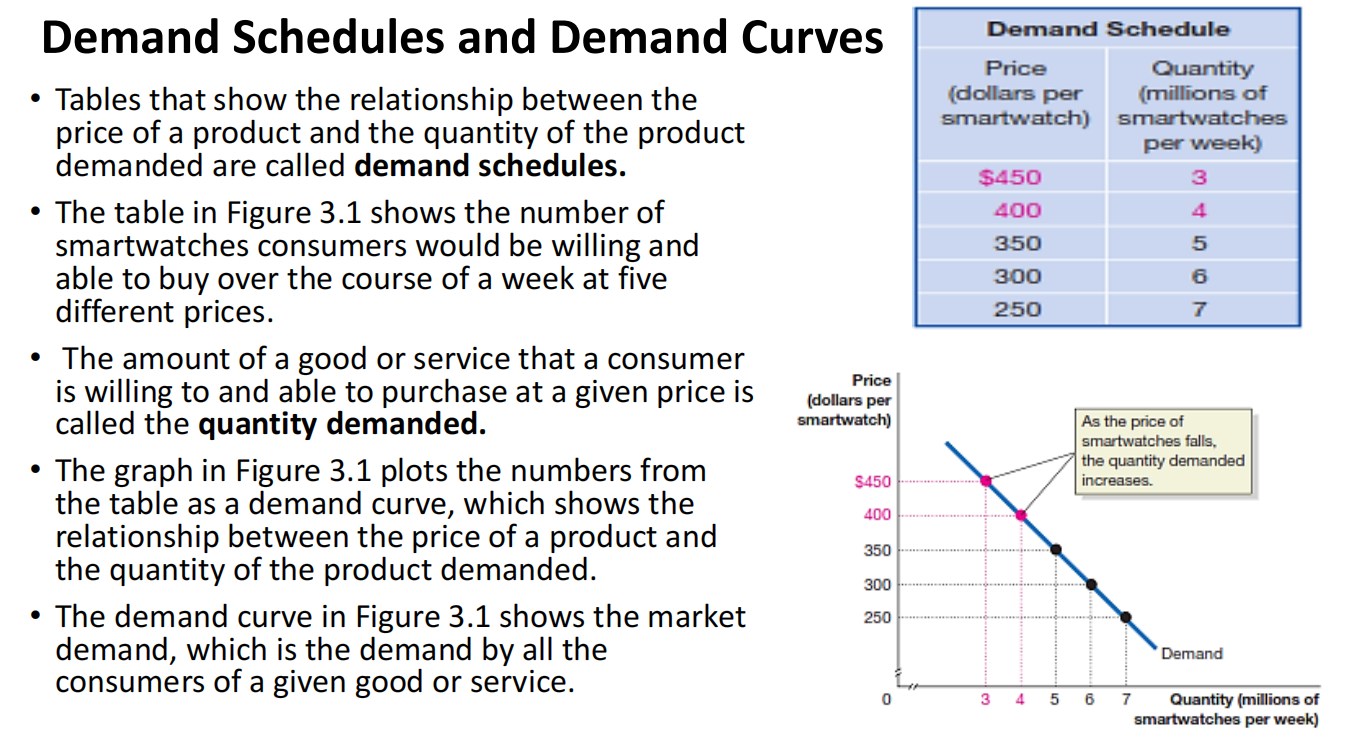
Tables that show the relationship between the price of a product and the quantity of the product demanded are called demand schedules.
📖 点击查看译文
显示产品价格与需求数量关系的表格称为需求表。
The table in Figure 3.1 shows the number of smartwatches consumers would be willing and able to buy over the course of a week at five different prices.
📖 点击查看译文
图 3.1 中的表格显示了消费者在一周内愿意并能够以五种不同价格购买的智能手表数量。
The amount of a good or service that a consumer is willing to and able to purchase at a given price is called the quantity demanded.
📖 点击查看译文
消费者在特定价格下愿意并能够购买的商品或服务数量称为需求量。
The graph in Figure 3.1 plots the numbers from the table as a demand curve, which shows the relationship between the price of a product and the quantity of the product demanded.
📖 点击查看译文
图 3.1 中的图表将表格中的数据绘制为需求曲线,展示产品价格与需求量之间的关系。
The demand curve in Figure 3.1 shows the market demand, which is the demand by all the consumers of a given good or service.
📖 点击查看译文
图 3.1 中的需求曲线表示市场需求,即所有消费者对某种商品或服务的总需求。
知识点列表与拓展 (Knowledge Points and Extensions):
1. Quantity Demanded (需求量)
-
解释 (Explanation):
The quantity demanded refers to the specific amount of a good or service consumers are willing and able to buy at a particular price.
(需求量指的是消费者在特定价格下愿意并能够购买的某种商品或服务的具体数量。)
-
例子 (Example):
If a smartwatch is priced at $250, and consumers are willing to buy 700 units per week, then the quantity demanded at this price is 700.
(如果智能手表的价格为 250 美元,消费者愿意每周购买 700 只,那么该价格下的需求量就是 700。)
-
拓展 (Extension):
The quantity demanded can change due to factors like income levels, preferences, and market trends, even if the price remains constant.
(即使价格不变,需求量也可能因收入水平、消费者偏好和市场趋势等因素而发生变化。)
2. Demand Schedule (需求表)
-
解释 (Explanation):
A demand schedule is a table listing the quantity demanded at different price levels.
(需求表是列出不同价格水平下需求量的表格。)
-
例子 (Example):
A demand schedule for coffee might show that at 3 per cup, demand rises to 300 cups per day.
(咖啡的需求表可能显示,在每杯 5 美元时,消费者每天需求 100 杯;而在每杯 3 美元时,需求上升到 300 杯。)
-
拓展 (Extension):
Businesses use demand schedules to make pricing decisions and estimate future sales based on historical data.
(企业利用需求表制定定价决策,并根据历史数据估算未来销售情况。)
3. Demand Curve (需求曲线)
-
解释 (Explanation):
A demand curve is a graphical representation of the demand schedule, illustrating the inverse relationship between price and quantity demanded.
(需求曲线是需求表的图形表示,展示价格与需求量之间的反向关系。)
-
例子 (Example):
If the price of a laptop falls from 800, and sales increase from 200 to 350 units, the demand curve would show this negative relationship.
(如果笔记本电脑的价格从 1,000 美元降至 800 美元,而销量从 200 台增加到 350 台,需求曲线会体现这一负相关关系。)
-
拓展 (Extension):
Demand curves can shift due to changes in consumer preferences, income, or market trends, even if the price remains unchanged.
(即使价格不变,需求曲线也可能因消费者偏好、收入或市场趋势的变化而发生移动。)
4
The Downward-Sloping Demand Curve (需求曲线的向下倾斜)
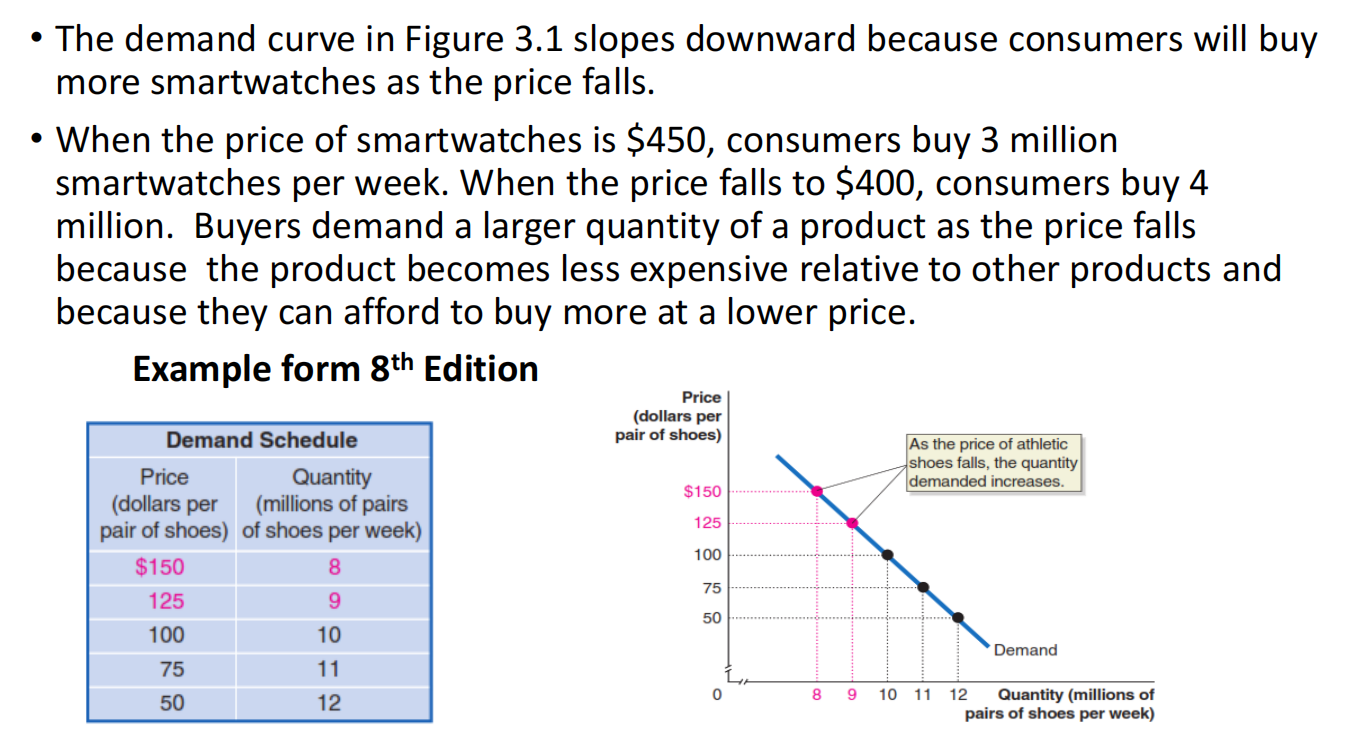
The demand curve in Figure 3.1 slopes downward because consumers will buy more smartwatches as the price falls.
📖 点击查看译文
图 3.1 中的需求曲线向下倾斜,因为随着价格下降,消费者会购买更多智能手表。
When the price of smartwatches is 400, consumers buy 4 million.
📖 点击查看译文
当智能手表的价格为 450 美元时,消费者每周购买 300 万只。 当价格降至 400 美元时,消费者购买 400 万只。
Buyers demand a larger quantity of a product as the price falls because the product becomes less expensive relative to other products and because they can afford to buy more at a lower price.
📖 点击查看译文
随着价格下降,消费者对某种商品的需求量增加,因为该商品相对于其他商品变得更便宜,同时他们也能在更低的价格下购买更多。
知识点列表与拓展 (Knowledge Points and Extensions):
1. Law of Demand (需求定律)
-
解释 (Explanation):
The law of demand states that, all else being equal, as the price of a product decreases, the quantity demanded increases, and vice versa.
(需求定律指出,在其他条件不变的情况下,商品价格下降时,需求量增加;反之,价格上升时,需求量减少。)
-
例子 (Example):
If the price of movie tickets drops from 8, more people are likely to go to the movies.
(如果电影票价格从 12 美元降至 8 美元,更多人可能会去看电影。)
-
拓展 (Extension):
The law of demand is influenced by factors like consumer preferences, income levels, and substitute goods.
(需求定律受消费者偏好、收入水平和替代品等因素的影响。)
2. Substitution Effect (替代效应)
-
解释 (Explanation):
When the price of a product decreases, it becomes relatively cheaper compared to alternative products, leading consumers to buy more of the cheaper product.
(当某种商品的价格下降时,相对于替代品,它变得更便宜,从而促使消费者购买更多这种较便宜的商品。)
-
例子 (Example):
If the price of smartwatches decreases, consumers might buy smartwatches instead of traditional watches.
(如果智能手表的价格下降,消费者可能会购买智能手表而不是传统手表。)
-
拓展 (Extension):
Businesses often use price discounts to attract customers by leveraging the substitution effect.
(企业通常利用价格折扣来吸引顾客,利用替代效应提高销售。)
3. Income Effect (收入效应)
-
解释 (Explanation):
As the price of a good falls, consumers’ purchasing power increases, allowing them to buy more of that good.
(当商品价格下降时,消费者的购买力增加,使他们能够购买更多该商品。)
-
例子 (Example):
If the price of a smartwatch drops from 400, consumers may feel like they have more money to spend and purchase additional goods.
(如果智能手表的价格从 450 美元降至 400 美元,消费者可能会觉得自己有更多可支配资金,从而购买更多商品。)
-
拓展 (Extension):
The income effect is more significant for normal goods but less impactful for inferior goods.
(收入效应对正常商品影响较大,但对低档商品影响较小。)
5
The Law of Demand (需求定律)
The inverse relationship between the price of a product and the quantity of the product demanded is called the law of demand.
📖 点击查看译文
商品价格与需求量之间的反向关系被称为需求定律。
Holding everything else constant, when the price of a product falls, the quantity demanded of the product will increase, and when the price of a product rises, the quantity demanded of the product will decrease.
📖 点击查看译文
在其他条件不变的情况下,商品价格下降时,需求量增加;而当商品价格上升时,需求量减少。
The law of demand holds for any market demand curve.
📖 点击查看译文
需求定律适用于任何市场需求曲线。
What Explains the Law of Demand? (需求定律的解释)
When the price of a product falls, consumers buy a larger quantity because of two effects, the substitution effect and the income effect:
📖 点击查看译文
当商品价格下降时,消费者购买更多商品,主要受到两种效应的影响:替代效应和收入效应。
1. The substitution effect refers to the change in the quantity demanded of a good that results because a change in price makes the good more or less expensive relative to other goods that are substitutes.
📖 点击查看译文
替代效应指的是,由于价格变化导致某种商品相对于其替代品变得更贵或更便宜,从而影响该商品的需求量。
知识点列表与拓展 (Knowledge Points and Extensions):
1. Law of Demand (需求定律)
-
解释 (Explanation):
The law of demand states that, all else equal, as the price of a good decreases, the quantity demanded increases, and vice versa.
(需求定律指出,在其他条件不变的情况下,商品价格下降时,需求量增加;反之,价格上升时,需求量减少。)
-
例子 (Example):
If the price of coffee decreases, more people will buy coffee instead of tea.
(如果咖啡的价格下降,更多人会购买咖啡而不是茶。)
-
拓展 (Extension):
The law of demand is one of the fundamental principles of microeconomics and applies to almost all goods and services.
(需求定律是微观经济学的基本原理之一,适用于几乎所有商品和服务。)
2. Substitution Effect (替代效应)
-
解释 (Explanation):
When the price of a good decreases, it becomes relatively cheaper compared to substitutes, leading consumers to buy more of the cheaper good.
(当某种商品价格下降时,相对于替代品,它变得更便宜,消费者因此购买更多该商品。)
-
例子 (Example):
If the price of Coca-Cola decreases while Pepsi remains the same, more people will choose Coca-Cola over Pepsi.
(如果可口可乐的价格下降,而百事可乐价格不变,更多人会选择可口可乐。)
-
拓展 (Extension):
The substitution effect plays a significant role in consumer choices and price competition among similar products.
(替代效应在消费者选择和类似产品的价格竞争中起着重要作用。)
3. Income Effect (收入效应)
-
解释 (Explanation):
As the price of a good falls, consumers effectively have more income to spend, allowing them to purchase more.
(当商品价格下降时,消费者的实际购买力增加,使他们能够购买更多商品。)
-
例子 (Example):
If the price of groceries decreases, consumers may feel wealthier and buy more food items.
(如果食品杂货价格下降,消费者可能会感觉自己更富有,从而购买更多食品。)
-
拓展 (Extension):
The income effect is particularly relevant for normal goods but has little impact on inferior goods.
(收入效应对正常商品影响较大,但对低档商品影响较小。)
6
Substitution and Income Effects (替代效应与收入效应)
When the price of smartwatches falls, people will substitute buying smartwatches for other goods, such as regular wristwatches or smartphones, such as the iPhone.
📖 点击查看译文
当智能手表的价格下降时,人们会选择购买智能手表来替代其他商品,比如普通手表或智能手机(如iPhone)。
The income effect of a price change refers to the change in the quantity demanded of a good that results because a change in the good’s price increases or decreases consumers’ purchasing power.
📖 点击查看译文
价格变化的收入效应指的是,由于商品价格的变动导致消费者购买力增加或减少,从而影响商品需求量的变化。
When the price of a good falls, the increased purchasing power of consumers’ incomes will usually lead them to purchase a larger quantity of the good.
📖 点击查看译文
当商品价格下降时,消费者的购买力提高,通常会导致他们购买更多该商品。
When the price of a good rises, the decreased purchasing power of consumers’ incomes will usually lead them to purchase a smaller quantity of the good.
📖 点击查看译文
当商品价格上升时,消费者的购买力下降,通常会导致他们购买更少该商品。
Although we can analyze them separately, the substitution effect and the income effect occur simultaneously whenever a price changes.
📖 点击查看译文
虽然我们可以分别分析替代效应和收入效应,但它们在价格变化时总是同时发生。
So, a fall in the price of smartwatches leads consumers to buy more smartwatches both because the smartwatches are now less expensive relative to substitute products and because the purchasing power of consumers’ incomes has increased.
📖 点击查看译文
因此,智能手表价格下降会导致消费者购买更多智能手表,既因为它们相对替代产品变得更便宜,也因为消费者的购买力提高了。
知识点列表与拓展 (Knowledge Points and Extensions):
1. Substitution Effect (替代效应)
-
解释 (Explanation):
When the price of a good falls, it becomes more attractive compared to substitute goods, leading consumers to shift their purchases toward the cheaper option.
(当某种商品价格下降时,相对于替代品,它变得更具吸引力,消费者会转向购买较便宜的商品。)
-
例子 (Example):
If the price of e-books decreases while printed books remain the same, more people will choose e-books instead.
(如果电子书的价格下降,而纸质书价格不变,更多人会选择电子书。)
-
拓展 (Extension):
The substitution effect is one of the main reasons why price changes influence consumer behavior in competitive markets.
(替代效应是价格变化影响竞争市场中消费者行为的主要原因之一。)
2. Income Effect (收入效应)
-
解释 (Explanation):
A change in the price of a good affects consumers’ real purchasing power, allowing them to buy more or less of the good.
(商品价格的变化会影响消费者的实际购买力,使他们能够购买更多或更少的商品。)
-
例子 (Example):
If the price of basic groceries drops, households can afford to buy more food or spend on other goods.
(如果基本食品的价格下降,家庭可以购买更多食物或在其他商品上消费。)
-
拓展 (Extension):
The income effect is more significant for normal goods and less relevant for inferior goods, which consumers buy less of as their purchasing power increases.
(收入效应对正常商品影响更大,而对低档商品影响较小,因为消费者购买力增加时会减少对低档商品的需求。)
7
Ceteris Paribus Condition (其他条件不变条件)
Notice that the definition of the law of demand contains the phrase holding everything else constant.
📖 点击查看译文
请注意,需求法则的定义包含“其他条件不变”这一短语。
In constructing the market demand curve for smartwatches, we focused only on the effect that changes in the price of smartwatches would have on the quantity consumers would be willing and able to buy.
📖 点击查看译文
在构建智能手表的市场需求曲线时,我们只关注价格变化对消费者愿意且能够购买的数量的影响。
We were holding constant other variables that might affect the willingness of consumers to buy smartwatches.
📖 点击查看译文
我们假设其他可能影响消费者购买智能手表意愿的变量保持不变。
Economists refer to the necessity of holding all variables other than price constant in constructing a demand curve as the ceteris paribus condition.
📖 点击查看译文
经济学家将构建需求曲线时保持除价格以外所有变量不变的必要性称为“其他条件不变条件”(Ceteris Paribus)。
Ceteris paribus means, else equal, in Latin.
📖 点击查看译文
Ceteris Paribus 在拉丁语中意为“其他条件相同”。
What would happen if we allowed a change in a variable, other than price, that might affect the willingness of consumers to buy smartwatches?
📖 点击查看译文
如果我们允许价格以外的变量发生变化,而这些变量可能影响消费者购买智能手表的意愿,会发生什么?
Consumers would then change the quantity they demanded at each price.
📖 点击查看译文
消费者会在每个价格水平上改变他们的需求数量。
We can illustrate this effect by shifting the market demand curve.
📖 点击查看译文
我们可以通过移动市场需求曲线来说明这种影响。
A shift of a demand curve is an increase or a decrease in demand.
📖 点击查看译文
需求曲线的移动表示需求的增加或减少。
A movement along a demand curve is an increase or a decrease in the quantity demanded.
📖 点击查看译文
沿需求曲线的移动表示需求数量的增加或减少。
知识点列表与拓展 (Knowledge Points and Extensions):
1. Ceteris Paribus Condition (其他条件不变条件)
-
解释 (Explanation):
The assumption that all other factors remain constant when analyzing the effect of one specific variable.
(在分析某个特定变量的影响时,假设所有其他因素保持不变。)
-
例子 (Example):
When analyzing the effect of price changes on smartwatch demand, we assume that consumer income and preferences remain constant.
(在分析价格变化对智能手表需求的影响时,我们假设消费者收入和偏好保持不变。)
-
拓展 (Extension):
The ceteris paribus condition allows economists to isolate the effect of one variable at a time, making economic models more manageable.
(其他条件不变条件使经济学家能够单独分析某个变量的影响,使经济模型更易管理。)
2. Demand Curve Shift vs. Movement Along the Curve (需求曲线的移动 vs. 沿曲线的移动)
-
解释 (Explanation):
- A shift in the demand curve occurs when a non-price factor changes, leading to a new demand curve.
(需求曲线的移动发生在非价格因素变化时,导致新的需求曲线。)
- A movement along the demand curve occurs when only the price of the good changes.
(沿需求曲线的移动发生在仅商品价格变化的情况下。)
-
例子 (Example):
- A rise in consumer income might shift the demand curve for smartwatches to the right.
(消费者收入增加可能会使智能手表的需求曲线右移。)
- A drop in smartwatch prices leads to a movement down the demand curve, increasing quantity demanded.
(智能手表价格下降会导致沿需求曲线向下移动,增加需求数量。)
-
拓展 (Extension):
Understanding the difference between shifts and movements is crucial for analyzing market dynamics and policy impacts.
(理解需求曲线移动与沿曲线移动的区别对分析市场动态和政策影响至关重要。)
8
Variables that Shift Market Demand (影响市场需求的变量)
Many variables other than price can influence market demand.
📖 点击查看译文
除了价格之外,许多变量都会影响市场需求。
These five are the most important:
📖 点击查看译文
以下五个因素最为重要:
-
Income (收入)
-
Prices of related goods (相关商品的价格)
-
Tastes (消费者偏好)
-
Population and demographics (人口和人口统计特征)
-
Expected future prices (预期未来价格)
We next discuss how changes in each of these variables affect the market demand.
📖 点击查看译文
接下来,我们将讨论这些变量的变化如何影响市场需求。
知识点列表与拓展 (Knowledge Points and Extensions):
1. Income (收入)
-
解释 (Explanation):
Higher income generally increases demand for normal goods and decreases demand for inferior goods.
(收入增加通常会提高对正常商品的需求,并减少对劣等商品的需求。)
-
例子 (Example):
As income rises, demand for luxury watches increases, while demand for second-hand watches decreases.
(随着收入增加,奢侈手表的需求上升,而二手手表的需求下降。)
-
拓展 (Extension):
Economic recessions can lead to an increase in demand for inferior goods, like instant noodles.
(经济衰退可能会增加对劣等商品(如方便面)的需求。)
2. Prices of Related Goods (相关商品的价格)
-
解释 (Explanation):
- Substitutes (替代品): If the price of a substitute rises, demand for the good increases.
(如果替代品的价格上升,该商品的需求会增加。)
- Complements (互补品): If the price of a complement rises, demand for the good decreases.
(如果互补品的价格上升,该商品的需求会减少。)
-
例子 (Example):
- If the price of Android smartwatches rises, demand for Apple Watches increases.
(如果安卓智能手表的价格上升,Apple Watch 的需求会增加。)
- If the price of wireless earbuds increases, demand for smartwatches may decrease.
(如果无线耳机的价格上升,智能手表的需求可能会减少。)
-
拓展 (Extension):
Companies monitor related goods’ prices to anticipate demand shifts.
(企业会关注相关商品的价格,以预测需求变化。)
3. Tastes (消费者偏好)
-
解释 (Explanation):
Changes in consumer preferences due to trends, advertising, or social influences affect demand.
(由于潮流、广告或社会影响,消费者偏好的变化会影响需求。)
-
例子 (Example):
A celebrity endorsing a smartwatch can increase demand significantly.
(明星代言智能手表可能会显著提高需求。)
-
拓展 (Extension):
Social media and influencers play a growing role in shaping consumer preferences.
(社交媒体和网红在塑造消费者偏好方面的作用越来越大。)
4. Population and Demographics (人口和人口统计特征)
-
解释 (Explanation):
Larger or aging populations can shift demand for certain products.
(人口增长或老龄化可能会改变某些产品的需求。)
-
例子 (Example):
A growing elderly population may increase demand for health-monitoring smartwatches.
(老龄人口增长可能会增加对健康监测智能手表的需求。)
-
拓展 (Extension):
Companies use demographic data to target specific consumer groups.
(企业使用人口统计数据来定位特定消费群体。)
5. Expected Future Prices (预期未来价格)
-
解释 (Explanation):
If consumers expect prices to rise, they may buy more now; if they expect prices to drop, they may delay purchases.
(如果消费者预期价格会上涨,他们可能会提前购买;如果预期价格下降,他们可能会推迟购买。)
-
例子 (Example):
Before a smartwatch price increase announcement, demand surges.
(在智能手表涨价公告发布前,需求激增。)
-
拓展 (Extension):
Businesses strategically time price changes to influence demand.
(企业会策略性地调整价格,以影响需求。)
9
Income and Its Effect on Demand (收入及其对需求的影响)
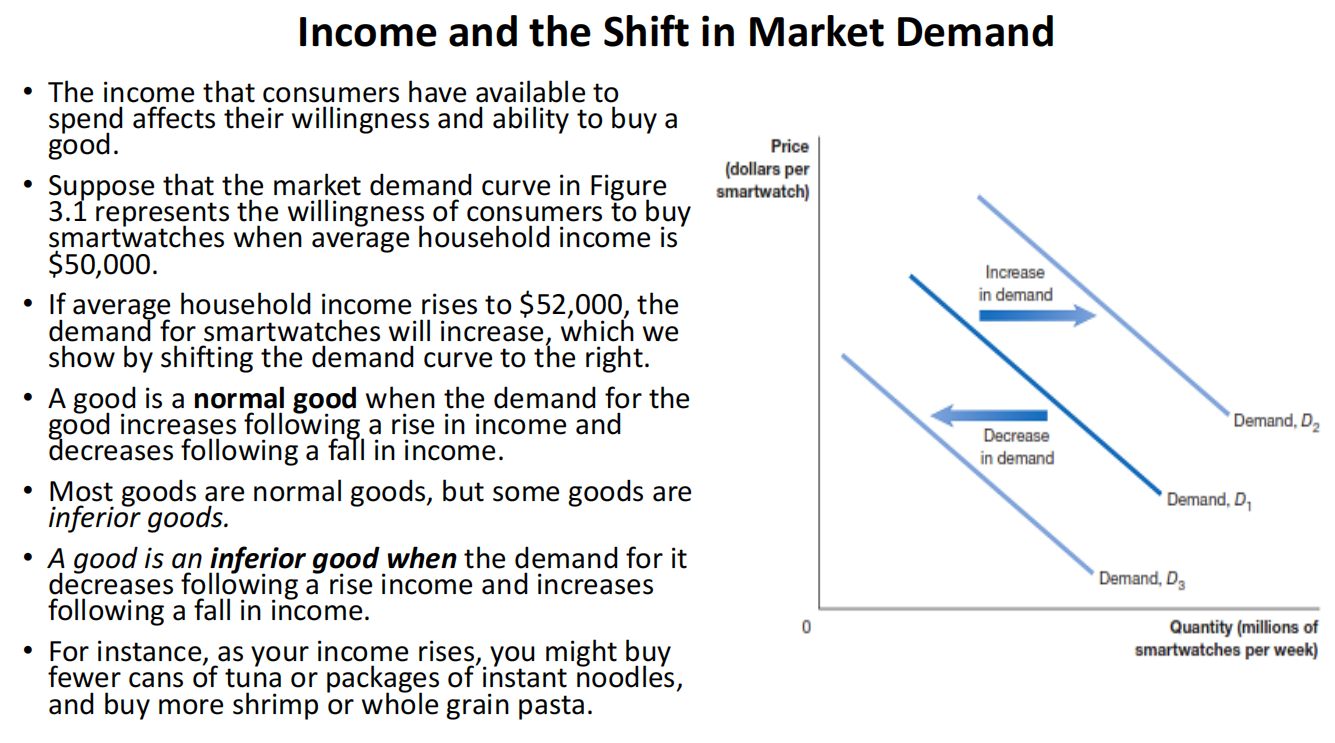
The income that consumers have available to spend affects their willingness and ability to buy a good.
📖 点击查看译文
消费者可支配的收入会影响他们购买商品的意愿和能力。
Suppose that the market demand curve in Figure 3.1 represents the willingness of consumers to buy smartwatches when average household income is $50,000.
📖 点击查看译文
假设图 3.1 中的市场需求曲线表示当平均家庭收入为 50,000 美元时,消费者购买智能手表的意愿。
If average household income rises to $52,000, the demand for smartwatches will increase, which we show by shifting the demand curve to the right.
📖 点击查看译文
如果平均家庭收入上升到 52,000 美元,智能手表的需求将增加,我们可以通过向右移动需求曲线来表示这一变化。
A good is a normal good when the demand for the good increases following a rise in income and decreases following a fall in income.
📖 点击查看译文
如果一种商品的需求在收入增加时上升,而在收入下降时减少,那么这种商品就是正常商品。
Most goods are normal goods, but some goods are inferior goods.
📖 点击查看译文
大多数商品都是正常商品,但也有一些是劣等商品。
A good is an inferior good when the demand for it decreases following a rise in income and increases following a fall in income.
📖 点击查看译文
如果一种商品的需求在收入增加时减少,而在收入下降时增加,那么这种商品就是劣等商品。
For instance, as your income rises, you might buy fewer cans of tuna or packages of instant noodles, and buy more shrimp or whole grain pasta.
📖 点击查看译文
例如,随着收入的增加,你可能会减少购买金枪鱼罐头或方便面,而更多地购买虾或全麦意面。
知识点列表与拓展 (Knowledge Points and Extensions):
1. Normal Goods (正常商品)
-
解释 (Explanation):
Goods for which demand increases as income rises.
(收入增加时需求上升的商品。)
-
例子 (Example):
- Luxury cars, branded clothing, organic food.
(豪华汽车、品牌服装、有机食品。)
-
拓展 (Extension):
Businesses often target wealthier consumers with high-end product lines.
(企业通常通过高端产品线来吸引高收入消费者。)
2. Inferior Goods (劣等商品)
-
解释 (Explanation):
Goods for which demand decreases as income rises.
(收入增加时需求下降的商品。)
-
例子 (Example):
- Instant noodles, generic-brand groceries, second-hand clothing.
(方便面、超市自有品牌食品、二手服装。)
-
拓展 (Extension):
During economic downturns, demand for inferior goods often rises.
(在经济衰退期间,劣等商品的需求通常会上升。)
10
Prices of Related Goods (相关商品的价格)
The prices of other goods can also affect consumer’s demand for a product.
📖 点击查看译文
其他商品的价格也会影响消费者对某种产品的需求。
Consumers who would use a smartwatch primarily for checking the time, making phone calls, and keeping track of their appointments could use a smartphone instead.
📖 点击查看译文
主要使用智能手表来看时间、打电话和管理日程的消费者可以选择使用智能手机来替代。
Goods and services that can be used for the same purpose are called substitutes.
📖 点击查看译文
可以用于相同用途的商品和服务被称为替代品。
When two goods are substitutes, the more you buy of one, the less you will buy of the other and vice versa.
📖 点击查看译文
当两种商品是替代品时,购买其中一种的数量增加,另一种的购买量就会减少,反之亦然。
An increase in the price of a substitute causes the demand curve for a good to shift to the right.
📖 点击查看译文
当替代品的价格上升时,某商品的需求曲线会向右移动。
Suppose that the market demand curve in Figure 3.1 represents the willingness and ability of consumers to buy smartwatches during a week when the average price of smartphones is $400.
📖 点击查看译文
假设图 3.1 的市场需求曲线表示当智能手机的平均价格为 400 美元时,消费者在一周内购买智能手表的意愿和能力。
If the average price of smartphones falls to $300, consumers will demand fewer smartwatches at every price.
📖 点击查看译文
如果智能手机的平均价格降至 300 美元,消费者在每个价格水平下对智能手表的需求都会减少。
We show this change by shifting the demand curve for smartwatches to the left.
📖 点击查看译文
我们通过向左移动智能手表的需求曲线来表示这一变化。
知识点列表与拓展 (Knowledge Points and Extensions)
1. Substitutes (替代品)
-
解释 (Explanation):
Goods that can replace each other in consumption.
(在消费中可以互相替代的商品。)
-
例子 (Example):
-
Tea and coffee
-
iPads and Android tablets
-
Uber and taxis
(茶和咖啡、iPad 和安卓平板、Uber 和出租车。)
-
-
拓展 (Extension):
Companies monitor the pricing of substitutes to adjust their own prices and maximize demand.
(公司会关注替代品的价格调整自己的价格,以最大化需求。)
2. Demand Curve Shifts (需求曲线的移动)
-
解释 (Explanation):
When the price of a substitute falls, the demand for the original good decreases (shift left).
When the price of a substitute rises, the demand for the original good increases (shift right).
(当替代品价格下降时,原商品的需求减少(曲线左移);当替代品价格上升时,原商品的需求增加(曲线右移)。)
-
例子 (Example):
-
If Netflix raises its price, more people may subscribe to Disney+.
-
If gasoline prices increase, more people may use public transportation.
(如果 Netflix 提价,可能会有更多人订阅 Disney+;如果汽油价格上涨,可能会有更多人选择公共交通。)
-
-
拓展 (Extension):
Understanding demand shifts helps businesses strategize pricing and marketing.
(理解需求曲线的移动有助于企业制定定价和营销策略。)
11
When Goods Are Complements (互补品)
Goods and services that are used together, such as hot dogs and hot dog buns, are called complements.
📖 点击查看译文
一起使用的商品和服务,如热狗和热狗面包,被称为互补品。
When two goods are complements, the more consumers buy of one, the more they will buy of the other.
📖 点击查看译文
当两种商品是互补品时,消费者购买其中一种的数量增加,另一种的购买量也会增加。
A decrease in the price of a complement causes the demand curve for a good to shift to the right.
📖 点击查看译文
当互补品的价格下降时,某商品的需求曲线会向右移动。
An increase in the price of a complement causes the demand curve for a good to shift to the left.
📖 点击查看译文
当互补品的价格上升时,某商品的需求曲线会向左移动。
People use applications, or apps, on their smartwatches.
📖 点击查看译文
人们在智能手表上使用应用程序(App)。
So, smartwatches and apps are complements.
📖 点击查看译文
因此,智能手表和 App 是互补品。
Suppose the market demand curve in Figure 3.1 represents the willingness of consumers to buy smartwatches at a time when the average price of an app is $1.99.
📖 点击查看译文
假设图 3.1 的市场需求曲线表示当 App 的平均价格为 1.99 美元时,消费者购买智能手表的意愿。
If the average price of apps falls to $0.99, consumers will buy more apps and more smartwatches, and the demand curve for smartwatches will shift to the right.
📖 点击查看译文
如果 App 的平均价格降至 0.99 美元,消费者会购买更多的 App 和智能手表,智能手表的需求曲线会向右移动。
知识点列表与拓展 (Knowledge Points and Extensions)
1. Complements (互补品)
-
解释 (Explanation):
Goods that are typically consumed together.
(通常一起消费的商品。)
-
例子 (Example):
-
Printers and ink cartridges
-
Cars and gasoline
-
Coffee and sugar
(打印机和墨盒、汽车和汽油、咖啡和糖。)
-
-
拓展 (Extension):
Businesses often bundle complementary goods to encourage higher sales.
(企业通常会捆绑销售互补商品,以促进销量。)
2. Demand Curve Shifts Due to Complementary Goods (因互补品价格变化导致的需求曲线移动)
-
解释 (Explanation):
-
When the price of a complement falls, the demand for the original good increases (shift right).
-
When the price of a complement rises, the demand for the original good decreases (shift left).
(当互补品价格下降时,原商品的需求增加(曲线右移);当互补品价格上升时,原商品的需求减少(曲线左移)。)
-
-
例子 (Example):
-
If movie ticket prices decrease, popcorn sales may increase.
-
If the price of gaming consoles drops, demand for video games may rise.
(如果电影票降价,爆米花的销量可能会上升;如果游戏机降价,游戏软件的需求可能会上升。)
-
-
拓展 (Extension):
Companies strategically price one product lower to increase demand for its complement.
(企业会有策略地降低某个商品的价格,以提升其互补品的需求。)
12
Tastes (消费者偏好)
An advertising campaign for a product can influence consumer demand.
📖 点击查看译文
广告宣传活动可以影响消费者的需求。
If Apple, Samsung, LG, and other firms making smartwatches begin to advertise heavily, consumers are likely to buy more smartwatches at every price, and the demand curve will shift to the right.
📖 点击查看译文
如果 Apple、Samsung、LG 等生产智能手表的公司加大广告投放,消费者可能会在所有价格水平上购买更多智能手表,需求曲线将向右移动。
For example, as Skechers struggled to earn a profit on its athletic shoes, it paid millions of dollars to advertise during the 2019 Super Bowl.
📖 点击查看译文
例如,Skechers 在努力提高运动鞋的利润时,曾在 2019 年超级碗期间投入数百万美元进行广告宣传。
If other firms making athletic shoes increase their advertising, consumers are likely to buy more of them at every price, and the demand curve will shift to the right.
📖 点击查看译文
如果其他运动鞋制造商增加广告投放,消费者可能会在所有价格水平上购买更多运动鞋,需求曲线将向右移动。
An economist would say that the advertising campaign has affected consumers’ taste for smartwatches and athletic shoes.
📖 点击查看译文
经济学家会认为,这种广告活动影响了消费者对智能手表和运动鞋的偏好。
Taste is a catchall category that refers to the many subjective elements that can enter into a consumer’s decision to buy a product.
📖 点击查看译文
“偏好”是一个广义概念,涵盖了影响消费者购买决策的许多主观因素。
A consumer’s taste for a product can change for many reasons.
📖 点击查看译文
消费者对某种产品的偏好可能因多种原因发生变化。
Sometimes trends play a substantial role.
📖 点击查看译文
有时,潮流趋势会起到重要作用。
For example, the popularity of low-carbohydrate diets caused a decline in demand for some goods, such as bread and donuts, and an increase in demand for fish.
📖 点击查看译文
例如,低碳水化合物饮食的流行导致了面包和甜甜圈等商品的需求下降,而鱼类的需求增加。
In general, when consumers’ taste for a product increases, the demand curve will shift to the right, and when consumers’ taste decreases, the demand curve will shift to the left.
📖 点击查看译文
一般来说,当消费者对某产品的偏好增强时,需求曲线会向右移动;当消费者偏好减弱时,需求曲线会向左移动。
知识点列表与拓展 (Knowledge Points and Extensions)
1. Tastes and Preferences (消费者偏好)
-
解释 (Explanation):
Tastes represent the subjective factors influencing consumers’ choices.
(偏好代表影响消费者选择的主观因素。)
-
例子 (Example):
-
Increased preference for sustainable products leads to higher demand for electric vehicles.
-
The rise of digital streaming platforms decreased the demand for DVDs.
(对环保产品的偏好增加,提高了对电动车的需求;数字流媒体平台的兴起降低了 DVD 的需求。)
-
-
拓展 (Extension):
Companies conduct market research to understand consumer preferences and adapt marketing strategies.
(公司会进行市场调研,以了解消费者偏好并调整营销策略。)
2. The Impact of Advertising on Demand (广告对需求的影响)
-
解释 (Explanation):
-
Effective advertising can increase demand, shifting the demand curve to the right.
-
Negative publicity or changing trends can decrease demand, shifting the demand curve to the left.
(有效的广告可以增加需求,使需求曲线右移;负面宣传或趋势变化可能减少需求,使需求曲线左移。)
-
-
例子 (Example):
-
Apple’s marketing campaigns increase consumer interest in new iPhones.
-
Negative health reports about sugary drinks reduce their demand.
(苹果的营销活动增加了消费者对新款 iPhone 的兴趣;关于含糖饮料的健康负面报道降低了其需求。)
-
-
拓展 (Extension):
Firms invest in branding to shape consumer perception and maintain long-term demand.
(企业投资品牌建设,以塑造消费者认知并维持长期需求。)
13
Population and Demographics (人口与人口统计特征)
As the population of a country increases, the number of consumers and the demand for most products will increase.
📖 点击查看译文
随着一个国家人口的增加,消费者数量和大多数产品的需求都会增加。
The demographics of a population refers to its characteristics, with respect to age, race, and gender.
📖 点击查看译文
人口统计特征指的是人口在年龄、种族和性别等方面的特征。
As the demographics of a country or region change, the demand for particular goods will increase or decrease because different categories of people tend to have different preferences for those goods.
📖 点击查看译文
随着一个国家或地区的人口统计特征发生变化,对特定商品的需求也会增加或减少,因为不同类别的人群往往对商品有不同的偏好。
For instance, the U.S. Census Bureau forecasts that Hispanics will increase from 18 percent of the U.S. population in 2019 to 26 percent in 2050.
📖 点击查看译文
例如,美国人口普查局预测,西班牙裔人口将在 2019 年占美国总人口的 18%,到 2050 年增至 26%。
This increase will expand demand for Spanish-language books, websites, and cable television channels, among other goods and services.
📖 点击查看译文
这种增长将扩大对西班牙语书籍、网站和有线电视频道等商品和服务的需求。
知识点列表与拓展 (Knowledge Points and Extensions)
1. Population Growth and Market Demand (人口增长与市场需求)
-
解释 (Explanation):
- A growing population increases the overall number of consumers, leading to greater demand for various goods and services.
(人口增长会增加消费者数量,从而提升各类商品和服务的需求。)
-
例子 (Example):
-
Countries with rising populations, like India, experience increasing demand for housing, education, and food.
-
As urban populations grow, demand for public transportation and infrastructure rises.
(人口增长较快的国家,如印度,对住房、教育和食品的需求不断增加;随着城市人口增长,公共交通和基础设施的需求也随之上升。)
-
-
拓展 (Extension):
Governments and businesses must plan ahead to accommodate population growth in sectors like healthcare, energy, and transportation.
(政府和企业需要提前规划,以满足医疗、能源和交通等领域因人口增长而增加的需求。)
2. Changing Demographics and Consumer Preferences (人口统计变化与消费偏好)
-
解释 (Explanation):
-
Different demographic groups have different spending habits and preferences.
-
Companies adjust their marketing strategies based on demographic shifts.
(不同的人口群体具有不同的消费习惯和偏好;企业会根据人口统计变化调整其市场策略。)
-
-
例子 (Example):
-
An aging population increases demand for healthcare services and retirement planning products.
-
A growing middle class in emerging economies boosts demand for luxury goods and tourism.
(人口老龄化会增加对医疗服务和养老规划产品的需求;新兴经济体中产阶级的增长促进了奢侈品和旅游业的发展。)
-
-
拓展 (Extension):
Businesses conduct demographic research to predict future trends and adapt their products accordingly.
(企业会进行人口统计研究,以预测未来趋势并调整产品策略。)
14
Expected Future Prices (预期未来价格)
Consumers choose not only which products to buy but also when to buy them.
📖 点击查看译文
消费者不仅要决定购买哪些产品,还要决定何时购买。
For instance, if enough consumers become convinced that houses will be selling for lower prices in three months, the demand for houses will decrease now, as some consumers postpone their purchases to wait for the expected price decrease.
📖 点击查看译文
例如,如果足够多的消费者确信房价将在三个月内下降,那么当前房屋的需求量就会减少,因为部分消费者会推迟购买,以等待预期的价格下降。
Alternatively, if enough consumers become convinced that the price of houses will be higher in three months, the demand for houses will increase now, as some consumers try to beat the expected price increase.
📖 点击查看译文
相反,如果足够多的消费者确信房价将在三个月后上涨,那么当前房屋的需求量就会增加,因为部分消费者会提前购买,以规避未来的价格上涨。
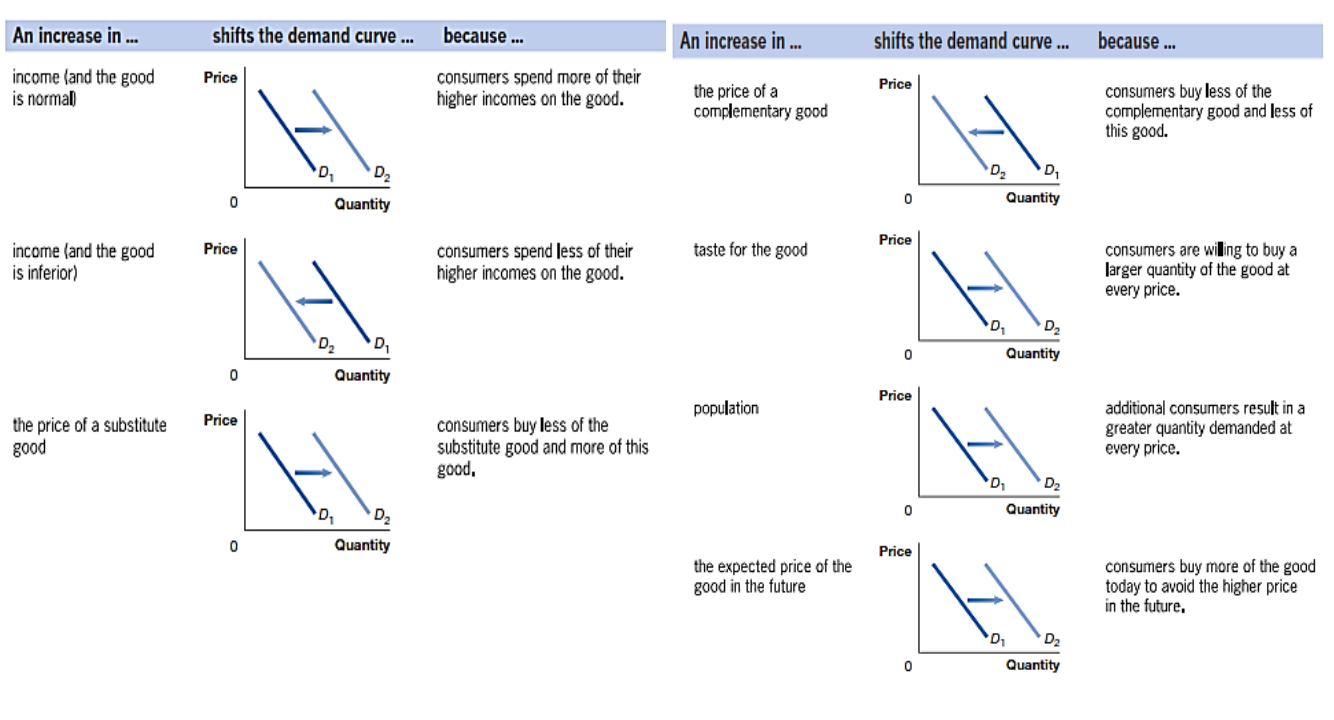
Table 3.1 summarizes the most important variables that cause market demand curves to shift.
📖 点击查看译文
表 3.1 总结了导致市场需求曲线发生变化的最重要变量。
Note that the table shows the shift in the demand curve that results from an increase in each of the variables.
📖 点击查看译文
请注意,该表显示了每个变量增加时对需求曲线的影响。
A decrease in these variables would cause the demand curve to shift in the opposite direction.
📖 点击查看译文
如果这些变量减少,需求曲线将向相反方向移动。
知识点列表与拓展 (Knowledge Points and Extensions)
1. Expected Future Prices and Current Demand (预期未来价格与当前需求)
-
解释 (Explanation):
-
If consumers expect prices to fall in the future, they may delay purchases, decreasing current demand.
-
If consumers expect prices to rise in the future, they may accelerate purchases, increasing current demand.
(如果消费者预期未来价格下降,他们可能推迟购买,从而降低当前需求;如果预期未来价格上涨,他们可能提前购买,从而增加当前需求。)
-
-
例子 (Example):
-
Before Black Friday sales, consumers may postpone purchasing electronics in anticipation of discounts.
-
When oil prices are expected to rise, demand for gasoline may increase before the price hike.
(在黑色星期五促销前,消费者可能推迟购买电子产品,以期待折扣;当预计油价上涨时,消费者可能会提前购买汽油。)
-
-
拓展 (Extension):
Businesses monitor consumer expectations about future prices to optimize pricing strategies.
(企业会关注消费者对未来价格的预期,以优化定价策略。)
15
16
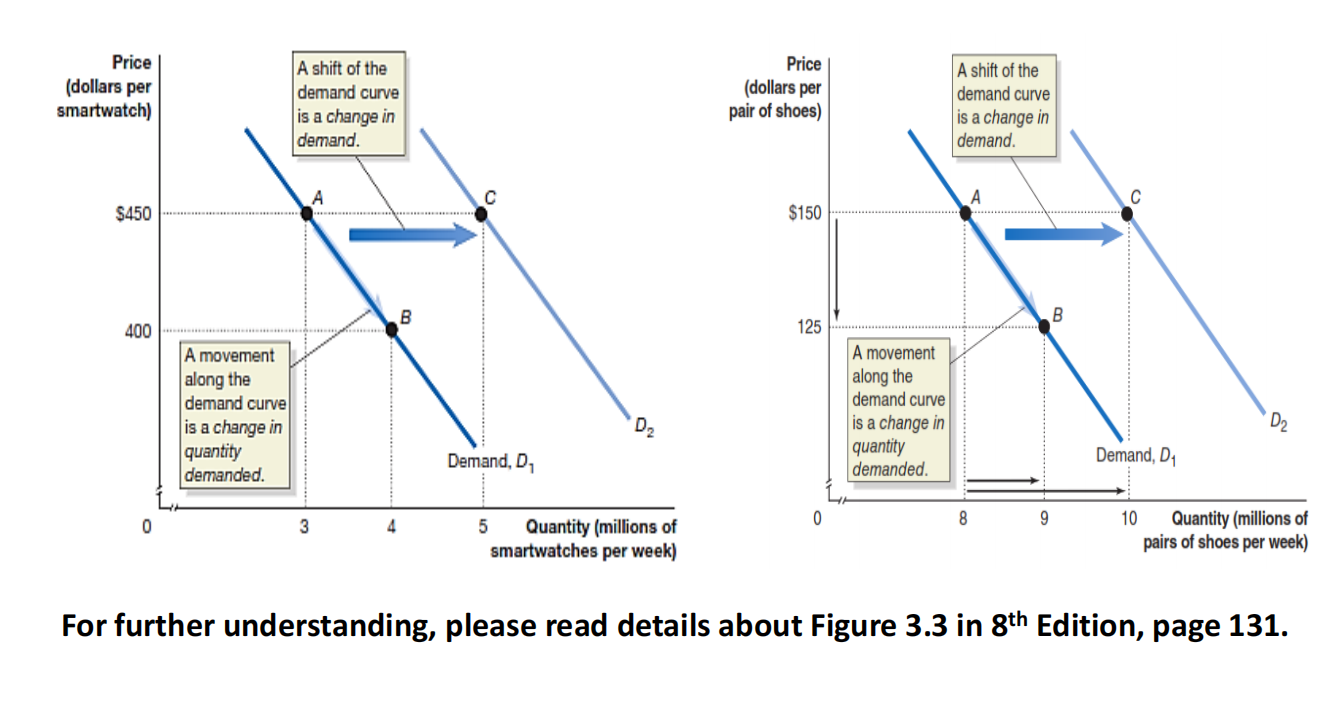
A Change in Demand versus a Change in Quantity Demanded
需求的变化 vs. 需求量的变化
It is important to understand the difference between a change in demand and a change in quantity demanded.
📖 点击查看译文
理解需求的变化与需求量的变化之间的区别非常重要。
A change in demand refers to a shift of the demand curve.
📖 点击查看译文
需求的变化指的是需求曲线的移动。
A shift occurs if there is a change in one of the variables other than the price of the product, that affects the willingness of consumers to buy the product.
📖 点击查看译文
当影响消费者购买意愿的变量(价格以外)发生变化时,需求曲线会发生移动。
A change in quantity demanded refers to a movement along the demand curve as a result of a change in the product’s price.
📖 点击查看译文
需求量的变化指的是由于产品价格的变化而沿着需求曲线发生的移动。
Figure 3.3 illustrates this important distinction.
📖 点击查看译文
图 3.3 说明了这一重要区别。
If the price of smartwatches falls from 400, the result will be a movement along the demand curve from point A to point B, an increase in quantity demanded from 3 million to 4 million.
📖 点击查看译文
如果智能手表的价格从 450 美元降至 400 美元,结果是沿着需求曲线从 A 点移动到 B 点,需求量从 300 万增加到 400 万。
If consumers’ incomes increase, or if another factor changes that makes consumers want more of the product at every price, the demand curve will shift to the right, an increase in demand.
📖 点击查看译文
如果消费者收入增加,或其他因素发生变化,使消费者在每个价格下都愿意购买更多的产品,需求曲线将向右移动,表示需求增加。
In this case, the increase in demand from D causes the quantity of smartwatches demanded at a price of $450 to increase from 3 million at point A to 5 million at point C.
📖 点击查看译文
在这种情况下,需求曲线从 D 右移,使得 450 美元价格下的智能手表需求量从 A 点的 300 万增加到 C 点的 500 万。
知识点列表与拓展 (Knowledge Points and Extensions)
1. Change in Demand vs. Change in Quantity Demanded (需求的变化 vs. 需求量的变化)
-
解释 (Explanation):
-
Change in Demand (需求的变化): The demand curve shifts left or right due to non-price factors (e.g., income, preferences).
-
Change in Quantity Demanded (需求量的变化): Movement along the same demand curve due to a change in price.
(需求的变化:需求曲线左右移动,原因是非价格因素的变化,如收入、偏好。
需求量的变化:沿着同一条需求曲线移动,原因是价格变化。)
-
-
例子 (Example):
-
A rise in consumer income leads to an increased demand for electric vehicles, shifting the demand curve to the right.
-
A discount on an iPhone leads to a higher quantity demanded, moving along the demand curve.
(消费者收入增加导致电动车需求增加,需求曲线右移。
iPhone 降价导致需求量上升,沿需求曲线移动。)
-
-
拓展 (Extension):
Firms analyze both changes in demand and changes in quantity demanded to optimize pricing strategies and product development.
(企业分析需求变化和需求量变化,以优化定价策略和产品开发。)
17
18
The Supply Side of the Market
市场的供给侧
LEARNING OBJECTIVE: List and describe the variables that influence supply
📖 点击查看译文
学习目标:列出并描述影响供给的变量。
Just as many variables influence the willingness and ability of consumers to buy a particular good or service, many variables influence the willingness and ability of firms to supply a good or service.
📖 点击查看译文
正如许多变量会影响消费者购买特定商品或服务的意愿和能力,许多变量也会影响企业供应商品或服务的意愿和能力。
The most important of these variables is price.
📖 点击查看译文
其中最重要的变量是价格。
The amount of a good or service that a firm is willing and able to supply at a given price is the quantity supplied.
📖 点击查看译文
企业在特定价格下愿意且能够供应的商品或服务数量称为供给量(Quantity Supplied)。
Holding other variables constant, when the price of a good rises, producing the good is more profitable, and the quantity supplied will increase.
📖 点击查看译文
在其他变量不变的情况下,当商品价格上升时,生产该商品的利润增加,供给量将增加。
When the price of a good falls, selling the good is less profitable, and the quantity supplied will decrease.
📖 点击查看译文
当商品价格下降时,销售该商品的利润减少,供给量将减少。
In addition, as we know that devoting more and more resources to the production of a good results in increasing marginal costs.
📖 点击查看译文
此外,我们知道,将越来越多的资源投入某种商品的生产会导致边际成本上升。
As with more and more production, the firms will need more time and machines and factories, so the marginal cost of production will increase. Therefore, with higher marginal costs, firms will supply a larger quantity only if the price is higher.
📖 点击查看译文
随着生产规模的扩大,企业需要更多的时间、机器和工厂,因此生产的边际成本会上升。因此,只有当价格更高时,企业才会供应更大量的商品。
知识点列表与拓展 (Knowledge Points and Extensions)
1. Supply and Quantity Supplied (供给与供给量)
-
解释 (Explanation):
-
Supply (供给): The entire relationship between price and the quantity firms are willing to supply.
-
Quantity Supplied (供给量): The specific amount supplied at a given price.
(供给:描述价格与企业愿意供应的数量之间的关系。
供给量:在特定价格下,企业愿意提供的具体数量。)
-
-
例子 (Example):
-
If the price of coffee increases, coffee producers will increase supply.
-
If the price of milk falls, dairy farmers may reduce production.
(如果咖啡价格上涨,咖啡生产商会增加供给。
如果牛奶价格下降,奶农可能会减少生产。)
-
2. The Law of Supply (供给定律)
-
解释 (Explanation):
- Law of Supply: When the price of a good increases, the quantity supplied increases, and vice versa.
(供给定律:当商品价格上升时,供给量增加,反之亦然。)
-
拓展 (Extension):
-
Governments may set price floors (最低价格) to encourage supply (e.g., minimum wage laws).
-
Technological advancements reduce production costs, shifting the supply curve rightward.
(政府可能设定最低价格以鼓励供给,例如最低工资法。
技术进步降低生产成本,使供给曲线右移。)
-
19
Supply Schedules and Supply Curves
供给表与供给曲线
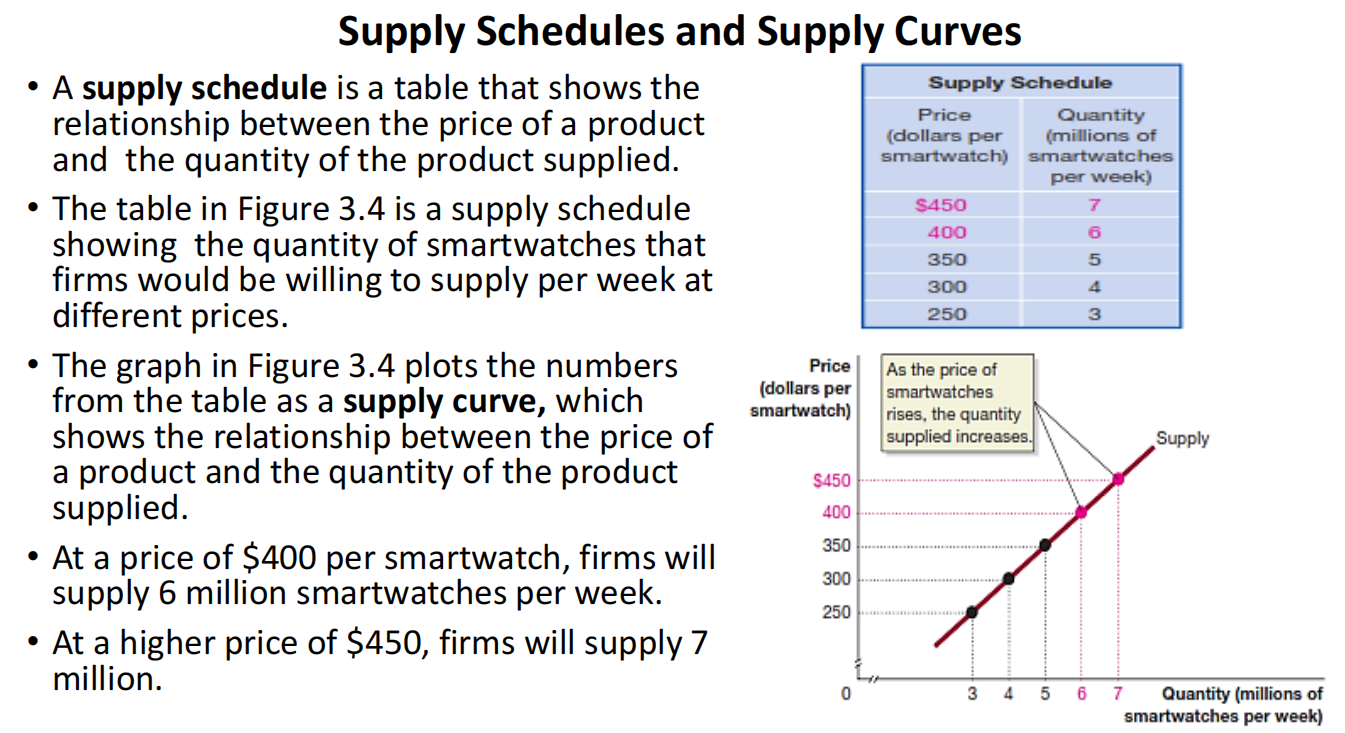
A supply schedule is a table that shows the relationship between the price of a product and the quantity of the product supplied.
📖 点击查看译文
供给表(Supply Schedule)是一张表格,显示了产品价格与供给量之间的关系。
The table in Figure 3.4 is a supply schedule showing the quantity of smartwatches that firms would be willing to supply per week at different prices.
📖 点击查看译文
图 3.4 中的表格是一个供给表,显示了企业在不同价格下每周愿意供应的智能手表数量。
The graph in Figure 3.4 plots the numbers from the table as a supply curve, which shows the relationship between the price of a product and the quantity of the product supplied.
📖 点击查看译文
图 3.4 中的图表将表格中的数据绘制为供给曲线(Supply Curve),该曲线显示了产品价格与供给量之间的关系。
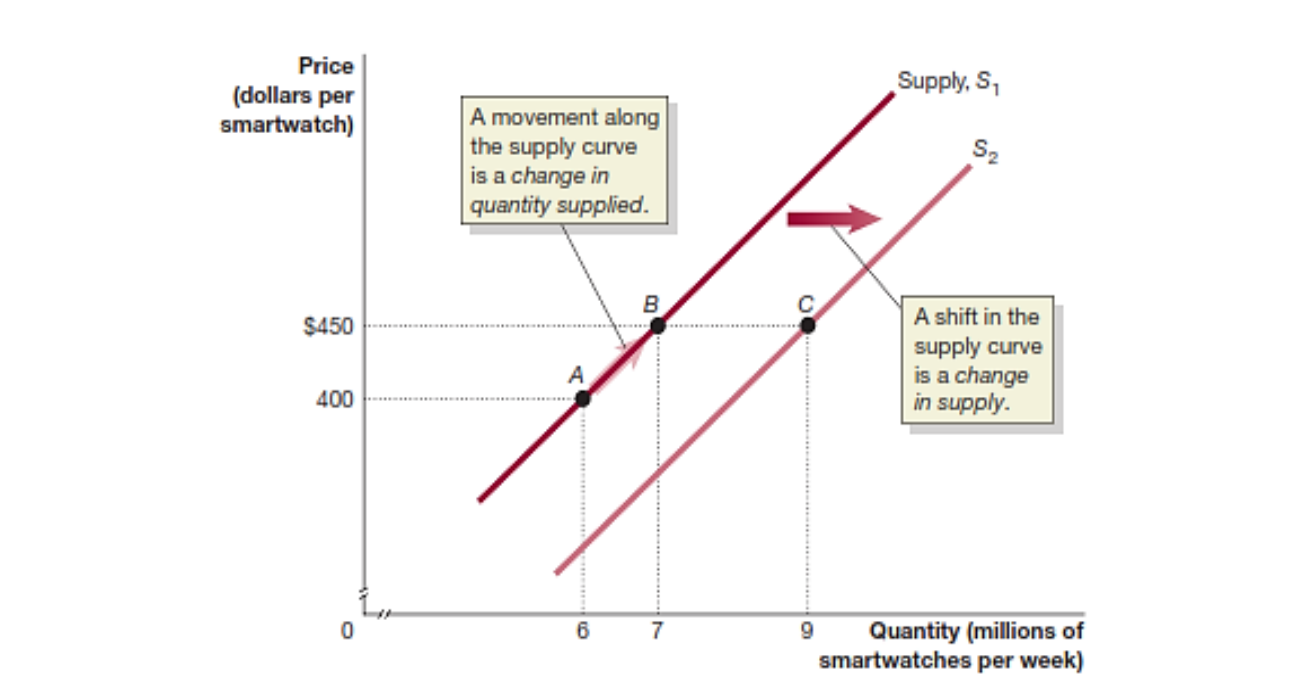
At a price of $400 per smartwatch, firms will supply 6 million smartwatches per week.
📖 点击查看译文
当智能手表的价格为 400 美元时,企业每周将供应 600 万块智能手表。
At a higher price of $450, firms will supply 7 million.
📖 点击查看译文
当价格上升到 450 美元时,企业将供应 700 万块智能手表。
知识点列表与拓展 (Knowledge Points and Extensions)
1. Supply Schedule (供给表) vs. Supply Curve (供给曲线)
-
供给表 (Supply Schedule):
- A tabular representation of price-quantity relationships.
(价格与供给量关系的表格表示。)
-
供给曲线 (Supply Curve):
- A graphical representation of the supply schedule.
(供给表的图形表示。)
2. Law of Supply and Movement Along the Curve (供给定律与曲线上的移动)
-
供给定律 (Law of Supply):
-
Higher prices lead to greater supply.
-
Lower prices lead to lower supply.
(价格上升,供给增加;价格下降,供给减少。)
-
-
曲线上的移动 (Movement Along the Curve):
-
Price changes → Move along the curve.
-
Non-price factors → Shift the curve.
(价格变化 → 沿曲线移动;非价格因素 → 使曲线移动。)
-
3. Factors Affecting Supply Curve Shifts (影响供给曲线移动的因素)
-
技术进步 (Technological advancements) → 供给曲线右移 (Increase in supply).
-
生产成本变化 (Changes in production costs) → 生产成本上升,供给曲线左移;成本下降,供给曲线右移。
-
政府政策 (Government policies) → 税收上升,供给减少;补贴增加,供给增加。
-
供应商数量 (Number of suppliers) → 供应商增加,供给增加;供应商减少,供给减少。
20
The Law of Supply
供给定律
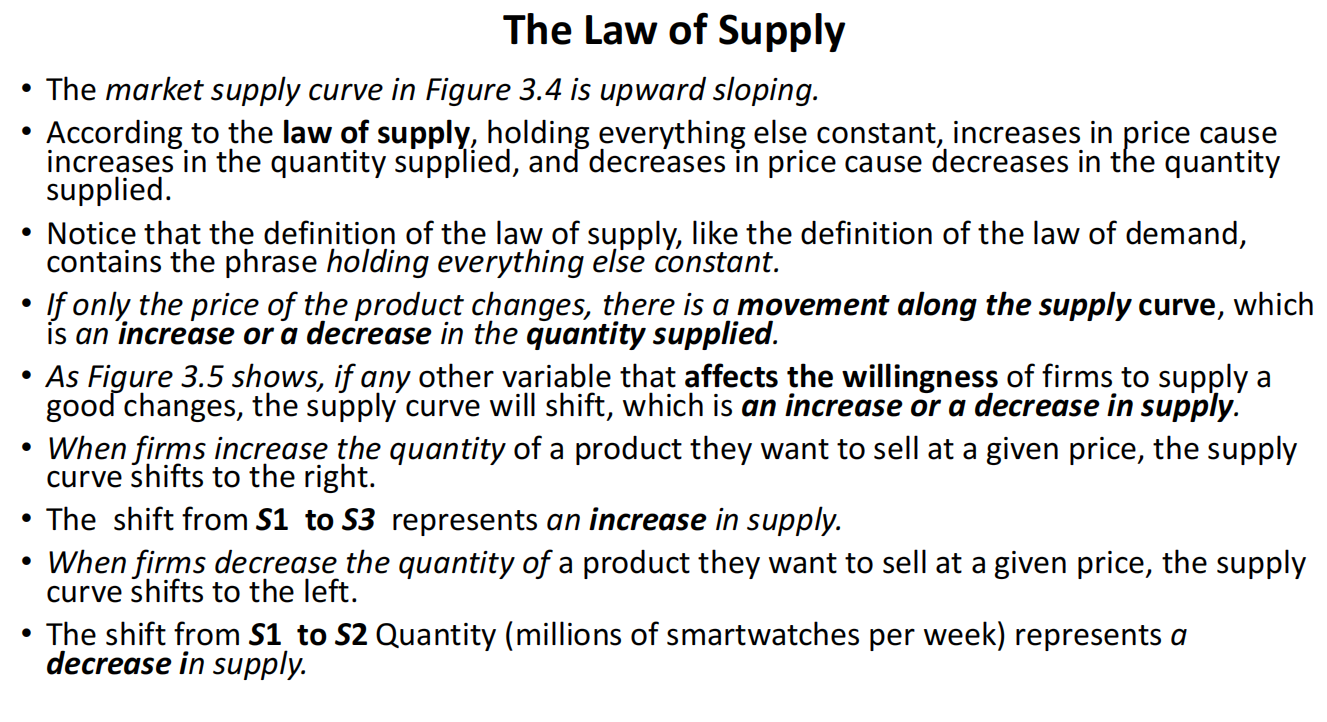
The market supply curve in Figure 3.4 is upward sloping.
📖 点击查看译文
图 3.4 中的市场供给曲线是向上倾斜的。
According to the law of supply, holding everything else constant, increases in price cause increases in the quantity supplied, and decreases in price cause decreases in the quantity supplied.
📖 点击查看译文
根据供给定律,在其他条件不变的情况下,价格上升会导致供给量增加,而价格下降会导致供给量减少。
Notice that the definition of the law of supply, like the definition of the law of demand, contains the phrase holding everything else constant.
📖 点击查看译文
请注意,供给定律的定义与需求定律类似,都包含“在其他条件不变的情况下”这一短语。
If only the price of the product changes, there is a movement along the supply curve, which is an increase or a decrease in the quantity supplied.
📖 点击查看译文
如果仅仅是产品价格发生变化,就会沿着供给曲线移动,表现为供给量的增加或减少。
As Figure 3.5 shows, if any other variable that affects the willingness of firms to supply a good changes, the supply curve will shift, which is an increase or a decrease in supply.
📖 点击查看译文
如图 3.5 所示,如果影响企业供给意愿的其他变量发生变化,供给曲线会发生移动,表现为供给的增加或减少。
When firms increase the quantity of a product they want to sell at a given price, the supply curve shifts to the right.
📖 点击查看译文
当企业在某一固定价格下愿意出售的产品数量增加时,供给曲线向右移动。
The shift from S1 to S3 represents an increase in supply.
📖 点击查看译文
从 S1 到 S3 的移动代表供给的增加。
When firms decrease the quantity of a product they want to sell at a given price, the supply curve shifts to the left.
📖 点击查看译文
当企业在某一固定价格下愿意出售的产品数量减少时,供给曲线向左移动。
The shift from S1 to S2 represents a decrease in supply.
📖 点击查看译文
从 S1 到 S2 的移动代表供给的减少。
知识点列表与拓展 (Knowledge Points and Extensions)
1. Law of Supply (供给定律) vs. Law of Demand (需求定律)
-
供给定律 (Law of Supply):
-
价格上升,供给量增加;价格下降,供给量减少。
-
供给曲线通常是向右上方倾斜的。
-
-
需求定律 (Law of Demand):
-
价格上升,需求量减少;价格下降,需求量增加。
-
需求曲线通常是向右下方倾斜的。
-
2. Movement Along the Supply Curve vs. Shift of the Supply Curve (供给曲线上的移动 vs. 供给曲线的移动)
-
曲线上的移动 (Movement Along the Curve):
-
仅价格变化 → 供给量变化(沿着曲线移动)。
-
价格上升,沿曲线向上移动;价格下降,沿曲线向下移动。
-
-
曲线的移动 (Shift of the Curve):
-
非价格因素变化 → 供给增加或减少(曲线整体移动)。
-
供给增加 → 供给曲线右移。
-
供给减少 → 供给曲线左移。
-
3. Factors That Shift the Supply Curve (影响供给曲线移动的因素)
-
生产技术 (Technology Improvements) → 生产效率提高,供给增加,曲线右移。
-
生产成本 (Cost of Production) → 成本上升,供给减少,曲线左移。
-
税收和补贴 (Taxes and Subsidies) → 税收上升,供给减少;补贴增加,供给增加。
-
生产者数量 (Number of Producers) → 生产者增加,供给增加;生产者减少,供给减少。
-
预期价格 (Expected Future Prices) → 如果企业预期未来价格上升,现在减少供给;如果预期未来价格下降,现在增加供给。
21
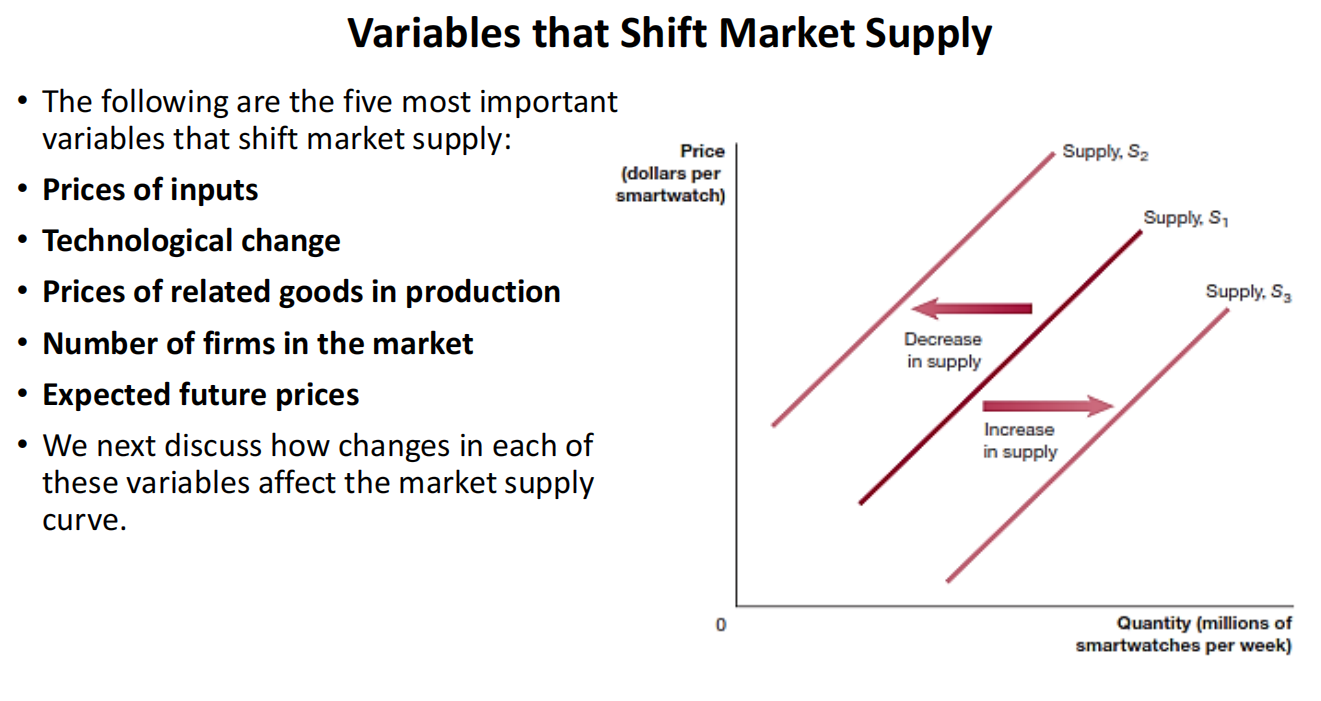
Variables That Shift Market Supply
影响市场供给的变量
The following are the five most important variables that shift market supply:
📖 点击查看译文
以下是影响市场供给曲线移动的五个最重要变量:
- Prices of inputs (投入品价格)
📖 点击查看译文
投入品的价格
- Technological change (技术变革)
📖 点击查看译文
技术变革
- Prices of related goods in production (相关产品的价格)
📖 点击查看译文
生产中相关产品的价格
- Number of firms in the market (市场中的企业数量)
📖 点击查看译文
市场中的企业数量
- Expected future prices (预期未来价格)
📖 点击查看译文
预期未来价格
We next discuss how changes in each of these variables affect the market supply curve.
📖 点击查看译文
接下来,我们讨论这些变量的变化如何影响市场供给曲线。
知识点列表与拓展 (Knowledge Points and Extensions)
1. How Each Variable Affects Supply (各变量如何影响供给)
| Variable (变量) | Increase (增加) | Decrease (减少) |
|-------------------------------|------------------------------------------------------|------------------------------------------------------|
| Prices of Inputs (投入品价格) | 生产成本上升 → 供给减少,曲线左移 | 生产成本下降 → 供给增加,曲线右移 |
| Technological Change (技术变革) | 提高生产效率 → 供给增加,曲线右移 | 生产技术落后 → 供给减少,曲线左移 |
| Prices of Related Goods (相关产品价格) | 替代品价格上升 → 供给减少,曲线左移 | 互补品价格上升 → 供给增加,曲线右移 |
| Number of Firms (企业数量) | 企业增加 → 供给增加,曲线右移 | 企业减少 → 供给减少,曲线左移 |
| Expected Future Prices (预期未来价格) | 预期价格上升 → 当前供给减少,曲线左移 | 预期价格下降 → 当前供给增加,曲线右移 |
2. Relationship Between Supply and Demand (供给与需求的关系)
-
供给与需求共同决定市场均衡价格 (Supply and demand together determine market equilibrium price)。
-
供给增加会导致均衡价格下降,供给减少会导致均衡价格上升 (An increase in supply lowers equilibrium price, while a decrease in supply raises it)。
-
需求增加会导致均衡价格上升,需求减少会导致均衡价格下降 (An increase in demand raises equilibrium price, while a decrease in demand lowers it)。
22
Prices of Inputs (投入品价格)
投入品价格对供给的影响
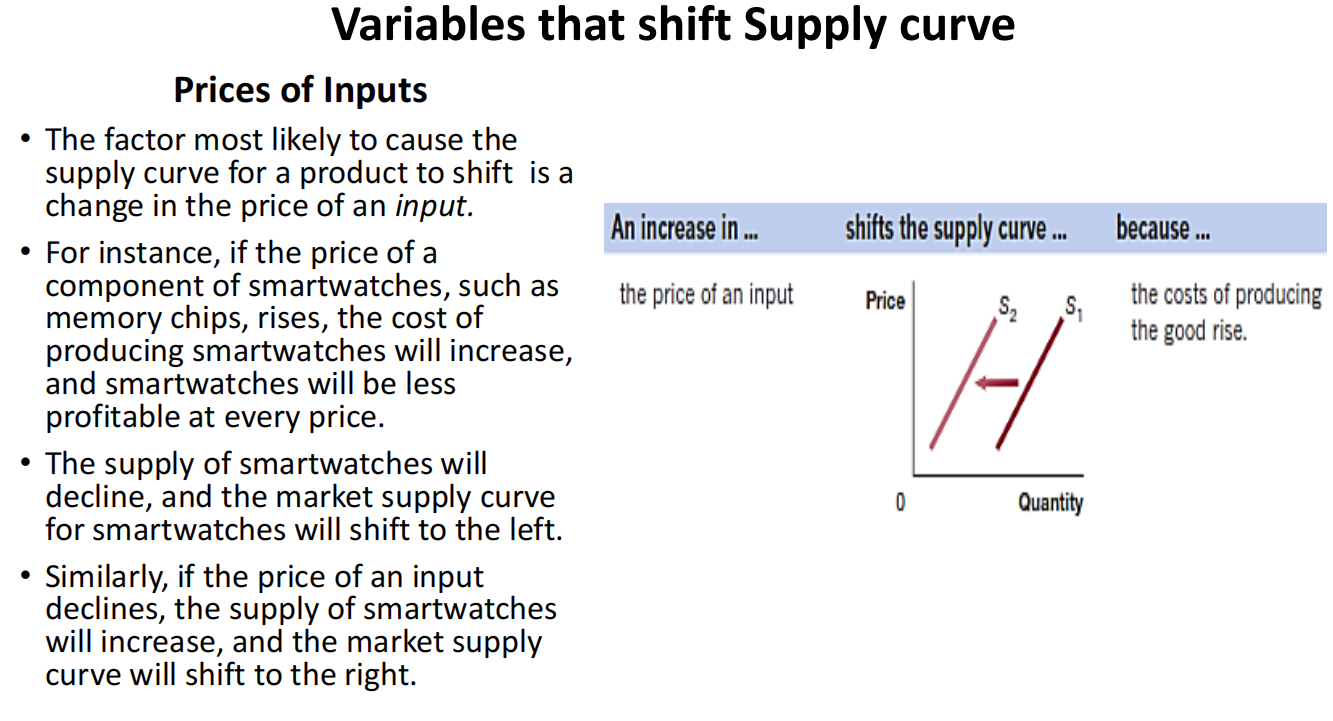
The factor most likely to cause the supply curve for a product to shift is a change in the price of an input.
📖 点击查看译文
最可能导致产品供给曲线移动的因素是投入品价格的变化。
-
Increase in Input Prices (投入品价格上升)
-
Effect: Higher production costs → Lower supply → Supply curve shifts left.
-
Example: If the price of memory chips rises, smartwatch production costs increase, reducing supply.
-
📖 点击查看译文
影响:生产成本上升 → 供给减少 → 供给曲线左移。
例子:如果存储芯片价格上升,智能手表的生产成本增加,导致供给减少。
-
-
Decrease in Input Prices (投入品价格下降)
-
Effect: Lower production costs → Higher supply → Supply curve shifts right.
-
Example: If the price of memory chips falls, smartwatch production costs decrease, increasing supply.
-
📖 点击查看译文
影响:生产成本下降 → 供给增加 → 供给曲线右移。
例子:如果存储芯片价格下降,智能手表的生产成本减少,导致供给增加。
-
知识点列表与拓展 (Knowledge Points and Extensions)
1. Why Do Input Prices Affect Supply? (为什么投入品价格影响供给?)
-
生产成本是企业利润的重要因素 (Production costs are a key factor in profitability)。
-
成本上升时,企业可能减少供给 (When costs rise, firms may reduce supply)。
-
成本下降时,企业可能扩大生产 (When costs fall, firms may increase production)。
2. Relationship Between Input Prices and Supply Curve (投入品价格与供给曲线的关系)
| Scenario (情况) | Effect on Supply (对供给的影响) | Shift in Supply Curve (供给曲线移动方向) |
|-------------------|--------------------------------|--------------------------------|
| Input price increases (投入品价格上升) | Supply decreases (供给减少) | Left shift (左移) |
| Input price decreases (投入品价格下降) | Supply increases (供给增加) | Right shift (右移) |
3. Real-World Example (现实案例)
-
Oil Price Increase (石油价格上升): Higher oil prices → Increased transportation costs → Lower supply of goods.
-
Silicon Chip Price Drop (硅芯片价格下降): Lower chip prices → Cheaper electronics production → Increased supply of gadgets.
23
Prices of Inputs (投入品价格)
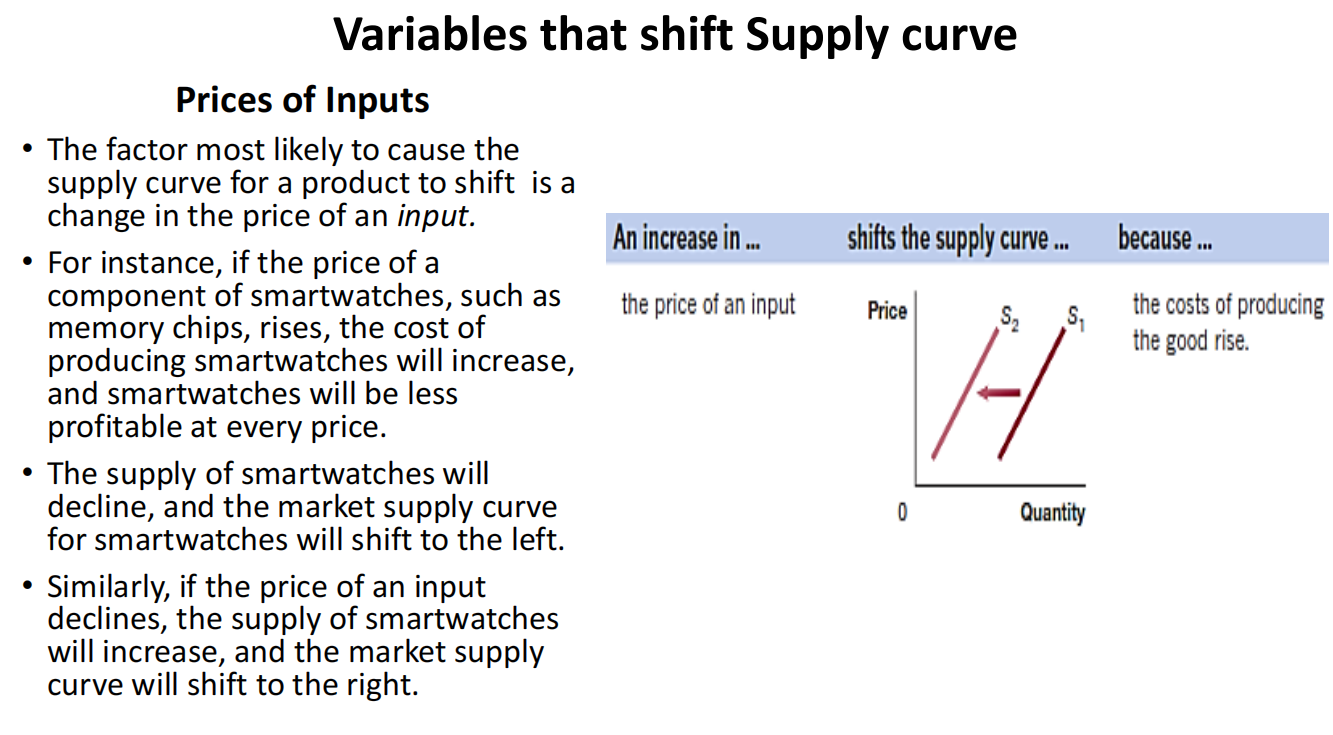
The factor most likely to cause the supply curve for a product to shift is a change in the price of an input.
📖 点击查看译文
最有可能导致产品供给曲线移动的因素是投入品价格的变化。
For instance, if the price of a component of smartwatches, such as memory chips, rises, the cost of producing smartwatches will increase, and smartwatches will be less profitable at every price.
📖 点击查看译文
例如,如果智能手表的某个组件(如存储芯片)价格上涨,生产智能手表的成本将增加,智能手表在任何价格水平下都会变得不那么盈利。
The supply of smartwatches will decline, and the market supply curve for smartwatches will shift to the left.
📖 点击查看译文
智能手表的供应将减少,市场供给曲线将向左移动。
Similarly, if the price of an input declines, the supply of smartwatches will increase, and the market supply curve will shift to the right.
📖 点击查看译文
同样地,如果某项投入品的价格下降,智能手表的供应将增加,市场供给曲线将向右移动。
知识点列表与拓展 (Knowledge Points and Extensions):
1. Input Prices and Supply Curve (投入品价格与供给曲线)
-
解释 (Explanation):
A change in the price of inputs, such as raw materials or labor, affects production costs and shifts the supply curve.
(投入品价格的变化,如原材料或劳动力,影响生产成本,并导致供给曲线移动。)
-
例子 (Example):
If the price of steel increases, car manufacturers face higher production costs, leading to a decrease in the supply of cars.
(如果钢铁价格上涨,汽车制造商的生产成本会增加,从而减少汽车的供应。)
-
拓展 (Extension):
Government policies, such as subsidies or tariffs on raw materials, can influence input prices and alter the supply of goods.
(政府政策,如对原材料的补贴或关税,可能影响投入品价格,从而改变商品供给。)
24
Prices of Related Goods in Production (相关商品的生产价格)
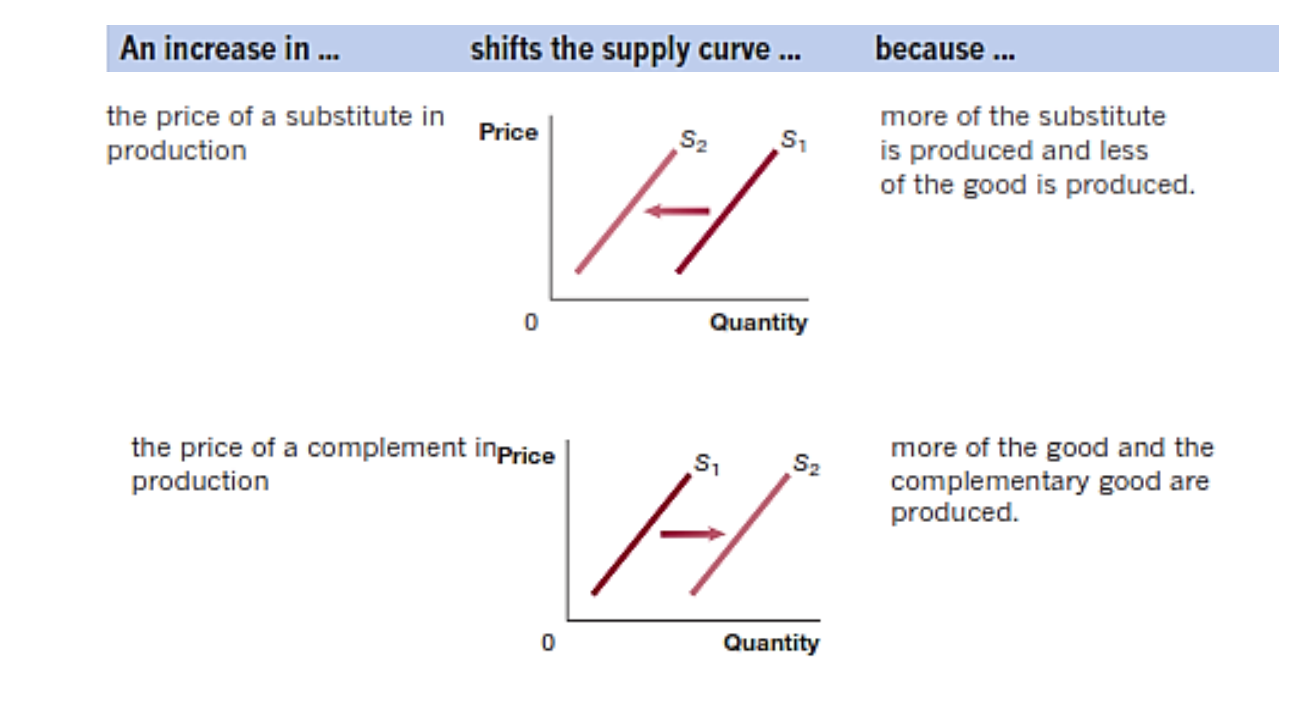
Firms often choose which good or service they will produce, while alternative goods that a firm could produce are called substitutes in production.
📖 点击查看译文
企业通常会选择生产哪种商品或服务,而企业可以生产的其他替代商品称为生产中的替代品。
For example, Apple produces the iPhone and the iPad, and Samsung produces the Galaxy S smartphone and Galaxy Tab.
📖 点击查看译文
例如,苹果生产 iPhone 和 iPad,三星生产 Galaxy S 智能手机和 Galaxy Tab 平板电脑。
These products typically use similar components and are often assembled in the same factories.
📖 点击查看译文
这些产品通常使用类似的组件,并且经常在同一工厂组装。
If the price of smartphones increases relative to the price of smartwatches, smartphones will become more profitable, and Apple, Samsung, and other firms will shift some of their productive capacity away from smartwatches and toward smartphones.
📖 点击查看译文
如果智能手机的价格相对于智能手表的价格上升,智能手机将变得更有利润,苹果、三星等公司将把部分生产能力从智能手表转向智能手机。
The firms will offer fewer smartwatches for sale at every price, so the supply curve for smartwatches will shift to the left.
📖 点击查看译文
企业在每个价格水平上提供的智能手表将减少,因此智能手表的供给曲线将向左移动。
Goods that are produced together are called complements in production.
📖 点击查看译文
共同生产的商品称为生产中的互补品。
For example, the same geological formations that contain oil usually also contain natural gas.
📖 点击查看译文
例如,含有石油的地质层通常也含有天然气。
If the price of oil rises, oil companies that begin pumping more oil from these formations will also produce more natural gas.
📖 点击查看译文
如果石油价格上涨,开始从这些地层开采更多石油的公司也会生产更多的天然气。
As a result, an increase in the price of oil will cause the supply curve for natural gas, complement in production, to shift to the right.
📖 点击查看译文
因此,石油价格的上涨将导致天然气(生产中的互补品)的供给曲线向右移动。
知识点列表与拓展 (Knowledge Points and Extensions):
1. Substitutes in Production (生产中的替代品)
-
解释 (Explanation):
Goods that compete for the same productive resources; an increase in the price of one can lead to a decrease in the supply of the other.
(竞争相同生产资源的商品;一种商品价格上升可能导致另一种商品的供应减少。)
-
例子 (Example):
If the price of tablets rises, a company like Apple may allocate more resources to tablet production, reducing smartphone output.
(如果平板电脑的价格上升,苹果公司可能会把更多资源用于生产平板电脑,从而减少智能手机的产量。)
-
拓展 (Extension):
Companies often adjust production based on profit margins, influencing market supply trends.
(企业通常根据利润率调整生产,从而影响市场供应趋势。)
2. Complements in Production (生产中的互补品)
-
解释 (Explanation):
Goods that are typically produced together; an increase in the production of one leads to an increase in the other.
(通常一起生产的商品;一种商品的生产增加通常会带动另一种商品的生产增加。)
-
例子 (Example):
Oil and natural gas are often extracted from the same geological formations, so an increase in oil production leads to more natural gas supply.
(石油和天然气通常来自相同的地质层,因此石油产量增加会带来更多的天然气供应。)
-
拓展 (Extension):
Agricultural products such as beef and leather are also complements in production—raising more cattle for beef results in more leather supply.
(农业产品如牛肉和皮革也是生产中的互补品——饲养更多牛以获取牛肉也会导致皮革供应增加。)
25
26
Number of Firms in the Market (市场中的企业数量)
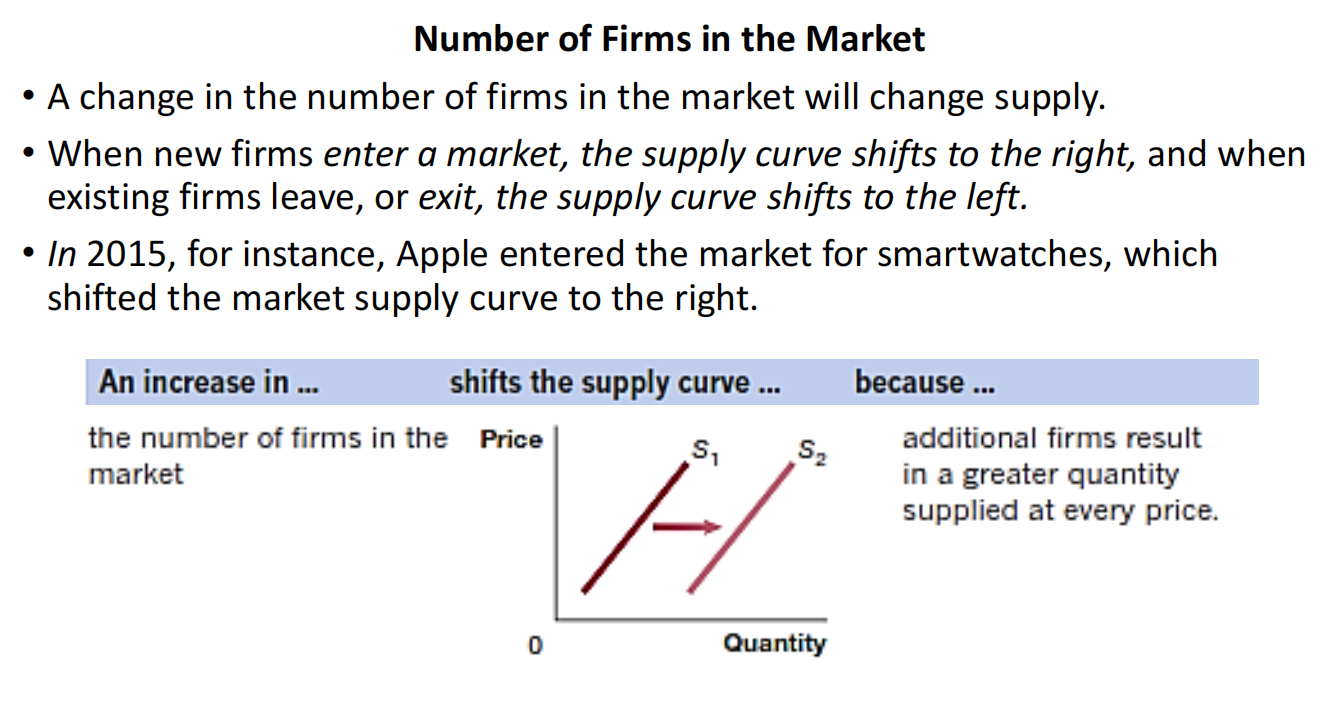
A change in the number of firms in the market will change supply.
📖 点击查看译文
市场中企业数量的变化会影响供给。
When new firms enter a market, the supply curve shifts to the right, and when existing firms leave, or exit, the supply curve shifts to the left.
📖 点击查看译文
当新的企业进入市场时,供给曲线向右移动;当现有企业退出市场时,供给曲线向左移动。
In 2015, for instance, Apple entered the market for smartwatches, which shifted the market supply curve to the right.
📖 点击查看译文
例如,在 2015 年,苹果公司进入智能手表市场,使市场供给曲线向右移动。
知识点列表与拓展 (Knowledge Points and Extensions):
1. Market Entry and Exit (市场进入与退出)
-
解释 (Explanation):
When firms enter a market, supply increases, shifting the supply curve to the right; when firms exit, supply decreases, shifting the curve to the left.
(当企业进入市场时,供给增加,供给曲线向右移动;当企业退出市场时,供给减少,供给曲线向左移动。)
-
例子 (Example):
The rise of e-commerce led to many new online retailers, increasing supply in the retail market.
(电子商务的兴起使许多新的在线零售商进入市场,从而增加了零售市场的供给。)
-
拓展 (Extension):
Government policies, technological advancements, and market conditions influence firm entry and exit.
(政府政策、技术进步和市场状况都会影响企业的进入和退出。)
27
Expected Future Prices (预期未来价格)
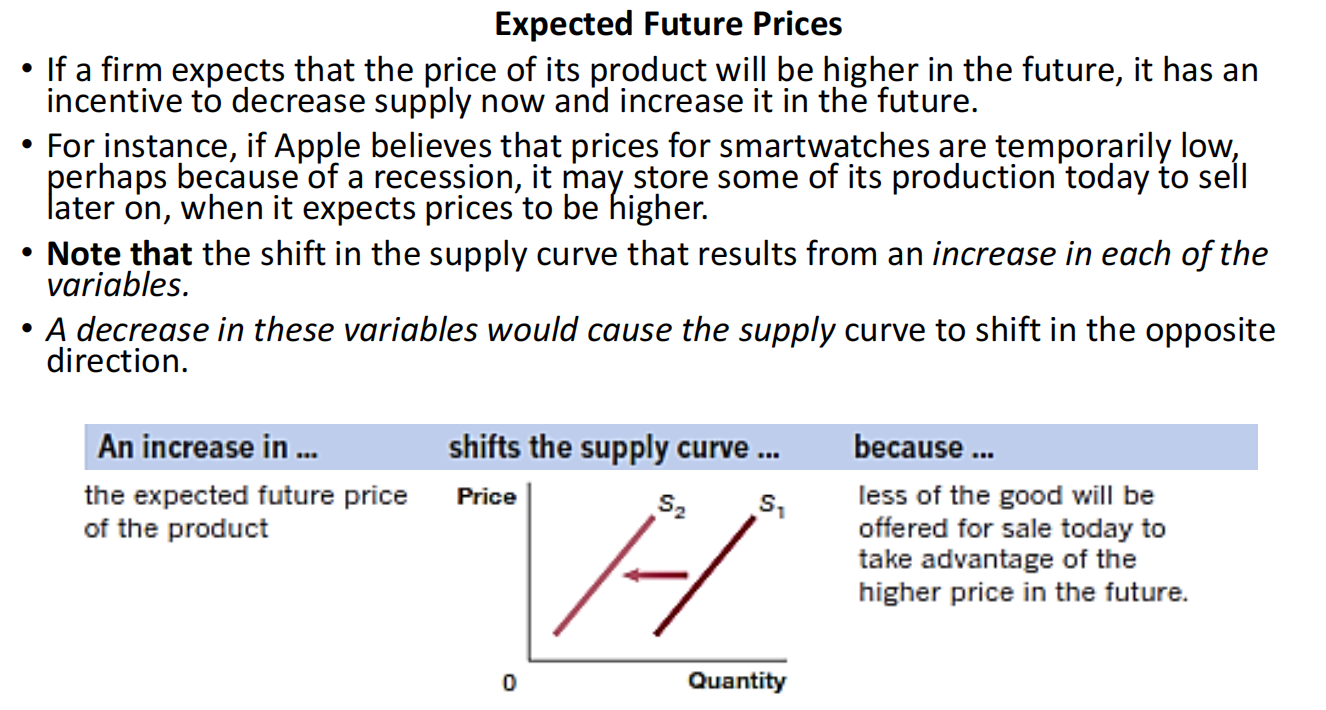
If a firm expects that the price of its product will be higher in the future, it has an incentive to decrease supply now and increase it in the future.
📖 点击查看译文
如果企业预期其产品未来价格会上涨,就会有动力现在减少供给,并在未来增加供给。
For instance, if Apple believes that prices for smartwatches are temporarily low, perhaps because of a recession, it may store some of its production today to sell later on, when it expects prices to be higher.
📖 点击查看译文
例如,如果苹果公司认为智能手表的价格暂时较低(可能是因为经济衰退),它可能会暂存部分产量,以便在未来价格上涨时出售。
Note that the shift in the supply curve that results from an increase in each of the variables.
📖 点击查看译文
请注意,由于这些变量的增加,供给曲线会发生移动。
A decrease in these variables would cause the supply curve to shift in the opposite direction.
📖 点击查看译文
如果这些变量减少,供给曲线会朝相反的方向移动。
知识点列表与拓展 (Knowledge Points and Extensions):
1. Supply and Future Price Expectations (供给与未来价格预期)
-
解释 (Explanation):
Firms adjust their supply strategies based on expected future prices—reducing supply now if they expect higher prices later.
(企业会根据未来价格预期调整供给策略——如果预期未来价格会上涨,它们会减少当前供给。)
-
例子 (Example):
Oil companies may reduce current drilling and storage when expecting oil prices to rise.
(如果预期石油价格上涨,石油公司可能会减少当前的开采并增加储存。)
-
拓展 (Extension):
Market speculation and economic conditions heavily influence firms’ supply decisions regarding future pricing.
(市场投机和经济状况对企业基于未来价格预期的供给决策有重要影响。)
28
A Change in Supply versus a Change in Quantity Supplied (供给变化与供给数量变化的区别)
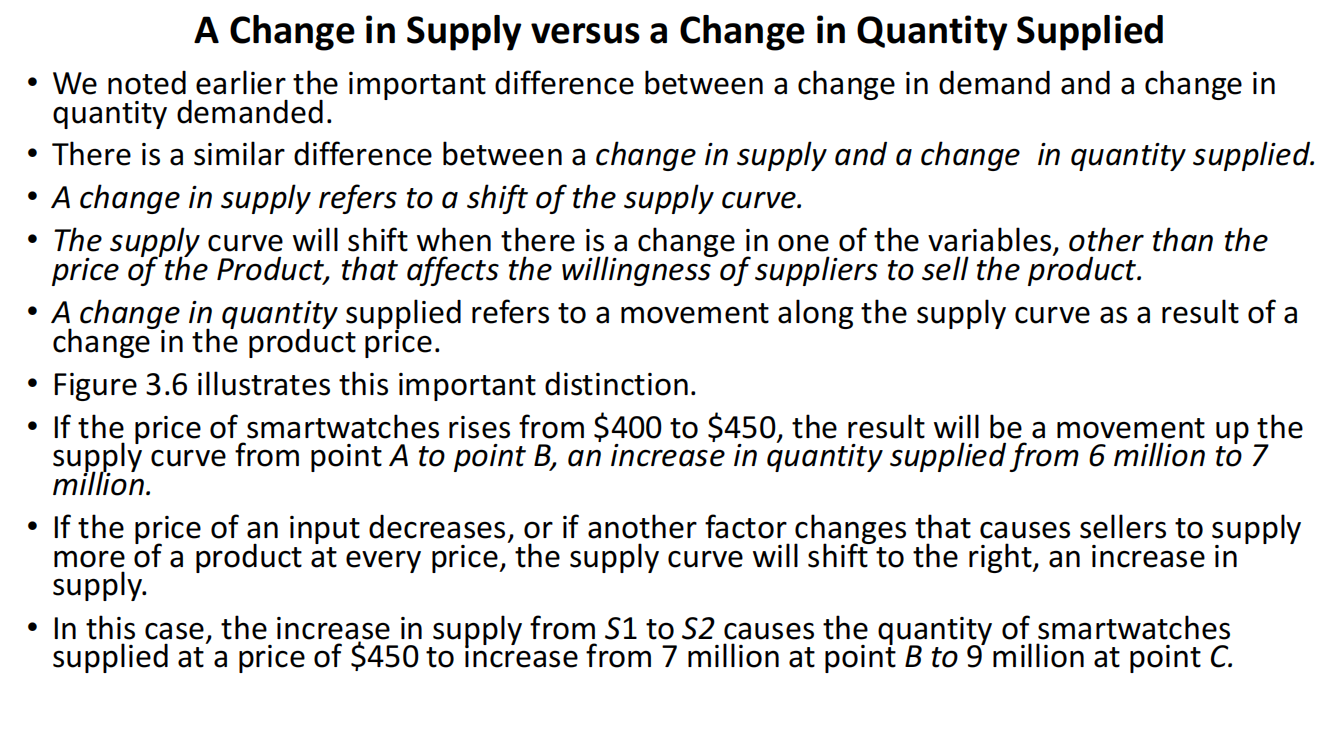
A change in supply refers to a shift of the supply curve.
📖 点击查看译文
供给的变化指的是供给曲线的移动。
The supply curve will shift when there is a change in one of the variables, other than the price of the product, that affects the willingness of suppliers to sell the product.
📖 点击查看译文
当影响供应商销售产品意愿的变量(而非产品价格)发生变化时,供给曲线会发生移动。
A change in quantity supplied refers to a movement along the supply curve as a result of a change in the product price.
📖 点击查看译文
供给数量的变化指的是由于产品价格的变化导致沿着供给曲线的移动。
If the price of smartwatches rises from 450, the result will be a movement up the supply curve from point A to point B, an increase in quantity supplied from 6 million to 7 million.
📖 点击查看译文
如果智能手表的价格从 400 美元上升到 450 美元,供给曲线会沿着曲线从 A 点移动到 B 点,供给数量从 600 万增加到 700 万。
If the price of an input decreases, or if another factor changes that causes sellers to supply more of a product at every price, the supply curve will shift to the right, an increase in supply.
📖 点击查看译文
如果投入品价格下降,或者其他因素导致卖方在每个价格水平上愿意提供更多产品,供给曲线将右移,表示供给增加。
In this case, the increase in supply from S1 to S2 causes the quantity of smartwatches supplied at a price of $450 to increase from 7 million at point B to 9 million at point C.
📖 点击查看译文
在这种情况下,供给从 S1 增加到 S2,使得在 450 美元的价格下,智能手表的供给数量从 B 点的 700 万增加到 C 点的 900 万。
知识点列表与拓展 (Knowledge Points and Extensions):
1. Change in Supply vs. Change in Quantity Supplied (供给变化 vs. 供给数量变化)
-
解释 (Explanation):
A change in supply shifts the entire supply curve, while a change in quantity supplied moves along the existing curve due to price changes.
(供给的变化导致整个供给曲线的移动,而供给数量的变化仅是由于价格变化导致沿现有曲线的移动。)
-
例子 (Example):
If smartwatch prices increase, manufacturers produce more, leading to movement along the curve. If production technology improves, the supply curve shifts.
(如果智能手表的价格上涨,制造商会生产更多,这导致沿曲线的移动。如果生产技术提高,供给曲线会整体右移。)
-
拓展 (Extension):
This distinction is crucial in understanding market dynamics and predicting the effects of external shocks on supply.
(这一区别对于理解市场动态以及预测外部冲击对供给的影响至关重要。)
29
30
Market Equilibrium: Putting Demand and Supply Together (市场均衡:将需求与供给结合在一起)
Learning Objective: Use a graph to illustrate market equilibrium
📖 点击查看译文
学习目标:使用图表来说明市场均衡。
The purpose of markets is to bring buyers and sellers together.
📖 点击查看译文
市场的目的是将买方和卖方聚集在一起。
To understand this process, we first need to see how markets work to reconcile the plans of buyers and sellers.
📖 点击查看译文
要理解这一过程,我们首先需要了解市场如何协调买方和卖方的计划。
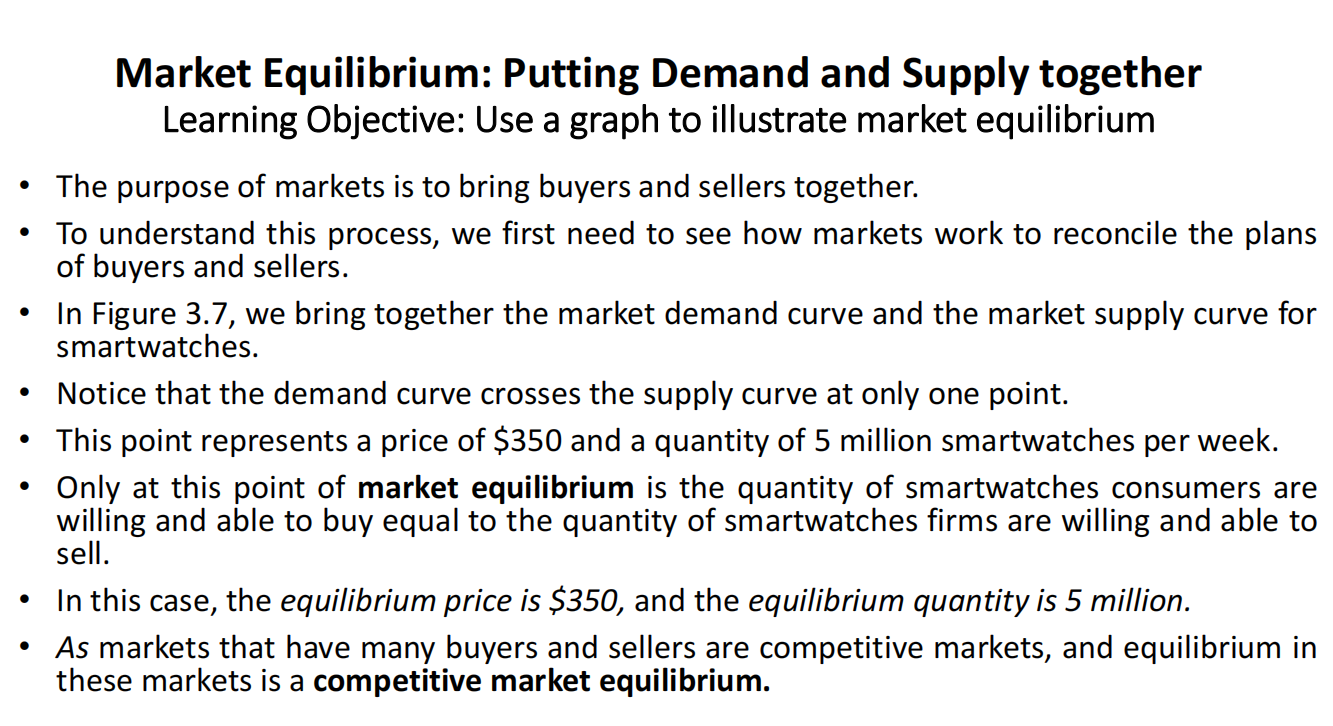
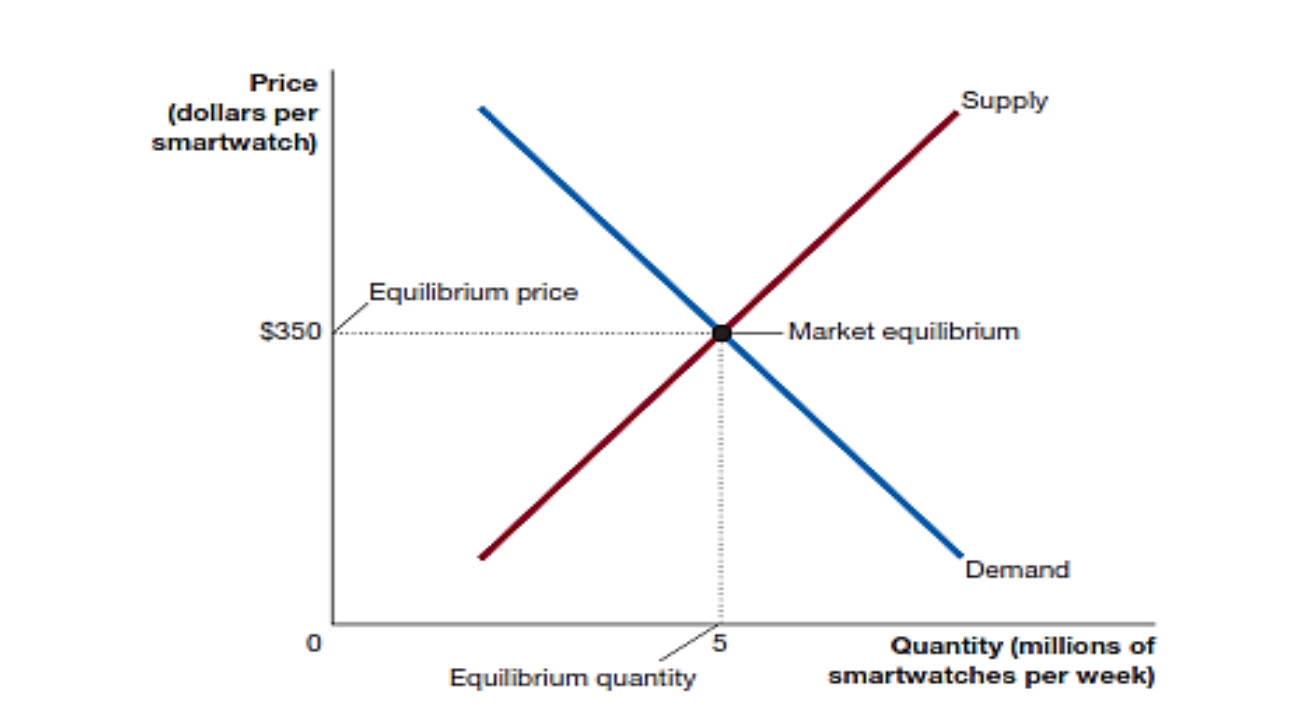
In Figure 3.7, we bring together the market demand curve and the market supply curve for smartwatches.
📖 点击查看译文
在图 3.7 中,我们将智能手表的市场需求曲线和市场供给曲线结合在一起。
Notice that the demand curve crosses the supply curve at only one point.
📖 点击查看译文
请注意,需求曲线仅在一个点上与供给曲线相交。
This point represents a price of $350 and a quantity of 5 million smartwatches per week.
📖 点击查看译文
该点对应的价格为 350 美元,数量为每周 500 万块智能手表。
Only at this point of market equilibrium is the quantity of smartwatches consumers are willing and able to buy equal to the quantity of smartwatches firms are willing and able to sell.
📖 点击查看译文
只有在这个市场均衡点,消费者愿意并且能够购买的智能手表数量才等于企业愿意并且能够销售的数量。
In this case, the equilibrium price is $350, and the equilibrium quantity is 5 million.
📖 点击查看译文
在这种情况下,均衡价格为 350 美元,均衡数量为 500 万。
As markets that have many buyers and sellers are competitive markets, and equilibrium in these markets is a competitive market equilibrium.
📖 点击查看译文
由于有许多买方和卖方的市场是竞争性市场,而这些市场的均衡称为竞争性市场均衡。
知识点列表与拓展 (Knowledge Points and Extensions):
1. Market Equilibrium (市场均衡)
-
解释 (Explanation):
Market equilibrium occurs when the quantity demanded equals the quantity supplied at a particular price.
(市场均衡是指在特定价格下,需求量等于供给量的状态。)
-
例子 (Example):
If the price of a smartwatch is set at $350, and at this price, both buyers and sellers agree on exchanging 5 million units per week, the market is in equilibrium.
(如果智能手表的价格设定为 350 美元,并且在该价格下,买方和卖方都同意每周交易 500 万块手表,那么市场处于均衡状态。)
-
拓展 (Extension):
Market equilibrium can shift due to changes in demand or supply, leading to new equilibrium prices and quantities. For example, if new technology reduces production costs, the supply curve shifts right, leading to a lower equilibrium price.
(市场均衡可能因需求或供给的变化而发生变化,从而导致新的均衡价格和数量。例如,如果新技术降低了生产成本,供给曲线向右移动,导致均衡价格下降。)
31
32
A Market that is Not in Equilibrium Moves Toward Equilibrium (一个不处于均衡的市场会朝均衡移动)
Once a market is in equilibrium, it remains in equilibrium.
📖 点击查看译文
一旦市场处于均衡状态,它将保持在均衡状态。
To see why, consider what happens if a market is not in equilibrium.
📖 点击查看译文
为了理解这一点,考虑一下如果市场不处于均衡状态时会发生什么。
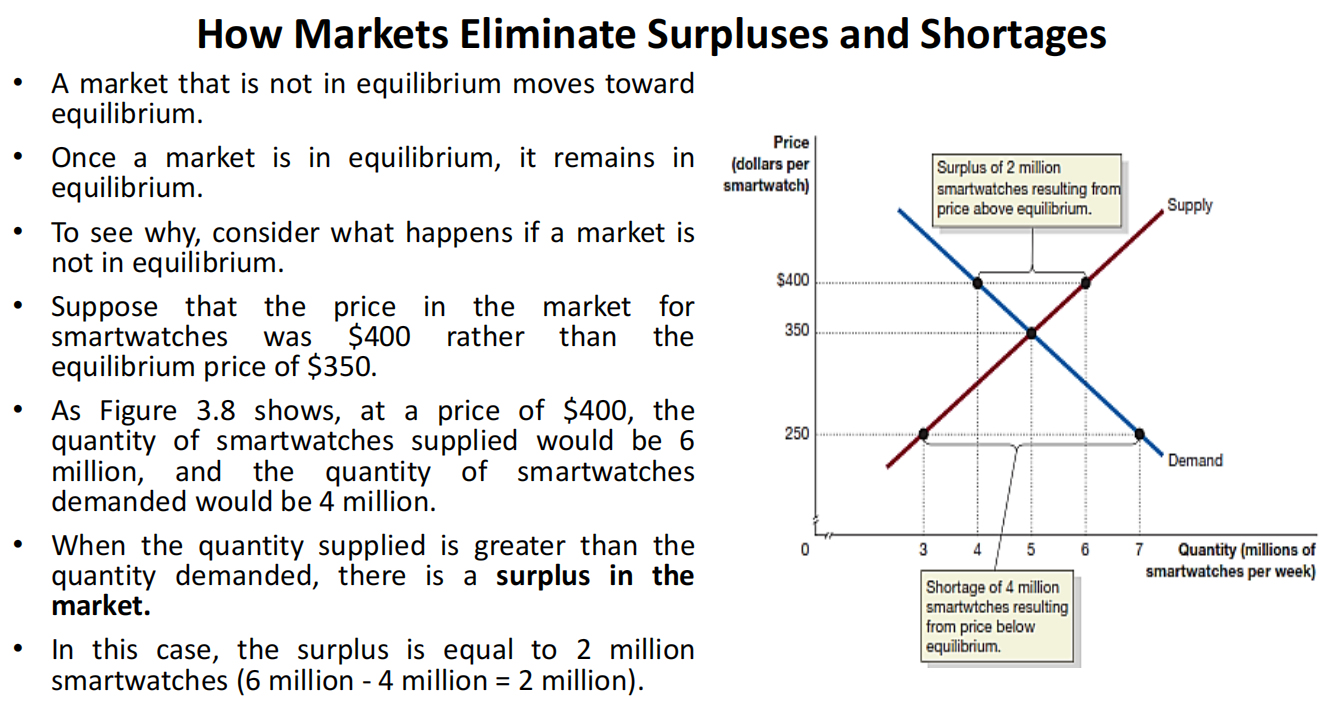
Suppose that the price in the market for smartwatches was 350.
📖 点击查看译文
假设智能手表市场的价格是 400 美元,而不是均衡价格 350 美元。
As Figure 3.8 shows, at a price of $400, the quantity of smartwatches supplied would be 6 million, and the quantity of smartwatches demanded would be 4 million.
📖 点击查看译文
如图 3.8 所示,当价格为 400 美元时,供给的智能手表数量为 600 万,而需求的数量为 400 万。
When the quantity supplied is greater than the quantity demanded, there is a surplus in the market.
📖 点击查看译文
当供给量大于需求量时,市场就会出现过剩。
In this case, the surplus is equal to 2 million smartwatches (6 million - 4 million = 2 million).
📖 点击查看译文
在这种情况下,过剩量为 200 万块智能手表(600 万 - 400 万 = 200 万)。
知识点列表与拓展 (Knowledge Points and Extensions):
1. Market Surplus (市场过剩)
-
解释 (Explanation):
A market surplus occurs when the quantity supplied exceeds the quantity demanded at a given price.
(市场过剩是指在特定价格下,供给量超过需求量的情况。)
-
例子 (Example):
At a price of $400, the quantity of smartwatches supplied is 6 million, while the quantity demanded is only 4 million, resulting in a surplus of 2 million smartwatches.
(当价格为 400 美元时,智能手表的供给量为 600 万,需求量仅为 400 万,导致 200 万块智能手表的过剩。)
-
拓展 (Extension):
Surpluses tend to push prices down, as sellers lower prices to clear excess inventory, which can help restore market equilibrium.
(过剩通常会推动价格下降,因为卖方会降低价格以清理过剩的库存,这有助于恢复市场均衡。)
Suppose that the market demand curve in Figure 3.1 represents the willingness of consumers to buy smartwatches when average household income is $50,000.
📖 点击查看译文
假设图 3.1 中的市场需求曲线表示当平均家庭收入为 50,000 美元时,消费者购买智能手表的意愿。
If average household income rises to $52,000, the demand for smartwatches will increase, which we show by shifting the demand curve to the right.
📖 点击查看译文
如果平均家庭收入上升到 52,000 美元,智能手表的需求将增加,我们可以通过向右移动需求曲线来表示这一变化。
A good is a normal good when the demand for the good increases following a rise in income and decreases following a fall in income.
📖 点击查看译文
如果一种商品的需求在收入增加时上升,而在收入下降时减少,那么这种商品就是正常商品。
Most goods are normal goods, but some goods are inferior goods.
📖 点击查看译文
大多数商品都是正常商品,但也有一些是劣等商品。
A good is an inferior good when the demand for it decreases following a rise in income and increases following a fall in income.
📖 点击查看译文
如果一种商品的需求在收入增加时减少,而在收入下降时增加,那么这种商品就是劣等商品。
For instance, as your income rises, you might buy fewer cans of tuna or packages of instant noodles, and buy more shrimp or whole grain pasta.
📖 点击查看译文
例如,随着收入的增加,你可能会减少购买金枪鱼罐头或方便面,而更多地购买虾或全麦意面。
知识点列表与拓展 (Knowledge Points and Extensions):
1. Normal Goods (正常商品)
-
解释 (Explanation):
Goods for which demand increases as income rises.
(收入增加时需求上升的商品。)
-
例子 (Example):
- Luxury cars, branded clothing, organic food.
(豪华汽车、品牌服装、有机食品。)
-
拓展 (Extension):
Businesses often target wealthier consumers with high-end product lines.
(企业通常通过高端产品线来吸引高收入消费者。)
2. Inferior Goods (劣等商品)
-
解释 (Explanation):
Goods for which demand decreases as income rises.
(收入增加时需求下降的商品。)
-
例子 (Example):
- Instant noodles, generic-brand groceries, second-hand clothing.
(方便面、超市自有品牌食品、二手服装。)
-
拓展 (Extension):
During economic downturns, demand for inferior goods often rises.
(在经济衰退期间,劣等商品的需求通常会上升。)
10

Prices of Related Goods (相关商品的价格)
The prices of other goods can also affect consumer’s demand for a product.
📖 点击查看译文
其他商品的价格也会影响消费者对某种产品的需求。
Consumers who would use a smartwatch primarily for checking the time, making phone calls, and keeping track of their appointments could use a smartphone instead.
📖 点击查看译文
主要使用智能手表来看时间、打电话和管理日程的消费者可以选择使用智能手机来替代。
Goods and services that can be used for the same purpose are called substitutes.
📖 点击查看译文
可以用于相同用途的商品和服务被称为替代品。
When two goods are substitutes, the more you buy of one, the less you will buy of the other and vice versa.
📖 点击查看译文
当两种商品是替代品时,购买其中一种的数量增加,另一种的购买量就会减少,反之亦然。
An increase in the price of a substitute causes the demand curve for a good to shift to the right.
📖 点击查看译文
当替代品的价格上升时,某商品的需求曲线会向右移动。
Suppose that the market demand curve in Figure 3.1 represents the willingness and ability of consumers to buy smartwatches during a week when the average price of smartphones is $400.
📖 点击查看译文
假设图 3.1 的市场需求曲线表示当智能手机的平均价格为 400 美元时,消费者在一周内购买智能手表的意愿和能力。
If the average price of smartphones falls to $300, consumers will demand fewer smartwatches at every price.
📖 点击查看译文
如果智能手机的平均价格降至 300 美元,消费者在每个价格水平下对智能手表的需求都会减少。
We show this change by shifting the demand curve for smartwatches to the left.
📖 点击查看译文
我们通过向左移动智能手表的需求曲线来表示这一变化。
知识点列表与拓展 (Knowledge Points and Extensions)
1. Substitutes (替代品)
-
解释 (Explanation):
Goods that can replace each other in consumption.
(在消费中可以互相替代的商品。)
-
例子 (Example):
-
Tea and coffee
-
iPads and Android tablets
-
Uber and taxis
(茶和咖啡、iPad 和安卓平板、Uber 和出租车。)
-
-
拓展 (Extension):
Companies monitor the pricing of substitutes to adjust their own prices and maximize demand.
(公司会关注替代品的价格调整自己的价格,以最大化需求。)
2. Demand Curve Shifts (需求曲线的移动)
-
解释 (Explanation):
When the price of a substitute falls, the demand for the original good decreases (shift left).
When the price of a substitute rises, the demand for the original good increases (shift right).
(当替代品价格下降时,原商品的需求减少(曲线左移);当替代品价格上升时,原商品的需求增加(曲线右移)。)
-
例子 (Example):
-
If Netflix raises its price, more people may subscribe to Disney+.
-
If gasoline prices increase, more people may use public transportation.
(如果 Netflix 提价,可能会有更多人订阅 Disney+;如果汽油价格上涨,可能会有更多人选择公共交通。)
-
-
拓展 (Extension):
Understanding demand shifts helps businesses strategize pricing and marketing.
(理解需求曲线的移动有助于企业制定定价和营销策略。)
11

When Goods Are Complements (互补品)
Goods and services that are used together, such as hot dogs and hot dog buns, are called complements.
📖 点击查看译文
一起使用的商品和服务,如热狗和热狗面包,被称为互补品。
When two goods are complements, the more consumers buy of one, the more they will buy of the other.
📖 点击查看译文
当两种商品是互补品时,消费者购买其中一种的数量增加,另一种的购买量也会增加。
A decrease in the price of a complement causes the demand curve for a good to shift to the right.
📖 点击查看译文
当互补品的价格下降时,某商品的需求曲线会向右移动。
An increase in the price of a complement causes the demand curve for a good to shift to the left.
📖 点击查看译文
当互补品的价格上升时,某商品的需求曲线会向左移动。
People use applications, or apps, on their smartwatches.
📖 点击查看译文
人们在智能手表上使用应用程序(App)。
So, smartwatches and apps are complements.
📖 点击查看译文
因此,智能手表和 App 是互补品。
Suppose the market demand curve in Figure 3.1 represents the willingness of consumers to buy smartwatches at a time when the average price of an app is $1.99.
📖 点击查看译文
假设图 3.1 的市场需求曲线表示当 App 的平均价格为 1.99 美元时,消费者购买智能手表的意愿。
If the average price of apps falls to $0.99, consumers will buy more apps and more smartwatches, and the demand curve for smartwatches will shift to the right.
📖 点击查看译文
如果 App 的平均价格降至 0.99 美元,消费者会购买更多的 App 和智能手表,智能手表的需求曲线会向右移动。
知识点列表与拓展 (Knowledge Points and Extensions)
1. Complements (互补品)
-
解释 (Explanation):
Goods that are typically consumed together.
(通常一起消费的商品。)
-
例子 (Example):
-
Printers and ink cartridges
-
Cars and gasoline
-
Coffee and sugar
(打印机和墨盒、汽车和汽油、咖啡和糖。)
-
-
拓展 (Extension):
Businesses often bundle complementary goods to encourage higher sales.
(企业通常会捆绑销售互补商品,以促进销量。)
2. Demand Curve Shifts Due to Complementary Goods (因互补品价格变化导致的需求曲线移动)
-
解释 (Explanation):
-
When the price of a complement falls, the demand for the original good increases (shift right).
-
When the price of a complement rises, the demand for the original good decreases (shift left).
(当互补品价格下降时,原商品的需求增加(曲线右移);当互补品价格上升时,原商品的需求减少(曲线左移)。)
-
-
例子 (Example):
-
If movie ticket prices decrease, popcorn sales may increase.
-
If the price of gaming consoles drops, demand for video games may rise.
(如果电影票降价,爆米花的销量可能会上升;如果游戏机降价,游戏软件的需求可能会上升。)
-
-
拓展 (Extension):
Companies strategically price one product lower to increase demand for its complement.
(企业会有策略地降低某个商品的价格,以提升其互补品的需求。)
12

Tastes (消费者偏好)
An advertising campaign for a product can influence consumer demand.
📖 点击查看译文
广告宣传活动可以影响消费者的需求。
If Apple, Samsung, LG, and other firms making smartwatches begin to advertise heavily, consumers are likely to buy more smartwatches at every price, and the demand curve will shift to the right.
📖 点击查看译文
如果 Apple、Samsung、LG 等生产智能手表的公司加大广告投放,消费者可能会在所有价格水平上购买更多智能手表,需求曲线将向右移动。
For example, as Skechers struggled to earn a profit on its athletic shoes, it paid millions of dollars to advertise during the 2019 Super Bowl.
📖 点击查看译文
例如,Skechers 在努力提高运动鞋的利润时,曾在 2019 年超级碗期间投入数百万美元进行广告宣传。
If other firms making athletic shoes increase their advertising, consumers are likely to buy more of them at every price, and the demand curve will shift to the right.
📖 点击查看译文
如果其他运动鞋制造商增加广告投放,消费者可能会在所有价格水平上购买更多运动鞋,需求曲线将向右移动。
An economist would say that the advertising campaign has affected consumers’ taste for smartwatches and athletic shoes.
📖 点击查看译文
经济学家会认为,这种广告活动影响了消费者对智能手表和运动鞋的偏好。
Taste is a catchall category that refers to the many subjective elements that can enter into a consumer’s decision to buy a product.
📖 点击查看译文
“偏好”是一个广义概念,涵盖了影响消费者购买决策的许多主观因素。
A consumer’s taste for a product can change for many reasons.
📖 点击查看译文
消费者对某种产品的偏好可能因多种原因发生变化。
Sometimes trends play a substantial role.
📖 点击查看译文
有时,潮流趋势会起到重要作用。
For example, the popularity of low-carbohydrate diets caused a decline in demand for some goods, such as bread and donuts, and an increase in demand for fish.
📖 点击查看译文
例如,低碳水化合物饮食的流行导致了面包和甜甜圈等商品的需求下降,而鱼类的需求增加。
In general, when consumers’ taste for a product increases, the demand curve will shift to the right, and when consumers’ taste decreases, the demand curve will shift to the left.
📖 点击查看译文
一般来说,当消费者对某产品的偏好增强时,需求曲线会向右移动;当消费者偏好减弱时,需求曲线会向左移动。
知识点列表与拓展 (Knowledge Points and Extensions)
1. Tastes and Preferences (消费者偏好)
-
解释 (Explanation):
Tastes represent the subjective factors influencing consumers’ choices.
(偏好代表影响消费者选择的主观因素。)
-
例子 (Example):
-
Increased preference for sustainable products leads to higher demand for electric vehicles.
-
The rise of digital streaming platforms decreased the demand for DVDs.
(对环保产品的偏好增加,提高了对电动车的需求;数字流媒体平台的兴起降低了 DVD 的需求。)
-
-
拓展 (Extension):
Companies conduct market research to understand consumer preferences and adapt marketing strategies.
(公司会进行市场调研,以了解消费者偏好并调整营销策略。)
2. The Impact of Advertising on Demand (广告对需求的影响)
-
解释 (Explanation):
-
Effective advertising can increase demand, shifting the demand curve to the right.
-
Negative publicity or changing trends can decrease demand, shifting the demand curve to the left.
(有效的广告可以增加需求,使需求曲线右移;负面宣传或趋势变化可能减少需求,使需求曲线左移。)
-
-
例子 (Example):
-
Apple’s marketing campaigns increase consumer interest in new iPhones.
-
Negative health reports about sugary drinks reduce their demand.
(苹果的营销活动增加了消费者对新款 iPhone 的兴趣;关于含糖饮料的健康负面报道降低了其需求。)
-
-
拓展 (Extension):
Firms invest in branding to shape consumer perception and maintain long-term demand.
(企业投资品牌建设,以塑造消费者认知并维持长期需求。)
13

Population and Demographics (人口与人口统计特征)
As the population of a country increases, the number of consumers and the demand for most products will increase.
📖 点击查看译文
随着一个国家人口的增加,消费者数量和大多数产品的需求都会增加。
The demographics of a population refers to its characteristics, with respect to age, race, and gender.
📖 点击查看译文
人口统计特征指的是人口在年龄、种族和性别等方面的特征。
As the demographics of a country or region change, the demand for particular goods will increase or decrease because different categories of people tend to have different preferences for those goods.
📖 点击查看译文
随着一个国家或地区的人口统计特征发生变化,对特定商品的需求也会增加或减少,因为不同类别的人群往往对商品有不同的偏好。
For instance, the U.S. Census Bureau forecasts that Hispanics will increase from 18 percent of the U.S. population in 2019 to 26 percent in 2050.
📖 点击查看译文
例如,美国人口普查局预测,西班牙裔人口将在 2019 年占美国总人口的 18%,到 2050 年增至 26%。
This increase will expand demand for Spanish-language books, websites, and cable television channels, among other goods and services.
📖 点击查看译文
这种增长将扩大对西班牙语书籍、网站和有线电视频道等商品和服务的需求。
知识点列表与拓展 (Knowledge Points and Extensions)
1. Population Growth and Market Demand (人口增长与市场需求)
-
解释 (Explanation):
- A growing population increases the overall number of consumers, leading to greater demand for various goods and services.
(人口增长会增加消费者数量,从而提升各类商品和服务的需求。)
-
例子 (Example):
-
Countries with rising populations, like India, experience increasing demand for housing, education, and food.
-
As urban populations grow, demand for public transportation and infrastructure rises.
(人口增长较快的国家,如印度,对住房、教育和食品的需求不断增加;随着城市人口增长,公共交通和基础设施的需求也随之上升。)
-
-
拓展 (Extension):
Governments and businesses must plan ahead to accommodate population growth in sectors like healthcare, energy, and transportation.
(政府和企业需要提前规划,以满足医疗、能源和交通等领域因人口增长而增加的需求。)
2. Changing Demographics and Consumer Preferences (人口统计变化与消费偏好)
-
解释 (Explanation):
-
Different demographic groups have different spending habits and preferences.
-
Companies adjust their marketing strategies based on demographic shifts.
(不同的人口群体具有不同的消费习惯和偏好;企业会根据人口统计变化调整其市场策略。)
-
-
例子 (Example):
-
An aging population increases demand for healthcare services and retirement planning products.
-
A growing middle class in emerging economies boosts demand for luxury goods and tourism.
(人口老龄化会增加对医疗服务和养老规划产品的需求;新兴经济体中产阶级的增长促进了奢侈品和旅游业的发展。)
-
-
拓展 (Extension):
Businesses conduct demographic research to predict future trends and adapt their products accordingly.
(企业会进行人口统计研究,以预测未来趋势并调整产品策略。)
14

Expected Future Prices (预期未来价格)
Consumers choose not only which products to buy but also when to buy them.
📖 点击查看译文
消费者不仅要决定购买哪些产品,还要决定何时购买。
For instance, if enough consumers become convinced that houses will be selling for lower prices in three months, the demand for houses will decrease now, as some consumers postpone their purchases to wait for the expected price decrease.
📖 点击查看译文
例如,如果足够多的消费者确信房价将在三个月内下降,那么当前房屋的需求量就会减少,因为部分消费者会推迟购买,以等待预期的价格下降。
Alternatively, if enough consumers become convinced that the price of houses will be higher in three months, the demand for houses will increase now, as some consumers try to beat the expected price increase.
📖 点击查看译文
相反,如果足够多的消费者确信房价将在三个月后上涨,那么当前房屋的需求量就会增加,因为部分消费者会提前购买,以规避未来的价格上涨。
Table 3.1 summarizes the most important variables that cause market demand curves to shift.
📖 点击查看译文
表 3.1 总结了导致市场需求曲线发生变化的最重要变量。
Note that the table shows the shift in the demand curve that results from an increase in each of the variables.
📖 点击查看译文
请注意,该表显示了每个变量增加时对需求曲线的影响。
A decrease in these variables would cause the demand curve to shift in the opposite direction.
📖 点击查看译文
如果这些变量减少,需求曲线将向相反方向移动。
知识点列表与拓展 (Knowledge Points and Extensions)
1. Expected Future Prices and Current Demand (预期未来价格与当前需求)
-
解释 (Explanation):
-
If consumers expect prices to fall in the future, they may delay purchases, decreasing current demand.
-
If consumers expect prices to rise in the future, they may accelerate purchases, increasing current demand.
(如果消费者预期未来价格下降,他们可能推迟购买,从而降低当前需求;如果预期未来价格上涨,他们可能提前购买,从而增加当前需求。)
-
-
例子 (Example):
-
Before Black Friday sales, consumers may postpone purchasing electronics in anticipation of discounts.
-
When oil prices are expected to rise, demand for gasoline may increase before the price hike.
(在黑色星期五促销前,消费者可能推迟购买电子产品,以期待折扣;当预计油价上涨时,消费者可能会提前购买汽油。)
-
-
拓展 (Extension):
Businesses monitor consumer expectations about future prices to optimize pricing strategies.
(企业会关注消费者对未来价格的预期,以优化定价策略。)
15

16

A Change in Demand versus a Change in Quantity Demanded
需求的变化 vs. 需求量的变化
It is important to understand the difference between a change in demand and a change in quantity demanded.
📖 点击查看译文
理解需求的变化与需求量的变化之间的区别非常重要。
A change in demand refers to a shift of the demand curve.
📖 点击查看译文
需求的变化指的是需求曲线的移动。
A shift occurs if there is a change in one of the variables other than the price of the product, that affects the willingness of consumers to buy the product.
📖 点击查看译文
当影响消费者购买意愿的变量(价格以外)发生变化时,需求曲线会发生移动。
A change in quantity demanded refers to a movement along the demand curve as a result of a change in the product’s price.
📖 点击查看译文
需求量的变化指的是由于产品价格的变化而沿着需求曲线发生的移动。
Figure 3.3 illustrates this important distinction.
📖 点击查看译文
图 3.3 说明了这一重要区别。
If the price of smartwatches falls from 400, the result will be a movement along the demand curve from point A to point B, an increase in quantity demanded from 3 million to 4 million.
📖 点击查看译文
如果智能手表的价格从 450 美元降至 400 美元,结果是沿着需求曲线从 A 点移动到 B 点,需求量从 300 万增加到 400 万。
If consumers’ incomes increase, or if another factor changes that makes consumers want more of the product at every price, the demand curve will shift to the right, an increase in demand.
📖 点击查看译文
如果消费者收入增加,或其他因素发生变化,使消费者在每个价格下都愿意购买更多的产品,需求曲线将向右移动,表示需求增加。
In this case, the increase in demand from D causes the quantity of smartwatches demanded at a price of $450 to increase from 3 million at point A to 5 million at point C.
📖 点击查看译文
在这种情况下,需求曲线从 D 右移,使得 450 美元价格下的智能手表需求量从 A 点的 300 万增加到 C 点的 500 万。
知识点列表与拓展 (Knowledge Points and Extensions)
1. Change in Demand vs. Change in Quantity Demanded (需求的变化 vs. 需求量的变化)
-
解释 (Explanation):
-
Change in Demand (需求的变化): The demand curve shifts left or right due to non-price factors (e.g., income, preferences).
-
Change in Quantity Demanded (需求量的变化): Movement along the same demand curve due to a change in price.
(需求的变化:需求曲线左右移动,原因是非价格因素的变化,如收入、偏好。
需求量的变化:沿着同一条需求曲线移动,原因是价格变化。)
-
-
例子 (Example):
-
A rise in consumer income leads to an increased demand for electric vehicles, shifting the demand curve to the right.
-
A discount on an iPhone leads to a higher quantity demanded, moving along the demand curve.
(消费者收入增加导致电动车需求增加,需求曲线右移。
iPhone 降价导致需求量上升,沿需求曲线移动。)
-
-
拓展 (Extension):
Firms analyze both changes in demand and changes in quantity demanded to optimize pricing strategies and product development.
(企业分析需求变化和需求量变化,以优化定价策略和产品开发。)
17

18

The Supply Side of the Market
市场的供给侧
LEARNING OBJECTIVE: List and describe the variables that influence supply
📖 点击查看译文
学习目标:列出并描述影响供给的变量。
Just as many variables influence the willingness and ability of consumers to buy a particular good or service, many variables influence the willingness and ability of firms to supply a good or service.
📖 点击查看译文
正如许多变量会影响消费者购买特定商品或服务的意愿和能力,许多变量也会影响企业供应商品或服务的意愿和能力。
The most important of these variables is price.
📖 点击查看译文
其中最重要的变量是价格。
The amount of a good or service that a firm is willing and able to supply at a given price is the quantity supplied.
📖 点击查看译文
企业在特定价格下愿意且能够供应的商品或服务数量称为供给量(Quantity Supplied)。
Holding other variables constant, when the price of a good rises, producing the good is more profitable, and the quantity supplied will increase.
📖 点击查看译文
在其他变量不变的情况下,当商品价格上升时,生产该商品的利润增加,供给量将增加。
When the price of a good falls, selling the good is less profitable, and the quantity supplied will decrease.
📖 点击查看译文
当商品价格下降时,销售该商品的利润减少,供给量将减少。
In addition, as we know that devoting more and more resources to the production of a good results in increasing marginal costs.
📖 点击查看译文
此外,我们知道,将越来越多的资源投入某种商品的生产会导致边际成本上升。
As with more and more production, the firms will need more time and machines and factories, so the marginal cost of production will increase. Therefore, with higher marginal costs, firms will supply a larger quantity only if the price is higher.
📖 点击查看译文
随着生产规模的扩大,企业需要更多的时间、机器和工厂,因此生产的边际成本会上升。因此,只有当价格更高时,企业才会供应更大量的商品。
知识点列表与拓展 (Knowledge Points and Extensions)
1. Supply and Quantity Supplied (供给与供给量)
-
解释 (Explanation):
-
Supply (供给): The entire relationship between price and the quantity firms are willing to supply.
-
Quantity Supplied (供给量): The specific amount supplied at a given price.
(供给:描述价格与企业愿意供应的数量之间的关系。
供给量:在特定价格下,企业愿意提供的具体数量。)
-
-
例子 (Example):
-
If the price of coffee increases, coffee producers will increase supply.
-
If the price of milk falls, dairy farmers may reduce production.
(如果咖啡价格上涨,咖啡生产商会增加供给。
如果牛奶价格下降,奶农可能会减少生产。)
-
2. The Law of Supply (供给定律)
-
解释 (Explanation):
- Law of Supply: When the price of a good increases, the quantity supplied increases, and vice versa.
(供给定律:当商品价格上升时,供给量增加,反之亦然。)
-
拓展 (Extension):
-
Governments may set price floors (最低价格) to encourage supply (e.g., minimum wage laws).
-
Technological advancements reduce production costs, shifting the supply curve rightward.
(政府可能设定最低价格以鼓励供给,例如最低工资法。
技术进步降低生产成本,使供给曲线右移。)
-
19

Supply Schedules and Supply Curves
供给表与供给曲线
A supply schedule is a table that shows the relationship between the price of a product and the quantity of the product supplied.
📖 点击查看译文
供给表(Supply Schedule)是一张表格,显示了产品价格与供给量之间的关系。
The table in Figure 3.4 is a supply schedule showing the quantity of smartwatches that firms would be willing to supply per week at different prices.
📖 点击查看译文
图 3.4 中的表格是一个供给表,显示了企业在不同价格下每周愿意供应的智能手表数量。
The graph in Figure 3.4 plots the numbers from the table as a supply curve, which shows the relationship between the price of a product and the quantity of the product supplied.
📖 点击查看译文
图 3.4 中的图表将表格中的数据绘制为供给曲线(Supply Curve),该曲线显示了产品价格与供给量之间的关系。
At a price of $400 per smartwatch, firms will supply 6 million smartwatches per week.
📖 点击查看译文
当智能手表的价格为 400 美元时,企业每周将供应 600 万块智能手表。
At a higher price of $450, firms will supply 7 million.
📖 点击查看译文
当价格上升到 450 美元时,企业将供应 700 万块智能手表。
知识点列表与拓展 (Knowledge Points and Extensions)
1. Supply Schedule (供给表) vs. Supply Curve (供给曲线)
-
供给表 (Supply Schedule):
- A tabular representation of price-quantity relationships.
(价格与供给量关系的表格表示。)
-
供给曲线 (Supply Curve):
- A graphical representation of the supply schedule.
(供给表的图形表示。)
2. Law of Supply and Movement Along the Curve (供给定律与曲线上的移动)
-
供给定律 (Law of Supply):
-
Higher prices lead to greater supply.
-
Lower prices lead to lower supply.
(价格上升,供给增加;价格下降,供给减少。)
-
-
曲线上的移动 (Movement Along the Curve):
-
Price changes → Move along the curve.
-
Non-price factors → Shift the curve.
(价格变化 → 沿曲线移动;非价格因素 → 使曲线移动。)
-
3. Factors Affecting Supply Curve Shifts (影响供给曲线移动的因素)
-
技术进步 (Technological advancements) → 供给曲线右移 (Increase in supply).
-
生产成本变化 (Changes in production costs) → 生产成本上升,供给曲线左移;成本下降,供给曲线右移。
-
政府政策 (Government policies) → 税收上升,供给减少;补贴增加,供给增加。
-
供应商数量 (Number of suppliers) → 供应商增加,供给增加;供应商减少,供给减少。
20

The Law of Supply
供给定律
The market supply curve in Figure 3.4 is upward sloping.
📖 点击查看译文
图 3.4 中的市场供给曲线是向上倾斜的。
According to the law of supply, holding everything else constant, increases in price cause increases in the quantity supplied, and decreases in price cause decreases in the quantity supplied.
📖 点击查看译文
根据供给定律,在其他条件不变的情况下,价格上升会导致供给量增加,而价格下降会导致供给量减少。
Notice that the definition of the law of supply, like the definition of the law of demand, contains the phrase holding everything else constant.
📖 点击查看译文
请注意,供给定律的定义与需求定律类似,都包含“在其他条件不变的情况下”这一短语。
If only the price of the product changes, there is a movement along the supply curve, which is an increase or a decrease in the quantity supplied.
📖 点击查看译文
如果仅仅是产品价格发生变化,就会沿着供给曲线移动,表现为供给量的增加或减少。
As Figure 3.5 shows, if any other variable that affects the willingness of firms to supply a good changes, the supply curve will shift, which is an increase or a decrease in supply.
📖 点击查看译文
如图 3.5 所示,如果影响企业供给意愿的其他变量发生变化,供给曲线会发生移动,表现为供给的增加或减少。
When firms increase the quantity of a product they want to sell at a given price, the supply curve shifts to the right.
📖 点击查看译文
当企业在某一固定价格下愿意出售的产品数量增加时,供给曲线向右移动。
The shift from S1 to S3 represents an increase in supply.
📖 点击查看译文
从 S1 到 S3 的移动代表供给的增加。
When firms decrease the quantity of a product they want to sell at a given price, the supply curve shifts to the left.
📖 点击查看译文
当企业在某一固定价格下愿意出售的产品数量减少时,供给曲线向左移动。
The shift from S1 to S2 represents a decrease in supply.
📖 点击查看译文
从 S1 到 S2 的移动代表供给的减少。
知识点列表与拓展 (Knowledge Points and Extensions)
1. Law of Supply (供给定律) vs. Law of Demand (需求定律)
-
供给定律 (Law of Supply):
-
价格上升,供给量增加;价格下降,供给量减少。
-
供给曲线通常是向右上方倾斜的。
-
-
需求定律 (Law of Demand):
-
价格上升,需求量减少;价格下降,需求量增加。
-
需求曲线通常是向右下方倾斜的。
-
2. Movement Along the Supply Curve vs. Shift of the Supply Curve (供给曲线上的移动 vs. 供给曲线的移动)
-
曲线上的移动 (Movement Along the Curve):
-
仅价格变化 → 供给量变化(沿着曲线移动)。
-
价格上升,沿曲线向上移动;价格下降,沿曲线向下移动。
-
-
曲线的移动 (Shift of the Curve):
-
非价格因素变化 → 供给增加或减少(曲线整体移动)。
-
供给增加 → 供给曲线右移。
-
供给减少 → 供给曲线左移。
-
3. Factors That Shift the Supply Curve (影响供给曲线移动的因素)
-
生产技术 (Technology Improvements) → 生产效率提高,供给增加,曲线右移。
-
生产成本 (Cost of Production) → 成本上升,供给减少,曲线左移。
-
税收和补贴 (Taxes and Subsidies) → 税收上升,供给减少;补贴增加,供给增加。
-
生产者数量 (Number of Producers) → 生产者增加,供给增加;生产者减少,供给减少。
-
预期价格 (Expected Future Prices) → 如果企业预期未来价格上升,现在减少供给;如果预期未来价格下降,现在增加供给。
21

Variables That Shift Market Supply
影响市场供给的变量
The following are the five most important variables that shift market supply:
📖 点击查看译文
以下是影响市场供给曲线移动的五个最重要变量:
- Prices of inputs (投入品价格)
📖 点击查看译文
投入品的价格
- Technological change (技术变革)
📖 点击查看译文
技术变革
- Prices of related goods in production (相关产品的价格)
📖 点击查看译文
生产中相关产品的价格
- Number of firms in the market (市场中的企业数量)
📖 点击查看译文
市场中的企业数量
- Expected future prices (预期未来价格)
📖 点击查看译文
预期未来价格
We next discuss how changes in each of these variables affect the market supply curve.
📖 点击查看译文
接下来,我们讨论这些变量的变化如何影响市场供给曲线。
知识点列表与拓展 (Knowledge Points and Extensions)
1. How Each Variable Affects Supply (各变量如何影响供给)
| Variable (变量) | Increase (增加) | Decrease (减少) |
|-------------------------------|------------------------------------------------------|------------------------------------------------------|
| Prices of Inputs (投入品价格) | 生产成本上升 → 供给减少,曲线左移 | 生产成本下降 → 供给增加,曲线右移 |
| Technological Change (技术变革) | 提高生产效率 → 供给增加,曲线右移 | 生产技术落后 → 供给减少,曲线左移 |
| Prices of Related Goods (相关产品价格) | 替代品价格上升 → 供给减少,曲线左移 | 互补品价格上升 → 供给增加,曲线右移 |
| Number of Firms (企业数量) | 企业增加 → 供给增加,曲线右移 | 企业减少 → 供给减少,曲线左移 |
| Expected Future Prices (预期未来价格) | 预期价格上升 → 当前供给减少,曲线左移 | 预期价格下降 → 当前供给增加,曲线右移 |
2. Relationship Between Supply and Demand (供给与需求的关系)
-
供给与需求共同决定市场均衡价格 (Supply and demand together determine market equilibrium price)。
-
供给增加会导致均衡价格下降,供给减少会导致均衡价格上升 (An increase in supply lowers equilibrium price, while a decrease in supply raises it)。
-
需求增加会导致均衡价格上升,需求减少会导致均衡价格下降 (An increase in demand raises equilibrium price, while a decrease in demand lowers it)。
22

Prices of Inputs (投入品价格)
投入品价格对供给的影响
The factor most likely to cause the supply curve for a product to shift is a change in the price of an input.
📖 点击查看译文
最可能导致产品供给曲线移动的因素是投入品价格的变化。
-
Increase in Input Prices (投入品价格上升)
-
Effect: Higher production costs → Lower supply → Supply curve shifts left.
-
Example: If the price of memory chips rises, smartwatch production costs increase, reducing supply.
-
📖 点击查看译文
影响:生产成本上升 → 供给减少 → 供给曲线左移。
例子:如果存储芯片价格上升,智能手表的生产成本增加,导致供给减少。
-
-
Decrease in Input Prices (投入品价格下降)
-
Effect: Lower production costs → Higher supply → Supply curve shifts right.
-
Example: If the price of memory chips falls, smartwatch production costs decrease, increasing supply.
-
📖 点击查看译文
影响:生产成本下降 → 供给增加 → 供给曲线右移。
例子:如果存储芯片价格下降,智能手表的生产成本减少,导致供给增加。
-
知识点列表与拓展 (Knowledge Points and Extensions)
1. Why Do Input Prices Affect Supply? (为什么投入品价格影响供给?)
-
生产成本是企业利润的重要因素 (Production costs are a key factor in profitability)。
-
成本上升时,企业可能减少供给 (When costs rise, firms may reduce supply)。
-
成本下降时,企业可能扩大生产 (When costs fall, firms may increase production)。
2. Relationship Between Input Prices and Supply Curve (投入品价格与供给曲线的关系)
| Scenario (情况) | Effect on Supply (对供给的影响) | Shift in Supply Curve (供给曲线移动方向) |
|-------------------|--------------------------------|--------------------------------|
| Input price increases (投入品价格上升) | Supply decreases (供给减少) | Left shift (左移) |
| Input price decreases (投入品价格下降) | Supply increases (供给增加) | Right shift (右移) |
3. Real-World Example (现实案例)
-
Oil Price Increase (石油价格上升): Higher oil prices → Increased transportation costs → Lower supply of goods.
-
Silicon Chip Price Drop (硅芯片价格下降): Lower chip prices → Cheaper electronics production → Increased supply of gadgets.
23

Prices of Inputs (投入品价格)
The factor most likely to cause the supply curve for a product to shift is a change in the price of an input.
📖 点击查看译文
最有可能导致产品供给曲线移动的因素是投入品价格的变化。
For instance, if the price of a component of smartwatches, such as memory chips, rises, the cost of producing smartwatches will increase, and smartwatches will be less profitable at every price.
📖 点击查看译文
例如,如果智能手表的某个组件(如存储芯片)价格上涨,生产智能手表的成本将增加,智能手表在任何价格水平下都会变得不那么盈利。
The supply of smartwatches will decline, and the market supply curve for smartwatches will shift to the left.
📖 点击查看译文
智能手表的供应将减少,市场供给曲线将向左移动。
Similarly, if the price of an input declines, the supply of smartwatches will increase, and the market supply curve will shift to the right.
📖 点击查看译文
同样地,如果某项投入品的价格下降,智能手表的供应将增加,市场供给曲线将向右移动。
知识点列表与拓展 (Knowledge Points and Extensions):
1. Input Prices and Supply Curve (投入品价格与供给曲线)
-
解释 (Explanation):
A change in the price of inputs, such as raw materials or labor, affects production costs and shifts the supply curve.
(投入品价格的变化,如原材料或劳动力,影响生产成本,并导致供给曲线移动。)
-
例子 (Example):
If the price of steel increases, car manufacturers face higher production costs, leading to a decrease in the supply of cars.
(如果钢铁价格上涨,汽车制造商的生产成本会增加,从而减少汽车的供应。)
-
拓展 (Extension):
Government policies, such as subsidies or tariffs on raw materials, can influence input prices and alter the supply of goods.
(政府政策,如对原材料的补贴或关税,可能影响投入品价格,从而改变商品供给。)
24

Prices of Related Goods in Production (相关商品的生产价格)
Firms often choose which good or service they will produce, while alternative goods that a firm could produce are called substitutes in production.
📖 点击查看译文
企业通常会选择生产哪种商品或服务,而企业可以生产的其他替代商品称为生产中的替代品。
For example, Apple produces the iPhone and the iPad, and Samsung produces the Galaxy S smartphone and Galaxy Tab.
📖 点击查看译文
例如,苹果生产 iPhone 和 iPad,三星生产 Galaxy S 智能手机和 Galaxy Tab 平板电脑。
These products typically use similar components and are often assembled in the same factories.
📖 点击查看译文
这些产品通常使用类似的组件,并且经常在同一工厂组装。
If the price of smartphones increases relative to the price of smartwatches, smartphones will become more profitable, and Apple, Samsung, and other firms will shift some of their productive capacity away from smartwatches and toward smartphones.
📖 点击查看译文
如果智能手机的价格相对于智能手表的价格上升,智能手机将变得更有利润,苹果、三星等公司将把部分生产能力从智能手表转向智能手机。
The firms will offer fewer smartwatches for sale at every price, so the supply curve for smartwatches will shift to the left.
📖 点击查看译文
企业在每个价格水平上提供的智能手表将减少,因此智能手表的供给曲线将向左移动。
Goods that are produced together are called complements in production.
📖 点击查看译文
共同生产的商品称为生产中的互补品。
For example, the same geological formations that contain oil usually also contain natural gas.
📖 点击查看译文
例如,含有石油的地质层通常也含有天然气。
If the price of oil rises, oil companies that begin pumping more oil from these formations will also produce more natural gas.
📖 点击查看译文
如果石油价格上涨,开始从这些地层开采更多石油的公司也会生产更多的天然气。
As a result, an increase in the price of oil will cause the supply curve for natural gas, complement in production, to shift to the right.
📖 点击查看译文
因此,石油价格的上涨将导致天然气(生产中的互补品)的供给曲线向右移动。
知识点列表与拓展 (Knowledge Points and Extensions):
1. Substitutes in Production (生产中的替代品)
-
解释 (Explanation):
Goods that compete for the same productive resources; an increase in the price of one can lead to a decrease in the supply of the other.
(竞争相同生产资源的商品;一种商品价格上升可能导致另一种商品的供应减少。)
-
例子 (Example):
If the price of tablets rises, a company like Apple may allocate more resources to tablet production, reducing smartphone output.
(如果平板电脑的价格上升,苹果公司可能会把更多资源用于生产平板电脑,从而减少智能手机的产量。)
-
拓展 (Extension):
Companies often adjust production based on profit margins, influencing market supply trends.
(企业通常根据利润率调整生产,从而影响市场供应趋势。)
2. Complements in Production (生产中的互补品)
-
解释 (Explanation):
Goods that are typically produced together; an increase in the production of one leads to an increase in the other.
(通常一起生产的商品;一种商品的生产增加通常会带动另一种商品的生产增加。)
-
例子 (Example):
Oil and natural gas are often extracted from the same geological formations, so an increase in oil production leads to more natural gas supply.
(石油和天然气通常来自相同的地质层,因此石油产量增加会带来更多的天然气供应。)
-
拓展 (Extension):
Agricultural products such as beef and leather are also complements in production—raising more cattle for beef results in more leather supply.
(农业产品如牛肉和皮革也是生产中的互补品——饲养更多牛以获取牛肉也会导致皮革供应增加。)
25

26

Number of Firms in the Market (市场中的企业数量)
A change in the number of firms in the market will change supply.
📖 点击查看译文
市场中企业数量的变化会影响供给。
When new firms enter a market, the supply curve shifts to the right, and when existing firms leave, or exit, the supply curve shifts to the left.
📖 点击查看译文
当新的企业进入市场时,供给曲线向右移动;当现有企业退出市场时,供给曲线向左移动。
In 2015, for instance, Apple entered the market for smartwatches, which shifted the market supply curve to the right.
📖 点击查看译文
例如,在 2015 年,苹果公司进入智能手表市场,使市场供给曲线向右移动。
知识点列表与拓展 (Knowledge Points and Extensions):
1. Market Entry and Exit (市场进入与退出)
-
解释 (Explanation):
When firms enter a market, supply increases, shifting the supply curve to the right; when firms exit, supply decreases, shifting the curve to the left.
(当企业进入市场时,供给增加,供给曲线向右移动;当企业退出市场时,供给减少,供给曲线向左移动。)
-
例子 (Example):
The rise of e-commerce led to many new online retailers, increasing supply in the retail market.
(电子商务的兴起使许多新的在线零售商进入市场,从而增加了零售市场的供给。)
-
拓展 (Extension):
Government policies, technological advancements, and market conditions influence firm entry and exit.
(政府政策、技术进步和市场状况都会影响企业的进入和退出。)
27

Expected Future Prices (预期未来价格)
If a firm expects that the price of its product will be higher in the future, it has an incentive to decrease supply now and increase it in the future.
📖 点击查看译文
如果企业预期其产品未来价格会上涨,就会有动力现在减少供给,并在未来增加供给。
For instance, if Apple believes that prices for smartwatches are temporarily low, perhaps because of a recession, it may store some of its production today to sell later on, when it expects prices to be higher.
📖 点击查看译文
例如,如果苹果公司认为智能手表的价格暂时较低(可能是因为经济衰退),它可能会暂存部分产量,以便在未来价格上涨时出售。
Note that the shift in the supply curve that results from an increase in each of the variables.
📖 点击查看译文
请注意,由于这些变量的增加,供给曲线会发生移动。
A decrease in these variables would cause the supply curve to shift in the opposite direction.
📖 点击查看译文
如果这些变量减少,供给曲线会朝相反的方向移动。
知识点列表与拓展 (Knowledge Points and Extensions):
1. Supply and Future Price Expectations (供给与未来价格预期)
-
解释 (Explanation):
Firms adjust their supply strategies based on expected future prices—reducing supply now if they expect higher prices later.
(企业会根据未来价格预期调整供给策略——如果预期未来价格会上涨,它们会减少当前供给。)
-
例子 (Example):
Oil companies may reduce current drilling and storage when expecting oil prices to rise.
(如果预期石油价格上涨,石油公司可能会减少当前的开采并增加储存。)
-
拓展 (Extension):
Market speculation and economic conditions heavily influence firms’ supply decisions regarding future pricing.
(市场投机和经济状况对企业基于未来价格预期的供给决策有重要影响。)
28

A Change in Supply versus a Change in Quantity Supplied (供给变化与供给数量变化的区别)
A change in supply refers to a shift of the supply curve.
📖 点击查看译文
供给的变化指的是供给曲线的移动。
The supply curve will shift when there is a change in one of the variables, other than the price of the product, that affects the willingness of suppliers to sell the product.
📖 点击查看译文
当影响供应商销售产品意愿的变量(而非产品价格)发生变化时,供给曲线会发生移动。
A change in quantity supplied refers to a movement along the supply curve as a result of a change in the product price.
📖 点击查看译文
供给数量的变化指的是由于产品价格的变化导致沿着供给曲线的移动。
If the price of smartwatches rises from 450, the result will be a movement up the supply curve from point A to point B, an increase in quantity supplied from 6 million to 7 million.
📖 点击查看译文
如果智能手表的价格从 400 美元上升到 450 美元,供给曲线会沿着曲线从 A 点移动到 B 点,供给数量从 600 万增加到 700 万。
If the price of an input decreases, or if another factor changes that causes sellers to supply more of a product at every price, the supply curve will shift to the right, an increase in supply.
📖 点击查看译文
如果投入品价格下降,或者其他因素导致卖方在每个价格水平上愿意提供更多产品,供给曲线将右移,表示供给增加。
In this case, the increase in supply from S1 to S2 causes the quantity of smartwatches supplied at a price of $450 to increase from 7 million at point B to 9 million at point C.
📖 点击查看译文
在这种情况下,供给从 S1 增加到 S2,使得在 450 美元的价格下,智能手表的供给数量从 B 点的 700 万增加到 C 点的 900 万。
知识点列表与拓展 (Knowledge Points and Extensions):
1. Change in Supply vs. Change in Quantity Supplied (供给变化 vs. 供给数量变化)
-
解释 (Explanation):
A change in supply shifts the entire supply curve, while a change in quantity supplied moves along the existing curve due to price changes.
(供给的变化导致整个供给曲线的移动,而供给数量的变化仅是由于价格变化导致沿现有曲线的移动。)
-
例子 (Example):
If smartwatch prices increase, manufacturers produce more, leading to movement along the curve. If production technology improves, the supply curve shifts.
(如果智能手表的价格上涨,制造商会生产更多,这导致沿曲线的移动。如果生产技术提高,供给曲线会整体右移。)
-
拓展 (Extension):
This distinction is crucial in understanding market dynamics and predicting the effects of external shocks on supply.
(这一区别对于理解市场动态以及预测外部冲击对供给的影响至关重要。)
29

30

Market Equilibrium: Putting Demand and Supply Together (市场均衡:将需求与供给结合在一起)
Learning Objective: Use a graph to illustrate market equilibrium
📖 点击查看译文
学习目标:使用图表来说明市场均衡。
The purpose of markets is to bring buyers and sellers together.
📖 点击查看译文
市场的目的是将买方和卖方聚集在一起。
To understand this process, we first need to see how markets work to reconcile the plans of buyers and sellers.
📖 点击查看译文
要理解这一过程,我们首先需要了解市场如何协调买方和卖方的计划。
In Figure 3.7, we bring together the market demand curve and the market supply curve for smartwatches.
📖 点击查看译文
在图 3.7 中,我们将智能手表的市场需求曲线和市场供给曲线结合在一起。
Notice that the demand curve crosses the supply curve at only one point.
📖 点击查看译文
请注意,需求曲线仅在一个点上与供给曲线相交。
This point represents a price of $350 and a quantity of 5 million smartwatches per week.
📖 点击查看译文
该点对应的价格为 350 美元,数量为每周 500 万块智能手表。
Only at this point of market equilibrium is the quantity of smartwatches consumers are willing and able to buy equal to the quantity of smartwatches firms are willing and able to sell.
📖 点击查看译文
只有在这个市场均衡点,消费者愿意并且能够购买的智能手表数量才等于企业愿意并且能够销售的数量。
In this case, the equilibrium price is $350, and the equilibrium quantity is 5 million.
📖 点击查看译文
在这种情况下,均衡价格为 350 美元,均衡数量为 500 万。
As markets that have many buyers and sellers are competitive markets, and equilibrium in these markets is a competitive market equilibrium.
📖 点击查看译文
由于有许多买方和卖方的市场是竞争性市场,而这些市场的均衡称为竞争性市场均衡。
知识点列表与拓展 (Knowledge Points and Extensions):
1. Market Equilibrium (市场均衡)
-
解释 (Explanation):
Market equilibrium occurs when the quantity demanded equals the quantity supplied at a particular price.
(市场均衡是指在特定价格下,需求量等于供给量的状态。)
-
例子 (Example):
If the price of a smartwatch is set at $350, and at this price, both buyers and sellers agree on exchanging 5 million units per week, the market is in equilibrium.
(如果智能手表的价格设定为 350 美元,并且在该价格下,买方和卖方都同意每周交易 500 万块手表,那么市场处于均衡状态。)
-
拓展 (Extension):
Market equilibrium can shift due to changes in demand or supply, leading to new equilibrium prices and quantities. For example, if new technology reduces production costs, the supply curve shifts right, leading to a lower equilibrium price.
(市场均衡可能因需求或供给的变化而发生变化,从而导致新的均衡价格和数量。例如,如果新技术降低了生产成本,供给曲线向右移动,导致均衡价格下降。)
31

32

A Market that is Not in Equilibrium Moves Toward Equilibrium (一个不处于均衡的市场会朝均衡移动)
Once a market is in equilibrium, it remains in equilibrium.
📖 点击查看译文
一旦市场处于均衡状态,它将保持在均衡状态。
To see why, consider what happens if a market is not in equilibrium.
📖 点击查看译文
为了理解这一点,考虑一下如果市场不处于均衡状态时会发生什么。
Suppose that the price in the market for smartwatches was 350.
📖 点击查看译文
假设智能手表市场的价格是 400 美元,而不是均衡价格 350 美元。
As Figure 3.8 shows, at a price of $400, the quantity of smartwatches supplied would be 6 million, and the quantity of smartwatches demanded would be 4 million.
📖 点击查看译文
如图 3.8 所示,当价格为 400 美元时,供给的智能手表数量为 600 万,而需求的数量为 400 万。
When the quantity supplied is greater than the quantity demanded, there is a surplus in the market.
📖 点击查看译文
当供给量大于需求量时,市场就会出现过剩。
In this case, the surplus is equal to 2 million smartwatches (6 million - 4 million = 2 million).
📖 点击查看译文
在这种情况下,过剩量为 200 万块智能手表(600 万 - 400 万 = 200 万)。
知识点列表与拓展 (Knowledge Points and Extensions):
1. Market Surplus (市场过剩)
-
解释 (Explanation):
A market surplus occurs when the quantity supplied exceeds the quantity demanded at a given price.
(市场过剩是指在特定价格下,供给量超过需求量的情况。)
-
例子 (Example):
At a price of $400, the quantity of smartwatches supplied is 6 million, while the quantity demanded is only 4 million, resulting in a surplus of 2 million smartwatches.
(当价格为 400 美元时,智能手表的供给量为 600 万,需求量仅为 400 万,导致 200 万块智能手表的过剩。)
-
拓展 (Extension):
Surpluses tend to push prices down, as sellers lower prices to clear excess inventory, which can help restore market equilibrium.
(过剩通常会推动价格下降,因为卖方会降低价格以清理过剩的库存,这有助于恢复市场均衡。)
评论
0 条正在加载评论...