1
The Price Elasticity of Demand and Its Measurement (需求价格弹性的测量)
We know that cutting the price of a good increases the quantity demanded and that raising the price reduces the quantity demanded.
📖 点击查看译文
我们知道,降低商品价格会增加需求数量,而提高价格会减少需求数量。
Although we saw consumers did change the amount of gasoline they bought, but they didn’t appear to change it by very much.
📖 点击查看译文
尽管我们看到消费者确实改变了他们购买的汽油量,但变化幅度似乎并不大。
The question is: How much will the quantity demanded change as a result of a price increase or decrease?
📖 点击查看译文
问题是:价格上涨或下跌会导致需求量发生多大变化?
How can we come up with a sensible way to measure how much quantity changes when price changes?
📖 点击查看译文
我们如何找到一种合理的方法来衡量价格变化时需求量的变化程度?
One idea is to look at the slope of the demand curve.
📖 点击查看译文
一种方法是观察需求曲线的斜率。
But this won’t work, since the value of the slope depends on the units used to measure on the axes.
📖 点击查看译文
但这种方法不可行,因为斜率的数值取决于坐标轴上使用的计量单位。
Instead, we define an elasticity, a measure of how much one economic variable responds to changes in another economic variable, based on percentage changes in the variables.
📖 点击查看译文
相反,我们定义弹性,它是一种基于变量的百分比变化来衡量一个经济变量对另一个经济变量变化的响应程度的指标。
Knowing the price elasticity of demand allows you to compute the effect of a price change on the quantity demanded.
📖 点击查看译文
了解需求价格弹性可以让你计算价格变化对需求量的影响。
This knowledge is important to a business in determining the price that will maximize profit.
📖 点击查看译文
这对于企业确定能最大化利润的价格至关重要。
知识点列表与拓展 (Knowledge Points and Extensions):
1. Price Elasticity of Demand (需求价格弹性)
-
解释 (Explanation):
Price elasticity of demand measures how much the quantity demanded of a good responds to changes in its price, calculated as the percentage change in quantity demanded divided by the percentage change in price.
(需求价格弹性衡量商品需求量对价格变化的响应程度,计算方式是需求量的百分比变化除以价格的百分比变化。)
-
例子 (Example):
If the price of coffee increases by 10% and the quantity demanded decreases by 20%, the price elasticity of demand is -2, indicating a relatively elastic demand.
(如果咖啡价格上涨10%,需求量减少20%,则需求价格弹性为-2,表明需求相对较有弹性。)
-
拓展 (Extension):
Price elasticity helps businesses set pricing strategies. For instance, if demand is inelastic, firms can increase prices without significantly reducing sales.
(需求价格弹性有助于企业制定定价策略。例如,如果需求缺乏弹性,企业可以提高价格,而不会显著减少销量。)
2
Factors Affecting Demand and Supply Elasticity (影响需求与供给弹性的因素)
In addition to a good’s price, consumer income and the prices of related goods also affect the quantity of the good that consumers demand.
📖 点击查看译文
除了商品价格外,消费者收入和相关商品的价格也会影响消费者对该商品的需求量。
As a manager, you can also apply the concept of elasticity to measure the responsiveness of demand to these other variables.
📖 点击查看译文
作为管理者,你还可以运用弹性概念来衡量需求对这些变量的响应程度。
There are many economic issues where we are also interested in the responsiveness of the quantity supplied of a good to changes in its price, which is called the price elasticity of supply.
📖 点击查看译文
在许多经济问题中,我们还关注商品供给量对价格变化的响应程度,这被称为供给价格弹性。
知识点列表与拓展 (Knowledge Points and Extensions):
1. Income Elasticity of Demand (需求的收入弹性)
-
解释 (Explanation):
Income elasticity of demand measures how the quantity demanded of a good responds to changes in consumer income. A positive value indicates a normal good, while a negative value indicates an inferior good.
(需求的收入弹性衡量需求量对消费者收入变化的响应程度。正值表示正常商品,负值表示低档商品。)
-
例子 (Example):
If consumer income increases by 10% and the demand for luxury cars increases by 15%, the income elasticity of demand is 1.5, indicating a luxury good.
(如果消费者收入增长10%,而豪华车需求增长15%,则需求的收入弹性为1.5,表明该商品是奢侈品。)
-
拓展 (Extension):
Businesses use income elasticity to predict how demand for their products will change with economic growth or recession.
(企业利用收入弹性预测在经济增长或衰退时期产品需求的变化。)
2. Cross-Price Elasticity of Demand (需求的交叉价格弹性)
-
解释 (Explanation):
Cross-price elasticity of demand measures how the quantity demanded of one good responds to changes in the price of another good. A positive value indicates substitutes, while a negative value indicates complements.
(需求的交叉价格弹性衡量一种商品的需求量对另一种商品价格变化的响应程度。正值表示替代品,负值表示互补品。)
-
例子 (Example):
If the price of tea increases by 10% and the demand for coffee increases by 5%, the cross-price elasticity is 0.5, indicating that tea and coffee are substitutes.
(如果茶的价格上涨10%,而咖啡的需求量增加5%,则交叉价格弹性为0.5,表明茶和咖啡是替代品。)
-
拓展 (Extension):
Understanding cross-price elasticity helps businesses anticipate how changes in competitors’ prices affect their own product demand.
(了解交叉价格弹性有助于企业预测竞争对手价格变化对自身产品需求的影响。)
3. Price Elasticity of Supply (供给价格弹性)
-
解释 (Explanation):
Price elasticity of supply measures how the quantity supplied of a good responds to changes in its price. A higher elasticity means suppliers can adjust production more easily.
(供给价格弹性衡量商品供给量对价格变化的响应程度。弹性越高,供应商调整生产的能力越强。)
-
例子 (Example):
If the price of wheat increases by 20% and the quantity supplied increases by 40%, the price elasticity of supply is 2, indicating a highly elastic supply.
(如果小麦价格上涨20%,供给量增加40%,则供给价格弹性为2,表明供给高度弹性。)
-
拓展 (Extension):
Industries with flexible production processes, like technology manufacturing, tend to have a higher price elasticity of supply compared to industries with fixed production capacities, like agriculture.
(与农业等生产能力固定的行业相比,生产流程较灵活的行业(如科技制造业)的供给价格弹性通常更高。)
3
Price Elasticity of Demand and Its Measurement (需求价格弹性及其测量)
We know from the law of demand that when the price of a product falls, the quantity demanded of the product increases.
📖 点击查看译文
根据需求定律,我们知道当产品价格下降时,其需求量会上升。
But the law of demand tells firms only that the demand curves for their products slope downward.
📖 点击查看译文
但需求定律仅告诉企业,它们产品的需求曲线是向下倾斜的。
It is more useful to have a measure of the responsiveness of the quantity demanded to a change in price.
📖 点击查看译文
更有用的是衡量需求量对价格变化的响应程度。
This measure is called the price elasticity of demand.
📖 点击查看译文
这种衡量方式称为需求价格弹性。
知识点列表与拓展 (Knowledge Points and Extensions):
1. Definition of Price Elasticity of Demand (需求价格弹性的定义)
-
解释 (Explanation):
Price elasticity of demand measures the percentage change in quantity demanded resulting from a percentage change in price.
(需求价格弹性衡量的是价格变化一个百分点所引起的需求量的百分比变化。)
-
例子 (Example):
If the price of a product decreases by 10% and the quantity demanded increases by 20%, the price elasticity of demand is -2.
(如果某商品价格下降10%,而需求量增加20%,则需求价格弹性为-2。)
-
拓展 (Extension):
A greater absolute value of price elasticity indicates higher sensitivity to price changes, while a smaller absolute value suggests lower sensitivity.
(价格弹性的绝对值越大,表示需求对价格变化越敏感;绝对值越小,则表示需求较不敏感。)
2. Why Slope Is Not a Good Measure of Elasticity (为何斜率不能很好地衡量弹性)
-
解释 (Explanation):
The slope of the demand curve depends on the units used for price and quantity, making it an inconsistent measure of elasticity.
(需求曲线的斜率依赖于价格和数量的计量单位,因此无法一致地衡量弹性。)
-
例子 (Example):
If the price of gasoline decreases by $1 per gallon, increasing demand from 10.1 million to 10.2 million gallons, the slope calculation differs when price is measured in cents instead of dollars.
(如果汽油价格每加仑下降1美元,使需求量从1010万加仑增加到1020万加仑,那么当价格以美分而非美元计量时,斜率计算会有所不同。)
-
拓展 (Extension):
Instead of slope, economists use elasticity, which is based on percentage changes, to provide a standardized measure of responsiveness.
(经济学家使用基于百分比变化的弹性来代替斜率,从而提供标准化的响应度衡量。)
3. Price Elasticity of Demand Formula (需求价格弹性的计算公式)
-
解释 (Explanation):
The formula for price elasticity of demand is:
(需求价格弹性的计算公式为:\ E_d = \frac{\%\ \text{需求量变化}}{\%\ \text{价格变化}}\)
-
例子 (Example):
If the price of soda increases by 10% and the quantity demanded decreases by 5%, the price elasticity of demand is -0.5.
(如果汽水价格上涨10%,需求量减少5%,则需求价格弹性为-0.5。)
-
拓展 (Extension):
Elasticity can be classified as elastic (), inelastic (), or unitary elastic ().
(弹性可分为富有弹性()、缺乏弹性()或单位弹性()。)
4
Price Elasticity of Demand and Its Measurement (需求价格弹性及其测量)
To avoid this confusion over units, economists use percentage changes when measuring the price elasticity of demand.
📖 点击查看译文
为了避免单位上的混淆,经济学家在衡量需求价格弹性时使用百分比变化。
Percentage changes are not dependent on units of measurement.
📖 点击查看译文
百分比变化不依赖于计量单位。
No matter what units we use to measure the quantity of gasoline, 10 percent more gasoline is 10 percent more gasoline, 10% less soda is 10% less soda.
📖 点击查看译文
无论用什么单位衡量汽油的数量,增加10%就是增加10%,减少10%汽水就是减少10%。
Therefore, the price elasticity of demand is measured by dividing the percentage change in the quantity demanded by the percentage change in the product’s price.
📖 点击查看译文
因此,需求价格弹性通过需求量的百分比变化除以价格的百分比变化来衡量。
知识点列表与拓展 (Knowledge Points and Extensions):
1. Percentage Change in Elasticity Calculation (弹性计算中的百分比变化)
-
解释 (Explanation):
Percentage changes eliminate unit dependency, making elasticity a consistent measure across different products and industries.
(百分比变化消除了对单位的依赖,使弹性成为适用于不同产品和行业的统一衡量标准。)
-
例子 (Example):
If the quantity demanded for a product rises from 100 units to 110 units when the price drops from 9, the percentage change in quantity is , and the percentage change in price is .
(如果某商品的需求量从100单位增加到110单位,而价格从10美元降到9美元,则需求量的百分比变化为10%,价格的百分比变化为-10%。)
-
拓展 (Extension):
Using percentage changes allows comparisons between different products, such as gasoline and soda, without the distortion caused by differing units.
(使用百分比变化可以在不同商品之间进行比较,如汽油和汽水,而不会因单位不同而导致失真。)
2. Price Elasticity of Demand Formula (需求价格弹性的计算公式)
-
解释 (Explanation):
The formula for price elasticity of demand is:
(需求价格弹性的计算公式为:\ E_d = \frac{\%\ \text{需求量变化}}{\%\ \text{价格变化}}\)
-
例子 (Example):
If the price of a product decreases by 20% and the quantity demanded increases by 40%, the price elasticity of demand is .
(如果某商品价格下降20%,而需求量增加40%,则需求价格弹性为-2。)
-
拓展 (Extension):
Elasticity values help businesses predict consumer reactions to price changes and optimize pricing strategies.
(弹性值帮助企业预测消费者对价格变化的反应,并优化定价策略。)
5
Price Elasticity and Its Interpretation (价格弹性及其解读)
Although the slope and price elasticity of demand are related, they are not the same thing.
📖 点击查看译文
尽管斜率和需求价格弹性相关,但它们并不相同。
Since price and quantity change in opposite directions on the demand curve, the price elasticity of demand is a negative number.
📖 点击查看译文
由于在需求曲线上,价格和数量变化的方向相反,因此需求价格弹性是一个负数。
However, we often refer to “more negative” elasticities as being “larger” or “higher.”
📖 点击查看译文
然而,我们通常将“更负”的弹性称为“更大”或“更高”。
A “large” value for the price elasticity of demand means that quantity demanded changes a lot in response to a price change.
📖 点击查看译文
需求价格弹性的数值较大意味着需求量对价格变化的反应较强烈。
If the quantity demanded is very responsive to changes in price, the percentage change in quantity demanded will be greater than the percentage change in price, and the price elasticity of demand will be greater than 1 in absolute value.
📖 点击查看译文
如果需求量对价格变化反应非常敏感,需求量的百分比变化将大于价格的百分比变化,且需求价格弹性的绝对值将大于1。
In this case, demand is elastic.
📖 点击查看译文
在这种情况下,需求是富有弹性的。
For example, if a 10 percent decrease in the price of bagels results in a 20 percent increase in the quantity of bagels demanded, then:
📖 点击查看译文
例如,如果百吉饼的价格下降10%,而需求量增加20%,那么:
Price elasticity of demand = 20% / -10% = -2, and we can conclude that the demand for bagels is elastic.
📖 点击查看译文
需求价格弹性 = 20% / -10% = -2,因此我们可以得出结论,百吉饼的需求是富有弹性的。
知识点列表与拓展 (Knowledge Points and Extensions):
1. Elastic vs. Inelastic Demand (弹性需求与非弹性需求)
-
解释 (Explanation):
-
If the absolute value of price elasticity of demand () is greater than 1, demand is elastic.
-
If is less than 1, demand is inelastic.
(如果需求价格弹性的绝对值大于1,需求是弹性的;如果小于1,需求是非弹性的。)
-
-
例子 (Example):
-
If the price of a luxury car drops by 5% and sales increase by 15%, the price elasticity of demand is , meaning demand is elastic.
-
If the price of salt rises by 10% but the quantity demanded decreases by only 2%, the price elasticity of demand is , meaning demand is inelastic.
(如果豪华车价格下降5%,销量增加15%,则需求价格弹性为-3,说明需求是弹性的。
如果食盐价格上涨10%,但需求量仅减少2%,则需求价格弹性为-0.2,说明需求是非弹性的。)
-
-
拓展 (Extension):
Businesses use elasticity to adjust pricing strategies—elastic demand suggests price cuts can boost revenue, while inelastic demand allows for price increases without significant sales loss.
(企业利用弹性来调整定价策略——如果需求具有弹性,降价可以增加收入;如果需求缺乏弹性,提高价格不会导致销量大幅下降。)
6
Types of Price Elasticity of Demand (需求价格弹性的类型)
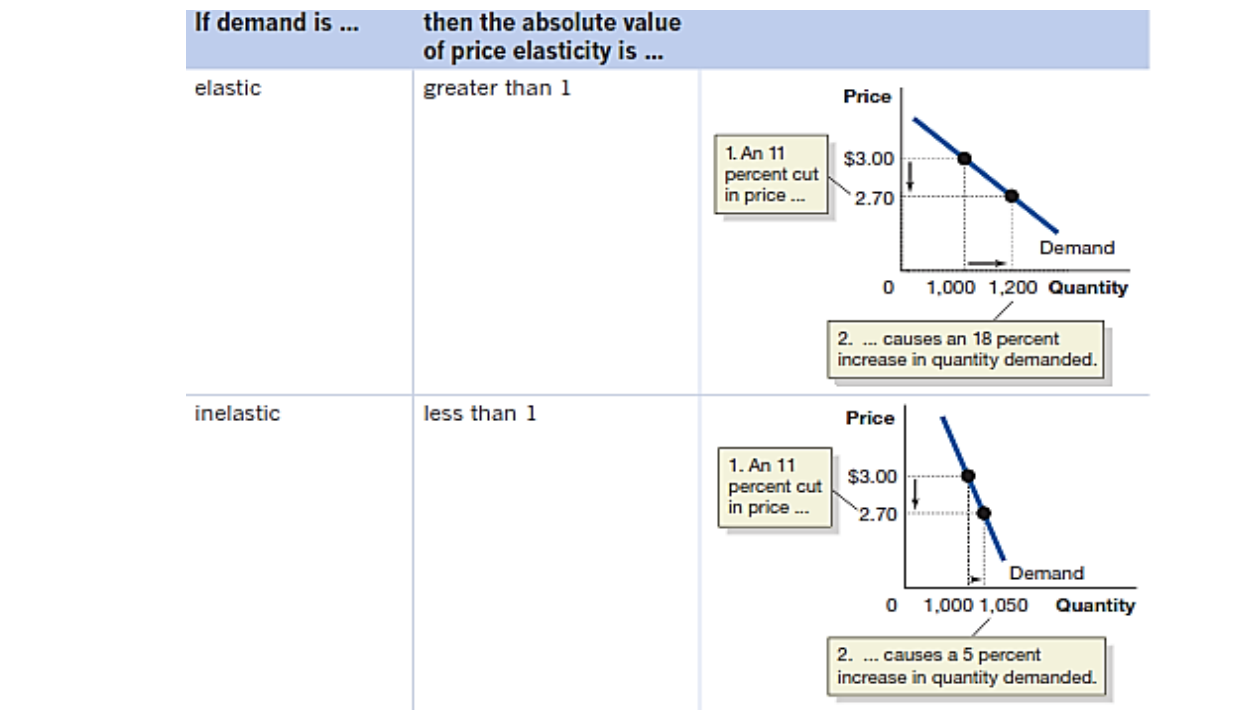
When the quantity demanded is not very responsive to price, however, the percentage change in quantity demanded will be less than the percentage change in price, and the price elasticity of demand will be less than 1 in absolute value.
📖 点击查看译文
然而,当需求量对价格变化的反应不太敏感时,需求量的百分比变化将小于价格的百分比变化,需求价格弹性的绝对值将小于1。
In this case, demand is inelastic.
📖 点击查看译文
在这种情况下,需求是非弹性的。
For example, if a 10 percent decrease in the price of wheat results in a 5 percent increase in the quantity of wheat demanded, then:
📖 点击查看译文
例如,如果小麦价格下降10%,而需求量增加5%,那么:
Price elasticity of demand = 5% / -10% = -0.5, and we can conclude that the demand for wheat is inelastic.
📖 点击查看译文
需求价格弹性 = 5% / -10% = -0.5,因此我们可以得出结论,小麦的需求是非弹性的。
In the special case where the percentage change in quantity demanded is equal to the percentage change in price, the price elasticity of demand equals -1 (or 1 in absolute value).
📖 点击查看译文
在特殊情况下,需求量的百分比变化等于价格的百分比变化,需求价格弹性等于-1(或绝对值为1)。
In this case, demand is unit elastic.
📖 点击查看译文
在这种情况下,需求是单位弹性的。
知识点列表与拓展 (Knowledge Points and Extensions):
1. Inelastic Demand (非弹性需求)
-
解释 (Explanation):
- When the absolute value of price elasticity of demand () is less than 1, demand is inelastic, meaning consumers are less sensitive to price changes.
(当需求价格弹性的绝对值小于1时,需求是非弹性的,意味着消费者对价格变化不太敏感。)
-
例子 (Example):
- If the price of gasoline rises by 15% but consumption falls by only 5%, the price elasticity of demand is , indicating inelastic demand.
(如果汽油价格上涨15%,但消费量仅下降5%,则需求价格弹性为-0.33,表明需求是非弹性的。)
-
拓展 (Extension):
Essential goods like medicine and staple foods tend to have inelastic demand since consumers continue buying them despite price changes.
(必需品如药品和主食的需求通常是非弹性的,因为即使价格变化,消费者仍会继续购买。)
2. Unit Elastic Demand (单位弹性需求)
-
解释 (Explanation):
- When the absolute value of price elasticity of demand () equals 1, demand is unit elastic, meaning the percentage change in quantity demanded equals the percentage change in price.
(当需求价格弹性的绝对值等于1时,需求是单位弹性的,意味着需求量的百分比变化等于价格的百分比变化。)
-
例子 (Example):
- If a 10% increase in the price of a product leads to a 10% decrease in quantity demanded, then the price elasticity of demand is , meaning demand is unit elastic.
(如果产品价格上涨10%,导致需求量下降10%,则需求价格弹性为-1,说明需求是单位弹性的。)
-
拓展 (Extension):
Unit elastic demand is rare but often assumed in economic models to simplify analysis.
(单位弹性需求较为罕见,但在经济模型中常被假设用于简化分析。)
7
An Example of Computing Price Elasticities (计算价格弹性的示例)
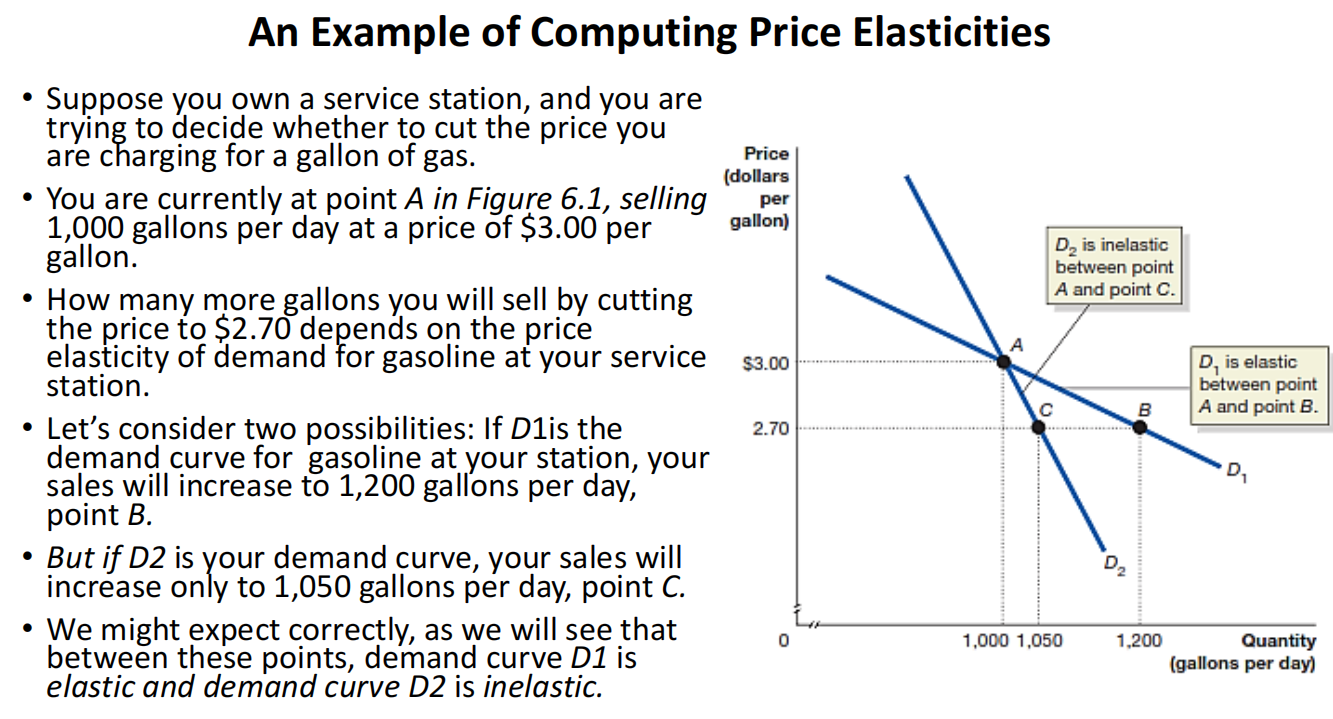
Suppose you own a service station, and you are trying to decide whether to cut the price you are charging for a gallon of gas.
📖 点击查看译文
假设你拥有一家加油站,并正在决定是否降低每加仑汽油的价格。
You are currently at point A in Figure 6.1, selling 1,000 gallons per day at a price of $3.00 per gallon.
📖 点击查看译文
目前,你位于图 6.1 的 A 点,每天以每加仑 3.00 美元的价格销售 1,000 加仑汽油。
How many more gallons you will sell by cutting the price to $2.70 depends on the price elasticity of demand for gasoline at your service station.
📖 点击查看译文
如果将价格降低至 2.70 美元,你能多卖出多少加仑取决于你加油站的汽油需求价格弹性。
Let’s consider two possibilities: If D1 is the demand curve for gasoline at your station, your sales will increase to 1,200 gallons per day, point B.
📖 点击查看译文
让我们考虑两种可能性:如果你的需求曲线是 D1,你的销量将增加到每天 1,200 加仑,即 B 点。
But if D2 is your demand curve, your sales will increase only to 1,050 gallons per day, point C.
📖 点击查看译文
但如果你的需求曲线是 D2,你的销量仅会增加到每天 1,050 加仑,即 C 点。
We might expect correctly, as we will see that between these points, demand curve D1 is elastic and demand curve D2 is inelastic.
📖 点击查看译文
我们可以合理地预期,在这些点之间,需求曲线 D1 是弹性的,而需求曲线 D2 是非弹性的。
知识点列表与拓展 (Knowledge Points and Extensions):
1. Elastic vs. Inelastic Demand (弹性需求 vs. 非弹性需求)
-
解释 (Explanation):
- If demand is elastic (), a price decrease leads to a proportionally larger increase in quantity demanded.
(如果需求是弹性的,即 ,价格下降会导致需求量的增长幅度更大。)
- If demand is inelastic (), a price decrease results in a proportionally smaller increase in quantity demanded.
(如果需求是非弹性的,即 ,价格下降导致的需求量增长幅度较小。)
-
例子 (Example):
- In the given scenario, a price drop from 2.70 increases sales to either 1,200 gallons (elastic demand) or 1,050 gallons (inelastic demand).
(在此情境下,价格从 3.00 美元降至 2.70 美元,销量可能增加到 1,200 加仑(弹性需求)或 1,050 加仑(非弹性需求)。)
-
拓展 (Extension):
Businesses use elasticity analysis to determine optimal pricing strategies. Products with inelastic demand can maintain higher prices without losing many customers, whereas elastic demand requires competitive pricing.
(企业利用弹性分析来制定最佳定价策略。非弹性需求的产品可以保持较高价格而不会失去太多顾客,而弹性需求的产品需要更具竞争力的价格。)
8
Calculating Price Elasticity Using the Midpoint Formula (使用中点公式计算价格弹性)
Suppose we calculate the price elasticity for D1 as the price is cut from 2.70.
📖 点击查看译文
假设我们计算 D1 的价格弹性,当价格从 3.00 美元降至 2.70 美元时。
The percentage change in price is 10% = (3.0 – 2.70)/3.0 × 100
📖 点击查看译文
价格的百分比变化为 10% = (3.0 – 2.70)/3.0 × 100。
This 10 percent price cut increases the quantity demanded from 1,000 gallons to 1,200 gallons, or by 20% = (1200 – 1000)/1000 × 100
📖 点击查看译文
这一 10% 的降价使需求量从 1,000 加仑增加到 1,200 加仑,变化幅度为 20% = (1200 – 1000)/1000 × 100。
Therefore, the price elasticity of demand between points A and B is 20% / -10% = -2.0.
📖 点击查看译文
因此,A 点和 B 点之间的需求价格弹性为 20% / -10% = -2.0。
Now let’s calculate the price elasticity for D1 as the price is increased from 3.00.
📖 点击查看译文
现在让我们计算 D1 的价格弹性,当价格从 2.70 美元上涨至 3.00 美元时。
The percentage change in price is 11.1% = (2.70 - 3.0)/2.70 × 100
📖 点击查看译文
价格的百分比变化为 11.1% = (2.70 - 3.0)/2.70 × 100。
This 11.1 percent price increase causes a decrease in the quantity demanded from 1,200 gallons to 1,000 gallons, or by 16.7% = (1000 -1200)/1200 × 100
📖 点击查看译文
这一 11.1% 的涨价导致需求量从 1,200 加仑减少到 1,000 加仑,变化幅度为 16.7% = (1000 -1200)/1200 × 100。
So, now our measure of the price elasticity of demand between points A and B is -16.7% / 11.1% = -1.5.
📖 点击查看译文
因此,我们现在计算出的 A 点和 B 点之间的需求价格弹性为 -16.7% / 11.1% = -1.5。
It can be confusing to have different values for the price elasticity of demand between the same two points on the same demand curve.
📖 点击查看译文
在同一条需求曲线上的两个相同点之间,价格弹性的值不同可能会让人感到困惑。
Economists use a formula that allows them to avoid this confusion when calculating elasticities.
📖 点击查看译文
经济学家使用一种公式来避免这种计算弹性时的困惑。
知识点列表与拓展 (Knowledge Points and Extensions):
1. The Midpoint Formula (中点公式)
-
解释 (Explanation):
- To avoid inconsistent elasticity values, economists use the midpoint formula to calculate price elasticity of demand:
(为避免计算出不同的弹性值,经济学家使用中点公式计算需求价格弹性:)
-
例子 (Example):
- Using the midpoint formula, the elasticity is consistent whether price increases or decreases.
(使用中点公式,无论价格上升还是下降,计算出的弹性值都保持一致。)
-
拓展 (Extension):
The midpoint formula is widely used in real-world applications, such as business pricing strategies and tax policy analysis.
(中点公式广泛应用于现实世界,例如企业定价策略和税收政策分析。)
9
Price Elasticity of Demand Along Different Demand Curves (不同需求曲线上的价格弹性)
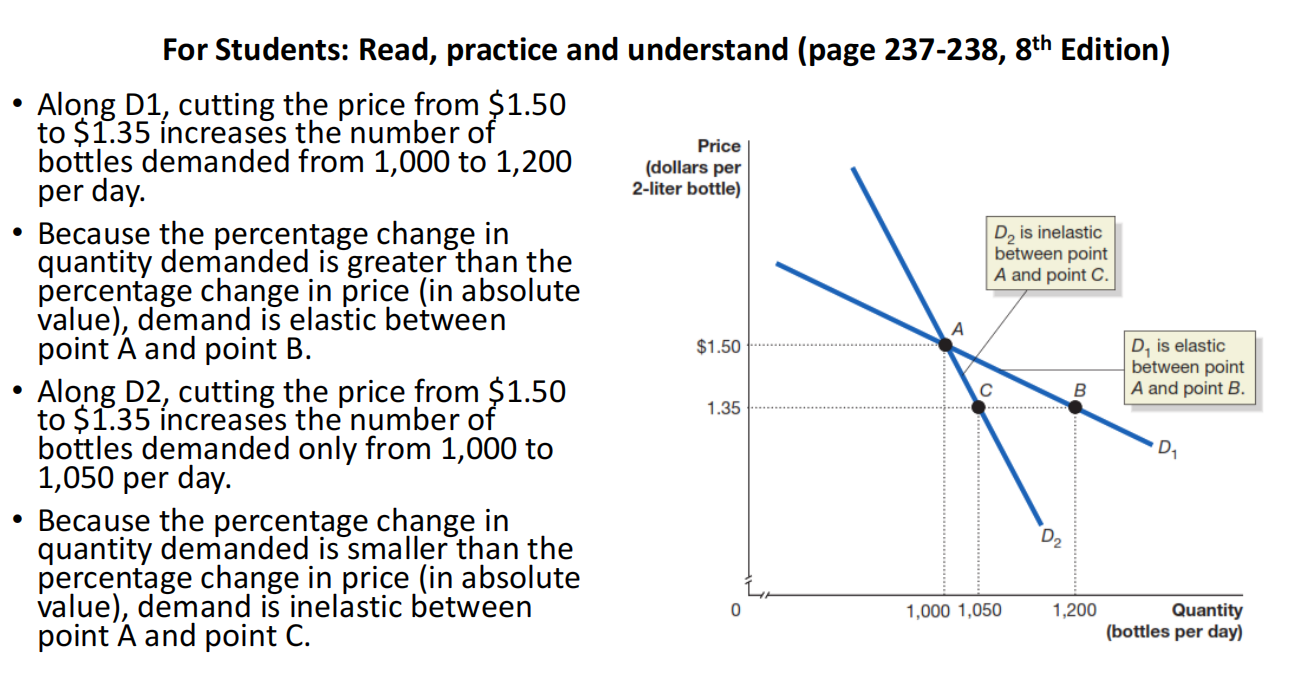
Along D1, cutting the price from 1.35 increases the number of bottles demanded from 1,000 to 1,200 per day.
📖 点击查看译文
在 D1 上,将价格从 1.50 美元降至 1.35 美元,使每日需求瓶数从 1,000 增加到 1,200。
Because the percentage change in quantity demanded is greater than the percentage change in price (in absolute value), demand is elastic between point A and point B.
📖 点击查看译文
由于需求量的百分比变化(绝对值)大于价格的百分比变化,因此在 A 点和 B 点之间,需求是弹性的。
Along D2, cutting the price from 1.35 increases the number of bottles demanded only from 1,000 to 1,050 per day.
📖 点击查看译文
在 D2 上,将价格从 1.50 美元降至 1.35 美元,使每日需求瓶数仅从 1,000 增加到 1,050。
Because the percentage change in quantity demanded is smaller than the percentage change in price (in absolute value), demand is inelastic between point A and point C.
📖 点击查看译文
由于需求量的百分比变化(绝对值)小于价格的百分比变化,因此在 A 点和 C 点之间,需求是无弹性的。
知识点列表与拓展 (Knowledge Points and Extensions):
1. Price Elasticity of Demand and Elastic vs. Inelastic Demand (需求价格弹性:弹性需求 vs. 无弹性需求)
-
解释 (Explanation):
-
If |E_d| > 1, demand is elastic: Consumers respond significantly to price changes.
(如果 |E_d| > 1,需求是弹性的:消费者对价格变化反应较大。)
-
If |E_d| < 1, demand is inelastic: Consumers do not change their demand much when price changes.
(如果 |E_d| < 1,需求是无弹性的:消费者对价格变化反应较小。)
-
-
例子 (Example):
-
Elastic Demand: Luxury goods, electronics, and restaurant meals.
(**弹性需求:**奢侈品、电子产品和餐馆餐饮。)
-
Inelastic Demand: Necessities like water, salt, and basic food items.
(**无弹性需求:**生活必需品,如水、盐和基本食品。)
-
-
拓展 (Extension):
Businesses use elasticity analysis to set optimal pricing strategies, and governments consider elasticity when imposing taxes.
(企业利用弹性分析制定最佳定价策略,政府在征税时也会考虑价格弹性。)
10
The Midpoint Formula for Elasticity (弹性的中点公式)
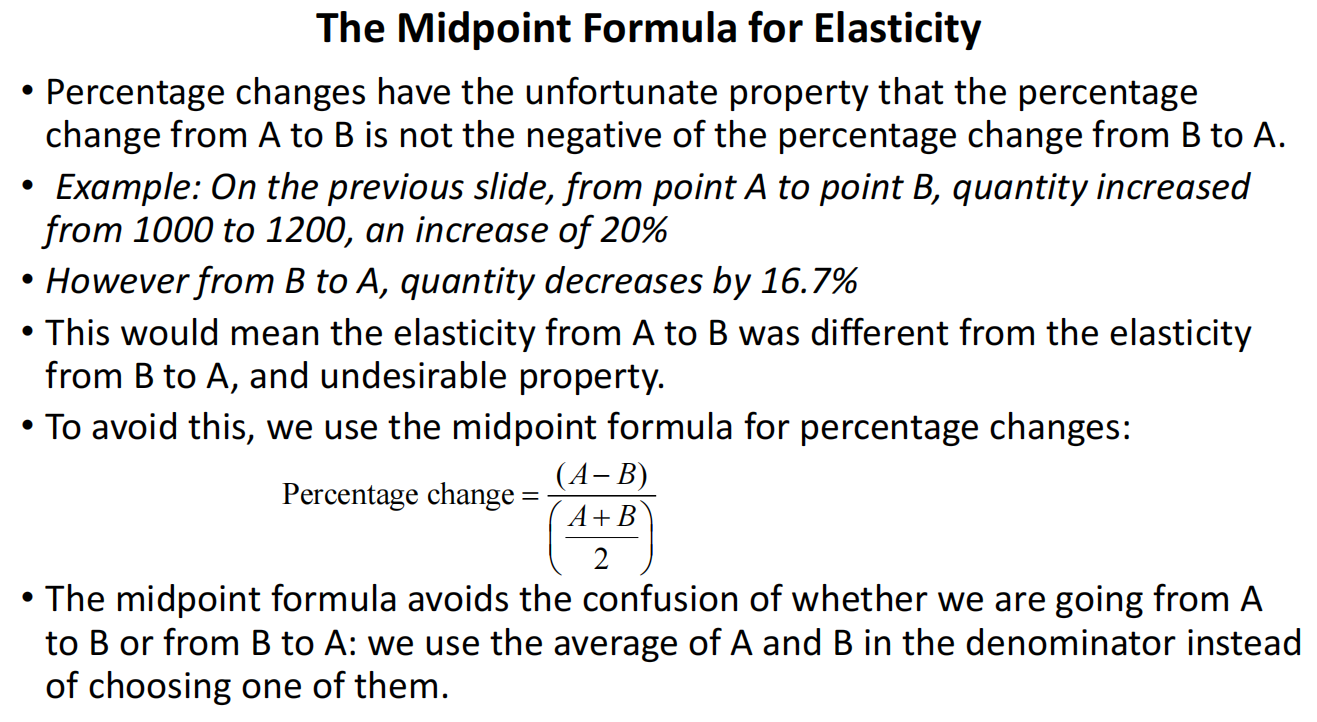
Percentage changes have the unfortunate property that the percentage change from A to B is not the negative of the percentage change from B to A.
📖 点击查看译文
百分比变化具有一个不理想的特性,即从 A 到 B 的百分比变化与从 B 到 A 的百分比变化并不互为相反数。
Example: On the previous slide, from point A to point B, quantity increased from 1000 to 1200, an increase of 20%.
📖 点击查看译文
例如:在前一页幻灯片中,从 A 点到 B 点,数量从 1000 增加到 1200,增加了 20%。
However, from B to A, quantity decreases by 16.7%.
📖 点击查看译文
然而,从 B 点到 A 点,数量减少了 16.7%。
This would mean the elasticity from A to B was different from the elasticity from B to A, an undesirable property.
📖 点击查看译文
这意味着从 A 到 B 的弹性与从 B 到 A 的弹性不同,这是一个不理想的特性。
To avoid this, we use the midpoint formula for percentage changes:
📖 点击查看译文
为避免这种情况,我们使用百分比变化的中点公式:
The midpoint formula avoids the confusion of whether we are going from A to B or from B to A: we use the average of A and B in the denominator instead of choosing one of them.
📖 点击查看译文
中点公式避免了 A 到 B 和 B 到 A 计算值不同的问题:在分母中使用 A 和 B 的平均值,而不是选择其中之一。
知识点列表与拓展 (Knowledge Points and Extensions):
1. The Midpoint Formula for Elasticity (弹性计算的中点公式)
- 公式 (Formula):
(其中, 为需求量, 为价格。)
-
优点 (Advantages):
-
计算出的弹性值在 A → B 和 B → A 之间是相同的,避免了方向带来的影响。
-
更准确地衡量需求对价格的敏感程度。
-
-
拓展 (Extension):
许多经济学家和市场分析师在计算需求弹性时采用中点公式,以确保结果一致并减少计算偏差。
11
Price Elasticity of Demand Calculation (需求价格弹性的计算)
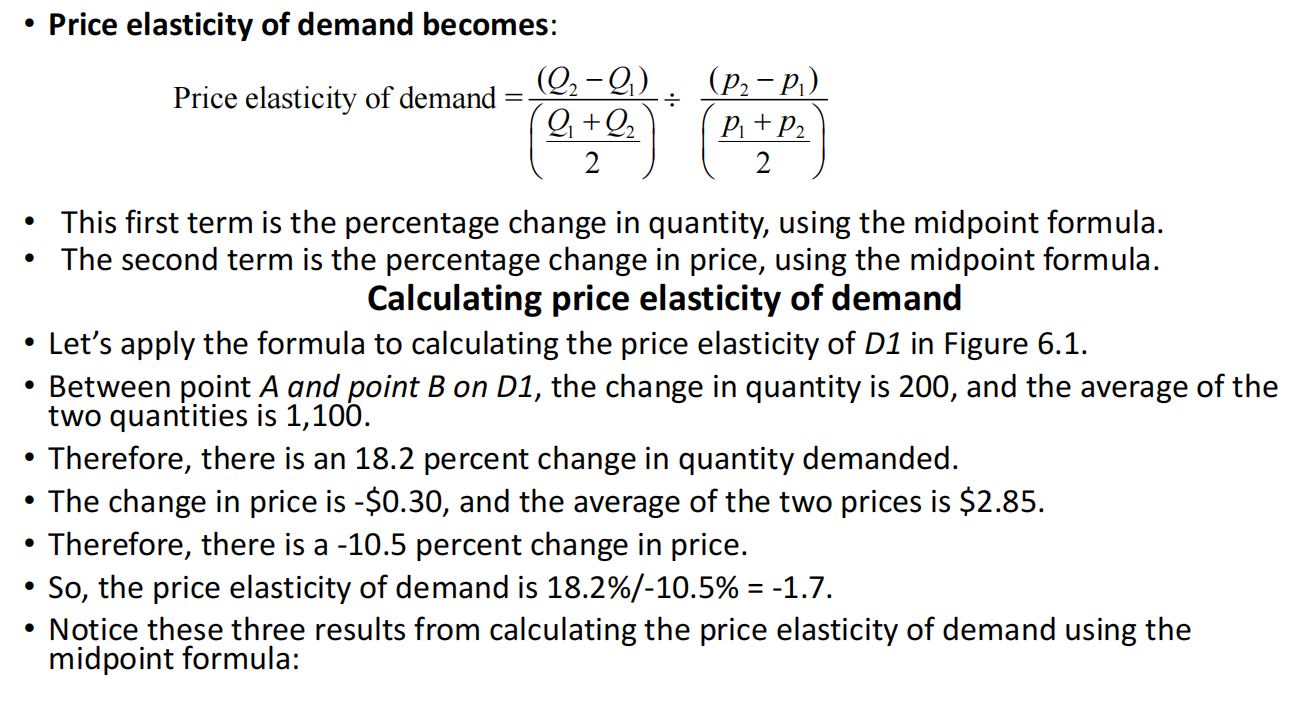
Price elasticity of demand becomes:
📖 点击查看译文
需求价格弹性计算如下:
• This first term is the percentage change in quantity, using the midpoint formula.
📖 点击查看译文
• 第一个部分是数量的百分比变化,使用中点公式计算。
• The second term is the percentage change in price, using the midpoint formula.
📖 点击查看译文
• 第二个部分是价格的百分比变化,使用中点公式计算。
Calculating price elasticity of demand
📖 点击查看译文
计算需求价格弹性
• Let’s apply the formula to calculating the price elasticity of D1 in Figure 6.1.
📖 点击查看译文
• 让我们将公式应用于计算图 6.1 中 D1 的需求价格弹性。
• Between point A and point B on D1, the change in quantity is 200, and the average of the two quantities is 1,100.
📖 点击查看译文
• 在 D1 的 A 点和 B 点之间,数量变化为 200,两个数量的平均值是 1,100。
• Therefore, there is an 18.2 percent change in quantity demanded.
📖 点击查看译文
• 因此,需求量的百分比变化为 18.2%。
• The change in price is -2.85.
📖 点击查看译文
• 价格变化为 -2.85。
• Therefore, there is a -10.5 percent change in price.
📖 点击查看译文
• 因此,价格的百分比变化为 -10.5%。
• So, the price elasticity of demand is 18.2%/-10.5% = -1.7.
📖 点击查看译文
• 因此,需求价格弹性为 18.2% / -10.5% = -1.7。
• Notice these three results from calculating the price elasticity of demand using the midpoint formula:
📖 点击查看译文
• 使用中点公式计算需求价格弹性时,需要注意以下三个结果:
知识点列表与拓展 (Knowledge Points and Extensions):
1. Price Elasticity of Demand Calculation (需求价格弹性的计算公式)
- 公式 (Formula):
其中:
-
是需求量,
-
是价格,
-
代表需求价格弹性。
2. 结果分析 (Result Analysis)
-
当 → 需求是弹性 (elastic) 的,即价格变化导致需求量较大幅度的变化。
-
当 → 需求是非弹性 (inelastic) 的,即价格变化对需求量影响较小。
-
当 → 需求是单位弹性 (unit elastic) 的,即价格和需求量的变化比例相同。
3. 拓展 (Extension):
-
需求弹性与市场结构、消费者偏好、商品替代性等因素密切相关。
-
生活必需品通常需求缺乏弹性,而奢侈品则具有较高弹性。
12
Key Points on Price Elasticity of Demand (需求价格弹性的关键点)
• Important to Note:
📖 点击查看译文
• 重要须知:
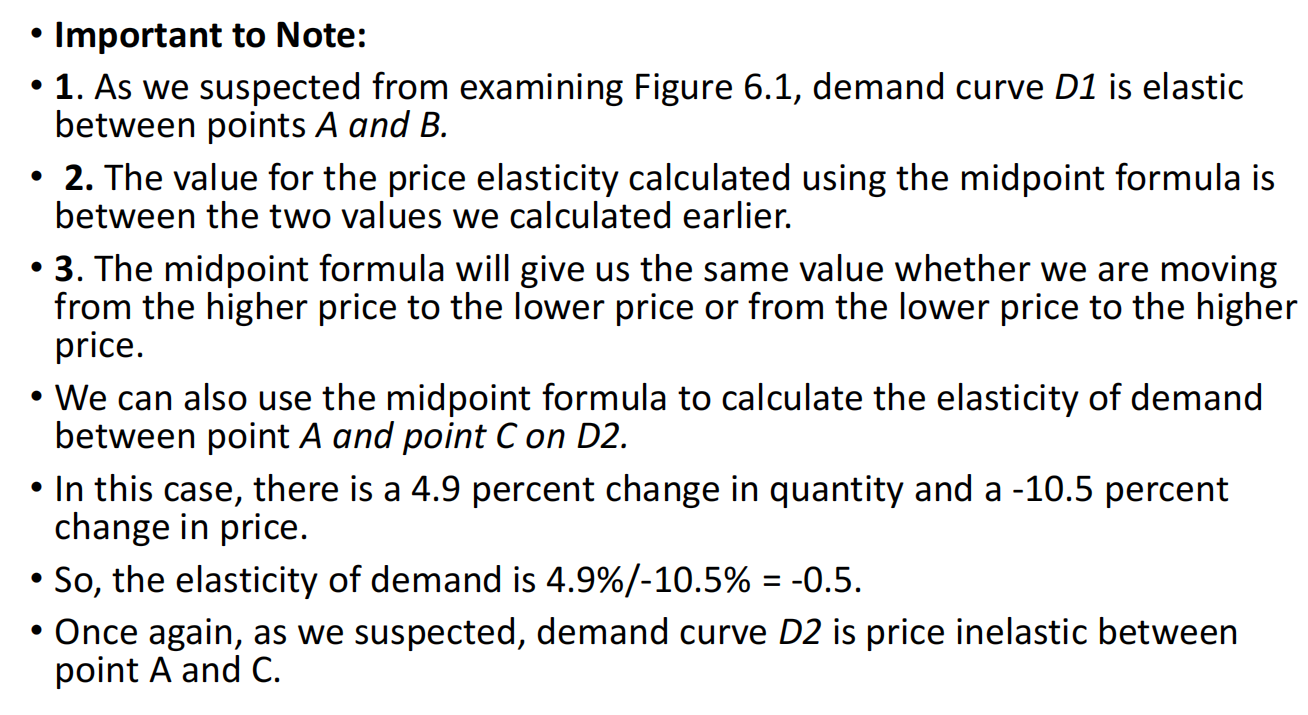
1. As we suspected from examining Figure 6.1, demand curve D1 is elastic between points A and B.
📖 点击查看译文
1. 正如我们从图 6.1 所观察到的,需求曲线 D1 在 A 点和 B 点之间是弹性的。
2. The value for the price elasticity calculated using the midpoint formula is between the two values we calculated earlier.
📖 点击查看译文
2. 使用中点公式计算的需求价格弹性值介于之前计算的两个值之间。
3. The midpoint formula will give us the same value whether we are moving from the higher price to the lower price or from the lower price to the higher price.
📖 点击查看译文
3. 无论是从高价格向低价格变动,还是从低价格向高价格变动,中点公式计算的弹性值都是相同的。
• We can also use the midpoint formula to calculate the elasticity of demand between point A and point C on D2.
📖 点击查看译文
• 我们还可以使用中点公式计算 D2 上 A 点和 C 点之间的需求弹性。
• In this case, there is a 4.9 percent change in quantity and a -10.5 percent change in price.
📖 点击查看译文
• 在这种情况下,数量变化为 4.9%,价格变化为 -10.5%。
• So, the elasticity of demand is 4.9%/-10.5% = -0.5.
📖 点击查看译文
• 因此,需求价格弹性为 4.9% / -10.5% = -0.5。
• Once again, as we suspected, demand curve D2 is price inelastic between point A and C.
📖 点击查看译文
• 再次验证,我们推测的结果正确,需求曲线 D2 在 A 点和 C 点之间是非弹性的。
知识点列表与拓展 (Knowledge Points and Extensions):
1. The Importance of the Midpoint Formula (中点公式的重要性)
-
解决了从 A 到 B 和从 B 到 A 计算弹性值不一致的问题。
-
使弹性计算结果在不同价格变动方向下保持一致性。
2. Elastic vs. Inelastic Demand (弹性需求 vs. 非弹性需求)
-
D1 (A → B): 弹性需求 ()
-
D2 (A → C): 非弹性需求 ()
3. Practical Implications (实际应用)
-
了解价格弹性有助于企业制定定价策略。
-
弹性需求商品 → 降价可增加销售额。
-
非弹性需求商品 → 涨价不会导致销量大幅下降。
13
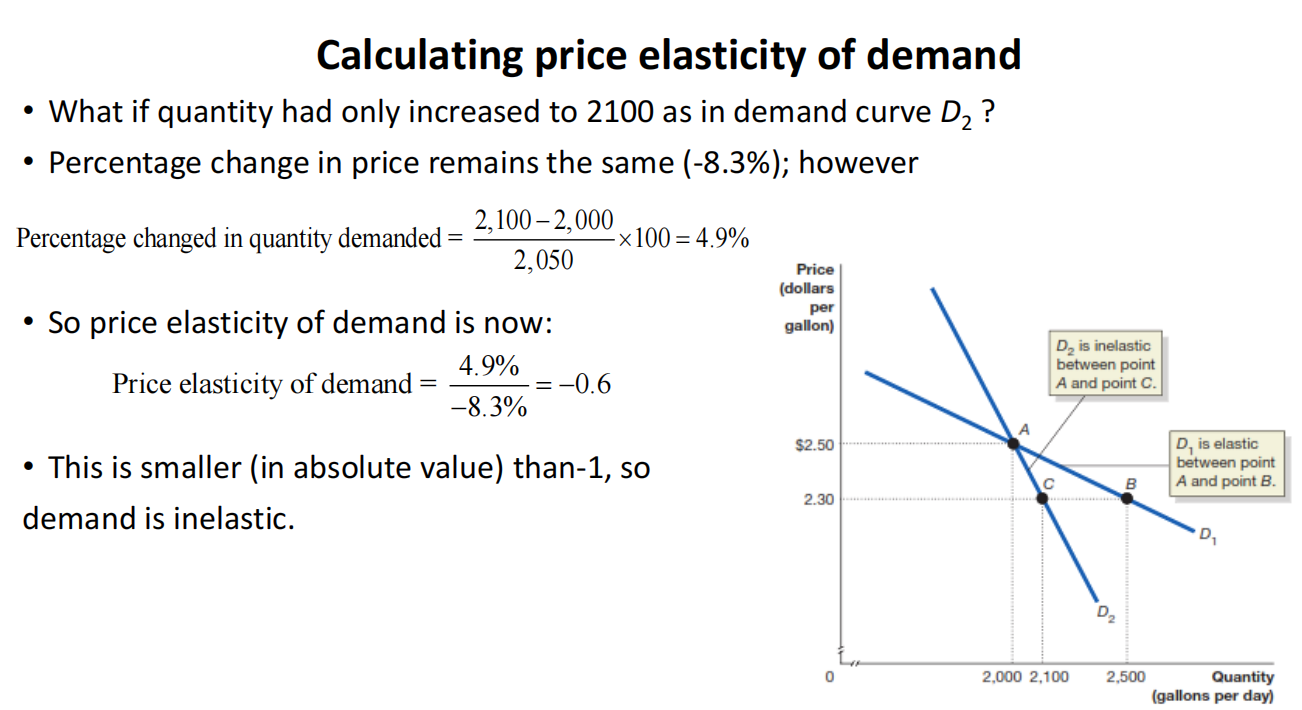
Calculating Price Elasticity of Demand (计算需求价格弹性)
Step 1: Compute Percentage Changes (计算百分比变化)
- Change in Quantity (数量变化):
- Change in Price (价格变化):
Step 2: Compute Price Elasticity of Demand (计算需求价格弹性公式)
Conclusion (结论)
Since , the demand is elastic in this case.
由于,需求是弹性的。
14
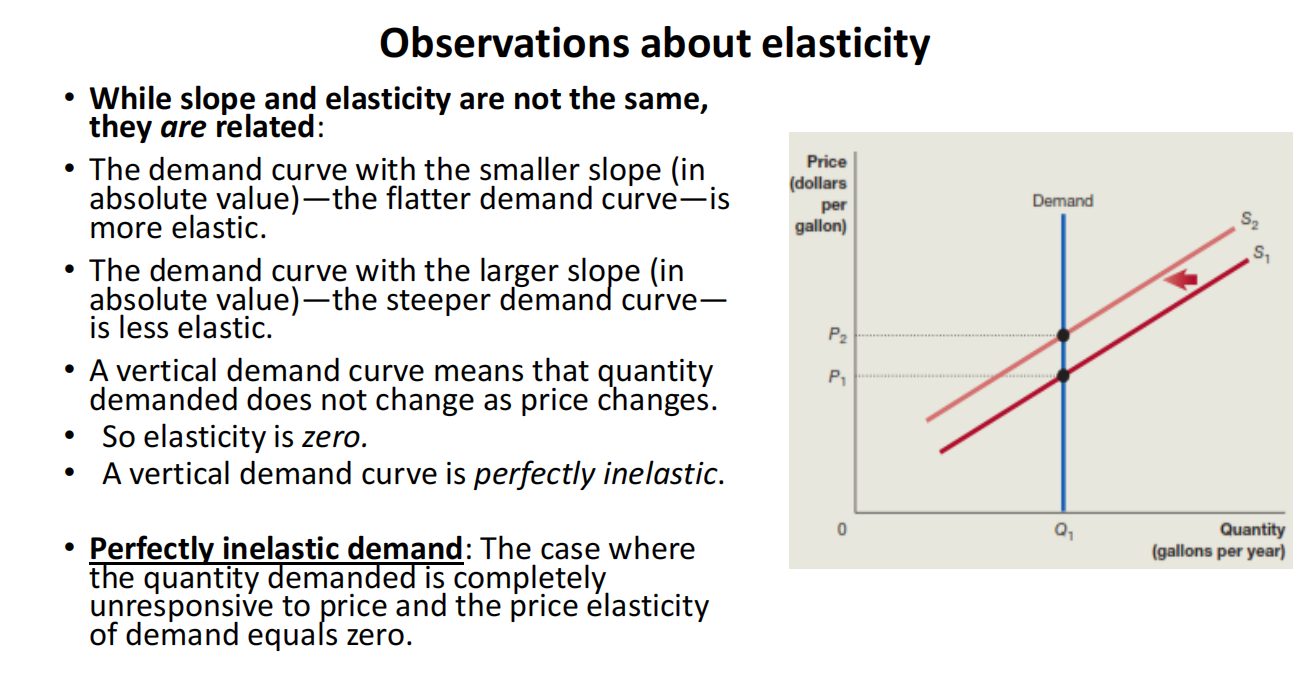
Observations about Elasticity (关于弹性的观察)
While slope and elasticity are not the same, they are related.
📖 点击查看译文
虽然斜率和弹性并不相同,但它们是相关的。
The demand curve with the smaller slope (in absolute value)—the flatter demand curve—is more elastic.
📖 点击查看译文
斜率较小(绝对值较小)的需求曲线,即较平坦的需求曲线,更具弹性。
The demand curve with the larger slope (in absolute value)—the steeper demand curve—is less elastic.
📖 点击查看译文
斜率较大(绝对值较大)的需求曲线,即较陡峭的需求曲线,弹性较小。
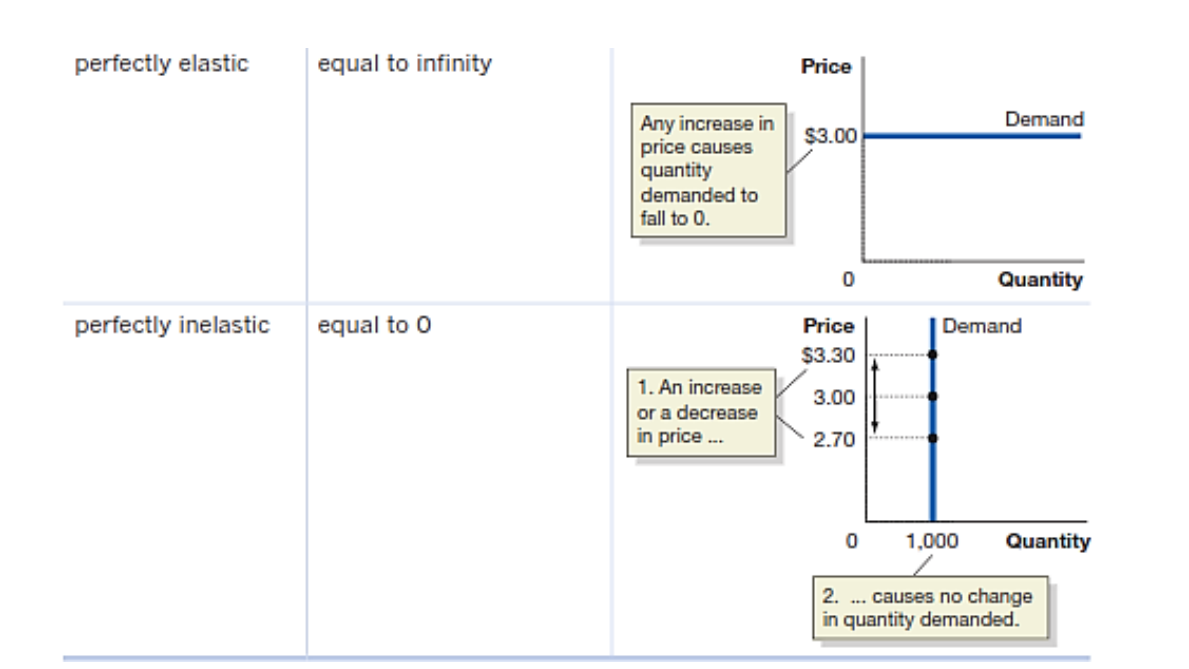
A vertical demand curve means that quantity demanded does not change as price changes.
📖 点击查看译文
垂直的需求曲线意味着无论价格如何变化,需求数量都不会改变。
So elasticity is zero.
📖 点击查看译文
因此,弹性为零。
A vertical demand curve is perfectly inelastic.
📖 点击查看译文
垂直的需求曲线表示需求完全无弹性。
Perfectly inelastic demand: The case where the quantity demanded is completely unresponsive to price and the price elasticity of demand equals zero.
📖 点击查看译文
完全无弹性的需求:即无论价格如何变化,需求数量都不会变化,此时需求价格弹性等于零。
知识点列表与拓展 (Knowledge Points and Extensions):
1. Relationship Between Slope and Elasticity (斜率与弹性的关系)
-
解释 (Explanation):
While slope measures the rate of change in price relative to quantity, elasticity measures the percentage change in quantity relative to price.
(斜率衡量的是价格相对于数量的变化率,而弹性衡量的是数量相对于价格的百分比变化。)
-
例子 (Example):
A steep demand curve (large slope) for necessities like insulin indicates low elasticity, while a flatter demand curve (small slope) for luxury goods like designer bags indicates high elasticity.
(必需品如胰岛素的需求曲线较陡峭(斜率较大),表明弹性较低,而奢侈品如设计师包的需求曲线较平缓(斜率较小),表明弹性较高。)
-
拓展 (Extension):
Firms use knowledge of elasticity to set pricing strategies, maximizing revenue by adjusting prices based on demand sensitivity.
(企业利用弹性知识制定定价策略,通过根据需求敏感性调整价格来最大化收入。)
2. Perfectly Inelastic Demand (完全无弹性的需求)
-
解释 (Explanation):
When demand is perfectly inelastic, consumers will buy the same amount regardless of price changes.
(当需求完全无弹性时,无论价格如何变化,消费者购买的数量都不会改变。)
-
例子 (Example):
Life-saving medications like insulin often exhibit perfectly inelastic demand because patients need them regardless of price.
(如胰岛素等救命药通常表现出完全无弹性的需求,因为患者无论价格如何都必须购买。)
-
拓展 (Extension):
Government policies often regulate the prices of inelastic goods to prevent excessive pricing that could harm consumers.
(政府通常会对无弹性商品的价格进行监管,以防止过高的定价损害消费者利益。)
15
Observations about Elasticity (关于弹性的观察)
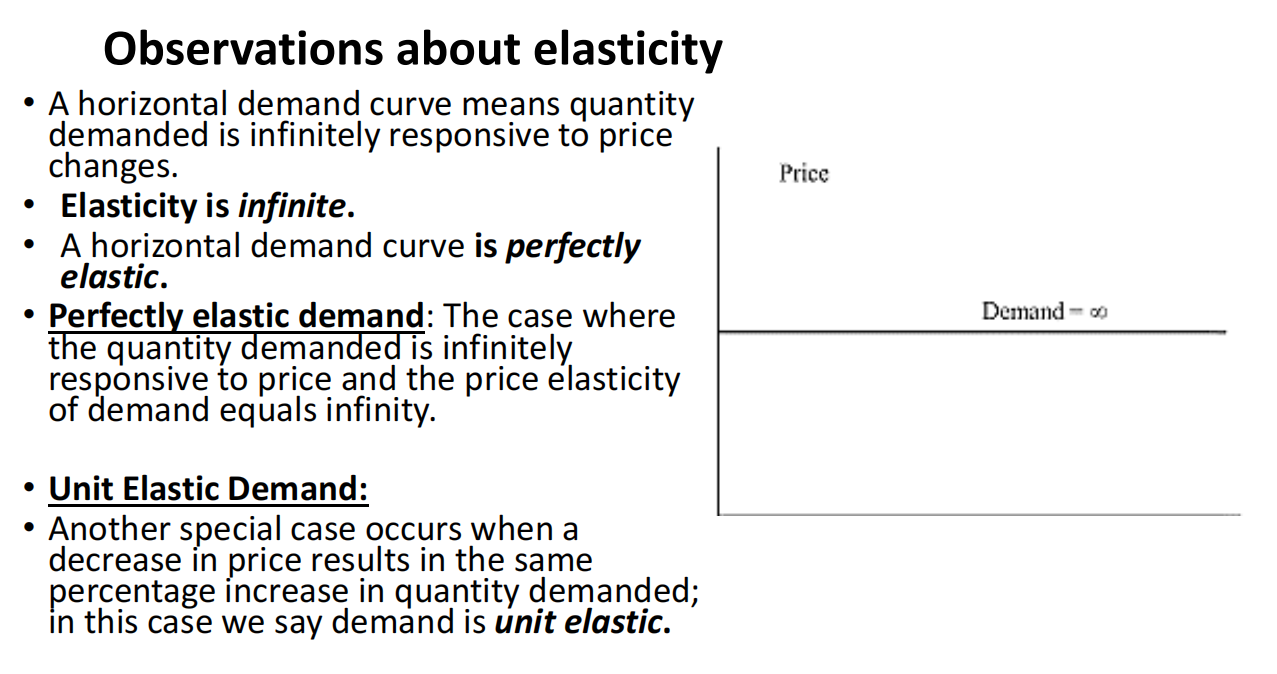
A horizontal demand curve means quantity demanded is infinitely responsive to price changes.
📖 点击查看译文
水平的需求曲线意味着需求数量对价格变化具有无限的响应能力。
Elasticity is infinite.
📖 点击查看译文
弹性为无穷大。
A horizontal demand curve is perfectly elastic.
📖 点击查看译文
水平的需求曲线表示需求完全有弹性。
Perfectly elastic demand: The case where the quantity demanded is infinitely responsive to price and the price elasticity of demand equals infinity.
📖 点击查看译文
完全有弹性的需求:即需求数量对价格变化具有无限的响应能力,此时需求价格弹性等于无穷大。
Unit Elastic Demand:
📖 点击查看译文
单位弹性需求:
Another special case occurs when a decrease in price results in the same percentage increase in quantity demanded; in this case, we say demand is unit elastic.
📖 点击查看译文
当价格下降导致需求数量按相同比例增加时,我们称需求为单位弹性。
知识点列表与拓展 (Knowledge Points and Extensions):
1. Perfectly Elastic Demand (完全有弹性的需求)
-
解释 (Explanation):
In a perfectly elastic market, even the slightest change in price leads to an infinite change in quantity demanded.
(在完全有弹性的市场中,即使价格发生极小的变化,需求数量也会发生无限变化。)
-
例子 (Example):
A highly competitive market, such as agricultural products sold at a fixed price, can exhibit nearly perfect elasticity.
(高度竞争的市场,如以固定价格出售的农产品,可能表现出接近完全弹性的需求。)
-
拓展 (Extension):
In perfect competition, firms are price takers because consumers will switch to alternatives if prices rise.
(在完全竞争市场中,企业是价格接受者,因为如果价格上涨,消费者会立刻转向替代品。)
2. Unit Elastic Demand (单位弹性需求)
-
解释 (Explanation):
When demand is unit elastic, total revenue remains unchanged as price changes.
(当需求是单位弹性时,价格变化不会影响总收入。)
-
例子 (Example):
If a store reduces the price of a product by 10% and sales increase by exactly 10%, the demand is unit elastic.
(如果商店将某商品的价格降低 10%,同时销量恰好增加 10%,则该商品的需求为单位弹性。)
-
拓展 (Extension):
Unit elastic demand is crucial in pricing strategies where businesses aim to maintain stable revenue while adjusting prices.
(单位弹性需求在定价策略中至关重要,企业希望在调整价格的同时保持稳定的收入。)
16
17
18
然而,当需求量对价格变化的反应不太敏感时,需求量的百分比变化将小于价格的百分比变化,需求价格弹性的绝对值将小于1。
In this case, demand is inelastic.
📖 点击查看译文
在这种情况下,需求是非弹性的。
For example, if a 10 percent decrease in the price of wheat results in a 5 percent increase in the quantity of wheat demanded, then:
📖 点击查看译文
例如,如果小麦价格下降10%,而需求量增加5%,那么:
Price elasticity of demand = 5% / -10% = -0.5, and we can conclude that the demand for wheat is inelastic.
📖 点击查看译文
需求价格弹性 = 5% / -10% = -0.5,因此我们可以得出结论,小麦的需求是非弹性的。
In the special case where the percentage change in quantity demanded is equal to the percentage change in price, the price elasticity of demand equals -1 (or 1 in absolute value).
📖 点击查看译文
在特殊情况下,需求量的百分比变化等于价格的百分比变化,需求价格弹性等于-1(或绝对值为1)。
In this case, demand is unit elastic.
📖 点击查看译文
在这种情况下,需求是单位弹性的。
知识点列表与拓展 (Knowledge Points and Extensions):
1. Inelastic Demand (非弹性需求)
-
解释 (Explanation):
- When the absolute value of price elasticity of demand () is less than 1, demand is inelastic, meaning consumers are less sensitive to price changes.
(当需求价格弹性的绝对值小于1时,需求是非弹性的,意味着消费者对价格变化不太敏感。)
-
例子 (Example):
- If the price of gasoline rises by 15% but consumption falls by only 5%, the price elasticity of demand is , indicating inelastic demand.
(如果汽油价格上涨15%,但消费量仅下降5%,则需求价格弹性为-0.33,表明需求是非弹性的。)
-
拓展 (Extension):
Essential goods like medicine and staple foods tend to have inelastic demand since consumers continue buying them despite price changes.
(必需品如药品和主食的需求通常是非弹性的,因为即使价格变化,消费者仍会继续购买。)
2. Unit Elastic Demand (单位弹性需求)
-
解释 (Explanation):
- When the absolute value of price elasticity of demand () equals 1, demand is unit elastic, meaning the percentage change in quantity demanded equals the percentage change in price.
(当需求价格弹性的绝对值等于1时,需求是单位弹性的,意味着需求量的百分比变化等于价格的百分比变化。)
-
例子 (Example):
- If a 10% increase in the price of a product leads to a 10% decrease in quantity demanded, then the price elasticity of demand is , meaning demand is unit elastic.
(如果产品价格上涨10%,导致需求量下降10%,则需求价格弹性为-1,说明需求是单位弹性的。)
-
拓展 (Extension):
Unit elastic demand is rare but often assumed in economic models to simplify analysis.
(单位弹性需求较为罕见,但在经济模型中常被假设用于简化分析。)
7

An Example of Computing Price Elasticities (计算价格弹性的示例)
Suppose you own a service station, and you are trying to decide whether to cut the price you are charging for a gallon of gas.
📖 点击查看译文
假设你拥有一家加油站,并正在决定是否降低每加仑汽油的价格。
You are currently at point A in Figure 6.1, selling 1,000 gallons per day at a price of $3.00 per gallon.
📖 点击查看译文
目前,你位于图 6.1 的 A 点,每天以每加仑 3.00 美元的价格销售 1,000 加仑汽油。
How many more gallons you will sell by cutting the price to $2.70 depends on the price elasticity of demand for gasoline at your service station.
📖 点击查看译文
如果将价格降低至 2.70 美元,你能多卖出多少加仑取决于你加油站的汽油需求价格弹性。
Let’s consider two possibilities: If D1 is the demand curve for gasoline at your station, your sales will increase to 1,200 gallons per day, point B.
📖 点击查看译文
让我们考虑两种可能性:如果你的需求曲线是 D1,你的销量将增加到每天 1,200 加仑,即 B 点。
But if D2 is your demand curve, your sales will increase only to 1,050 gallons per day, point C.
📖 点击查看译文
但如果你的需求曲线是 D2,你的销量仅会增加到每天 1,050 加仑,即 C 点。
We might expect correctly, as we will see that between these points, demand curve D1 is elastic and demand curve D2 is inelastic.
📖 点击查看译文
我们可以合理地预期,在这些点之间,需求曲线 D1 是弹性的,而需求曲线 D2 是非弹性的。
知识点列表与拓展 (Knowledge Points and Extensions):
1. Elastic vs. Inelastic Demand (弹性需求 vs. 非弹性需求)
-
解释 (Explanation):
- If demand is elastic (), a price decrease leads to a proportionally larger increase in quantity demanded.
(如果需求是弹性的,即 ,价格下降会导致需求量的增长幅度更大。)
- If demand is inelastic (), a price decrease results in a proportionally smaller increase in quantity demanded.
(如果需求是非弹性的,即 ,价格下降导致的需求量增长幅度较小。)
-
例子 (Example):
- In the given scenario, a price drop from 2.70 increases sales to either 1,200 gallons (elastic demand) or 1,050 gallons (inelastic demand).
(在此情境下,价格从 3.00 美元降至 2.70 美元,销量可能增加到 1,200 加仑(弹性需求)或 1,050 加仑(非弹性需求)。)
-
拓展 (Extension):
Businesses use elasticity analysis to determine optimal pricing strategies. Products with inelastic demand can maintain higher prices without losing many customers, whereas elastic demand requires competitive pricing.
(企业利用弹性分析来制定最佳定价策略。非弹性需求的产品可以保持较高价格而不会失去太多顾客,而弹性需求的产品需要更具竞争力的价格。)
8

Calculating Price Elasticity Using the Midpoint Formula (使用中点公式计算价格弹性)
Suppose we calculate the price elasticity for D1 as the price is cut from 2.70.
📖 点击查看译文
假设我们计算 D1 的价格弹性,当价格从 3.00 美元降至 2.70 美元时。
The percentage change in price is 10% = (3.0 – 2.70)/3.0 × 100
📖 点击查看译文
价格的百分比变化为 10% = (3.0 – 2.70)/3.0 × 100。
This 10 percent price cut increases the quantity demanded from 1,000 gallons to 1,200 gallons, or by 20% = (1200 – 1000)/1000 × 100
📖 点击查看译文
这一 10% 的降价使需求量从 1,000 加仑增加到 1,200 加仑,变化幅度为 20% = (1200 – 1000)/1000 × 100。
Therefore, the price elasticity of demand between points A and B is 20% / -10% = -2.0.
📖 点击查看译文
因此,A 点和 B 点之间的需求价格弹性为 20% / -10% = -2.0。
Now let’s calculate the price elasticity for D1 as the price is increased from 3.00.
📖 点击查看译文
现在让我们计算 D1 的价格弹性,当价格从 2.70 美元上涨至 3.00 美元时。
The percentage change in price is 11.1% = (2.70 - 3.0)/2.70 × 100
📖 点击查看译文
价格的百分比变化为 11.1% = (2.70 - 3.0)/2.70 × 100。
This 11.1 percent price increase causes a decrease in the quantity demanded from 1,200 gallons to 1,000 gallons, or by 16.7% = (1000 -1200)/1200 × 100
📖 点击查看译文
这一 11.1% 的涨价导致需求量从 1,200 加仑减少到 1,000 加仑,变化幅度为 16.7% = (1000 -1200)/1200 × 100。
So, now our measure of the price elasticity of demand between points A and B is -16.7% / 11.1% = -1.5.
📖 点击查看译文
因此,我们现在计算出的 A 点和 B 点之间的需求价格弹性为 -16.7% / 11.1% = -1.5。
It can be confusing to have different values for the price elasticity of demand between the same two points on the same demand curve.
📖 点击查看译文
在同一条需求曲线上的两个相同点之间,价格弹性的值不同可能会让人感到困惑。
Economists use a formula that allows them to avoid this confusion when calculating elasticities.
📖 点击查看译文
经济学家使用一种公式来避免这种计算弹性时的困惑。
知识点列表与拓展 (Knowledge Points and Extensions):
1. The Midpoint Formula (中点公式)
-
解释 (Explanation):
- To avoid inconsistent elasticity values, economists use the midpoint formula to calculate price elasticity of demand:
(为避免计算出不同的弹性值,经济学家使用中点公式计算需求价格弹性:)
-
例子 (Example):
- Using the midpoint formula, the elasticity is consistent whether price increases or decreases.
(使用中点公式,无论价格上升还是下降,计算出的弹性值都保持一致。)
-
拓展 (Extension):
The midpoint formula is widely used in real-world applications, such as business pricing strategies and tax policy analysis.
(中点公式广泛应用于现实世界,例如企业定价策略和税收政策分析。)
9

Price Elasticity of Demand Along Different Demand Curves (不同需求曲线上的价格弹性)
Along D1, cutting the price from 1.35 increases the number of bottles demanded from 1,000 to 1,200 per day.
📖 点击查看译文
在 D1 上,将价格从 1.50 美元降至 1.35 美元,使每日需求瓶数从 1,000 增加到 1,200。
Because the percentage change in quantity demanded is greater than the percentage change in price (in absolute value), demand is elastic between point A and point B.
📖 点击查看译文
由于需求量的百分比变化(绝对值)大于价格的百分比变化,因此在 A 点和 B 点之间,需求是弹性的。
Along D2, cutting the price from 1.35 increases the number of bottles demanded only from 1,000 to 1,050 per day.
📖 点击查看译文
在 D2 上,将价格从 1.50 美元降至 1.35 美元,使每日需求瓶数仅从 1,000 增加到 1,050。
Because the percentage change in quantity demanded is smaller than the percentage change in price (in absolute value), demand is inelastic between point A and point C.
📖 点击查看译文
由于需求量的百分比变化(绝对值)小于价格的百分比变化,因此在 A 点和 C 点之间,需求是无弹性的。
知识点列表与拓展 (Knowledge Points and Extensions):
1. Price Elasticity of Demand and Elastic vs. Inelastic Demand (需求价格弹性:弹性需求 vs. 无弹性需求)
-
解释 (Explanation):
-
If |E_d| > 1, demand is elastic: Consumers respond significantly to price changes.
(如果 |E_d| > 1,需求是弹性的:消费者对价格变化反应较大。)
-
If |E_d| < 1, demand is inelastic: Consumers do not change their demand much when price changes.
(如果 |E_d| < 1,需求是无弹性的:消费者对价格变化反应较小。)
-
-
例子 (Example):
-
Elastic Demand: Luxury goods, electronics, and restaurant meals.
(**弹性需求:**奢侈品、电子产品和餐馆餐饮。)
-
Inelastic Demand: Necessities like water, salt, and basic food items.
(**无弹性需求:**生活必需品,如水、盐和基本食品。)
-
-
拓展 (Extension):
Businesses use elasticity analysis to set optimal pricing strategies, and governments consider elasticity when imposing taxes.
(企业利用弹性分析制定最佳定价策略,政府在征税时也会考虑价格弹性。)
10

The Midpoint Formula for Elasticity (弹性的中点公式)
Percentage changes have the unfortunate property that the percentage change from A to B is not the negative of the percentage change from B to A.
📖 点击查看译文
百分比变化具有一个不理想的特性,即从 A 到 B 的百分比变化与从 B 到 A 的百分比变化并不互为相反数。
Example: On the previous slide, from point A to point B, quantity increased from 1000 to 1200, an increase of 20%.
📖 点击查看译文
例如:在前一页幻灯片中,从 A 点到 B 点,数量从 1000 增加到 1200,增加了 20%。
However, from B to A, quantity decreases by 16.7%.
📖 点击查看译文
然而,从 B 点到 A 点,数量减少了 16.7%。
This would mean the elasticity from A to B was different from the elasticity from B to A, an undesirable property.
📖 点击查看译文
这意味着从 A 到 B 的弹性与从 B 到 A 的弹性不同,这是一个不理想的特性。
To avoid this, we use the midpoint formula for percentage changes:
📖 点击查看译文
为避免这种情况,我们使用百分比变化的中点公式:
The midpoint formula avoids the confusion of whether we are going from A to B or from B to A: we use the average of A and B in the denominator instead of choosing one of them.
📖 点击查看译文
中点公式避免了 A 到 B 和 B 到 A 计算值不同的问题:在分母中使用 A 和 B 的平均值,而不是选择其中之一。
知识点列表与拓展 (Knowledge Points and Extensions):
1. The Midpoint Formula for Elasticity (弹性计算的中点公式)
- 公式 (Formula):
(其中, 为需求量, 为价格。)
-
优点 (Advantages):
-
计算出的弹性值在 A → B 和 B → A 之间是相同的,避免了方向带来的影响。
-
更准确地衡量需求对价格的敏感程度。
-
-
拓展 (Extension):
许多经济学家和市场分析师在计算需求弹性时采用中点公式,以确保结果一致并减少计算偏差。
11

Price Elasticity of Demand Calculation (需求价格弹性的计算)
Price elasticity of demand becomes:
📖 点击查看译文
需求价格弹性计算如下:
• This first term is the percentage change in quantity, using the midpoint formula.
📖 点击查看译文
• 第一个部分是数量的百分比变化,使用中点公式计算。
• The second term is the percentage change in price, using the midpoint formula.
📖 点击查看译文
• 第二个部分是价格的百分比变化,使用中点公式计算。
Calculating price elasticity of demand
📖 点击查看译文
计算需求价格弹性
• Let’s apply the formula to calculating the price elasticity of D1 in Figure 6.1.
📖 点击查看译文
• 让我们将公式应用于计算图 6.1 中 D1 的需求价格弹性。
• Between point A and point B on D1, the change in quantity is 200, and the average of the two quantities is 1,100.
📖 点击查看译文
• 在 D1 的 A 点和 B 点之间,数量变化为 200,两个数量的平均值是 1,100。
• Therefore, there is an 18.2 percent change in quantity demanded.
📖 点击查看译文
• 因此,需求量的百分比变化为 18.2%。
• The change in price is -2.85.
📖 点击查看译文
• 价格变化为 -2.85。
• Therefore, there is a -10.5 percent change in price.
📖 点击查看译文
• 因此,价格的百分比变化为 -10.5%。
• So, the price elasticity of demand is 18.2%/-10.5% = -1.7.
📖 点击查看译文
• 因此,需求价格弹性为 18.2% / -10.5% = -1.7。
• Notice these three results from calculating the price elasticity of demand using the midpoint formula:
📖 点击查看译文
• 使用中点公式计算需求价格弹性时,需要注意以下三个结果:
知识点列表与拓展 (Knowledge Points and Extensions):
1. Price Elasticity of Demand Calculation (需求价格弹性的计算公式)
- 公式 (Formula):
其中:
-
是需求量,
-
是价格,
-
代表需求价格弹性。
2. 结果分析 (Result Analysis)
-
当 → 需求是弹性 (elastic) 的,即价格变化导致需求量较大幅度的变化。
-
当 → 需求是非弹性 (inelastic) 的,即价格变化对需求量影响较小。
-
当 → 需求是单位弹性 (unit elastic) 的,即价格和需求量的变化比例相同。
3. 拓展 (Extension):
-
需求弹性与市场结构、消费者偏好、商品替代性等因素密切相关。
-
生活必需品通常需求缺乏弹性,而奢侈品则具有较高弹性。
12

Key Points on Price Elasticity of Demand (需求价格弹性的关键点)
• Important to Note:
📖 点击查看译文
• 重要须知:
1. As we suspected from examining Figure 6.1, demand curve D1 is elastic between points A and B.
📖 点击查看译文
1. 正如我们从图 6.1 所观察到的,需求曲线 D1 在 A 点和 B 点之间是弹性的。
2. The value for the price elasticity calculated using the midpoint formula is between the two values we calculated earlier.
📖 点击查看译文
2. 使用中点公式计算的需求价格弹性值介于之前计算的两个值之间。
3. The midpoint formula will give us the same value whether we are moving from the higher price to the lower price or from the lower price to the higher price.
📖 点击查看译文
3. 无论是从高价格向低价格变动,还是从低价格向高价格变动,中点公式计算的弹性值都是相同的。
• We can also use the midpoint formula to calculate the elasticity of demand between point A and point C on D2.
📖 点击查看译文
• 我们还可以使用中点公式计算 D2 上 A 点和 C 点之间的需求弹性。
• In this case, there is a 4.9 percent change in quantity and a -10.5 percent change in price.
📖 点击查看译文
• 在这种情况下,数量变化为 4.9%,价格变化为 -10.5%。
• So, the elasticity of demand is 4.9%/-10.5% = -0.5.
📖 点击查看译文
• 因此,需求价格弹性为 4.9% / -10.5% = -0.5。
• Once again, as we suspected, demand curve D2 is price inelastic between point A and C.
📖 点击查看译文
• 再次验证,我们推测的结果正确,需求曲线 D2 在 A 点和 C 点之间是非弹性的。
知识点列表与拓展 (Knowledge Points and Extensions):
1. The Importance of the Midpoint Formula (中点公式的重要性)
-
解决了从 A 到 B 和从 B 到 A 计算弹性值不一致的问题。
-
使弹性计算结果在不同价格变动方向下保持一致性。
2. Elastic vs. Inelastic Demand (弹性需求 vs. 非弹性需求)
-
D1 (A → B): 弹性需求 ()
-
D2 (A → C): 非弹性需求 ()
3. Practical Implications (实际应用)
-
了解价格弹性有助于企业制定定价策略。
-
弹性需求商品 → 降价可增加销售额。
-
非弹性需求商品 → 涨价不会导致销量大幅下降。
13

Calculating Price Elasticity of Demand (计算需求价格弹性)
Step 1: Compute Percentage Changes (计算百分比变化)
- Change in Quantity (数量变化):
- Change in Price (价格变化):
Step 2: Compute Price Elasticity of Demand (计算需求价格弹性公式)
Conclusion (结论)
Since , the demand is elastic in this case.
由于,需求是弹性的。
14

Observations about Elasticity (关于弹性的观察)
While slope and elasticity are not the same, they are related.
📖 点击查看译文
虽然斜率和弹性并不相同,但它们是相关的。
The demand curve with the smaller slope (in absolute value)—the flatter demand curve—is more elastic.
📖 点击查看译文
斜率较小(绝对值较小)的需求曲线,即较平坦的需求曲线,更具弹性。
The demand curve with the larger slope (in absolute value)—the steeper demand curve—is less elastic.
📖 点击查看译文
斜率较大(绝对值较大)的需求曲线,即较陡峭的需求曲线,弹性较小。
A vertical demand curve means that quantity demanded does not change as price changes.
📖 点击查看译文
垂直的需求曲线意味着无论价格如何变化,需求数量都不会改变。
So elasticity is zero.
📖 点击查看译文
因此,弹性为零。
A vertical demand curve is perfectly inelastic.
📖 点击查看译文
垂直的需求曲线表示需求完全无弹性。
Perfectly inelastic demand: The case where the quantity demanded is completely unresponsive to price and the price elasticity of demand equals zero.
📖 点击查看译文
完全无弹性的需求:即无论价格如何变化,需求数量都不会变化,此时需求价格弹性等于零。
知识点列表与拓展 (Knowledge Points and Extensions):
1. Relationship Between Slope and Elasticity (斜率与弹性的关系)
-
解释 (Explanation):
While slope measures the rate of change in price relative to quantity, elasticity measures the percentage change in quantity relative to price.
(斜率衡量的是价格相对于数量的变化率,而弹性衡量的是数量相对于价格的百分比变化。)
-
例子 (Example):
A steep demand curve (large slope) for necessities like insulin indicates low elasticity, while a flatter demand curve (small slope) for luxury goods like designer bags indicates high elasticity.
(必需品如胰岛素的需求曲线较陡峭(斜率较大),表明弹性较低,而奢侈品如设计师包的需求曲线较平缓(斜率较小),表明弹性较高。)
-
拓展 (Extension):
Firms use knowledge of elasticity to set pricing strategies, maximizing revenue by adjusting prices based on demand sensitivity.
(企业利用弹性知识制定定价策略,通过根据需求敏感性调整价格来最大化收入。)
2. Perfectly Inelastic Demand (完全无弹性的需求)
-
解释 (Explanation):
When demand is perfectly inelastic, consumers will buy the same amount regardless of price changes.
(当需求完全无弹性时,无论价格如何变化,消费者购买的数量都不会改变。)
-
例子 (Example):
Life-saving medications like insulin often exhibit perfectly inelastic demand because patients need them regardless of price.
(如胰岛素等救命药通常表现出完全无弹性的需求,因为患者无论价格如何都必须购买。)
-
拓展 (Extension):
Government policies often regulate the prices of inelastic goods to prevent excessive pricing that could harm consumers.
(政府通常会对无弹性商品的价格进行监管,以防止过高的定价损害消费者利益。)
15

Observations about Elasticity (关于弹性的观察)
A horizontal demand curve means quantity demanded is infinitely responsive to price changes.
📖 点击查看译文
水平的需求曲线意味着需求数量对价格变化具有无限的响应能力。
Elasticity is infinite.
📖 点击查看译文
弹性为无穷大。
A horizontal demand curve is perfectly elastic.
📖 点击查看译文
水平的需求曲线表示需求完全有弹性。
Perfectly elastic demand: The case where the quantity demanded is infinitely responsive to price and the price elasticity of demand equals infinity.
📖 点击查看译文
完全有弹性的需求:即需求数量对价格变化具有无限的响应能力,此时需求价格弹性等于无穷大。
Unit Elastic Demand:
📖 点击查看译文
单位弹性需求:
Another special case occurs when a decrease in price results in the same percentage increase in quantity demanded; in this case, we say demand is unit elastic.
📖 点击查看译文
当价格下降导致需求数量按相同比例增加时,我们称需求为单位弹性。
知识点列表与拓展 (Knowledge Points and Extensions):
1. Perfectly Elastic Demand (完全有弹性的需求)
-
解释 (Explanation):
In a perfectly elastic market, even the slightest change in price leads to an infinite change in quantity demanded.
(在完全有弹性的市场中,即使价格发生极小的变化,需求数量也会发生无限变化。)
-
例子 (Example):
A highly competitive market, such as agricultural products sold at a fixed price, can exhibit nearly perfect elasticity.
(高度竞争的市场,如以固定价格出售的农产品,可能表现出接近完全弹性的需求。)
-
拓展 (Extension):
In perfect competition, firms are price takers because consumers will switch to alternatives if prices rise.
(在完全竞争市场中,企业是价格接受者,因为如果价格上涨,消费者会立刻转向替代品。)
2. Unit Elastic Demand (单位弹性需求)
-
解释 (Explanation):
When demand is unit elastic, total revenue remains unchanged as price changes.
(当需求是单位弹性时,价格变化不会影响总收入。)
-
例子 (Example):
If a store reduces the price of a product by 10% and sales increase by exactly 10%, the demand is unit elastic.
(如果商店将某商品的价格降低 10%,同时销量恰好增加 10%,则该商品的需求为单位弹性。)
-
拓展 (Extension):
Unit elastic demand is crucial in pricing strategies where businesses aim to maintain stable revenue while adjusting prices.
(单位弹性需求在定价策略中至关重要,企业希望在调整价格的同时保持稳定的收入。)
16

17

18

评论
0 条正在加载评论...