1
The Determinants of the Price Elasticity of Demand (影响需求价格弹性的因素)
We have seen that the demand for some products may be elastic, while the demand for other products may be inelastic.
📖 点击查看译文
我们已经看到,一些产品的需求可能是有弹性的,而另一些产品的需求可能是无弹性的。
In this section, we examine why price elasticities differ among products.
📖 点击查看译文
在本节中,我们探讨为什么不同产品的价格弹性存在差异。
The key determinants of the price elasticity of demand are:
📖 点击查看译文
需求价格弹性的关键决定因素包括:
• The availability of close substitutes to the good
📖 点击查看译文
• 该商品是否有接近的替代品
• The passage of time
📖 点击查看译文
• 时间的推移
• Whether the good is a luxury or a necessity
📖 点击查看译文
• 该商品是奢侈品还是必需品
• The definition of the market
📖 点击查看译文
• 市场的定义范围
• The share of the good in the consumer’s budget
📖 点击查看译文
• 该商品在消费者预算中的占比
知识点列表与拓展 (Knowledge Points and Extensions):
1. The Availability of Close Substitutes (替代品的可获得性)
-
解释 (Explanation):
Goods with more close substitutes tend to have higher price elasticity because consumers can switch easily.
(拥有更多接近替代品的商品通常具有更高的价格弹性,因为消费者可以轻松更换。)
-
例子 (Example):
If the price of Coca-Cola rises, consumers may switch to Pepsi, making the demand for Coca-Cola more elastic.
(如果可口可乐的价格上涨,消费者可能会改买百事可乐,使得可口可乐的需求更加有弹性。)
-
拓展 (Extension):
In monopolistic markets, where substitutes are limited, demand tends to be more inelastic.
(在垄断市场中,由于替代品有限,需求往往更缺乏弹性。)
2. The Passage of Time (时间的推移)
-
解释 (Explanation):
Demand elasticity increases over time as consumers adjust their behaviors.
(随着时间推移,需求弹性可能会增加,因为消费者会调整他们的消费行为。)
-
例子 (Example):
When gasoline prices rise suddenly, demand may initially be inelastic, but over time, consumers may switch to fuel-efficient cars.
(当汽油价格突然上涨时,需求最初可能是无弹性的,但随着时间推移,消费者可能会改用节能型汽车。)
-
拓展 (Extension):
Long-term elasticity is crucial for industries like energy and technology, where adaptation plays a key role.
(长期弹性对能源和技术行业至关重要,因为消费者和企业会随着时间调整策略。)
3. Luxuries vs. Necessities (奢侈品 vs. 必需品)
-
解释 (Explanation):
Luxuries tend to have higher price elasticity, while necessities tend to be inelastic.
(奢侈品通常具有较高的价格弹性,而必需品的价格弹性较低。)
-
例子 (Example):
If the price of designer handbags rises, consumers may cut back on purchases, but if the price of rice rises, demand remains stable.
(如果名牌手袋的价格上涨,消费者可能减少购买;但如果大米的价格上涨,需求仍可能保持稳定。)
-
拓展 (Extension):
Governments often impose taxes on inelastic goods like cigarettes and gasoline because demand remains stable despite price increases.
(政府通常对无弹性商品(如香烟和汽油)征税,因为即使价格上涨,需求仍然稳定。)
4. The Definition of the Market (市场定义的范围)
-
解释 (Explanation):
A narrowly defined market has more elastic demand because substitutes are easier to find.
(定义较狭窄的市场往往需求更有弹性,因为替代品更容易找到。)
-
例子 (Example):
The demand for “vanilla ice cream” is more elastic than the demand for “ice cream” in general.
(“香草味冰淇淋”的需求比“冰淇淋”的总体需求更具弹性。)
-
拓展 (Extension):
Companies use market segmentation to target consumers with different levels of price sensitivity.
(企业通过市场细分来吸引不同价格敏感度的消费者。)
5. The Share of the Good in the Consumer’s Budget (商品在预算中的占比)
-
解释 (Explanation):
Goods that take up a larger share of a consumer’s budget tend to have higher elasticity.
(占消费者预算较大比例的商品通常具有较高的价格弹性。)
-
例子 (Example):
If the price of a luxury car increases by 10%, consumers may delay their purchase, whereas a 10% increase in the price of salt has little effect on demand.
(如果豪华车价格上涨 10%,消费者可能会推迟购买,而如果食盐价格上涨 10%,需求几乎不会受到影响。)
-
拓展 (Extension):
Understanding budget share helps businesses set pricing strategies that optimize revenue.
(了解商品在消费者预算中的占比有助于企业制定最优的定价策略以优化收入。)
2
The Availability of Close Substitutes (紧密替代品的可得性)
The availability of substitutes is the most important determinant of price elasticity of demand.
📖 点击查看译文
替代品的可得性是价格弹性的最重要决定因素。
If a product has fewer substitutes available, it will have a less elastic demand.
📖 点击查看译文
如果一种产品的替代品较少,那么它的需求弹性较低。
Example: There are few substitutes for gasoline, so its price elasticity of demand is low.
📖 点击查看译文
例如:汽油的替代品较少,因此其需求价格弹性较低。
So, when the price of gasoline rises, consumers have few alternatives, so the quantity demanded falls only a little.
📖 点击查看译文
因此,当汽油价格上涨时,消费者的选择有限,需求量仅小幅下降。
If a product has more substitutes available, it will have more elastic demand.
📖 点击查看译文
如果一种产品的替代品较多,那么它的需求弹性较高。
Example: There are many substitutes for Nike (Reeboks, Adidas, etc.), so their price elasticity of demand is high.
📖 点击查看译文
例如:Nike 有许多替代品(如 Reebok、Adidas 等),因此其需求价格弹性较高。
So, when the price of Nike rises, consumers have more alternatives, so the quantity demanded falls very much.
📖 点击查看译文
因此,当 Nike 的价格上涨时,消费者有更多替代选择,需求量大幅下降。
知识点列表与拓展 (Knowledge Points and Extensions):
1. Price Elasticity of Demand (需求价格弹性)
-
解释 (Explanation):
Price elasticity of demand measures how much the quantity demanded of a good responds to a change in its price.
(需求价格弹性衡量一种商品的需求量对其价格变化的反应程度。)
-
例子 (Example):
Luxury goods like designer handbags tend to have higher price elasticity since consumers can easily switch to alternatives.
(奢侈品如设计师品牌手袋往往具有较高的价格弹性,因为消费者可以轻易更换替代品。)
-
拓展 (Extension):
Understanding price elasticity helps businesses set pricing strategies, predict revenue changes, and make informed marketing decisions.
(理解价格弹性有助于企业制定定价策略、预测收入变化并做出明智的市场决策。)
3
The Passage of Time (时间的推移)
Over time, people can adjust their buying habits more easily.
📖 点击查看译文
随着时间的推移,人们可以更容易地调整自己的购买习惯。
It usually takes consumers some time to adjust their buying habits when prices change.
📖 点击查看译文
当价格变化时,消费者通常需要一段时间来调整他们的购买习惯。
Elasticity is higher in the long run than the short run.
📖 点击查看译文
从长期来看,需求弹性比短期更高。
Example: If the price of gasoline rises, it takes a while for people to adjust their gasoline consumption.
📖 点击查看译文
例如:如果汽油价格上涨,人们需要一段时间来调整他们的汽油消费。
How might they do that?
📖 点击查看译文
他们可能会如何调整?
It also takes a while for consumers to decide to begin taking public transportation.
📖 点击查看译文
消费者需要时间来决定是否开始使用公共交通工具。
Buying a more fuel-efficient car.
📖 点击查看译文
购买更节能的汽车。
Moving closer to work.
📖 点击查看译文
搬到离工作地点更近的地方。
The more time that passes, the more elastic the demand for a product becomes.
📖 点击查看译文
时间越长,产品的需求弹性就越大。
知识点列表与拓展 (Knowledge Points and Extensions):
1. Short-Run vs. Long-Run Elasticity (短期与长期弹性)
-
解释 (Explanation):
In the short run, demand tends to be less elastic because consumers need time to adjust. In the long run, demand becomes more elastic as consumers find alternatives.
(在短期内,需求往往较缺乏弹性,因为消费者需要时间调整。长期来看,需求变得更具弹性,因为消费者会找到替代方案。)
-
例子 (Example):
When electricity prices rise suddenly, consumers may initially keep using the same amount, but over time, they may switch to energy-saving appliances.
(当电价突然上涨时,消费者可能会暂时维持原有用电量,但随着时间推移,他们可能会改用节能电器。)
-
拓展 (Extension):
Understanding the time dimension of price elasticity helps businesses and policymakers predict long-term consumer behavior and market adjustments.
(理解价格弹性的时间维度有助于企业和政策制定者预测长期消费者行为及市场调整。)
4
Whether the Good Is a Luxury or a Necessity (商品是奢侈品还是必需品)
People are more flexible with luxuries than necessities, so price elasticity of demand is higher for luxuries as compared to necessary goods.
📖 点击查看译文
人们对奢侈品的需求比必需品更具弹性,因此奢侈品的价格弹性高于必需品。
Example: Many people consider milk and bread necessities; they will buy them every week almost regardless of the price.
📖 点击查看译文
例如,许多人认为牛奶和面包是必需品,他们几乎每周都会购买,而不太受价格影响。
Tickets to a concert are a luxury, so the demand for concert tickets is much more elastic than the demand for bread.
📖 点击查看译文
音乐会门票是一种奢侈品,因此其需求弹性远高于面包的需求弹性。
The demand curve for a luxury is more elastic than the demand curve for a necessity.
📖 点击查看译文
奢侈品的需求曲线比必需品的需求曲线更具弹性。
The Definition of the Market (市场的定义)
The more narrowly defined the market, the more substitutes are available, and hence the more elastic is demand.
📖 点击查看译文
市场定义越狭窄,可替代品就越多,因此需求弹性就越高。
Example: You might believe there is no good substitute for jeans, so your demand for jeans is very inelastic.
📖 点击查看译文
例如,你可能认为牛仔裤没有合适的替代品,因此你对牛仔裤的需求缺乏弹性。
But if you consider different brands of jeans, you might be more sensitive to the price of a particular brand.
📖 点击查看译文
但如果考虑不同品牌的牛仔裤,你可能会对某个特定品牌的价格更敏感。
For example, if you own a service station and raise the price you charge for gasoline, many of your customers will switch to buying from a competitor.
📖 点击查看译文
例如,如果你拥有一个加油站并提高汽油价格,许多顾客可能会转向竞争对手购买汽油。
So, the demand for gasoline at one particular station is likely to be elastic.
📖 点击查看译文
因此,单个加油站的汽油需求可能是有弹性的。
The demand for gasoline as a product, on the other hand, is inelastic because consumers have few alternatives (in the short run) to buying it.
📖 点击查看译文
另一方面,作为一种商品,汽油的整体需求是缺乏弹性的,因为消费者在短期内几乎没有替代选择。
知识点列表与拓展 (Knowledge Points and Extensions):
1. Necessities vs. Luxuries (必需品与奢侈品的需求弹性)
-
解释 (Explanation):
Necessities have inelastic demand because people continue buying them despite price changes, while luxuries have elastic demand as people can easily forgo them.
(必需品的需求缺乏弹性,因为人们无论价格如何变化都会继续购买;奢侈品的需求则较具弹性,因为人们可以轻易放弃购买。)
-
例子 (Example):
Water and electricity are necessities, so their demand remains stable even if prices increase. In contrast, luxury vacations see demand drops when prices rise.
(水和电是必需品,因此即使价格上涨,需求仍然保持稳定。相反,奢华度假旅行在价格上涨时需求会下降。)
-
拓展 (Extension):
Governments may impose higher taxes on luxury goods due to their elastic demand, while necessities often receive subsidies to keep them affordable.
(政府可能对奢侈品征收更高的税收,因为其需求较具弹性,而必需品通常会获得补贴以保持价格可负担。)
2. Market Definition and Demand Elasticity (市场定义与需求弹性)
-
解释 (Explanation):
Broadly defined markets have inelastic demand due to fewer substitutes, while narrowly defined markets have more elastic demand as substitutes are available.
(广义市场的需求缺乏弹性,因为替代品较少,而狭义市场的需求较具弹性,因为替代品较多。)
-
例子 (Example):
The demand for gasoline as a whole is inelastic, but demand for a specific gas station’s fuel is elastic because customers can choose competitors.
(整体而言,汽油的需求缺乏弹性,但单个加油站的汽油需求较具弹性,因为顾客可以选择其他加油站。)
-
拓展 (Extension):
Companies define their market scope strategically to influence demand elasticity, such as branding products uniquely to reduce substitutability.
(企业会通过战略性定义市场范围来影响需求弹性,例如通过品牌塑造使产品独特化,以降低可替代性。)
5
The Share of a Good in a Consumer’s Budget (商品在消费者预算中的占比)
If a good is a small portion of your budget, you will likely not be very sensitive to its price.
📖 点击查看译文
如果某种商品在你的预算中占比很小,你对其价格变化可能不会太敏感。
On the other hand, if the good takes a large fraction of your budget, its demand will be more elastic.
📖 点击查看译文
另一方面,如果某种商品在你的预算中占比很大,其需求弹性会更高。
Example: You might buy table salt once a year or less; changes in its price will not affect very much how much you buy.
📖 点击查看译文
例如,你可能一年或更长时间才买一次食盐,因此其价格变化不会对你的购买量产生太大影响。
Big-ticket items, such as houses, cars, and furniture, take up a larger share in the average consumer’s budget.
📖 点击查看译文
高价商品,如房屋、汽车和家具,在普通消费者的预算中占比更大。
Increases in the prices of these goods are likely to result in significant declines in the quantity demanded.
📖 点击查看译文
这些商品的价格上涨可能会导致需求量大幅下降。
In general, the demand for a good will be more elastic the larger the share of the good in the average consumer’s budget.
📖 点击查看译文
总体而言,商品在消费者预算中的占比越大,其需求弹性通常越高。
知识点列表与拓展 (Knowledge Points and Extensions):
1. Budget Share and Price Sensitivity (预算占比与价格敏感度)
-
解释 (Explanation):
Goods that make up a small portion of a consumer’s budget tend to have inelastic demand, while goods that take a large portion of the budget have more elastic demand.
(在消费者预算中占比小的商品通常需求缺乏弹性,而占比大的商品需求则更具弹性。)
-
例子 (Example):
Daily essentials like salt or toothpaste have low budget shares and inelastic demand, whereas luxury cars or expensive vacations have high budget shares and elastic demand.
(食盐或牙膏等日用品的预算占比低,需求缺乏弹性,而豪华汽车或昂贵的度假旅行预算占比高,需求较具弹性。)
-
拓展 (Extension):
Companies often price lower-budget-share goods strategically with smaller price fluctuations, while high-budget-share goods may have seasonal or promotional discounts to attract consumers.
(企业通常对低预算占比商品进行策略性定价,使价格波动较小,而对高预算占比商品则可能采取季节性折扣或促销策略来吸引消费者。)
6
The Relationship between Price Elasticity of Demand and Total Revenue (价格弹性与总收益的关系)
Knowing the price elasticity of demand allows a firm to calculate how changes in price will affect its total revenue, which is the total amount of funds it receives from selling a good or service.
📖 点击查看译文
了解需求的价格弹性可以让企业计算价格变化如何影响其总收益,即销售商品或服务所获得的全部资金。
Total revenue is calculated by multiplying price per unit by the number of units sold:
📖 点击查看译文
总收益的计算方法是每单位价格乘以销售数量:
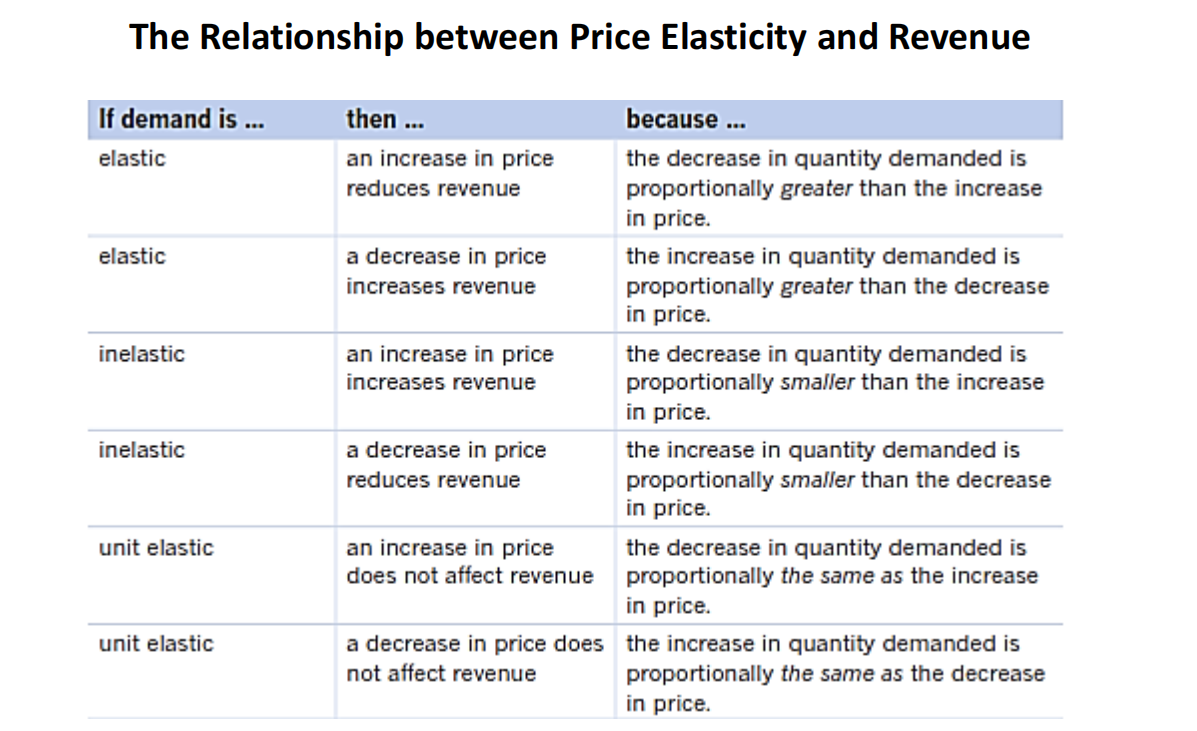
When demand is inelastic, price and total revenue move in the same direction: An increase in price raises total revenue, and a decrease in price reduces total revenue.
📖 点击查看译文
当需求缺乏弹性时,价格与总收益同向变化:价格上升,总收益增加;价格下降,总收益减少。
When demand is elastic, price and total revenue move inversely: An increase in price reduces total revenue, and a decrease in price raises total revenue.
📖 点击查看译文
当需求具有弹性时,价格与总收益反向变化:价格上升,总收益减少;价格下降,总收益增加。
To understand the relationship between price elasticity and total revenue, consider Figure 6.2.
📖 点击查看译文
要理解价格弹性与总收益的关系,可以参考图6.2。
Panel (a) shows a demand curve for gasoline that is inelastic between point A and point B.
📖 点击查看译文
图(a) 显示了汽油需求曲线在A点和B点之间缺乏弹性。
The total revenue received by the service station owner at point A equals the price of 3,000.
📖 点击查看译文
加油站老板在A点的总收益等于3,000。
This amount equals the areas of rectangles C and D in the figure because together the rectangles have a height of $3.00 and a base of 1,000 gallons.
📖 点击查看译文
该金额等于图中矩形C和D的面积总和,因为这两个矩形的高度为$3.00,底边长度为1,000加仑。
知识点列表与拓展 (Knowledge Points and Extensions):
1. Price Elasticity and Revenue (价格弹性与收益的关系)
-
解释 (Explanation):
The price elasticity of demand determines how a price change affects total revenue: inelastic demand leads to revenue increase when price rises, whereas elastic demand leads to revenue decrease.
(需求的价格弹性决定了价格变动对总收益的影响:当需求缺乏弹性时,价格上升会提高总收益;当需求具有弹性时,价格上升会减少总收益。)
-
例子 (Example):
If an airline raises ticket prices and still fills most seats, the demand is inelastic, and total revenue increases. However, if a fast-food chain raises prices and loses many customers, the demand is elastic, and total revenue decreases.
(如果航空公司提高机票价格且大部分座位仍被填满,说明需求缺乏弹性,总收益增加。而如果快餐连锁店提高价格导致顾客大量流失,说明需求具有弹性,总收益减少。)
-
拓展 (Extension):
Businesses use this concept to set optimal pricing strategies, such as discounting elastic products to boost sales volume or maintaining high prices for inelastic goods to maximize revenue.
(企业利用这一概念制定最佳定价策略,例如对弹性商品进行折扣以提高销量,或保持缺乏弹性的商品价格以最大化收益。)
7
The Relationship between Price Elasticity of Demand and Total Revenue (价格弹性与总收益的关系)
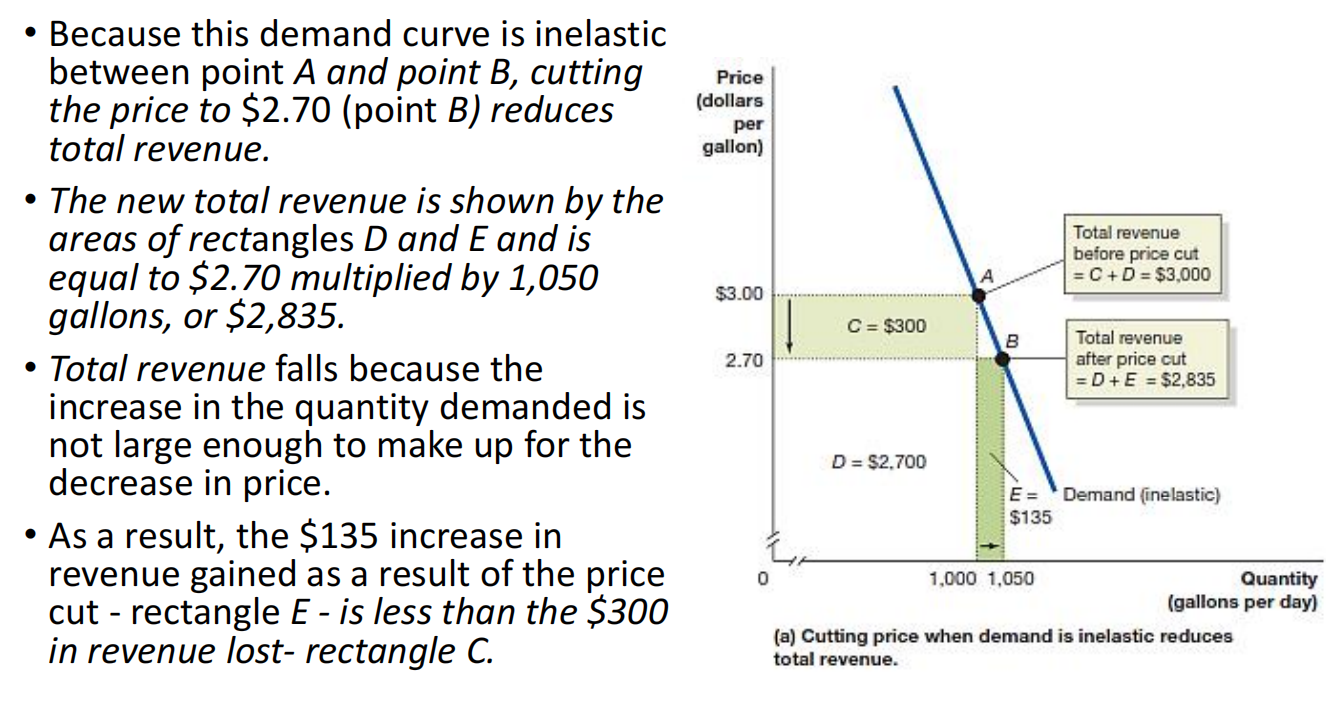
Because this demand curve is inelastic between point A and point B, cutting the price to $2.70 (point B) reduces total revenue.
📖 点击查看译文
由于这条需求曲线在A点和B点之间缺乏弹性,将价格降至$2.70(B点)会减少总收益。
The new total revenue is shown by the areas of rectangles D and E and is equal to 2,835.
📖 点击查看译文
新的总收益由矩形D和E的面积表示,其值等于2,835。
Total revenue falls because the increase in the quantity demanded is not large enough to make up for the decrease in price.
📖 点击查看译文
总收益下降的原因是需求量的增加不足以弥补价格下降的影响。
As a result, the 300 in revenue lost - rectangle C.
📖 点击查看译文
因此,由于降价带来的300的收益损失(矩形C)。
知识点列表与拓展 (Knowledge Points and Extensions):
1. Price Cuts and Revenue in Inelastic Demand (缺乏弹性需求下的降价与收益关系)
-
解释 (Explanation):
When demand is inelastic, reducing the price leads to a smaller proportional increase in quantity demanded, resulting in a decline in total revenue.
(当需求缺乏弹性时,降低价格导致的需求量增加比例较小,从而使总收益下降。)
-
例子 (Example):
A gas station lowers fuel prices by 10%, but demand only increases by 5%, causing total revenue to decline.
(加油站将油价降低10%,但需求量仅增加5%,最终导致总收益下降。)
-
拓展 (Extension):
Firms dealing with inelastic goods, such as utilities and essential medications, often avoid price cuts as they would reduce total revenue.
(经营缺乏弹性商品的企业,如公共事业和必需药品,通常避免降价,以防止总收益下降。)
8
The Relationship between Price Elasticity of Demand and Total Revenue (价格弹性与总收益的关系)
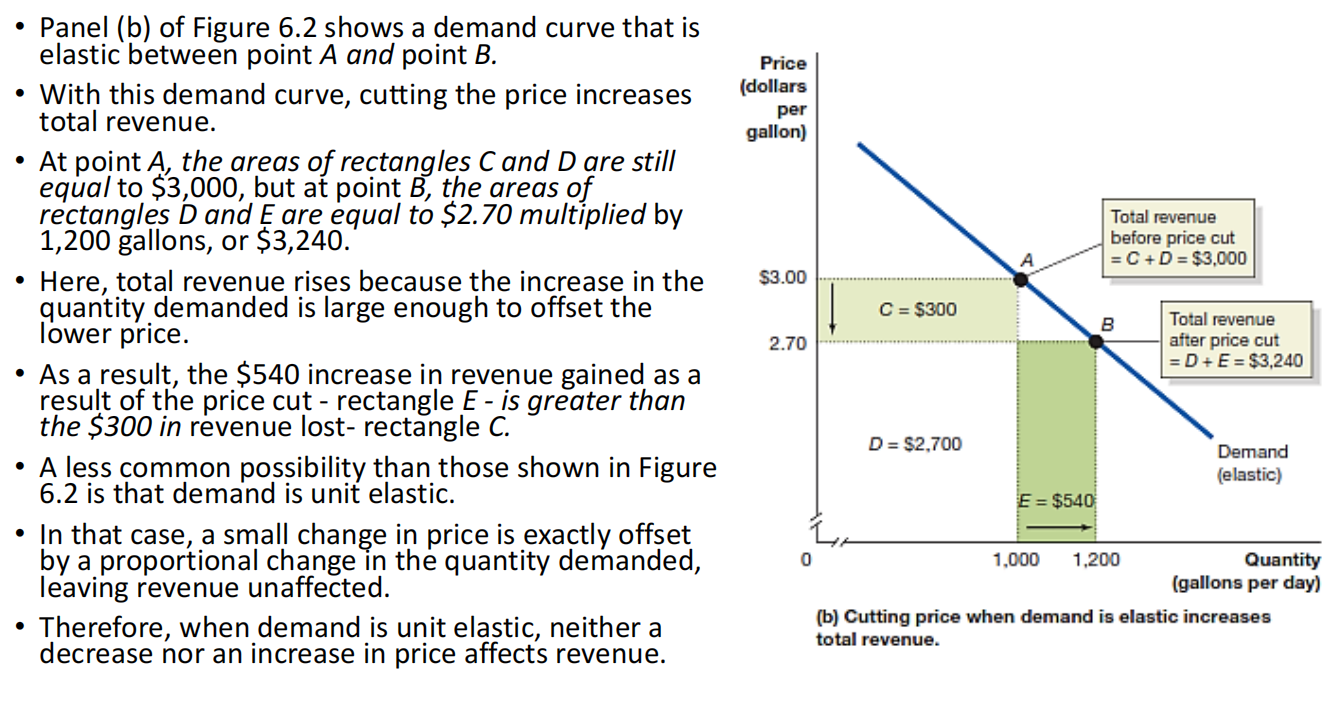
Panel (b) of Figure 6.2 shows a demand curve that is elastic between point A and point B.
📖 点击查看译文
图6.2的(b)部分显示了A点和B点之间需求富有弹性的需求曲线。
With this demand curve, cutting the price increases total revenue.
📖 点击查看译文
在这条需求曲线上,降低价格会增加总收益。
At point A, the areas of rectangles C and D are still equal to 2.70 multiplied by 1,200 gallons, or $3,240.
📖 点击查看译文
在A点,矩形C和D的面积仍然等于2.70乘以1,200加仑,即$3,240。
Here, total revenue rises because the increase in the quantity demanded is large enough to offset the lower price.
📖 点击查看译文
在这里,总收益增加,因为需求量的增长足以弥补价格下降的影响。
As a result, the 300 in revenue lost - rectangle C.
📖 点击查看译文
因此,由于降价带来的300的收益损失(矩形C)。
A less common possibility than those shown in Figure 6.2 is that demand is unit elastic.
📖 点击查看译文
比图6.2所示情况更少见的一种可能性是,需求是单位弹性的。
In that case, a small change in price is exactly offset by a proportional change in the quantity demanded, leaving revenue unaffected.
📖 点击查看译文
在这种情况下,价格的微小变化被需求量的同比变化完全抵消,使总收益不受影响。
Therefore, when demand is unit elastic, neither a decrease nor an increase in price affects revenue.
📖 点击查看译文
因此,当需求是单位弹性时,无论价格上涨还是下跌,都不会影响总收益。
知识点列表与拓展 (Knowledge Points and Extensions):
1. Price Cuts and Revenue in Elastic Demand (富有弹性需求下的降价与收益关系)
-
解释 (Explanation):
When demand is elastic, reducing the price leads to a larger proportional increase in quantity demanded, resulting in an increase in total revenue.
(当需求富有弹性时,价格降低会导致需求量更大幅度的增加,从而使总收益上升。)
-
例子 (Example):
A clothing store reduces the price of T-shirts by 10%, causing sales to increase by 25%, leading to higher total revenue.
(服装店将T恤价格降低10%,导致销量增长25%,最终总收益上升。)
-
拓展 (Extension):
Companies selling luxury or non-essential goods often use discounts and promotions to maximize revenue by taking advantage of elastic demand.
(销售奢侈品或非必需品的公司通常利用折扣和促销策略,以弹性需求特性来最大化收益。)
2. Unit Elastic Demand and Revenue (单位弹性需求与收益关系)
-
解释 (Explanation):
When demand is unit elastic, a change in price leads to a proportional change in quantity demanded, resulting in no change in total revenue.
(当需求为单位弹性时,价格的变动导致需求量同比变化,使总收益保持不变。)
-
例子 (Example):
If a company increases the price of a product by 5% and sales drop exactly by 5%, total revenue remains unchanged.
(如果公司将产品价格提高5%,而销量恰好减少5%,那么总收益不会发生变化。)
-
拓展 (Extension):
Businesses need to determine whether their products exhibit unit elastic demand to avoid unnecessary price adjustments that do not impact total revenue.
(企业需要判断其产品是否具有单位弹性需求,以避免不必要的价格调整,因为这不会影响总收益。)
9
10
Elasticity and Revenue with a Linear Demand Curve (线性需求曲线下的弹性与收益)
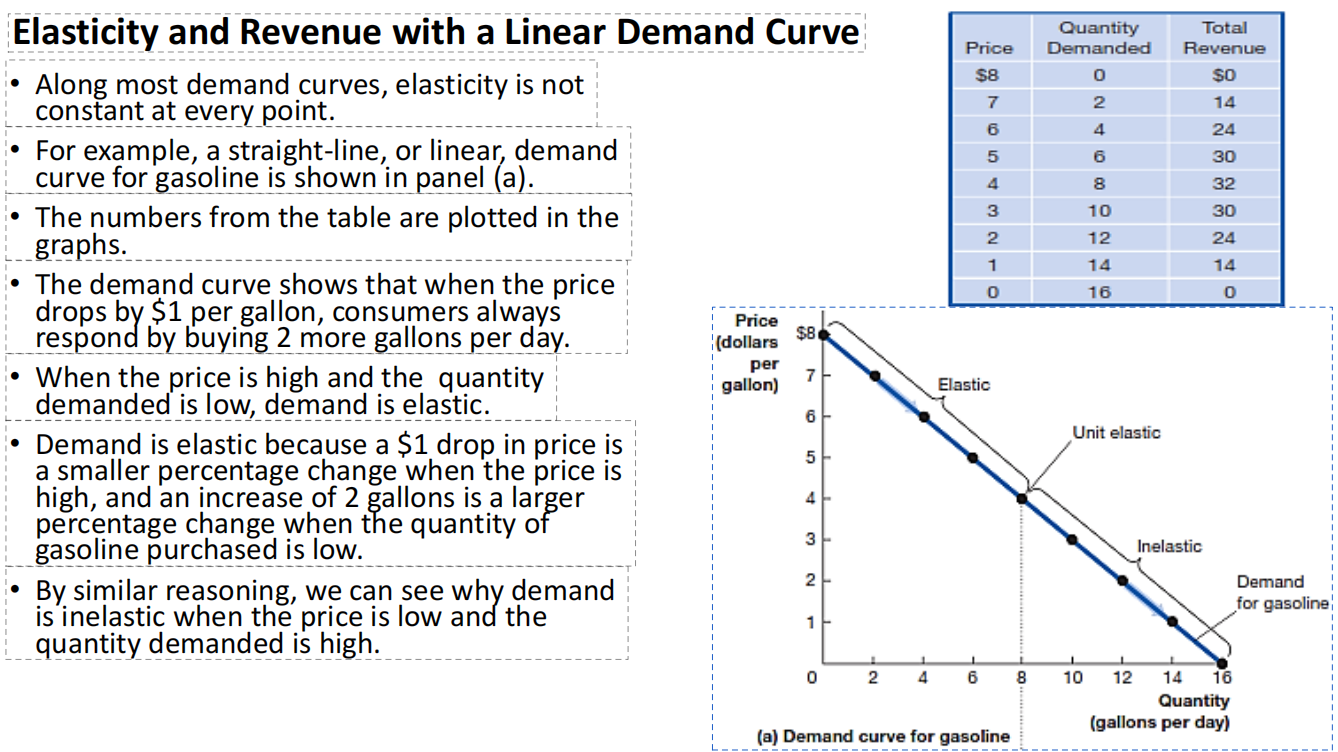
Along most demand curves, elasticity is not constant at every point.
📖 点击查看译文
在大多数需求曲线上,弹性在每个点上并不是恒定的。
For example, a straight-line, or linear, demand curve for gasoline is shown in panel (a).
📖 点击查看译文
例如,面板(a)中显示了一条关于汽油的直线或线性需求曲线。
The numbers from the table are plotted in the graphs.
📖 点击查看译文
表格中的数据被绘制在图表中。
The demand curve shows that when the price drops by $1 per gallon, consumers always respond by buying 2 more gallons per day.
📖 点击查看译文
需求曲线表明,当价格每加仑下降$1时,消费者每天会额外购买2加仑。
When the price is high and the quantity demanded is low, demand is elastic.
📖 点击查看译文
当价格较高且需求量较低时,需求是有弹性的。
Demand is elastic because a $1 drop in price is a smaller percentage change when the price is high, and an increase of 2 gallons is a larger percentage change when the quantity of gasoline purchased is low.
📖 点击查看译文
需求具有弹性,因为当价格较高时,$1的下降所占的比例较小,而当购买的汽油数量较少时,增加2加仑的比例较大。
By similar reasoning, we can see why demand is inelastic when the price is low and the quantity demanded is high.
📖 点击查看译文
同样的推理可以解释,当价格较低且需求量较高时,需求为何缺乏弹性。
知识点列表与拓展 (Knowledge Points and Extensions):
1. Elasticity Varies Along a Linear Demand Curve (线性需求曲线上的弹性变化)
-
解释 (Explanation):
A linear demand curve does not have constant elasticity—elasticity is higher when price is high and quantity demanded is low, and lower when price is low and quantity demanded is high.
(线性需求曲线的弹性并不恒定——当价格高、需求量低时,弹性较大;当价格低、需求量高时,弹性较小。)
-
例子 (Example):
If gasoline prices drop from 4 per gallon, demand might increase significantly (elastic). But if prices drop from 1, the increase in demand might be much smaller (inelastic).
(如果汽油价格从4,加仑需求可能大幅增加(弹性)。但如果价格从1,需求增长可能很小(缺乏弹性)。)
-
拓展 (Extension):
Businesses need to consider where their product lies on the demand curve when making pricing decisions to maximize revenue.
(企业在制定定价策略时,需要考虑其产品在需求曲线上的位置,以优化收益。)
2. Revenue Implications of Elastic vs. Inelastic Demand (弹性与缺乏弹性需求对收益的影响)
-
解释 (Explanation):
When demand is elastic, lowering prices increases total revenue; when demand is inelastic, lowering prices reduces total revenue.
(当需求有弹性时,降价会增加总收益;当需求缺乏弹性时,降价会减少总收益。)
-
例子 (Example):
A high-end smartphone brand might see a large sales increase with a small price cut (elastic demand), while a necessity like salt sees little change in demand when prices fluctuate (inelastic demand).
(高端智能手机品牌可能会因小幅降价带来销量大幅增长(弹性需求),而像食盐这样的必需品,即使价格波动,需求变化也很小(缺乏弹性需求)。)
-
拓展 (Extension):
Price discrimination strategies, such as discounts and premium pricing, can help businesses take advantage of different elasticity levels among consumer segments.
(价格歧视策略,如折扣定价和溢价策略,可以帮助企业利用不同消费群体的需求弹性特性。)
11
Elasticity and Revenue with a Linear Demand Curve (线性需求曲线下的弹性与收益)
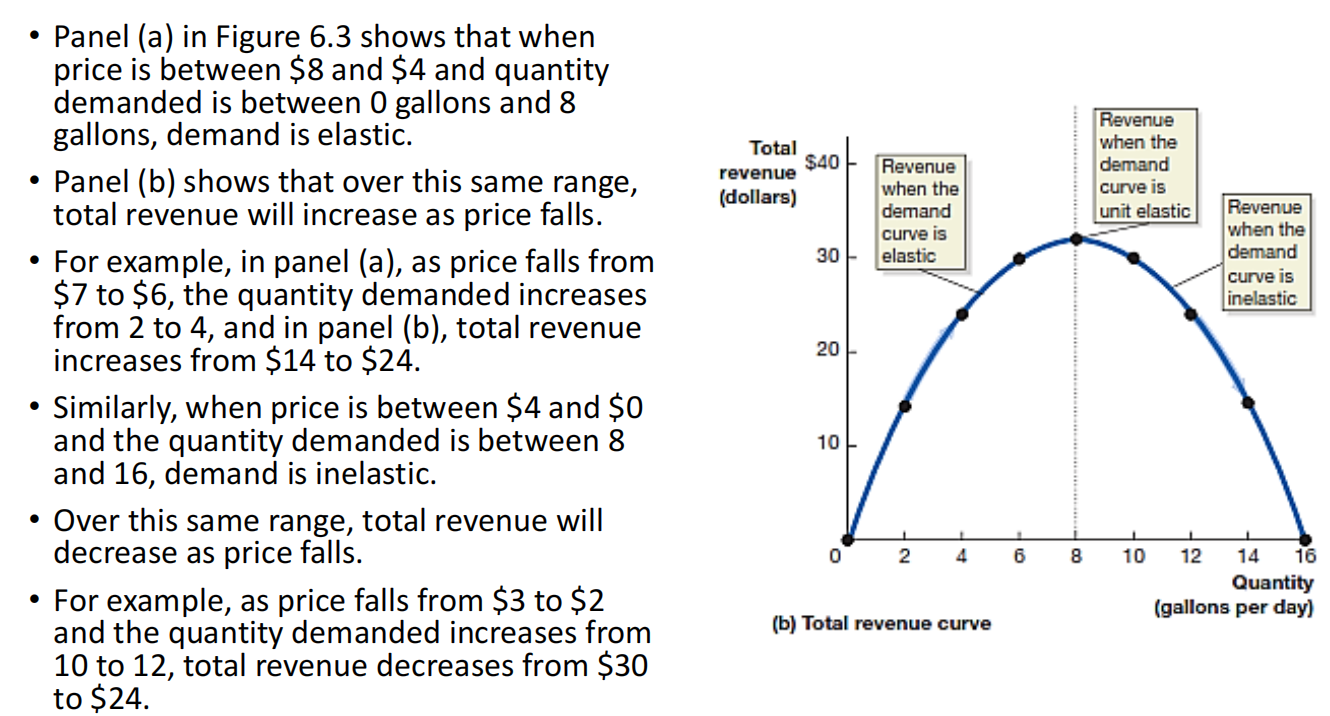
Panel (a) in Figure 6.3 shows that when price is between 4 and quantity demanded is between 0 gallons and 8 gallons, demand is elastic.
📖 点击查看译文
图 6.3 的面板 (a) 显示,当价格在 4 之间,需求量在 0 加仑到 8 加仑之间时,需求是有弹性的。
Panel (b) shows that over this same range, total revenue will increase as price falls.
📖 点击查看译文
图 6.3 的面板 (b) 显示,在相同的价格范围内,随着价格下降,总收益会增加。
For example, in panel (a), as price falls from 6, the quantity demanded increases from 2 to 4, and in panel (b), total revenue increases from 24.
📖 点击查看译文
例如,在面板 (a) 中,当价格从 6 时,需求量从 2 增加到 4;在面板 (b) 中,总收益从 24。
Similarly, when price is between 0 and the quantity demanded is between 8 and 16, demand is inelastic.
📖 点击查看译文
同样地,当价格在 0 之间,需求量在 8 到 16 之间时,需求缺乏弹性。
Over this same range, total revenue will decrease as price falls.
📖 点击查看译文
在同样的价格范围内,随着价格下降,总收益将减少。
For example, as price falls from 2 and the quantity demanded increases from 10 to 12, total revenue decreases from 24.
📖 点击查看译文
例如,当价格从 2,需求量从 10 增加到 12 时,总收益从 24。
知识点列表与拓展 (Knowledge Points and Extensions):
1. Elastic and Inelastic Ranges on a Linear Demand Curve (线性需求曲线上的弹性与缺乏弹性区间)
-
解释 (Explanation):
A linear demand curve has both elastic and inelastic regions. The upper portion (higher prices, lower quantity demanded) is elastic, while the lower portion (lower prices, higher quantity demanded) is inelastic.
(线性需求曲线包含弹性和缺乏弹性的区域。上部分(价格较高,需求量较低)是弹性的,而下部分(价格较低,需求量较高)是缺乏弹性的。)
-
例子 (Example):
If a luxury brand handbag drops in price from 6,000, demand may increase significantly (elastic). But if the price drops from 300, demand may not change much (inelastic).
(如果奢侈品牌手袋的价格从 6,000,需求可能会大幅增长(弹性)。但如果价格从 300,需求可能变化不大(缺乏弹性)。)
-
拓展 (Extension):
Businesses can use this principle to set pricing strategies:
-
Price reductions in the elastic range can boost total revenue.
-
Price reductions in the inelastic range can harm total revenue.
(企业可以利用这一原理制定定价策略:
-
在弹性区间降价可以增加总收益。
-
在缺乏弹性区间降价可能会减少总收益。)
-
2. Revenue Maximization Strategies (收益最大化策略)
-
解释 (Explanation):
Total revenue is maximized at unit elasticity, where price changes do not affect total revenue. Businesses should aim to find this optimal point.
(总收益在单位弹性时达到最大,此时价格变化不会影响总收益。企业应找到这个最佳点。)
-
例子 (Example):
Streaming services often experiment with subscription prices to find the unit elastic point where price changes neither increase nor decrease revenue.
(流媒体服务通常会调整订阅价格,以找到价格变化不会影响收益的单位弹性点。)
-
拓展 (Extension):
Dynamic pricing models in e-commerce and airline industries use real-time demand data to optimize pricing.
(电子商务和航空业的动态定价模型使用实时需求数据来优化定价。)
12
Other Demand Elasticities (其他需求弹性)
In addition to price elasticity, two other demand elasticities are important:
📖 点击查看译文
除了价格弹性之外,另外两种重要的需求弹性是:
1. Cross-price elasticity of demand (交叉价格弹性)
2. Income elasticity of demand (收入弹性)
Cross-Price Elasticity of Demand (交叉价格弹性)
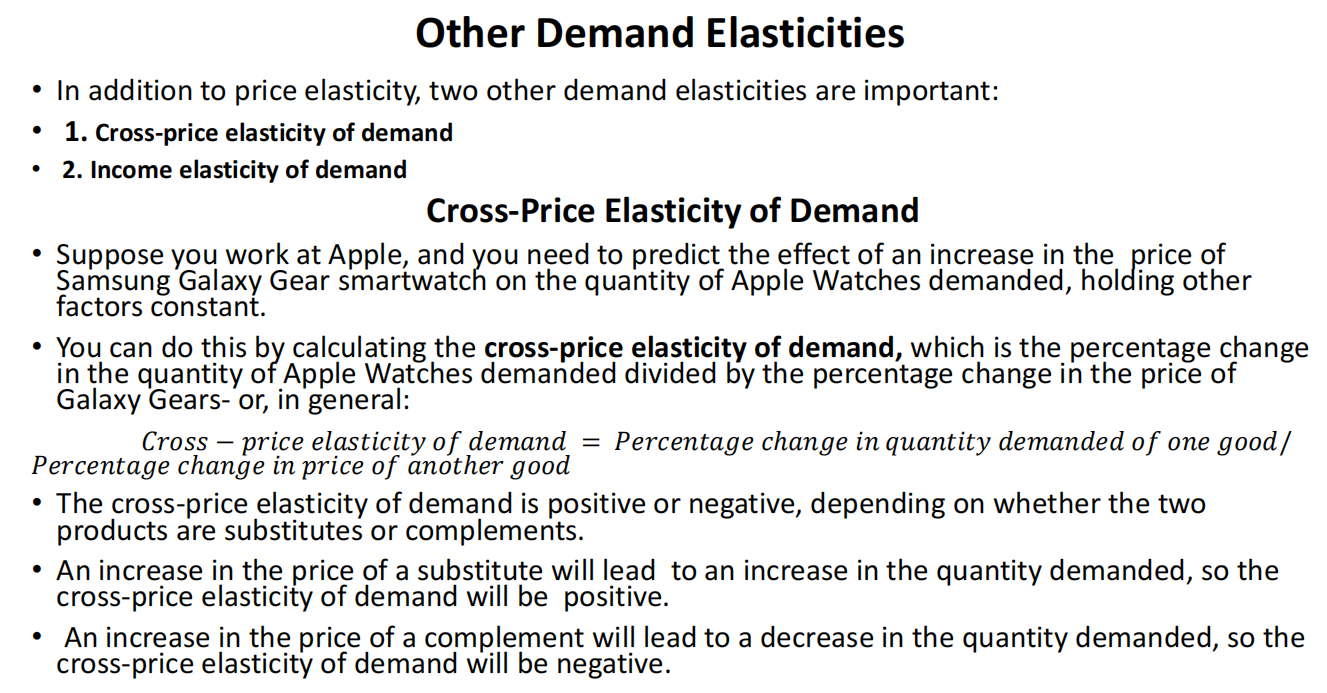
Suppose you work at Apple, and you need to predict the effect of an increase in the price of Samsung Galaxy Gear smartwatch on the quantity of Apple Watches demanded, holding other factors constant.
📖 点击查看译文
假设你在 Apple 工作,需要预测在其他因素不变的情况下,三星 Galaxy Gear 智能手表价格上涨对 Apple Watch 需求量的影响。
You can do this by calculating the cross-price elasticity of demand, which is the percentage change in the quantity of Apple Watches demanded divided by the percentage change in the price of Galaxy Gears—or, in general:
📖 点击查看译文
你可以通过计算交叉价格弹性来预测。交叉价格弹性是 Apple Watch 需求量的百分比变化除以 Galaxy Gear 价格的百分比变化。其公式如下:
The cross-price elasticity of demand is positive or negative, depending on whether the two products are substitutes or complements.
📖 点击查看译文
交叉价格弹性可以是正数或负数,这取决于两种产品是替代品还是互补品。
An increase in the price of a substitute will lead to an increase in the quantity demanded, so the cross-price elasticity of demand will be positive.
📖 点击查看译文
如果某种替代品的价格上升,另一种商品的需求量会增加,因此交叉价格弹性为正。
An increase in the price of a complement will lead to a decrease in the quantity demanded, so the cross-price elasticity of demand will be negative.
📖 点击查看译文
如果某种互补品的价格上升,另一种商品的需求量会减少,因此交叉价格弹性为负。
知识点列表与拓展 (Knowledge Points and Extensions):
1. Substitutes and Complements in Cross-Price Elasticity (替代品与互补品的交叉价格弹性)
-
解释 (Explanation):
-
If cross-price elasticity is positive, the two goods are substitutes. (如交叉价格弹性为正,则两种商品为替代品。)
-
If cross-price elasticity is negative, the two goods are complements. (如交叉价格弹性为负,则两种商品为互补品。)
-
-
例子 (Example):
-
iPhone and Samsung Galaxy: Positive cross-price elasticity (iPhone 和三星 Galaxy:正交叉价格弹性)
-
Coffee and sugar: Negative cross-price elasticity (咖啡和糖:负交叉价格弹性)
-
-
拓展 (Extension):
Businesses can use cross-price elasticity to make pricing decisions, such as increasing the price of a competitor’s product through promotions on their own substitute product.
(企业可以利用交叉价格弹性制定定价策略,例如通过促销自己的替代产品,间接影响竞争对手产品的价格。)
2. Practical Applications of Cross-Price Elasticity (交叉价格弹性的实际应用)
-
解释 (Explanation):
Firms analyze cross-price elasticity to determine how the price of related goods impacts demand for their own products.
(企业分析交叉价格弹性,以确定相关商品的价格如何影响自身产品的需求。)
-
例子 (Example):
-
Microsoft may monitor how changes in MacBook prices affect demand for Surface laptops.
-
(微软可能会关注 MacBook 价格变化如何影响 Surface 笔记本电脑的需求。)
-
-
拓展 (Extension):
Companies can use bundling strategies to leverage cross-price elasticity, such as selling smartphones with wireless earbuds at a discount.
(企业可以利用捆绑销售策略,如以折扣价捆绑销售智能手机和无线耳机,以利用交叉价格弹性。)
13
Cross-Price Elasticity of Demand (交叉价格弹性)
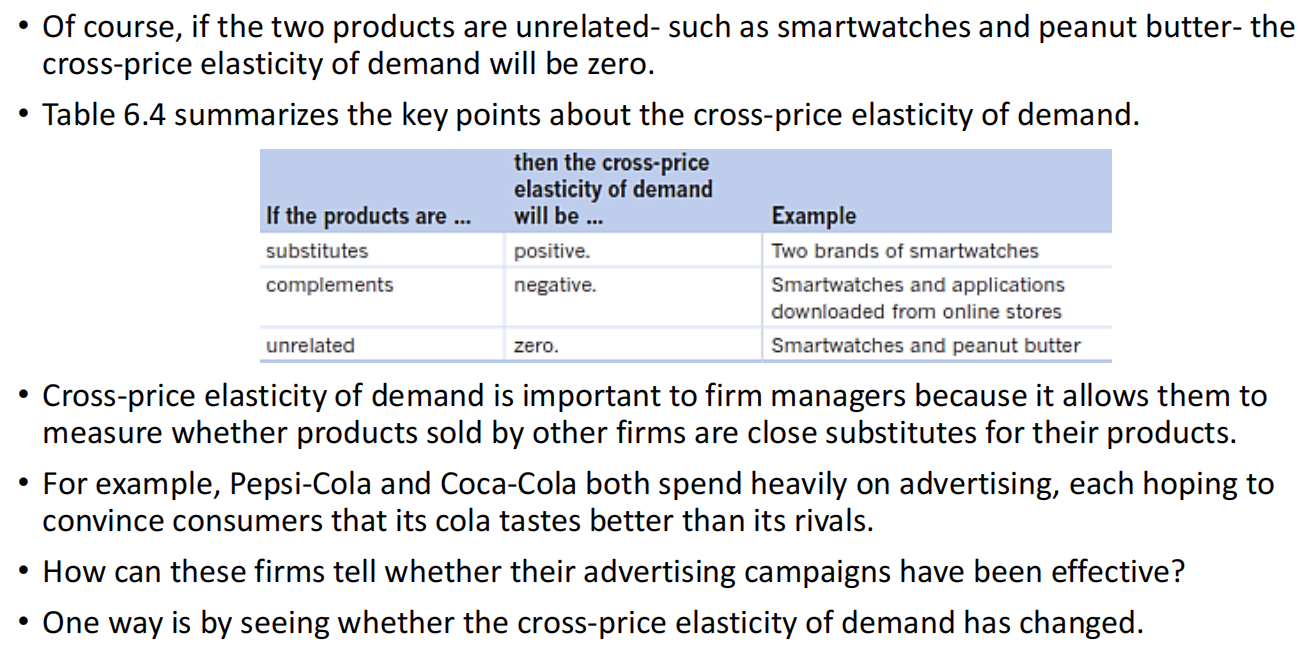
• Of course, if the two products are unrelated—such as smartwatches and peanut butter—the cross-price elasticity of demand will be zero.
📖 点击查看译文
当然,如果两种商品彼此无关,比如智能手表和花生酱,那么它们的交叉价格弹性将为零。
• Table 6.4 summarizes the key points about the cross-price elasticity of demand.
📖 点击查看译文
表 6.4 总结了关于交叉价格弹性的关键点。
• Cross-price elasticity of demand is important to firm managers because it allows them to measure whether products sold by other firms are close substitutes for their products.
📖 点击查看译文
交叉价格弹性对企业管理者至关重要,因为它可以帮助他们判断其他公司销售的产品是否是自己产品的近似替代品。
• For example, Pepsi-Cola and Coca-Cola both spend heavily on advertising, each hoping to convince consumers that its cola tastes better than its rivals.
📖 点击查看译文
例如,百事可乐和可口可乐都在广告上投入巨资,希望能说服消费者自己的可乐比竞争对手的更好喝。
• How can these firms tell whether their advertising campaigns have been effective?
📖 点击查看译文
这些公司如何判断自己的广告宣传是否有效?
• One way is by seeing whether the cross-price elasticity of demand has changed.
📖 点击查看译文
一种方法是观察交叉价格弹性是否发生了变化。
知识点列表与拓展 (Knowledge Points and Extensions):
1. Identifying Unrelated Goods (识别无关商品)
-
解释 (Explanation):
- When cross-price elasticity is zero, the two goods are unrelated. (如果交叉价格弹性为零,则两种商品彼此无关。)
-
例子 (Example):
- Smartphones and peanut butter: Zero cross-price elasticity (智能手机和花生酱:交叉价格弹性为零)
-
拓展 (Extension):
-
Firms do not need to consider pricing interactions between unrelated goods when making pricing decisions.
-
(企业在定价决策时,不需要考虑彼此无关商品的定价互动。)
-
2. Cross-Price Elasticity in Competitive Markets (竞争市场中的交叉价格弹性)
-
解释 (Explanation):
-
If cross-price elasticity is highly positive, two products are strong substitutes, leading to aggressive competition.
-
(如果交叉价格弹性高度为正,则两种产品是强替代品,导致激烈的竞争。)
-
-
例子 (Example):
- Coca-Cola vs. Pepsi: Strong positive cross-price elasticity (可口可乐 vs. 百事可乐:高度正交叉价格弹性)
-
拓展 (Extension):
-
Companies monitor changes in cross-price elasticity to evaluate the effectiveness of advertising and branding strategies.
-
(公司会监测交叉价格弹性的变化,以评估广告和品牌策略的有效性。)
-
14
Income Elasticity of Demand (收入弹性)
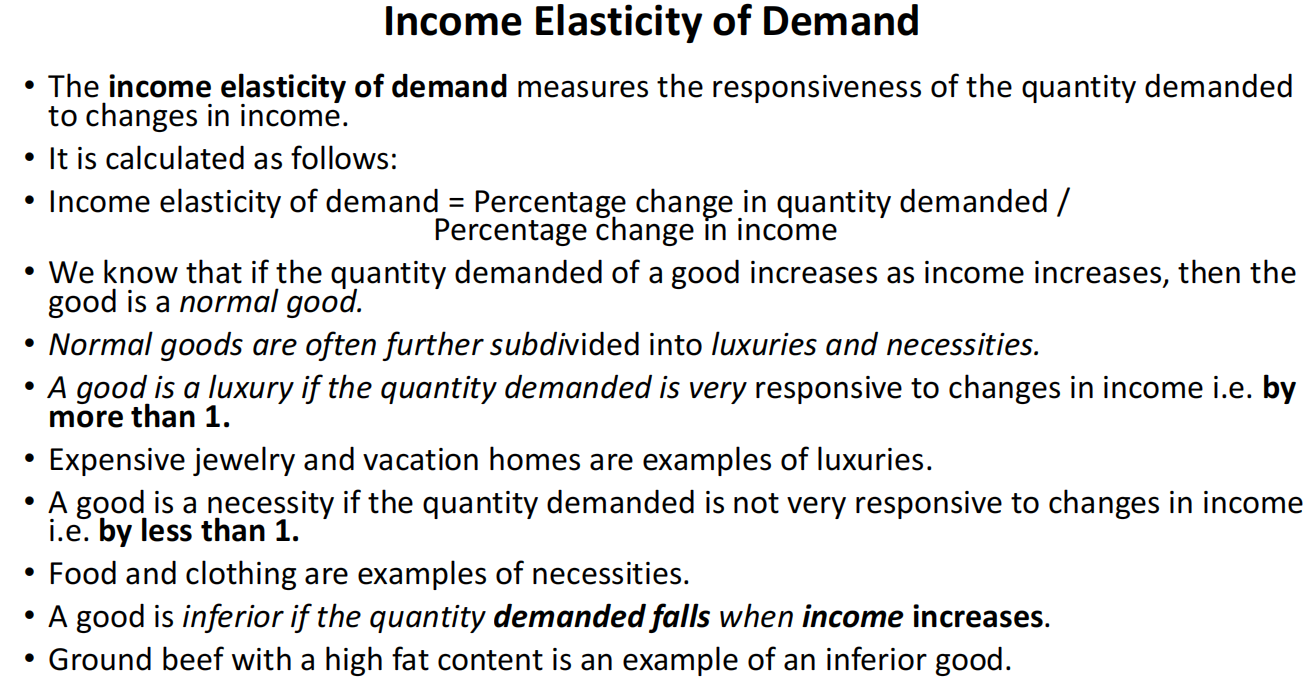
• The income elasticity of demand measures the responsiveness of the quantity demanded to changes in income.
📖 点击查看译文
收入弹性衡量的是需求量对收入变化的敏感程度。
• It is calculated as follows:
📖 点击查看译文
其计算方式如下:
• Income elasticity of demand = Percentage change in quantity demanded / Percentage change in income
📖 点击查看译文
收入弹性 = 需求量的百分比变化 / 收入的百分比变化
• We know that if the quantity demanded of a good increases as income increases, then the good is a normal good.
📖 点击查看译文
如果一种商品的需求量随着收入的增加而增加,则该商品为正常商品。
• Normal goods are often further subdivided into luxuries and necessities.
📖 点击查看译文
正常商品通常可进一步分为奢侈品和必需品。
• A good is a luxury if the quantity demanded is very responsive to changes in income i.e. by more than 1.
📖 点击查看译文
如果某种商品的需求量对收入变化非常敏感(收入弹性大于 1),则该商品为奢侈品。
• Expensive jewelry and vacation homes are examples of luxuries.
📖 点击查看译文
昂贵的珠宝和度假别墅是奢侈品的例子。
• A good is a necessity if the quantity demanded is not very responsive to changes in income i.e. by less than 1.
📖 点击查看译文
如果某种商品的需求量对收入变化不太敏感(收入弹性小于 1),则该商品为必需品。
• Food and clothing are examples of necessities.
📖 点击查看译文
食品和服装是必需品的例子。
• A good is inferior if the quantity demanded falls when income increases.
📖 点击查看译文
如果某种商品的需求量在收入增加时下降,则该商品为劣等品。
• Ground beef with a high fat content is an example of an inferior good.
📖 点击查看译文
高脂肪含量的碎牛肉是劣等品的例子。
知识点列表与拓展 (Knowledge Points and Extensions):
1. Understanding Income Elasticity (理解收入弹性)
-
解释 (Explanation):
-
If income elasticity > 1, the good is a luxury.
-
If 0 < income elasticity < 1, the good is a necessity.
-
If income elasticity < 0, the good is inferior.
-
-
例子 (Example):
-
Luxury: Sports cars, designer handbags (奢侈品:跑车、名牌包)
-
Necessity: Bread, electricity (必需品:面包、电力)
-
Inferior Good: Instant noodles, used cars (劣等品:方便面、二手车)
-
-
拓展 (Extension):
-
Businesses use income elasticity to predict how demand will change as the economy grows.
-
(企业利用收入弹性预测经济增长时的需求变化。)
-
2. Income Elasticity and Market Strategy (收入弹性与市场策略)
-
解释 (Explanation):
-
Firms producing luxury goods benefit during economic booms but struggle in recessions.
-
Firms producing inferior goods may thrive in recessions as consumers cut spending.
-
-
例子 (Example):
- Airlines offer economy-class tickets to capture demand during downturns. (航空公司提供经济舱机票以适应经济低迷期的需求。)
-
拓展 (Extension):
-
Governments can use income elasticity data to plan social welfare policies.
-
(政府可以利用收入弹性数据制定社会福利政策。)
-
15
Using Elasticity to Analyze the Disappearing Family Farm (利用弹性分析家庭农场的消失)
• The concepts of price elasticity and income elasticity can help us understand many economic issues.
📖 点击查看译文
价格弹性和收入弹性的概念可以帮助我们理解许多经济问题。
• For example, some people are concerned that the family farm is becoming an endangered species in the United States.
📖 点击查看译文
例如,一些人担心美国的家庭农场正在濒临灭绝。
• Although food production has been growing steadily, the number of farms and farmers continues to dwindle.
📖 点击查看译文
尽管食品产量一直在稳定增长,但农场和农民的数量却在不断减少。
• In 1950, the United States had more than 5 million farms, and more than 23 million people lived on farms.
📖 点击查看译文
1950年,美国有超过500万家农场,超过2300万人居住在农场上。
• By 2015, only about 2 million farms remained, and fewer than 3 million people lived on them.
📖 点击查看译文
到2015年,仅剩约200万家农场,居住在农场上的人口不足300万。
• The federal government has several programs that are intended to aid farmers.
📖 点击查看译文
联邦政府制定了多个旨在帮助农民的计划。
• Many of these programs have been aimed at helping small, family-operated farms, but growth in farm production, combined with low price and income elasticities for most food products, have made it difficult for owners of family farms to earn a profit.
📖 点击查看译文
许多这些计划的目标是帮助小型家庭农场,但农业产量的增长,加上大多数食品价格弹性和收入弹性较低,使得家庭农场主难以盈利。
• In 1950, the average U.S. wheat farmer harvested about 17 bushels from each acre of wheat planted.
📖 点击查看译文
1950年,美国平均每位小麦农民每英亩收获约17蒲式耳的小麦。
• By 2015, because of the development of superior strains of wheat and improvements in farming techniques, the average American wheat farmer harvested 44 bushels per acre.
📖 点击查看译文
到2015年,由于优良小麦品种的开发和农业技术的改进,美国平均每位小麦农民每英亩收获44蒲式耳小麦。
• So, even though the total number of acres devoted to growing wheat declined from about 62 million to about 48 million, total wheat production rose from about 1.0 billion bushels to about 2.1 billion.
📖 点击查看译文
因此,尽管用于种植小麦的总面积从约6200万英亩减少到约4800万英亩,但总小麦产量却从约10亿蒲式耳上升到约21亿蒲式耳。
知识点列表与拓展 (Knowledge Points and Extensions):
1. Price and Income Elasticities in Agriculture (农业中的价格弹性与收入弹性)
-
解释 (Explanation):
-
Food products have low price elasticity → An increase in supply leads to price drops but not a proportional increase in quantity demanded.
-
Food products have low income elasticity → Rising incomes do not significantly increase food consumption.
-
-
例子 (Example):
- Increased wheat production leads to lower prices but not much higher demand, reducing profits for farmers.
-
拓展 (Extension):
-
Government price support programs exist to stabilize agricultural incomes.
-
(政府设有价格支持计划以稳定农业收入。)
-
2. Technological Advancements in Farming (农业技术进步的影响)
-
解释 (Explanation):
-
Improved wheat strains and farming techniques increase yield per acre.
-
Reduced farming land but higher total production.
-
-
例子 (Example):
- Precision agriculture, genetically modified crops (精准农业,转基因作物)
-
拓展 (Extension):
-
Increased productivity often benefits large farms while hurting small family farms.
-
(生产力提升通常有利于大农场,但不利于小型家庭农场。)
-
16
The Impact of Increased Wheat Production on Prices (小麦产量增加对价格的影响)
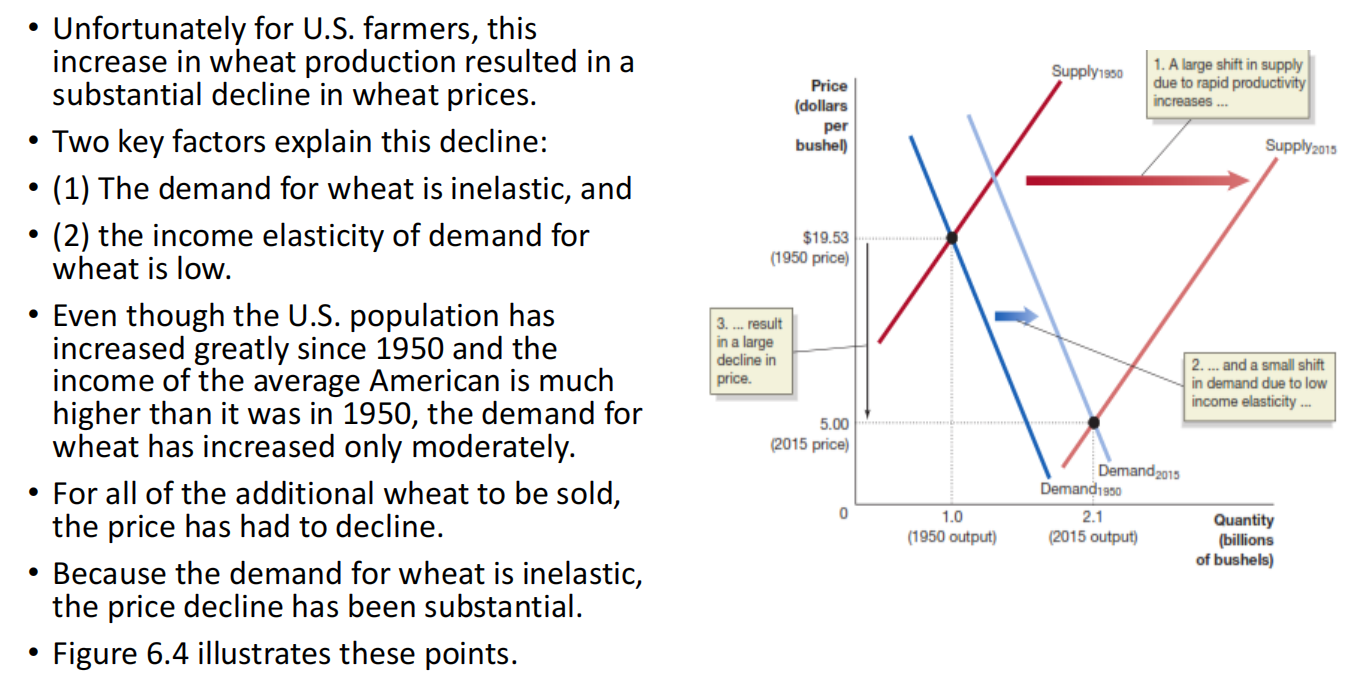
• Unfortunately for U.S. farmers, this increase in wheat production resulted in a substantial decline in wheat prices.
📖 点击查看译文
不幸的是,对于美国农民来说,小麦产量的增加导致了小麦价格的大幅下降。
• Two key factors explain this decline:
📖 点击查看译文
两个关键因素解释了这一价格下降:
• (1) The demand for wheat is inelastic, and
📖 点击查看译文
(1) 小麦的需求是缺乏弹性的,
• (2) the income elasticity of demand for wheat is low.
📖 点击查看译文
(2) 小麦的收入弹性较低。
• Even though the U.S. population has increased greatly since 1950 and the income of the average American is much higher than it was in 1950, the demand for wheat has increased only moderately.
📖 点击查看译文
尽管自1950年以来,美国人口大幅增长,且美国人的平均收入远高于1950年,但小麦需求仅略有增加。
• For all of the additional wheat to be sold, the price has had to decline.
📖 点击查看译文
为了出售所有额外生产的小麦,价格不得不下降。
• Because the demand for wheat is inelastic, the price decline has been substantial.
📖 点击查看译文
由于小麦的需求缺乏弹性,价格下降幅度较大。
• Figure 6.4 illustrates these points.
📖 点击查看译文
图6.4 说明了这些观点。
知识点列表与拓展 (Knowledge Points and Extensions):
1. Price Elasticity of Demand for Wheat (小麦的价格弹性)
-
解释 (Explanation):
-
Inelastic demand means that even if prices drop, demand does not increase significantly.
-
Farmers increase production, but revenues decline due to falling prices.
-
-
例子 (Example):
- If wheat supply doubles, price may fall sharply, but consumers won’t buy twice as much.
-
拓展 (Extension):
-
Price elasticity is crucial for government agricultural policies.
-
(价格弹性对于政府农业政策至关重要。)
-
2. Income Elasticity of Demand for Wheat (小麦的收入弹性)
-
解释 (Explanation):
-
Low income elasticity → Rising incomes do not significantly increase wheat consumption.
-
Wheat is a staple good, not a luxury.
-
-
例子 (Example):
- As income rises, people may spend more on organic food or dining out, but not on wheat itself.
-
拓展 (Extension):
-
This explains why farmers struggle to profit, even when the economy grows.
-
(这解释了即使经济增长,农民仍难以盈利。)
-
17
The Decline of Small Family Farms in the U.S. (美国小型家庭农场的衰退)
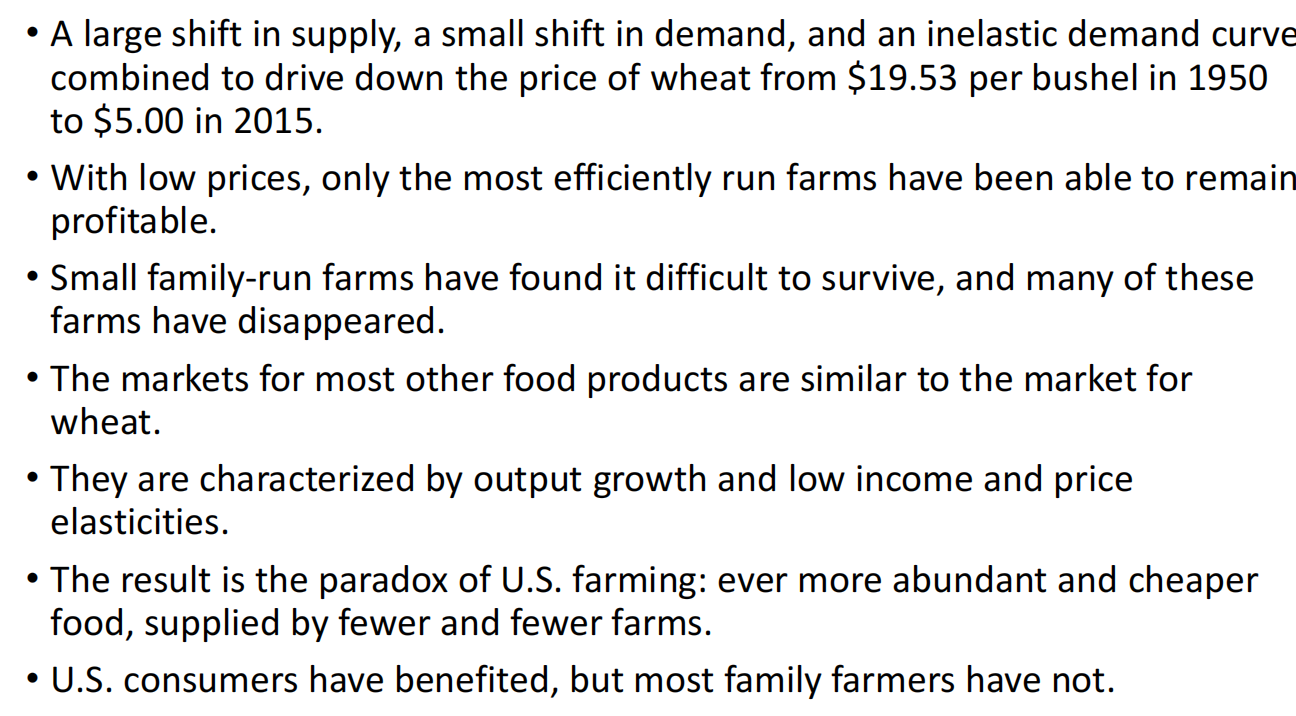
• A large shift in supply, a small shift in demand, and an inelastic demand curve combined to drive down the price of wheat from 5.00 in 2015.
📖 点击查看译文
供给的大幅增加、需求的小幅变化以及缺乏弹性的需求曲线共同导致小麦价格从1950年的每蒲式耳19.53美元下降至2015年的5.00美元。
• With low prices, only the most efficiently run farms have been able to remain profitable.
📖 点击查看译文
在低价格下,只有运营效率最高的农场才能保持盈利。
• Small family-run farms have found it difficult to survive, and many of these farms have disappeared.
📖 点击查看译文
小型家庭农场很难生存,许多这样的农场已经消失。
• The markets for most other food products are similar to the market for wheat.
📖 点击查看译文
大多数其他食品的市场与小麦市场类似。
• They are characterized by output growth and low income and price elasticities.
📖 点击查看译文
这些市场的特点是产量增长以及低收入弹性和低价格弹性。
• The result is the paradox of U.S. farming: ever more abundant and cheaper food, supplied by fewer and fewer farms.
📖 点击查看译文
最终形成了美国农业的悖论:食物越来越丰富且便宜,但生产它们的农场却越来越少。
• U.S. consumers have benefited, but most family farmers have not.
📖 点击查看译文
美国消费者受益了,但大多数家庭农场主却没有。
知识点列表与拓展 (Knowledge Points and Extensions):
1. The Impact of Supply and Demand on Price (供需对价格的影响)
-
解释 (Explanation):
-
Supply increased significantly → Prices dropped.
-
Demand changed only slightly → Could not absorb extra supply.
-
Inelastic demand → Small demand shifts cannot offset price drops.
-
-
例子 (Example):
- Wheat price fell from 5.00 per bushel (1950-2015).
-
拓展 (Extension):
-
Technology advancements (e.g., GMOs, fertilizers) boosted yields but hurt small farms.
-
(技术进步如转基因作物和化肥提高了产量,但对小型农场不利。)
-
2. The Disappearance of Small Farms (小型农场的消失)
-
解释 (Explanation):
-
Large farms achieve economies of scale, while small farms struggle to survive.
-
Only efficient, large-scale farms remain profitable.
-
-
例子 (Example):
- U.S. farms dropped from 5 million (1950) to 2 million (2015).
-
拓展 (Extension):
-
Government subsidies aim to support small farms, but benefits often go to large agribusinesses.
-
(政府补贴旨在支持小型农场,但受益者往往是大型农业企业。)
-
3. The Farming Paradox (农业悖论)
-
解释 (Explanation):
-
Food is cheaper and more abundant, but small farmers suffer.
-
U.S. consumers benefit from low food prices, but farming families decline.
-
-
例子 (Example):
- Wheat production doubled, but family farms disappeared.
-
拓展 (Extension):
-
The same trend appears in dairy, corn, and soybean markets.
-
(同样的趋势也出现在奶制品、玉米和大豆市场中。)
-
18
The Price Elasticity of Supply and Its Measurement (供给的价格弹性及其测量)
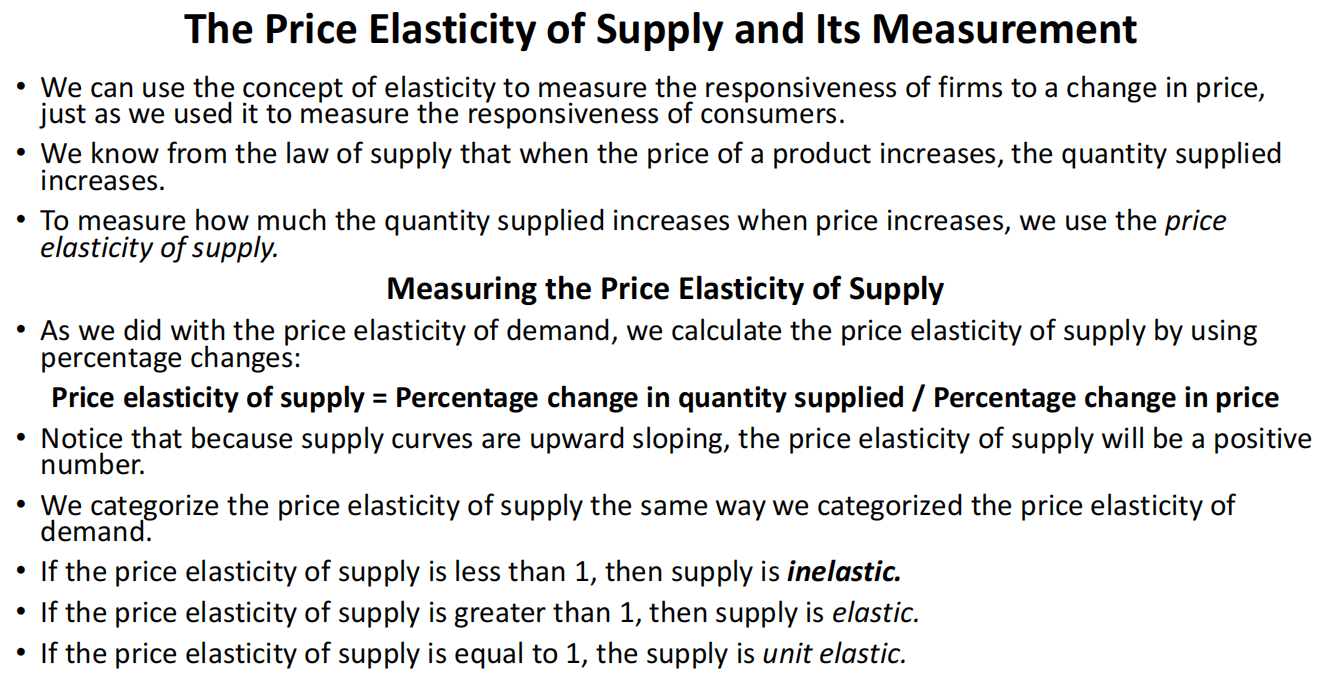
• We can use the concept of elasticity to measure the responsiveness of firms to a change in price, just as we used it to measure the responsiveness of consumers.
📖 点击查看译文
我们可以使用弹性的概念来衡量企业对价格变化的响应程度,就像我们用它来衡量消费者的响应程度一样。
• We know from the law of supply that when the price of a product increases, the quantity supplied increases.
📖 点击查看译文
根据供给定律,当产品价格上升时,供给数量也会上升。
• To measure how much the quantity supplied increases when price increases, we use the price elasticity of supply.
📖 点击查看译文
为了衡量价格上升时供给数量增加的程度,我们使用供给的价格弹性。
Measuring the Price Elasticity of Supply (供给的价格弹性测量)
• As we did with the price elasticity of demand, we calculate the price elasticity of supply by using percentage changes:
📖 点击查看译文
与需求的价格弹性一样,我们通过百分比变化计算供给的价格弹性:
• Price elasticity of supply = Percentage change in quantity supplied / Percentage change in price
📖 点击查看译文
供给的价格弹性 = 供给数量的百分比变化 / 价格的百分比变化
• Notice that because supply curves are upward sloping, the price elasticity of supply will be a positive number.
📖 点击查看译文
注意,由于供给曲线是向上倾斜的,因此供给的价格弹性是一个正数。
• We categorize the price elasticity of supply the same way we categorized the price elasticity of demand.
📖 点击查看译文
我们对供给的价格弹性分类方式与对需求的价格弹性分类方式相同。
• If the price elasticity of supply is less than 1, then supply is inelastic.
📖 点击查看译文
如果供给的价格弹性小于 1,则供给是缺乏弹性的。
• If the price elasticity of supply is greater than 1, then supply is elastic.
📖 点击查看译文
如果供给的价格弹性大于 1,则供给是有弹性的。
• If the price elasticity of supply is equal to 1, the supply is unit elastic.
📖 点击查看译文
如果供给的价格弹性等于 1,则供给是单位弹性的。
知识点列表与拓展 (Knowledge Points and Extensions):
1. Definition and Importance of Price Elasticity of Supply (供给价格弹性的定义与重要性)
-
解释 (Explanation):
-
Measures how responsive producers are to price changes.
-
Helps businesses and policymakers understand market reactions.
-
-
例子 (Example):
- If the price of gold rises, mining companies increase production if supply is elastic.
-
拓展 (Extension):
-
Short-run vs. long-run supply elasticity.
-
(短期 vs. 长期供给弹性)
-
2. Categories of Supply Elasticity (供给弹性的分类)
-
解释 (Explanation):
-
Elastic supply (弹性供给): Producers react strongly to price changes (Es > 1).
-
Inelastic supply (缺乏弹性的供给): Producers react weakly to price changes (Es < 1).
-
Unit elastic supply (单位弹性供给): Proportional response (Es = 1).
-
-
例子 (Example):
-
Luxury goods (奢侈品) → Often have elastic supply.
-
Agricultural products (农产品) → Usually inelastic supply in the short term.
-
-
拓展 (Extension):
-
Time factor: In the short run, supply tends to be inelastic, but in the long run, it becomes more elastic.
-
(时间因素:短期内供给往往缺乏弹性,而长期内供给会更有弹性。)
-
19
Determinants of the Price Elasticity of Supply (供给价格弹性的决定因素)
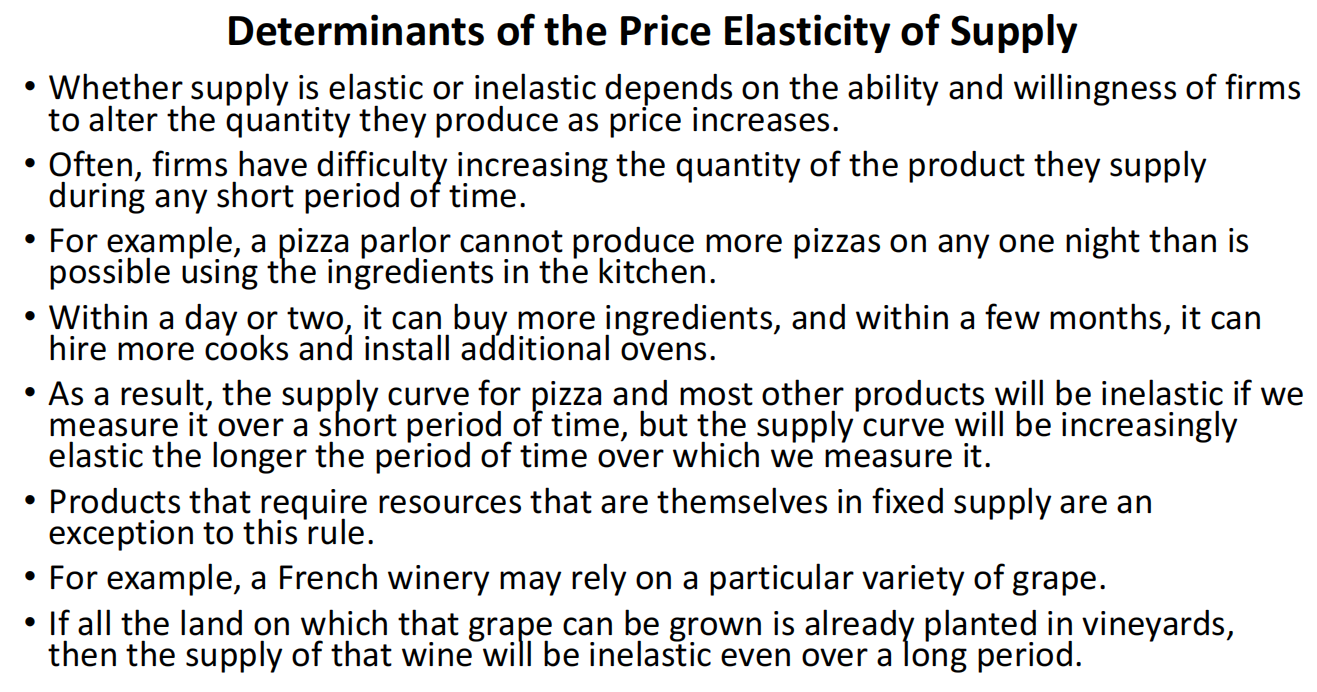
• Whether supply is elastic or inelastic depends on the ability and willingness of firms to alter the quantity they produce as price increases.
📖 点击查看译文
供给是弹性还是缺乏弹性取决于企业在价格上涨时调整生产数量的能力和意愿。
• Often, firms have difficulty increasing the quantity of the product they supply during any short period of time.
📖 点击查看译文
通常,企业在短期内很难增加其供应的产品数量。
• For example, a pizza parlor cannot produce more pizzas on any one night than is possible using the ingredients in the kitchen.
📖 点击查看译文
例如,一家比萨店在某个晚上最多只能生产厨房食材所允许的比萨数量。
• Within a day or two, it can buy more ingredients, and within a few months, it can hire more cooks and install additional ovens.
📖 点击查看译文
在一两天内,它可以购买更多食材;在几个月内,它可以雇佣更多厨师并安装额外的烤箱。
• As a result, the supply curve for pizza and most other products will be inelastic if we measure it over a short period of time, but the supply curve will be increasingly elastic the longer the period of time over which we measure it.
📖 点击查看译文
因此,如果我们在短期内衡量比萨和大多数其他产品的供给曲线,它会是缺乏弹性的;但随着衡量时间的延长,供给曲线将变得越来越有弹性。
• Products that require resources that are themselves in fixed supply are an exception to this rule.
📖 点击查看译文
需要固定供应资源的产品是这一规则的例外。
• For example, a French winery may rely on a particular variety of grape.
📖 点击查看译文
例如,一家法国酒庄可能依赖于某种特定品种的葡萄。
• If all the land on which that grape can be grown is already planted in vineyards, then the supply of that wine will be inelastic even over a long period.
📖 点击查看译文
如果所有适合种植这种葡萄的土地已经被葡萄园占据,那么即使在较长时间内,该酒的供给也仍然是缺乏弹性的。
知识点列表与拓展 (Knowledge Points and Extensions):
1. Short-run vs. Long-run Elasticity (短期 vs. 长期供给弹性)
-
解释 (Explanation):
-
Short-run supply (短期供给): Firms cannot easily change production, so supply is inelastic.
-
Long-run supply (长期供给): Firms have more time to adjust resources, so supply is more elastic.
-
-
例子 (Example):
-
Fast-food restaurants (快餐店) → In the short run, they cannot expand quickly.
-
Automobile manufacturers (汽车制造商) → In the long run, they can build new factories.
-
-
拓展 (Extension):
-
Investment in capital goods increases supply elasticity over time.
-
(资本品投资会提高长期供给弹性。)
-
2. Fixed Supply Constraints (固定供给限制)
-
解释 (Explanation):
- Some goods have naturally limited resources, making their supply inelastic even in the long run.
-
例子 (Example):
-
Land for famous vineyards (知名葡萄园的土地) → Cannot expand even if prices rise.
-
Rare metals like platinum (铂等稀有金属) → Mining cannot easily increase supply.
-
-
拓展 (Extension):
-
Technology and substitutes can sometimes mitigate supply constraints.
-
(技术和替代品有时可以缓解供给限制。)
-
20
Polar Cases of Perfectly Elastic and Perfectly Inelastic Supply (完全弹性与完全无弹性供给的极端情况)
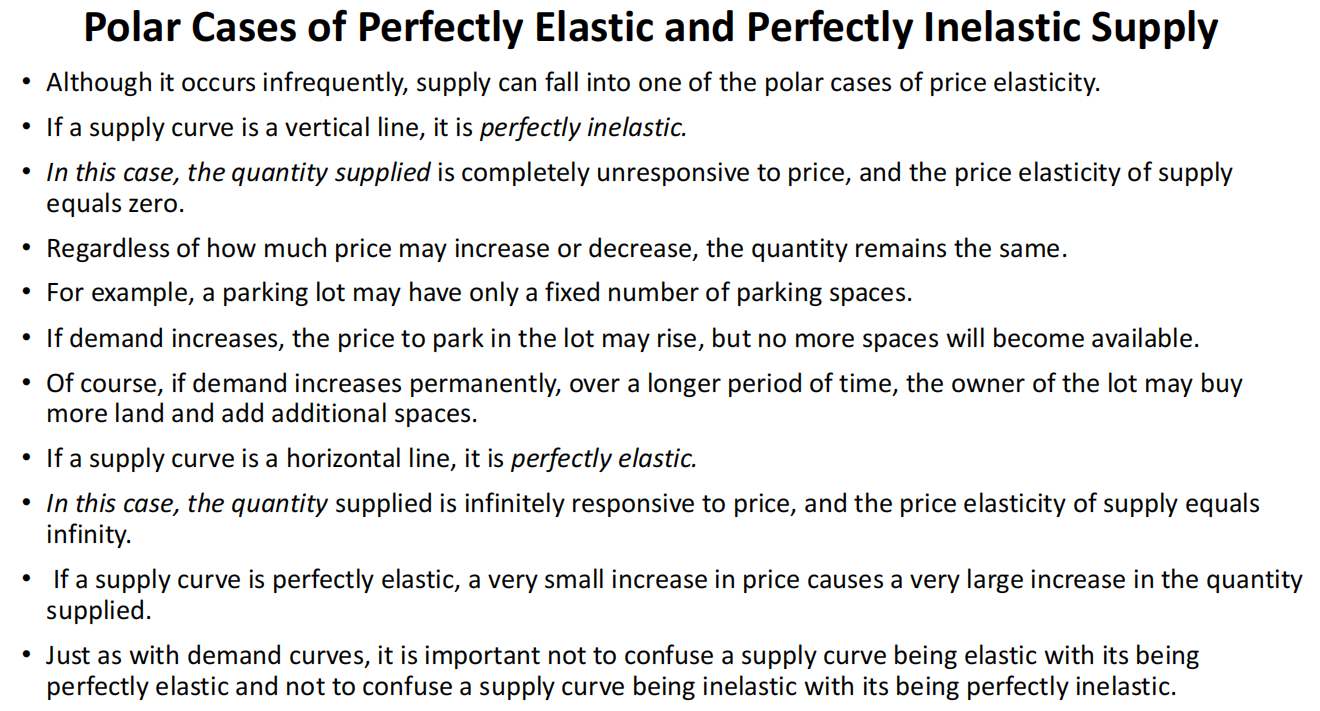
• Although it occurs infrequently, supply can fall into one of the polar cases of price elasticity.
📖 点击查看译文
虽然这种情况很少发生,但供给有时会处于价格弹性的极端情况之一。
• If a supply curve is a vertical line, it is perfectly inelastic.
📖 点击查看译文
如果供给曲线是一条垂直线,那么它是完全无弹性的。
• In this case, the quantity supplied is completely unresponsive to price, and the price elasticity of supply equals zero.
📖 点击查看译文
在这种情况下,供给数量对价格完全没有反应,供给的价格弹性等于零。
• Regardless of how much price may increase or decrease, the quantity remains the same.
📖 点击查看译文
无论价格如何上涨或下跌,供给数量都保持不变。
• For example, a parking lot may have only a fixed number of parking spaces.
📖 点击查看译文
例如,一个停车场可能只有固定数量的停车位。
• If demand increases, the price to park in the lot may rise, but no more spaces will become available.
📖 点击查看译文
如果需求增加,停车费可能会上涨,但不会有更多停车位可用。
• Of course, if demand increases permanently, over a longer period of time, the owner of the lot may buy more land and add additional spaces.
📖 点击查看译文
当然,如果需求长期增加,停车场的所有者可能会购买更多土地,增加额外的停车位。
• If a supply curve is a horizontal line, it is perfectly elastic.
📖 点击查看译文
如果供给曲线是一条水平线,那么它是完全弹性的。
• In this case, the quantity supplied is infinitely responsive to price, and the price elasticity of supply equals infinity.
📖 点击查看译文
在这种情况下,供给数量对价格的反应是无限的,供给的价格弹性等于无穷大。
• If a supply curve is perfectly elastic, a very small increase in price causes a very large increase in the quantity supplied.
📖 点击查看译文
如果供给曲线是完全弹性的,那么价格的极小上涨会导致供给数量的极大增加。
• Just as with demand curves, it is important not to confuse a supply curve being elastic with its being perfectly elastic and not to confuse a supply curve being inelastic with its being perfectly inelastic.
📖 点击查看译文
与需求曲线一样,重要的是不要将“弹性供给”与“完全弹性供给”混淆,也不要将“无弹性供给”与“完全无弹性供给”混淆。
知识点列表与拓展 (Knowledge Points and Extensions):
1. Perfectly Inelastic Supply (完全无弹性供给)
-
定义 (Definition):
- Price elasticity of supply = 0 → Supply does not change regardless of price changes.
-
例子 (Example):
-
Fixed number of stadium seats (固定数量的体育场座位) → Even if ticket prices increase, the number of available seats remains the same.
-
Land in a city center (市中心的土地) → The supply is fixed, price changes do not affect availability.
-
-
拓展 (Extension):
-
Government policies (政府政策) can sometimes increase supply elasticity, e.g., expanding urban areas.
-
(政府政策有时可以提高供给弹性,例如扩展城市区域。)
-
2. Perfectly Elastic Supply (完全弹性供给)
-
定义 (Definition):
- Price elasticity of supply = ∞ → Any small price change leads to an infinitely large change in quantity supplied.
-
例子 (Example):
-
Perfectly competitive markets (完全竞争市场) → Firms can supply any quantity at the market price.
-
Commodity markets (大宗商品市场) → If wheat farmers can sell at a fixed price, they will supply as much as possible.
-
-
拓展 (Extension):
-
Short-run vs. long-run differences: Some goods may appear elastic in the short run but become inelastic in the long run.
-
(短期 vs. 长期差异:某些商品在短期内可能表现出弹性,但在长期内会变得无弹性。)
-
21
Using Price Elasticity of Supply to Predict Changes in Price (利用供给价格弹性预测价格变化)
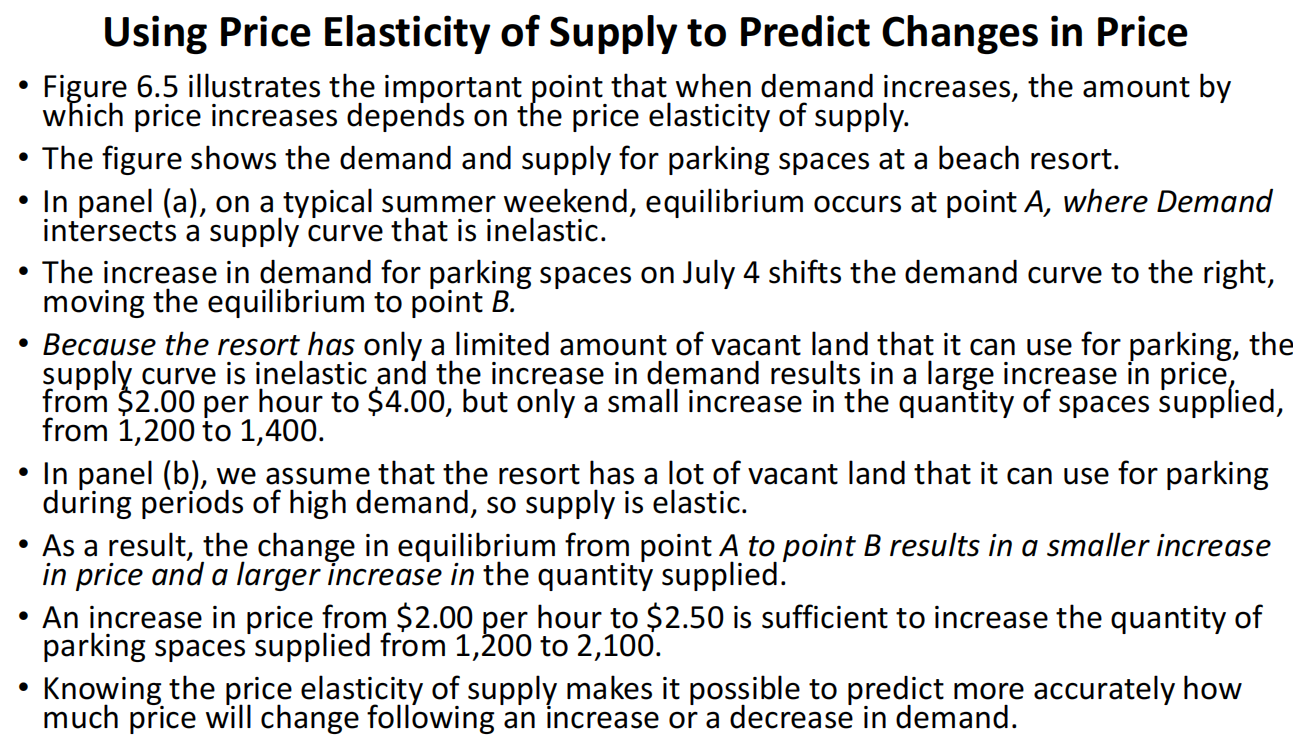
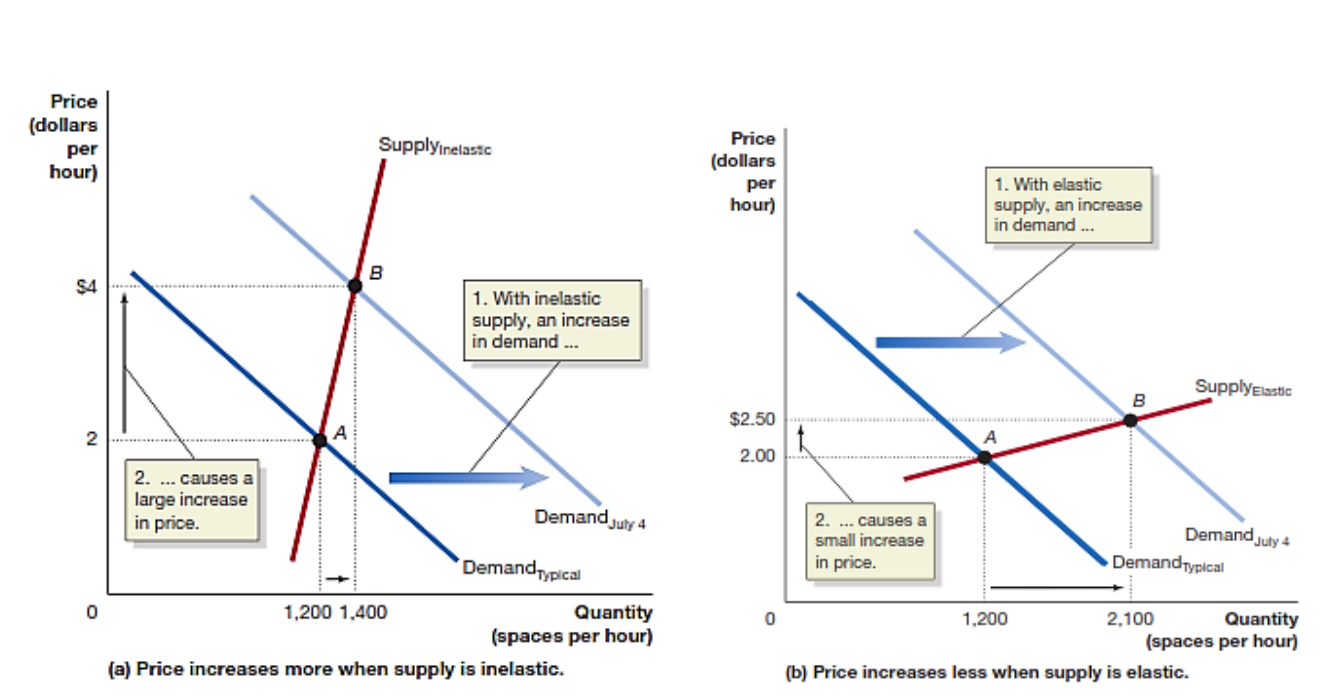
• Figure 6.5 illustrates the important point that when demand increases, the amount by which price increases depends on the price elasticity of supply.
📖 点击查看译文
图 6.5 说明了一个重要观点:当需求增加时,价格上涨的幅度取决于供给的价格弹性。
• The figure shows the demand and supply for parking spaces at a beach resort.
📖 点击查看译文
该图显示了海滩度假区的停车位供需情况。
• In panel (a), on a typical summer weekend, equilibrium occurs at point A, where Demand intersects a supply curve that is inelastic.
📖 点击查看译文
在 (a) 图中,在典型的夏季周末,市场均衡发生在 A 点,此时需求曲线与一条无弹性的供给曲线相交。
• The increase in demand for parking spaces on July 4 shifts the demand curve to the right, moving the equilibrium to point B.
📖 点击查看译文
7 月 4 日对停车位的需求增加,使需求曲线右移,市场均衡移动到 B 点。
• Because the resort has only a limited amount of vacant land that it can use for parking, the supply curve is inelastic and the increase in demand results in a large increase in price, from 4.00, but only a small increase in the quantity of spaces supplied, from 1,200 to 1,400.
📖 点击查看译文
由于度假区可用于停车的空地有限,供给曲线是无弹性的,因此需求增加导致价格大幅上涨,从每小时 2.00 美元涨至 4.00 美元,但停车位供应量仅从 1,200 个增加到 1,400 个。
• In panel (b), we assume that the resort has a lot of vacant land that it can use for parking during periods of high demand, so supply is elastic.
📖 点击查看译文
在 (b) 图中,假设度假区有大量空地可用于应对高需求时期的停车,因此供给是有弹性的。
• As a result, the change in equilibrium from point A to point B results in a smaller increase in price and a larger increase in the quantity supplied.
📖 点击查看译文
因此,均衡从 A 点移动到 B 点后,价格涨幅较小,而供给量的增长幅度较大。
• An increase in price from 2.50 is sufficient to increase the quantity of parking spaces supplied from 1,200 to 2,100.
📖 点击查看译文
价格从每小时 2.00 美元上涨到 2.50 美元,就足以使停车位供应量从 1,200 个增加到 2,100 个。
• Knowing the price elasticity of supply makes it possible to predict more accurately how much price will change following an increase or a decrease in demand.
📖 点击查看译文
了解供给的价格弹性,可以更准确地预测需求增加或减少后价格的变化幅度。
知识点列表与拓展 (Knowledge Points and Extensions):
1. Price Elasticity of Supply and Price Changes (供给价格弹性与价格变化)
-
无弹性供给 (Inelastic Supply):
-
定义 (Definition): 供给量对价格变化的反应较小(供给弹性 < 1)。
-
特征 (Characteristics):
-
价格上涨幅度大,供给量增长有限。
-
短期内资源有限(如土地、时间、技术限制)。
-
-
例子 (Examples):
-
市中心停车位 (Urban parking spaces) → 空间有限,即使价格上涨,停车位供应仍难以增加。
-
名牌手工制品 (Luxury handmade goods) → 生产速度受限,短期内无法大幅增加供给。
-
-
2. Elastic Supply and Price Stability (弹性供给与价格稳定)
-
弹性供给 (Elastic Supply):
-
定义 (Definition): 供给量对价格变化的反应较大(供给弹性 > 1)。
-
特征 (Characteristics):
-
价格上涨幅度小,供给量增长较快。
-
生产资源较容易调整(如工厂、劳动力、土地储备)。
-
-
例子 (Examples):
-
临时市场摊位 (Temporary market stalls) → 需求上涨时,可迅速增加供应。
-
快时尚服装 (Fast fashion production) → 厂商能快速调整生产规模,适应市场变化。
-
-
3. Predicting Market Behavior (预测市场行为)
-
影响市场均衡的因素 (Factors Affecting Market Equilibrium):
-
需求增加 (Increase in Demand) → 价格和供给数量的变化取决于供给弹性。
-
短期 vs. 长期 (Short-run vs. Long-run Effects)
-
短期:供给更无弹性,价格波动较大。
-
长期:供给更具弹性,价格变化趋于平稳。
-
-
-
应用案例 (Practical Applications):
-
政府调控 (Government Regulation) → 了解供给弹性有助于制定税收、价格管制政策。
-
商业决策 (Business Strategy) → 企业可以利用供给弹性分析来优化生产与定价策略。
-
22
At point A, the areas of rectangles C and D are still equal to 2.70 multiplied by 1,200 gallons, or $3,240.
📖 点击查看译文
在A点,矩形C和D的面积仍然等于2.70乘以1,200加仑,即$3,240。
Here, total revenue rises because the increase in the quantity demanded is large enough to offset the lower price.
📖 点击查看译文
在这里,总收益增加,因为需求量的增长足以弥补价格下降的影响。
As a result, the 300 in revenue lost - rectangle C.
📖 点击查看译文
因此,由于降价带来的300的收益损失(矩形C)。
A less common possibility than those shown in Figure 6.2 is that demand is unit elastic.
📖 点击查看译文
比图6.2所示情况更少见的一种可能性是,需求是单位弹性的。
In that case, a small change in price is exactly offset by a proportional change in the quantity demanded, leaving revenue unaffected.
📖 点击查看译文
在这种情况下,价格的微小变化被需求量的同比变化完全抵消,使总收益不受影响。
Therefore, when demand is unit elastic, neither a decrease nor an increase in price affects revenue.
📖 点击查看译文
因此,当需求是单位弹性时,无论价格上涨还是下跌,都不会影响总收益。
知识点列表与拓展 (Knowledge Points and Extensions):
1. Price Cuts and Revenue in Elastic Demand (富有弹性需求下的降价与收益关系)
-
解释 (Explanation):
When demand is elastic, reducing the price leads to a larger proportional increase in quantity demanded, resulting in an increase in total revenue.
(当需求富有弹性时,价格降低会导致需求量更大幅度的增加,从而使总收益上升。)
-
例子 (Example):
A clothing store reduces the price of T-shirts by 10%, causing sales to increase by 25%, leading to higher total revenue.
(服装店将T恤价格降低10%,导致销量增长25%,最终总收益上升。)
-
拓展 (Extension):
Companies selling luxury or non-essential goods often use discounts and promotions to maximize revenue by taking advantage of elastic demand.
(销售奢侈品或非必需品的公司通常利用折扣和促销策略,以弹性需求特性来最大化收益。)
2. Unit Elastic Demand and Revenue (单位弹性需求与收益关系)
-
解释 (Explanation):
When demand is unit elastic, a change in price leads to a proportional change in quantity demanded, resulting in no change in total revenue.
(当需求为单位弹性时,价格的变动导致需求量同比变化,使总收益保持不变。)
-
例子 (Example):
If a company increases the price of a product by 5% and sales drop exactly by 5%, total revenue remains unchanged.
(如果公司将产品价格提高5%,而销量恰好减少5%,那么总收益不会发生变化。)
-
拓展 (Extension):
Businesses need to determine whether their products exhibit unit elastic demand to avoid unnecessary price adjustments that do not impact total revenue.
(企业需要判断其产品是否具有单位弹性需求,以避免不必要的价格调整,因为这不会影响总收益。)
9

10

Elasticity and Revenue with a Linear Demand Curve (线性需求曲线下的弹性与收益)
Along most demand curves, elasticity is not constant at every point.
📖 点击查看译文
在大多数需求曲线上,弹性在每个点上并不是恒定的。
For example, a straight-line, or linear, demand curve for gasoline is shown in panel (a).
📖 点击查看译文
例如,面板(a)中显示了一条关于汽油的直线或线性需求曲线。
The numbers from the table are plotted in the graphs.
📖 点击查看译文
表格中的数据被绘制在图表中。
The demand curve shows that when the price drops by $1 per gallon, consumers always respond by buying 2 more gallons per day.
📖 点击查看译文
需求曲线表明,当价格每加仑下降$1时,消费者每天会额外购买2加仑。
When the price is high and the quantity demanded is low, demand is elastic.
📖 点击查看译文
当价格较高且需求量较低时,需求是有弹性的。
Demand is elastic because a $1 drop in price is a smaller percentage change when the price is high, and an increase of 2 gallons is a larger percentage change when the quantity of gasoline purchased is low.
📖 点击查看译文
需求具有弹性,因为当价格较高时,$1的下降所占的比例较小,而当购买的汽油数量较少时,增加2加仑的比例较大。
By similar reasoning, we can see why demand is inelastic when the price is low and the quantity demanded is high.
📖 点击查看译文
同样的推理可以解释,当价格较低且需求量较高时,需求为何缺乏弹性。
知识点列表与拓展 (Knowledge Points and Extensions):
1. Elasticity Varies Along a Linear Demand Curve (线性需求曲线上的弹性变化)
-
解释 (Explanation):
A linear demand curve does not have constant elasticity—elasticity is higher when price is high and quantity demanded is low, and lower when price is low and quantity demanded is high.
(线性需求曲线的弹性并不恒定——当价格高、需求量低时,弹性较大;当价格低、需求量高时,弹性较小。)
-
例子 (Example):
If gasoline prices drop from 4 per gallon, demand might increase significantly (elastic). But if prices drop from 1, the increase in demand might be much smaller (inelastic).
(如果汽油价格从4,加仑需求可能大幅增加(弹性)。但如果价格从1,需求增长可能很小(缺乏弹性)。)
-
拓展 (Extension):
Businesses need to consider where their product lies on the demand curve when making pricing decisions to maximize revenue.
(企业在制定定价策略时,需要考虑其产品在需求曲线上的位置,以优化收益。)
2. Revenue Implications of Elastic vs. Inelastic Demand (弹性与缺乏弹性需求对收益的影响)
-
解释 (Explanation):
When demand is elastic, lowering prices increases total revenue; when demand is inelastic, lowering prices reduces total revenue.
(当需求有弹性时,降价会增加总收益;当需求缺乏弹性时,降价会减少总收益。)
-
例子 (Example):
A high-end smartphone brand might see a large sales increase with a small price cut (elastic demand), while a necessity like salt sees little change in demand when prices fluctuate (inelastic demand).
(高端智能手机品牌可能会因小幅降价带来销量大幅增长(弹性需求),而像食盐这样的必需品,即使价格波动,需求变化也很小(缺乏弹性需求)。)
-
拓展 (Extension):
Price discrimination strategies, such as discounts and premium pricing, can help businesses take advantage of different elasticity levels among consumer segments.
(价格歧视策略,如折扣定价和溢价策略,可以帮助企业利用不同消费群体的需求弹性特性。)
11

Elasticity and Revenue with a Linear Demand Curve (线性需求曲线下的弹性与收益)
Panel (a) in Figure 6.3 shows that when price is between 4 and quantity demanded is between 0 gallons and 8 gallons, demand is elastic.
📖 点击查看译文
图 6.3 的面板 (a) 显示,当价格在 4 之间,需求量在 0 加仑到 8 加仑之间时,需求是有弹性的。
Panel (b) shows that over this same range, total revenue will increase as price falls.
📖 点击查看译文
图 6.3 的面板 (b) 显示,在相同的价格范围内,随着价格下降,总收益会增加。
For example, in panel (a), as price falls from 6, the quantity demanded increases from 2 to 4, and in panel (b), total revenue increases from 24.
📖 点击查看译文
例如,在面板 (a) 中,当价格从 6 时,需求量从 2 增加到 4;在面板 (b) 中,总收益从 24。
Similarly, when price is between 0 and the quantity demanded is between 8 and 16, demand is inelastic.
📖 点击查看译文
同样地,当价格在 0 之间,需求量在 8 到 16 之间时,需求缺乏弹性。
Over this same range, total revenue will decrease as price falls.
📖 点击查看译文
在同样的价格范围内,随着价格下降,总收益将减少。
For example, as price falls from 2 and the quantity demanded increases from 10 to 12, total revenue decreases from 24.
📖 点击查看译文
例如,当价格从 2,需求量从 10 增加到 12 时,总收益从 24。
知识点列表与拓展 (Knowledge Points and Extensions):
1. Elastic and Inelastic Ranges on a Linear Demand Curve (线性需求曲线上的弹性与缺乏弹性区间)
-
解释 (Explanation):
A linear demand curve has both elastic and inelastic regions. The upper portion (higher prices, lower quantity demanded) is elastic, while the lower portion (lower prices, higher quantity demanded) is inelastic.
(线性需求曲线包含弹性和缺乏弹性的区域。上部分(价格较高,需求量较低)是弹性的,而下部分(价格较低,需求量较高)是缺乏弹性的。)
-
例子 (Example):
If a luxury brand handbag drops in price from 6,000, demand may increase significantly (elastic). But if the price drops from 300, demand may not change much (inelastic).
(如果奢侈品牌手袋的价格从 6,000,需求可能会大幅增长(弹性)。但如果价格从 300,需求可能变化不大(缺乏弹性)。)
-
拓展 (Extension):
Businesses can use this principle to set pricing strategies:
-
Price reductions in the elastic range can boost total revenue.
-
Price reductions in the inelastic range can harm total revenue.
(企业可以利用这一原理制定定价策略:
-
在弹性区间降价可以增加总收益。
-
在缺乏弹性区间降价可能会减少总收益。)
-
2. Revenue Maximization Strategies (收益最大化策略)
-
解释 (Explanation):
Total revenue is maximized at unit elasticity, where price changes do not affect total revenue. Businesses should aim to find this optimal point.
(总收益在单位弹性时达到最大,此时价格变化不会影响总收益。企业应找到这个最佳点。)
-
例子 (Example):
Streaming services often experiment with subscription prices to find the unit elastic point where price changes neither increase nor decrease revenue.
(流媒体服务通常会调整订阅价格,以找到价格变化不会影响收益的单位弹性点。)
-
拓展 (Extension):
Dynamic pricing models in e-commerce and airline industries use real-time demand data to optimize pricing.
(电子商务和航空业的动态定价模型使用实时需求数据来优化定价。)
12

Other Demand Elasticities (其他需求弹性)
In addition to price elasticity, two other demand elasticities are important:
📖 点击查看译文
除了价格弹性之外,另外两种重要的需求弹性是:
1. Cross-price elasticity of demand (交叉价格弹性)
2. Income elasticity of demand (收入弹性)
Cross-Price Elasticity of Demand (交叉价格弹性)
Suppose you work at Apple, and you need to predict the effect of an increase in the price of Samsung Galaxy Gear smartwatch on the quantity of Apple Watches demanded, holding other factors constant.
📖 点击查看译文
假设你在 Apple 工作,需要预测在其他因素不变的情况下,三星 Galaxy Gear 智能手表价格上涨对 Apple Watch 需求量的影响。
You can do this by calculating the cross-price elasticity of demand, which is the percentage change in the quantity of Apple Watches demanded divided by the percentage change in the price of Galaxy Gears—or, in general:
📖 点击查看译文
你可以通过计算交叉价格弹性来预测。交叉价格弹性是 Apple Watch 需求量的百分比变化除以 Galaxy Gear 价格的百分比变化。其公式如下:
The cross-price elasticity of demand is positive or negative, depending on whether the two products are substitutes or complements.
📖 点击查看译文
交叉价格弹性可以是正数或负数,这取决于两种产品是替代品还是互补品。
An increase in the price of a substitute will lead to an increase in the quantity demanded, so the cross-price elasticity of demand will be positive.
📖 点击查看译文
如果某种替代品的价格上升,另一种商品的需求量会增加,因此交叉价格弹性为正。
An increase in the price of a complement will lead to a decrease in the quantity demanded, so the cross-price elasticity of demand will be negative.
📖 点击查看译文
如果某种互补品的价格上升,另一种商品的需求量会减少,因此交叉价格弹性为负。
知识点列表与拓展 (Knowledge Points and Extensions):
1. Substitutes and Complements in Cross-Price Elasticity (替代品与互补品的交叉价格弹性)
-
解释 (Explanation):
-
If cross-price elasticity is positive, the two goods are substitutes. (如交叉价格弹性为正,则两种商品为替代品。)
-
If cross-price elasticity is negative, the two goods are complements. (如交叉价格弹性为负,则两种商品为互补品。)
-
-
例子 (Example):
-
iPhone and Samsung Galaxy: Positive cross-price elasticity (iPhone 和三星 Galaxy:正交叉价格弹性)
-
Coffee and sugar: Negative cross-price elasticity (咖啡和糖:负交叉价格弹性)
-
-
拓展 (Extension):
Businesses can use cross-price elasticity to make pricing decisions, such as increasing the price of a competitor’s product through promotions on their own substitute product.
(企业可以利用交叉价格弹性制定定价策略,例如通过促销自己的替代产品,间接影响竞争对手产品的价格。)
2. Practical Applications of Cross-Price Elasticity (交叉价格弹性的实际应用)
-
解释 (Explanation):
Firms analyze cross-price elasticity to determine how the price of related goods impacts demand for their own products.
(企业分析交叉价格弹性,以确定相关商品的价格如何影响自身产品的需求。)
-
例子 (Example):
-
Microsoft may monitor how changes in MacBook prices affect demand for Surface laptops.
-
(微软可能会关注 MacBook 价格变化如何影响 Surface 笔记本电脑的需求。)
-
-
拓展 (Extension):
Companies can use bundling strategies to leverage cross-price elasticity, such as selling smartphones with wireless earbuds at a discount.
(企业可以利用捆绑销售策略,如以折扣价捆绑销售智能手机和无线耳机,以利用交叉价格弹性。)
13

Cross-Price Elasticity of Demand (交叉价格弹性)
• Of course, if the two products are unrelated—such as smartwatches and peanut butter—the cross-price elasticity of demand will be zero.
📖 点击查看译文
当然,如果两种商品彼此无关,比如智能手表和花生酱,那么它们的交叉价格弹性将为零。
• Table 6.4 summarizes the key points about the cross-price elasticity of demand.
📖 点击查看译文
表 6.4 总结了关于交叉价格弹性的关键点。
• Cross-price elasticity of demand is important to firm managers because it allows them to measure whether products sold by other firms are close substitutes for their products.
📖 点击查看译文
交叉价格弹性对企业管理者至关重要,因为它可以帮助他们判断其他公司销售的产品是否是自己产品的近似替代品。
• For example, Pepsi-Cola and Coca-Cola both spend heavily on advertising, each hoping to convince consumers that its cola tastes better than its rivals.
📖 点击查看译文
例如,百事可乐和可口可乐都在广告上投入巨资,希望能说服消费者自己的可乐比竞争对手的更好喝。
• How can these firms tell whether their advertising campaigns have been effective?
📖 点击查看译文
这些公司如何判断自己的广告宣传是否有效?
• One way is by seeing whether the cross-price elasticity of demand has changed.
📖 点击查看译文
一种方法是观察交叉价格弹性是否发生了变化。
知识点列表与拓展 (Knowledge Points and Extensions):
1. Identifying Unrelated Goods (识别无关商品)
-
解释 (Explanation):
- When cross-price elasticity is zero, the two goods are unrelated. (如果交叉价格弹性为零,则两种商品彼此无关。)
-
例子 (Example):
- Smartphones and peanut butter: Zero cross-price elasticity (智能手机和花生酱:交叉价格弹性为零)
-
拓展 (Extension):
-
Firms do not need to consider pricing interactions between unrelated goods when making pricing decisions.
-
(企业在定价决策时,不需要考虑彼此无关商品的定价互动。)
-
2. Cross-Price Elasticity in Competitive Markets (竞争市场中的交叉价格弹性)
-
解释 (Explanation):
-
If cross-price elasticity is highly positive, two products are strong substitutes, leading to aggressive competition.
-
(如果交叉价格弹性高度为正,则两种产品是强替代品,导致激烈的竞争。)
-
-
例子 (Example):
- Coca-Cola vs. Pepsi: Strong positive cross-price elasticity (可口可乐 vs. 百事可乐:高度正交叉价格弹性)
-
拓展 (Extension):
-
Companies monitor changes in cross-price elasticity to evaluate the effectiveness of advertising and branding strategies.
-
(公司会监测交叉价格弹性的变化,以评估广告和品牌策略的有效性。)
-
14

Income Elasticity of Demand (收入弹性)
• The income elasticity of demand measures the responsiveness of the quantity demanded to changes in income.
📖 点击查看译文
收入弹性衡量的是需求量对收入变化的敏感程度。
• It is calculated as follows:
📖 点击查看译文
其计算方式如下:
• Income elasticity of demand = Percentage change in quantity demanded / Percentage change in income
📖 点击查看译文
收入弹性 = 需求量的百分比变化 / 收入的百分比变化
• We know that if the quantity demanded of a good increases as income increases, then the good is a normal good.
📖 点击查看译文
如果一种商品的需求量随着收入的增加而增加,则该商品为正常商品。
• Normal goods are often further subdivided into luxuries and necessities.
📖 点击查看译文
正常商品通常可进一步分为奢侈品和必需品。
• A good is a luxury if the quantity demanded is very responsive to changes in income i.e. by more than 1.
📖 点击查看译文
如果某种商品的需求量对收入变化非常敏感(收入弹性大于 1),则该商品为奢侈品。
• Expensive jewelry and vacation homes are examples of luxuries.
📖 点击查看译文
昂贵的珠宝和度假别墅是奢侈品的例子。
• A good is a necessity if the quantity demanded is not very responsive to changes in income i.e. by less than 1.
📖 点击查看译文
如果某种商品的需求量对收入变化不太敏感(收入弹性小于 1),则该商品为必需品。
• Food and clothing are examples of necessities.
📖 点击查看译文
食品和服装是必需品的例子。
• A good is inferior if the quantity demanded falls when income increases.
📖 点击查看译文
如果某种商品的需求量在收入增加时下降,则该商品为劣等品。
• Ground beef with a high fat content is an example of an inferior good.
📖 点击查看译文
高脂肪含量的碎牛肉是劣等品的例子。
知识点列表与拓展 (Knowledge Points and Extensions):
1. Understanding Income Elasticity (理解收入弹性)
-
解释 (Explanation):
-
If income elasticity > 1, the good is a luxury.
-
If 0 < income elasticity < 1, the good is a necessity.
-
If income elasticity < 0, the good is inferior.
-
-
例子 (Example):
-
Luxury: Sports cars, designer handbags (奢侈品:跑车、名牌包)
-
Necessity: Bread, electricity (必需品:面包、电力)
-
Inferior Good: Instant noodles, used cars (劣等品:方便面、二手车)
-
-
拓展 (Extension):
-
Businesses use income elasticity to predict how demand will change as the economy grows.
-
(企业利用收入弹性预测经济增长时的需求变化。)
-
2. Income Elasticity and Market Strategy (收入弹性与市场策略)
-
解释 (Explanation):
-
Firms producing luxury goods benefit during economic booms but struggle in recessions.
-
Firms producing inferior goods may thrive in recessions as consumers cut spending.
-
-
例子 (Example):
- Airlines offer economy-class tickets to capture demand during downturns. (航空公司提供经济舱机票以适应经济低迷期的需求。)
-
拓展 (Extension):
-
Governments can use income elasticity data to plan social welfare policies.
-
(政府可以利用收入弹性数据制定社会福利政策。)
-
15

Using Elasticity to Analyze the Disappearing Family Farm (利用弹性分析家庭农场的消失)
• The concepts of price elasticity and income elasticity can help us understand many economic issues.
📖 点击查看译文
价格弹性和收入弹性的概念可以帮助我们理解许多经济问题。
• For example, some people are concerned that the family farm is becoming an endangered species in the United States.
📖 点击查看译文
例如,一些人担心美国的家庭农场正在濒临灭绝。
• Although food production has been growing steadily, the number of farms and farmers continues to dwindle.
📖 点击查看译文
尽管食品产量一直在稳定增长,但农场和农民的数量却在不断减少。
• In 1950, the United States had more than 5 million farms, and more than 23 million people lived on farms.
📖 点击查看译文
1950年,美国有超过500万家农场,超过2300万人居住在农场上。
• By 2015, only about 2 million farms remained, and fewer than 3 million people lived on them.
📖 点击查看译文
到2015年,仅剩约200万家农场,居住在农场上的人口不足300万。
• The federal government has several programs that are intended to aid farmers.
📖 点击查看译文
联邦政府制定了多个旨在帮助农民的计划。
• Many of these programs have been aimed at helping small, family-operated farms, but growth in farm production, combined with low price and income elasticities for most food products, have made it difficult for owners of family farms to earn a profit.
📖 点击查看译文
许多这些计划的目标是帮助小型家庭农场,但农业产量的增长,加上大多数食品价格弹性和收入弹性较低,使得家庭农场主难以盈利。
• In 1950, the average U.S. wheat farmer harvested about 17 bushels from each acre of wheat planted.
📖 点击查看译文
1950年,美国平均每位小麦农民每英亩收获约17蒲式耳的小麦。
• By 2015, because of the development of superior strains of wheat and improvements in farming techniques, the average American wheat farmer harvested 44 bushels per acre.
📖 点击查看译文
到2015年,由于优良小麦品种的开发和农业技术的改进,美国平均每位小麦农民每英亩收获44蒲式耳小麦。
• So, even though the total number of acres devoted to growing wheat declined from about 62 million to about 48 million, total wheat production rose from about 1.0 billion bushels to about 2.1 billion.
📖 点击查看译文
因此,尽管用于种植小麦的总面积从约6200万英亩减少到约4800万英亩,但总小麦产量却从约10亿蒲式耳上升到约21亿蒲式耳。
知识点列表与拓展 (Knowledge Points and Extensions):
1. Price and Income Elasticities in Agriculture (农业中的价格弹性与收入弹性)
-
解释 (Explanation):
-
Food products have low price elasticity → An increase in supply leads to price drops but not a proportional increase in quantity demanded.
-
Food products have low income elasticity → Rising incomes do not significantly increase food consumption.
-
-
例子 (Example):
- Increased wheat production leads to lower prices but not much higher demand, reducing profits for farmers.
-
拓展 (Extension):
-
Government price support programs exist to stabilize agricultural incomes.
-
(政府设有价格支持计划以稳定农业收入。)
-
2. Technological Advancements in Farming (农业技术进步的影响)
-
解释 (Explanation):
-
Improved wheat strains and farming techniques increase yield per acre.
-
Reduced farming land but higher total production.
-
-
例子 (Example):
- Precision agriculture, genetically modified crops (精准农业,转基因作物)
-
拓展 (Extension):
-
Increased productivity often benefits large farms while hurting small family farms.
-
(生产力提升通常有利于大农场,但不利于小型家庭农场。)
-
16

The Impact of Increased Wheat Production on Prices (小麦产量增加对价格的影响)
• Unfortunately for U.S. farmers, this increase in wheat production resulted in a substantial decline in wheat prices.
📖 点击查看译文
不幸的是,对于美国农民来说,小麦产量的增加导致了小麦价格的大幅下降。
• Two key factors explain this decline:
📖 点击查看译文
两个关键因素解释了这一价格下降:
• (1) The demand for wheat is inelastic, and
📖 点击查看译文
(1) 小麦的需求是缺乏弹性的,
• (2) the income elasticity of demand for wheat is low.
📖 点击查看译文
(2) 小麦的收入弹性较低。
• Even though the U.S. population has increased greatly since 1950 and the income of the average American is much higher than it was in 1950, the demand for wheat has increased only moderately.
📖 点击查看译文
尽管自1950年以来,美国人口大幅增长,且美国人的平均收入远高于1950年,但小麦需求仅略有增加。
• For all of the additional wheat to be sold, the price has had to decline.
📖 点击查看译文
为了出售所有额外生产的小麦,价格不得不下降。
• Because the demand for wheat is inelastic, the price decline has been substantial.
📖 点击查看译文
由于小麦的需求缺乏弹性,价格下降幅度较大。
• Figure 6.4 illustrates these points.
📖 点击查看译文
图6.4 说明了这些观点。
知识点列表与拓展 (Knowledge Points and Extensions):
1. Price Elasticity of Demand for Wheat (小麦的价格弹性)
-
解释 (Explanation):
-
Inelastic demand means that even if prices drop, demand does not increase significantly.
-
Farmers increase production, but revenues decline due to falling prices.
-
-
例子 (Example):
- If wheat supply doubles, price may fall sharply, but consumers won’t buy twice as much.
-
拓展 (Extension):
-
Price elasticity is crucial for government agricultural policies.
-
(价格弹性对于政府农业政策至关重要。)
-
2. Income Elasticity of Demand for Wheat (小麦的收入弹性)
-
解释 (Explanation):
-
Low income elasticity → Rising incomes do not significantly increase wheat consumption.
-
Wheat is a staple good, not a luxury.
-
-
例子 (Example):
- As income rises, people may spend more on organic food or dining out, but not on wheat itself.
-
拓展 (Extension):
-
This explains why farmers struggle to profit, even when the economy grows.
-
(这解释了即使经济增长,农民仍难以盈利。)
-
17

The Decline of Small Family Farms in the U.S. (美国小型家庭农场的衰退)
• A large shift in supply, a small shift in demand, and an inelastic demand curve combined to drive down the price of wheat from 5.00 in 2015.
📖 点击查看译文
供给的大幅增加、需求的小幅变化以及缺乏弹性的需求曲线共同导致小麦价格从1950年的每蒲式耳19.53美元下降至2015年的5.00美元。
• With low prices, only the most efficiently run farms have been able to remain profitable.
📖 点击查看译文
在低价格下,只有运营效率最高的农场才能保持盈利。
• Small family-run farms have found it difficult to survive, and many of these farms have disappeared.
📖 点击查看译文
小型家庭农场很难生存,许多这样的农场已经消失。
• The markets for most other food products are similar to the market for wheat.
📖 点击查看译文
大多数其他食品的市场与小麦市场类似。
• They are characterized by output growth and low income and price elasticities.
📖 点击查看译文
这些市场的特点是产量增长以及低收入弹性和低价格弹性。
• The result is the paradox of U.S. farming: ever more abundant and cheaper food, supplied by fewer and fewer farms.
📖 点击查看译文
最终形成了美国农业的悖论:食物越来越丰富且便宜,但生产它们的农场却越来越少。
• U.S. consumers have benefited, but most family farmers have not.
📖 点击查看译文
美国消费者受益了,但大多数家庭农场主却没有。
知识点列表与拓展 (Knowledge Points and Extensions):
1. The Impact of Supply and Demand on Price (供需对价格的影响)
-
解释 (Explanation):
-
Supply increased significantly → Prices dropped.
-
Demand changed only slightly → Could not absorb extra supply.
-
Inelastic demand → Small demand shifts cannot offset price drops.
-
-
例子 (Example):
- Wheat price fell from 5.00 per bushel (1950-2015).
-
拓展 (Extension):
-
Technology advancements (e.g., GMOs, fertilizers) boosted yields but hurt small farms.
-
(技术进步如转基因作物和化肥提高了产量,但对小型农场不利。)
-
2. The Disappearance of Small Farms (小型农场的消失)
-
解释 (Explanation):
-
Large farms achieve economies of scale, while small farms struggle to survive.
-
Only efficient, large-scale farms remain profitable.
-
-
例子 (Example):
- U.S. farms dropped from 5 million (1950) to 2 million (2015).
-
拓展 (Extension):
-
Government subsidies aim to support small farms, but benefits often go to large agribusinesses.
-
(政府补贴旨在支持小型农场,但受益者往往是大型农业企业。)
-
3. The Farming Paradox (农业悖论)
-
解释 (Explanation):
-
Food is cheaper and more abundant, but small farmers suffer.
-
U.S. consumers benefit from low food prices, but farming families decline.
-
-
例子 (Example):
- Wheat production doubled, but family farms disappeared.
-
拓展 (Extension):
-
The same trend appears in dairy, corn, and soybean markets.
-
(同样的趋势也出现在奶制品、玉米和大豆市场中。)
-
18

The Price Elasticity of Supply and Its Measurement (供给的价格弹性及其测量)
• We can use the concept of elasticity to measure the responsiveness of firms to a change in price, just as we used it to measure the responsiveness of consumers.
📖 点击查看译文
我们可以使用弹性的概念来衡量企业对价格变化的响应程度,就像我们用它来衡量消费者的响应程度一样。
• We know from the law of supply that when the price of a product increases, the quantity supplied increases.
📖 点击查看译文
根据供给定律,当产品价格上升时,供给数量也会上升。
• To measure how much the quantity supplied increases when price increases, we use the price elasticity of supply.
📖 点击查看译文
为了衡量价格上升时供给数量增加的程度,我们使用供给的价格弹性。
Measuring the Price Elasticity of Supply (供给的价格弹性测量)
• As we did with the price elasticity of demand, we calculate the price elasticity of supply by using percentage changes:
📖 点击查看译文
与需求的价格弹性一样,我们通过百分比变化计算供给的价格弹性:
• Price elasticity of supply = Percentage change in quantity supplied / Percentage change in price
📖 点击查看译文
供给的价格弹性 = 供给数量的百分比变化 / 价格的百分比变化
• Notice that because supply curves are upward sloping, the price elasticity of supply will be a positive number.
📖 点击查看译文
注意,由于供给曲线是向上倾斜的,因此供给的价格弹性是一个正数。
• We categorize the price elasticity of supply the same way we categorized the price elasticity of demand.
📖 点击查看译文
我们对供给的价格弹性分类方式与对需求的价格弹性分类方式相同。
• If the price elasticity of supply is less than 1, then supply is inelastic.
📖 点击查看译文
如果供给的价格弹性小于 1,则供给是缺乏弹性的。
• If the price elasticity of supply is greater than 1, then supply is elastic.
📖 点击查看译文
如果供给的价格弹性大于 1,则供给是有弹性的。
• If the price elasticity of supply is equal to 1, the supply is unit elastic.
📖 点击查看译文
如果供给的价格弹性等于 1,则供给是单位弹性的。
知识点列表与拓展 (Knowledge Points and Extensions):
1. Definition and Importance of Price Elasticity of Supply (供给价格弹性的定义与重要性)
-
解释 (Explanation):
-
Measures how responsive producers are to price changes.
-
Helps businesses and policymakers understand market reactions.
-
-
例子 (Example):
- If the price of gold rises, mining companies increase production if supply is elastic.
-
拓展 (Extension):
-
Short-run vs. long-run supply elasticity.
-
(短期 vs. 长期供给弹性)
-
2. Categories of Supply Elasticity (供给弹性的分类)
-
解释 (Explanation):
-
Elastic supply (弹性供给): Producers react strongly to price changes (Es > 1).
-
Inelastic supply (缺乏弹性的供给): Producers react weakly to price changes (Es < 1).
-
Unit elastic supply (单位弹性供给): Proportional response (Es = 1).
-
-
例子 (Example):
-
Luxury goods (奢侈品) → Often have elastic supply.
-
Agricultural products (农产品) → Usually inelastic supply in the short term.
-
-
拓展 (Extension):
-
Time factor: In the short run, supply tends to be inelastic, but in the long run, it becomes more elastic.
-
(时间因素:短期内供给往往缺乏弹性,而长期内供给会更有弹性。)
-
19

Determinants of the Price Elasticity of Supply (供给价格弹性的决定因素)
• Whether supply is elastic or inelastic depends on the ability and willingness of firms to alter the quantity they produce as price increases.
📖 点击查看译文
供给是弹性还是缺乏弹性取决于企业在价格上涨时调整生产数量的能力和意愿。
• Often, firms have difficulty increasing the quantity of the product they supply during any short period of time.
📖 点击查看译文
通常,企业在短期内很难增加其供应的产品数量。
• For example, a pizza parlor cannot produce more pizzas on any one night than is possible using the ingredients in the kitchen.
📖 点击查看译文
例如,一家比萨店在某个晚上最多只能生产厨房食材所允许的比萨数量。
• Within a day or two, it can buy more ingredients, and within a few months, it can hire more cooks and install additional ovens.
📖 点击查看译文
在一两天内,它可以购买更多食材;在几个月内,它可以雇佣更多厨师并安装额外的烤箱。
• As a result, the supply curve for pizza and most other products will be inelastic if we measure it over a short period of time, but the supply curve will be increasingly elastic the longer the period of time over which we measure it.
📖 点击查看译文
因此,如果我们在短期内衡量比萨和大多数其他产品的供给曲线,它会是缺乏弹性的;但随着衡量时间的延长,供给曲线将变得越来越有弹性。
• Products that require resources that are themselves in fixed supply are an exception to this rule.
📖 点击查看译文
需要固定供应资源的产品是这一规则的例外。
• For example, a French winery may rely on a particular variety of grape.
📖 点击查看译文
例如,一家法国酒庄可能依赖于某种特定品种的葡萄。
• If all the land on which that grape can be grown is already planted in vineyards, then the supply of that wine will be inelastic even over a long period.
📖 点击查看译文
如果所有适合种植这种葡萄的土地已经被葡萄园占据,那么即使在较长时间内,该酒的供给也仍然是缺乏弹性的。
知识点列表与拓展 (Knowledge Points and Extensions):
1. Short-run vs. Long-run Elasticity (短期 vs. 长期供给弹性)
-
解释 (Explanation):
-
Short-run supply (短期供给): Firms cannot easily change production, so supply is inelastic.
-
Long-run supply (长期供给): Firms have more time to adjust resources, so supply is more elastic.
-
-
例子 (Example):
-
Fast-food restaurants (快餐店) → In the short run, they cannot expand quickly.
-
Automobile manufacturers (汽车制造商) → In the long run, they can build new factories.
-
-
拓展 (Extension):
-
Investment in capital goods increases supply elasticity over time.
-
(资本品投资会提高长期供给弹性。)
-
2. Fixed Supply Constraints (固定供给限制)
-
解释 (Explanation):
- Some goods have naturally limited resources, making their supply inelastic even in the long run.
-
例子 (Example):
-
Land for famous vineyards (知名葡萄园的土地) → Cannot expand even if prices rise.
-
Rare metals like platinum (铂等稀有金属) → Mining cannot easily increase supply.
-
-
拓展 (Extension):
-
Technology and substitutes can sometimes mitigate supply constraints.
-
(技术和替代品有时可以缓解供给限制。)
-
20

Polar Cases of Perfectly Elastic and Perfectly Inelastic Supply (完全弹性与完全无弹性供给的极端情况)
• Although it occurs infrequently, supply can fall into one of the polar cases of price elasticity.
📖 点击查看译文
虽然这种情况很少发生,但供给有时会处于价格弹性的极端情况之一。
• If a supply curve is a vertical line, it is perfectly inelastic.
📖 点击查看译文
如果供给曲线是一条垂直线,那么它是完全无弹性的。
• In this case, the quantity supplied is completely unresponsive to price, and the price elasticity of supply equals zero.
📖 点击查看译文
在这种情况下,供给数量对价格完全没有反应,供给的价格弹性等于零。
• Regardless of how much price may increase or decrease, the quantity remains the same.
📖 点击查看译文
无论价格如何上涨或下跌,供给数量都保持不变。
• For example, a parking lot may have only a fixed number of parking spaces.
📖 点击查看译文
例如,一个停车场可能只有固定数量的停车位。
• If demand increases, the price to park in the lot may rise, but no more spaces will become available.
📖 点击查看译文
如果需求增加,停车费可能会上涨,但不会有更多停车位可用。
• Of course, if demand increases permanently, over a longer period of time, the owner of the lot may buy more land and add additional spaces.
📖 点击查看译文
当然,如果需求长期增加,停车场的所有者可能会购买更多土地,增加额外的停车位。
• If a supply curve is a horizontal line, it is perfectly elastic.
📖 点击查看译文
如果供给曲线是一条水平线,那么它是完全弹性的。
• In this case, the quantity supplied is infinitely responsive to price, and the price elasticity of supply equals infinity.
📖 点击查看译文
在这种情况下,供给数量对价格的反应是无限的,供给的价格弹性等于无穷大。
• If a supply curve is perfectly elastic, a very small increase in price causes a very large increase in the quantity supplied.
📖 点击查看译文
如果供给曲线是完全弹性的,那么价格的极小上涨会导致供给数量的极大增加。
• Just as with demand curves, it is important not to confuse a supply curve being elastic with its being perfectly elastic and not to confuse a supply curve being inelastic with its being perfectly inelastic.
📖 点击查看译文
与需求曲线一样,重要的是不要将“弹性供给”与“完全弹性供给”混淆,也不要将“无弹性供给”与“完全无弹性供给”混淆。
知识点列表与拓展 (Knowledge Points and Extensions):
1. Perfectly Inelastic Supply (完全无弹性供给)
-
定义 (Definition):
- Price elasticity of supply = 0 → Supply does not change regardless of price changes.
-
例子 (Example):
-
Fixed number of stadium seats (固定数量的体育场座位) → Even if ticket prices increase, the number of available seats remains the same.
-
Land in a city center (市中心的土地) → The supply is fixed, price changes do not affect availability.
-
-
拓展 (Extension):
-
Government policies (政府政策) can sometimes increase supply elasticity, e.g., expanding urban areas.
-
(政府政策有时可以提高供给弹性,例如扩展城市区域。)
-
2. Perfectly Elastic Supply (完全弹性供给)
-
定义 (Definition):
- Price elasticity of supply = ∞ → Any small price change leads to an infinitely large change in quantity supplied.
-
例子 (Example):
-
Perfectly competitive markets (完全竞争市场) → Firms can supply any quantity at the market price.
-
Commodity markets (大宗商品市场) → If wheat farmers can sell at a fixed price, they will supply as much as possible.
-
-
拓展 (Extension):
-
Short-run vs. long-run differences: Some goods may appear elastic in the short run but become inelastic in the long run.
-
(短期 vs. 长期差异:某些商品在短期内可能表现出弹性,但在长期内会变得无弹性。)
-
21

Using Price Elasticity of Supply to Predict Changes in Price (利用供给价格弹性预测价格变化)
• Figure 6.5 illustrates the important point that when demand increases, the amount by which price increases depends on the price elasticity of supply.
📖 点击查看译文
图 6.5 说明了一个重要观点:当需求增加时,价格上涨的幅度取决于供给的价格弹性。
• The figure shows the demand and supply for parking spaces at a beach resort.
📖 点击查看译文
该图显示了海滩度假区的停车位供需情况。
• In panel (a), on a typical summer weekend, equilibrium occurs at point A, where Demand intersects a supply curve that is inelastic.
📖 点击查看译文
在 (a) 图中,在典型的夏季周末,市场均衡发生在 A 点,此时需求曲线与一条无弹性的供给曲线相交。
• The increase in demand for parking spaces on July 4 shifts the demand curve to the right, moving the equilibrium to point B.
📖 点击查看译文
7 月 4 日对停车位的需求增加,使需求曲线右移,市场均衡移动到 B 点。
• Because the resort has only a limited amount of vacant land that it can use for parking, the supply curve is inelastic and the increase in demand results in a large increase in price, from 4.00, but only a small increase in the quantity of spaces supplied, from 1,200 to 1,400.
📖 点击查看译文
由于度假区可用于停车的空地有限,供给曲线是无弹性的,因此需求增加导致价格大幅上涨,从每小时 2.00 美元涨至 4.00 美元,但停车位供应量仅从 1,200 个增加到 1,400 个。
• In panel (b), we assume that the resort has a lot of vacant land that it can use for parking during periods of high demand, so supply is elastic.
📖 点击查看译文
在 (b) 图中,假设度假区有大量空地可用于应对高需求时期的停车,因此供给是有弹性的。
• As a result, the change in equilibrium from point A to point B results in a smaller increase in price and a larger increase in the quantity supplied.
📖 点击查看译文
因此,均衡从 A 点移动到 B 点后,价格涨幅较小,而供给量的增长幅度较大。
• An increase in price from 2.50 is sufficient to increase the quantity of parking spaces supplied from 1,200 to 2,100.
📖 点击查看译文
价格从每小时 2.00 美元上涨到 2.50 美元,就足以使停车位供应量从 1,200 个增加到 2,100 个。
• Knowing the price elasticity of supply makes it possible to predict more accurately how much price will change following an increase or a decrease in demand.
📖 点击查看译文
了解供给的价格弹性,可以更准确地预测需求增加或减少后价格的变化幅度。
知识点列表与拓展 (Knowledge Points and Extensions):
1. Price Elasticity of Supply and Price Changes (供给价格弹性与价格变化)
-
无弹性供给 (Inelastic Supply):
-
定义 (Definition): 供给量对价格变化的反应较小(供给弹性 < 1)。
-
特征 (Characteristics):
-
价格上涨幅度大,供给量增长有限。
-
短期内资源有限(如土地、时间、技术限制)。
-
-
例子 (Examples):
-
市中心停车位 (Urban parking spaces) → 空间有限,即使价格上涨,停车位供应仍难以增加。
-
名牌手工制品 (Luxury handmade goods) → 生产速度受限,短期内无法大幅增加供给。
-
-
2. Elastic Supply and Price Stability (弹性供给与价格稳定)
-
弹性供给 (Elastic Supply):
-
定义 (Definition): 供给量对价格变化的反应较大(供给弹性 > 1)。
-
特征 (Characteristics):
-
价格上涨幅度小,供给量增长较快。
-
生产资源较容易调整(如工厂、劳动力、土地储备)。
-
-
例子 (Examples):
-
临时市场摊位 (Temporary market stalls) → 需求上涨时,可迅速增加供应。
-
快时尚服装 (Fast fashion production) → 厂商能快速调整生产规模,适应市场变化。
-
-
3. Predicting Market Behavior (预测市场行为)
-
影响市场均衡的因素 (Factors Affecting Market Equilibrium):
-
需求增加 (Increase in Demand) → 价格和供给数量的变化取决于供给弹性。
-
短期 vs. 长期 (Short-run vs. Long-run Effects)
-
短期:供给更无弹性,价格波动较大。
-
长期:供给更具弹性,价格变化趋于平稳。
-
-
-
应用案例 (Practical Applications):
-
政府调控 (Government Regulation) → 了解供给弹性有助于制定税收、价格管制政策。
-
商业决策 (Business Strategy) → 企业可以利用供给弹性分析来优化生产与定价策略。
-
22

评论
0 条正在加载评论...